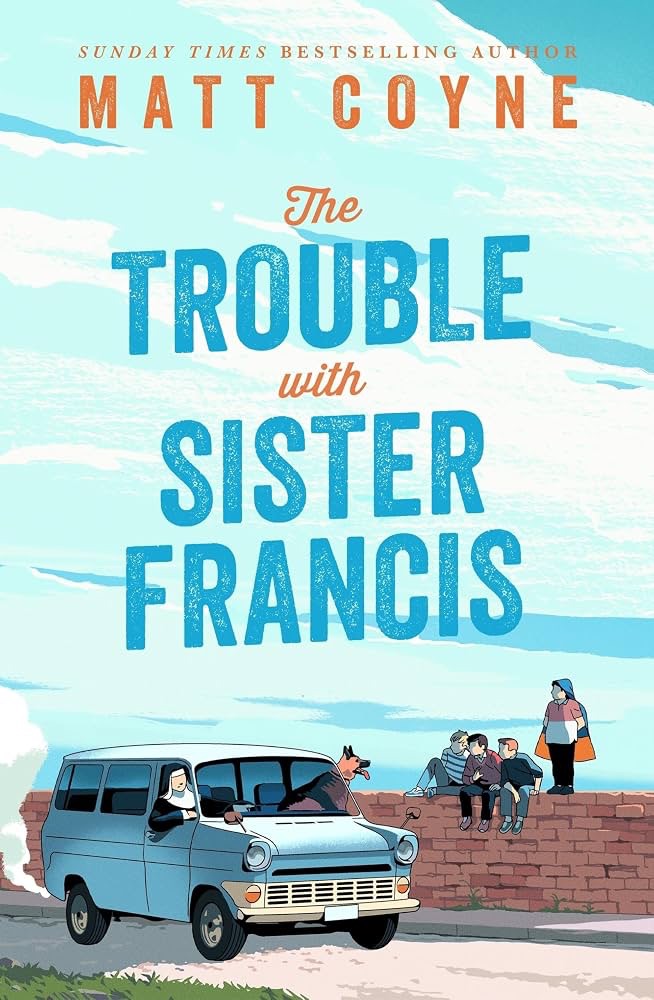
Sister Francis is an unlikely nun.
She’s sixty, sweary, drives like a lunatic and smokes like a stacked chimney . . . and she runs the Blessed Assumption Boys Club.
Richie, Bennett, Kenny and Stan are four best friends from the Whittle council estate with little to do but get up to no good. After a run-in with local bullies, they discover the crumbling, forgotten club and find themselves in the company of the most remarkable person they will ever meet.
Set against early 1980s Britain, THE TROUBLE WITH SISTER FRANCIS is a funny, heartwarming, and heartbreaking story of unlikely heroes, quiet rebellions, fierce loyalty and unexpected hope.
And at the centre of it all lies a long-forgotten journal that might just change everything.
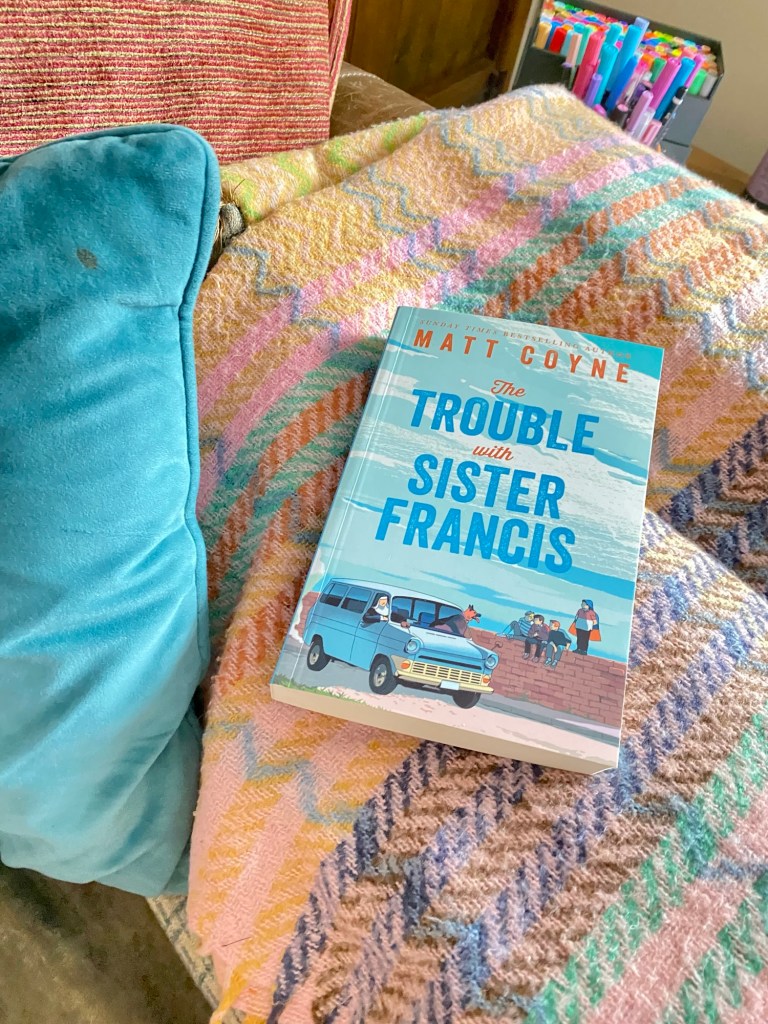
I feel like I’ve been living under a rock because I seem to be the only book blogger who hasn’t read Matt Coyne’s Frank and Red, so this was my first introduction to his writing. I didn’t even follow him on social media before now so I went in completely blind. I can honestly say this book was a gem from start to finish. Matt Coyne’s ability to write a novel with the emotional intelligence to balance weighty subjects like war and loss against laugh out loud comedy is akin to Sue Townsend and her wonderful creation Adrian Mole. In fact it was Adrian I thought of when reading these four boys, Richie, Bennett, Kenny and Stan, all from the Whittle Council Estate in Sheffield in the early 1980s. Their dialogue is pitch perfect for a boy of that age, with their slang, swearing and prurient interest in Mrs Bolcheck’s ‘wibblies’. It brought back a memory of my brother and his friend Darren who would hang out together in our Lincolnshire village, hiding behind hedges to shout at a rather well endowed lady ‘show us your tits’. Thank goodness there were no formidable nuns nearby.
Nostalgia and charm are definitely are a huge factor in the enjoyment of this story, with exactly the right 1980s sweets, pop culture references and Northern humour. For me, it the presence of a nun that drew me in and having been brought up Roman Catholic nuns feature strongly in my memory. In 1980 as I was falling in love with Lady Di like the rest of the world and wondering whether to cut off my hair, I was also making my holy communion. I couldn’t get to Catholic school where we lived so I went to the convent every Monday evening for lessons with Sister Anne, a large, twinkly and very maternal nun who taught me my catechism. She also gave me homework every week, to write out a Bible story and illustrate it. I came across this folder when my mum and dad downsized a few years ago and found various crayon drawings of Jesus and his disciples but thanks to a seven year olds grasp of anatomy I’d placed their arms too low on their bodies. The result was various saints whose spidery hands looked like big throbbing knobs! How did she keep a straight face?
Sister Francis is more like my rather formidable previous schoolteacher, Sister Joan. She had the sharpness and discipline of a military veteran, but underneath that there was a twinkle that made me think there was a sense of humour and quick wit underneath. Sister Francis drives an old clapped out van as if she’s in a rally car. Smoke seems to billow from the exhaust and the a cigarette she always has on the go. She swears and is often reading the racing post. I have always found nuns to be singular and quirky individuals so I warmed to her immediately. Although she’s a comic character there’s so much more to her. She’s clearly keen on restarting a boy’s club she used to run years ago, with origins of supporting boys who had lost their father in WW2. She has a way of relating to boys from the area and our four friends can see she’s a formidable ally from the first day. When they roll up to the clapped out shed they’re accosted by one of the local priests, asking what they’re doing hanging around the presbytery and accusing them of looking for things to steal. When Sister Francis bursts out of the shed he’s taken aback and the boys notice she uses her sweetest voice and emphasises the holy intentions behind her club, but as soon as he’s gone she lights up and is her sweary self. Behind this exterior are buckets of empathy and determination to help the boys in her care, not that she’s easy on them. The four boys have a deal with her, if they come and help her clean the club house on the last Saturdays of term they can come to the club in the holidays and keep the entrance fee. It’s hard work but they stick at it and I found this so reminiscent of little dens me and my brother would build together in those long summer holidays where the sun seemed to shine endlessly.

I developed a soft spot for Rich’s Grandad Bob, who has a keen sense of humour and is a great role model for a young boy who has lost his father. I loved how he made Rich laugh with his assessment of Aunt Carole – she has a beard and looks like a pirate. He’s also there for the worse times too, after Rich’s dad died he has enough sense to simply sit with him as the loss hits him, no platitudes or promises, just sitting with him in his grief. Alongside Rich’s 1980s narrative is the journal of another boy who went to the Dead Dad’s Club after the upheaval of WW2. This narrative is evocative of a totally different era as Reginald is evacuated to a small village near Sheffield that’s something of a culture shock after growing up in London. It includes little documents he’s saved that really add to the historic significance of his experiences. Evacuees didn’t always have the best time and Reginald is coping with the boredom of the village and his observations on what passes as news worthy are so funny. He’s also navigating that rite of passage from primary to secondary school and the author really does conjure up those fears about the bigger school, getting lost and being without your usual friends. I wasn’t sure where his story fit with our four main characters and this is kept under wraps until exactly the right moment. This book has been a wonderful mood lifter just when I needed one, like a warm hug in book form. One line made me think about the friends who knew me in my small village at a similar age, one of whom I’ve tried to see regularly more recently. We try to get together at least once a month for cake and a catch up and I remember being taken aback at first by exactly how well she knew me. But of course she does. As Matt Coyne writes ‘real friendships are cast in the everyday’ and even though my friend and I often just walked her dog, cleaned out the rabbits and watched telly we grew up together and that counts for a lot. I heartily recommend this hilarious but heartfelt story that’s a ray of sunshine in book form.
Out Now from Wildfire Books
Meet the Author

Matt Coyne is from Sheffield, South Yorkshire. In September 2015, his life was turned upside down by the arrival of his son, Charlie. Three months into parenthood, he took to social media to write about his experience as a clueless first-time dad. Within days, his post about surviving the early months of parenthood was shared by millions around the world.
Following this, Matt created his popular blog Man vs Baby, which now has more than 500,000 followers. He is the author of two Sunday Timesbestselling books – Dummy and Man vs. Toddler – both based on Man vs Baby and has written for the Guardian, Telegraph, Private Eye and GQ.
The Trouble with Sister Francis is Matt’s second novel, following his acclaimed, award-winning debut Frank and Red.
Matt lives in Sheffield with his son Charlie, his partner Lyndsay and a Jack Russell terrier with ‘issues’ called Popcorn.


Great review. I loved it too. And you MUST read Frank and Red!
LikeLike