Posted in Personal Purchase

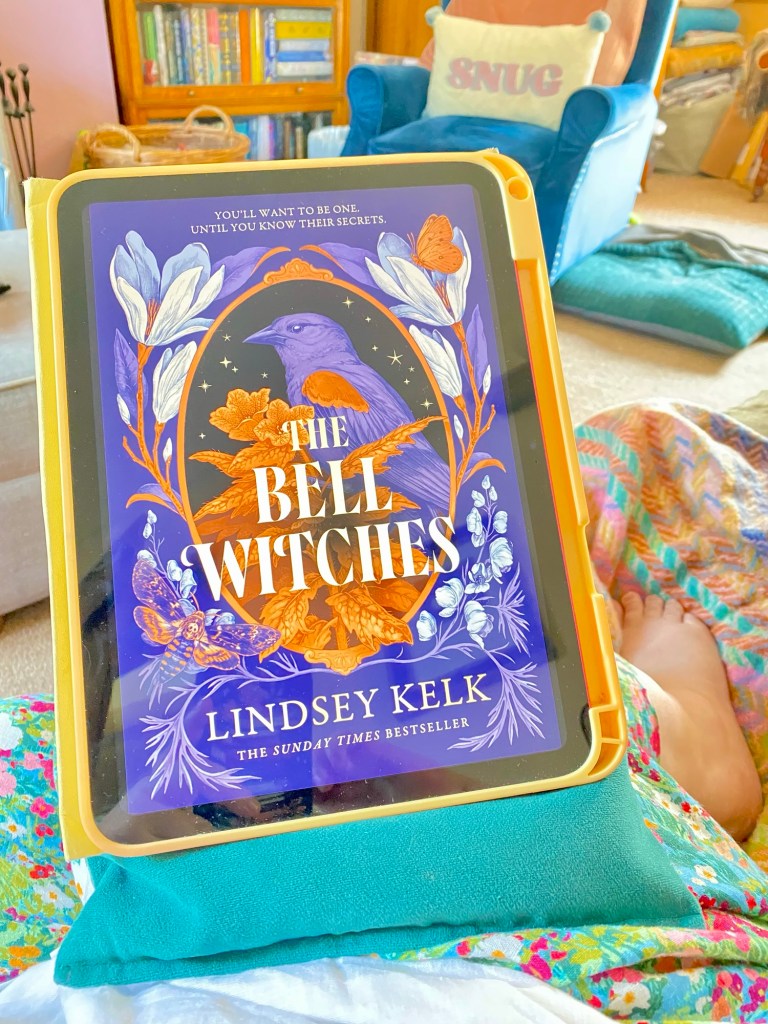
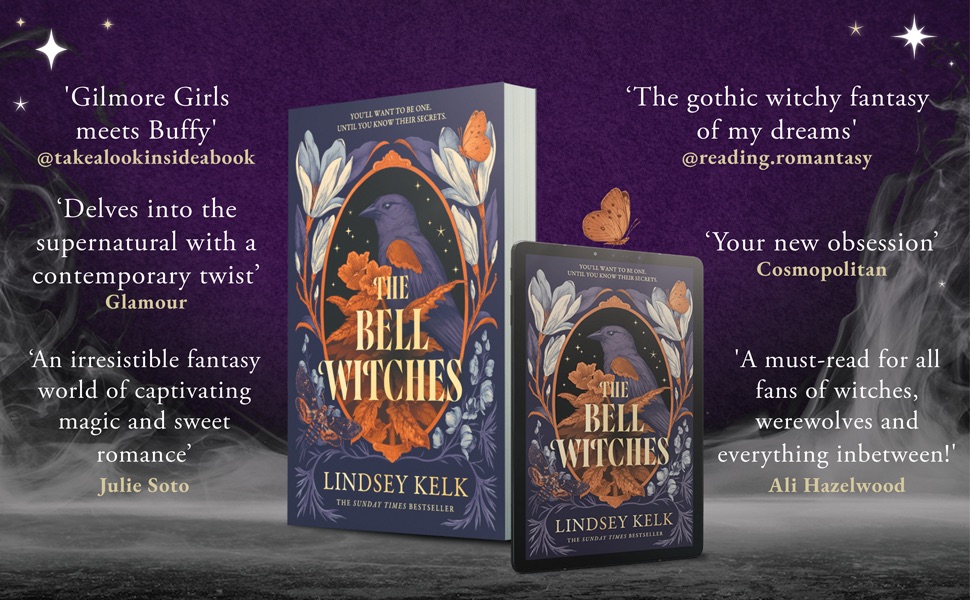
The Bell Witches by Lindsey Kelk 

After sixteen-year-old Emily’s father tragically dies, she is forced to live with the only family she has left, an aunt and grandmother in the heart of Savannah, Georgia in a house as beautiful as it is mysterious.

But all is not what it seems with the Bell family; they’re hiding a magical secret.

When Emily meets the alluring Wyn, she forms a connection that feels like it was always meant to be. As the spark between them grows more powerful, her life takes an exhilarating and terrifying turn; but every step closer to him, takes her a step further away from her family.

Emily will find out that blood is always thicker than water…

THERE’S NO BOND GREATER THAN MAGIC

YA fiction isn’t usually on my radar, but I love both Alice Hoffman’s and Sarah Addison Allen’s mix of small town America and witches so I gave it a try. I was sold on the cover comment that this was ‘Buffy meets the Gilmore Girls’. It certainly isn’t short on atmosphere, with a charming setting in Savannah and Bell House in particular. For Emily who is used to the Welsh climate, it’s hard to acclimatise to the soupy heat that leaves everyone dripping in minutes – their laundry basket must be full every day. The Spanish moss that hangs from the trees like a natural brand of tinsel is actually parasitic, showing us that not everything is as beautiful as it first appears. Bell House is breathtaking and Emily’s first glimpse is overwhelming, calling it ‘Sleeping Beauty’s castle through an Instagram filter’. Everything has that southern charm, including her aunt Ashley’s breakfasts that have so much variety it feels like going out to brunch every morning. What Emily hasn’t yet realised is that she has the power to change the weather just by changing mood and Bell House is equally responsive to the people who live there, but its sentience isn’t just benign. Emily’s grandmother Catherine is in tune with the house and drips with Southern charm, her sayings are pure Deep South hokum; “you look like you were rode hard and put away wet” made me giggle out loud. As she starts to educate Emily in her heritage as a witch I wondered whether her sweetness was just as synthetic as saccharin. 

I felt like the plot was paced awkwardly, feeling both too slow and too fast at once. This was a slow burn at first, setting up both the atmosphere and back story of the Bell family. While this is understandable as the first book in a series, it did feel like the plot took a back seat to description. Conversely, the central romance seemed to proceed at the speed of light with an intensity that felt unnecessary at this early stage. It felt as if their connection was simply announced rather than slowly building up through their emotions. I wanted more from her new friends Lydia and Jackson, both of whom promise fun and mischief and are incredibly loyal to Emily despite only knowing her a few weeks. I liked Lydia’s role as the naughty twin and I hope their friendship develops in the next book. Jackson is taken with Emily and I was expecting some rivalry between him and Emily’s love interest Wyn. I also loved her aunt Ashley who cares for Bell House and its inhabitants so beautifully, but has a dry wit and plenty of sarcasm. She doesn’t take to Emily right away and she’s a great antidote to Catherine’s syrupy sweetness. She never leaves the house and doesn’t pretend to be happy about her role, there’s far more going on here than meets the eye. 

Catherine is the strongest character, stunningly beautiful and clearly very powerful. She takes her role as Emily’s mentor and caretaker very seriously, but there’s very little emotional connection. Catherine isn’t a cuddly grandma at all and imposes quite a few rules on Emily including a ban on dating until her ‘becoming’ when she comes into her full power as a Bell witch. It is Catherine who relates the story of the family of witches who have lived in this house and her history with Emily’s father Paul, who didn’t want Emily to grow up knowing about her potential powers. I loved that the author addressed issues from within that history that resonate today, especially the witch’s role as wise woman to others in her area.

“She helped women who wanted to control the size of their families […] there have always been women who help others in that regard.” 

This is important to Emily who soon discovers she’s a natural apothecary, somehow able to identify most of the plants in Bell House’s garden along with their specific uses. I liked the idea that witches tend to have a speciality, with Catherine being an elemental witch. She suspects Emily of having many different powers, shown clearly when they encounter an unexpected attacker in the cemetery one night. This is a terrifying incident for Emily, even though she doesn’t know the full implications of her actions yet. Catherine tells her that their powers don’t signify them as good or bad, but the opposing forces they work with must be treated with respect. It felt like the book really picked up the pace towards the final third, with Emily’s becoming on the horizon and Lydia planning her a birthday party. This contrast shows us how extreme Catherine’s regime is and reminds us that Emily is a teenager who should be getting to know other young people and looking forward to dancing the night away on her birthday. Instead she’s heading out to a cemetery in the dark, for a potentially dangerous initiation into the Bell tradition under a guidance of a grandmother who doesn’t always seem to have her granddaughter’s best interests at heart. This is where Ashley comes into her own and I hoped to see Emily’s relationship with her aunt develop in future books. The becoming is going to be a reckoning for Emily, Catherine and Wyn in an action packed finale that is gripping and unexpected. There were elements of this novel that I really enjoyed and others I felt were underdeveloped or rushed. I wanted more depth to Wyn and Emily, with perhaps a few twists to their relationship considering their age and Jackson’s interest in Emily. The atmosphere and setting really stood out most, the action sequences were dramatic and fast paced and there were characters with a lot of potential. I am very interested to see how werewolves are going to integrate with the story and how Bell House will respond to Emily after her becoming. I really hope we also see more of that conflict between normal teenager and all powerful witch, as well as more about Savannah and its history. The sequel is out now so look out for my review coming in the next few weeks. 

Sequel The Witch and the Wolf is out now from Magpie Publishing

Meet the Author

Lindsey is a Sunday Times and USA Today bestselling author, podcaster and vociferous defender of The Cheesecake Factory. Her books include the I Heart series, Christmas Fling, The Christmas Wish, Love Story and YA fantasy series, The Bell Witches.

When she isn’t writing, Lindsey moonlights as a co-host on Tights and Fights, a pro-wrestling podcast on the Maximum Fun network. Yes, really, pro-wrestling. And when she isn’t writing, podcasting or ruining her life with social media, Lindsey is most likely to be found reading, watching literally anything on television, texting the group chat or planning a karaoke night (please note she cannot sing).

Born and raised in South Yorkshire, Lindsey lived in London and New York before settling in Los Angeles, where she lives with her husband and their two cats.

Posted in Squad Pod Collective

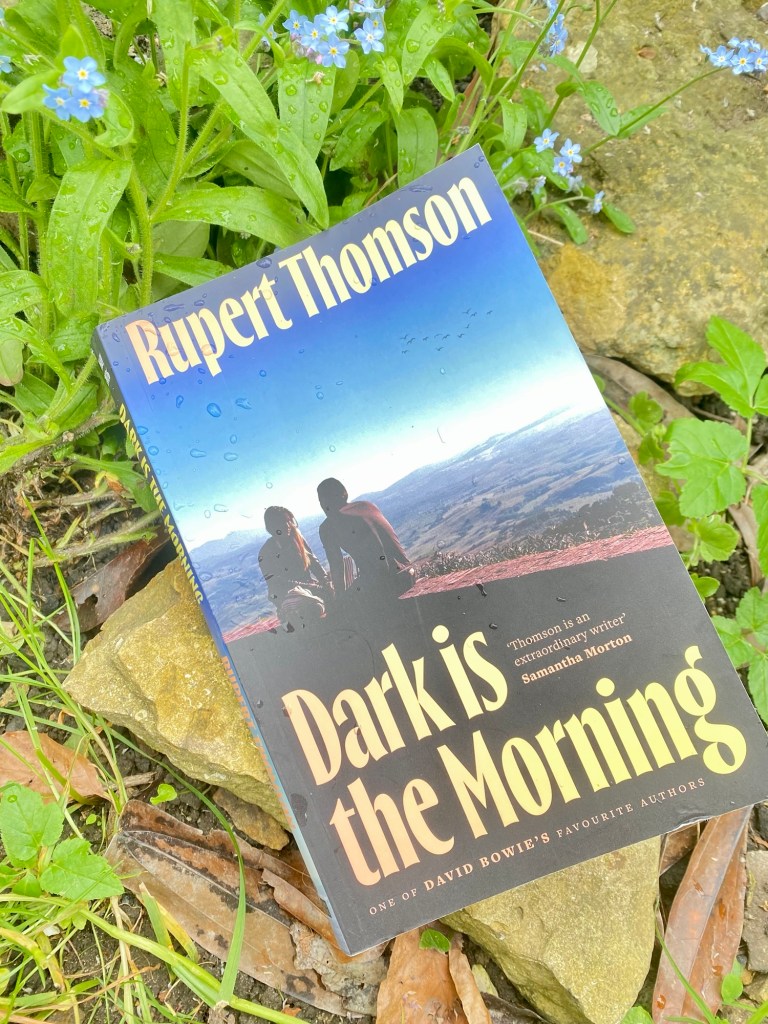
Dark Is The Morning by Rupert Thomson 

Sometimes love isn’t where you belong

In a mountain village in the Abruzzo region of Italy, Gino, a troubled young man, realises that his childhood sweetheart Franca can give his life the happiness and stability he needs. They seem made for each other, and move to a remote house in the countryside – but there is something in Franca’s past that haunts Gino.

Descending into pathological jealousy and resentment towards a married man who had been Franca’s lover, Gino is unable to stop himself imagining the worst, and embarks on a violent path that has catastrophic consequences.

There couldn’t be a better book for a counsellor to read than this one, following the life of Gino who lives in a small Italian town on the Adriatic Sea. The setting isn’t a bucolic, sun drenched and charming little town, despite Gino’s upbringing on his father’s smallholding where he mainly grows tomatoes. This is a grittier Italy, perfectly suited to the story and Gino himself. Although there is a sense that there’s a different existence within reach, perhaps the life his father has living off the land or whatever brings his father’s friend Harry back every few months. Whatever contentment is, Gino doesn’t know how to find it or accept it once he has it. Gino was born here and makes the comment that he’ll die here if he isn’t careful. He doesn’t want to live the life his parents have, he has bigger and better things to do. However, it could also be the foreshadowing of what’s to come when he meets Franca again. Franca was at school with Gino and in some senses he feels they’re both outsiders: ‘She was a strange little stringy thing, with a thin face and brown hair’. Franca was nicknamed The Rat by other girls, but then Gino was called Dopey after the dwarf in Snow White. She’s very bold, walking up to Gino and telling him that she’s going to marry him one day something both of them were teased about for years. Now, when his father mentions her, he seems irritated but they do have something in common, an inability to live up to their heroic parents. Gino confided in her when they were thirteen, saying all he seems to do is disappoint his father. Franca seems to get this, after all Gino’s father is known for something heroic he did in WW2 and her father is the local ambulance man. Maybe, she suggests, they could be something different to each other? She’s a realist, saying her father could have wanted a beautiful daughter and she’s aware she isn’t. How can they compare to heroes? They are only human. Gino gets into trouble in his teens and spent time in a psychiatric unit and he admits he’d forgotten his old friend, but the conversation with his father lights up his memory and he questions his choices. With a new view on life he searches Franca out and asks to take her to dinner and they are married in a whirlwind and given the chance to make a home in her aunt’s house in the countryside. Is it possible that Gino has learned from his mistakes and now sees what is important in life? 

If I had a trainee who wanted to understand the Cognitive Behavioural Therapy concept of negative automatic thoughts I’d get them to read this book. Everything Gino experiences is filtered through a faulty lens. Whether this is innate or a result of constantly feeling like a disappointment is hard to tell. At the moment he has it all, but in his mind it’s already unravelling. The house needs a lot of work, but could be a secluded haven for a family. Gino hears that something strange happened to Franca’s aunt here during the war and starts to wonder about it, could an event like that leave something in the house like a mood or a feeling? Is the house unlucky in some way? To be transparent about her past Franca tells him about an affair she had with one of her father’s friends. Although outwardly he seems to accept this confession, inwardly it becomes a nagging concern he can’t shake off. He asks others about man who has a concrete business, telling them he has a friend who’s putting in a pool. He tells himself he just wants to look at him, but can he resist speaking to him or perhaps even warning him off? At the end of her working day Franca goes to a cafe in town to wait for Gino to pick her up after work. He notices that she’s chatting to a man, laughing and passing the time of day and he knows he’s been trying to pick her up. His strangest obsession comes when his son Elio is born, a beautiful baby with amazing violet eyes. Everyone who sees him comments on what a beautiful boy he is and he genuinely seems hypnotic for some people, almost holy. All Gino can see is a boy who looks nothing like him. Neither he nor Franca are beauties so how can Elio be his and inspire such reverence in complete strangers? Being in his mind is exhausting and worrying, the author leaves us unsure what he might do next. Pressure mounts with every page and Harry is the only person who seems to get through to Gino, telling him that perhaps the boy embodies the beauty inside them both. 

Everything about Gino screams of a paranoid personality disorder, his mistrust of others and ability to twist innocent encounters into personal slights and grudges are classic symptoms. He has stopped listening to others and his behaviours become more extreme, including hallucinations that his baby son is talking to him. Franca is disturbed to come home and find Elio screaming in the house alone, while Gino is zoned out in the garden. As readers we’re inside his mind and see his motivations, the wrong patterns of thinking and the way he broods and cultivates grudges that are simply not there. Instead of facing these painful thoughts he directs his anger and obsession outward. If Elio is nothing like him, then someone else must be the father. I genuinely believe that Pierozzi would have carried on his life rarely thinking of Franca and her new husband, but Gino’s places himself in harm’s way. Pierozzi is a dangerous man. He’s described as someone things happened to and that resonated with my idea of Gino. Is this something people would eventually say about him? The way the author builds this difficult inner world is so clever and I was anxious, mainly for Franca and Elio. They are living in the middle of nowhere, with a husband and father who is no longer rational. I was mentally screaming at her to make sure she had somewhere safe to go. 

Franca is very sure of her own emotions and choices. When Gino asks her if she’d still marry him she tells him calmly that her feelings have never changed. However she does have “something of the fox about her. That sudden, absolute stillness, that pricking of the ears, that readiness to flee.” Will Franca be just as resolute if she does sense danger? I felt so sad for her, because Gino’s obsession with her past harms her, even though it has nothing to do with him. Why can’t he see that she has only ever loved him? Despite him leaving and never making her any promises when they’re younger, her love never dies. That shows loyalty, but it’s never appreciated or rewarded. Even the beautiful son they have isn’t enough and I wondered if it was partly about his fears of her infidelity but mainly about his relationship with his own father. They were so different in character and distant emotionally, did he ever wonder about his own paternity? The author bookends this story with Harry as the narrator and honestly I had an emotional reaction to being back in Harry’s steady hands at the end. Being in his world felt safer and the way he frames Gino’s story gives it some closure and structure too. I found myself wondering how I’d work with a client like Gino and whether he could ever be satisfied with his life. This book has emotional depth and complexity, tension and action alongside some incredibly surreal moments too. I would definitely read this author again. 

Out now from Head of Zeus

Meet the Author

Rupert Thomson is the author of fifteen critically acclaimed novels, including ‘The Insult’, which was shortlisted for the Guardian Fiction Prize, and chosen by David Bowie as one of the 100 Must-Read Books of All Time, ‘The Book of Revelation’, which was made into a feature film by the Australian writer/director, Ana Kokkinos, and ‘Death of a Murderer’, which was shortlisted for the Costa Prize.

His latest novel, ‘Dark is the Morning’, was published on May 7th 2026. Praised in advance by the likes of Chloe Aridjis, Claire-Louise Bennet, Sarah Waters, Julie Myerson, and Philip Pullman, LoveReading subsequently made it one of their Star Books of the Year, saying “Thomson’s writing casts an almost other-worldly spell…Teeming with tension, ‘Dark is the Morning’ represents literary fiction at its most page-turningly thrilling and poignant.” According to the Financial Times, which admired Thomson’s “stunned, post-traumatic prose”, it’s “the ideal holiday read: frictionless at the level of the sentence; stealthy, romantic, and utterly unpredictable in every other way.”

Rupert Thomson is a Fellow of the Royal Society of Literature, and has contributed to the Financial Times, Granta, the Guardian, the Independent, and the London Review of Books. He has lived in many cities around the world, including Athens, Berlin, Amsterdam, New York, Sydney, Rome, and most recently Barcelona. He currently lives in London.

Posted in Netgalley

The Secret Thread by Eve Chase 

I think Eve Chase’s books get better every time and I absolutely adored her last one, The Midnight Hour. There are elements of the same nostalgia in this book too as we’re introduced to Mimi Mott, interior designer and fashion icon who is in London preparing for an exhibition and auction of some of her oldest belongings. Jo is a journalist, desperate for a break and responds to an advert for an assistant to help Mimi with her exhibition artefacts. Once Mimi has chosen an object, Jo will note down her memories and then write some copy for the exhibit. She and Jo click immediately and she’s set to work straight away. However, Jo had her reasons for wanting this job and if Mimi finds out what they are and who Jo is she could be in a lot of trouble. She would also be in trouble with her grandmother who has no idea what her new job entails or who it’s with. As she treads this tightrope we’re taken back into the 1960s and Mimi Mott’s past. 

We know what we’re getting with Eve Chase, usually an ancestral home or a family with big secrets and here we get both. The story is told in a dual timeline, the present shows us Mimi and Jo working on the exhibits and a little bit about Jo’s life. The past takes us back to the 1960s when Mimi was plain Miriam Bramley and came from a family of gardeners working at Rushwood for the Caswell family. Over the summer, the Caswells are having a huge party and the younger members of the family, Nancy and Lawrence, are back for the summer. Miriam is the youngest in her family with the twins, Pamela and Alfred being nearer to the Caswell’s age. The old hierarchy of master and servant has been diluted a bit, but Miriam’s father is old school. He doesn’t want his children confusing things by mixing with the Caswells. It’s partly that they should know their place, but also that they can only be disappointed by moving in those upper class circles. However, Mrs Caswell is American and less constrained by class and these are teenagers who have their own ideas about things. Swimming down in the river on a hot evening, Miriam feels a spark with Lawrence and Alfred is absolutely besotted by Nancy who is beautiful and always taking photographs. Things become even more tense when Miriam becomes interested in the work being done to get the house staged for the party and meets Whipple, a London based interiors specialist who needs an assistant. It might as well be Miriam who has a good eye and can use a sewing machine. Her father isn’t keen but Miriam knows this could be her big break into the business. After that summer everything changes for both the Bramley and the Caswell family, but the author keeps us guessing as to what tragedy could still be affecting the family sixty years on? 

I enjoyed the changing class constraints of the 1960s with Mr Bramley’s upstairs/ downstairs approach to his work. The change really is led by Nancy who thinks the class barriers are wrong and ends up inviting the Bramley siblings to the party. I felt for the young Mimi who is so ambitious because there was a time I was the same. I could see women of my mum’s generation stuck after giving up work when they got married. I didn’t want to be dependent on another person and I wanted to explore who I could be. Mimi knows that eventually she will have to leave because she’s not like her sister Pam who seems happy with her fate of keeping her hands in the soil, marrying someone like her dad and producing another generation of hard working Bramleys. Their dad doesn’t want them to mix with the Caswells because no good will come of it. He doesn’t want Mimi to work with Whipple because the Bramleys have always been gardeners. I was rooting for Mimi’s big break and cheered her on when she breaks away from tradition. Would she get her dream career and the man though? As we see the older Mimi we have some of the answers and she’s certainly a huge success, exuding quiet luxury and incredible taste. She is a household name. I felt like she got what she wanted because she dared to reach for it. Jo is similar because she’s willing to work hard for what she wants. However she feels terrible for deceiving Mimi and starts to question how much she’s strayed from the good person she thought she was. What happens when the final piece of copy is written? 

I struggled a little with Mimi’s sister Pamela because of the way she punishes Mimi for her ambitions, whether they’re for a career or for a man who’s out of their reach. Just because working the soil and marrying a man like her father is perfect for Pamela, doesn’t mean it’s right for her sister. She also gets to keep her family because she’s seen as the ‘good sister.’ I felt for her losses deeply, but Mimi loses everyone and has to rebuild in a bedsit on her own at first. There are visits but they’re few and far between and only when her father isn’t around. Jo is enjoying her work and finding Mimi’s version of the past intriguing and enlightening. She hates lying to her and dreads being discovered, not just because of their growing closeness, but because of Mimi’s driver Woody. He takes her home on nights she works late and she feels completely safe with him, as well as having the hint of a spark. As we countdown towards the auction the tension becomes impossible to manage. Her grandmother has brought Jo up, after the death of her parents, and she hates keeping secrets from her too. Although Pamela’s not been behaving like herself either, even making an impromptu trip to London which confuses Jo because she usually hates leaving home. 

Eve Chase knows how to create characters we care about and exactly when to reveal the secrets of the past for the reader to feel the full impact. It’s like dropping a bomb into these character’s lives and we know nothing can be the same again. There’s also the secondary impact in the present because of course Jo’s secrets must come to light too. When Mimi picks an object for the auction, and she and Jo talk about it, it’s easy to see how much it affects Mimi and conjures up memories of the past. She has always known how much power there is in objects from the moment she picks up a piece of crystal from a chandelier at Rushwood and Whipple encourages her to hold it up to the light and take it in: 

“a kaleidoscopic rainbow, every colour of Rushwood – stone, grass, willow, rose – caught in it’s mineral heart.” 

Each of Mimi’s fabric or wallpaper patterns has its genesis there, from the plants tended by her family to the objects at Rushwood and even her trip to the seaside with Lawrence. This is why we keep objects and I understand this so deeply because my house has the chesterfield leather chairs I used to sit in at my friend Nigel’s house, the first antique ginger jar my late husband and I bought to start a collection, a snow globe of New York from my 40th birthday trip and a little stone bird by my bed, part of a matching pair I shared with my friend Kathryn before she died. Mimi gets this human connection with the items we use to decorate our homes. Her auction will show the thread linking each piece to its place in her memory, no less powerful than Pamela’s continuation of the family’s tradition as a gardener. Even though everyone thinks Mimi has forgotten her family, I felt that she never forgot what happened that summer and has immortalised it through her life’s work. 

Out May 28th from Michael Joseph

Meet the Author

Eve Chase is million-copy bestselling novelist writing rich suspenseful novels. New novel, The Secret Thread. Also, The Midnight Hour, The Birdcage, The Glass House/The Daughters of Foxcote Manor (US), The Vanishing of Audrey Wilde/The Wildling Sisters (US) and Black Rabbit Hall.

Say hello @evepollychase on Instagram and Facebook

Posted in Blogger Life

The Last Ten Books I Bought

I thought that today I’d share with you the last ten books I’ve bought. Sometimes people think that because I review books on my blog, I get given every book I review but that’s far from the case. I still buy an enormous amount of books every month. It’s my main indulgence, aside from Doc Marten boots and a weird fascination with animals in clothes (probably best left unexplored but I’m sure it has to do with Mr Tumnus). I’d do get proof copies but they are becoming more scarce these days so mainly they come from the reviewing I do through the Squad Pod Collective – a group of blogger friends who have come together to share the book love – or through blog tours. More often it’s digital copies that are available, either offered by the publisher or through NetGalley. There are many reasons I might buy a book, as discussed last week there are come authors who are must-buy and are usually pre-ordered for a discount. Another reason might be that I’ve loved a book on Netgalley or digital proof and I’d like a finished copy. Then there’s the bookshop purchases where I have a terrible love of spredges and beautiful book cover art as well as the story itself. Finally comes those I buy second-hand in charity shops, second hand bookshops like Barter Books in Alnwick or Vinted, which is a great hunting ground for special editions. I also collect various copies of old classics or my favourites – I have about six different copies of The Night Circus for example. Currently on my radar is the Folio Society copy of The Colour Purple which is stunning but will take up a whole month’s book budget! Here are my latest buys:

I love Will Dean’s Tuva Moodysson series and pre-order those always, but his stand-alone novels I tend to buy on Kindle. This has all the hallmarks of a heart-stopping thriller.

Three of them adrift on the narrowboat.
Mother, son, and wickedness.

Peggy Jenkins and her teenage son, Samson, live on a remote stretch of canal in the Midlands. She is a writer and he is a schoolboy. Together, they battle against the hardness and manipulation of the man they live with. To the outside world he is a husband and father. To them, he is a captor.

Their lives are tightly controlled; if any perceived threat appears, their mooring is moved further down the canal, further away from civilisation. Until the day when the power suddenly shifts, and nothing can be the same again.

I left the parking ticket bookmark in this one, because I bought this from my local bookshop on Saturday and then my other half went to Screwfix so I read five chapters in the car out of boredom. I wanted to read this before I watched the BBC series and as usual I’ve left it to the last minute. I recently thoroughly enjoyed Rachel Pariss’s novel about Charlotte Lucas and I’d forgotten how lovely it is to be in Austen’s worlds so I thought this would be light relief, both from other reading and the news.

In Jane Austen’s Pride and Prejudice, we know the fates of the five Bennet girls. But while her sisters are celebrated for their beauty or their wit, Mary is the “plain” middle sister, the introvert in a family of extroverts, and a constant disappointment to her mother.

Lonely and lacking connection, Mary turns to the only place she feels safe: her books. Determined to be “right” since she can never be “beautiful,” she prepares for a life of solitude at Longbourn.

One by one, the other sisters move on: Jane and Lizzy for love, and Lydia for respectability. Mary is destined to remain single, at least until her father dies and the house is bequeathed to the reviled Mr Collins.

But when that fateful day finally arrives, the life Mary expected is turned upside down. In the face of uncertainty, she slowly discovers that there is hope for the “plain” sister after all. . .

Experience the witty, life-affirming tale of a young woman finally finding her place in the world.

This book falls into the special edition category as it’s one I might normally have bought on Kindle, but couldn’t resist this beautiful signed edition complete with stunning spredges and endpapers.

It’s the summer of 1939. London is on the brink of catastrophic war. Iris Hawkins, an ambitious young woman in the stuffy world of City finance, has a chance encounter with Geoff, a technical whizz at the BBC’s nascent television unit.

What was supposed to be one night of abandon draws her instead into an adventure of otherworldly pursuit – into a reality where time bends, spirits can be summoned, and history hangs by a thread. Soon there are Nazi planes overhead. But Iris has more to contend with than the terrors of the Blitz. Over the rooftops of burning London, in the twisted passages between past and present, a fascist fanatic is travelling with a gun in her hand.

And only Iris can stop her from altering the course of history forever.

Just look at those beautiful spredges. I’m itching to dive into this but need to get my blog tour reading done first.

As you can see another ‘nostalgic’ purchase. Wuthering Heights is one of my favourite books of all time, despite the problematic middle bit where too many people die at once, so when I bought Essie Fox’s beautiful retelling through Catherine Earnshaw’s eyes I couldn’t resist this new edition of Wuthering Heights. The spredges are to die for!

With a nature as wild as the moors she loves to roam, Catherine Earnshaw grows up alongside Heathcliff, a foundling her father rescued from the streets of Liverpool. Their fierce, untamed bond deepens as they grow – until Mr Earnshaw’s death leaves Hindley, Catherine’s brutal brother, in control and Heathcliff reduced to servitude.

Desperate to protect him, Catherine turns to Edgar Linton, the handsome heir to Thrushcross Grange. She believes his wealth might free Heathcliff from cruelty – but her choice is fatally misunderstood, and their lives spiral into a storm of passion, jealousy and revenge.

Now, eighteen years later, Catherine rises from her grave to tell her story – and seek redemption.

Essie Fox’s Catherine reimagines Wuthering Heights with beauty and intensity – a haunting, atmospheric retelling that brings new life to a timeless classic and lays bare the dark heart of an immortal love.

As you will know I’ve been raving about this one after reading it last month and yes I do have a proof copy but I do like to support independent publishers, authors and bookshops so I went to Lindum Books for her signing a few weeks ago. Sadly, by the time I arrived they’d run out of copies so they were waiting for new stock and Rachel kindly supplied a signed bookplate for it.

Lincolnshire, 1914. As the First World War approaches, three women are living, trapped between the unforgiving marsh, the wide, relentless river, and the isolation of the fen.

Their lives are held fast by profound grief, haunted by the spectres of the past. Trapped by the looming presence and eerie stillness of a hospital that has never admitted a single patient.  

Eleanor longs to escape. To make a life with the man she loves, leaving her sister, and all her ghosts behind. Clara’s marriage is crumbling and violent and she yearns for peace and security for both herself and her innocent children. Meanwhile, Lily, a formidable force of will, stands resolute against the relentless tide of change. She will stop at nothing, no matter the devastating cost, to ensure that life, and her family, remain frozen in an unyielding embrace of the past.

The author, Rachel Canwell, grew up with the story of this forgotten hospital. Isolated, stocked weekly and cleaned daily but never admitting a single patient. The hospital was real, tended by her family for over sixty years and set against the ethereal beauty and loneliness of the Fens, is the inspiration for her novel.

This beauty is the independent bookshop copy of Almost Life that came from Lindum Books. I always love the artwork from Kiran’s books and this is a stunner.

One chance encounter can define a lifetime

Erica and Laure meet on the steps of the Sacré-Cœur in Paris, 1978. Erica is a student, relishing her first summer abroad before beginning university at home in England. Laure is studying for her Ph.D. at the Sorbonne, drinking and smoking far too much, and sleeping with a married woman.

The moment the two women meet the spark is undeniable. But their encounter turns into far more than a summer of love. It is the beginning of a relationship that will define their lives and every decision they have yet to make. Spanning cities, decades and heartbreaks, fate brings them within touching distance again and again.

But will they be brave enough to seize the life they truly want?

My next purchases are two for the Kindle and after recently reading and reviewing her third Cal Hooper novel The Keeper, I decided I need to catch up on the first two in the series. I’d previously read her Dublin Murders series so I know I enjoy her writing and I read The Keeper through Netgalley so these are a treat for when I have a gap ?!

The Searcher covers Cal Hooper’s move to Ireland and the fixer-upper he’s bought in a remote Irish village, thinking it would be the perfect escape. After twenty-five years in the Chicago police force, and a bruising divorce, he just wants to build a new life in a pretty spot with a good pub where nothing much happens.

But then a local kid comes looking for his help. His brother has gone missing, and no one, least of all the police, seems to care. Cal wants nothing to do with any kind of investigation, but somehow he can’t make himself walk away.

Soon Cal will discover that even in the most idyllic small town, secrets lie hidden, people aren’t always what they seem, and trouble can come calling at his door.

The Hunter takes us back to Ardnakelty and blazing summer, when two men arrive in the village they’re coming for gold. What they bring is trouble.

Two years have passed since retired Police Detective Cal Hooper moved from Chicago to the West of Ireland looking for peace. He’s found it, more or less – in his relationship with local woman Lena, and the bond he’s formed with half-wild teenager Trey. So when two men turn up with a money-making scheme to find gold in the townland, Cal gets ready to do whatever it takes to protect Trey. Because one of the men is no stranger: he’s Trey’s father.

But Trey doesn’t want protecting. What she wants is revenge.

My final book came from the indie Northodox Press and features a place I know very well indeed. The Adelphi Hotel in Liverpool is a famous landmark I’ve known all my life, with my mum being a Liverpool girl. A former grand hotel, designed to look like the interior of an ocean liner it still has spectacular bones although its more recent furnishing choices in the original tea room have made it look more like a nursing home. Every time I go past it we say someone could make a lot of money doing that place up, it could be gorgeous. I live in hope, but currently she’s a strange mishmash of styles from art deco to faux leather BarcaLoungers. It’s a great cheap place to stay in Liverpool and my dad particularly enjoyed the prostitute’s card that was slipped under his door in the middle of the night!

Where better to work than the famous Adelphi Hotel?

Alistair Monroe is keen to make his way in Nineteenth Century Liverpool. The Adelphi is a landmark known for its grandeur, drawing many visitors, including Clemency Martin, an American psychic.

She too needs to make her way. But Alistair discovers that power and darkness lie at the heart of the hotel, and he must finally take risks to bring the truth to light. Step into the atmospheric world of the Adelphi…

So that’s all my recent purchases and buying secrets, but I’m sure there’ll be more next month, if I can resist The Folio Society that is.

Posted in Netgalley

Getting Away by Kate Sawyer

Margaret Smith is at the beach.

It is a summer day unlike any other Margaret has ever known.

The Smith family have left the town where they live and work and go to school and come to a place where the sky is blue, the sand is white, and the sound of the sea surrounds them. An ordinary family discovering the joy of getting away for the first time.

Over the course of the coming decades, they will be transformed through their holiday experiences, each new destination a backdrop as the family grows and changes, love stories begin and end — and secrets are revealed.

Getting Away takes us into the lives and the secrets of four generations of the Smith family, through their holidays. From an east coast beach in the UK just after the war to the early 21st Century, Maggie is central to this, moving from childhood to old age. Through each character in the novel, the author creates snapshots of the century from Maggie’s father Jim and his war injuries to an renewed openness about individual sexuality and her brother Tommy having to police the first Pride in London. He’s worried about the lads at work and their response, he’s not keen either but change is the only constant. We can also see the huge changes in social mobility across the generations. We start with Jim and Betty and their daughter Maggie just affording a day at the beach with a picnic brought from home. Later, Maggie’s brother Tommy and his wife Debbie buy an apartment in Spain and then her granddaughter Melissa is the first in the family to go ‘travelling’ as a young woman as opposed to having a holiday. The shifts are seismic when seen together like this and it made me realise that my own grandchildren will look at me and my husband and realise we were born in the last century. Just like I did with my grandma who was born in 1913, they’ll probably imagine all the changes we’ve seen in that time. That’s what reading this felt like, as morals, finances and our ability to connect with others changes beyond recognition. When Robert takes a holiday with his friend Fitz while Susan is pregnant, they have to send a telegram to one of his destinations to get him to come home urgently. By the next generation, Melissa is island hopping around Asia and keeps them all updated via Instagram and her blog. What is amazing about Kate Sawyer is this doesn’t feel contrived and all these things in the background are just that, because the real drama is happening within this family and the secrets each generation keeps from the next. 

Maggie is at the centre though and hers is the most carefully guarded secret. I loved how she and her mother Betty slowly grew to understand each other, but also how one secret breeds another. Her husband Alec knows Maggie is vulnerable when he meets her on a break with her friends, but he’s looking for a wife who won’t make demands and will be happy to travel around the world for his job buying fabric. He is a protector and he remains that way throughout her life, although things do change within their marriage. Maggie has panic attacks near the sea, although her friends don’t know why. We know something happened on a day by the sea when the Americans from Jim’s work travelled with them, but she keeps the secret for decades. However, she isn’t the only one with a huge secret. Maggie’s brothers couldn’t be more different. Tommy comes across as very brash and often drunk, very proud of how well he’s doing at work and happy to splash the cash around. Robert is the baby of the three and a lot more sensitive than his brother. I rooted for him and his girlfriend Susan who he’s desperately in love with. As secrets start to come out their relationship suffers, but I was sure they’d never stopped loving each other. Their children are the final generation we get to know, but it felt like Robert was impacted most by decisions made about his life, even though it was a common choice in that situation. I love how this author writes about her character’s inner lives, she even makes me root for people when their behaviour isn’t great. Once I’m a few chapters in these are real people and I’m feeling every one of their emotions. 

Having once had a spectacularly bad holiday with my lovely family I was amazed that they all persevered over years. There are all those little details about each character and how they irritate each other. When they undertake a trip to Florence with Maggie, Betty is exhausted and the others are bored. Maggie likes to stride about the city while her husband Alec is working, sight-seeing and learning about art, architecture and the local food. With all good intentions she wants to make sure those she loves get the most out of being here, but everyone else wants some shade and a cold drink. Tommy is more of a drink by the pool and English food sort of person, it’s clear he has a drinking problem and it doesn’t help his temper. Bringing us into the 21st Century, I loved how Joe and his husband Piotr’s daughter Maja has travelled all over the world when she’s only a toddler. This family have gone from greenhouse tomatoes by the North Sea to being more like the Americans who visited Jim and Betty and scoffed at how backward the British seemed. They also go through every complicated situation a family can, with secrets, affairs, divorce, violence and the addition of those who become ‘found family” like Robert’s lifelong friend Fitz and his daughter. I loved that their friendship survived huge upheaval and betrayal, and that it happened on a holiday pilgrimage. I particularly enjoyed Maggie’s solo holiday after her divorce and her sexual adventure, beautifully written and much needed in order to heal from the past and claim her future as a desirable woman. Maggie’s favourite book is A Room With a View so she felt like a kindred spirit and the passion in that book obviously appealed to this woman who had to reach middle-age before desire was a priority. I loved that this family kept its in-laws close, even after divorce and we can see that as everyone comes together for Joe’s wedding. I became utterly absorbed by this family, so much so I felt like I’d seen one of them as a client. It emphasises the secret complexity of everyday lives and made we think about the fascinating narratives in both sides of my own families. The ending felt like the best one we can ever hope for, which is a family taking time and trying to heal together. 

Out now from Zaffre Books

Meet the Author

Kate was born in Bury St Edmunds, Suffolk, UK where she grew up in the countryside as the eldest of four siblings, after briefly living with her parents in Qatar and the Netherlands.

Kate Sawyer worked as an actor and producer before turning her hand to fiction. She has previously written for theatre and short-film.

Having lived in South London for the best part of two decades with brief stints in the Australia and the USA she recently returned to East Anglia to have her first child as a solo mother by choice.

Posted in Publisher Proof

Warning Signs by Tracy Sierra

I couldn’t stop talking about Tracy Sierra’s debut novel Night Watching. I inhaled it and I have been lending and buying it for everyone around me since. So I approached her second novel with trepidation, would it be as good as the first? Well I can set your mind at rest. This novel is incredible. The ‘stayed in bed almost all day to keep reading it’ type of incredible. The plot is simple enough. A young boy named Zach is taken by his father on a ‘boy’s trip’ to the wilderness with people he hopes will invest in his business. This is a part of the country he visited often with his mother who taught him everything he knows about skiing these mountains and survival. As they settle into their cabin and make it ready for guests it’s clear that Zach is an innocent boy, easily ordered around by his dad who’s angry that his secretary Ginny hasn’t been up to prepare the cabin as she promised. As they settle in for their first night, Zach is convinced something is lurking around especially when he has the visit the outside toilet alone and in the dark. The noises and shadows are like nothing he’s heard before. Could a monster be up here with them in the mountains? Possibly. But sometimes, monsters aren’t always what we expect. 

This author is fast becoming a master of complex and painful family dynamics with an edge of horror. This monster in the snow brought back memories of the first time I read The Shining and there are parallels in the isolated mountain setting, the pressure cooker of people forced together and the young, innocent boy at the centre of the tale. This wilderness is somewhere Zach knows very well, having come up here regularly with his mum and sister and this was one of my first questions. Where are the women in this story? We know Zach came up here with groups of women and their kids, but his mum, sister and even the expected Ginny are nowhere. In a small vignette at the beginning we see a previous trip and Zach’s mum explaining how to check the snow for the likelihood of an avalanche. She impresses upon him the importance of turning back, even if the risk is small it’s not worth taking. It’s clear very early on that Bram, his father, doesn’t have the same attitude to risk. He’s the sort of guy who thinks men take risks and would rather show bravado to his guests than follow the advice of his wife through Zach or the guide that comes with the cabin. 

Zach is a beautiful narrator and he’s written with such care, everything he thinks or tells us maintains that innocent, slightly anxious voice. I desperately wanted to protect him and get him out of this situation. As adults we wear masks – the one we wear for our job for example or the ‘telephone voice’ many of us use without really intending to. Children don’t and that creates a tension, especially in an environment where the whole purpose is to impress and sell yourself. Bram makes it clear that these men expect a winner and he has to act like one. Heartbreakingly, Zach has a soft toy he’s smuggled up there but knows it must remain hidden or risk it disappearing. Bram can’t have a weak son. This idea of wearing different masks is beautifully depicted as Zach takes us back to an evening at home where his mother has returned home late and a little drunk. He listens in silence to their argument and curses his mother because she knows the rules. Why does she set out to make him angry? Zach describes his father’s other side as his ‘underself.’

“For Christmas two years ago, someone had given his sister a stuffed octopus that could be flicked inside out. Flip one way, pink, fuzzy and smiling. Flip the other way, green, slick and glowering […] switching outerself to underself.”

He also has this horrible realisation, that we all have at some point in our childhood, that other people might dislike your parent or think they’re an idiot. As they set out and he watches his interactions with the other men he notes that they can see through Bram. The guide sees he knows nothing and Bram’s need to own the best of everything means his mountain gear is flashy, it looks too new. The only other kid on the trip is Russ and he makes it clear that he knows exactly what type of Bram is because his dad is exactly the same: 

“My dad, yours? They’re selfish. They nearly got us killed. And for what? Steve said you and me shouldn’t have skied it and they ignored him, because god forbid they don’t get to do exactly what they want.” 

How scary must it be as a child to learn that your parent is willing to take huge risks with your life for money? Even worse, Zach finds something that makes him wonder; if his dad has an underself, does everyone else? Coming at this from a psychological viewpoint I loved the way Zach describes his concerns about the men he’s with and his father in particular. The environment brings its own dangers with further snowfall and too many risks taken. Survival becomes a question between which is safest – taking the chance with the environment or staying indoors which is undoubtedly warmer and locks out whatever it is that Zach saw the night he ventured to the outside toilet. There’s always a tipping point and the pressure the author builds is almost unbearable. My heart was in my throat during those final chapters because I felt so protective of this incredible little boy. Tracy Sierra is able to evoke that heart thumping fear we feel as children, sometimes when we’re doing nothing more dangerous than lying in bed in the dark. With Zach she explores the difference between a manageable fear that’s no more than a calculated risk with the right understanding and techniques, the fear that simply comes from encountering something we’ve never seen before and the fear we don’t want to acknowledge because it makes us face a terrible truth. 

Out Now From Viking Books

Meet the Author


Tracy Sierra was born and raised in the Colorado mountains. She currently lives in New England in an antique colonial-era home complete with its own secret room. When not writing, she works as an attorney and spends time with her husband, two children, and flock of chickens

Posted in Netgalley

The House of Fallen Sisters by Louise Hare

A fantastic new novel from a writer who is now on my list of ‘must buy’ authors. She sets her novel in 18th Century Covent Garden, where bawdy houses are far from uncommon and while Mrs Macauley’s house isn’t a high class establishment, her girls are clean and she looks after them well. Our main character Sukey Maynard is a young black woman who has run from Mrs Macauley and finds a young man almost beaten to death in the street. He is also black and she fears he’s a runaway slave. So she finds a local doctor who is known to treat people in poverty and leaves him there, with Dr. Sharp promising to let her know how he gets on. Sadly, her altruistic act means Mrs Macauley’s security man Jakes catches up with her; in saving Jonathon’s life she has forfeited her own. As she’s dragged back to the house and a punishment in ‘the coffin’, it sets up a claustrophobic and scary atmosphere where the rules have to be obeyed. However, life at Mrs Macauley’s is more complicated than that. Sukey is anxious, having just had her first bleed. This means she is ready for work and has years of ‘debt’ owed for her keep so far. She and her equally young friend, Emmy are like family, having grown up together after the death of Sukey’s mother who was Mrs Macauley’s friend. They were prostitutes together in their younger years, along with a third woman Madame Vernier who is recently back on the London scene after years in France. After visiting Mrs Macauley, Madame Vernier learns that Sukey may be ready to work and that an auction will be held for her virginity. She promises to help, hopefully finding someone for the auction who has the means to ‘keep’ Sukey if he’s pleased with her. But why does Madame Vernier want to help? Is it in remembrance of her friend or does she have a different scheme in mind? 

The plot is fascinating with disappearing prostitutes, competing houses and Sukey desperately trying to work out who has fled of their own accord and who might have been taken by the feared ‘Piper’. When Madame Vernier secures Sukey a regular client she feels her worries are solved, but as Mrs Macauley starts to apply pressure for more than a week to week retainer will he come through for her? She dreads being thrown downstairs into the parlour for the nightly competition with the other girls for whichever drunk falls through the door. When the most vocal and experienced resident Camille goes missing from one of Madame Vernier’s parties, Sukey is determined to find out what happened to her. Weirdly she’s also sure she saw another girl missing from their neighbourhood, but working the party under a different name. There’s a mystery here and Sukey is unsure who to trust. This mystery brings an element of suspense to the story and means Sukey must grow up fast if she’s to solve it. She’s a naive girl, only just a young teenager really. She’s been protected until now by Mrs Macauley and considers Emmy her sister, so it’s a huge jolt to suddenly be deemed a woman and expected to entertain men with no experience whatsoever. Even worse must be seeing the ledger with every moment of her childhood laid out in pounds and shillings – an amount she now has to pay back. It’s no surprise that Sukey’s hopes for a ‘keeper’ are paramount and when she thinks she’s safe it leaves the other girls thinking she feels superior. 

I thoroughly enjoyed getting to know this house of working women and regular readers know my love for writing marginalised people back into history. Here it was great to read about women who are not the middle or upper class characters we often encountered in historical fiction. This is the turning upside down of 19th Century fiction norms, where we might expect the book’s focus to be one of rescuing our heroine. Yes, these women are in a tough situation and it may not be the way they’ve chosen to earn a living, but there are benefits compared to service or marriage. They are cooked for, sleep till late in the morning and they don’t have the drudgery of housework. They are also free from spending their lives obeying the man of the house. They earn more for less hours of work than a domestic servant. Their hours of leisure are their own, within reason and we see Sukey become more emancipated as she meets others who are black and live in her neighbourhood. I particularly loved the bookshop owner and his son who write the famous guide to London’s prostitutes and a profitable line in erotic literature. This is a great novel where no one is quite what you think they are and our intrepid heroine has a lot to learn, very fast. I learned a huge amount about the ethnicity of London in the 18th Century and I have to say I loved how the mystery unravelled. Sukey’s choices towards the end show a huge amount of growth and a deep longing for independence. I must also mention the title, bringing to mind a very different type of house and a sisterhood of nuns. This is another fantastic novel from Louise Hare with a complex and fascinating heroine. 

Out on 12th February from HQ

Meet the Author

Louise Hare is a London-based writer and has an MA in Creative Writing from Birkbeck, University of London. Originally from Warrington, the capital is the inspiration for much of her work, including This Lovely City, which began life after a trip into the deep level shelter below Clapham Common. This Lovely City was featured on the inaugural BBC TWO TV book club show, Between the Covers, and has received multiple accolades, securing Louise’s place as an author to watch. This is her fourth novel.

Posted in Squad Pod Collective

Blank Canvas by Grace Murray 

Introducing an outstanding new voice in literary fiction: a sensual, sharp, and utterly compelling campus novel about grief, reinvention, and the ripple effects of telling lies

If I ever woke up with an ungodly dread ― that I could change it all now, turn around, and confess ― I ignored it. I had never been good, and there was no point in trying now.

On a small liberal arts campus in upstate New York, Charlotte begins her final year with a lie. Her father died over the summer, she says. Heart attack. Very sudden.

Charlotte had never been close with her classmates but as she repeats her tale, their expressions soften into kindness. And so she learns there are things worth lying for: attention, affection, and, as she embarks on a relationship with fellow student Katarina, even love. All she needs to do is keep control of the threads that hold her lie – and her life – together.

But six thousand miles away, alone in the grey two-up-two-down Staffordshire terrace she grew up in, her father is very much alive, watching television and drinking beer. Charlotte has always kept difficult truths at arm’s length, but his resolve to visit his distant daughter might just be the one thing she can’t control?

I found myself unsure who to like in this novel about a student on a liberal arts campus, but I became drawn in by the tangle of lies and complicated emotions around Charlotte and her relationship with Katarina. When Charlotte first sees Katarina on campus she’s not impressed and describes some aspects of her as ugly, but I thought she became fascinated by Katarina’s confidence. This stands out in the work she’s producing and her very clear sense of who she is, she also seems to make friends easily, whereas Charlotte is something of a loner. When they first meet Katarina has a lot of opinions, likening the TV show ‘Married at First Sight’ to our ancestors enjoyment of public executions. She sees no distinction between high and low forms of art. Katarina is an artist who has no trouble in taking her work seriously, whereas Charlotte is full of doubts and struggles to meet the workload. Charlotte doesn’t really know who she is: in the car she checks whether Katarina likes a song before confirming that she likes it too; she starts to dress like Katarina and notices her wardrobe has become ‘theirs’. It’s also clear that she feels different and dislocated from a sense of family, as she notices Katarina’s lock screen on her phone where she and her mother are hugging and smiling for the camera she thinks they look like ‘catalogue people, entirely unreal’. When Katarina and her friends ask about her own family she tells them family life was turbulent, she was uprooted from schools and moved around a lot. She also tells them her father died over the summer. Of course this brings sympathy and less questions, but Tamsyn mentions her misgivings to Katarina: 

“If my dad were gone […] I’d feel insane. Totally scooped out. I wouldn’t be able to chill or smile, or fuck or anything.” 

Charlotte tells Katarina that Tamsyn can’t cope with someone’s grief response being different to her own. Even though Charlotte seems attached to Katarina, she says things that suggest she’s just playing out the role of girlfriend rather than actually being present. There are things she doesn’t like about Katarina, in fact she finds some behaviours disgusting, but pushes the thoughts to the back of her mind. As she analyses how she feels she does mention that she loves her – “in a way. The only way I could”. What she has learned is that her story of her father’s sudden heart attack makes people soften towards her and treat her nicely. Although that comes with its own problems, when the following summer Katarina finds them a working stay in Italy. As they’re fed by Guilia and do the work on her smallholding she finds a sense of peace and even contentment, but she doesn’t know how to process or enjoy these positive emotions.

“There was something bottomless about being content. I knew other emotions well, sought them out. I knew how to be in them, occupy them and how to cover them up, so they looked like something else, all wrapped and packaged.” 

Her need to be so tightly controlled is being tested and there may be something else she can’t control. The father she has buried and mourned in her head has been concerned about the growing distance between him and his daughter. He could simply book an AirBnB and fly out to see her, meet her friends and have a catch up. I felt Charlotte’s tension as she tries to control her every response and remember the lies she has told before and be consistent. I was waiting for everything to collapse and found myself concerned about what that might do to her mental health. I also felt for her father, who comes across as a loving and kind man. I found myself wondering whether her lie was rooted in repressed feelings around her dad. What was she angry about and what had happened in her childhood to leave her with no sense of who she is or what she is worth? During the last third of the book we find the answers to these questions, bringing that hopefulness to the book that began to creep in during their time in Italy. Not only does Charlotte have to deal with the consequences of her lies, she must face the reasons she started to tell them in the first place. This was where I started to feel some emotion for her and I think other readers will too. When I used to work with clients, I would use the brick wall analogy. If the wall is unstable, the builder must take it back brick by brick to where the problem begins and fix it before rebuilding. That’s what Charlotte must now do and I had hopes that she would reconcile with her father, find some inspiration for her final art piece and most of all find her sense of self. 

I was impressed by the author’s depiction of Charlotte’s fragile mental state and sense of self. The novel asks all sorts of questions about what makes us who we are – is it the things we like, the people who love us, our achievements or is there a solid, innate character that determines all these things? Is our sense of who we are fixed and unchanging or is it more fluid? The background of university and Charlotte’s choice of a creative subject is interesting because we create and generate ideas that show aspects of our self and the times we live in. One of the tutors explains this by showing his students a female face that can be seen reproduced in many different ways through centuries and art movements, but it is eventually revealed to be variations on the Madonna. He tells his students that every image is the ghost of all the words and pictures that come before it and that is also true of us. The self we are today is the result of every thing, person or experience we’ve ever known, good or bad. It is only by stripping back and rebuilding, accepting all the parts of our self – even the parts or experiences we don’t like and have caused us pain – that we can be content. In that journey, Charlotte might finally be able to create something she can own and be proud of. 

Meet the Author

Grace Murray was born in 2003 and grew up in Norwich. She has recently graduated from Edinburgh University, where she read English Literature and found time to write between her studies and two part-time jobs. Her short fiction has been published in The London Magazine.


In writing Blank Canvas, Grace set out to explore themes of Catholic guilt and queer identity, clashing moral codes and lies, and the opportunity for reinvention presented by moving between countries and settings. Blank Canvas was written over the course of a year as part of WriteNow, Penguin Random House’s flagship mentorship scheme for emerging talent. Grace Murray won one of nine places on the scheme on the exceptional strength of her writing, selected from a pool of over 1,300 applicants.

Posted in Netgalley

High Season by Katie Bishop

In the heat of summer, the past can become hazy. . .

For twenty years, Nina Drayton has told herself that she must have seen her sister, Tamara, being murdered by the family babysitter – Josie Jackson. That she doesn’t remember it because she was five, and amnesia is a normal trauma response.

But now, with the anniversary of Tamara’s death approaching and true crime investigators revisiting the case, Nina finds it harder to suppress her doubts.

Returning to her family’s sparkling villa on the Cote d’Azur for the first time since the murder, she wants to uncover more about the summer that changed so many lives.

Because if she was wrong, then she sent an innocent woman to jail – and the real killer is still walking free.

I really enjoyed Katie’s debut novel The Girls of Summer so this was a definite must buy for me. The setting was so evocative and I loved the tension between the two different versions of this small town on the Cote d’Azure. There’s the statement holiday home of the Drayton’s, architect designed and jutting out over the sea as if imposing itself on nature. This house and the parties held there in the summer season are all about the rich heiress impressing her friends and other society families holidaying in the area. From it’s viewpoint on the cliff top, the beach shack and the local dive school seem rather shabby but these belong to the families who live here all year round and are simply trying to make a living. They work hard, long hours in the summer season so that they can make the money for the rest of the year, when the everything closes and people like the Draytons return to London or go skiing in the Alps. Through two timelines we’re shown what happens when these two sets of people collide, sparking an event that changes lives and still affects those involved in the present day. Nina Drayton has returned to sort out her mother’s affairs and decide what to do with the crumbling property they never use. However, her visit has stirred up memories of that summer when her sister Tamara died and she gave evidence that put a young local woman called Josie in prison. Now released, Josie has returned to the dive shop her family owned, now run by her brother and his girlfriend. She will be moving in with them until she can get her life on track, but in the meantime Tamara’s murder has become a social media sensation and a podcaster is in town researching the case. Will Josie be able to build a life for herself with this much publicity surrounding the case and will Nina be able to shake off the uneasy feeling she has about what she saw the night her sister died? 

There were shades of Atonement in this story that explores memory, identity and how we view events at different points in life. As a child Nina gave her evidence, but even after years of psychology training she’s unsure about exactly what she saw. Her husband Ryan asks her outright: 

“How do you know you weren’t making it up? Kids make things up all the time right?” 

It’s the first time anyone has ever had the guts to ask her the very thing she has always wondered. It’s something she has tried to cover up, shove to the back of her mind and starve out of her body. She’s tormented by the elusive nature of her memories, as one summer becomes conflated with several others, just a stream of partying adults and often forgotten children. Josie was in and out of the Drayton’s house that summer, either earning money with her friend Hannah for keeping an eye on Nina and the guests smaller children or by invite when Blake Drayton started to take an interest in her. The author takes us back in time between that summer and the present when Josie has been released from prison. Josie has always claimed to be innocent and her yearning for an ordinary life is very endearing. I felt for her as she struggles to keep hold of her sense of self in a world where other people will only see an ex-prisoner. She may have served her sentence but to others she will always be a murderer, so she’s not expecting to be given a chance. She’s surprised when Nic stops to pass the time of day and asks if she would like to go out. We’re shown exactly who Josie is when she feels uncomfortable in the posh restaurant he takes her to and they ditch their booking for lobster rolls at the beach shack instead. When we see her with her brother or out in the water we can see how at home she is here, in tune with nature and the simple things in life. 

The author uses transcripts from TikTok videos and the true crime podcast to show us how human lives are no more than a commodity to be packaged in sensational one minute reels to keep the conversation going. Engagement is the goal and there’s plenty, showing us exactly what happens when people become gripped by a puzzle to solve forgetting that behind the headlines are real people trying to live their lives. Here the truth is especially elusive. Josie is fixated on the person who is destroying her second chance, just throwing out wild theories and ludicrous cliffhangers for her followers to pass judgement on. Josie has been judged and served her time, so she didn’t expect to be tried in the court of social media opinion once again. We never truly know who is behind the anonymous profile picture, it could be someone next door or it could be someone on the other side of the world. When we go back to that summer we can see that both Tamara Drayton and her brother Blake are damaged by their upbringing. When he shows an interest in Josie she’s unbelievably flattered. She knows there is a gulf between their lifestyles and for a teenage girl attention from the wealthy, good looking Blake Drayton gives her a sense of acceptance. This, much younger Josie, would stay in the posh restaurant because she’s not comfortable enough to say ‘this isn’t me.’ It’s this uncertainty and inadequacy that Blake has noticed, he sees the local girls as expendable but he assures Josie that it’s over with his rich girlfriend and he really likes her. Meanwhile, Josie’s friend Hannah has struck up a friendship with the rich and popular Tamara Drayton. However assured she seems, under the expensive clothes and air of sophistication, Tamara is still a teenage girl struggling with her own identity and lack of support from her mother. As the days become hotter, the tension between these young people is certain to boil over. 

I found the final third of this book impossible to put down. I was waiting desperately for a confrontation between Nina and Josie, something that could help both of them. I wasn’t sure whether these tentative connections would spark another terrible event or whether as adults there could be reconciliation. Would Nina be able to voice her uncertainty and guilt? Would Hannah reach out to her friend, now released and needing to hear about what happened between her and Tamara? At the very least I was rooting for Josie to find a peace within herself. As their present lives threaten to move out of control, Josie starts to have a dream she’s had all her life at times of pressure. A dream of falling.. 

“The future seems to gape in front of Josie, vast and undefined […] a fall from a very high cliff”. 

I really wanted her to think about the times she dives, with all the confidence of someone who’s done this since they were a child. Underneath the water she is both at home and awed by the wonder of what’s living just underneath the surface, especially when she dives for the first time since her release. I wanted her to remember how comfortable she is in the water and realise that it never mattered if she fell: she knows how to swim. 

Meet the Author

Katie Bishop is a writer and journalist based in the UK. Her debut novel, The Girls of Summer published in 2023 with Transworld, UK and St. Martin’s Press, US. Her second novel, High Season, was published in August 2025.

Posted in Throwback Thursday, Uncategorized

Throwback Thursday: The Attic Child by Lola Jaye 

“Until the lions have their own historians, the history of the hunt will always glorify the hunter.”
                                                                            Chinua Achebe (Author)

When I was gathering books for the Queen’s jubilee stall at our village book exchange, I could have stuck to the British Isles and its experience of life in the reign of Elizabeth II. However, I wanted to look at the jubilee from a global viewpoint and include the voices of all the Queen’s subjects. For me that includes voices from countries that were once part of our empire, some of whom are now under the Commonwealth banner. I think these other voices are important; those who are literally silenced, but also those who were ignored because were simply not the white, middle class, man that society is used to listening to. This book had a beautiful example of one such voice and I was reading it around jubilee time. Celestine Babbington is recorded for history in a silent form, photographed wearing clothes he didn’t choose and posing with a man whose relationship to him is very problematic. The man, Richard Babbington, is a wealthy explorer who has a love for Africa and a large mansion house in England and by 1907, Celestine is being kept in the attic of that house, only allowed out to work as a domestic slave.

Years later, a young girl called Lowra is suffering the same fate. Locked in the attic as punishment for any transgression since her fate was left in the hands of her resentful stepmother. After her mother died, Lowra’s dad remarried and from that day on her life was punctuated by spells of abuse. While locked in the attic she finds an unusual necklace with clawed hands, unlike anything she’s seen before. There’s also an old-fashioned porcelain doll and a sentence on the wall, written in an unfamiliar language. These are her only comfort, because she feels as if the person that owned them is still with her in some way. As an adult, her stepmother’s abuse still affects her and she’s conflicted when she inherits Babbington’s house. People seem to think she’s lucky and the town is proud of this intrepid explorer. Looking into the house’s history leads her to an exhibition of Babbington’s life, where she sees photographs of Babbington and a young black boy wearing an African wrap and what looks like her necklace, the one from the attic. However, the thing that keeps Lowra transfixed, is the young boy’s eyes. Lowra sees someone filled with sorrow, a fellow sufferer of the darkness inside that house. His name is Celestine Babbington. Lowra wants to find out more about this boy, how he came to be in England and what happened to him after Babbington’s death. She enlists the help of a history specialist called Monty, who has an interest in stories that have not been told, particularly those of empire. Together they start their search for the attic child.

I think anyone who talks about the glory of our empire should be encouraged to read this book. It’s fitting that the opening quote of the book is from the incredible author Chinua Achebe, because his novel Things Fall Apart is a perfect companion to this tale. This time the story is partially told by an innocent victim of our Victorian forays into Africa, a child called Dikembe, who is largely ignorant of the atrocities being carried out by the Belgian forces plundering the natural resources of his homeland. At the time of Dikembe’s childhood, his homeland was named the Belgian Congo, a large area of Africa now known as Zaire, then the Democratic Republic of Congo. Very few Europeans had reached this area of Africa, known for tropical diseases like sleeping sickness. King Leopold of Belgium had urged the Belgian Government to colonise the country, but when they stalled their efforts he decided to take charge himself. He took ownership of the country and named it the Congo Free State in 1885, using his private army the Force Publique to press gang Congolese men and boys to work for him in the production of rubber. No one knows the exact population of the country at this time, but due to exploitation and the exposure to new diseases it is estimated that up to ten million native people died during Leopold’s rule of the country. Dikembe is young enough to stay at home each day with his mother, but he envies his brothers who go off to work with their father every morning. His parents keep him ignorant of the way native workers were treated so it is an utter shock when his father is killed one day. Richard Babbington, based on a real man called Henry Morton Stanley, expresses an interest in Dikembe. He wants to take him back to England and turn him into a gentleman and his companion. Ridden with grief and terrified about what could happen to her youngest son, his mother agrees, knowing this may be the only way to keep him safe. Although his intentions seem pure, isn’t this just another form of colonisation? He then takes away Dikembe’s name, calling him Celestine Babbington.

I found both these children’s circumstances heartbreaking and realised that Lowra’s affinity with this boy is because she sees something in his photographs echoed in her own eyes. I thought the two character narrative worked really well here, but all of the characters are so well crafted that they pulled me into their stories and didn’t let go till the end. We’re with Lowra and Monty on their quest, finding out more about Dikembe’s story and we experience the effect these revelations have on all the characters. It’s moving to see Monty identifying with Dikembe and feeling emotional pain from the injustices he has gone through. Monty still experiences racism and oppression, just in different ways and Lowra can’t be part of that even though she has empathy for how Monty feels. They worked together well and slowly become close by being honest about their pasts and what effect their life experiences have had on them mentally. Lola Jaye has managed to engage the emotions, but also educate me at the same time, because I didn’t know much about the Belgian empire or King Leopold’s exploitation and murder of the Congolese population. However, it was those complex issues of identity and privilege that really came across to me, especially in the character of Richard Babbington. His arrogant assumption that he could give Dikembe a better life is privilege in action, as Dikembe soon finds out that he’s a womanising drunk and the companionship he spoke of only works one way. All he does bestow is money, for clothes and school, but what Dikembe craves is the warmth and love of his mother calling him a ‘good child’. The way this need for love and comfort was also exploited made me cry. I was desperately hoping that by the end, these terrible injustices didn’t stop him living his life to the full, including embracing happiness when the chance came his way. We see this play out for Lowra during the novel, can she ever accept that she is worthy of love? I wasn’t surprised to learn that Lola Jaye is a therapist, because she understands trauma and how it can manifest through several generations. The story doesn’t pull it’s punches so I felt angry and I felt sad, but somehow the author has managed to make the overall message one of hope. Hope in the resilience of the human spirit.

Lola Jayne’s latest novel is The Manual for Good Wives. It came out in 2025 is on my tbr for March. 

Everything about Adeline Copplefield is a lie . . .

To the world Mrs Copplefield is the epitome of Victorian propriety: an exemplary society lady who writes a weekly column advising young ladies on how to be better wives.

Only Adeline has never been a good wife or mother; she has no claim to the Copplefield name, nor is she an English lady . . .

Now a black woman, born in Africa, who dared to pretend to be something she was not, is on trial in the English courts with all of London society baying for her blood. And she is ready to tell her story . . .