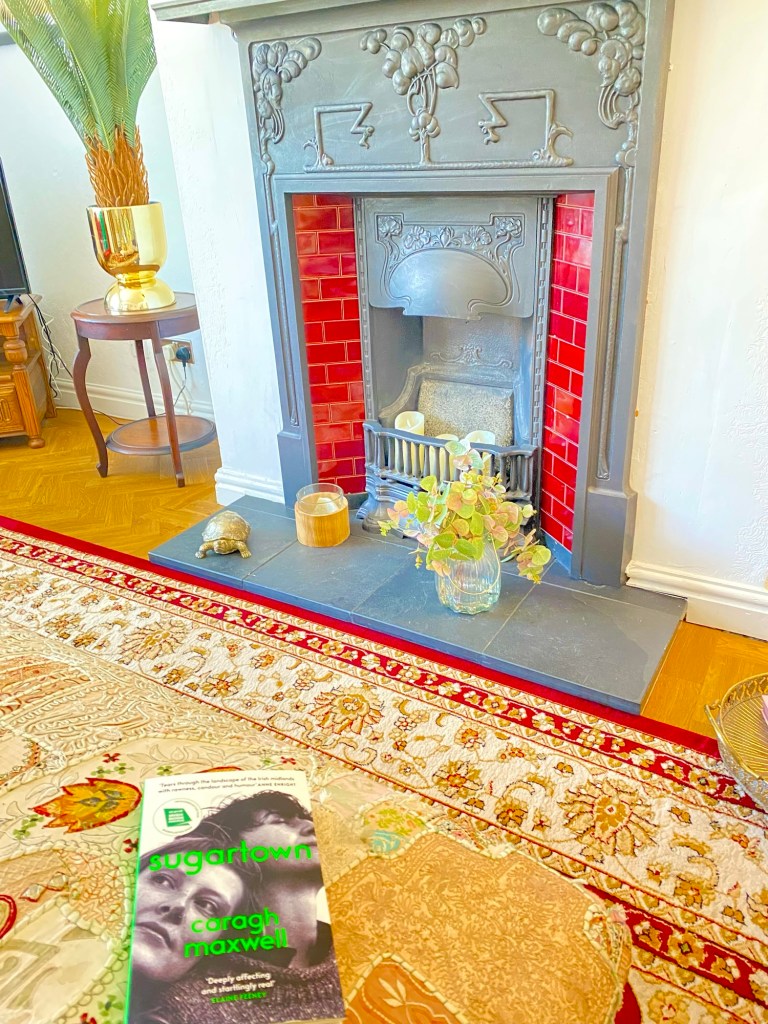
What do you do when you’ve ruined your life? You go home to your mother, if you’re lucky enough still to have one. Saoirse Maher wouldn’t recommend it.
Leaving home wasn’t supposed to be temporary. When she moved to London, Saoirse was leaving Ireland behind for good, and with it her messy, broken family. But it turns out that starting again isn’t as easy as she imagined, and when her five-year relationship goes south, Saoirse finds herself out of options. And so here she is, trudging back to her mother Máire’s house up a side road on the outskirts of Irish civilisation.
Except the world she comes back to is nothing like the one she left behind. Her mother has a new family, and everyone else seems to be moving on. But between the drinking, drugs, and an entirely healthy, not-problematic-at-all-thanks relationship with Charlie, there’s plenty to distract her.
Don’t look too closely, and everything’s fine. Saoirse is just fine.
This was one of those books where the narrative voice captures you straight away and you know you’ll follow wherever she takes you. Saoirse is in her early twenties, newly returned to a small town in the Irish midlands when her big life in London doesn’t go as planned. Now back under the roof of her mother, her second husband JJ and their three perfect daughters, all Saoirse can see is the difference between the mother her little sisters have and the mother she had at the same age. Back then Máire was young and struggling, with a husband who’d rather drink his wages than bring them home to his wife and child. In fact Saoirse can remember being in her mother’s car, driving from pub to pub to look for him. There was so much drama between her parents she might as well have been invisible. When she contrasts this with Lily, Grace and Emilia’s life she can see the difference but she can’t understand it; are they just more lovable than her? She notices the way her mother Máire dotes on them, puts their hair into identical plaits but stops short of identical clothes, reads to them at night and makes sure they’re cared for and these small expressions of love hit Saoirse like poison darts. Her sisters even get to call her Mammy, something that Máire was very clear about:
“I was christened Máire Lynch. Not Mammy. That is not my name. I won’t speak to you if you don’t use my name.”
Sometimes she wonders if the impression she has of their relationship is distorted but then she remembers Granny Lynch, the person who cared for her most asking her aunt to give her some leeway; ‘leave her be, you’ve met her mother.’ Granny’s is the only place she had stability and felt loved for herself, just for existing. Even now, at the age of 24, Saoirse feels her mum’s bite as she bullies her out of bed in the morning, insists she does an interview for the local hardware store and is insistent that JJ shouldn’t have to keep her. Saoirse just wanted a few days grace to gather her thoughts and adjust, but now she’s everything she didn’t want to be, living back with her mother in a small Irish town and doing a job that has no meaning and pays enough money to get by week to week. Then, with her friend Doireann she spends it on alcohol and drugs to forget the tedium and disappointment of life for a few hours. She isn’t even allowed to express her disappointments because Máire is right there, ready to tell her what it was like to be her age with a baby and an alcoholic husband. The author uses wit and humour, even within the darker themes and here Saoirse talks about the ‘overarching theme of the Annual Irish Suffering Olympics’. If you complained about a broken toe, someone else had lost their foot in a mowing accident, so you should ‘get over yourself’. This was such a familiar moment of Irish family humour that it made me smile.
It’s easy to forget Máire’s struggles because Saoirse’s voice is so compelling. It’s no wonder her mother enjoys the routine and stability of her relationship with JJ after the turbulence of marriage to Saoirse’s father. When Saoirse hits rock bottom her dad is briefly there for her, but it’s the first time. Although we concentrate on the mother/ daughter relationship, he has been completely absent in her life. He’s one of those Irishmen who are great at stories and for the craic down at the pub, but they don’t see the state he’s in at home and the way he chooses drink over his family again and again. He seems stable enough at the moment, living with his second wife and making bodhrains in his garden workshop, but he will always let her down. I was concerned that Saoirse would end up living her mum’s life, young, pregnant and with a partner who can’t be trusted. I felt so maternal towards Saoirse throughout and I could see that her lack of parental support left her craving love and acceptance. It’s like a huge hole that can never be filled. Unfortunately it also leaves her open to damaging relationships and when she meets Charlie, through Doireann and her on again off again boyfriend Connor, she falls headlong into tumultuous and possessive feelings.
I was holding on to hope that she could get her life back on track, even when it hits rock bottom and she wakes up in hospital. In the end she turns to counselling and one of the first things they talk about is that emptiness Saoirse feels where the love and support of a parent should be. One line of dialogue in the book broke my heart more than anything and it’s when Máire is throwing all her anger and resentment at her daughter. Their fight turns physical when Saoirse reminds her that she forgot she had a fourth child. When she asks her mother what she’ll tell her little sisters Máire says ‘I’ll tell them to be anyone but you.’ It’s so harsh it stopped me short. Of course in order to heal we look for closure and Saoirse has tried drugs, alcohol, relationships and acting out to fill that hole at her centre. The counsellor asks her some searching questions. What if that closure never comes? What if she doesn’t have a relationship with her mother? Somehow she has to learn to feel that uncomfortable absence without trying to fill it with other things. I felt there was hope that she would build self esteem, because even in the throes of first love she finds Doireann’s relationship with Connor uncomfortable. When she tries to clarify whether they are together or not, Doireann says they’re not ‘together, together’ but it’s great because they both get their space and they’re not making claims on each other. Saoirse is confused and asks Doireann who else she’s seeing, but she’s only seeing Connor while he’s seeing other girls.
“So you do all the things a couple does without the security of knowing you’re not going to get cheated on.”
Of course she could be cheated on whether in an official relationship or not, but the need to point out that only Connor benefits from their arrangement shows that Saoirse does have some expectations and standards. She knows she doesn’t want that kind of relationship. She wants boundaries, exclusivity and respect it’s just that her desperate need for love and acceptance means she settles for less. She also knows that her own capacity for love is immense, saying she would tear herself down to make sure Charlie grew because ‘it was just my way.’ Luckily at this point she moves in with Doireann and her family and sees a totally different way of parenting, a seemingly natural maternity in her mum Karen who struggled to become a parent and sees her daughter as something of a miracle. Saoirse notices that they have saved mementoes of every milestone in their daughter’s life and yet are still able to listen and support her plans to move away from home. When Karen’s had a hard shift at the hospital, Saoirse listens and makes her a cup of tea and Karen tells her she’s a ‘good girleen’ but the compliment is so alien to her she doesn’t know what to do with it. Being mothered makes her realise how complicated it is and opens up the guilt, anger, resentment and thoughts that she could ‘fuck up’ her own daughter. Yet she’s already thinking about how to stop repeating the pattern.
This is a remarkable debut. Every single character felt completely real and the author has captured the awkward vulnerability of youth and a girl who has never had that parental safety net that allows her to experiment and work out who she is. The language is beautiful too from the viciousness of a resentful parent, to the delirium of drug addled parties and the tedium of the hardware store. She describes a silence between her and her mother as weighing on her like ‘wet wool’ and I could feel its heaviness. It all rings true and struck a chord with me about my own teenage years and not always being understood. Some of the descriptive passages are so layered they create tiny moments of stillness within the turbulence becoming passages to breathe in. I found myself responding to the book bodily, so immersed that when the author described a panic attack I realised I was holding my own breath. I felt sad, angry and deeply maternal towards Saoirse and with my counsellor head on I wanted to help. I wanted her to see that she wasn’t the sum of her parents and all the bad things that had happened, that even in the darkest moments there is a tiny spark of light. Any writer that can make a reader feel so much for her characters and their journey is special and I can’t wait to read what Caragh does next, but for now I know Saoirse will be staying with me for a while.
Out now from OneWorld Publications
Caragh Maxwell is a writer living in Sligo town. She graduated from the Trinity College MPhil in Creative Writing in 2023, and her essays, poems and stories have been published in The Irish Times, The Cormorant and other publications. Her writing focuses on the self, memory, and womanhood. Sugartown is her debut novel, and was shortlisted for the 2025 A Post Irish Book Awards.


