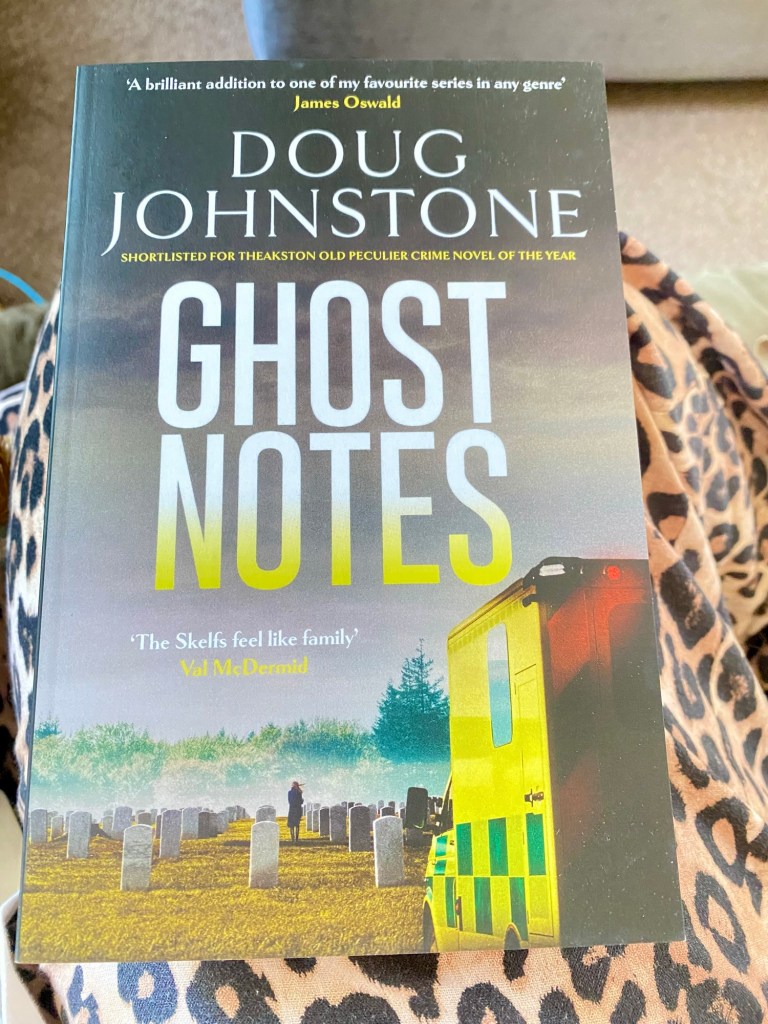
The Skelf women have been keeping their heads down, running the family’s funeral directors and private investigation businesses. But when a woman collapses at her husband’s funeral and is saved by Dorothy, she finds herself drawn into the murky world of ‘grief tech’ – a booming new industry that creates digital avatars of the dead.
Jenny’s latest case – a simple blackmail job for an old school friend – quickly spirals into chaos as the woman’s tangled love life pulls Jenny towards dangerous old habits.
Meanwhile, Hannah and her wife, Indy, are confronted by the unexpected arrival of Indy’s ex-boyfriend, claiming to be dying and eager for the Skelfs to arrange his funeral. But his arrival uncovers more ghosts from the past, and threatens to upend everything they’ve built.
As their cases collide and their personal lives spiral, the Skelfs face danger from all sides. How far will they go to protect one another, and what will it cost to finally silence the ghosts?
I always love the ideas and philosophies that Doug Johnstone brings to the Skelf series and in this eighth book his musical knowledge must have inspired the title. A ghost note can be played on piano, but more frequently on the drums and the matriarch of the family, Dorothy, is still drumming. She teaches and plays in a band that comes together for what used to be called ‘pauper’s funerals’, a duty that the funeral parlour perform for those who are buried or cremated by the local authority. As Dorothy teaches she explains ‘ghost notes’ to her student – a soft note like a whisper, usually on the snare drum played between the accented beat. The listener might not hear them being played, but would feel a difference when they’re not. They partner beautifully with one of Hannah’s physics concepts, the ghost particle, invisible and very rarely connecting with other matter that makes up our world but ever present. There are people in our lives who are like these notes, ever present but often completely unnoticed, until they aren’t there any more and we can feel their absence. I’ve felt like this about Hannah’s wife Indy in the series and have often wished to hear more about her life and experiences. She’s always quietly been in the background of the Skelf’s very dramatic and noisy lives, she is the person who notices you haven’t had a drink and brings you one before you’ve even asked. I was so excited to see her taking more of a central role in this story, where three cases are also dividing up their time. Jenny’s investigation comes from a local estate agent who is being blackmailed. Dorothy is investigating a family’s tragic losses as they bury the father of a girl found dead several months before. This takes her into the world of ‘grief bots’ and how anything built for profit has a harmful element to it. Finally there’s Hannah who is investigating the trouble brought to their door by Indy’s ex-partner and those he has wronged.
The book opens with a funeral and a widow who has a heart attack by the grave side. This family have already experienced tragedy, because the man in the coffin has killed himself after the death of his daughter. If the widow can’t be saved then her son will have lost his whole family. On her return home the widow asks Dorothy to look into her husband’s death and the first thing she discovers is very strange – a company who scrape a dead person’s identity from the internet and use AI to create a lifelike avatar of that person. The account holder simply signs into the app to visit their loved one, but innovations like this – including social media and other apps – are rarely altruistic and always based on money, so somewhere there’s a catch. I found this part of the story quite emotional because there’s something about seeing your lost love one moving and breathing. I can’t even watch videos I have of my late husband, photographs are fine but a moving version is still too much for me twenty years on. Also, thinking from a therapy perspective, how do we ever get over losing someone when they’re still there at the opening of an app? Apps like this could be seriously harmful to someone who’s grieving, complicating already painful emotions. Quietly, Dorothy is dealing with a loss of her own as her detective boyfriend Thomas is still not accepting her letters sent to the prison where he serves a sentence for murder. Jenny’s case seems simple but quickly turns into something more complicated, emotionally and investigatively. Watching an estate agent with a very busy sex life drags Jenny into a realisation that she’s been hovering around for some time. Luckily she has Archie there to support her and I loved how non-judgemental he is because Jenny needs to know someone is staying for the long haul, even while trying to push them away.
It’s Hannah and Indy who have the most dangerous encounter when an unknown face from Indy’s past comes crashing into their life, along with everyone who’s looking for him, to settle scores or the money owed. It seems implausible that Indy dated a man who is involved in the drug scene, although for Hannah it’s a revelation that Indy even dated a man. This chequered past brings violence into their home and Hannah has to reevaluate the woman she’s married to in light of their conversations. It’s clear there is so much Hannah didn’t know, not just about this relationship but about the deaths of Indy’s parents and other losses. So far in their relationship Hannah has always been the one to bring the chaos and her wife has always been the calm ship steering them into safe waters. To me Indy has always seemed like a wise woman, slightly mystical and enigmatic, but now we can see that her wisdom is hard won and comes from mistakes she can never take back. It’s when Schrodinger disappeared that I began to worry, the Skelf’s cat has been with them through thick and thin and I was so worried that he’d been taken as a threat.
Lately, I’ve been struggling with the world around me, feeling more and more dislocated from what ‘ordinary’ people think. Being a disabled person in a world that appears to hate our very existence is draining and even depressing. Added to that, the work we do with Stand Up To Racism means we’re exposed to individuals who hate others, people who they perceive to be different thanks to the hateful rhetoric from some of our politicians and the sections of the media. It feels so prevalent that more than once I’ve found myself stopping and asking ‘is it me?’ Am I in the wrong? Then I read a Skelf novel and feel like I’ve found my tribe among these intelligent, flawed, tough and compassionate women and their found family. Each one is genuinely woke and I mean that as a positive thing, rather than the insult it has become. Having your consciousness raised was always considered a good thing and these incredible women give me hope. Their compassion for others is shown again and again, in their work on civic funerals, their search for more environmentally friendly funeral options, their tendency to take in waifs and strays and their constant love and care for each other. Doug Johnstone’s writing reassures me that there are people like this in the world and that I might fit here after all. Good people like Archie, Brodie and Indy who quietly go about their business supporting the Skelf’s are the ghost notes of the family. Barely noticeable, but incredibly vital too.
Out now from Orenda Books.
Meet the Author

Doug Johnstone is the author of twelve novels, most recently The Great Silence, the third in the Skelfs series, which has been optioned for TV. In 2021,The Big Chill, the second in the series, was longlisted for the Theakston’s Old Peculier Crime Novel of the Year. In 2020, A Dark Matter, the first in the series, was shortlisted for the McIlvanney Prize for Scottish Crime Novel of the Year and the Capital Crime Amazon Publishing Independent Voice Book of the Year award. Black Hearts (Book four), will be published in 2022. Several of his books have been best sellers and award winners, and his work has been praised by the likes of Val McDermid, Irvine Welsh and Ian Rankin. He’s taught creative writing and been writer in residence at various institutions, and has been an arts journalist for twenty years. Doug is a songwriter and musician with five albums and three EPs released, and he plays drums for the Fun Lovin’ Crime Writers, a band of crime writers. He’s also player-manager of the Scotland Writers Football Club. He lives in Edinburgh.


