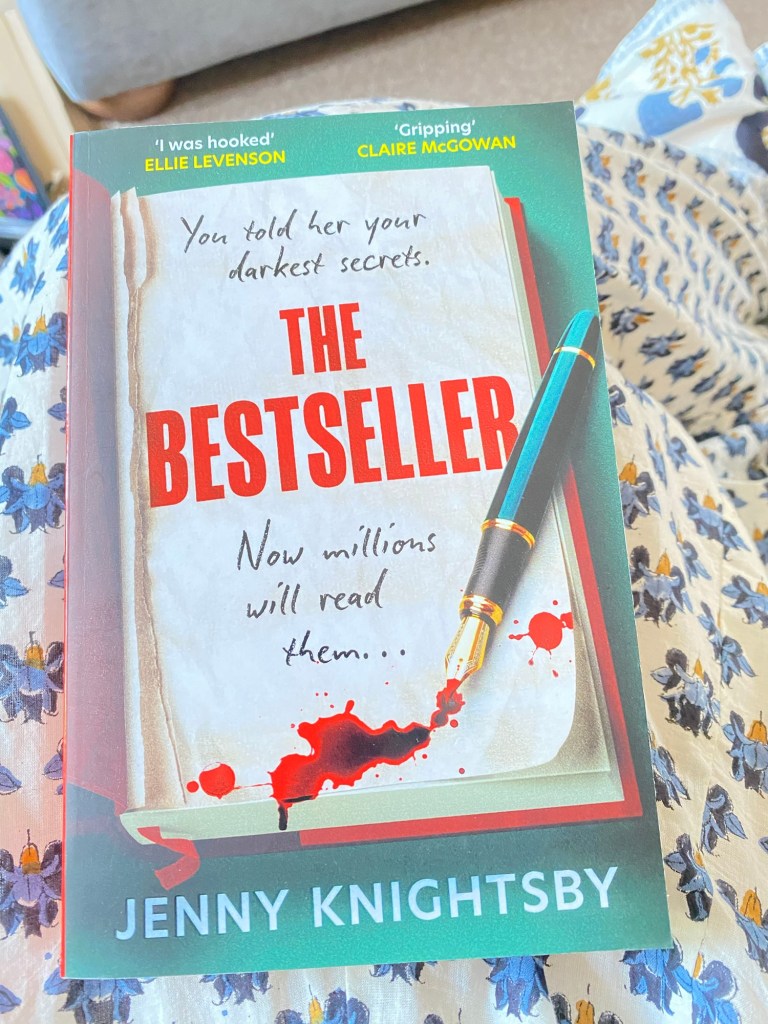
Therapist Helena Salve knows that client confidentiality is the number one unbreakable rule of her job. But the constant stories of coercive control and threat she hears from her client Belle about her dangerous husband have been wearing her down. One night over too many glasses of wine, she tells her best friend Tala everything that Belle has told her. The problem is, Tala is a down-on-her-luck novelist who is looking for an idea for her new thriller.
Months later, Tala is excitedly telling Helena that her publisher is saying this is going to be her biggest book ever. The story is Belle’s story. Not only is Helena’s job on the line, but if Belle’s husband is as dangerous as she says, her life is too…
Why would Tala do this to Helena? She knows what’s at stake.
Your friends are meant to protect you… aren’t they?
This is a great premise for a thriller and having been a therapist I’m always fascinated by books based on the therapeutic relationship. I think there’s a general fascination about what therapist’s personal lives actually look like. Do they have it all sorted? The answer is invariably no and in this novel there’s so much projection happening between Helena and her client Belle. Confidentiality is the bedrock of any therapeutic relationship, but that can get tricky when the therapist knows the client needs either specialist help or practical help. Helena is there to listen and guide Belle towards her own answers, but the constant disclosure of coercive control is uncomfortable to sit in. The urge to do rather than sit back and listen becomes difficult for Helena and it’s this discomfort that leads to her talking about it with best friend Tala. She asks Belle to bring her husband Julius to the sessions as she’s normally a couple’s counsellor, but that wouldn’t work either because he might take the opportunity to abuse his wife verbally and emotionally in the session. It is impossible to counsel a narcissist.This is an issue for supervision, where Helena should disclose that she’s finding Belle’s passivity and indecision on leaving her husband Julius very difficult. The fact that she doesn’t, tells me she wants to show her supervisor Martha that she’s doing this ‘right’. Helena is a perfectionist and perhaps she seeks approval from her supervisor rather than being totally honest. There’s something about Helena that’s very responsible, aware of her ethical framework and unwilling to break out of it. However, sometimes this demeanour doesn’t seem real.
I found Helena an odd central character because we have access to her inner life but I still felt she was almost ‘missing’ in the story. She feels very flat compared to other characters and it was as if she’d fallen permanently into her counselling role, treating everyone with empathy rather than displaying honest human reactions to events. However, as those events start to spiral out of control, that serene outer surface does start to crack. The author uses flashbacks to give us a picture of how all the characters meet while they’re at university, but also to show us incidents that would have me dumping her boyfriend Dylan, but Helena accepts and forgives. One scene is a dinner with Martha her tutor, but Dylan is late. When he does arrive he’s very drunk and relieves himself on the rug! This would have been an unforgivable red flag for me. Helena seems to have the measured outlook a lot of counsellors have, the ability to think on something for a while and not act on her first emotions. There’s no doubt she’s furious and betrayed when she realises best friend Tala has written a book based on her current client Belle. Inside she’s screaming ‘how could you do this to me?’ She’s terrified of her career and reputation being finished by this breach of confidentiality but she doesn’t show it. She waits and mulls it over, never displaying the emotions underneath. This either shows an ability to rationalise obstacles and work out a response that’s fully thought through, or she’s completely out of touch with her own emotions and unable to express them as soon as they arise. It made me think of the famous book ‘The Body Keeps the Score’ where the author explains how trauma is not just a psychological event, it’s a physiological one too. The trauma is felt bodily and stays within the nervous system, causing physical reactions if not addressed through holistic therapy such as a combination of EMDR, yoga, meditation and neurofeedback. The body stores the trauma as muscle tension, hypervigilance and a rapid heart rate continuing to experience them long after the trauma has passed. I felt like Helena was storing her emotions bodily, without truly feeling and expressing them, that is until events start to spiral out of control.
Tala is Helena’s opposite in every way. She’s impulsive, creative and a torrent of emotion at all stages of her life. There’s clearly been an event that’s affected her permanently and it’s only through flashbacks that we see what this is. It makes sense of her neediness when it comes to relationships and when she thinks she’s found one after years of being single, she isn’t going to give it up easily. I couldn’t believe the audacity of taking Helena’s private impressions and worries for her client and turning them into a sensational thriller. It seems out of character for Tala who has been a steadfast friend for many years. Maybe she didn’t expect the book to take off the way it does and now it’s being advertised on the Tube and on the side of buses she can’t take it back. Risky behaviour isn’t new to Tala, we see in flashbacks that she experimented at university with drink and drugs. There’s an element of mothering in Helena’s relationship with her friend, replacing a missing element in her life? Helena and Dylan are that stable couple Tala runs to when things go wrong, but what about when things go right? As Helena reacts to the new book I wondered how much she was threatened by Tala’s success? If Tala gets her act together and does really well with the book, she might stop being the person who depends on Helena. No longer the person to be pitied and sighed over. When she brings a new boyfriend into the mix it’s as if all the problems in Tala’s life are being resolved at once and she is well aware of this change in their dynamic.
I loved the way the author wrote about coercive control and as a survivor of this type of relationship it matters when people get it right. One of the worst elements for me was that other people can’t always see it, it’s subtle and hard to pin down when someone is exerting their will over you. It’s rarely straightforward because it exists within the dynamic of your relationship, so one seemingly innocuous word could bring you sharply back into line and leave you dreading the real ‘fallout’ later when you’re alone. The worst thing about this type of relationship is that you start to police yourself, trained into acting the way that pleases the abuser. They might seem to champion you to others, but in truth are jealous of what you’ve achieved and once the reflected glory has worn off they might try sabotage. After leaving my relationship I felt an enormous amount of relief but then self-doubt would creep in as if I’d internalised the abuser’s voice. It’s disorienting because the person you were in love with isn’t real, but just a mask they wear to hide their true self. All of this can be seen in Belle’s relationship with Julius and I think my own experience helped me understand why Helena wants to help this woman, even though she’s struggling to stay within the boundaries of their therapy. It’s very hard to sit back and not give advice in these situations or offer help beyond the counselling room. It was interesting to see how the professional distance became impossible when Martha ended up in hospital and Helena was without supervision.
It seems that the lives of these three friends and their paths into adulthood hinged on a single night. I thought the author managed these flashbacks well, placing them absolutely perfectly for maximum effect. It seems everyone has secrets but they are slowly revealed creating a very addictive read with short, pacy chapters that make you want to read just one more – I desperately wanted to know where Martha’s cat had gone! The tension is almost unbearable as I worried about Helena overstepping with her client, or the client finding out what’s in Tala’s book and somehow passing that on to Julius. Would Helena be safe? As her well-ordered life starts to fall apart Helena starts to lose her belongings, forget her schedule and have terrible nightmares. She has no access to Martha and her relationship with Tala is broken. I wondered if she was heading for a breakdown. You may see the twist coming, but that doesn’t detract from the story. Eyes are opened, secrets past and present are revealed and I devoured the last few chapters late at night, unable to wait till the morning to find out what happened. This was an excellent thriller, full of psychological drama and really nailed the experience of being a counsellor with a problematic client. I also loved the ‘meta’ structure of reading a book about a book and just like Tala’s new novel this one should be a bestseller.
Out now from Mountain Leopard Press
Meet the Author
Jenny Knightsby is a hospital doctor based in West London. The Bestseller was shortlisted for the Lucy Cavendish Fiction Prize 2024 and is Knightsby’s debut novel.


