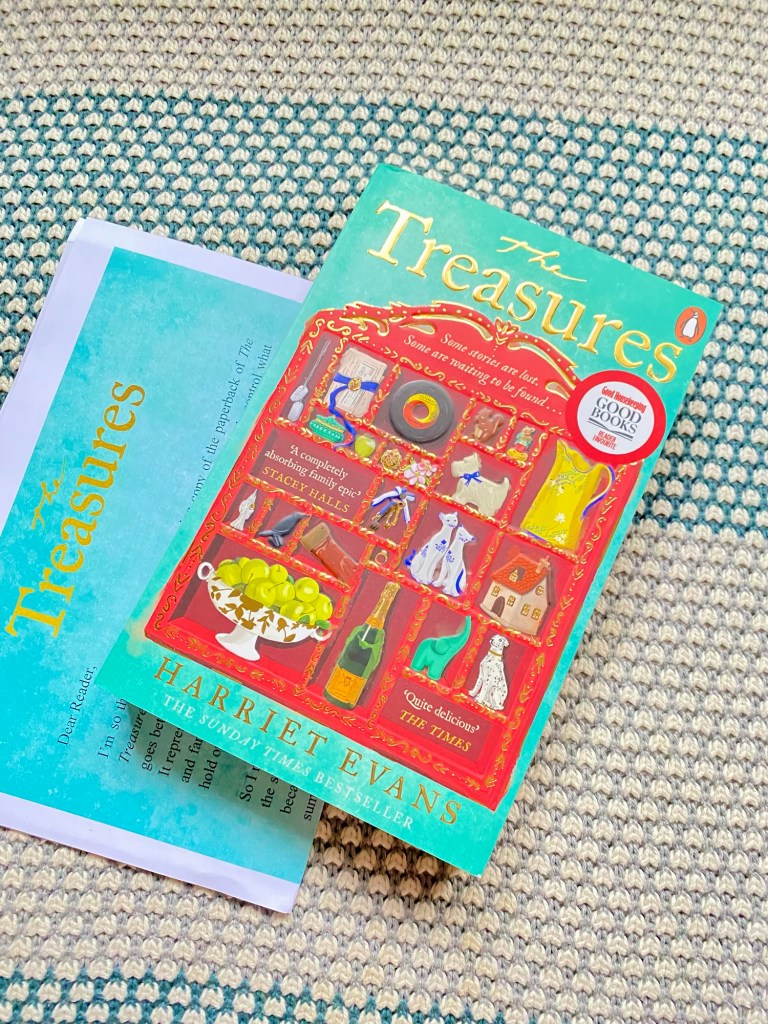
One golden summer. One missing treasure. And a secret that binds two lives together.
Every year, Alice’s father gives her a treasure. Then on the morning of her sixteenth birthday, her final gift vanishes – along with the fragile certainty of her world. Alice runs, towards New York City and away from the memories of that last summer at the orchard where she grew up.
Across the Atlantic, Tom has always felt that something is missing from his life. When he finds a long-forgotten letter, it leads him away from Sevenstones – the house at the heart of his family for generations – and towards a truth no one has ever fully told.
From post-war London to 1960s New York, Alice and Tom’s stories become entwined. But will the secrets of their past bring them together, or break them apart?
I always think that the good marker of a book is when you find yourself thinking about it days later and discussing it – or in my case boring someone who hasn’t even read it with my thoughts and feelings. This book brought up so many feelings! While we start with Alice’s devastating story of her early years, it was Tom’s narrative where the book came alive for me, with his early life in Dumfries and Galloway only a stone’s throw from my favourite yearly holiday destination. The descriptions are so vivid, from the hand to mouth existence of Tom and his father and their total connection with the seasons. The frozen sheep they find that keeps them going all winter and the beautiful hare at the gate signalling the oncoming summer. It’s a magical place and although life isn’t easy it’s familiar, with a strong connection between father and son since the death of his mother. To be torn from all of that and transported to post-war London by his mother’s family feels so unjust. His Aunt Jenny and Uncle Henry are eccentric and not as wealthy as they once were, evidenced by the ghosts of sold paintings on the wallpaper and their diet of tinned goods. As Tom deals with new expectations, the fractured feel of the city and its bomb sites, we start to sense a secret behind all of this, only hinted at and never made clear to Tom. A promise was made in wartime, one that couldn’t be broken and has it’s roots in a house called Sevenstones where ravens nest in the trees and a key was left under a stone at the door for anyone who needed an interlude from their wartime duties. It’s a secret that follows Tom throughout his years at school and eventually across the Atlantic.
Each section of this book is so evocative of its time and place. The captures the unrest in 1950s London and attitudes towards those who enlisted to fight in the war from Britain’s colonies, now returned to settle here as part of the Windrush generation. There are Teddy Boys rioting and children playing in bomb craters, the contrast of Westminster school and forays into Portobello Market. Meanwhile, Alice’s narrative takes her from a small town in upstate New York where minds and opportunities are equally small, into Manhattan during the unrest and change of the 1960s. Living in a squat in the East Village she is part of the hippy generation, with the backdrop of protests against segregation and the assassinations of Martin Luther King and Bobby Kennedy. Then comes the anti – Vietnam War demonstrations accompanied by the music of Joni Mitchell and Joan Baez. All seen through a haze of pot, LSD and The Beatles more psychedelic years. Alice’s generation is my mother’s too so the music, peace and love, the fashion and political beliefs are familiar and nostalgic. Tom travels to the USA to look for Alice, who he accidentally spoke to by phone briefly, for answers about his past and a woman called Teddy Kynaston who seems to be the key to the secrets he’s discovered.
Alice’s humming of Yesterday is so symbolic, with its twin refrains of the young girl running away early one morning and the parent’s lament that they sacrificed everything for her. Both young people are damaged by the generation before and there’s a definite sense of Phillip Larkin’s ‘This Be The Verse’ about the narrative – everyone always remembers the first line but forgets the second “they do not mean to, but they do’. The generation before us were messed up by their parents too, a theme that I imagine will run throughout the next novels in this series. Tom and Alice are failed by parents keeping secrets and making decisions to right the wrongs of the past that only make things worse. I felt something of Tom’s confused identity, having gone to a grammar school where many of my classmates were considerably better off than we were. I was taught to drop my accent and while I got a great education I didn’t feel like I belonged anywhere. For Tom the disparity is even greater and in his beautifully naive way he reminded me of Jay Gatsby, unaware of how ruthless the rich can be even when it comes to love. The parallel reaches across the Atlantic to Alice’s family and her dad’s employer, the oily and deeply unpleasant writer Wilder Kynaston. He’s wants to write from a young girl’s perspective, perhaps Daisy Buchanan’s but Alice is quite clear that no one cares about the Buchanans, they’re just as careless with feelings as Tom’s Westminster friends. Gatsby is great because of his loyalty and fierce love for a girl who doesn’t deserve his devotion, something Tom understands.
I felt so deeply angry with the Kynastons and the Caldicotts, especially as the truth of their wartime connection comes into the open. Their story made me understand why people of my grandparent’s age feel nostalgia about wartime – there was a freedom that disappeared into the 1950s and what felt like a concerted effort to force women back into their pre-war roles and behaviour. Women were flying planes up and down the country, joining the ambulance service in heavily bombed cities, working as land girls or taking on roles in the forces. They experienced a freedom in their social life they’d never had before and people took risks because they didn’t know if they’d live through the next day, never mind see the consequences. For women like Jenny, Teddy and Irene it allowed them to be fully themselves only to find themselves controlled and back in the domestic sphere and for some the consequences of being different are devastating. The author takes 20th Century events and shows their consequences in one generation of a family and I’m fascinated to see where these characters go next, something hinted at in the final chapters. As the book drew to a close I found myself hanging on through the final twists that bring us back to Sevenstones. I was so desperate for a specific outcome that when a previous character popped up unexpectedly in the final pages I swore out loud! The treasures in this story are not necessarily the trinkets that Alice carries with her or the carved house that Tom always carries in his pockets as a talisman. It’s the people they represent and the love that flows between them, even long after they’ve gone.
Out now from Penguin and part of the Sevenstones Trilogy
Meet the Author

Harriet is the author of an incredible fourteen novels, selling over a million copies and being a Top Ten bestseller as well as a Richard and Judy pick twice. Prior to that she worked in publishing, editing authors like Marian Keyes and Sue Townsend. She claims working on the reissue of the book LACE as a proud moment from her junior career.
The Treasures was released in 2025 and is the first book in a family saga featuring the Ravens over a fifty year stretch of the 20th and 21st centuries.
Last year she published her first murder mystery featuring detective Dora Wildwood, a character she hopes to continue into future novels.
She is on the management committee of the Society of Authors, fighting for better deals for authors, talking about the dangers of AI, ghostwriters, bad contracts, ghosting, royalties and other issues facing authors. She also volunteers with Inspiring the Future, aiming to widen aspiration for all children, and am an ambassador for the London Library.
Harriet lives in Bath with her family and a huge fluffy cat.
Harriet can be found on instagram as @harrietevansauthor.


I’m hoping to read this next month!
LikeLiked by 1 person
Hope you enjoy ❤️📚
LikeLiked by 1 person