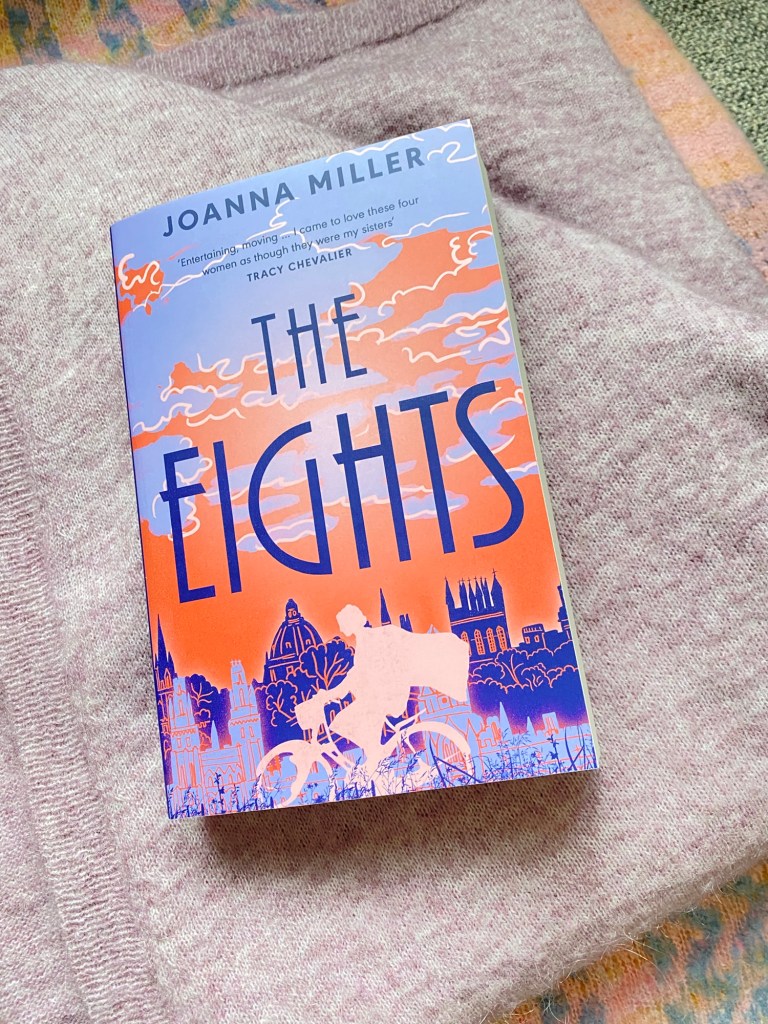
I pre-ordered this book as soon as I read the blurb. I could see myself falling in love with this story of four pioneering women who attend Oxford University as part of the first cohort to gain an actual degree. The four women arrive at Oxford in a time of great upheaval. The First World War has ended and women have just been awarded the vote. Women have experienced more freedom during war time, by working to replace enlisted men, volunteering for the war effort. Beatrice comes from a progressive family, with a suffragette mother who attended Oxford herself. Beatrice is very political, obviously a feminist and is used to being noticed, as she’s usually the tallest woman in a room. Marianne is a scholarship student, but she seems to have secrets. She returns home every other weekend and struggles financially but she is determined to get what education she can. Ottoline (Otto) comes from a wealthy family, but is haunted by volunteering for a nursing role during the war. She found it so distressing, she was redeployed as a driver giving patients transportation rather than working on the front line. She’s had symptoms of PTSD ever since, but also feelings of shame that she couldn’t do her duty. Dora also struggles with the consequences of war. She received a letter from her fiancé Charles’s regiment to inform her he’d been killed, then only two weeks later her brother George also lost his life. She still sees Charles wherever she goes and being so close to his university only serves to keep him at the forefront of her mind. These four girls are assigned to a corridor where the rooms start with the number eight, giving them their affectionate nickname. This seemingly random allocation starts strong friendships as the girls help each other negotiate their university work, their memories of the war and being taken seriously by their male counterparts.
Oxford University is the oldest English- speaking university in the world, having and I was amazed to read it was founded in the 11th Century. The first colleges for men were fully established 200 years later and the Bodleian Library opened in 1602. Women were only starting show interest in an Oxford education in the late 1800s and four women’s colleges were established, however even after years of negotiation to do the same courses as men, women had to be chaperoned to lectures. I was also amazed that despite doing exactly the same exams, women could not be awarded degrees and dons would still refuse to teach them. I couldn’t imagine doing all that work, then having nothing tangible to show for it. It must have been soul-destroying. The author’s story begins after women got the vote and it took until 1920 for women to become fully enrolled at the university as men had been, a ritual called matriculation. The author lays out this facts at the beginning of the novel, which is brilliant for setting the scene generally but also allows us into what is an exclusive world with it’s own language and culture. She separates her book into the named terms – such as Michaelmas or Hilary – and lays out the dress code and rules, different for men and women. She also lets us into what the exams are called and has a glossary at the back in case you get lost. Finally she splits her first chapter between the four girls so we get a really good sense of who they are and where they’re from.
This is a real character led novel from Joanna Miller, creating a similar feel to those novels I loved as a girl such as the Little Women series or What Katy Did At School. With both of those novels I felt like I knew the characters and they would be great fun to be friends with. I loved the secret societies, the scrapes they got into and the character building lessons learned. This has all that, but with great emotional heft and real, gritty issues from that time period. I loved how the characters developed over time and how each of the friends supported but also changed each other with their different backgrounds and perspectives on the world. I felt Marianne’s predicament strongly, in that she’s landed with three friends who are reasonably comfortable financially. I felt it when they all swapped presents for Christmas, but Marianne couldn’t afford to buy for each of them, so instead created a framed favourite poem each. Her offerings are always from the heart and she’s definitely the most thoughtful and most serious of the girls. She also has the hurdle of illness to climb over, as well as whatever takes her home on weekends. The others notice that she’s never managed her reading so what is she doing? She has the constant fear of not passing the year and losing her scholarship, so she’s mentally preparing herself for the eventuality of only spending one year studying. Ottoline is probably her opposite, in fact if it wasn’t for her love of maths she might be tearing about London with her sister and the rest of the Bright Young Things. There’s the rather imperious side to Otto, such as the way she’s always scuttling into tearooms and the nickname ‘Baroness’ that she earned in the war. However, there’s a softer side too and that terrible sense of failure she still feels. Yet she definitely comes through for Marianne when she contracts flu. Otto proves capable of dealing with bodily fluids, cooling Marianne in the bath and even washing her down with a damp cloth. She is even the first to uncover Marianne’s secret and guards it ferociously.

Beatrice is living with the weight of her mother’s success, both as a student of Oxford and a suffragette. She is a woman of ‘considerable reknown’ and this has given Beatrice an interesting childhood. She now has several hobbies – writing letters to politicians and watching debates in the commons, propagating orchids and being able to read Ancient Greek. She seems the perfect fit for Oxford but has never really lived in close proximity to other young women or lived anywhere but the family home in Bloomsbury. Two key events in the book seem to shape her future. She meets a young woman called Ursula who is outspoken, political and wears men’s clothing, which is much more comfortable than women’s. Beatrice is bowled over by her new acquaintance and is determined to wear men’s shirts and ties from then on. There is also the ceremony for her mother who will finally be awarded an Oxford degree. There’s a constant push and pull between who Beatrice is and where she has come from; does she accept and enjoy the legacy of her mother, or does she move away from it? Through her we learn about some of the most harrowing aspects of the suffragette’s fight, particularly the way the women were treated as protestors and prisoners. Dora is a delightful girl from the country, who comes to university seeming rather old-fashioned. Her longer skirts and waist length hair seem incongruous when hemlines are rising and hair is being shingled shorter than ever. Yet she’s weighed down with the early throes of bereavement and has come to Oxford in the hope of feeling closer to the memory of her fiancé who should have come to Queen’s College. She wants more from life than to pour tea, play whist and prop up her mother whose grief is inconsolable. Dora will perhaps change the most and with a terrible shock to come, she may have to make a decision between the new life she has created or her old one.
I loved every moment I spent with these young women. They are all equally interesting and important so I couldn’t pick one I gelled with most. I loved Beatrice’s awakening, her straight forward manner and her bravery. Otto made me laugh and became so much more nuanced than the spoiled rich girl she could have been. Dora’s gentle strength is admirable, especially when it is tested. Marianne is the dark horse of the group, but she’s surprising and has a strong sense of what is right for her. This is a favourite time period for me so I loved the clothing, the outings, the rising tide of women wanting more from life than a ring and motherhood. These women are the birth of who we are now and I think the author was really successful in portraying issues that are still relevant. As we see women’s rights being eroded and the misogyny on social media, the novel is also about how men treat women. It can even be seen in small ways, such as the pranks played on the women by male students. However, it’s also the control wielded by a father figure or professor, the deception and double-standards men use to manipulate women, the sexual predator or abuser who finds a chance moment or a position of power to commit violence. I believe that just the chance to pursue their education with the freedom men take for granted, is a huge step for the women in terms of status but also self-confidence. However, it is the friendship of these four women, first and foremost, that helps them grow. Their unflinching support and understanding of each other is beautifully drawn and brings to mind something I’ve always said to women on my ‘authentic self’ workshops; men may come and go, but it’s the women in your life who will hold you up’.
Out now from Fig Tree
Meet the Author

Joanna has always loved stories – even from an early age, when the Headteacher complained to her parents that she had read all the books in the school library. Joanna went on to study English at Exeter College, Oxford and later returned to the University to train as a teacher.
After ten years in education, she set up an award-winning poetry gift business. During this time, she wrote thousands of poems to order and her rhyming verse was filmed twice by the BBC.
Unable to resist the lure of the classroom, Joanna recently returned to Oxford University to study for a diploma in creative writing. THE EIGHTS is her debut novel and is inspired by her love of local history and historical fiction.
When Joanna is not writing, she is either walking her dog or working in the local bookshop. She lives with her husband and three children near the Grand Union Canal in Hertfordshire, UK.

 The Lotus Readers