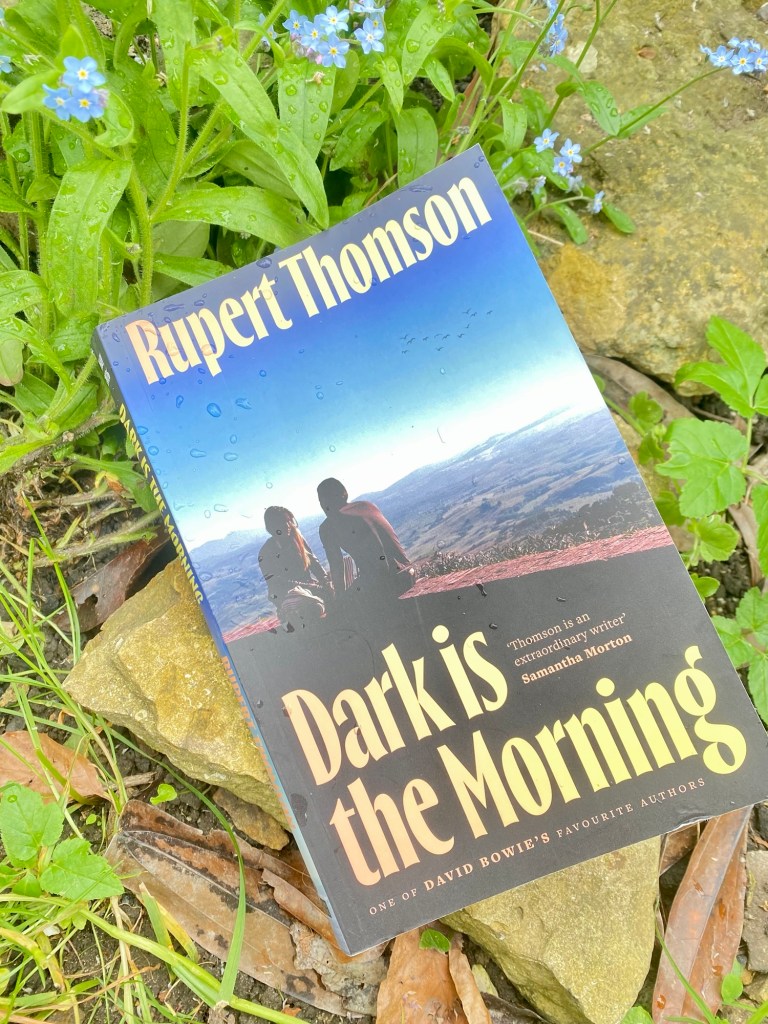
Sometimes love isn’t where you belong
In a mountain village in the Abruzzo region of Italy, Gino, a troubled young man, realises that his childhood sweetheart Franca can give his life the happiness and stability he needs. They seem made for each other, and move to a remote house in the countryside – but there is something in Franca’s past that haunts Gino.
Descending into pathological jealousy and resentment towards a married man who had been Franca’s lover, Gino is unable to stop himself imagining the worst, and embarks on a violent path that has catastrophic consequences.
There couldn’t be a better book for a counsellor to read than this one, following the life of Gino who lives in a small Italian town on the Adriatic Sea. The setting isn’t a bucolic, sun drenched and charming little town, despite Gino’s upbringing on his father’s smallholding where he mainly grows tomatoes. This is a grittier Italy, perfectly suited to the story and Gino himself. Although there is a sense that there’s a different existence within reach, perhaps the life his father has living off the land or whatever brings his father’s friend Harry back every few months. Whatever contentment is, Gino doesn’t know how to find it or accept it once he has it. Gino was born here and makes the comment that he’ll die here if he isn’t careful. He doesn’t want to live the life his parents have, he has bigger and better things to do. However, it could also be the foreshadowing of what’s to come when he meets Franca again. Franca was at school with Gino and in some senses he feels they’re both outsiders: ‘She was a strange little stringy thing, with a thin face and brown hair’. Franca was nicknamed The Rat by other girls, but then Gino was called Dopey after the dwarf in Snow White. She’s very bold, walking up to Gino and telling him that she’s going to marry him one day something both of them were teased about for years. Now, when his father mentions her, he seems irritated but they do have something in common, an inability to live up to their heroic parents. Gino confided in her when they were thirteen, saying all he seems to do is disappoint his father. Franca seems to get this, after all Gino’s father is known for something heroic he did in WW2 and her father is the local ambulance man. Maybe, she suggests, they could be something different to each other? She’s a realist, saying her father could have wanted a beautiful daughter and she’s aware she isn’t. How can they compare to heroes? They are only human. Gino gets into trouble in his teens and spent time in a psychiatric unit and he admits he’d forgotten his old friend, but the conversation with his father lights up his memory and he questions his choices. With a new view on life he searches Franca out and asks to take her to dinner and they are married in a whirlwind and given the chance to make a home in her aunt’s house in the countryside. Is it possible that Gino has learned from his mistakes and now sees what is important in life?
If I had a trainee who wanted to understand the Cognitive Behavioural Therapy concept of negative automatic thoughts I’d get them to read this book. Everything Gino experiences is filtered through a faulty lens. Whether this is innate or a result of constantly feeling like a disappointment is hard to tell. At the moment he has it all, but in his mind it’s already unravelling. The house needs a lot of work, but could be a secluded haven for a family. Gino hears that something strange happened to Franca’s aunt here during the war and starts to wonder about it, could an event like that leave something in the house like a mood or a feeling? Is the house unlucky in some way? To be transparent about her past Franca tells him about an affair she had with one of her father’s friends. Although outwardly he seems to accept this confession, inwardly it becomes a nagging concern he can’t shake off. He asks others about man who has a concrete business, telling them he has a friend who’s putting in a pool. He tells himself he just wants to look at him, but can he resist speaking to him or perhaps even warning him off? At the end of her working day Franca goes to a cafe in town to wait for Gino to pick her up after work. He notices that she’s chatting to a man, laughing and passing the time of day and he knows he’s been trying to pick her up. His strangest obsession comes when his son Elio is born, a beautiful baby with amazing violet eyes. Everyone who sees him comments on what a beautiful boy he is and he genuinely seems hypnotic for some people, almost holy. All Gino can see is a boy who looks nothing like him. Neither he nor Franca are beauties so how can Elio be his and inspire such reverence in complete strangers? Being in his mind is exhausting and worrying, the author leaves us unsure what he might do next. Pressure mounts with every page and Harry is the only person who seems to get through to Gino, telling him that perhaps the boy embodies the beauty inside them both.
Everything about Gino screams of a paranoid personality disorder, his mistrust of others and ability to twist innocent encounters into personal slights and grudges are classic symptoms. He has stopped listening to others and his behaviours become more extreme, including hallucinations that his baby son is talking to him. Franca is disturbed to come home and find Elio screaming in the house alone, while Gino is zoned out in the garden. As readers we’re inside his mind and see his motivations, the wrong patterns of thinking and the way he broods and cultivates grudges that are simply not there. Instead of facing these painful thoughts he directs his anger and obsession outward. If Elio is nothing like him, then someone else must be the father. I genuinely believe that Pierozzi would have carried on his life rarely thinking of Franca and her new husband, but Gino’s places himself in harm’s way. Pierozzi is a dangerous man. He’s described as someone things happened to and that resonated with my idea of Gino. Is this something people would eventually say about him? The way the author builds this difficult inner world is so clever and I was anxious, mainly for Franca and Elio. They are living in the middle of nowhere, with a husband and father who is no longer rational. I was mentally screaming at her to make sure she had somewhere safe to go.
Franca is very sure of her own emotions and choices. When Gino asks her if she’d still marry him she tells him calmly that her feelings have never changed. However she does have “something of the fox about her. That sudden, absolute stillness, that pricking of the ears, that readiness to flee.” Will Franca be just as resolute if she does sense danger? I felt so sad for her, because Gino’s obsession with her past harms her, even though it has nothing to do with him. Why can’t he see that she has only ever loved him? Despite him leaving and never making her any promises when they’re younger, her love never dies. That shows loyalty, but it’s never appreciated or rewarded. Even the beautiful son they have isn’t enough and I wondered if it was partly about his fears of her infidelity but mainly about his relationship with his own father. They were so different in character and distant emotionally, did he ever wonder about his own paternity? The author bookends this story with Harry as the narrator and honestly I had an emotional reaction to being back in Harry’s steady hands at the end. Being in his world felt safer and the way he frames Gino’s story gives it some closure and structure too. I found myself wondering how I’d work with a client like Gino and whether he could ever be satisfied with his life. This book has emotional depth and complexity, tension and action alongside some incredibly surreal moments too. I would definitely read this author again.
Out now from Head of Zeus
Meet the Author
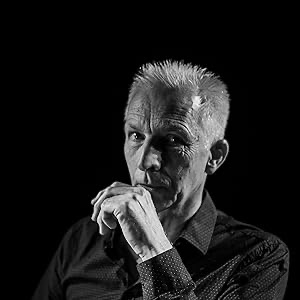
Rupert Thomson is the author of fifteen critically acclaimed novels, including ‘The Insult’, which was shortlisted for the Guardian Fiction Prize, and chosen by David Bowie as one of the 100 Must-Read Books of All Time, ‘The Book of Revelation’, which was made into a feature film by the Australian writer/director, Ana Kokkinos, and ‘Death of a Murderer’, which was shortlisted for the Costa Prize.
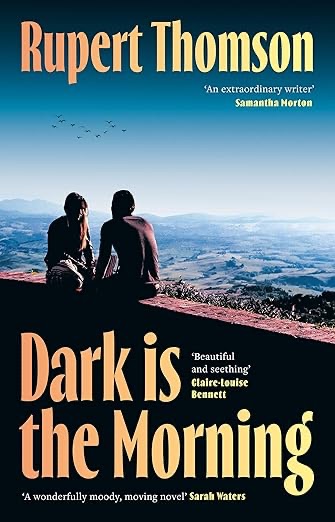
His latest novel, ‘Dark is the Morning’, was published on May 7th 2026. Praised in advance by the likes of Chloe Aridjis, Claire-Louise Bennet, Sarah Waters, Julie Myerson, and Philip Pullman, LoveReading subsequently made it one of their Star Books of the Year, saying “Thomson’s writing casts an almost other-worldly spell…Teeming with tension, ‘Dark is the Morning’ represents literary fiction at its most page-turningly thrilling and poignant.” According to the Financial Times, which admired Thomson’s “stunned, post-traumatic prose”, it’s “the ideal holiday read: frictionless at the level of the sentence; stealthy, romantic, and utterly unpredictable in every other way.”
Rupert Thomson is a Fellow of the Royal Society of Literature, and has contributed to the Financial Times, Granta, the Guardian, the Independent, and the London Review of Books. He has lived in many cities around the world, including Athens, Berlin, Amsterdam, New York, Sydney, Rome, and most recently Barcelona. He currently lives in London.

 The Lotus Readers
I enjoyed this book, albeit with a growing sense of dread things weren’t going to end well. But I enjoyed even more your fascinating insights into Gino’s psychological state.
LikeLike
Thank you. He’s a fascinating character and so much to unpack there.
LikeLike