Posted in Monthly Wrap Up

Books of the Month! September 2022.

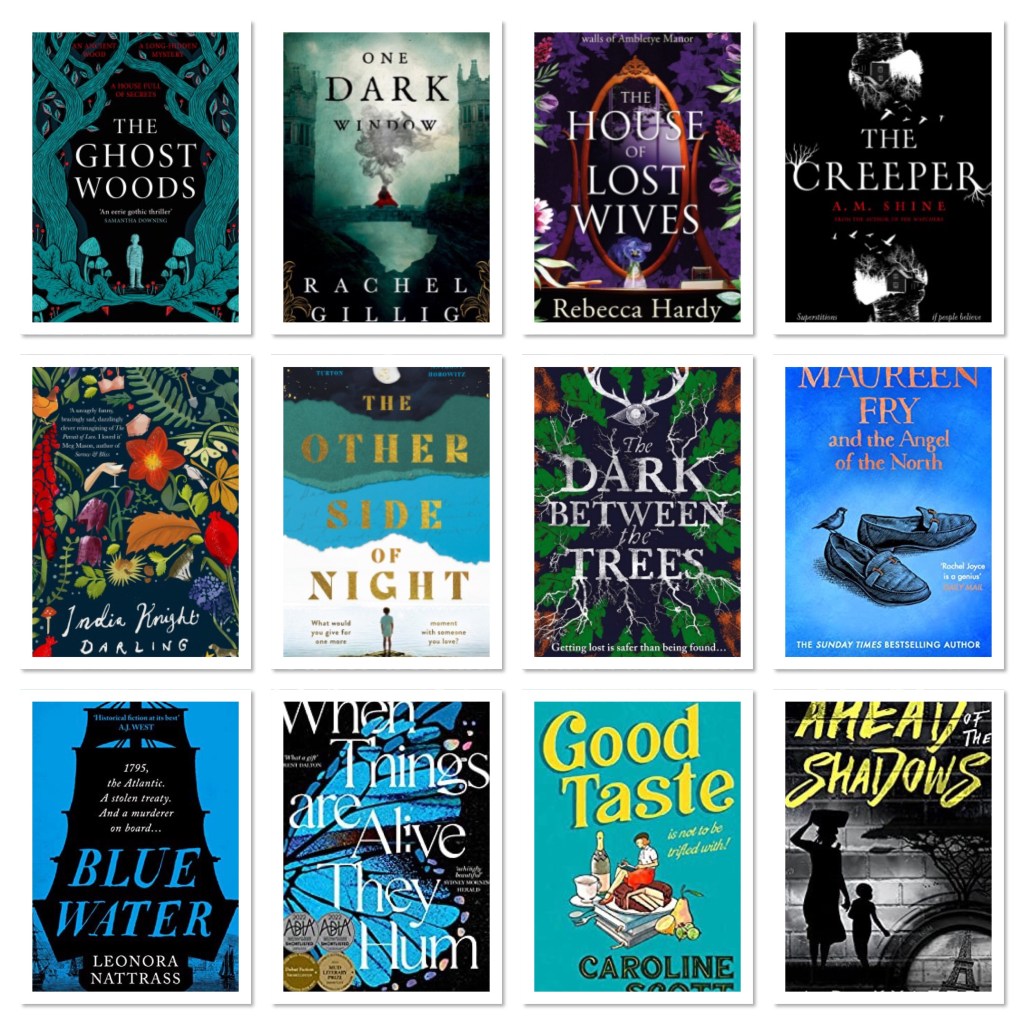
What an excellent reading month it’s been and a good mix of independent publishers as well as the majors. As part of the Squad Pod Collective, this month we’ve been reading Sandstone Press novels as part of our Sandtember feature. Next month will be Orentober – a celebration of Orenda Books, two of which feature here. I’ve been a lot busier and had so much more clarity this month, possibly something to do with us moving into the cooler months of autumn which are my favourite of the year, possibly due to it being Halloween, my birthday, Bonfire Night and the run up to Christmas. Plus Strictly is back on the telly. Here we have mainly thrillers and crime fiction, but very different from each other. I think some of this month’s books may easily reach my Books of the Year list in December. Hope you all have a great October!
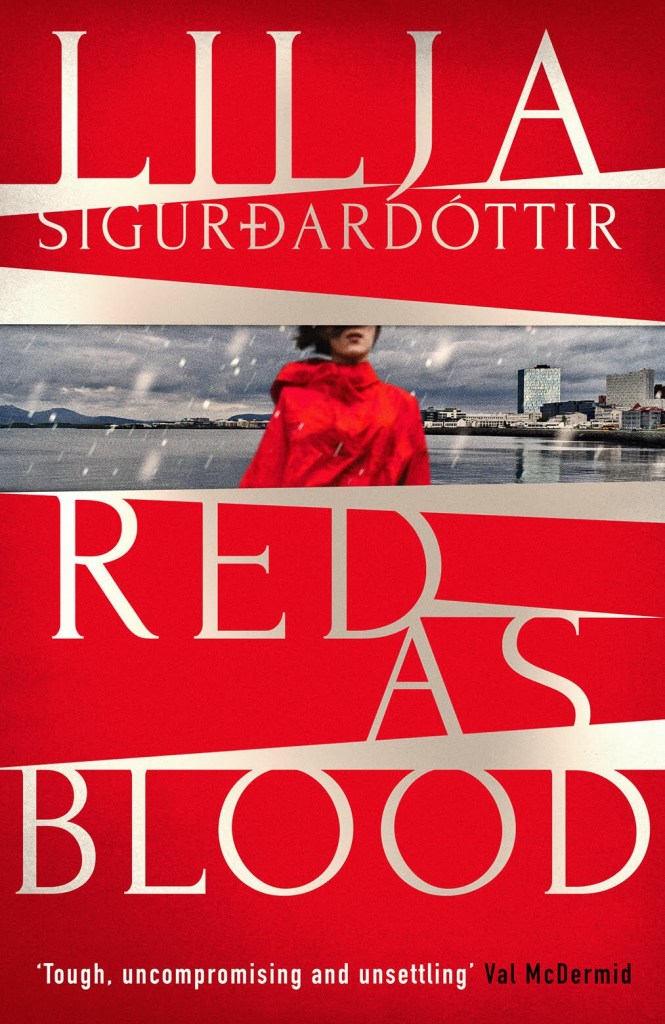
This is an October review, but I read it as soon as it was delivered to my Kindle. I loved her first in the series so I was eager to see what Āróra was up to now. I won’t tell you too much, just a quick outline of what to expect from this excellent thriller. When entrepreneur Flosi arrives home for dinner one night, he discovers that his house has been ransacked, and his wife Gudrun missing. A letter on the kitchen table confirms that she has been kidnapped. If Flosi doesn’t agree to pay an enormous ransom, Gudrun will be killed. Forbidden from contacting the police, he gets in touch with Áróra, who specialises in finding hidden assets, and she, alongside her detective friend Daniel, try to get to the bottom of the case without anyone catching on.

Meanwhile, Áróra and Daniel continue the puzzling, devastating search for Áróra’s sister Ísafold, who disappeared without trace. As fog descends, in a cold and rainy Icelandic autumn, the investigation becomes increasingly dangerous, and confusing. Chilling, twisty and unbearably tense, Red as Blood is the second instalment in the riveting, addictive An Áróra Investigation series, and everything is at stake…

Out 13th October from Orenda Books

I thoroughly enjoyed this twisty thriller from an author I read automatically these days, knowing I’m going to get a quality thriller. Here we’re brought into the arty, bohemian world of the Churcher and Lally families and their adjoining houses on the edge of the heath. Frank Churcher and his friend Lal have been friends since the 1970s when they shared drugs, alcohol, women and ideas. Frank has called everyone together to celebrate the 50th Anniversary edition of his book The Golden Bones. This could be one reunion that tears the family apart…

Nell has come home at her family’s insistence to celebrate an anniversary. Fifty years ago, her father wrote The Golden Bones. Part picture book, part treasure hunt, Sir Frank Churcher created a fairy story about Elinore, a murdered woman whose skeleton was scattered all over England. Clues and puzzles in the pages of The Golden Bones led readers to seven sites where jewels were buried – gold and precious stones, each a different part of a skeleton. One by one, the tiny golden bones were dug up until only Elinore’s pelvis remained hidden.
The book was a sensation. A community of treasure hunters called the Bonehunters formed, in frenzied competition, obsessed to a dangerous degree. People sold their homes to travel to England and search for Elinore. Marriages broke down as the quest consumed people. A man died. The book made Frank a rich man. Stalked by fans who could not tell fantasy from reality, his daughter, Nell, became a recluse. But now the Churchers must be reunited. The book is being reissued along with a new treasure hunt and a documentary crew are charting everything that follows. Nell is appalled, and terrified. During the filming, Frank is set to reveal the whereabouts of the missing golden bone, but as one of his grandchildren climbs the tree for the treasure all hell is going to break loose. This was an addictive thriller, with complicated family dynamics and a brilliant final chapter.
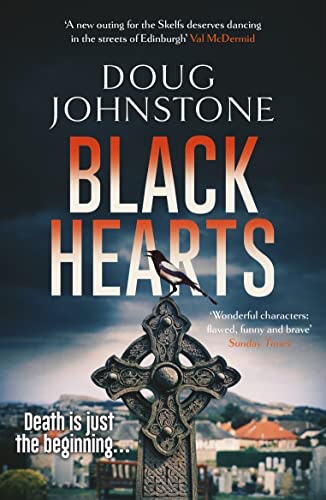
Orenda Books must get so fed up with me banging on about the genius of Doug Johnstone and his wonderful creations; the Skelf women. Set in Edinburgh, Grandmother Dorothy, daughter Jenny and granddaughter Hannah live in the shadow of death every day. Jenny and Dorothy live literally above a morgue, as the family’s funeral business is run from the ground floor. They also run a private investigation business from their kitchen table. But now their own grief interwines with that of their clients, as they are left reeling by shocking past events. As usual there’s a shocking opening, with a fist-fight by an open grave. This leads Dorothy to investigate the possibility of a faked death, while a young woman’s obsession with Hannah threatens her relationship with Indy and puts them both in mortal danger. An elderly man claims he’s being abused by the ghost of his late wife, while ghosts of another kind come back to haunt Jenny from the grave … pushing her to breaking point.

As the Skelfs struggle with increasingly unnerving cases and chilling danger lurks close to home, it becomes clear that grief, in all its forms, can be deadly… you can look for my full review of this in my Sept 2022 archive, but it really is a cracker.
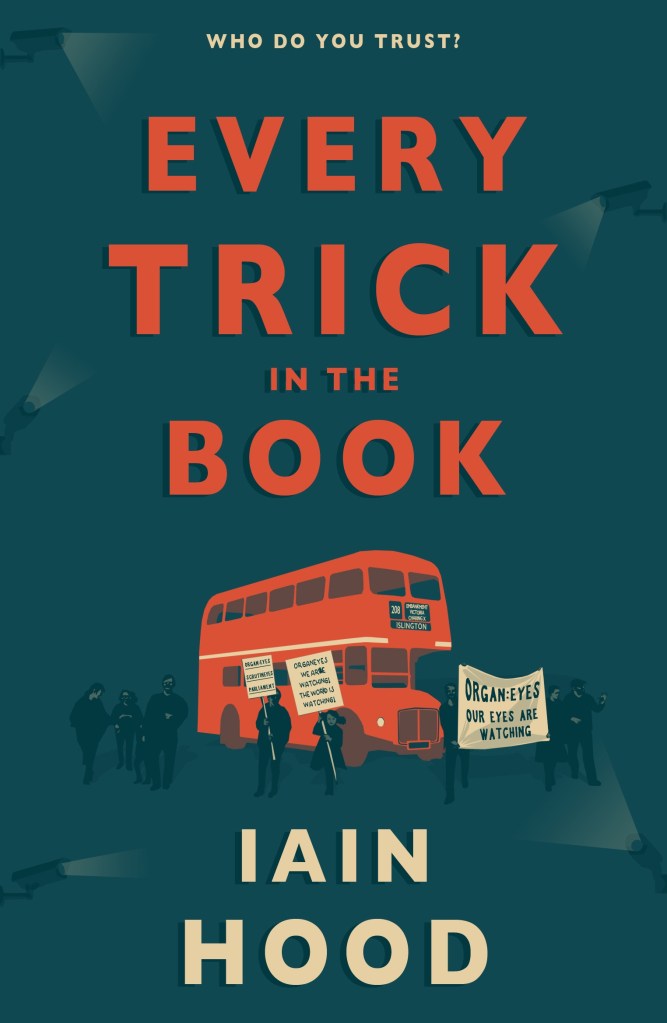
This was one of those blog tours I was asked to do and I went in blind. I knew nothing about the author or the book, but straight away I was intrigued. You are invited to cast your eye over the comfortable north London home of a family of high ideals, radical politics and compassionate feelings. Julia, Paul and their two daughters, Olivia and Sophie, look to a better society, one they can effect through ORGAN:EYES, the campaigning group they fundraise for and march with, supporting various good causes. But is it all too good to be true? When the surface has been scratched and Paul’s identity comes under the scrutiny of the press, a journey into the heart of the family begins. Who are these characters really? Are any of them the ‘real’ them at all? Every Trick in the Book is a genre-deconstructing novel that explodes the police procedural and undercover-cop story with nouveau romanish glee. Hood overturns the stone of our surveillance society to show what really lies beneath. Be prepared to never take anything at face value again.
Now I’d been waiting all year for this one. It’s been up there with Jessie Burtons House of Fortune as the ones I’ve most been looking forward to this year. I wasn’t disappointed. Kate Atkinson has written a crime novel that lays bare a decade in flux, a London that’s drowning in decadence and a generation determined to leave loss and grief behind them.

1926, and in a country still recovering from the Great War, London has become the focus for a delirious new nightlife. In the clubs of Soho, peers of the realm rub shoulders with starlets, foreign dignitaries with gangsters, and girls sell dances for a shilling a time. At the heart of this glittering world is notorious Nellie Coker, ruthless but also ambitious to advance her six children, including the enigmatic eldest, Niven whose character has been forged in the crucible of the Somme. But success breeds enemies, and Nellie’s empire faces threats from without and within. For beneath the dazzle of Soho’s gaiety, there is a dark underbelly, a world in which it is all too easy to become lost.With her unique Dickensian flair, Kate Atkinson brings together a glittering cast of characters in a truly mesmeric novel that captures the uncertainty and mutability of life; of a world in which nothing is quite as it seems. I loved the historical background to this fascinating story and my only complaint was that I wanted to spend more time with some of her characters. See my September archive for the full review, but I was dazzled and drawn deeply into Atkinson’s world.

Tuva Moodyson is another character I’m always banging on about on Twitter. I think she’s an incredible woman and I love the representation of her disability too. Here Tuva is back at work after the shooting of her girlfriend, police officer Noora. Noora survived but now exists in a persistent vegetative state, in bed and cared for round the clock by her mother. In the circumstances, Noora’s parents understood that Tuva needed to go back to work. Dean takes us straight into the action, as Tuva finds an armoured hunting dog wounded by the side of the road. In the course of taking the dog to the vet, Tuva leans of a farm further down the road where a group of survivalists live. It’s not long before she hears that a girl’s gone missing from Rose Farm, and while the police will be investigating, Tuva wants to find her story. There are two businesses on the farm, a café and spa, so Tuva visits to get to know a couple of the residents up there. Andreas, who patrols the compound with his dogs, shows Tuva the security system and training they have in place for their members, including underground bunkers if necessary. Are these people simply ‘preppers’, getting ready for the end of the world, or is something more sinister going on? Who is the mysterious Abraham? What was missing girl Elsa Nyberg to do with the preppers and is she still alive? As usual, Tuva throws herself in and soon her own life is in danger.
This was an interesting and addictive book from Lucy Banks and I loved it. The public think Ava is a monster. Ava doesn’t think she’s to blame. She’s spent twenty five years in prison and now it’s time to start a new life. With a changed identity, her name is now Robin, she has a roof over her head and she hopes for the quiet life she’s always wanted. However, her idea of quiet is an uninhabited island off the coast of Scotland, just her and the seabirds. This reminds her of the places they lived when she was small, when her father was working for a bird protection charity. He would teach her to catch and tag the puffins. There’s no hope for a quiet life, as probation officer Margot pops in unexpectedly pushing her to apply for jobs because ‘the state can’t keep you forever’. There’s Bill next door, who likes a chat and flirt over the garden hedge, not to mention his daughter Amber who really isn’t sure of their new neighbour. Finally there’s her unwanted visitor; the strange person in black who lurks and watches; the person who sent the poison pen letter; the person who throws a brick through the window. We see everything through Robin’s mind and a slow unease starts to creep in here and there. Is she the murderer she’s been painted as or is she misunderstood? I went from feeling sorry for Robin, to being terrified of her. Absolutely brilliant!

So that’s this month. I’m having a week’s break from blog tours to read Robert Galbraith’s The Ink Black Heart, which has been staring at me from the TBR shelf for past fortnight. Here are some of next month’s reads.
Posted in Orenda, Random Things Tours

Black Hearts by Doug Johnstone

As all subscribers and Twitter followers must know by now, I am a huge fan of The Skelf series. I’m a Skelfaholic and I’m in a strange cycle of waiting for the next book to be published, devouring it overnight, then longing for the next one again. It’s even worse this time because I have it on good authority that this could be the penultimate book in the series. So one more book and no more Skelfing! I’m going to be like a weasel with a sore head when I have to go cold turkey. It has been wonderful to be back in Edinburgh with this family of three: part private investigators, part undertakers and all round incredible women. For those who haven’t met them yet, the Skelfs are three generations of women. Grandmother Dorothy is in her seventies, but is still active in both the investigative and the funeral parts of the business. In her spare time she still drums like a badass and has a lover almost twenty years her junior. Daughter Jenny is back home, living above the business and struggling with memories of psychopath ex- husband Craig. She’s drowning her pain with alcohol and sex.

Jenny’s daughter Hannah is now a PhD student, working in the astrophysics department, but still finding time to help out in the family business. She’s now married to girlfriend Indy, is feeling settled and might be slowly moving past what happened to her father. Each novel begins with a memorable opening scene and here we kick off with a fist fight at a funeral. The women are also brought diverse and unusual cases, both for funerals and their PI work. A gentleman approaches Dorothy after his wife’s funeral, to ask if they can help him deal with a nighttime visitor. He believes his wife’s spirit is punishing him and he has the bruises to prove it. Hannah is approached by Laura at university, the young woman claims to know her, but Hannah has absolutely no recollection of her. When Laura starts to turn up wherever Hannah goes, she starts to suspect mental health problems, but nothing dangerous. She stops being harmless the closer she gets to the family, especially when Hannah drops into the funeral parlour and finds Laura talking to Indy. Laura wants them to do her mother’s funeral, but Hannah thinks it’s unwise. How can she let this fragile girl down gently?

Aside from their cases Johnstone also picks up those storylines that weave throughout the novels. In the main we are drawn back to Craig, Jenny’s ex-husband and Hannah’s father, who is still haunting the family. Jenny is the most visibly affected by her interactions with Craig’s family, most notably his sister, who seems to have inherited his ability to manipulate and turn to violence to get what she wants. Will Craig ever leave them alone and will Jenny be able to tread the line between her own pain as his ex and Hannah’s pain as his daughter. Both tend to overlook the grief that Dorothy still feels at the loss of her own husband Jim, complicated now by her relationship with police detective Thomas. Indy’s grief is also overlooked a lot, especially since she’s just gone through disinterring her parents in order to give them the cremation in line with their faith. Hannah and Jenny bring the drama and it’s Jenny I was particularly worried about. She’s getting messy, day drinking and embarking on a highly controversial sexual relationship with the wrong person. She never wakes up feeling better, but in the moment she has to drown out the constant pictures in her head. It’s clearly PTSD and she’s in danger of drawing others into her drama, especially Archie who works for the funeral business. Can she rein her behaviour, when professional help seems doomed to failure at this point?

Aside from these incredible women, and the lovely Indy of course, the things I most love about these books is Doug Johnstone’s love for Edinburgh and the way he weaves incredible ideas, philosophy and physics into his novels. I’ve not been to Edinburgh since I was in my twenties, but the way he describes the city makes me want to go back. He doesn’t sugar coat the city either, there’s good and bad here, but as a whole these books are a poem to a place that’s in his soul. Dorothy muses on her home town a lot in this novel and considering she was born in America, this place is her heart’s homeland. She ponders on the people this city produces, including her husband and child, the history, and the architecture almost as if she’s taking stock. She concludes that she’s a person who always looks forward to where life’s going, but grief and loss are like the waves and there’s no telling when it will wash ashore again. Jenny tends to frequent the less salubrious areas of the city. She’s stuck. Her past has quite literally washed ashore and the problem with losing someone is you’re not the only one grieving and everyone grieves differently. She’s not mourning Craig as he truly was. She’s grieving the loss of all that hope; the hope they both had for the future on their wedding day and when Hannah was born. Similarly Craig’s mum and sister aren’t missing the Craig who committed all those terrible crimes. Violet misses the little boy she had and the life she wanted for him and his sister just misses her baby brother.

I loved the elements of Japanese spirituality and having read Messina’s novel The Phonebox at the Edge of the World, I loved the concept of the wind phone. I’ve always thought that a good way of letting go of the past, especially when you’re struggling emotionally, is to make a physical gesture or step in the direction you want to go. That might mean taking off a wedding ring when you’re getting divorced, or moving house to somewhere that isn’t filled with old memories. I found talking to my late husband in my head a bit strange and it only made me miss him more. So I wrote to him in my journal instead. To have a phonebox dedicated to speaking with those who have died seems a very effective way of keeping them in the present with you, but in a controlled and deliberate way. I was reminded of the Samuel Beckett quote:

“Memories are killing. So you must not think of certain things, of those that are dear to you, or rather you must think of them, for if you don’t there is the danger of finding them, in your mind, little by little.”

Hannah seems to be the person who’s most accepting of her losses. She always seems older than she is and with Indy alongside her she has all the support she needs. There’s so much wisdom in these two young women, honed from a combination of Indy’s spirituality, years of working with grieving families and Hannah’s physics knowledge, especially where it tries to explain the universe. The supermassive black holes that are thought to be at heart of every galaxy are mysterious. We know that they have a huge power that acts like a magnet, drawing in items from across the universe into the void. Each of the Skelf women have their own grief to bear, a black hole at the centre of their heart. Each must find their own way to remember a little, to prevent becoming overwhelmed by their memories. To prevent that black hole from drawing in every part of them. Only by reconciling this, can they live in the present moment and make plans for their altered future, a future I can’t wait to read about.

Meet the Author

Doug Johnstone is the author of twelve novels, most recently The Great Silence, described as ‘A novel [that] underlines just how accomplished Johnstone has become’ by the Daily Mail. He has been shortlisted for the McIlvanney Prize for Scottish Crime Book of the Year three times, and the Capital Crime Best Independent Voice one; The Big Chill was longlisted for Theakston’s Old Peculier Crime Novel of the Year. He’s taught creative writing and been writer in residence at various institutions, and has been an arts journalist for twenty years. Doug is a songwriter and musician with five albums and three EPs released, and he plays drums for the Fun Lovin’ Crime Writers, a band of crime writers. He’s also player-manager of the Scotland Writers Football Club. He lives in Edinburgh.

Posted in Random Things Tours

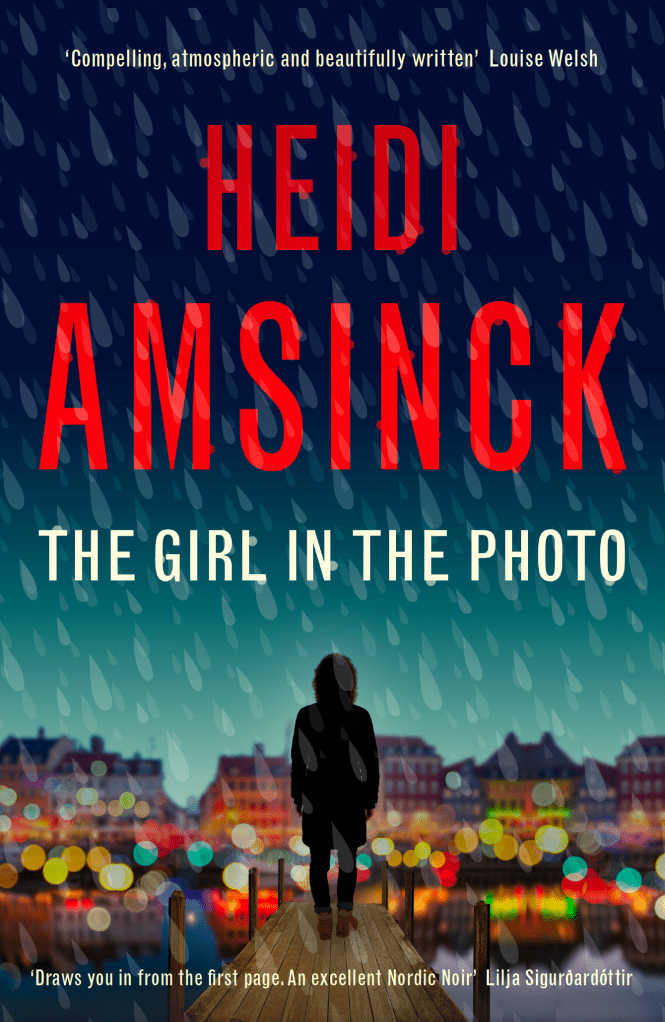
The Girl in the Photo by Heidi Amsinck

As many of you know, I’m a big fan of Scandi and Nordic Noir whether it’s on television or in book form. I was also drawn in by the beautiful covers of these books, in fact I’d like a pair to frame and put on the wall. Sometimes books don’t live up to their covers, but I throughly enjoyed the first book following the investigative reporter known only as Jensen. My Name is Jensen set up the main characters beautifully so it was good to be back in the company of both Jensen and her ex-lover, DI Henrik Jungerson. In this second novel both our main characters are in a state of transition. Jensen is no longer working for newspaper Dagbladet and is working freelance, in a style that becomes a mix of private investigator and reporter. She has the help of a young man called Gustav, the nephew of her editor at the newspaper. Jensen knows he has been in trouble at his school, but not the extent of his problems. As they try and get used to each other’s style of working, Jensen is also adjusting to a new apartment with a difficult landlord. The first crime seems to be a burglary gone wrong, with an elderly woman brutally murdered and an incredibly expensive diamond necklace missing. Henrik is the officer on the case, but Jensen is hired by the woman’s rather unpleasant daughter to find the necklace. More murders follow, but what Henrik notices at each crime scene is a photo of the same young girl. They’re not obvious, just placed somewhere in the room, but Henrik doesn’t like coincidences and wants to connect the investigations. His superiors are unconvinced, especially as Henrik’s issues at home and with drink are starting to get out of control. Working the same case means he will cross paths with the one woman in Copenhagen he wants to avoid, Jensen.

This was an interesting case, told by Jensen and Henrik in turn, from their own perspective and with their individual ideas on what the victims have in common. They are remarkably alike in the way they think and are drawn together both by the threads of the case and what feels like a gravitational force. Nobody thinks like Jensen, except for Henrik. She knows he is only a step behind her. Nobody on the force thinks like Henrik and he almost craves her presence, not necessarily in an emotional way, more than that he wants someone to keep up with him and to bounce ideas off. Jensen has the freedom of being freelance, to work when she wants and makes choices on how she investigates that a police officer couldn’t. Breaking into a client’s summer cabin is risky, but it gets her further forward in the case. Henrik couldn’t do this, because he’s hemmed in by police rules and regulations. Yet there are perks to being an officer, such as the ability to look at official records, that Jensen wishes she had. He can also command respect and get families to cooperate in a way she can’t and this can really hamper her investigation. Despite these differences, no one else has worked out the significance of the photograph, in fact he’s pretty much been told that this is a simple case and he should stop complicating matters. Yet he can’t leave it alone. He knows it’s the key. Really they’re a perfect team, pushing each other on and keeping up with each other intellectually.

I enjoyed Jensen’s working relationship with Gustav. She soon realises he’s a bit of a maverick and that he’s been expelled from school for something much more significant than Margarethe is letting on. The mystery itself is an interesting one, not as clear cut as it first appears and with some deeply unpleasant characters too. The pacing is excellent too. Each character coming at the mystery from their own starting point and working towards each other. The author adds to the information we have in every chapter, just enough to keep the reader engaged, but tantalised and eager to read the next section. As for their personal relationship I found it hard to empathise with Henrik’s perspective. He seems to see her as a temptation that he’s unable to shake off; once in her orbit, he’s inexorably pulled towards her. If he piles all the guilt onto Jensen and avoids seeing her, he avoids facing the fact that he made a choice to cheat on his wife. Then, when he realises that Jensen’s landlord is interested in her, he becomes the jealous spurned lover. As if he didn’t choose to stay with his wife. The author manages to convey these complicated psychological aspects of her characters, so even though we might not agree with their perspective, we can understand their emotions. I was left feeling that we’ve only just scratched the surface when it comes to these two characters and I’m interested to see where we go next.

Meet The Author

Heidi Amsinck is a writer and journalist who was born in Copenhagen and now lives in London. She was London Correspondent for the
Danish daily Jyllands-Posten. She has written many stories
of BBC Radio 4, all read by Tim McInnerny. She was previously shortlisted for the VS Pritchett Memorial Prize. My Name is Jensen, her first thriller, was published to critical acclaim in 2021 and has also been translated into Danish and German.

Posted in Orenda, Random Things Tours

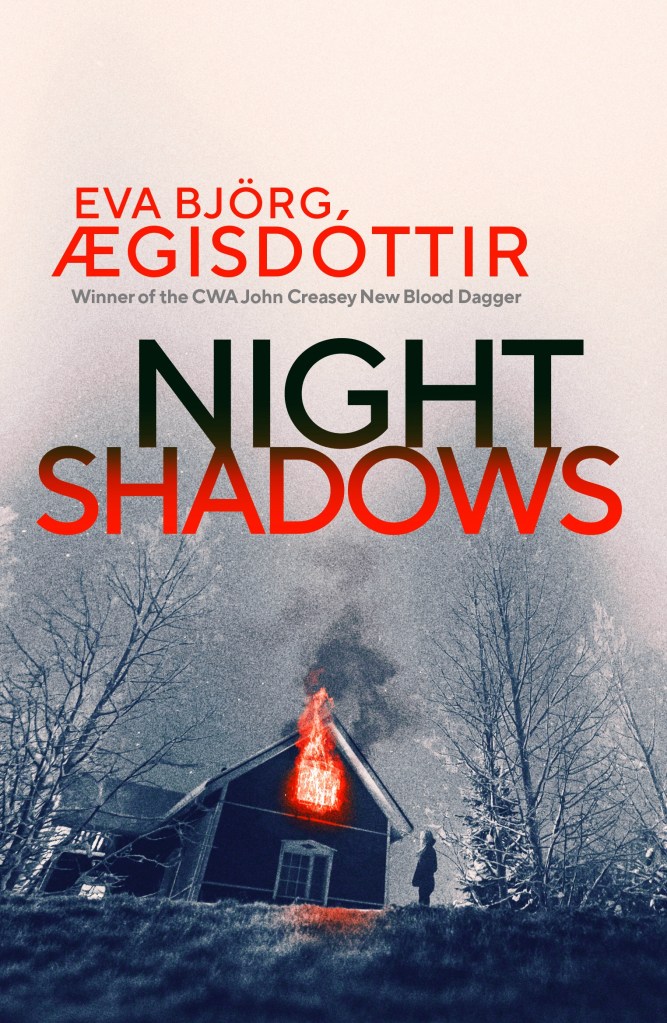
Night Shadows by Eva Björg, Aegisdóttir

The small community of Akranes is devastated when a young man dies in a mysterious house fire, and when Detective Elma and her colleagues from West Iceland CID discover the fire was arson, they become embroiled in an increasingly perplexing case involving multiple suspects. What’s more, the dead man’s final online search raises fears that they could be investigating not one murder, but two. A few months before the fire, a young Dutch woman takes a job as an au pair in Iceland, desperate to make a new life for herself after the death of her father. But the seemingly perfect family who employs her turns out to have problems of its own and she soon discovers she is running out of people to turn to. As the police begin to home in on the truth, Elma, already struggling to come to terms with a life-changing event, finds herself in mortal danger as it becomes clear that someone has secrets they’ll do anything to hide…

I devoured this crime novel in a day while ill in bed. I could barely look up from the book to talk to anyone, because I was so deeply embedded in the cold, bleak Icelandic landscape and the twists and turns of this fascinating story. Having read the previous novels in the Forbidden Iceland series, I was immediately at home with detective Elma and her partner Saever. The investigation starts with a fire in a neighbourhood of Akranes, a small town near Reykjavik. The neighbours hear the smoke alarm and come running to the house to check no one is home. The family are said to be away, but as the fire is put out a body is found in one of the bedrooms and turns out to be the teenage son, Marinó. Elma can’t understand why he is still on the bed, as if asleep. If the neighbours were woken by the fire why wasn’t this boy and why is his the room where the fire started? Soon they get their answers – he is full of sleeping tablets. It seems a party was held at the house that weekend, with a few of the neighbourhood’s teenagers attended. Elma needs to know what went on that night, who was there and where was Marinó when they left. The case becomes complicated when it becomes clear a young woman is missing. Lise was working as an au pair for one of the families living near the fire and was seen at the party. Lise was looking after the daughters of couple Laufey and Unnar, but had decided to leave and had packed everything before the party. She was ready to return to Holland the following morning. Laufey remembers seeing her bags packed that evening and when they were gone the next morning she assumed she’d left for an early flight. But Lise never reached Holland.

I enjoyed reading Elma’s voice in the first novel of this series so it was nice to pick up where we left off. Motherhood is a thread throughout the novel and it was almost as if Elma was learning exactly what being a mum entailed. She is close with her own family, despite sister Dagny getting on her nerves she realises the importance of having them around her and being there for her nieces. Within the teenagers who were present at the weekend party there is a young mother, who is trying everything to keep her relationship with the father going and overlooking a lot too. Laufney is the mum we follow most and she is almost coping as a single mum, with husband Unnar usually out and doing one thing that really infuriates me – referring to ‘babysitting’ his own children. Their own first child is a teenager, living in his own pad in the garage but still enjoying the comforts of home. Laufney is so proud of her son Andri who is soon moving to Sweden to play football at a professional level. Their two daughters are much younger. Klara is ten years old, quiet and slightly reserved, but very talented at drawing. In fact Elma finds her drawing so striking that she notices it pinned on the fridge. With the family in the main house, a girl is drawn up against the window, looking inside. Saever ccomments its like something from a horror film and he’s eerily prescient. It’s Anna the youngest daughter of the family who is sitting on the loo in the middle of the night and notices movement outside. A girl with long hair and a bulky coat is staring into the house. Anna knows it is Lise and shes not scared of Lise who was kind to her, but Lise is dead and dead people don’t come back. She goes to Klara for comfort and she reassures her, she knows she’s seen Lise because a few weeks ago she’d been been in the garden. In one of the scariest scenes Ive read in a while, the girl notices Klara and strides directly over to the window, peering in with both hands resting on the glass. I was sorry that I just happened to be reading that scene at three a.m.

The crime itself and Elma’s personal life is about loyalty and how far we’d go to keep those we love safe and for mothers that’s such a strong instinct. Elma finds these deep instincts at the forefront of her mind throughout, both personally and professionally. One of the biggest question marks I had is over Laufey and Unnar’s marriage. He is very easy to dislike thanks to his habits of sleeping with other women, even those that should be totally off limits. Yet I found myself more horrified by some of the things he did and said around his wife and children. Klara seemed to be on a diet and I was sure this was a result of Unnar’s comments to Anna about Laufey’s weight and how she didn’t want to become fat like Mum. He also makes it clear that he finds her too serious and no fun anymore. These little chips at someone’s confidence are abusive and I didn’t like that the same attitudes were being taught to the girls. I was becoming more and more uncomfortable about him and felt he could be the murderer, then kept looking at the younger generation and kids like Isak who is disrespectful to his girlfriend. It showed how these attitudes are still cross-generational. Could the murderer be one of these youngsters? CCTV showing a slight figure in a down coat near Marinó’s home led me down that path.

I loved how the book addressed Elma’s relationships and how she investigates. Even knowing she has a partner who will back her to the hilt, doesn’t stop her running away with a lead every now and then. As soon as she’s had a hunch, she has to act on it, and that doesn’t usually involve telling someone where she’s going or waiting for back up. This can lead her into danger, something that’s terrifying for those who love her and needs to change. Especially now that life is going to be significantly different. I’m already looking forward to the next chapter for this intelligent and perceptive detective.

Meet the Author

Born in Akranes in 1988, Eva moved to Trondheim, Norway to study her MSc in Globalisation when she was 25. After moving back home having completed her MSc, she knew it was time to start working on her novel. Eva has wanted to write books since she was 15 years old, having won a short story contest in Iceland. Eva worked as a stewardess to make ends meet while she wrote her first novel, The Creak on the Stairs. The book went on to win the CWA Debut Dagger, the Blackbird Award, was shortlisted (twice) for the Capital Crime Readers’ Awards, and became a number one bestseller in Iceland. The critically acclaimed Girls Who Lie (book two in the Forbidden Iceland series) soon followed, with Night Shadows (book three) following suit in July 2022. Eva lives with her husband and three children in Reykjavík.

Posted in Random Things Tours

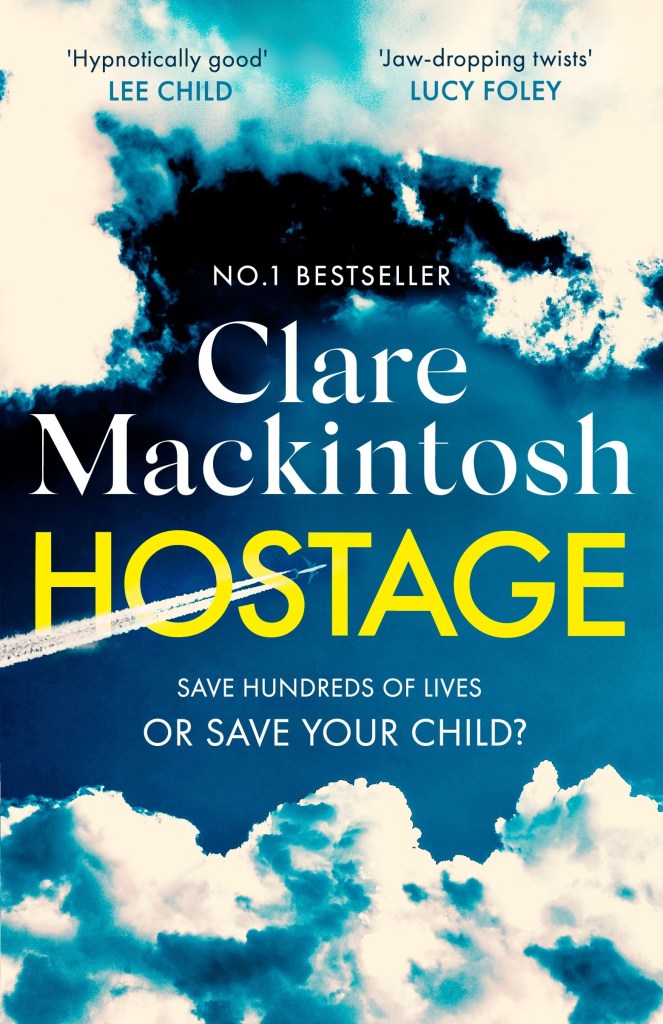
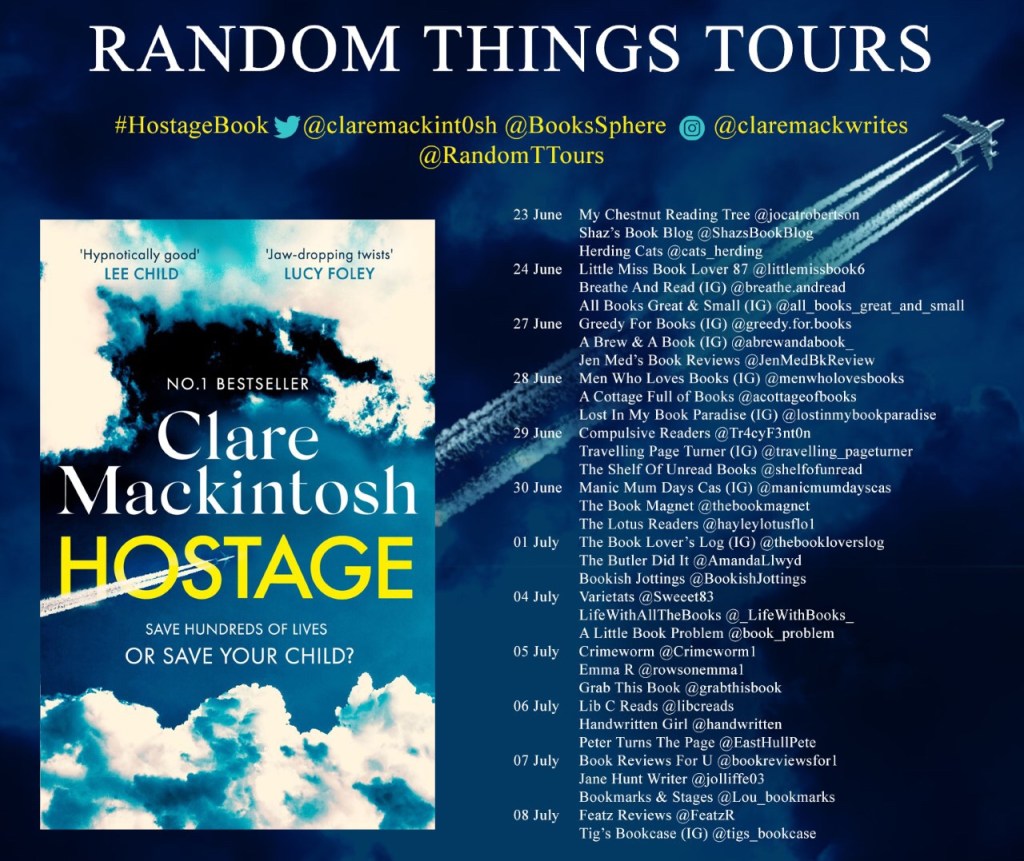
Hostage by Clare Mackintosh

This was an absolutely nail-biting thriller of a novel that never lets up and practically had me biting my own nails. In fact I’d been reading this, then binge watching Ozark with my other half and had to ask for a half hour of comedy before bed, because I couldn’t cope with any more tension! I probably should also be honest and say that planes make me horribly claustrophobic. I’m never scared of crashing. I just hate that I can’t get up and walk out of the door. So my own phobia probably added to the tension of the novel. Mina is a flight attendant and has the honour of working on the first ever direct flight from London to Sydney. Back home, husband Adam is holding the fort while he comes to terms with recent mistakes in his marriage. He is also finding it hard to develop a relationship with his adoptive daughter Sophie. After waiting a long time to adopt a child, they’ve had problems settling Sophie and also connecting with her in the way they expected. However, she does love her most recent babysitter, so Adam is quite relieved when Mina has booked this miracle worker to cover her hours on this historic flight. So, it’s a massive shock when her baby sitter takes them both hostage, citing her membership to a climate change group and explaining that Mina’s plane will now be in the hands of her fellow protestors. Simultaneously, Mina is left with a note and a choice; let one of the protestors onto the flight deck or her daughter’s life is in danger. Mina has already found Sophie’s ‘Epipen’ in the galley, so she knows they mean business. She has also been left in no doubt that one of their associates has been following Sophie and their young babysitter, leading Mina to believe it’s going to be easy for them to get to her. Their plan, if Mina cooperates, could be to fly the plane and all three hundred passengers into the Sydney Opera House. She is left with a terrible dilemma – one life, that of her precious daughter, or the lives of everyone on board.

The book alternates between Mina’s perspective and what’s happening at home for Adam and Sophie. In between are chapters from the perspective of one of the hijackers, each one named after a river. These are an interesting break from the tension, because they explain that person’s reasons for joining a radical climate change group, one that’s willing to consider acts of terrorism to bring their cause to the forefront of the news agenda. I didn’t feel a connection or empathy with these, or any of the main characters really. They’re flawed and therefore very human and believable. Mina’s husband Adam has been deceitful and their marriage is still in a state of repair over his behaviour. This isn’t about character though, this is all about the situation. The pressurised and locked cabin adds to the claustrophobic atmosphere the author has created and the passenger’s isolation from both their loved ones and the safety of their homes. This is all about the rollercoaster thrills of the hostage situation and perhaps the fear many of us have about the heightened terrorism threat and flying in general.

Although I guessed some of what happens, the story definitely entertains and keeps you on edge. In fact I could see a film version doing exactly the same thing. Some aspects were unexpected though, especially the situation Adam and Sophie find themselves in back in London. Due to unforeseen complications, they are in more danger than was planned and certainly more than Mina has expected. I really enjoyed this subplot, because it went somewhere I didn’t expect and I was definitely on tenterhooks wondering whether they would come out alive. It was also clever to have little snippets of information about the passengers and what had made them book this inaugural flight non-stop around the world. Whether they were here by intention or simple chance, none of them expected to become a fireball in the sky. This did induce some emotion in me, because it made the passengers more than a seat number. Sophie became the most interesting character for me as the book progressed. Her behaviour, when seen in detail, could point to her being neuro divergent and I thought this was portrayed well. She is extremely intelligent and I loved how that becomes more obvious as their predicament worsens. Oh and read all the way to the end. The twists don’t stop coming with the tense and very modern take on this common nightmare scenario.

Meet The Author

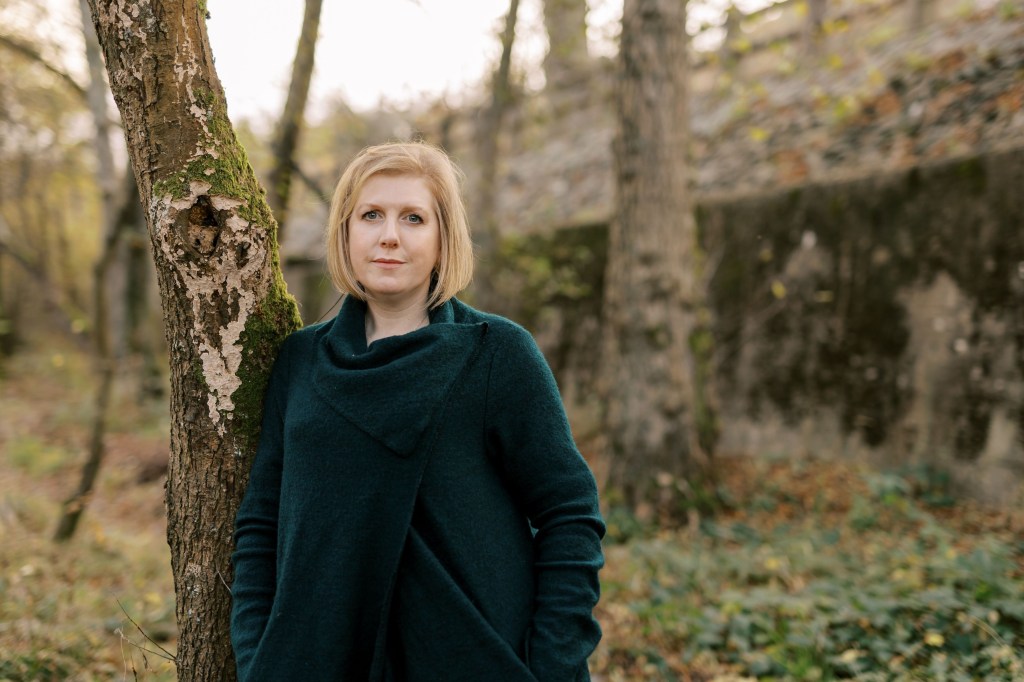
With over 2 million copies of her books sold worldwide, number one bestseller Clare Mackintosh is the multi-award-winning author of I Let You Go, which was a Sunday Times and New York Times bestseller and the fastest-selling title by a new crime writer in 2015. It also won the Theakston Old Peculier Crime Novel of the Year in 2016. Both Clare’s second and third novels, I See You and Let Me Lie, were number one Sunday Times bestsellers. All three of her thrillers were selected for the Richard & Judy Book Club, and together have been translated into forty languages. After the End was published in 2019 and became an instant Sunday Times bestseller, and in 2021 Hostage flew straight into the top ten. Together, her books have spent more than sixty weeks in The Sunday Times bestseller lists. 

Clare is patron of the Silver Star Society, a charity based at the John Radcliffe hospital in Oxford, which supports parents experiencing high-risk or difficult pregnancies. She lives in North Wales with her husband and their three children.

For more information visit Clare’s website http://www.claremackintosh.com or find her at http://www.facebook.com/ClareMackWrites or on Twitter @ClareMackint0sh #ILetYouGo #ISeeYou #LetMeLie #AftertheEnd #HostageBook

Posted in Throwback Thursday

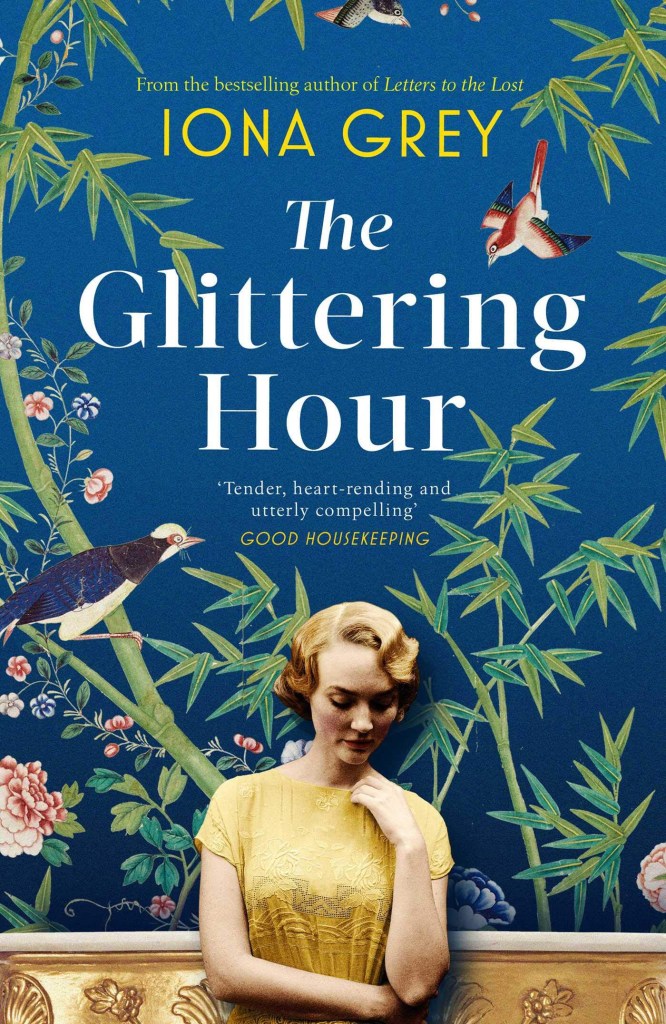
Throwback Thursday! The Glittering Hour by Iona Grey.

This week’s reading took me back into the world of the Bright Young Things, the young generations of aristocrats in 1920s Britain intent on living it up and shaking off the aftermath of WWI. The Mitford sisters were part of this scene and it was while reading about Nancy Mitford’s exploits in 1920’s London that my mind was drawn back to this beautiful book depicting that new generation. A book I read originally for the blog tour back in 2019. Iona Grey shows young people coping with a legacy of loss and parents that are still stuck in the hierarchical society of the Edwardian period. Our heroine, Selina Lennox, is one of those ‘Bright Young Things’ who were followed by the press from party to party, determined to the live the full life that their parents, and especially older siblings, have missed out on. Her family are part of an ailing aristocracy that still has its property, but is running short on money. Her elder sister is making an advantageous marriage and since the death of their brother in the war they have the pressure of producing a male heir. Selina is being steered towards the heir of a ruby mining business situated in Burma. Rupert is a war veteran, and it is possibly active service that has made him so stiff and taciturn. Selina finds him too serious and prefers the company of her friends and the social whirl of extravagant parties thrown during the season. One night, while careering through London on a treasure hunt, the car she is travelling in hits a cat. Selina can’t leave the poor creature and is horrified to see her friends disappearing into the night, leaving her in a garden square somewhere in Bloomsbury.

Young, struggling artist Lawrence Weston chances upon Selina and offers his help. They climb into the locked garden square and give the cat a proper burial. Selina is drawn to this dark haired young man but also knows she is taking a huge risk disappearing at night with a stranger who isn’t from within her social circle. Lawrence is transfixed by Selina’s golden beauty and feels an instant connection. He knows she is far above him and her family would be horrified. He lives in a shared house and rents a studio where he paints portraits of the aristocracy’s lost sons of war in all their military splendour. This pays the bills, but he would really love to be a photographer and as yet no one sees this as art. Realistically, he has no chance with Selina but can’t seem to stay away despite receiving warnings from most of his friends.

Interspersed with this is the story of Selina’s daughter Alice in the years before WW2. Alice lives on the family estate and is looked after by Polly who was Selina’s maid. Alice’s grandparents are still in residence, still living the values of a bygone age. Miranda has now given birth to Archie, the all important heir for the estate. Selina is in Burma with her husband and we see their journey in a series of letters she writes to Alice. They clearly have a very loving relationship, so it seems strange that Alice is hidden away in the cold nursery corridor? I kept wondering why, if she loves her daughter as much as she seems to, would Selina leave her with a family who show her no affection? Alice has been sent a treasure hunt from her mother and Polly gives her the clues to follow. Solving the clues takes her to different parts of the estate and her mother explains their significance, they’re part of Alice’s origin story. The clues help Alice come to know and love the gardens, especially the deserted Chinese House with its old gramophone. What exactly is their link to Selina’s past and Alice’s future?

Iona Grey has created a beautiful novel here, filled with moments of joy and sadness. For me, the meaning of the title is so poignant encompassing both the historical period and the love story at the heart of the novel. The 1920’s is a decade that stands alone. A moment of extravagance, partying and glamour, between two world wars – a glittering hour. This glittering generation defied the death that had stalked their fathers and elder brothers in the trenches and were determined to enjoy life while they could. It has a romantic meaning too – for Lawrence, Selina is his glittering hour, they share a moment of pure love and beauty that burns bright but can’t burn forever. Grey shows what happens when we dare to break away from the boundaries and societal rules of our class and how the reverberations from this can last for several generations. The love may not last, but the memories can sustain us for a lifetime.

Thanks to Simon and Schuster UK and Random Things Book Tours for the chance to read this novel and join the blog tour. See below for the next stops.

Posted in Random Things Tours

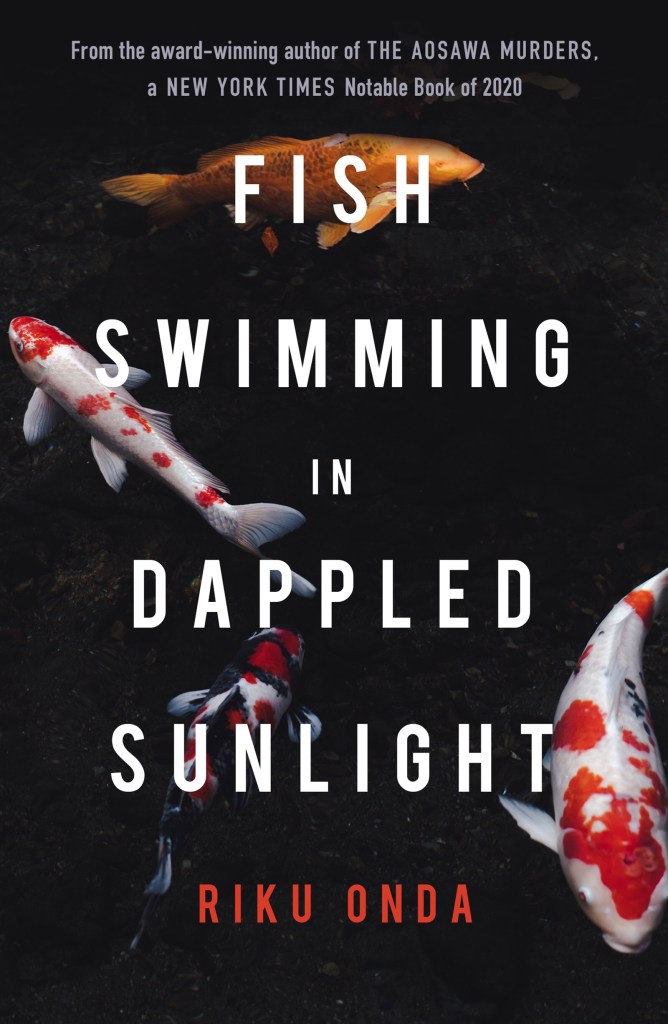
Fish Swimming in Dappled Sunlight by Riku Onda.

This book was an incredibly different reading experience considering it followed an historical fiction novel and a Regency romance. All that lush description and melodrama, followed by this very spare and quiet novel set over one night and mainly in one empty apartment. The contrast was stark and showed that we don’t need very much to convey a story and engage the reader. So short that I read it in one afternoon, this is a story of two people moving out of a flat and agreeing to spend their final night of the tenancy together. Aiko and Hiro are our only characters and their relationship has broken down since taking a trip together, trekking in the mountains of northern Japan. During the trek their mountain guide died inexplicably and both believe the other to be a murderer. This night is their last chance to get a confession out of each other and finally learn the truth. Who is the murderer and what actually happened on the mountain? This is a captured evening where a quiet battle of wills is taking place and the shocking events leading up to this night will finally be revealed.

My first assumption was that Hiro and Aiko are a couple, breaking up after living together, perhaps during their university years. The author conveys an eerie atmosphere, the couple are quite subdued and it’s almost as if they aren’t fully there. Have their minds sprung forward to their next step in life, or backwards to when things were different? There are those annoying marks and shadows on the walls that show where their furniture and pictures once were. The couple feel similar to those marks, like ‘ghostly shadows’ on the rug they’re merely an imprint of what was once present. Even their conversation is sparse, but when we’re taken into their minds we can see that’s where they really live. So much is going on emotionally and intellectually that I could imagine them giving off a sound, like a hum or buzz to signify the intensity of their inner thoughts. We never move out of the room, but we delve into the recent and distant pasts through their inner world. In the room with each other, they start in a quiet and measured way, then with each new piece of information they start to calculate and consider the other. This is where the tension builds, we can feel it inside them and it’s only a matter of time before it spills over into the room. Then comes the first accusation and the pace picks up. It’s not long before the first revelations begin.

I thought that the author used metaphors and memories beautifully and wove them into the psychological game being played. One is the ‘Pearl Earring’ song by Yumi Matsutoya that Hiro remembers an old girlfriend listening to when he was at school. The memory is triggered by Aiko saying she lost an earring while packing. In the song the girl throws her pearl earring under her lover’s bed when she knows it’s the last time she’ll be there. Aiko suggests she doesn’t want this reminder of her lover so throws it away, perhaps after ceremonially throwing the other at a place with special meaning. Hiro gives it more of a metaphorical meaning – one half of a pair is no use without the other. Is this what he thinks about him and Aiko. Aiko hasn’t lost her earring, she has stuffed it in his backpack and claims not to know why. She describes it as a landline, just waiting for him to find it. I think we leave things behind when we want to return or be remembered. The one that resonated most with me was the fish metaphor, where the title of the book comes from:

I see sunlight flickering through the trees. Fragments of the stifled emotions and desire we do not put into words, flit across them, like shadows moving through the wavering light. Deep below the dappled sunlight, fish twist and turn at the bottom of a dark-blue pool […] it is impossible to see them clearly or count them.

Aiko notices their presence, in and out of this room as she thinks of the fish. She sees Hiro has retreated mentally, he’s deep inside his own head just like the fish who disappear into the darker reaches of the pool with a flick of their fins. They are completely present with each other only fleetingly, as dappled sunlight dances across and illuminates them. They come together, then scuttle into the darkened corners, nursing their wounds and planning their next move. The same metaphor occurs at a pivotal point in the novel and gives a sense of the light illuminating different worlds, universes and possibilities.

I’m being so careful not to give away a single revelation or twist, but there are a few and they are unusual and surprising. This is a really unique psychological thriller, it seems sparse, but actually has so much depth and richness. I found myself completely immersed in this couple’s story, both the visible and the invisible. Still playing with memory, the pair delve into their childhoods, trying to work out what makes each other tick and discover how they ended up here. One has more memories of their childhood than the other, but can we trust what we remember? Our impression of something, may be no more than a fleeting glimpse of a much bigger picture. We may have based a lifelong idea of a situation or person on a mere fragment. Even the things we use to jog our memory can be misleading, such as photographs. Hiro muses on how we’re pushed into smiling for photos, to look like we’re enjoying ourselves and love the people we’re with. If we believe our photo albums, the picture we have of the past is distorted. There are so many things going on behind the scenes that are never captured – the moments in the deep blue water.

Published by Bitter Lemon Press 16th June 2022.

Meet The Author

Author: Riku Onda, born in 1964, has been writing fiction since 1991 and has published prolifically since. She has won the Yoshikawa Eiji Prize for New Writers, the Japan Booksellers’ Award, the Yamamoto Shūgorō Prize and the Naoki Prize. Her work has been adapted for film and television.

Translator: Alison Watts is an Australian-born Japanese to English translator and long time resident of Japan. She has wrote the translation of The Aosawa Murders, Aya Goda’s TAO: On the Road and On the Run In Outlaw China and of Sweet Bean Paste by Durian Sukegawa.
Published by BITTER LEMON PRESS•E: books@bitterlemonpress.com Distributed by TURNAROUND PUBLISHER SERVICES•T: 020 8829 3000 PR by Alex Hippisley-Cox• T: 07921 127077 E: alex@ahipcoxpr.co.uk

Posted in Random Things Tours

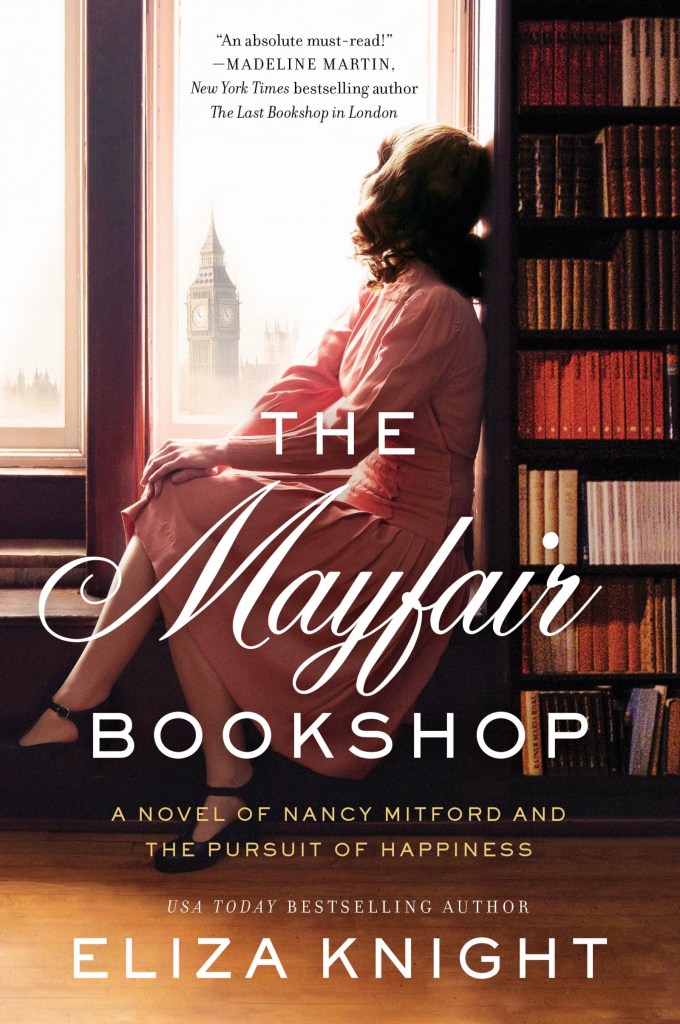
The Mayfair Bookshop by Eliza Knight

1938: She was one of the six sparkling Mitford sisters, known for her stinging quips, stylish dress, and bright green eyes. But Nancy Mitford’s seemingly dazzling life was really one of turmoil: with a perpetually unfaithful and broke husband, two Nazi sympathizer sisters, and her hopes of motherhood dashed forever. With war imminent, Nancy finds respite by taking a job at the Heywood Hill Bookshop in Mayfair, hoping to make ends meet, and discovers a new life.

Present Day: When book curator Lucy St. Clair lands a gig working at Heywood Hill she can’t get on the plane fast enough. Not only can she start the healing process from the loss of her mother, it’s a dream come true to set foot in the legendary store. Doubly exciting: she brings with her a first edition of Nancy’s work, one with a somewhat mysterious inscription from the author. Soon, she discovers her life and Nancy’s are intertwined, and it all comes back to the little London bookshop—a place that changes the lives of two women from different eras in the most surprising ways.

I have always held a fascination for the Mitford sisters, sparked mainly by childhood visits to Chatsworth when Deborah Mitford was the Duchess of Devonshire. Over the years I read more about these fascinating sisters, and I saw Debo (as she was known) as a formidable woman with great ideas for diversifying the estate. I acquired several books about Chatsworth and it’s resident women over the years, then several years ago I purchased a copy of the Mitford sister’s letters and met the then Dowager Duchess at a book signing. She was gracious, but there was a fierce intelligence there and a barely disguised lack of patience for fools. I had never been sure what the phrase ‘gimlet eyed’ actually meant until I observed her that day. More recently, the appearance of the glamorous, but dangerous Diana Mitford in the final series of Peaky Blinders seemed to open a few people’s eyes to the rise of fascism in Britain and turned the spotlight once again on this extraordinary family. While it probably wasn’t a realistic portrayal of her, it was certainly compelling. So I jumped at the chance to delve into the Mitford’s world once more in this book, perfect for a bibliophile as we spend time with both book curators, sellers and writers.

Nancy is a witty companion and rather poignant too, which is a very endearing combination. We meet her as one of the Bright Young Things, careering round London drinking cocktails and following treasure hunts, all the while looking absolutely fabulous. She is in love with a young man called Hamish who she fully expects to marry. However, when the story returns to her, she’s been disappointed in love and is married to someone else altogether, who she nicknames Prod. She and her husband have a rather sad marriage and underneath the sparkle I felt we were seeing something of Nancy’s more vulnerable side. The author skilfully weaves fact and fiction, thoroughly researching Nancy’s writings and letters, then creating a full inner world for her character. Of course we can’t know for sure how Nancy was truly feeling and to me she seemed one of those people who didn’t let them show easily. However, it rang true for her to be disappointed in her marriage, to resent Prod’s quite visible affairs and to be sad at her lack of a baby, especially as her younger sisters became mums before her. The journey she took as a woman was moving, especially the acceptance of things she would never be – a happily married woman and a mother. She also struggles with a bad case of imposter syndrome, common in writers, calling herself a bad novelist when all her work needs is experience, maturity and honesty of feeling.

Her WWII friend, the Iris that our modern heroine Lucy is searching for, helps her a great deal. With this friend she doesn’t have to be entertaining, witty Nancy, always ready to solve a problem and keep a brave face on things. She allows herself to be vulnerable in someone else’s presence and it feels like a huge psychological breakthrough. She can just be herself. On a bookish note, Lucy was fascinating because I had no idea there was such a profession as a book curator – where do I train and when I can start? I found her research really interesting, because I’ve always wanted to go into the library in Chatsworth and finding out they have a secret staircase was rather thrilling. Her research is inspired by the book her family acquired, inscribed to a friend called Iris from Nancy. Left for Iris at the Heywood Hill Bookshop, it was clearly never collected. Though there is no other mention of Iris that Lucy can find, it’s clear she had a huge effect on Nancy from the inscription alone. While working from this very bookshop, the same place Nancy worked during WWII, she hopes to find more references to Iris and her role in Nancy’s life. I wanted to Lucy to have an adventure of her own while in London and perhaps be inspired by some of Nancy’s spirit. As the book moves along we can see the women are on a similar journey, in terms of making the life they want to have, instead of waiting for it to happen.

Through their letters, it’s clear that the Mitford sisters had a rather awkward and contrary relationship. Despite often being completely at odds with each other, they continue to write, use terms of endearment and their family’s own language and share their news. Despite the scandalous relationship between Diana and Mosley, for whom she left a husband and two children, and Unity’s transformation into a Hitler fan girl, the other sisters continue to write to them. It has to be said that many in the aristocracy had fascist views, but Nancy didn’t share her sister’s politics. As WWII really took hold, Nancy’s huge social circle and fluent French meant she was useful to the government, but would this stretch to discussing her own family? I was fascinated to see this dynamic play out and wondered whether the women could repair their connections afterwards, remembering they are sisters first and foremost. The period detail was brilliant and the complete change between the London of the partying 1920’s and the more somber run up to WWII was done so well. I loved the nostalgic feel of the novel and those lovely little bits only bibliophiles like me can appreciate, such as a part library part menagerie with bird cages and tree branches. If you love bookish chat and the idea of working in a bookshop or have a similar fascination with the Mitfords you’ll love this one. Even if you’ve not come across the family before, there’s so much to love here and it won’t take many pages for Nancy’s wit and engaging narrative will draw you in. However, underneath the charm of the novel is a gripping story of a woman growing into herself, learning what makes her content and realising that she can, as a woman, make choices to pursue her own happiness.

Meet The Author

Eliza Knight is an award-winning and USA Today bestselling author. Her love of history began as a young girl when she traipsed the halls of Versailles. She is a member of the Historical Novel Society and Novelists, Inc., and the creator of the popular historical blog, History Undressed. Knight lives in Maryland with her husband, three daughters, two dogs and a turtle

Posted in Random Things Tours

Beloved Ghost by Fiona Graph

I thoroughly enjoyed Fiona Graph’s first novel Things That Bounded because of the wonderfully detailed historical context she wove around her story. Here she does the same for her characters Theo and Zac, who meet during WWII and survive Dunkirk together. After this experience they become lovers. Theo works at Bletchley Park with Alan Turing, then goes to work in the Foreign Office after the war, while Zac works for MI6. They have a good life. However, this is a time where the love they’ve found with each other, isn’t accepted in the way it is now. Homosexuality is a crime and it’s not hard to imagine how stressful it must be to hide your true self as soon as you leave your front door. The pressure of being an outcast takes it toll on their mental health, with Zac becoming so severely depressed he has to go away. Can this beautiful relationship survive?

I love how Fiona Graph creates her characters, then uses them to drive the story forward. There’s a quiet bravery in their choice to be together in a society doesn’t accept them. The fact that they’re establishment figures is interesting too, both working as civil servants for a system of government that actively persecuted them. The fear of being outed, particularly at work, must have been incredible. Add to that the very real fear of being assaulted, arrested and ultimately being jailed for nothing more than loving each other. There’s the loneliness too, where straight couples can be open and make connections with their neighbours or work colleagues, these men can’t. They can’t invite anyone into their lives and be honest about their love for each other. This means avoiding friendships and relying solely on each other, placing further strain on the couple; they have to be everything to each other. This intensity is hard to maintain and I was so invested in their love for each other, that I was genuinely upset when the pressure became too much.

The author presents the mundane everyday things that happen when two people live together, because of course the men live just like any other couple, gay or straight. She does this by showing their routine, the domestic detail of everyday life is touching. This is all Zac and Theo want, the ability to live like anyone else. It makes us realise how brave men of this generation had to be, just to have what a straight couple probably takes for granted. It drives home the sense of injustice they must have felt. It seems galling that they fought side by side like every other man in WWII, but back in the ordinary world they have to live with a terrible fear of betrayal and prosecution. I kept reading as I was longing for their love to triumph over everything. However unrealistic that might be. The author’s setting was beautifully evoked and I felt firmly in the mid – 20th Century. I felt the most important thing Graph succeeds in doing is to show us, through these characters, the experience of so many men who were vilified and criminalised for loving the ‘wrong’ person. Yet we never feel that Theo and Zac are just ciphers created for this purpose. They feel wholly real and I was so involved with their emotional journey that I almost expected to look up from my book and see them there. Also, this could have been relentlessly miserable, but it isn’t. There’s something hopeful and uplifting about their courage and their enduring love for each other. I truly wanted them to triumph over the obstacles that faced them and for their love, despite the challenges it brings, to remain undimmed.

Meet The Author

Fiona Graph lives in London.

Her first novel, ‘Things That Bounded‘, was published in October 2020.

‘Beloved Ghost’ is her second novel

Twitter @fiona_graph

Posted in Random Things Tours

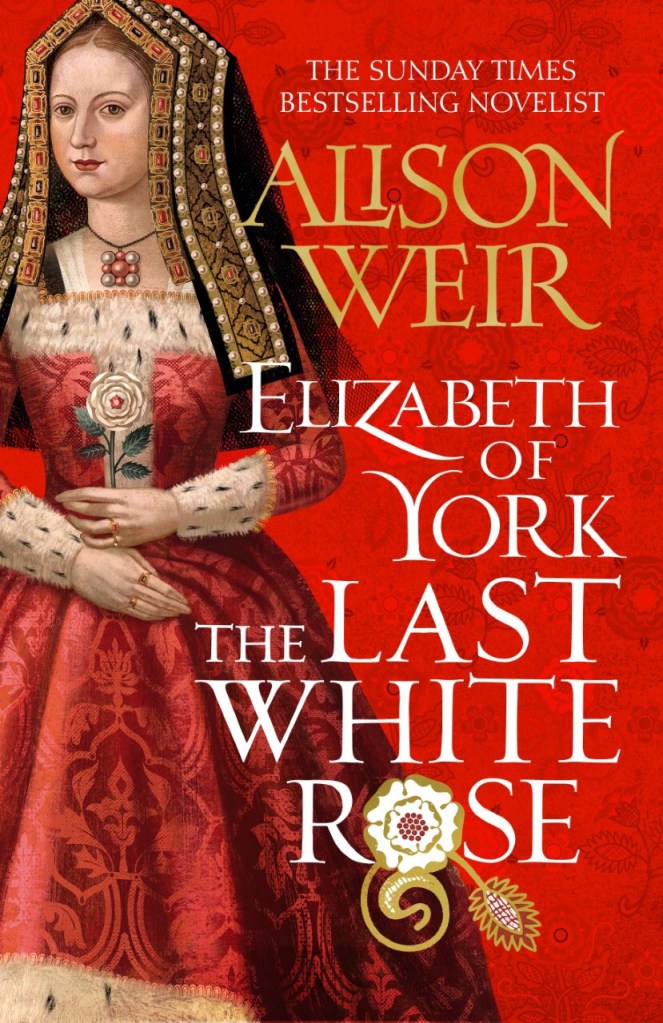
Elizabeth of York: The Last White Rose by Alison Weir

I love novels of courtly intrigue, in fact at my previous home I had shelves placed in the alcoves either side of the fireplace and one whole side was devoted to books on the Tudors and the Wars of the Roses. So the story of Elizabeth of York is familiar to me, but I love Alison Weir’s books and I was interested to see her take on this incredibly important Queen. As Alison Weir states in her afterword, Elizabeth is at the juncture of several important events in England’s royal history. There’s the instability caused by the Wars of the Roses or Cousin’s War, with battles, changes of allegiance and her family’s fortunes rising and falling with every intrigue. There are parts of her life shrouded in mystery and with differing viewpoints from historical researchers and novelists. I have always wondered how her relationship with Richard III changed from niece and uncle, to prospective wife. I have read accounts that suggest an affair between the two, one that took place in front of Richard’s sick wife Anne Neville and was branded scandalous in the court. I wanted to read Alison Weir’s take on this strangely incestuous relationship, whether Elizabeth was complicit and desired the match or whether this was a political match – suggested by Richard who wished to legitimise his rule, above the claim to the crown held by Elizabeth’s brothers and sons of Edward IV. Did Elizabeth, and her mother Katherine Woodville, see this as the only way to secure their family’s safety under Richard’s rule? The other mystery is that of the missing princes in the tower, a subject Alison Weir has looked at closely before. Some accounts suggest a conspiracy drawn up by Henry VII’s mother Margaret Stanley, to advance her son’s claim to the throne and label Richard III forever as guilty of regicide and killing his own nephews. Others lay the blame squarely at Richard’s door, for arranging their murder then forever hiding their remains so they couldn’t even have a proper burial. I was interested in how Elizabeth coped with potential marriages to the very two men who had most to gain from her brother’s killing.

The novel begins at one of life’s terrible downturns for the family, as Edward IV’s wife Katherine is forced to flee to sanctuary with her children, Elizabeth being the eldest. This time shut off from the world and all the comforts they were used to had a huge impression on Elizabeth and could have been enough of a trauma to be an underlying cause of the choices she made in later life. The fear of having nothing, facing poverty and being barred from courtly life is ever present and the privilege of her royal blood, her claim to the crown and her importance to England is drummed into her from a young age. I often think that it was Mary Boleyn who had the right idea, a generation or so later, of leaving court and all it’s intrigues behind and becoming the wife of a farmer. If you are always told you are destined to be a Queen though, does that sort of thought ever enter your head? Court is really the only life that Elizabeth knows. The author really puts across the drama of courtly life, especially during Henry VII’s reign when any whiff of a usurper seems to have him running to her rooms in a panic. The stress seems constant and I did wonder how many of these people died purely from lifestyle.

The feasting was incredible, with weird mixes of courses confusing the eater’s tastebuds and stomach, taking them from brawn, fish in jelly, custard then to peacock. These snippets of courtly life set the scene so well and almost dazzle the reader with such a sense of spectacle. I would find myself distracted from all the stress, and the grief, by the descriptions of week long revels and Christmas celebrations. Just a description of the costumes for a masque or the clothes of the time gave that sumptuous and luxurious feel to the court. I was rather reminded of another Queen Elizabeth and the lavish celebrations planned for the end of this month. Weir captures that element of disguise and distraction that’s still apparent between the royal family’s private and public arenas today. I am largely disinterested in our current royals, but a wedding will dazzle me and I end up watching the whole thing. If told how much it’s cost I get incensed, but then I get sucked in by the whole spectacle. So, in a time when supporting a royal household could mean getting caught up in a costly and dangerous war I could see how the ceremony would have to be even more lavish to gain the public’s attention. Men in the novel don’t have the luxury of choice, so if you were a tenant of the local landowner you were compelled to fight for their cause, no matter whether you agreed or not. Thank goodness that today, royal rivals only parade their discord round the chat shows and not on the battlefield.

Ultimately though, I felt some sympathy for this young woman who was borne of a King who won his crown on the battlefield, then promised in marriage to a man who won his crown in the same way. Like most women of her time, her fate is decided for her, albeit it in a more dramatic way than most. Here she seems to love Henry and the older they get, they mellow and the closer they become. I did wonder whether other novels strayed nearer the truth, that fed up with being constantly touted as the most eligible lady in England, her relationship with Richard was something she was complicit with, a type of rebellion where she was willing to ruin herself just to have some agency in her own life. What I love most about this book was how well written it is, obviously meticulously researched and gave me a slightly different perspective to events I knew well. For example, Margaret Stanley the King’s mother, is described as kind and almost sweet in character for the small ways she tries to look after those around her. I thought that Elizabeth’s relationship with Lord Stanley was interesting and probably gives us the biggest clue to this young woman’s real character and motivations. Stanley is known for changing allegiances when he’s sure which way the battle is turning. At the Battle of Bosworth he rode out with Richard III, only to turn to his stepson’s cause and actually strike down the King, taking his crown and placing it on Henry VII’s head. He and Elizabeth are made of similar stuff, each one watches the way wind blows before committing in order to survive. We can see her as blown about by that prevailing wind or as a politically astute young woman who knows how to secure her children’s future.

Meet The Author

Alison Weir lives and works in Surrey. Her books include Britain’s Royal Families, The Six Wives of Henry VIII, Children of England, Eleanor of Aquitaine, Henry VIII: King and Court, Mary, Queen of Scots and Isabella: She-Wolf of France.