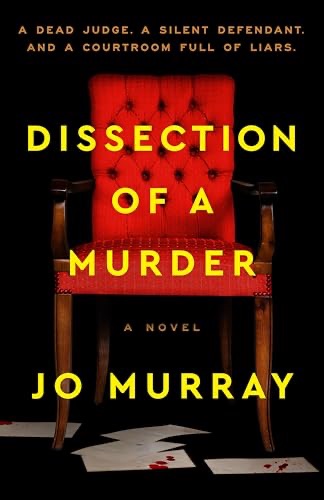
A dead judge. A silent defendant. And a courtroom full of liars.
When Leila Reynolds is handed her first murder case, she’s shocked at how high-profile it is: the murder of a well-respected, well-known judge. This shouldn’t be the kind of case she’s leading; it’s way beyond her expertise. But the defendant, Jack Millman, is clear. He wants her, and only her.
To make things worse, he’s refusing to talk. How is she supposed to prove herself on what appears to be an unwinnable case?
Losing is not an option. She must find the most persuasive argument. Trials aren’t won by convincing judges or fellow barristers – they’re all about convincing a jury.
Suddenly, Leila finds herself fighting not only to keep Jack out of prison, but also to keep her own secrets buried.
It’s true what they say – there are two sides to every story.
Guilty or not guilty?
Wow! This was a ‘devour in one sitting’ thriller in the high stakes setting of a barrister’s chambers and an incendiary case where two of their barristers have been requested; one in prosecution and one in defence. The defendant has requested Leila, an up and coming young barrister who has just heard she’s getting a mention in an exclusive legal publication. The man who’s keen to let Leila know she has him to thank for that mention, is her previous mentor Julian. As a pupil she had to work under Julian to complete her training and he’s now going to be her opponent in court. Even more complicated is the fact that they’re now husband and wife. This is a murder case and the victim was a high court judge, Anton Smythe, who died in a flat above a nightclub after being hit in the head with a doorstop. The accused is Jack, who works as security for the nightclub owner and lives on the premises. Leila is surprised that his solicitor has requested her because she has defended this client before, and lost. When they meet again for instructions, Jack tells her he will be pleading not guilty but offers no defence. She absolutely refuses to put him on the stand and his solicitor agrees. They should argue his case if he will trust them with the truth. Jack sticks to his guns, he will not say a word about his defence until he is on the stand. Could this be paranoia? Although to be a judge like Anton means you have powerful friends, maybe it is sensible to keep his story under wraps for now.
I’m a big fan of legal dramas like Silk and North Square so the setting in a barrister’s chambers definitely appealed to me. I loved Maxine Peake as Martha, she was Northern, intelligent, quick with a put down and nobody’s fool. Leila comes across as more of a gentle character than that, but definitely intelligent, determined and perhaps driven by a background that has its secrets. I intensely disliked Julian, but he is so well-written. There was a definite power imbalance between them, especially since she’d been his pupil. He must have seen her star quality and I had the thought that maybe he’d married Leila to keep her under him, both literally and figuratively. The layers of charm and ease soon fall away as the case starts.
“You want someone whose mind is in alignment with yours, but whose appetite for dominance will never exceed your own”.

When Leila is congratulated on her mention he makes sure to comment that without his influence it wouldn’t have happened. I noticed that his ex-wife seems to want to talk to Leila, something she’s avoiding but might be worthwhile. As lines are drawn in the court room there’s a definite misogyny in how Julian gangs up with the police witnesses against her, but because he can couch it in terms of prosecuting competently even though she’s his wife, it’s hard to narrow down his intentions. Is he just serving the best interests of his client? Or is he trying to rattle his wife and make her feel like she’s dependent on him? As the case continues their once calm married life becomes more fraught and separate. Leila isn’t sure whether it’s just the case and the distance needed to be opponents or whether something more fundamental is wrong. The other thing that struck me as odd is that it’s Leila who goes to spend Friday evenings having fish and chips with her mother-in-law Audrey who is in the early stages of dementia. Julian never goes with her. When she does have one lucid moment Leila asks what she thinks about her son. ‘You can’t trust him she says very quietly. Thats why he doesn’t come to see me. He hates women who can see through him.” Maybe Leila is just starting to see the real man she married. There is also mystery around Leila’s background, definitely a poorer area of the North East than Durham but she seems to have no family. It’s as if she has totally reinvented herself. She calls it a wretched life that’s left it’s mark:
“It’s the smaller, subtler things I’m now fiercely protective of, like feeling safe when I turn the light off before I go to sleep […] recognising my body is my own and I now get a say in who touches it. The things I had to do to get here you’d be horrified to know.”
It feels as if her relationships have been transactional even when she’s had a choice. Could Julian just be another rung on the ladder? It seems he wasn’t her first mentor and she wonders often whether this past will catch up with her. The twist is very good indeed. I had an inkling, but it is a proper ‘sixth sense’ moment where you’ll want to flick back through the book and see the clues you missed. This is a high drama, high stakes, legal battle and only one of them can win. The tension is unbearable as Jack takes the stand, it almost feels like a done deal but no one is expecting his testimony. The fall out is seismic. This is such a clever thriller with a cast of characters you won’t like but will be fascinated with. It’s very well written by an author who knows this profession and its pitfalls for women, particularly working class ones. It feels like social commentary – with the well educated, upholders of the law and all their status, against the ordinary, working class person who’s usually in the dock. Can the law be the great equaliser it seems or are some people more equal than others? This was a great debut with a fast pace and some brilliant ‘oh my God’ moments.
Meet the Author

Jo grew up in Teesside during the 90s when working class girls were told they probably shouldn’t try to become barristers. Thankfully, she ignored everyone. After studying Classics at Newcastle University, she went to law school and did just that. Jo was a criminal barrister before leaving the profession to look after her two children. She lives in North Yorkshire.

