Posted in Publisher Proof

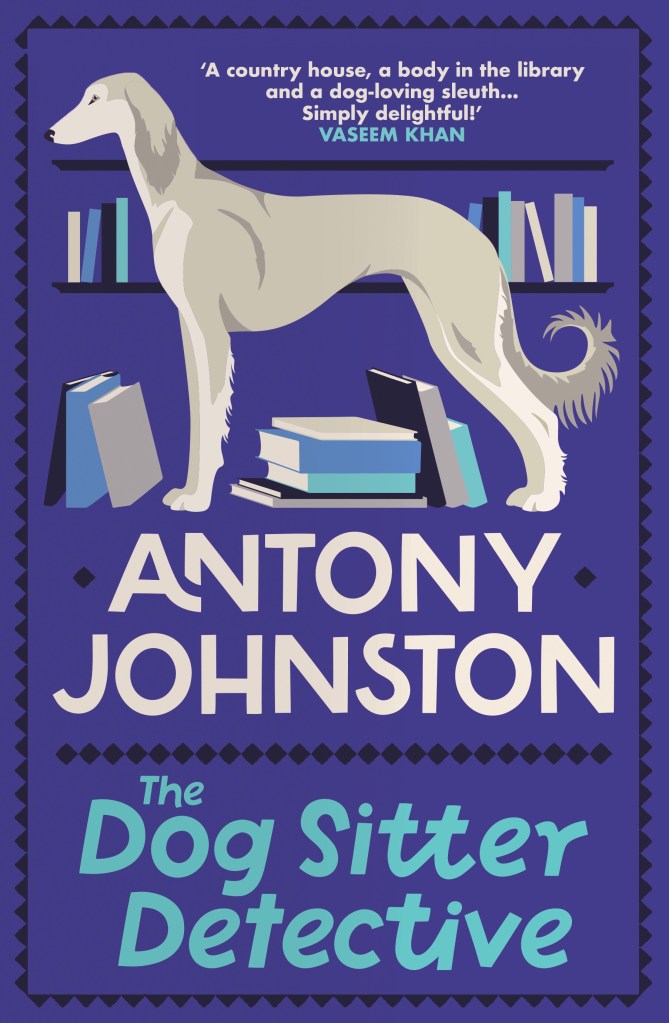
The Dog Sitter Detective by Antony Johnston

Meet Gwinny, an unlikely bloodhound, and her four-legged friends determined to dig up the truth.

Penniless Gwinny Tuffel is delighted to attend her good friend Tina’s upmarket wedding. But when the big day ends with a dead body and not a happily-ever-after, Gwinny is left with a situation as crooked as a dog’s hind leg.

When her friend is accused of murder, Gwinny takes it upon herself to sniff out the true culprit. With a collection of larger-than-life suspects and two pedigree salukis in tow, she is set to have a ruff time of it.

When I was offered a chance to review this novel I jumped at it because it sounded so quirky and charming. I was pulled into the novel quickly because it was a book that was perfect for the time – a cozy crime novel in the middle of some dark Scandi Noir – but also due to the author’s vivid characters. It was like putting on a cozy blanket and escaping into an Agatha Christie novel with added dogs. It had all the expected ingredients of a cozy crime novel; a country house, a wedding and the worst present of all – a body in the library. Especially when that body is one of the wedding party! At first it seems like an open and shut case, because the person stood over the body must be the main suspect. It’s not as simple as it looks though, the author has the odd red herring and revelation up her sleeve sending the police and the reader scurrying off in the wrong direction. Gwinny lives in an affluent part of town and from the outside it’s not exaggerating to say she lives with a certain amount of luxury. However, she is asset rich and money poor, with a bank balance that could do with a cash injection. Quickly! Since her father became ill she has been his sole carer and her acting career has paused indefinitely. She knows she can’t keep herself in the black if nothing changes.

A posh country wedding offers the perfect chance to pause and enjoy herself. So making promises to address the situation on her return, she plans to enjoy watching her best friend Tina walk down the aisle. Once the body is found the wedding grinds to a halt and for some reason Gwinny is volunteered to look after Spera and Fede, two beautiful Saluki dogs. With the dogs in tow she gets to work on the murder mystery, with her intuition and talent for deduction she knows straight away that something is ‘off’. I really enjoyed Gwinny’s character because she is so formidable, rather like that eccentric spinster aunt who has no time for idiots and won’t take any nonsense, from anyone. She can be rash and jump in with both feet, but she’s kind and incredibly loyal too. Even though she’s only just acquired the dogs she really does put herself out to protect them especially when other people don’t want them around. Her companion is Alan Birch, a retired police detective however, they blend perfectly together as an investigating team. The plot twists and turns in quite a modern thriller style, but then the author brings in that classic final scene when all the characters are brought together to unmask a murderer. It felt like the author loved this genre and although he updates it slightly, I think he really did give an elegant nod to classic cozy crime through his main character and the setting. Meanwhile keeping the story quite modern and crafting an ending that satisfies the reader. This was an enjoyable escape from everyday life and I would recommend it to anyone who enjoys classic crime novels with a dash of humour and a sprinkle of clever deduction.

Published by Allison and Busby 18th May 2023

Meet the Author

Photo Credit: Sarah Walton Photography

ANTONY JOHNSTON is a New York Times bestselling writer and podcaster. For more than twenty years he’s written books, graphic novels, non-fiction, videogames, film, and more. Much of it has been done with a snoozing hound curled up in his study.

Antony’s crime and thriller titles include the Brigitte Sharp spy thriller novels (The Exphoria Code, The Tempus Project and The Patrios
Network
) currently being developed for TV by Red Planet; The Fuse, a series of sci-fi murder mystery graphic novels (starring an older female police detective); adapting Anthony Horowitz’s Alex Rider books to graphic novels; and the Charlize Theron movie Atomic Blonde, which was adapted from Antony’s graphic novel. He also wrote Stealing Life, an SFF crime caper novel, and Blood on the Streets, a ‘superhero crime noir’ for Marvel comics.

His productivity guide The Organised Writer has helped authors all over the world take control of their workload, and he interviews fellow writers on his podcast Writing and Breathing. Antony is joint vice chair of the Crime Writers’ Association, a member of the International Thriller Writers group, a Shore Scripts screenwriting judge, and formerly sat on the Writers’ Guild of Great Britain’s videogames committee. Born in Birmingham, Antony grew up in nearby Redditch before moving to London for work. He now lives and works close to Pendle Hill in Lancashire.


Find out more about Antony’s other work at AntonyJohnston.com, and follow him on Twitter at @AntonyJohnston.

Visit https://dogsitterdetective.com/

Posted in Orenda, Random Things Tours

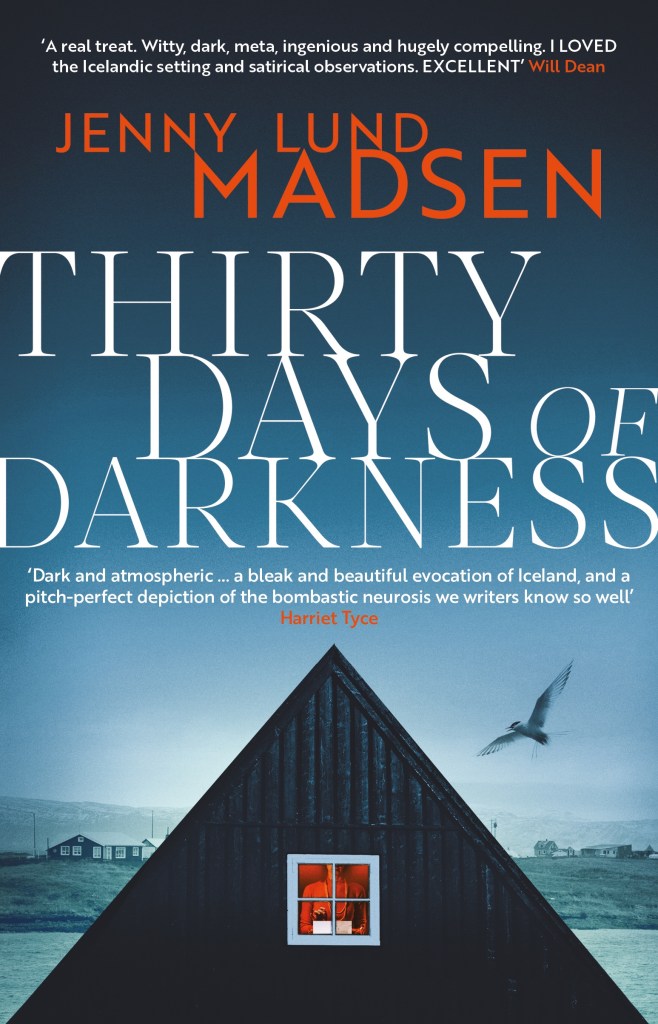
Thirty Days of Darkness by Jenny Lund Madsen

The first thing I loved about this book was that stunning cover. I hadn’t fully taken it in when I received the book, but once I’d found my reading glasses I couldn’t stop looking at it. That tiny lit up window, a little orange glow of creativity in the darkness really fired up my imagination. I’d love Orenda to create some book posters to accompany their author’s work. The blurb drew me in with it’s conflict between genre authors and their supposedly high brow literary fiction colleagues. Hannah writes literary fiction and is dismayed at a book festival to see the crowds attending a Q and A with Jørn Jenson, the darling of Scandi Noir, who churns out a formulaic book every year. Yet he’s filling a tent with fans and she’s in a lonely booth waiting for someone to drop by. I loved that she launched a book at his head! In the ensuing row, Jensen goads Hannah into saying she could write a crime novel in a month. Her agent uses the incident as a great marketing strategy and pours fuel on the fire, talking to the press about the wager and even putting Hannah on a plane to Iceland as a writing retreat. There she will live with a lady called Ella and hopefully, within thirty days, complete a commercial success. Yet within days of Hannah’s arrival there’s a real life crime, as Ella’s nephew Thor is found drowned in the waters of the harbour. Can Hannah use the case to write her crime masterpiece? As she starts to ask questions about this small town community will she find inspiration, or will she be in more danger than she ever imagined?

Hannah is an interesting heroine in that she isn’t all that likeable at first. She’s prickly, arrogant and a definite book snob.

“Hannah Krause-Bendix has never received a bad review. Not once has anyone had a negative thing to say in any of the reviews of her four novels. A literary superstar, twice nominated for the Nordic Council Literature Prize. Didn’t win, but that doesn’t matter; anyway, she doesn’t believe the mark of good literature is how many awards it’s won. She’s actually refused the numerous other prizes she’s won over the years. No – Hannah sees herself as a forty-five year old living embodiment of integrity and will always maintain that it is beneath her to seek commercial success.”

I was starting to feel sorry for her editor and publisher. Her disgust for the current literary scene is obvious. She hates festivals and signings, prizes, social media and is dismissive of bloggers (how dare she – *swoon*). As she picks up Jensen’s latest book as if it is ‘a pair of homeless man’s lost pants’ she notes that most of the reviews are from obscure bloggers she’s never heard of. She’s no better as she arrives in Iceland, annoyed that her new landlady is late, that her jeep looks and sounds like it’s five miles off it’s new home at the scrap yard, plus she drives with her steamed up glasses so close to the windscreen that Hannah wonders whether she can drive, or even see. Then she makes the terrible faux pas of calling her friend and publisher Bastian to get her a flight back to Copenhagen, assuming Ella can’t understand her. Of course she can. I was cringing about her behaviour. Yet I didn’t dislike her. Despite these failings, plus the alcoholism, infidelity, snooping and complete conviction she’s in the right, there’s something rather freeing about her impulsiveness. We all have those thoughts, those imps of the perverse, that pop into our mind and encourage us to poke that person who’s bending over to reach a low shelf in the supermarket. We don’t do it of course, but Hannah does. In the course of the novel she randomly feels a homeless man’s head, buys the town teenagers alcohol, starts an affair with someone she’s barely met and as we know, tries to hit a man in the head with a book. She seems disconnected from others in the sense that we don’t know her family, she has few obligations and she thinks nothing of asking very personal questions in entirely inappropriate circumstances. I sort of loved that.

There is definitely a blackly comic element to this story and a satirical eye for both the book world and crime fiction in general. There’s a meta element to the story too, as Hannah makes observations and discoveries about crime fiction that then seem to bleed into the actual case. She observes that her investigations are suggesting the case is actually quite simple to solve, Jørn, who has followed her to Iceland, advises that in crime fiction the killer is never the most obvious suspect. Subsequently, her enquiries move from the her current suspect and start to take a darker turn, towards the last people she’s suspected. Jørn tells her:

“ a good crime novel has three crucial components. One: a spectacular and violent opening, preferably a murder. Two: false leads and false suspects. […] Point three is surprises.’

He also rather amusingly points out that the protagonist shouldn’t be likeable, because no one enjoys a likeable protagonist in crime. In fact during a violent clash with her first, rather boringly obvious suspect, she even doubts her own credentials as a protagonist. As she fights for her life, she berates herself for her stupid plan of luring him to a window, because she’s now in front of an open window with a possible murderer.

Of course, he isn’t the murderer after all. In the end the crime is complex and rather like the book of Icelandic sagas that Ella gives her to read. The roots of this murder lie way in the past with the last people Hannah suspected. In fact in the echo of the saga, someone takes something that is highly prized and didn’t belong to them, setting in motion years of secrets, lies and denial. Yes, there’s a lot of the clever stuff going on that us ‘weirdo’ readers like, as one teenager describes Hannah’s fan base, but there’s also a solid thriller as well. It’s a bleak and claustrophobic atmosphere as soon as Hannah reaches the island where she knows no one and feels alien. The remoteness of the town and it’s isolation when the bad weather comes just add to that sense of being completely alone. This is not a place to be injured or to be a victim of crime; there is only one police officer in town, with back up over an hour away on a good day. Jørn may preen and prance around like the archetypal action hero, but he is surprisingly very useful to have around in a sticky situation and despite his woeful writing, is possibly a good friend to have, especially where he’s the only familiar and friendly face. Alongside Hannah I suspected three or four different people and the author kept me guessing, just leaving tiny clues along the way. At first there was a little bit of scepticism -I remember watching Murder She Wrote with my parents when I was younger and my dad wondering why nobody told Jessica Fletcher to ‘bugger off and mind her own business’. However, once the action started to heat up I forgot that Hannah had no business interrogating suspects and just kept reading. She’s no Jessica and this is definitely not cozy crime. It’s dark, disorientating and scary as hell, but you’ll not be able to put it down. This is an incredible debut and I’d love to see where Hannah ends up next. Now back to that cover – I think it would make a lovely tote bag ……

Meet The Author

Jenny Lund Madsen is one of Denmark’s most acclaimed scriptwriters (including the international hits Rita and Follow the Money) and is known as an advocate for better representation for sexual and ethnic minorities in Danish TV and film. She recently made her debut as a playwright with the critically acclaimed Audition (Aarhus Teater) and her debut literary thriller, Thirty Days of Darkness, first in an addictive new series, won the Harald Mogensen Prize for Best Danish Crime Novel of the year and was shortlisted for the coveted Glass Key Award. She lives in Denmark with her young family.

Posted in Random Things Tours

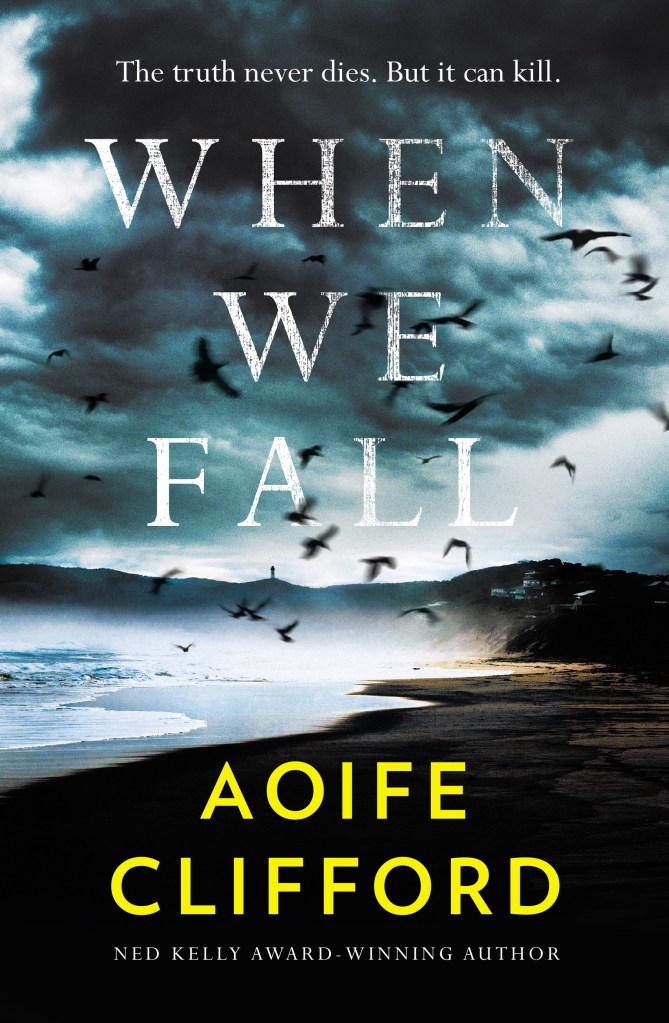
When We Fall by Aoife Clifford

I’m slowly becoming a fan of ‘Outback Noir’ so I guess I picked up Aoife Clifford’s new novel with certain expectations. I was pleasantly surprised to find a few differences in this crime novel and a labyrinthine story that really pulls the reader into small town Australia with its complicated relationships. As one Merritt resident says:

“People here are a bit like trees, with roots deep in the earth, far more tangled than what’s visible on the surface.”

Criminal barrister Alex has returned to her home town to spend some time with her mother Denny and have one of those difficult conversations. Denny is struggling with dementia, but is stubborn and in denial. She had a distant relationship with her own parents and had Alex as a young Mum. Alex has bad memories of her grandparents so Merritt isn’t her favourite place, but Denny is getting worse, no matter how much she tries to cover it up and Alex must talk to her about sheltered accommodation. It’s on a beach walk trying to broach the subject that they find a dismembered leg with a distinctive black feather tattoo. It turns out that the leg belongs to art gallery owner Maxine MacFarlane and local police chief Kingsley ‘King’ Kelly dismisses it as a boating accident when the rest of her body is found further up the coast. But Alex’s barrister’s instincts tell her there might be more to this than meets the eye and she starts to snoop. King Kelly warns her off very early on and comes across as the archetypal small town cop – lazy, prejudiced and jaded, not to mention a misogynist. He holds court in his local cafe and seems well connected in the town, especially with people who matter. Alex wants to question a possible link between Maxine’s death and the disappearance of artist and activist Bella Gregg two years before. Not only did Bella exhibit at Maxine’s gallery, but as an activist she often protested wearing black feather wings that went missing at the same time she did. There’s also a strange symmetry about their autopsy results – Maxine was washed up on the sea shore but didn’t have saltwater in her lungs whereas Bella did have saltwater in her lungs but was found inland. There was also an upcoming exhibition at Maxine’s gallery, linked to Bella’s death. Could this have laid the blame for Bella’s death at a local’s door?

The plot is intriguing, full of different avenues that are never obvious. Some keep you reading ferociously but turn out to be red herrings, while truths lurk underneath like a riptide. One minute I suspected someone, then someone completely different, although that’s not surprising in a town where male suspects are plentiful. My eye was on King Kelly throughout because he’s a thoroughly unpleasant character, but there are strangers in town; a new doctor who’s just arrived, as well as a visiting investor in a potential eco-friendly extension of the town. Locally there’s the rep for the town extension who seems keen to do anything for a better future than the local fishermen he went to school with. Bella’s own stepfather is known to be dealing drugs and there’s even a link to Alex’s family, with one thread involving a GP who was the partner of her grandfather. The past definitely has a role here, both in the crime and in the questions Alex has about her childhood. I was nervous for her in a town where outspoken women seem to get silenced. Alex is just as stubborn as her mother once she has an idea in her head and she’s been without cases to distract her of late.

Aside from the crime, Alex has a lot to contend with: her husband Tom is pushing for their divorce to move a bit quicker; her career seems to have taken a nosedive since their separation; then there’s her formidable mother to contend with. I loved the snappish and often humorous dialogue between Alex and Denny. There was a lot of truth in their exchanges, but that humorous edge offered a bit of light in the shade of a terrible crime. Alex’s instincts are strong, she’s perceptive and intelligent but seems to have a blind spot when it comes to danger. She places herself in potentially life threatening situations without seeing the danger looming over her. I didn’t always understand why, but felt it might have had something to do with her childhood in Merritt. Clifford surprised me with Alex’s home town, because I didn’t get the dry outback setting I expected. Despite wanting to develop as a holiday destination, it didn’t feel very welcoming and it seems to be raining constantly. Everyone is in raincoats. This is a small seaside town and has a claustrophobic feel without the outback heat. She shows it through the people, like the local cop with a finger in every pie and suspicious residents who are reluctant to talk. She gave me an Australia I hadn’t seen before and it gave this read a unique feel. This was such a well-written book, sinister and complicated with an ending that felt just right. I’m now looking for a gap to read her earlier novels, because I’ve already ordered them.

Meet the Author

Aoife Clifford is the author of All These Perfect Strangers, which was long-listed for both
the Australian Industry General Fiction Book of the Year and the Voss Literary Prize, and Second Sight, a Publishers Weekly (starred review) and PW Pick for Book of the Week. Aoife’s short stories have been published in Australia, United Kingdom and the United States, winning premier prizes such as the Scarlet Stiletto and the S.D. Harvey Ned Kelly Award.

Posted in Netgalley

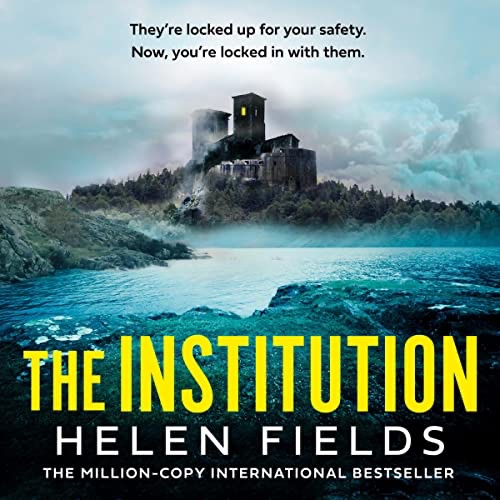
The Institution by Helen Fields.

I was eager to read this having loved her previous novel The Last Girl To Die, so I’ve felt very lucky to be granted early access to it on NetGalley. Our heroine is Dr. Connie Woolwine, a behaviourist and profiler rather than a psychiatrist, she works privately alongside her investigator Brodie. She has access to The Institution to look for a killer within the high security wing. Housed in one of the towers, the wing is known as ‘heaven’ and has six inmates, all of whom are either serial or spree killers. Her cover story is an unusual one. Brodie will go deep undercover as a potential inmate, with Connie as his current therapist. Brodie has been in the millitary and suffers from PTSD amongst other issues, so Connie is there to assess the ward, meet the inmates and decide whether it’s the best place for Brodie to be treated. The truth is a lot more gruesome. A nurse from the ward has been found dead on one of it’s treatment rooms. Tara was restrained and had a rudimentary caesarean performed on her, but was then left to bleed to death. The baby has not been found and the killer could only have been on the unit. With a grieving family waiting for a ransom demand, staff and inmates at the unit have been given a different story about this well-liked member of staff. They are told that Tara will be resting at home for the final stages of her pregnancy. Now Connie is on the clock, desperately trying to find baby Aurora and which one of the killers could have murdered the ward’s most popular nurse in such a brutal way.

Connie seems maverick, with strange methods such as talking to, sniffing and touching Tara’s body. She’s an unusual narrator because I didn’t always feel sure of her. We find out that when she was a young woman she was admitted to a mental health unit after an accident left her mute and doctors couldn’t find a physical cause. She was given ECT and treated by psychiatrists until a new doctor decided to re-scan her brain and found a previously hidden blood clot. Once removed, Connie could speak again. This experience has left it’s mark and it seems very important to her, even when self-disclosing to a patient, that they know she wasn’t really mentally unwell. We’re mainly in Connie’s world with interspersed short chapters on an assessment session, each subject’s name as the title. These sections read like session notes and give us Connie’s views of each inmate. Rubio for example, acts like a baby and wants to be cuddled and nursed. He gave me the creeps, especially when he’s wearing a nappy. The Professor is more on Connie’s level intellectually, but acts very superior. I didn’t feel that the sessions were helping me understand who might have done this. In fact I think I learned more about Connie than the patients. In the meantime, poor Brodie is living with these inmates and has gone through being sedated and restrained by staff. The staff are incredibly suspicious, with orderlies who enjoy their power too much, nurses who seem to resent Connie’s presence and a male doctor who makes a pass at her almost immediately. I kept wondering who would choose to work here, in such a dangerous and bleak place?

I felt it was clever to keep the reader questioning Connie and it wasn’t just her inner world that worried me. There were points in the story where her instincts really concerned me, such as going off alone to very remote places in the building and on the grounds. There was also a major flaw in the plan, in that her investigator is so confined by his role as a patient he can only observe. This really does leave Connie to take on the more dangerous part of physically investigating, but as she’s untrained for this role and potentially more easily overpowered, it left me feeling on edge. Also someone who is thinking ahead of her could use her seemingly erratic behaviour and appearance to make her worst fears comes true. The tension is unrelenting and nowhere is safe, including rooms that have a lock! The claustrophobia is intense and works like a set of Chinese boxes: from the location and the effects of the storm, the compound, the locked building, the high security tower within the whole institution, all the way down to the treatment room and it’s restraints. These layers of confinement did make me uncomfortable and when a character is further confined with drugs or the threat of ECT, it brings it home how powerless patients and the murder victim were. These layers also emphasise the brutality about drugging someone and stealing a baby from the ultimate place of safety, their mother’s womb.

There is a strange fascination in hearing about the inmate’s crimes, mainly because they seem so at odds with the men we encounter through Connie. Her sessions feel slightly strange from a therapy perspective, but of course Connie is not really there to engage in a therapeutic relationship. Unknown to them and the staff, she’s using the session to assess whether they’re behind the crime and I was interested in the ethics of this approach. As disaster strikes and the ward has to be evacuated, the tension jumps up a level with men who are usually in their cells now roaming free. For those left on the ward it becomes a fight for survival, with only a basic knowledge of the inmates to inform them about which ones can be trusted and those who must be avoided. This was an exciting end to the novel and really did keep me gripped to the bitter end, waiting for the perpetrator to admit their role in the murder and kidnap plot. I was biting my nails, worried that Connie wouldn’t find baby Aurora before it was too late. This was an intelligent thriller, full of tension and unexpected twists and turns. It’s cemented my suspicion that Helen Fields really is a must-buy author.

Meet the Author

An international and Amazon #1 best-selling author, Helen is a former criminal and family law barrister. Every book in the Callanach series has claimed an Amazon #1 bestseller flag. ‘Perfect Kill’ was longlisted for the Crime Writers Association Ian Fleming Steel Dagger in 2020, and others have been longlisted for the McIlvanney Prize, Scottish crime novel of the year. Helen also writes as HS Chandler, and has released legal thriller ‘Degrees of Guilt’. In 2020 Perfect Remains was shortlisted for the Bronze Bat, Dutch debut crime novel of the year. In 2022, Helen was nominated for Best Crime Novel and Best Author in the Netherlands. Now translated into more than 20 languages, and also selling in the USA, Canada & Australasia, Helen’s books have won global recognition. She has written standalone novels, The Last Girl To Die, These Lost & Broken Things and The Shadow Man. Her first UK hardback, The Institution, comes out in March 2022. She regularly commutes between West Sussex, USA and Scotland. She lives with her husband and three children. Helen can be found on Twitter @Helen_Fields for up to date news and information or at http://www.helenfields.co.uk.

Posted in Netgalley

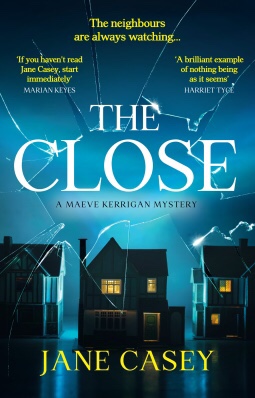
The Close by Jane Casey. A Maeve Kerrigan Mystery.

I absolutely loved being back in the world of Maeve Kerrigan. So much so I read this straight through in one day. The set up was brilliant – a modern slavery racket is suspected and Maeve must get close to one of the conspirators, an unlikely criminal. The mayor of London’s assistant has brought a sad case to their attention. A young man called Davey who died after suffering neglect, starvation and physical abuse. He was the perfect target for slavery, an easily influenced man with learning disabilities but physically strong and capable. Strangely, there have been other young men go missing from the system after using the same address, that of an elderly lady in a normal suburban close. There needs to be close surveillance so Una Burt puts her best officers on it, Maeve must move into the close with Josh Derwent as her boyfriend, pretending to dog sit for the usual occupant. Josh thinks Maeve needs a break from her normal routine, because after the court case convicting her partner of domestic abuse Maeve has been drifting and not herself at all. Similarly, Maeve thinks Josh could do with a break away from his live in girlfriend Melissa. How will they fare as a couple on the close and will they be able to flush out the conspirators in the slavery case?

I loved the tension between Derwent and Maeve in this story, close together in the house and away from all their usual distractions it brings their chemistry into focus. Every time they behaved like a couple it felt completely natural, until it was imagining them going back to colleagues was unthinkable. They have had so many obstacles in their time as friends, always something preventing them from becoming more, so could this be the perfect timing? At times the tension in their house was more unbearable than the tension in the case! There are parts of Derwent that I don’t like, but I can see ways in which he’d be good for Maeve and vice versa. They ingratiate themselves with the neighbours easily because they sense this chemistry, they seem like a real couple. The elderly lady in question is tricky, seemingly an innocent and kindly woman but if she is involved with mistreating these men, her kindness is all a front. She reveals that she does provide a bed for young men with disabilities from time to time, but doesn’t elaborate on whether it’s an official arrangement. When Maeve discovers there’s a oreviously unknown son, whose wife runs a care home, the chain starts to come together. However this isn’t the only crime lurking under the respectability of suburbia. The author uses short chapters narrated by a man who is very unpleasant and possibly dangerous. He lurks after dark watching through the windows of those who don’t close their curtains, even Josh and Maeve. He has a very incel vibe, so could he be a lone male with little female attention and experience, or is he hiding his feelings about women under the veneer of a happy family man?

I enjoyed watching these people through Maeve’s eyes as her instincts are usually spot on and her insight seems to be coming back to her as the novel continues. This break is exactly what she needed. Her interactions with a lady with dementia in the close are brilliant because Maeve doesn’t dismiss what she claims to have seen just because of her illness. Maeve knows there are moments of lucidity and keeps thinking about what she’s said and trying to interpret it. When she goes missing in the dark Maeve is desperate to find her, but so is our unknown man and it’s a real heart pounding part of the book, hoping against hope that Maeve gets to her first. It’s clear that this seemingly happy and respectable close is anything but, with the men hiding all sorts from irritating foibles to murder. Towards the end I was powering through the pages to find out who was hurting girls in the close, whether Maeve’s fire and copper’s instinct was returning, but also whether Josh and aMaeve were going to confront their feelings for each other. This was an addictive thriller, focusing on one of my favourite fictional police duos and I loved seeing them in a different environment, but still flushing out crime.

Published by Harper Collins 2nd March

Meet The Author

Jane Casey is a bestselling crime writer who was born and brought up in Dublin. A former editor, she has written twelve crime novels for adults (including ten in the Maeve Kerrigan series) and three for teenagers (the Jess Tennant series). Her books have been international bestsellers, critically acclaimed for their realism and accuracy. The Maeve Kerrigan series has been nominated for many awards: in 2015 Jane won the Mary Higgins Clark Award for The Stranger You Know and Irish Crime Novel of the Year for After the Fire. In 2019, Cruel Acts was chosen as Irish Crime Novel of the Year at the Irish Book Awards. It was a Sunday Times bestseller. Stand-alone novel The Killing Kind was a Richard and Judy Book Club pick in 2021, and is currently being filmed for television. Jane lives in southwest London with her husband, who is a criminal barrister, and their two children.

Posted in Personal Purchase

Other Women by Emma Flint

It is 1923 and a country is in mourning. Thousands of husbands, fathers, sons and sweethearts were lost in the war, millions more returned home wounded and forever changed.

Beatrice Cade is an orphan, unmarried and childless. London is full of invisible women who struggle to find somewhere to work through their grief. But Bea is determined to make a new life for herself. She takes a room in a Bloomsbury ladies’ club and a job in the City. Just when her new world is taking shape, a fleeting encounter threatens to ruin everything.

Kate Ryan is an ordinary wife and mother. Following the end of the war, she has managed to build an enviable life with her husband and young daughter. To anyone looking in from the outside, they seem like a normal, happy family. But when two policemen knock on her door one morning and threaten to destroy the facade Kate has created, she knows what she has to do to protect the people she loves. And suddenly, two women who never should have met are connected for ever . . .

I can’t say enough great things about this incredible novel, but I’m going to try and do it justice. It’s a historical mystery, extraordinarily clever psychologically and made me think about feminism, sisterhood and the difference between what society expects women’s lives to look like and the life decisions we make for ourselves. Flint has told her story through the eyes of the Kate and Bea, two women who are strangers, but connected by one man. Bea was an orphan and is now an unmarried woman in her late thirties. She’s the book-keeper for a firm in London who has pretty much resigned herself to being a career girl and living in a woman’s hostel. All this changes when she meets the handsome and charming Tom Ryan, a salesman at her firm. Bea struggles to believe that this man, with his movie star looks, would be interested in a woman like her. She expects him to chat up the young women, who have noticed him and are giggling, but he makes a point of stopping at her desk. He comments on her name, telling her that Beatrice was the great love of a poet. Bea is smitten and agrees to meet him, despite the fact that he is married. She is mentally aware of his wife’s presence, the third person always standing between them. Despite this, will Bea allow herself to succumb to Tom’s advances and can it end any other way but heartbreak or disaster?

Flint’s setting is vitally important to this story. We can draw parallels between contemporary women and these two characters, but they are also very much products of their time. This is a post-war Britain and everything has been changed by a war so terrible it is known as the Great War. Men have come home destroyed by what they’ve experienced physically and mentally.

‘There were empty sleeves and eye patches that one must not stare at or draw attention to; there were crutches and bandages and dreadful ridges of thick pink skin; and sometimes there was simply an absence in a face where a man had left a part of himself – the brightest and most vital part – in a muddy foreign field.’

Whereas women could be said to have flourished. Yes, there’s the ever present weight of grief and loss, but some of the changes in women’s lives had been positive. Both Kate and Bea are working women, and represent the many women who became wage earners during the Great War, plugging the gap in the employment market as more men joined up to fight. This was liberating for many women, who were then reluctant to move back to the domestic sphere after the war. There were also a shortage of men in the marriage market, some women had lost their fiancé or husband but there were others who came of age just after WW1 for whom eligible men were scarce. Having the option of throwing themselves into an absorbing career instead proved very fulfilling for some, like Morley’s office manager who clearly expected Bea to be left on the shelf and had marked her out as a potential replacement. Women being outside the domestic sphere meant that the pre-war rigid barriers of social class started to be breached. Different classes of people mingled in work places and matches that would have been impossible a few years before became more common. Bea still longs for love, but as her personal life becomes complicated and painful she does muse on what she has lost. As a single working woman she had women friends and lived in a vibrant city where she could take herself to the theatre, to a museum or for tea with friends. Now that she can see the reality of a relationship, she wonders was she better off before?

Bea knows there is a difference between herself and the girls who have young men to wait for. These are carefree girls, full of life, ‘neat and slender – sleek hair, dainty ankles, flickering glances and quicksilver laughter.’ She’s of a different sort, in looks and class. Where her married sister Jane looks on career girls as modern, smart and fashionable Bea looks a little closer and sees

‘frizzed modern hairstyles that they’d seen in advertisements and that didn’t suit them; women with lines around their eyes that no amount of cream or powder would cover. And women who, despite the well-cut clothes, had red rough hands and nails cut to the quick.’

Bea is well aware she is plain and there are references to Jane Eyre in the way she sees herself. After talking to Tom, she sees herself in the bathroom mirror and is shocked at the difference between her tumultuous, rich inner life and this pale, plain outside. She feels such overwhelming emotions that she disassociates from her rather normal body; ‘how can all these feelings come out of this plain face and body?’ It immediately took me to the conversation between Jane and Rochester when she challenges him for underestimating her:

‘Do you think, because I am poor, obscure, plain, and little, I am soulless and heartless? You think wrong! I have as much soul as you, and full as much heart!…’

In fact Tom uses the comparison to flatter her, praising her strength and courage in living such a lonely life. Patronised by her sister too, she is full of anger inside and expresses the creeping fear that not only is she without a husband, she’s noticed younger, smarter girls starting to come into the workplace. Bright, young things who might be better at her job and quicker. She admits to being afraid of the day when the axe falls, her clothes become shabbier and she gets more desperate. Yet is it any better to be at the mercy of a man? As Kate’s story unfolds we can see that the state of being a wife, is just as unstable and scary, because where Bea has all the responsibility and makes decisions for herself Kate is powerless, entirely dependent on the whims of her husband. A husband who is capable of terrible things. The more Kate starts to learn about her husband, tiny jigsaw pieces start to slot together in her head. She has to admit to herself that she has always known there was something hidden underneath:

‘Hadn’t I known – hadn’t I always known – that he had something terrible inside him, something that lay rotting under the smooth surface of our normal life? I saw glimpses of it sometimes. I thought of his face as he persuaded me, sweet-talked me, into doing things I did not want to do. I thought of how dirty, how shamed, I felt afterwards.’

Set in the 1920’s, this story is based on the true case of Emily Kaye and her married lover Herbert Mahon. The novel’s aim was to give voice to Mahon’s wife and so Kate’s voice came to life, creating a brilliant interplay between her narration and Bea’s. I loved how well the pace was controlled, from relatively slow at the beginning to a breakneck pace towards the end as Kate makes sense of what has happened and holds the key to solve the mystery. I loved how the author showed us the truth of contemporary attitudes to women, that a man can do something terrible, but it will always be the woman’s fault. How Bea is simply disregarded as shameless, getting old and desperate, brazen and responsible for enticing Tom, despite him being married. It’s quite shocking, but then when I thought about our tabloid’s attitudes to women, I realised that women are judged every day for their appearance, their sexuality, their life choices and if ever there is a marital affair in the papers the ‘other woman’ is always blamed. It’s scary to think how little some people’s attitudes have changed, but thank goodness we can earn for ourselves, own property and have bank accounts. I loved the sense of sisterhood the author brings into the story and it made me think about how it’s the women in my life who have held me up when I couldn’t manage alone. I was on tenterhooks wondering whether Kate would realise that to choose the sisterhood is to change things for her own daughter. To make a decision towards a better world for women. This book was a brilliant piece of historical fiction, an addictive mystery that stirred up the emotions and had me completely hooked. As soon as I’d finished, I wanted to read it again.

Published by Picador 23rd February 2023

Meet The Author

Emma Flint was born and grew up in Newcastle upon Tyne. She graduated from the University of St Andrews with an MA in English Language and Literature, and later completed a novel-writing course at the Faber Academy. She lives and works in London.

Since childhood, she has been drawn to true-crime stories, developing an encyclopaedic knowledge of real-life murder cases from the early 20th century. Her first novel, Little Deaths, was longlisted for the Women’s Prize for Fiction, for the Desmond Elliott Prize, for the Crime Writers’ Association Gold Dagger Award, and for The Guardian’s Not the Booker Prize.

Other Women is her second novel.

Posted in Netgalley

Cut Adrift by Jane Jesmond.

I really enjoyed our first outing with Jenifry (Jen) Shaw so I jumped at the chance to read the second outing for this daring and independent woman. Jen is taking time off to go climbing and has chosen Alajar, Spain as her destination, drawn in by a mysterious postcard showing a bar with decorative cork tiles on the ceiling. We met the shadowy undercover police officer Nick back in Cornwall and in the brief time they met their combined skills kept each other alive. There was also a connection between them that couldn’t be explored due to Nick being pulled straight back into another case. So when the postcard arrives with ‘wish you were here’ as the only message, Jen decides to take a chance and find the bar hoping this might be the right time to connect properly. Their time is limited though and it’s not long before Nick is off on another case. Jen does have a family issue to sort out though. Her brother has called in a panic to say that their father is planning to sell the family farm in Cornwall and the only person who can stop him is their mother. As usual their mother is elsewhere and not easy to contact, apparently teaching yoga to refugees in Malta. Jen takes advantage of Nick’s absence to fly to Malta in the hope of explaining to her mother what she needs to do to save the farmhouse where Jen and her brother grew up.

When Jen arrives though, her mother seems to be in the middle of a crisis with a family of refugees. The mother Nahla is an old friend of Morwenna’s and she’s with her two children Aya and Rania in a state of distress. This links back to a heart stopping prologue where we see that Nahla’s husband has been killed in Libya and the family have fled the country in a boat bound for Malta. Aya is so traumatised that she’s silent and both Rania and her mother are displaced and shellshocked by their experience. Now they’re forced into a refugee camp where disease, crime and trafficking are rife and no one can be trusted. Jen knows her mother and there’s no point trying to bring Morwenna’s mind back to home when she’s on a crusade. Jen’s now committed to helping Morwenna bring her friend and her daughters out of the refugee camp and settle them into a new home. The story is both heart stopping and heart rending. The author knows exactly how to pace her story with thrilling, fast paced set pieces followed by periods of calm that gave me chance to breath and think about what’s just happened. The scene with the fire in the clinic on the refugee camp had me gritting my teeth with anxiety, as Jen desperately tries to save those inside through the roof. Jen’s climbing skills are always at the forefront of the action and I trust her skills, but a part when she’s having to free climb a cliff with a complete novice was nail-bitingly tense.

The Maltese setting is fascinating with a sharp contrast between the picturesque streets with bougainvillea cascading prettily from the walls and the squalor of the camp. The distance between the Malta of the tourist trail and the Malta of those who arrive in the trafficker’s boats is vast. Morwenna is living across the two worlds, set up in a beautiful home with her lover Peter but entering the camp every day to teach yoga and help out at the clinic. The desperation of the refugees is made very clear and the way the traffickers ruthlessly exploit that desperation is horrifying. Nahla expects their escape from Libya to be uncomfortable and frightening, but she doesn’t expect their belongings to be discarded, to be forced into fighting others to make sure her and her children are on the boat, or to have her youngest child Aya hit when she can’t help but cry. Aya’s behaviour from there on is that of a deeply traumatised child, who automatically folds herself into tiny spaces without complaint knowing not to make a sound until she’s told to come out of hiding. Both girls are so vulnerable, clinging to the only person they recognise and so open to exploitation. It is difficult for Jen to get to the bottom of who is behind trafficking from the Maltese camp and when it becomes clear that secret services are also embedded in the camp it becomes even more complex. They have an entirely separate agenda, trying to separate potential terrorists using large movements of people from the Middle East and North Africa to slip into the UK undetected.

Jen is even more of a force to be reckoned with in this second novel and seems surprised at the connection she makes with Nahla’s daughter, particularly Rania. She’s more than an equal for those refugees stirring up trouble in the camp and her fitness skills mean she can escape many tense situations, but there were times when I was very worried. Her urge to protect the girls left her very vulnerable at times, luckily there was help from others but there were a couple of occasions when this was resolved by coincidences that stretched my credibility a little. Despite that I understood why the author had made those choices, for the development of other aspects of the story. Overall this was a page turning thriller, with a heroine I really enjoyed spending more time with.

Published by Verve 28th Feb 2023

Meet the Author

Jane Jesmond writes crime, thriller and mystery fiction. Her debut novel, On The Edge, the first in a series featuring dynamic, daredevil protagonist Jen Shaw was a Sunday Times Crime Fiction best book. The second in the series, Cut Adrift, will be published in Feb 2023, and A Quiet Contagion, an unsettling historical mystery for modern times, in Nov 2023. Although she loves writing (and reading) thrillers and mysteries, her real life is very quiet and unexciting. Dead bodies and dangerous exploits are not a feature. She lives by the sea in the northwest tip of France with a husband and a cat and enjoys coastal walks and village life. Unlike her daredevil protagonist, she is terrified of heights!

Posted in Netgalley

Picture You Dead by Peter James

Detective Superintendent Roy Grace finds himself plunged into an unfamiliar and rarefied world of fine art. Outwardly it appears respectable, gentlemanly, above reproach. But beneath the veneer, he rapidly finds that greed, deception and violence walk hand-in-hand.

It was lovely to be back in the world of Roy Grace, a character I was introduced to by a lovely new neighbour nearly ten years ago. When she moved in across the road from me with her English teacher daughter, they both had an extensive library. So, she asked me over for a cup of tea and to look through their boxes of duplicate books. She’d noticed I had a substantial library of my own when she popped round to introduce herself. This unexpected rummage through their cast offs brought both Elly Griffiths and Roy Grace to my notice. Luckily for me, both mum and daughter had a full set of Grace novels so I was able to spend a few weeks slowly working my way through his entire story. I managed to get access to Peter James’s latest through Netgalley a couple of months ago, but have been a little late in writing up my review.

This time Grace’s case takes him into the world of art collecting and finds that when a collector wants a particular painting, they might pursue it using any means at their disposal, even murder. Everything is set in motion by a couple called Harry and Freya Kipling, an ordinary couple who work as a builder and a teacher. On their weekends they like nothing more than browsing car boot sales for bric a brac and on one particular day Harry brings home a hideous painting of an old hag. He explains to Freya that he bought it for the ornate frame, hoping they could use it for a different painting. He leaves it in the conservatory, but on a sunny day the heat coming through the glass starts to burn the painting. That’s when the couple notice there’s something completely different underneath and after asking an expert Harry cleans the picture with acetone. Underneath is a fêtes galantes style painting of a couple in a garden that looks like others by Fragonard. Of course Harry doesn’t imagine for a minute that it’s worth anything, but for fun they attend a local filming of the Antiques Roadshow. As they queue up in front of the painting expert, they’re shocked to be taken aside and told the he would like to do some quick research on the their picture before filming. He then drops a bombshell, that this painting could be a missing Fragonard; the Spring painting in a series on the seasons. Alone it’s worth upwards of a million pounds, but with the others in the series it’s worth much more. The Kipling’s treat the painting almost like a ticking time bomb, something that worsens when their episode of the roadshow is televised. Now everyone knows they own this painting, including people who want it and will stop at nothing to obtain it.

This is an incredibly tough time for CSI Grace and his wife Cleo, he has only just lost his son Leo in a tragic accident and they are preparing for his funeral. Leo had only lived with Roy and Cleo for a few months, after his mother Sandy’s death in Munich. Sandy was Roy’s first wife who went missing early on in his career, causing so many problems and putting Roy in a position as suspect in her disappearance. He hadn’t even known Sandy was still alive, let alone he had a son, so it’s been a rollercoaster of combined grief and joy. To find out he had a son was shocking and to lose him so soon afterwards has been terrible, plus Cleo is close to giving birth to their second child together. His DI Glen Branson is at loggerheads with his fiancé over her job as a journalist, specialising in crime. Her ambition can mean criticising the force, something Glen is very sensitive about. With all this at home, at work Roy and Glen are looking at a cold case, the murder of an antiques and art dealer on his return home one evening. He was killed in his car on his own drive, as he waited for his electric gates to open, by someone who knew his movements very well. When the Kiplings have their house broken into, with nothing taken, it seems certain to be linked to their appearance on the Antiques Roadshow. Then when another body turns up, this time outside the home of renowned art forger Dave Hegarty, the coincidences start to pile up. As Roy’s team work their way through the collectors of Fragonard, will he find one who’s willing to kill to complete their collection?

This is a very different world to the one Roy’s team usually inhabit, but as always where huge amounts of money are involved, people are ruthless. The author is an absolute master at giving us moments of personal joy and anguish, alongside extreme tension and fear. One section of the book has a home invasion that’s absolutely heart-stopping! Then next we’re at Leo’s funeral, an incredibly personal moment where we’re taken into Roy’s anger over Sandy’s disappearance and guilt about his relationship with his son. Alongside this is the anticipation about the birth of his second child with Cleo, due in the next few weeks. The case is fascinating and I fell completely into this world of art collecting, from those who can afford the real thing to the world of forgeries where being as good as Dave Hegarty can bring plaudits and plenty of cash too. I felt so bad for the Kiplings, who had simply bought a painting at a boot sale and didn’t deserve any of the horror and stress that followed. It was good to be back with the team again; Tanya showing her usual organisation and Norman’s terrible jokes from the 1980’s really bringing the reader back into their world. Then of course there’s Brighton, with the usual mix of the seedy and strange that comes with Roy’s job and how it contrasts with the quieter rural life he’s chosen for his family. I only hope from here on there’s less personal turbulence for a character I’ve come to enjoy so much.

Meet The Author

Peter James is a UK No.1 bestselling author, best known for his Detective Superintendent Roy Grace series, now a hit ITV drama starring John Simm as the troubled Brighton copper. Much loved by crime and thriller fans for his fast-paced page-turners full of unexpected plot twists, sinister characters, and accurate portrayal of modern day policing, he has won over 40 awards for his work including the WHSmith Best Crime Author of All Time Award and Crime Writers’ Association Diamond Dagger.

To date, Peter has written an impressive total of 19 Sunday Times No. 1s, sold over 21 million copies worldwide and been translated into 38 languages. His books are also often adapted for the stage – the most recent being Looking Good Dead.

Visit Peter James http://www.peterjames.com

Follow Peter on Instagram > @peterjamesuk

Follow Peter on Twitter > @peterjamesuk

Follow Peter on Facebook > http://www.facebook.com/peterjames.roygrace

Posted in Personal Purchase

The Last Remains by Elly Griffiths

It’s always a treat to be back in Norfolk with Dr. Ruth Galloway, in fact it feels like I’m visiting an old friend. One of those friends you maybe only see once a year, but you just pick up where you left off like you’ve never been apart. This time we’re in the very North of Norfolk, branching into Cambridgeshire and even my home city of Lincoln too. The last book was set in the middle of the pandemic and in The Last Remains we’re still dealing with the aftermath. There’s a sense of dislocation from regular life, but weirdly there’s restlessness and a lsense of urgency too. An urge to start getting things done. It’s no surprise that several characters have big changes on the horizon. Ruth’s university are thinking of scrapping the archaeology department. Nelson remains single, but is still living in the marital home he shared with wife Michelle. Cathbad is still struggling with the ongoing symptoms of long COVID, much to his partner Judy’s concern. The group of friends are once again drawn together by a body. This one is walled up in an old cafe that’s being renovated. Ruth thinks the skeleton is female and has been placed there deliberately. She’s not ancient either, with Ruth ruling that the bones are not historic and likely to have only been there twenty years. What follows is a delve into the more recent past and a group of archaeology students spellbound by the knowledge of their tutor Leo Ballard. Could this go back to an evening of students and their tutor camping in the forest and talking about Norfolk mythology? At least there is one person to ask who’s very close to home and he’s always around where strange Norfolk legends are concerned.

The case is a complex one, with the themes of twinning and disguises. There are also interesting contemporary issues, especially for anyone like me who went to university for the first time in the 1990s. If we apply today’s standards of conduct to the relationships between students and tutors in the past, it’s clear the lines are more blurred. Leo Ballard was happy to have his students at his home and have camping trips with them too. The students would also congregate at the cafe where the body is found – The Green Man. The cafe was run by a man called Peter Webster who had two daughters- Gaia and Freya – who also studied archaeology. However, the walled up skeleton is a student from Lincoln called Emily who was on the receiving end of a blow to the head. Emily was a student at Cambridge University and went missing after the camping trip to Grimes Graves, a prehistoric flint mine. It was thought she had been travelling on the train to Lincoln to visit her parents, but was seen to get off at Ely and simply vanished. I was creeped out by Leo Ballard immediately and I didn’t like his manner when talking about young girls. He seemed to take advantage of his position to lure young students into relationships with him. Freya Webster points out that he never visited the cafe himself, but he felt present because of how much his students talked about him. His following of students felt like a cult, impressed by his knowledge and taken in by his stories. In fact he wasn’t above a bit of theatre, since all students remember seeing a strange figure with horns emerging from the woods when they were camping. Was this a group hallucination or did someone in the group want to genuinely scare the students?

Cathbad, everyone’s favourite druid, is not his usual self. He is still experiencing breathing problems when exerting himself, he sleeps more than he used to and has difficulties remembering things. It seems that even he is questioning his longevity and is acting out of character, such as taking the whole family to mass at Easter. So, when he goes missing, his partner Judy is distraught. I think she fears he’s gone walkabout, a spiritual walk taken when the individual knows they’re going to die. It’s a change that Ruth is struggling to deal with, especially since Cathbad has always seemed invincible. She’s facing enough changes of her own with the department of archaeology under threat of closure and she questions what more she could have done, but she’s written books and even had a television series. She’s probably the nose high profile archaeology tutor she can think of. She doesn’t like changes that threaten her and Kate’s settled existence on the salt marshes, next door to the sister she has only recently found. Kate is now at secondary school and is used to the changes of the last year. She is not surprised at the occasional presence of Nelson in the early morning and he also arrives most Saturday evenings bearing pizza. Ruth has a lot of respect for Nelson’s wife Michelle, who had the guts to break the endless deadlock of their three sided relationship. She has moved to Blackpool with Nelson’s youngest, George. Now that Nelson is free though, she isn’t sure what it means or what she wants. She senses Nelson moving ever closer to the big discussion of their future, but finds herself avoiding it. She can’t imagine ever being anywhere but here with Kate and Flint, looking out to sea from her little cottage. However, what if Michelle returned?

There’s plenty of tension here, in the case and in the relationships. The sequence with Ruth and Kate at Grimes Graves made me feel claustrophobic! Ruth has interest from David, another department member, and his declaration of love has surprised her, despite friend Shona saying it was obvious. David is going to work at Uppsala University in Sweden and would like Ruth to go with him, where a new post is waiting for her. If she stays at UNN there’s an assistant dean’s position possible. I felt like Ruth was waiting for a big gesture from Nelson. She doesn’t want him by default, just because Michelle has gone. When Michelle returns and is at their marital home, Ruth disengages. Nelson needs to choose and he needs to do it independently. Will he do this or will it just be easier to slip back into his marriage? Does Michelle even want that? I like that Ruth loves her independence and values her life without a man very highly. He has to prove what he will add to her life, because it’s really great as it is. I was on the edge of my seat wondering what she would choose. I was also worried for Cathbad, but loved the way these friends come together as a community. Judy and Ruth support each other and their children get along really well too, so they come together to wait for Cathbad’s return, trying not to think about the alternative. I will say that there’s a wedding a the end, but I’m not telling you which characters tie the knot. It’s going to be fascinating to see Ruth, perhaps in a new location and different job going forward. However, I think there will always be part of her and Flint’s spirit wandering the marshland.

Out now from Quercus

Meet The Author

Elly is the author of two crime series, the Dr Ruth Galloway books and the Brighton Mysteries. Last year she also published a stand-alone, The Stranger Diaries, and a children’s book, A Girl Called Justice. She has also previously written books under my real name, Domenica de Rosa (I know it sounds made up). The Ruth books are set in Norfolk, somewhere Elly went for holidays in her childhood, but it was a chance remark of my husband’s that gave me her idea for the first in the series, The Crossing Places. They were crossing Titchwell Marsh in North Norfolk when her husband, who’s an archaeologist, mentioned that prehistoric people thought that marshland was sacred ground. Because it’s neither land nor sea, but something in-between, they saw it as a bridge to the afterlife; neither land nor sea, neither life nor death. In that moment, she said, she saw Dr Ruth Galloway walking towards her out of the mist… Elly lives near Brighton with Andy. They have two grown-up children and a cat called Gus who accompanies her as she writes in the garden shed.

Posted in Personal Purchase

The Homes by J.B. Mylet

Lesley and Jonesy have been in foster care together ever since they can remember, in the same room and often in the same bed if Jonesy creeps in late at night. Our narrator is Lesley and she stands out as a little different from the other girls in the homes. She’s clever and goes to the grammar school instead of the one on site. She’s good at maths and seeing patterns in things, so what starts happening at the homes seems to her like a puzzle she can solve. Because someone at the homes is killing girls, possibly raping them and killing them. Who could it be?

The Homes are a sprawling institution made up of 30 cottages filled with the orphans of Glasgow and those needing care. So large, it has it’s own hospital, church and school, with every cottage run by a house mother and father with a Christian ethos. Set in the 1960’s and based on the Quarrier’s orphan village near the Bridge of Weir, where the author’s mother spent some of her childhood. He writes these girls as very isolated and dealt with at a distance, not just from their families, but from the staff too. He throws us in at the deep end with a morning that Lesley’s been dreading. Today she has to face the school bully Glenda, who lives a few cottages up. The adults know that Lesley is very likely to take a beating, but they do nothing. As she leaves for her school bus, Lesley can see a crowd of girls gathering at Glenda’s gate hoping for blood. It’s fair to say they get a bit of a surprise when the encounter doesn’t play out the way they expect. I felt as if the children were treated like animals, like when I’ve brought rescue cats home and left them to sort out their hierarchy amongst themselves. Even so, I would worry if any of them were distressed or fighting. These kids are fed, watered and disciplined, but they’re not cherished.

Only once called by her Christian name, Morag is known as Jonesey and she is a larger than life character. I loved the little characteristics that Lesley relates to us, such as the giggling in church, the constant chatter, and the way she often slips into Lesley’s bed at night but still isn’t restful. Even in her sleep Lesley is often woken by Jonesey’s jerking limbs, she’s like a puppy whose brain is asleep but whose body is still on the go. She’s absolutely irrepressible and incredibly loyal to Lesley, often waiting outside for her bus to arrive in the early evening, wriggling like that excited puppy again. By contrast, Lesley is outwardly very quiet. Her inner world is lively though, bright and full of questions. She has a dogged determination that helps her at school with tricky maths problems, but proves to be a nuisance to the police and the perpetrator of these terrible murders. Unfortunately, her amateur sleuthing is not quick enough to save the third victim. In between the case we learn a lot about the upheaval Lesley has suffered in life. She’s visited by her gran mostly, but she isn’t great at answering all the questions Lesley has. She’s clearly very fond of her granddaughter, but doesn’t want to get into the minutiae of why her mother placed her in care. Her mother visits less, but when the answers finally come there are painful truths to process. I was so glad she had Jonesey and her therapist Eadie but I worried for her going forwards and eventually leaving care. I bonded with Lesley, enjoying her intelligence and sense of fun as well as the way she coped with difficult situations.

A bit like Lesley I suspected every character along the way, knowing that people who work with children are not always doing it for the right reasons. There are people at the homes who are there for their own ends. There are various levels of abuse going on in the community. They’re forced into a religious upbringing they may not want and the expectations, particularly of girls, is tied up in that Christian morality. The discipline is down to each house parent and is always strict, but could also be violent and humiliating. At worst these children are preyed upon by the most horrific kinds of abuser and the tension builds towards a conclusion that not only unmasks a killer, but blows the lid open on everything that is wrong with the institution. I thought the historical setting was captured incredibly well, not so much the location but the emotional landscape of the 1960s. This was a time of secrets, when children were seen and not heard and definitely didn’t have rights. A time when young women were still shamed for their burgeoning sexuality and perfectly normal urges and their consequences. This was the time when my mother was growing up and it felt as if the author had the context just right. I thought the author perfectly balanced Lesley’s personal realisations and growth, with the tension of the murder investigation. As the inhabitants of Lesley’s cottage sit down for Sunday lunch with their houseparents, the Pattersons, she has a very grown up revelation. In the space of her week, this is the only time they feel ‘like a big normal family’ and it’s becoming apparent that all adults will eventually let her down. By the end I realised Lesley had drawn me into her story to such an extent I was wondering about her future. Despite the murders being solved, I was reluctant to close the book and leave her behind.

Published by Viper, 26th May 2022.

Meet the Author

J.B. Mylet was inspired to write The Homes based on the stories his mother told him about her childhood. She grew up in the infamous Quarrier’s Homes in Scotland in the 1960s, along with a thousand other orphaned or unwanted children, and did not realise that children were supposed to live with their parents until she was seven. He felt this was a story that needed to be told. He lives in London.

You can follow James on Twitter @JamesMylet, or find him on Facebook.