Posted in Random Things Tours

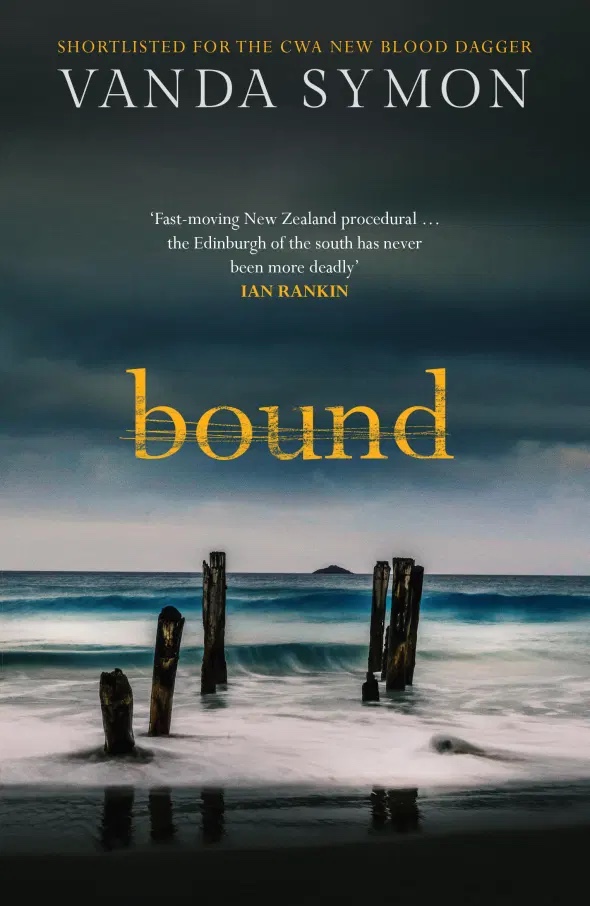
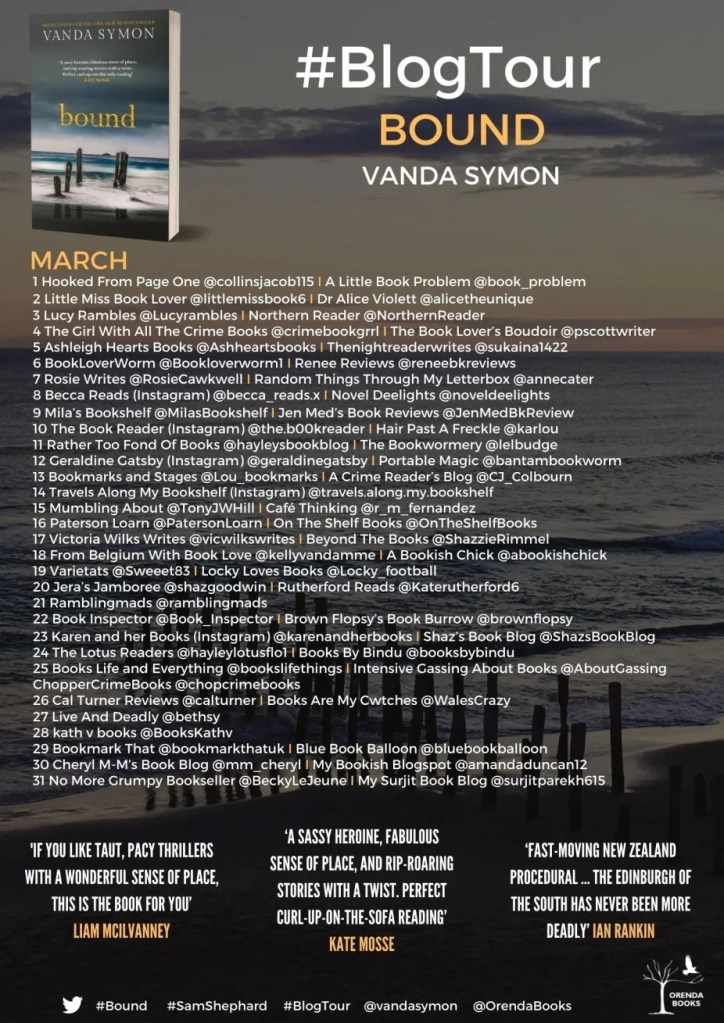
Bound by Vanda Symon.

When the official investigation into the murder of a respectable local businessman fails to add up, and personal problems start to play havoc with her state of mind, New Zealand’s favourite young detective Sam Shephard turns vigilante..

The New Zealand city of Dunedin is rocked when a wealthy and apparently respectable businessman is murdered in his luxurious home while his wife is bound and gagged, and forced to watch. But when Detective Sam Shephard and her team start investigating the case, they discover that the victim had links with some dubious characters.

The case seems cut and dried, but Sam has other ideas. Weighed down by her dad’s terminal cancer diagnosis, and by complications in her relationship with Paul, she needs a distraction, and launches her own investigation.

And when another murder throws the official case into chaos, it’s up to Sam to prove that the killer is someone no one could ever suspect.

I really enjoyed this crime novel with an interesting lead character, a case with so many twists and turns, and an array of background issues to get my teeth into. Our detective Sam Shephard is a strong woman, adept at her job and extremely dedicated too. She lives with a friend, but is in a relationship with Paul, another detective in the squad. When they get the job investigating the murder of reputable local businessman John Henderson, they soon find a link to a previous case. Two well-known criminals are implicated in the brutal shooting, both of them suspected in the murder of their fellow officer Reihana, and attempted murder of Smithy, who is still struggling physically despite being back at work. They need to find the link between regular business and the less ethically sound dealings that has brought the business into the criminal underworld. However, they also need to make sure that all of their dealings with the case, including forensics and other evidence collecting, are squeaky clean. Smithy, and to some extent Sam, will have to be seen to take a back seat on this one. Besides, once the link is found, between the gangsters and Henderson, it should be cut and dried, but is it? Why did they leave his wife Jill bound to a chair, alive? It is possible that someone else in Henderson’s life have reason to kill him?

Sam finds herself impressed by their teenage son, who has had the presence of mind to film the crime scene on his phone before freeing his mother. She creates a good rapport with him and manages to get important evidence about their potential suspects and their business dealings with his father. Sam works with a lot of integrity and will not accept the easy answer, until she’s uncovered everything. She would love to find their suspects guilty, but has her own idea about the motive for this crime that goes against what they know so far. This puts her in contention with the DI and he is not happy, they’ve been butting heads a lot and he’s not going to back her theory. Sam may have to go it alone here and do enough to prove her theory, without him.

I really enjoyed Symon’s mix of the professional and personal in Sam’s life, it felt like a good balance between the two. Sam is trying to keep her relationship with Paul on the down low, but circumstances may be taking that decision out of her control. There was also an interesting family dynamic, as Sam’s father is brought to the hospital and will be discharged to a hospice. These are possibly the final weeks of his life, but it’s clear that her unpleasant boss DI Johns will be less than sympathetic. Even sending her out of state on an errand. Her Mum seems less than impressed with her dedication to her job. There’s clearly history between Sam and her Mum, who accuses her of not being there for her Dad. Sam protests that she will, but her Mum rejects her promise. Sam manages not to snap back knowing that her Mum is angry and scared about her husband and the future, it how long will she able to stay silent. The moment when she sits quietly with her father and whispers to him the one secret she hasn’t told anyone, was so moving.

The pace of the novel is great – one of those where the short chapters create that ‘I can fit in one more chapter before bed’ feeling. Developments come at us thick and fast, both in the case and in her personal life. What I loved is Sam’s absolute dedication to her job, and determination to uphold New Zealand’s laws. Often when female characters have struggles in their personal life, things start to fall apart at work. Not so for Sam, she is good at separating her work life from home life, despite her mother’s digs about her loyalties. I felt I was getting a fully rounded character, not the usual stereotype about strong, working, women who have a messy love life, divorces, a drinking habit. Although we get personal with her, I came out of the novel admiring a good detective, with a full professional and personal life. The fact that this stood out to me is worrying and says a lot about how professional women are still portrayed in fiction. The story kept my attention because it was full of small surprises, such as Henderson’s assistant Astrid, whose previous CV was unexpected. This led me to expect bigger twists and I kept on reading. The author left us a few loose ends too, and I’m a sucker for the unresolved bits. Plus now I’m already hooked into the next book!

Meet The Author
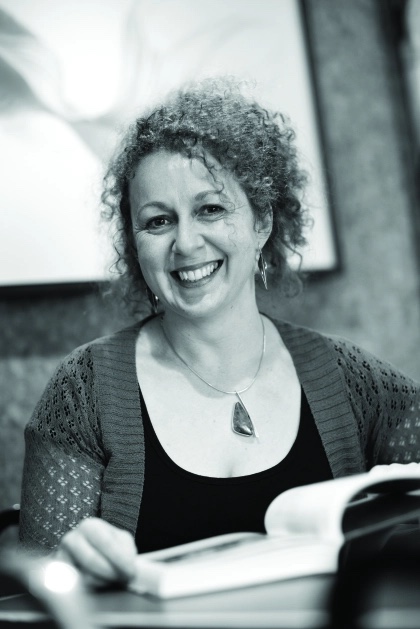
Vanda Symon is a crime writer, TV presenter and radio host from Dunedin, New Zealand, and the chair of the Otago Southland branch of the New Zealand Society of Authors. The Sam Shephard series has climbed to number one on the New Zealand bestseller list, and also been shortlisted for the Ngaio Marsh Award for best crime novel. She currently lives in Dunedin, with her husband and two sons. –This text refers to an alternate kindle_edition edition.
Posted in Publisher Proof

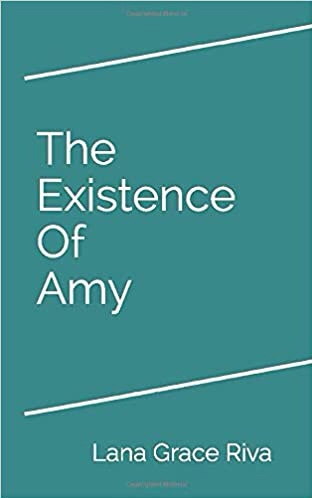
The Existence of Amy by Lana Grace Riva

This book is a great insight into something a lot of readers will relate to, especially at the current time when we’re in the middle of the third lockdown of this pandemic. Mental health referrals are soaring, particularly for anxiety, OCD and depression, and although I’m not counselling at the moment I know there are clients who would really benefit from reading this book. It definitely helped me too. Some people expect counsellors to have their mental health in tip top condition, but often we’re ‘wounded healers’ who have experienced mental ill health. I’ve had bouts of depression and anxiety in the past, and so do others in my family, which lead me to a career in mental health. I encourage clients to read books like this one. There’s a great sense of solidarity in knowing you are not alone, gaining an insight into what someone else’s inner thoughts are like, and how they affect their day to day lives.

Amy is the narrator of the novel and despite functioning well on the surface, she has all three of the conditions I’ve already mentioned. Amy works full time, has a home to maintain and manages to keep up with friends. On the outside she is coping. Inside though, she is battling against a constant, exhausting, barrage of intrusive and dark thoughts. I thought the author did an incredible job of creating this relatable and loveable character, because it helps the reader empathise with her daily difficulties and journey moving forwards. It’s a very difficult balancing act to show the reader how it feels to be in Amy’s shoes while creating an easy and engaging read that never felt too heavy. The writer shows us how simply daily living, like going on a bus journey. Amy has to somehow negotiate paying, balancing while the bus is moving, and getting the bus to stop while all the time her brain is screaming ‘Don’t touch that handrail’ or ‘don’t press the button’. Then the hardest part of all is keeping a serene, swan-like surface so that nobody around her notices anything different. Followed by the constant worry about whether people noticed or thought she was weird.

I felt Amy was in a position a lot of people with these mental health conditions face; she could identify her anxieties and concerns as ‘wrong thinking’ but she needed coping strategies for day to day. At lot of readers might identify this as a time when they were part way through therapy, or when facing a flare-up of their symptoms and needing to update or refresh their coping skills.

I found Amy very difficult to leave within the pages of the book when finished. She played on my mind for a few days as I thought about her struggle and what insights I’d gained from the novel. Therapists read case studies all the time, but it was impactful to experience Amy in the format of a novel. Clients bring to therapy their frame of reference. The therapist sees events through their eyes and accepts their account as their ‘lived experience’ without judgement. There are times when we might sense another version of events, and this is what the novel gave me. I felt more immersed in her life, could see how she functioned with family and friends, and in her work situation. The author stripped away all the medicalised jargon and the impersonal language of a case study and instead gave me a fully-fledged person to know inside and out. I did find myself running through how I would help and support Amy.

The novel emphasised something I’ve always thought vital for someone experiencing these conditions; the existence of a strong, support network. In fact, Amy hits her lowest point when her closest friend announces she’s moving overseas. When we’re feeling mentally unwell we don’t always recognise or feel able to accept offers of help. Being honest with friends and family about how we feel and allowing them to support and help us as we move on is so important I felt a lot of hope for Amy going forward, and for the clients I will be able to help more fully after reading her journey.

Meet The Author

Lana Grace Riva has written two books, one nonfiction the other fiction, both based on her experiences of mental health. Her first book ‘Happier Thinking’ is a short collection of tips and exercises to maintain a healthy mind. Her second book ‘The Existence Of Amy’ is a fictional story based on a very real depiction of mental illness. 

Website: https://lanagraceriva.com/
Instagram: @lanagraceriva
Twitter: @lanagraceriva

If you enjoyed this I would also recommend the memoir Pure by Rose Cartwright for an insight into Pure OCD.

Posted in Netgalley

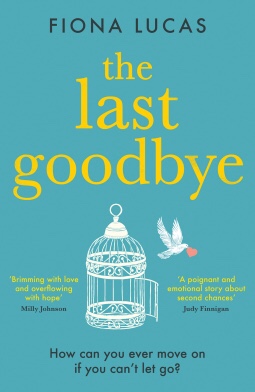
The Last Goodbye by Fiona Lucas

This romantic comedy had an unusual premise, but first attracted me because of the cover! I have a tattoo exactly the same on my lower back with a quote from Jane Eyre, so I was interested to know why the image represented the book.

Our female protagonist, Anna, is in the throes of grief after the death of her husband. The plot hinges on an interesting device – Anna calls her dead husband’s phone number and weirdly, someone answers. A tentative friendship develops allowing her to explore the anger, numbness, false starts and maelstrom of emotions as she rebuilds her life after such a huge loss. The first call happens on a New Years Eve just over two years since Anna lost Spencer. She has been coerced by her friend Gaby to go to a party and is suffering just one of several attempts over the last few months to set her up with a nice man. Of course whenever Anna meets someone new, it’s like a klaxon goes off in her head screaming ‘not Spencer’ over and over again. On this night Anna flees the party and heads for the comfort of home and for emotional support she rings Spencer’s mobile number, thinking that hearing his voice on the answerphone will reassure her. However, instead of hearing Spencer’s voice, a strange man comes on the line saying ‘ I beg your pardon’.

As more weeks pass and Anna feels so scared of leaving Spencer behind and living in the moment, she continues to call the number and talk to the man at the end of the phone. A friendship starts to emerge between her and the man who has inherited Spencer’s old number. His name is Brody and Anna starts to realise she is not the only one who wants to live in the past. Brody gives Anna the space to grieve. He doesn’t know Spencer so he has no vested interest or conflicting opinion to intrude on Anna’s grief process. In this way he acts rather like a therapist with empathy, zero judgement and a hope Anna will get through this. Other people in her life either want Anna to move forward when she is not ready, or to wallow in grief. Her friends seem to think two years is enough time to start moving forward and although they are well-meaning their interventions annoy Anna and push her too far too soon. Spencer’s mother Gayle wants to envelop Anna in her grief process. She assumes that because they both loved Spencer, their grieving process is the same. Anna keeps up their tradition of Sunday lunch together, just like when Spencer was alive, but also pores over old photo albums and still wants them to mark anniversaries like his birthday together. In her presence Anna becomes suffocated by grief and guilt when she thinks about moving on with her life. Anyone new in Anna’s life would seem like an insult to Gayle. There is nowhere she can do this grieving thing her way, honestly and openly.

My counselling supervisor used to say that if you find yourself giving the same piece of advice to several clients, it may be something you should look at for your own life. This is definitely the case with Brody, as he gives Anna advice he could do with listening to. Brody is living an isolated existence on Dartmoor with his dog. He allows Anna’s emotions to take the lead in their phone calls, but doesn’t seem keen to divulge his own. I started to wonder why he is living the life of a hermit. What is he hiding away from? Between Brody and her best friend Gabi, Anna starts to feel she can gather all these broken fragments of herself together and start to rebuild. The author found a unique structure for the novel, that allowed Anna’s raw grief to find its voice in these late night phone calls. Brody becomes Anna’s closest friend and with Gabi’s help, she now has hope and a way forward that is so uplifting for the reader. Both the main characters have such moving stories they bring a lump to the throat and their journey through grief is brilliantly rendered by the author. She shows us that each person’s grief is individual, it has its own path with unique highs and lows. She also depicts something I often say to – you can’t get round or climb over grief, the only way out is through it. I could see Anna reaching for the other side of her pain and I found myself wishing for Brody to find his way out too.

What a beautifully written account of grief this is. I was moved and uplifted, and the experience of grief felt very authentic. So what about the cover image and that tattoo? My husband died in 2007 and I rushed my grief journey, only to end up in an abusive relationship that took three years to leave. So, on my fortieth birthday I had my birdcage tattoo and underneath the words from Jane Eyre ‘ I am no bird; and no net ensnares me’. It reminds me I can get through anything so it feels like a fitting image for Anna and Brady’s story.

Meet the Author

Fiona Lucas is an award-winning author of contemporary women’s fiction. The Last Goodbye is her first novel written under this name, but she’s been writing heartwarming love stories and feel-good women’s fiction as Fiona Harper for more than a decade. During her career, she’s won numerous awards, including a Romantic Novel Award in 2018, and chalked up a no.1 Kindle bestseller. Fiona lives in London with her husband and two daughters

Posted in Random Things Tours

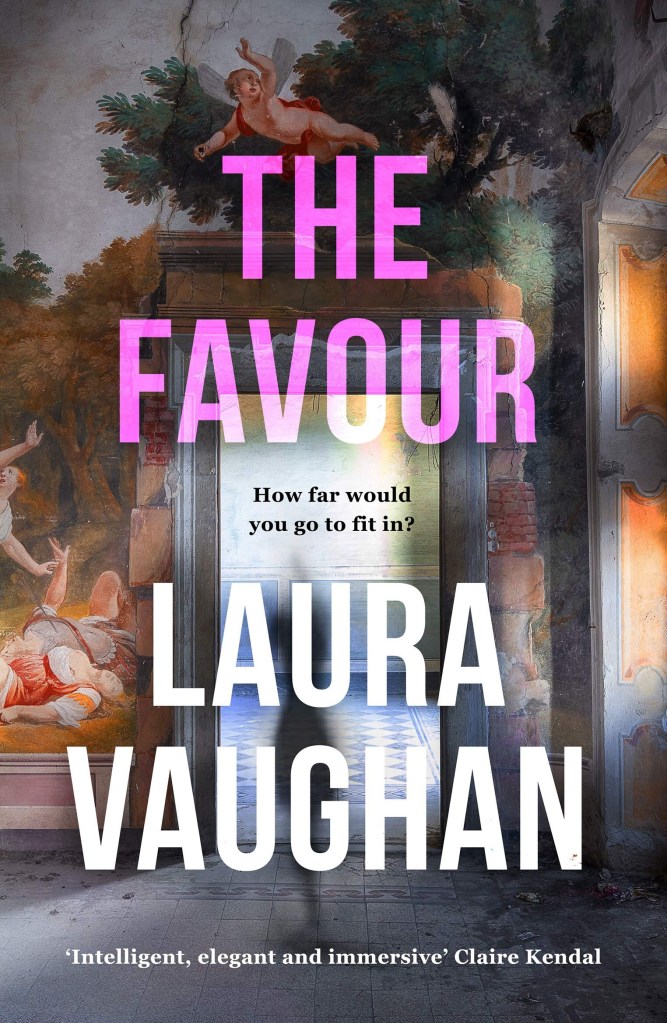
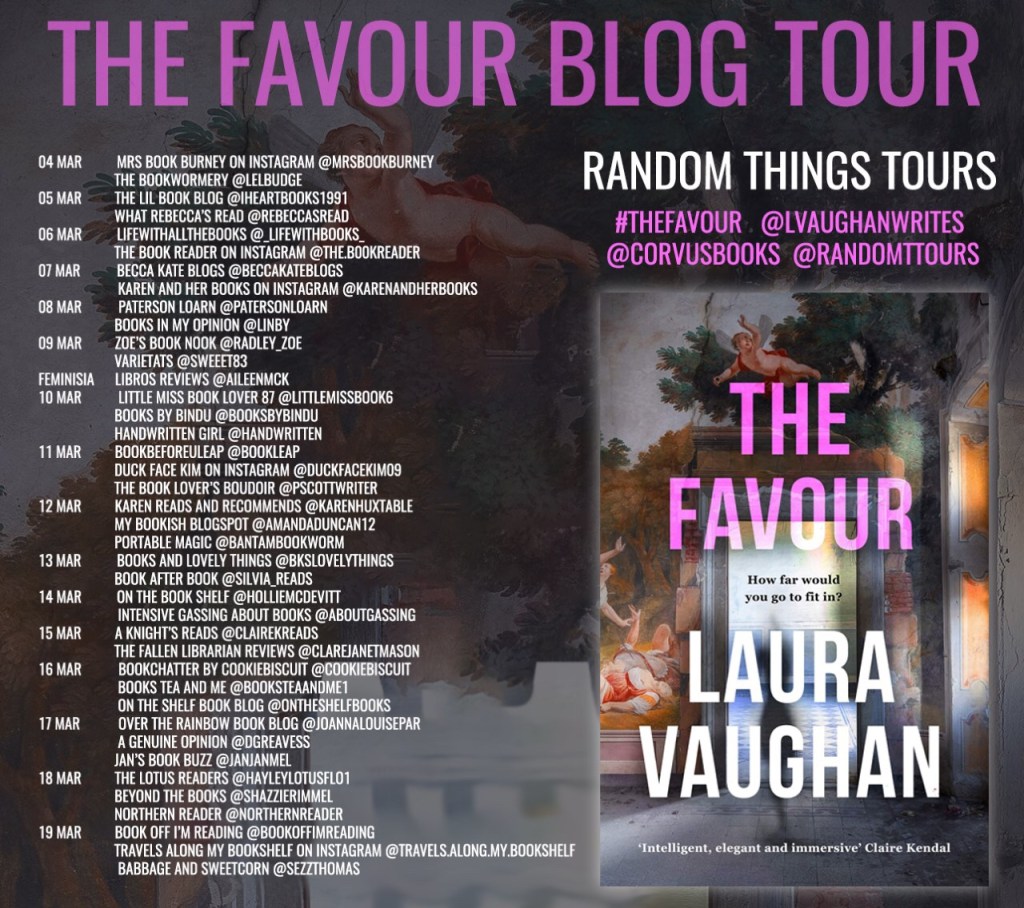
The Favour by Laura Vaughan.

Fortune favours the fraud…

When she was thirteen years old, Ada Howell lost not just her father, but the life she felt she was destined to lead. Now, at eighteen, Ada is given a second chance when her wealthy godmother gifts her with an extravagant art history trip to Italy.

In the palazzos of Venice, the cathedrals of Florence and the villas of Rome, she finally finds herself among the kind of people she aspires to be: sophisticated, cultured, privileged. Ada does everything in her power to prove she is one of them. And when a member of the group dies in suspicious circumstances, she seizes the opportunity to permanently bind herself to this gilded set.

But everything hidden must eventually surface, and when it does, Ada discovers she’s been keeping a far darker secret than she could ever have imagined…

I’m drawn to any book based in the beautiful cities of Italy, but I was also drawn by the premise of Ada’s inability to accept a change in circumstances after the death of her father means selling off the family’s ramshackle mansion in Wales. I felt that I might understand someone struggling to fit in between social circles having come from a working class family then through my 11+ ending up at a very middle class grammar school. I found it very hard to fit in, but once I did, it was just as difficult to fit back where I’d come from, forever caught between two different tribes. However, Ada was in another league altogether, totally unable to accept the life her mother had created for them. A period terrace in London and the local secondary school are not enough for her, nor is a stepfather with an ordinary, dull name like Brian. Her plan to study at Cambridge, at the same college as her father, falls through when she fluffs her second interview. It looks like she might have to accept her more humble lifestyle, but the along comes her godmother’s offer of a modern grand tour with Dilettanti Discoveries.

Now she has to find a way to fit in with the Lorcans and Annabelle’s of this world and she has a plan for that. Ada knows all the right lingo to seem like one of the group – using the phrase ‘we had to sell up’ is a distinctive one for people of a certain class. It has the scent of ‘distressed gentry’, people who have had to sell off the family pile due to death duties or renovation costs on their large country houses. She even talks about Garreg Las as the family’s smaller home, hinting of a more distinguished estate belonging to her father’s family in Ireland. One by one, as they stalk art galleries and churches, Ada tries to ingratiate herself with the group. Will they accept her story or sniff out the truth of who she is and where she belongs? These are deliciously awful people and there isn’t a single one I’d want to spend time with. They had an air of entitlement and superiority, but it was hard not to enjoy their witty, self-assured conversation. There’s a certain polish and charm that makes them alluring, but it’s all surface. Oliver seems suspicious of Ada, and Mallory has also been picked out as an outsider, being American and Jewish. However, Mallory’s attempts at friendship are shunned by Ada, who desperately wants to belong to the most fashionable set. To ingratiate herself with Lorcan, Ada reveals a secret; she has seen Lorcan’s half-sister Annabelle in a romantic clinch with one of their tutors. She agrees to keep the secret between them, to place herself at the centre of the group. Then, when a suspicious death occurs, Ada is not just at the centre of the group, she’s at the centre of a potential crime. She makes a decision to grant one of the group a favour, something you might barely notice, but it furthers Ada’s quest to belong. If one of the group owe her a favour, surely she becomes accepted forever? I didn’t even think about what it could mean going forward, but that’s how clever the book is. You are captive, watching each consequence of Ada’s decision opening up in front of you, one after another, like a set of Russian Dolls.

Meanwhile, in the background, Vaughan creates a beautiful backdrop of art, architecture and soft Italian light. I could imagine what a beautiful film this would make as these intriguing characters stroll through formal Italian gardens, along the Arno or in the twisty, labyrinthine lanes of Venice. All the reference points Vaughan touches upon – such as Ada glimpsing the same fountain where Lucy Honeychurch witnesses a passionate fight in Room With A View – were my own source of inspiration for visiting Italy. Of course the upper classes prefer the more refined Florence, whereas I’ll admit my lower class allegiance to Venice. This revered circle of friends have so many niche rules and in-jokes it’s impossible to negotiate them all, without tripping yourself up. Just like a valuable renaissance painting, being one of the elite is very difficult to fake. In these beautiful backdrops there are constant hints of fakery and disguise: the trompe l’oeil frescos of the country houses; the maze of laurel hedges; the association of Venice with carnival and disguise. Even the example of Room With A View has it’s plot of a well-to-do young girl on her own Grand Tour, trying to keep secret her love for a distinctly lower class clerk she meets at a pensione in Florence. All of this imagery and reference to facade, disguise and things not quite being as they seem adds to the atmosphere and intrigue. It’s like seeing a beautiful bowl of fruit, that at its centre, is rotten to the core. This book will make a great book club read, not only to discuss these awful characters, but to ponder on what we might have done in the same circumstances. As the years roll by, what price will Ada pay and how long can she maintain the facade she has built? This is a complex and intriguing novel, full of flawed characters, with a central character showing all the signs of a borderline personality – Ada simply doesn’t know who she is. There is a void at her centre that can only be filled by imitating and adopting the lifestyle of those around her, with possible lifelong ramifications.

Meet The Author

Laura Vaughan grew up in rural Wales and studied Art History in Italy and Classics at Bristol and Oxford. She got her first book deal aged twenty-two and went on to write eleven books for children and young adults. The Favour is her first novel for adults. She lives in
South London with her husband and two children.
For more information, please contact
Kirsty Doole
Publicity Director, Atlantic Books kirstydoole@atlantic-books.co.uk
07850 096902 @CorvusBooks | @theotherkirsty

Now check out the other stops on the blog tour:

Posted in Throwback Thursday

Throwback Thursday! The Illusionists and Daughter of the House by Rosie Thomas.


My experience of finding these two novels by Rosie Thomas shows that the old cliché ‘never judge a book by its’ cover’ does sometimes apply. I was browsing on my kindle (a lethal pastime) and looking through my recommendations when I came across Daughter of the House. The cover had a magical, ‘circus’ feel that I loved so I had to discover more. It had an historical setting pre- WWI onward; a period I’d been drawn to that year. It also promised a brave, enlightened woman at the centre of the story about growing up in an unconventional musical hall family. I bought it based on cover alone, then realised it was the second in a series of books.The first was The Illusionists and I knew from the cover of top hats, decks of cards and magic wands that this was the series for me. It’s rare for me to find a magical novel set in the late Victorian period that I haven’t read. The title seemed familiar though and it was only the next morning that I found (among the many piles of books that litter the corners of my house) I had a hardback copy of the same novel, but had never picked it up to read. The cover was very different, depicting a bridge over an almost impressionistic river scene, that told me nothing about the contents inside. A friend had bought me the book when it first came out, but due to that cover and the lack of a synopsis on the back it kept being recycled to the bottom of the TBR pile. It showed me a difference between buying physical books and kindle copies. I am often alerted to unusual and highly enjoyable novels via kindle store or apps like Goodreads that I wouldn’t necessarily pick up in a book shop due to the cover. Of course the bonus was that I now had two great novels to read back to back and I was not disappointed by either of them.

Set in 1885 the first novel follows the story of Eliza who is a young woman limited by lack of money whose only choices for the future seem to be the domesticity of an advantageous marriage (an idea she finds suffocating) or a degrading downward spiral towards life on the streets. Despite the massive social changes happening in fin de siècle London, women have less chance of making their fortune and living life on their own terms. Then she meets the charismatic and ambitious illusionist Devil Wix. Devil is haunted by traumatic events in his childhood, but is determined to become a household name and successful entrepreneur in the theatre world. We follow Devil’s mission as he puts together a band of quirky misfits to put on the greatest show London has ever seen in the run down Palmyra Theatre. During the 12 years covered by the novel Devil is by turns alluring, brilliant and often comical. However, from his friend’s and Eliza’s point of view he can be elusive, maddening and deceptive when he wants to be. Somehow though, the reader is able to forgive him anything. Perhaps this is because we are charmed by him in the same way Eliza is. Two friends work alongside Devil. His magician friend Carlos and set/props designer Jasper. Carlos is a dwarf in stature, but has mighty magical ambitions of his own and with Devil creates new and memorable illusions to stun audiences. Jasper is more of a scientist who tinkers away in his workshop creating the props for the illusions, but has also designed an automaton he names Lucy. As soon as Eliza comes into their world it is as if the circle of friends is complete and they work together to create a magical show. Although it seems inevitable that they will be together, Devil and Eliza’s courtship is a slow dance. Their budding relationship sees Eliza step outside what is thought to be respectable for a Victorian woman and embark upon an alternative life she never thought possible. For Devil the relationship brings him the stability he has never had and a partner in work and life who can match him for determination, ambition and creativity.

The magical and more supernatural elements of the novel are balanced beautifully with the historical period detail. Eliza chooses to live in a women’s hostel and work for a living even before she becomes involved with the theatre crowd. This is a bold, modern choice that tells us a lot about her character. The author uses Eliza’s sister as the contrasting Victorian ideal of ‘The Angel in the House’. Eliza’s visits to her sister’s home show us that traditional Victorian domestic life, but while Eliza loves her nieces and nephews she doesn’t envy her sister’s position in society and often seems relieved to return to her unconventional life. She treads a very fine line between what is and isn’t respectable by socialising in bars with Devil, Carlos and Jasper, staying alone with Devil in his flat, becoming a life model at the art school and performing on the stage. She is confounded by her need for Devil to be faithful and exclusive to her.


We also see economic change and social mobility throughout the novel. Devil promotes his shows in a way that has never been done before. First he utilises Eliza’s art student friends to create mysterious adverts across the city, that develop a buzz about his show. He then creates street illusions that are easy to transport and perform, then performs these ‘pop-up’ illusions in the street, handing out leaflets to stunned onlookers. By choosing his streets carefully he attracts wealthy audiences who are happy to spend money and this ensures the theatre is packed night after night. Due to this method of promoting his theatre, and the different audience he attracts, Devil changes what is acceptable as entertainment in upper class circles. Whereas music hall was thought to be low culture and only for the working classes, Devil exploits the human need to ‘keep up with the Joneses’ and makes his theatre the place to be seen.. His entrepreneurial skills result in an upward mobility for his family so they can live in a beautiful area of London and have more opportunities that he had. This is where the story develops into the second novel and into a background of even more turbulent times in the early 20th Century.

Daughter of the House centres on Devil and Eliza’s daughter Zenobia (known to the family as Nancy) against the backdrop of WWI, the Suffragette movement and the decline of music hall. The novel opens as the family embark upon a boat trip and tragedy strikes when the captain decides they must return to port because of a storm. The boat crashes into the marina and it is a fight for survival for Devil and Eliza and all of their children. Thomas creates a beautiful metaphor here in Nancy’s fight to stay above the water as her large Victorian skirts and petticoat become water-logged and start dragging her under. This foreshadows Nancy need to live a different life and break free of Victorian expectations of women, perhaps even more radically than her mother did. In the struggle Nancy not only saves herself, but her brother too and it is here we see the beginnings of her resilience and determination. It is also here that we see the first glimpse of what she calls her ‘Uncanny’ – the ability to see beyond the physical world. Nancy fights against this unique gift and doesn’t want anyone to know about her ability. Yet it is because of this accident that family friend Mr Feather does become aware of her abilities. As his beloved sister is lost in the accident, he begs Nancy to foresee where she is and this episode sets off an obsession that never goes away.


The Palmyra theatre is struggling and Devil has been hiding the true extent of their financial difficulties from his family. Eliza’s growing role as a mother has meant taking time away from managing the theatre and Devil does not have her administrative or financial skills. Eliza loves her children, but is frustrated in the very role she never really wanted. Meanwhile Devil flounders in his management of the Palmyra, making bad financial decisions and failing to provide what modern audiences want to see. As the crisis deepens Nancy becomes aware that her gift, hidden until now, might be the only answer to her family’s problems. The late Victorian appetite for mesmerism, hypnosis and spiritualism has continued into the 20th Century and Nancy’s gift soon begins to fill the theatre. So, as WWI draws to a close, the Palmyra is once again playing to packed houses as grieving families in their thousands want to find their lost sons, fathers and husbands still lying unfound in the battlefields of France. Thomas shows the social and historical change of three difficult decades so cleverly especially the wake of WWI as women become more in control of their lives and a country grieves a generation lost. For those who survived, the need for to forget the horrors of war can be seen at the raucous country house parties of Nancy’s theatre friends. The breakdown of class barriers becomes apparent as Nancy’s brother transcends his family’s social class, becoming an officer in the army and attracting a wife from an aristocratic family. Alternative ways of living are explored as the author shows us more women living alone, and Nancy’s gay best friends who have openly set up home together. Yet, we also see what post-war living could be like for the lower classes who acquired injuries, but can’t afford adequate care or rehabilitation. Nancy’s brother returns home with shell-shock and finds coping with the outside world beyond his capabilities, instead finding solace in his garden.

The book explores Nancy’s struggle with a rare and beautiful gift that can also be terrifying and unexpected. Her rivalry with Mr Feather highlights the darker side of clairvoyance and ultimately ends in unwanted confrontation. We see the need in people who desperately want to hear from their lost loved one only to be disappointed. A disappointment that can develop into an obsession and an inability to move forward in the grieving process. Nancy wrestles to maintain the purity and honesty of her gift; never pretending or creating hope where there is none. Audiences fail to realise that she is unable to control her gift. It isn’t like picking up a telephone, she doesn’t know who or what will come through. However, audiences want the reassurance that they were seeking, or the guarantee their loved one lives on somewhere in the afterlife and is waiting for them. Nancy tries to give no promises and does not want to offer false reassurance, if forced to give the exact promise they seek, she feels she has betrayed herself and her gift. This is the difference between true clairvoyance and show business and for Nancy they are uneasy bedfellows. What she sees is not always spectacular nor the happy ending an audience might be hoping for. This dilemma rang true for me as something all people with these gifts might face and it shows that making money from her ‘Uncanny’ is not as going to be as easy as her father’s magic tricks; if she is going to do it with integrity.


I would recommend reading both of these books, but they do stand-alone too. The Wix family are entertaining and intriguing, the historical backdrop is well researched, and even the smaller characters are well written and memorable. Carlos’s determination to overcome his disability is inspiring and his friendship with Devil, like all showbiz partnerships, is full of ups and downs. Eliza’s sister and brother-in-law are there to provide a contrast to the Wix’s unconventional relationship, but their characters are still well-rounded and the relationship between the sisters feels real. Eliza’s realisation that having children is all consuming and life-changing creates an unexpected affinity with her sister. She recognises that even if you want an alternative way of life, children always create a need for a strong family network and support around you. In the early 20th Century women’s lives are changing, but not that much. Eliza’s daughter, Nancy, realises that even though she is more accepted as a strong independent woman she is still hampered by her class and bohemian background. Despite feeling free to pursue her love for a married man, she finds that this freedom is not all she imagined it would be and yearns for more. If you want page turning story-telling with a supernatural and magical twist then these are the books for you.

Posted in Netgalley

The Disappearance of Stephanie Mailer by Joel Dicker. Translation by Howard Curtis.

I’m revisiting this book and expanding on my original NetGalley review for this blog blast, as I recover from moving house and suffering an infection from a nasty cat bite! So, I’ve refreshed my memory and really thought about this interesting book again. First of all, here’s the blurb:

A twisting new thriller from the author of The Truth about the Harry Quebert Affair

In the summer of 1994, the quiet seaside town of Orphea reels from the discovery of four murders.

Two young police officers, Jesse Rosenberg and Derek Scott crack the case and identify the killer.

Then, twenty years later and just as he is on the point of taking early retirement, Rosenberg is approached by Stephanie Mailer, a journalist who believes he made a mistake back in 1994 and that the real murderer is still out there, perhaps ready to strike again. But before she can give any more details, Stephanie Mailer mysteriously disappears, and Rosenberg and Scott are forced to confront the possibility that her suspicions might have been proved true.

What happened to Stephanie Mailer?

What did she know?

And what really happened in Orphea all those years ago?

For me, this author manages to do something very clever with his novels. He writes thrillers that keep you hooked, while delivering a strangely relaxing read. It’s like the same feeling you get watching a really good TV series; in the days before multi-channels and Netflix, English dramas tended to be short and low budget, whereas American and Scandinavian channels invested money at their dramas, often delivering 22 episodes per season. These longer dramas allow every character to develop and lets the story breathe. If the series is a thriller there can be so many twists and turns over a longer time, red herrings can develop and be dismissed, and the tension of the last few episodes becomes unbearable. That’s what I felt happened with this book, it’s slow and characters change and surprise you. I think readers may have a bit of a marmite reaction to it – those who like their thrillers short and snappy will be frustrated, but those who love to explore character, setting, and a tale that meanders through many twists and turns before revealing the truth, will love it. It’s every shade of grey, rather like life.

The dual timelines of 1994 and 2014 work very well, with the past informing the future for the reader. Both cases are also intriguing and form an interesting contrast. The 1994 shootings are so dramatic, public and involve many victims, whereas the 2014 disappearance has a less public impact. I found myself constantly asking if Stephanie disappeared because of the 1994 case she’s investigating for an article – opening old wounds in a small town that wants to believe it caught it’s killer – or whether something more personal and unrelated was happening. The fact that she turns up just as Captain Jesse Rosenberg is about to retire seems too much of a coincidence though. Jesse is a likeable character, a good, honest cop whose diligence sets him apart. Despite his impending retirement, Stephanie’s disappearance and the knowledge that his findings on the original case were wrong, leave him determined to solve both cases before he leaves. However, Jesse and colleague Derek Scott became small town celebrities for solving the 1994 shootings, and maybe they liked the status and boost to their careers a little too much? It would be very difficult to accept they were wrong, but Jesse seems to do that and appears determined to find the truth of both cases. I also found myself questioning the circumstances of the original case. We know that the original investigation was wrong, but not why it was wrong. The mayor and his family were shot dead, but across the street a jogger called Megan is also shot, in the back of the head. Was this a case of wrong time, wrong place, for Megan? Did she see something that would have revealed the killer? Or should we be turning the whole case on its head? What if Megan was the intended victim all along?

These were just some of my thoughts as I wandered through this slice of small town life gone wrong. I love convoluted plots where I have no clue where I will end up in a few chapters time. All too often in thrillers, the truth is easy to work out early on, but here I had no idea and an array of clues and characters to decipher. This novel was long, but it has to be so the reader isn’t overwhelmed with the amount of information. It didn’t feel daunting though, and the writer’s technique of building tension towards small revelations throughout, certainly piqued my interest and kept me reading. Yes, maybe the novel might have benefitted from cutting a couple of characters or points of view. However, it might have lost that constant feeling of uncertainty needed in a good thriller. This is a slow burner of a novel, packed with possibilities and the odd red herring or two to keep the reader on their toes. In the last few chapters I couldn’t wait to uncover the truth, because the long build-up had intensified the tension. The manner in which the truth is revealed was a surprise, as if by accident rather than spelled out in black and white like a traditional detective novel. I felt this contributed to the ‘realness’ of the story; how many real life killers are arrested for something quite different at first? Life is full of multiple characters, faulty memories, strange cul-de-sacs and a million shades of grey, and that is exactly what the author has represented in this novel.

Posted in Random Things Tours

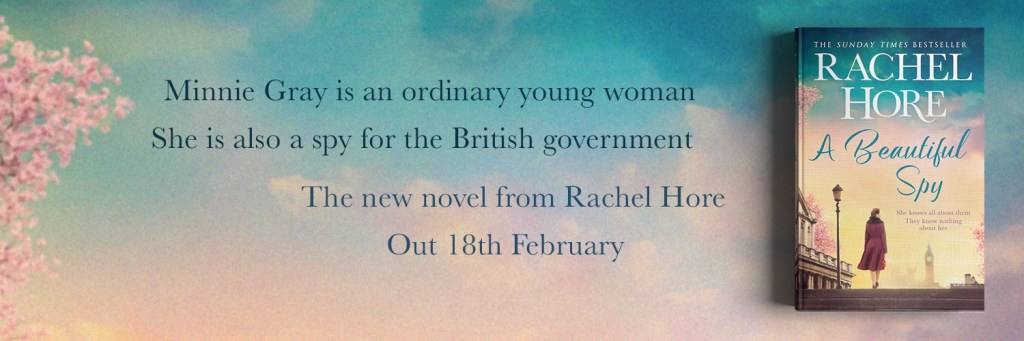
A Beautiful Spy by Rachel Hore

Minnie Gray is an ordinary young woman.
She is also a spy for the British government.

It all began in the summer of 1928…

Minnie is supposed to find a nice man, get married and have children. The problem is it doesn’t appeal to her at all. She is working as a secretary, but longs to make a difference.

Then, one day, she gets her chance. She is recruited by the British government as a spy. Under strict instructions not to tell anyone, not even her family, she moves to London and begins her mission – to infiltrate the Communist movement.

She soon gains the trust of important leaders. But as she grows more and more entangled in the workings of the movement, her job becomes increasingly dangerous. Leading a double life is starting to take its toll on her relationships and, feeling more isolated than ever, she starts to wonder how this is all going to end. The Russians are notorious for ruthlessly disposing of people given the slightest suspicion.

What if they find out?

I became very fond of Minnie Gray as I started to read this interesting new novel by Rachel Hore. Based on the true story of Olga Gray, a young woman recruited by Maxwell Knight in the 1930s, to infiltrate The Friends of the Soviet Union, the author has cleverly blended fact and fiction to create an intriguing and interesting novel. I loved how Minnie felt a little like a square peg in a round hole – even at home in Edgbaston with her mother (where she feels most like she belongs) she’s restless and somehow a little different to the others. At a garden party, she gravitates towards a woman playing croquet; a woman of very individual and modern style. It’s as if she recognises a woman like this wouldn’t be afraid of shaking things up. They talk about the possibility of Minnie making a move to London, that maybe she could be recommended as someone to work for the government. Minnie is so excited, this might just be that direction and purpose in life she’s been looking for. She wants something for herself, not the stereotypical marriage to a nice middle class man to produce 2.4 children, that her mother expects. She’s fed up of being at parties, dangled before an ever dwindling pool of eligible gentlemen. Her excitement, turns to hope as she waits for a phone call and watches the letterbox, but nothing comes. It’s only when she’s lost hope that a call comes for her to interview and she meets her ‘handler’ Max.

I loved the eccentric ‘Britishness’ of the people Minnie meets in her new life. Most interesting is Max, who has a flat like a menagerie, full of various animals including a parrot. She goes to work at the communist organisation as someone interested in helping others, rather than the cause itself. In order to supplement her income, she takes another niche job, typing for a distressed gentlewomen’s charity. Here she makes friends with another typist and starts to have something like a social life. Minnie is thriving out there on her own, but we are privy to her inner thoughts. She’s plagued with self- doubt – ‘is she doing this right?’ It often seems to her that she’s achieving very little, not important enough within the party to make a difference or furnish Max with anything useful. However, espionage is a long game, and the more insignificant and innocuous someone seems the better. Eventually she seems so much a part of the furniture that she is chosen to do something she never imagined. Having never been further than London, Minnie will be undertaking a mission to India as her career in espionage really takes off.

I could see how much work had gone into research, as well as mixing fact and fiction in such a way that it becomes authentic. The author embedded Minnie into the 1930s from her clothes, to societal norms and mentions of world events such as the rise of Nazism. In snippets of chat at the communist organisation I could hear ideas and concerns about the working class and keeping them on board with a left leading political party. This disenfranchised class would be easy pickings for Oswald Moseley’s fascist party in a couple of years time. This is a time of political turmoil across Europe, as the tensions started in the aftermath of WW1 begin to boil over. The author really emphasises the fear and trepidation of choosing a double life, especially as a woman. I loved Minnie’s determination to be different and do something important, despite often feeling lonely and scared. I felt the author balanced this well with her need for adventure, as well as the excitement and thrill that keeps her going as the work gets more and more dangerous. I thoroughly enjoyed this fascinating book. Rachel Hore has created a wonderful heroine who I found inspiring and authentic, with just a hint of vulnerability that made her so sympathetic. I felt completely transported to the 1930s, due to the author’s knowledge of this time period and her deeply layered descriptions of Minnie’s world. I could close my eyes and picture every setting – Minnie’s home, Max’s flat full of animals, an overcrowded train in India and the wall of heat before the monsoon rain. This was an excellent read for anyone who likes their historical fiction and enjoys determined and original heroines whose courage takes them on amazing adventures.

Meet The Author

I came to writing quite late, after a career editing fiction at HarperCollins in London. My husband and I had moved out to Norwich with our three young sons and I’d had to give up my job and writing was something that I’d always wanted to try. I originally studied history, so it was wonderful finally to put my knowledge to good use and to write The Dream House, which is partly set in the 1920s in Suffolk and London.

Most of my novels are dual narrative, often called ‘time slip’, with a story in the present alternating with one set in the past. I love the freedom that they give me to escape into the past, but also the dramatic ways in which the stories interact. My characters are often trying to solve some mystery about the past and by doing so to resolve some difficulty or puzzle in their own lives.

The books often involve a lot of research and this takes me down all sorts of interesting paths. For The Glass Painter’s Daughter I took an evening class in working with coloured glass. My creations were not very amazing, but making them gave me insight into the processes so that my characters’ activities would feel authentic. For A Week in Paris I had to research Paris in World War II and the early 1960s through films and books and by visiting the city – that was a great deal of work for one novel. Last Letter Home involved me touring a lot of country houses with old walled kitchen gardens in search of atmosphere and to explore the different kinds of plants grown there.

Places often inspire my stories. The Memory Garden, my second novel, is set in one of my favourite places in the world – Lamorna Cove in Cornwall – which is accessed through a lovely hidden valley. A Place of Secrets is set in a remote part of North Norfolk near Holt, where past and present seem to meet. Southwold in Suffolk, a characterful old-fashioned seaside resort with a harbour and a lighthouse, has been a much loved destination for our family holidays and has made an appearance in fictional guise in several of my novels, including The Silent Tide and The Love Child. Until very recently I taught Publishing and Creative Writing part-time at the University of East Anglia, but I’ve just become a full-time writer.

I hope that you are able to find my books easily and enjoy them – I am always happy to hear from readers!

Happy reading!  

Visit Rachel at http://www.rachelhore.co.uk, or follow her on Twitter @rachelhore or Facebook

Posted in Damp Pebbles Tour

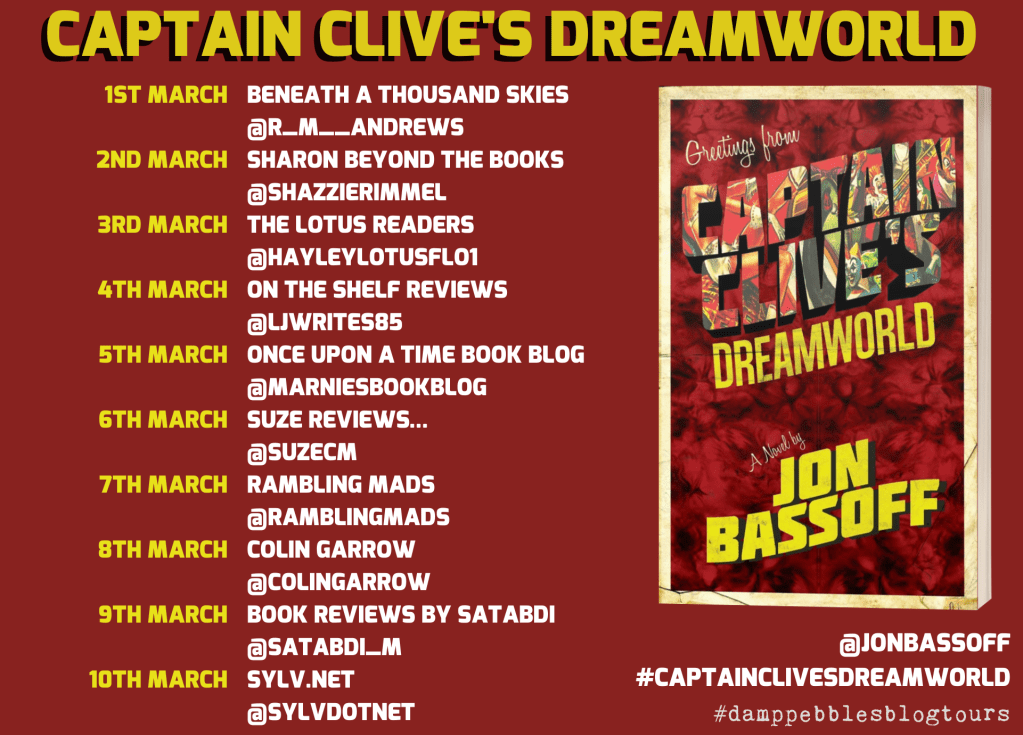
Captain Clive’s Dreamworld by John Bassoff.

After becoming the suspect in the death of a young woman, Deputy Sam Hardy is reassigned to the town of Angels and Hope, which, within its borders, holds the once magnificent amusement park, Captain Clive’s Dreamworld. When he arrives, however, Hardy notices some strange happenings. The park is essentially empty of customers. None of the townsfolk ever seem to sleep. And girls seem to be going missing with no plausible explanation. As Hardy begins investigating, his own past is drawn into question by the town, and he finds himself becoming more and more isolated. The truth—about the town and himself—will lead him to understand that there’s no such thing as a clean escape.

This is such an incredible mix of genres and influences! I’ve seen so many suggestions but for me at different times I felt: The Truman Show, Hot Fuzz, Black Mirror and 1984. Every so often a little lightning strike of recognition would occur – such as everyone denying someone’s presence or dropping strange sayings like ‘the greater good’ – and my brain would fire off into a film or TV series. I also think it’s no coincidence that a lot of these references are visual. This book grabbed hold of my visual memory and didn’t let go. It also felt like a cautionary tale, bringing up some of the same points as Russell T. Davies’s Years and Years. It read as a warning against rampant consumerism and the sort of faux nostalgia people cling to that made Brexit happen in the U.K. I find it strange that a book with so many points of recognition still managed to feel entirely unique.

At first, Sam thinks Angels and Hope seems like a lovely place to live. Almost idyllic. At the centre of this community is the amusement park Captain Clive’s Dreamworld; the town was built to house staff of the park. It’s motto is ‘Where dreams really do come true’ and you could be forgiven for thinking they have. Sam isn’t the average man though, and he starts to notice anomalies. No one ever seems to visit the amusement park for a start, so why are the staff necessary? There’s also the problem of Bridget Bishop, a girl that no one else in the town seems to remember now she’s gone missing. Or maybe they can remember her but are denying her existence? This is the last straw for Sam and he starts to investigate what’s really going on in the village. This is where the book becomes very disturbing, in a couple of scenes that are unexpected and disturbing. However they do seem to fit what I know about Bassoff’s writing, he likes to mash-up genres and expectations. The scenes are also in-keeping with the idea that seems to be the undercurrent of this novel; life is unexpected, our place in it is total chance.

Bassoff seems to be posing the idea that we like to create myths and religions in order to give life pattern and purpose, but they are an illusion. Real life doesn’t seem to have any sense to it and we’re so scared by that, we have to create philosophies that make sense of it. When something terrible happens there is an emotional seismic shock in society, in my lifetime that’s probably 9/11 or the death of Princess Diana. Then, conspiracy theories spring up around the event. People would rather believe a shadowy conspiracy of men in grey, headed up by the Duke of Edinburgh arranged Diana’s death. This is more palatable then a Princess was driven at high speed, by a man who’d been drinking, only to die in a tragic car accident while being pursued by paparazzi. Having watched a bit of David Lynch over the years I was reminded of some of his work. In Twin Peaks we had the beautiful Laura Palmer who is found dead in the river wrapped in plastic and a beautiful town goes into mourning for its Homecoming Queen. However, as people slowly begin to tell their stories it’s clear that this town didn’t know the reality of being Laura Palmer. She was addicted to cocaine, suffering from sexual abuse and sleeping with most of men or women she came into contact with. I remember being quite disturbed by the scenes from the night Laura is killed and her cousin Maddie. This book does the same as Lynch’s work on Twin Peaks and in films like Blue Velvet. Places have a surface, but underneath there’s a dark underbelly that most people never see. So, the revealing scenes are disturbing, but they are also needed for the story being told. The surface story of this book is disgraced cop is moved to a small town with an amusement park promising dreams that come true. Dig a little deeper and we find something terrible.This is far from a world where dreams come true, unless your dreams are nightmares.

Posted in Netgalley

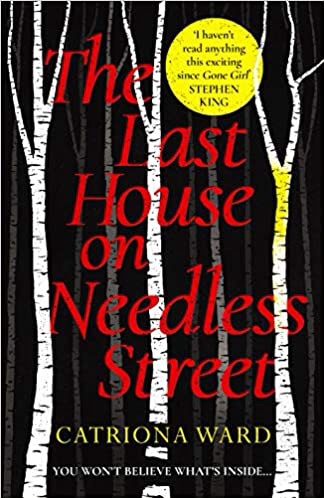
The Last House on Needless Street by Catriona Ward

Publisher: Viper (Serpents Tail) 18th March 2020

I finished this novel in a sort of shell-shocked silence. I felt like I needed to go straight back to the beginning and start again. It is extraordinary and unlike anything I’ve ever read before. It’s also very difficult to review without spoiling other reader’s experience of it, but I have to give it a go.

The house in question is the home of our first narrator Ted. As we read Ted’s view of the world we start to realise there is something unique and odd about the way he experiences the world. He made me feel uneasy. We get a sense that something is very wrong when the birds he loves to watch, are trapped and killed. Ted spends a lot of time thinking about an incident several years before when a little girl disappeared from the lake nearby and was never found. Others might have forgotten, but not Ted and not the girl’s sister who has a huge sense of guilt about her sister’s loss. Ted was a suspect at the time and it’s not hard to see why; he’s a slightly strange loner, living nearby in a ramshackle home with boarded up windows. The girl’s sister hasn’t forgotten that Ted was a suspect and decides to rent the house next door and watch him, in the hope of finally discovering where her sister is. CCTV proved Ted’s alibi at the time, but the sister’s convinced she has found the culprit.

Things take a very strange turn when we meet another narrator, Ted’s cat Olivia. In other hands this might have seemed twee or whimsical, but here it isn’t. It did give me a shock in the first instance, when a narrator I’d assumed to be human, stopped to lick the back of their legs! I loved the way the author played with language in these sections. Olivia doesn’t realised Ted is a name, she thinks it’s a word for his species, so all people are ‘teds’ and dogs are ‘brouhahas’. She describes her love for another of her species, a beautiful cat with emerald eyes that she sometimes spies preening herself, through the cat flap. She also has a belief system, including her very own god who she refers to as LORD. Yet there are aspects of this cat, that are distinctly not cat-like and I started to wonder if all wasn’t as it seemed. Could this cat be someone or something else entirely?

Other narrators are introduced and I was sometimes thoroughly confused, but never contemplated putting the book down. The beauty of the language and cleverness of the structure kept me going, determined to work out what exactly was going on. I was starting to be unsure which sections were real and what was illusion. The author is clearly hugely skilled at creating that sense of the uncanny – when everything seems normal and recognisable, but there is just that sense that something is off-kilter and sinister. This was so psychologically clever and I enjoyed Ted’s visits to the ‘bug man’ who appears to be some sort of psychotherapist, until he appears where we don’t expect him. I was so involved in this world of Ted’s that I was starting to forget the original crime, the loss of a little girl on the beachfront of the lake. The writing is so involving that I was inside Ted at times and the uneasy feeling is that you will never be able to get out. I guessed some of what is going on, but not the whole and I love the ambition and audacity. This is a unique, original and deeply creative piece of work that enthralled and stunned in equal measure. Ward is a writer of immense imagination and talent and I feel privileged to have been given the chance to read this before it hits the shelves and becomes a phenomenon.

Meet The Author

CATRIONA WARD was born in Washington, DC and grew up in the United States, Kenya, Madagascar, Yemen, and Morocco. She read English at St Edmund Hall, Oxford and is a graduate of the Creative Writing MA at the University of East Anglia. Her next gothic thriller, The Last House on Needless Street, will be published March 2021 by Viper (Serpents Tail). 

Ward’s second novel, Little Eve (Weidenfeld & Nicolson, 2018) won the 2019 Shirley Jackson Award and the August Derleth Prize for Best Horror Novel at the 2019 British Fantasy Awards, making her the only woman to have won the prize twice, and was a Guardian best book of 2018. Her debut Rawblood (W&N, 2015) won Best Horror Novel at the 2016 British Fantasy Awards, was shortlisted for the Author’s Club Best First Novel Award and a WHSmith Fresh Talent title. Her short stories have appeared in numerous anthologies. She lives in London and Devon.

Posted in Uncategorized

Books of the Month. February 2021.

I’m going to let you into a secret about book bloggers. When it comes to blog tour invites we’re like kids in a sweet shop. I knew I’d be moving around this time this year, but when the emails roll in it’s so tempting to say yes and think about the consequences later. So, in the month I attempt to move two adults, two teenagers, a dog, two cats and over 1500 books (yes I counted) I took on seven blog tours. Four of them in the week of moving, and having to use my other half’s phone as a hot spot because he had the broadband turned off three days too early. We are existing with only four of everything in the kitchen, and walking around sideways through corridors of boxes marked ‘Books Hallway’, ‘Books Office’ and ‘HAYLEY’S MARCH TBR DO NOT TOUCH’. This is only the first phase too. The next weekend is when my furniture comes that’s been in storage. When I met my other half he was living in a three storey town house and I was in a tiny barn. When it came to moving in together it had to be the townhouse because we couldn’t all fit in my tiny barn. Of course we were so in love that waiting and buying something later simply wasn’t an option. Three years ago it was’i love you, I can’t live without you’; last night as I was going to sleep I apparently said ‘I’ll never leave you; I couldn’t face the packing’. My vertigo is playing up, I have one swollen eyelid and I’m having nightmares about catching two semi-feral cats on Friday morning. Despite this it’s been a great month for books,

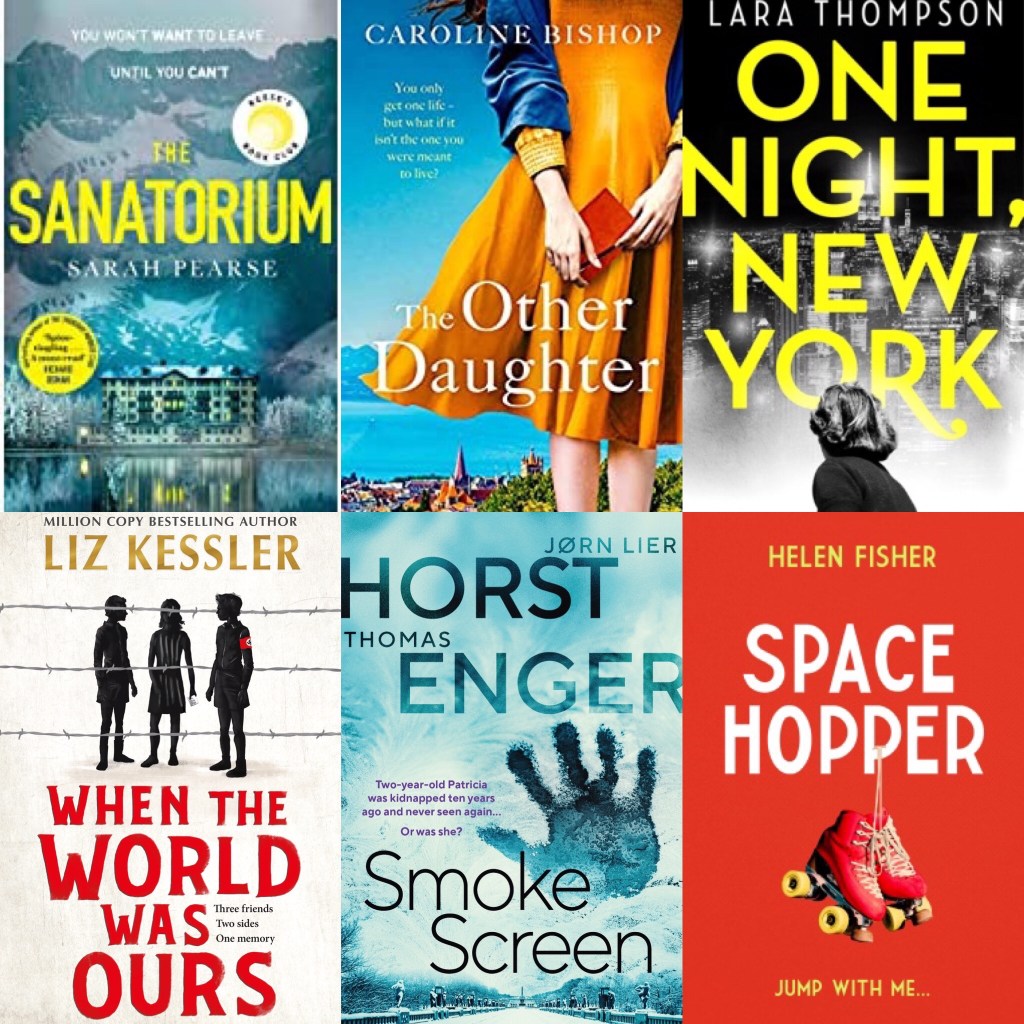
Sarah Pearse’s The Sanatorium was an unsettling read for someone who gets claustrophobic and the author used cleverly layered ideas and images to push that sense of being trapped. The Sanatorium was a rehabilitation hospital for people with TB in Switzerland; being trapped in your body and struggling for breath is in the very DNA of this building. Redesigned by a famous architect, it is now a luxury hotel where Elin and her boyfriend Will have been invited to celebrate her brother’s engagement. Our heroine, Elin, has panic attacks and is haunted by the thought of drowning. The remote location, prone to becoming cut off by avalanche, feels like it’s weighed down by its own past. Added to this was the sinister sound of breathing through a mask, as a killer stalks the grounds and the halls in a black, rubber gas mask. With so many secrets to unearth, Elin tries to rely on her police training to investigate, but until her own family secrets are uncovered can she unmask the killer and their motives? This was a great thriller, full of atmosphere and built on a sinister history.

Also set in Switzerland and full of family secrets is Caroline Bishop’s debut novel The Other Daughter. Part historical fiction and part dissection of mother/daughter relationships this is a dual timeline structure that works well. In the present day, Jess is learns a shocking secret about her birth that affects her so strongly she is struggling to function. Her godmother suggests she take a sabbatical from work and look for answers surrounding her mother and time she spent in Switzerland researching the women’s rights movement. Switzerland didn’t give women the vote until the 1970s, a fact that has always shocked me. Our other timeline follows journalist Sylvie as she pitches the idea for a story to her boss, and takes a research trip out to Switzerland. The truth comes to light slowly as Jess tries to uncover what happened, then Sylvie’s chapter show us what it was like to be there at that time. I found myself drawn in by these interesting women, such well rounded and believable characters. The sense of place was very strong in Switzerland and London and it’s clear that an awful lot of research went into bringing this chapter of history to life. The book made me think again about who gets to write history, and how much we need journalists like Sylvie to bring another part of the jigsaw to light. A brilliant debut about women’s rights, but also relationships between mothers and daughters.

Another book about mothers and daughters is Helen Fisher’s brilliant time-hop novel Spacehopper. I was a child of the 1970s/early 1980s so much of the background of this novel felt strangely familiar. Faye lost her mother when she was very young, so knows how important it is to create moments and family traditions for her daughters Esther and Evie. When looking for Christmas decorations in the attic, Faye finds an old box that has moved with her from house to house. It’s the box for the space hopper her Mum Jeanie bought for her one Christmas. It brings back so many memories of wonderful times she had with her Mum, but also stirs up the emotions of finding herself alone in the world. Faye has a photograph of the day she unwrapped this box and it is her only tangible link with her mother. Although Jeanie isn’t in the picture, it’s just Faye stood in the box, everything about it is suffused with love and it makes her realise how much she lost when her mum died. As she stands in the box once more, Faye finds herself back in the 1970s under their old Christmas tree. She’s now an intruder in her childhood home, which means her six year old self and her mum are both asleep upstairs. I loved the audacity of the concept, it made me smile and I trusted the author to take me somewhere special. This is a curious mix of time travel, loss and the relationships between mothers and daughters. It asks the question of whether we can ever truly know our mothers and would we sacrifice our ‘now’ to spend just one more day with the person we’ve lived and lost. Humorous, heartfelt and so incredibly charming, I really loved this incredible debut.

A much darker tale of mothers and daughters emerges in this atmospheric slice of Nordic Noir written by two of the genres best writers and the second in their Blixx and Ramm series. Smokescreen starts with a bang, as on New Years Eve a bomb goes off at the harbour where revellers are gathering for the countdown to midnight. Journalist, Emma Ramm, has escaped her flat, and visiting boyfriend Casper, for some air and alone time when a bomb explodes in a dustbin, killing those closest and injuring dozens of others. Emma is shocked to find Casper, fatally injured at the centre of the explosion – he must have set out to meet her. Detective Alexander Blixx is soon on the scene and his attention is drawn to a body found in the water, someone he remembers from a previous case. Could one of them find who left the bomb? Is there a link with the cold case of a missing child that haunts Blixx? This book starts at a steady pace, slowly adding tension – one scene of a lone hotel worker followed as she’s walking home really stood out for me. As revelations come thick and fast you will not want to put this down.

One Night, New York is another novel that becomes addictive the further you read. Frances flees the Great Depression in Kansas for New York City life with her brother Stan. On the train she meets a bohemian pair, a journalist and photographer, who are fascinated by her untouched beauty and give her their card. So starts a tale of corruption, crime and exploitation that begins and ends with a tense stand off at the top of the Empire State Building. As Frances is introduced to art, fashion, champagne and the decadent 1930s, her brother Stan is embroiled in the dark underworld beneath the glamour. Girls are going missing; young naive girls lured into the sex trade or as escorts to wealthy and powerful men. Frances befriends Agnes, the photographers assistant and for the first time has a true soulmate. Agnes holds a terrible secret, her sister is one of the disappeared and she knows who’s responsible. Frances has a secret too, the terrible reasons she left Kansas. Highlighting the differences between rural poverty and city exes, Frances finds that newcomers are expendable in Manhattan and no one is who they seem. I loved Frances at once and although she left Kansas with no innocence to lose, there was still an awakening of sorts: a sensual awareness of art, fabrics, photography and her own sexual desire. She’d seen very little kindness in her life and I found myself hoping for happiness.

Finally, comes Liz Kessler’s novel about three childhood friends in Vienna before the start of WW2. As the Nazis begin to make their presence felt in Europe these three friends will find their paths going in different directions. This novel really does show evil, as it’s experienced by innocent children. Leo, Elsa and Max spend all their time together in and outside of school, but things are about to change. Told in three narratives, from each child’s point of view, we experience first hand their confusion, sadness and fear as life changes. From Jewish families, Elsa and Leo have different options: one family chooses to leave Vienna and the other stays for the Nazi occupation. It was heart rending to see Leo and Max separated at school, especially to hear their inner thoughts wondering why, when nothing has changed since yesterday? I was moved by Max, whose father is determined to further his position in the party, by openly violent means if necessary. When he forces his son to shout anti-Jewish slogans out of the window, despite him not believing them, I was so sad for him. Even worse is seeing their rise as a family within the SS and Max’s slow brainwashing into the youth movement. This is a great book for adults and young adults alike and packs quite an emotional punch.

So that’s my February. In March I’m looking forward to some great blog tours including Mirrorland by Carole Johnstone, The Favour by Laura Vaughan and A Beautiful Spy by Rachel Hore. I’m also reviewing Until Next Weekend by Rachel Marks, Bound by Vanda Symon and the wonderful We Are All Birds of Uganda by Hafsa Zayyan.