
Loved and Missed by Susie Boyt
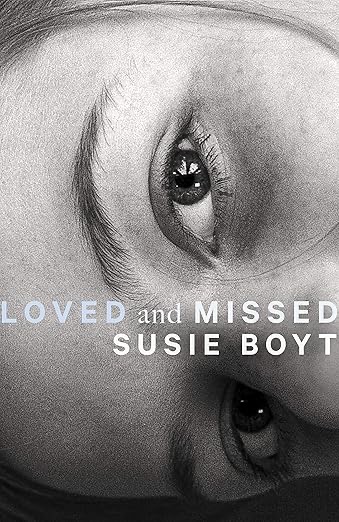
I love the tagline to this novel because it is just so peculiarly British. The phrase ‘shall I be mother’ meaning ‘shall I pour the tea’ must seem so odd to people whose first language isn’t English. It fits perfectly to this book because it’s about all those tiny tasks of motherhood, not to mention the ‘mental load’. It acknowledges a role, but is it a role that can be avoided as easily as it can be adopted? Underlying all those tiny things a mother does are huge acts of care and love, duty, loyalty and service. I read this book back when I was at university but have never been a mother, until I entered a relationship with a man who had two daughters around eight years ago. So it’s later in life when I’ve started to complain about all the tiny things I do that go unnoticed, usually after Christmas when I have the annual moan of ‘without women there would be no Christmas.” Loved and Missed is about Ruth a schoolteacher and single mother whose daughter Eleanor rebels against her fiercely, before leaving her to bring up her granddaughter Lily when Eleanor can’t. It’s not a plot driven novel, but more of an observance on life as a mum. The title refers to a gravestone that Lily notices with the epitaph ‘Loved and Missed’, which sounds as if love was intended but never quite reached or the target moved at the last moment. This slightly comedic, bittersweet observation sets the tone for a novel that’s about the mundanities of everyday life but also the emotions hidden amongst the endless washing and cleaning. It suggests that motherhood can take many forms and doesn’t always run in linear ways – a truth that rings home for me as the mother to many more people than my two stepdaughters. However, once taken, these bonds can’t be removed. This is a novel about what jt’s like to be in a mother -daughter relationship that may be a rollercoaster at times and at other times just ordinary everyday life.
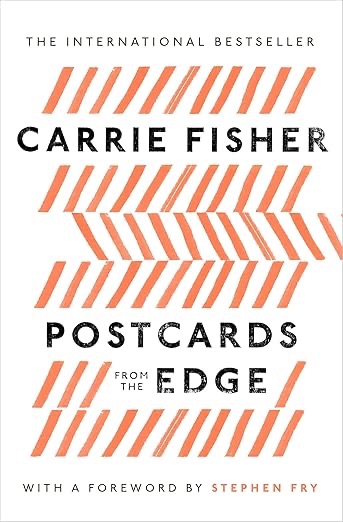
Postcards From The Edge
‘I don’t think you can even call this a drug. This is just a response to the conditions we live in.’
I really do miss Carrie Fisher, whether it’s the 19year old of Star Wars, the cynical friend of Sally Albright or the grumpy and hilarious mother in Catastrophe. A fictionalised look at her own relationship with her mother Debbie Reynolds, made all the more poignant by the fact that we now know that when Carrie died suddenly and unexpectedly, her mother died the day after. She just wanted to be with Carrie, said Reynolds’s son and it tells us how strong that bond is, even when it’s been stretched and almost broken. Susannah Vale is a former acclaimed actress, but is now in rehab, feeling like ‘something on the bottom of someone’s shoe, and not even someone interesting’. She becomes Immersed in the harrowing, but often hilarious, goings-on of the drug hospital and wondering how she’ll cope – and find work – back on the outside. Then she meets the Heathcliff of addiction, new patient Alex. He’s ambitious, Byronically good looking and is in the depths of addiction. He makes Suzanne realize that, although her life might seem eccentric, there’s always someone who’s even closer to the edge of reason. This is clearly in some ways autobiographical, dealing with that second generation Hollywood problem of following in a parent’s footsteps. There are times when Suzanne would like her mum to be there, but Mum is filming so has to send the maid over instead. It’s quite different from the film, but both are witty and a great read. I often wondered if Debbie Fisher’s role as Grace’s mother in the series Will and Grace had some basis in her relationship with her daughter and it’s possible.
One Italian Summer by Rebecca Serle
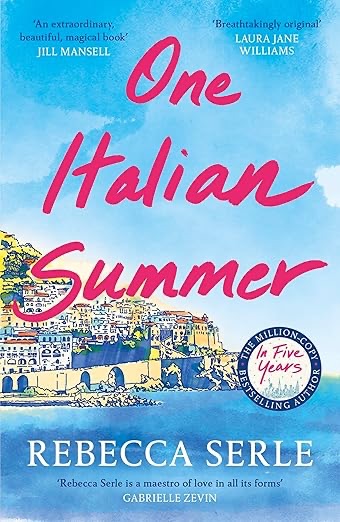
When Katy’s mother dies, she is left reeling. Carol wasn’t just Katy’s mum, but her best friend and first phone call. She had all the answers and now, when Katy needs her the most, she is gone. To make matters worse, the mother-daughter trip of a lifetime looms: two weeks in Positano, the magical town where Carol spent the summer before she met Katy’s father. Katy has been waiting years for Carol to take her, and now she is faced with embarking on the adventure alone. But as soon as she steps foot on the Amalfi Coast, Katy begins to feel her mother’s spirit. Buoyed by the stunning waters, beautiful cliffsides, delightful residents, and – of course – delectable food, Katy feels herself coming back to life. And then Carol appears, healthy and sun-tanned… and thirty years old. Meeting her Mum at this age is going to throw up things Katy didn’t know about. Carol doesn’t recognise her, so her actions are completely unguarded, whereas Katy does know who Carol is and I wondered how long she would be able to keep it to herself. It was interesting to see Katy starting to question whether all aspects of their relationship were positive. Carol has always been so opinionated about how things should be done so Katy and Eric have always gone to her for advice when making decisions. Katy realises she’s never made her own decisions because Carol has always weighed in on everything from what clothes to buy and whether she should have children yet. She always seemed so sure of what to do and Katy has felt inadequate to an extent, unable to weigh up the options and make her own mistakes. There is a bit of anger and resentment here; Why does this Carol seem so go with the flow when her mum always planned everything with military precision? This was another beautiful book from Rebecca Searle, concentrating on the relationships between mothers and daughters and the effect our parents have on our development as people. All set in the magical Italian sun, with a lot of personal reflection and even a little bit of romance thrown in. I loved how the space and the experience gives Katy a chance to re-evaluate her life and the way she’s been living it.
I’m Glad My Mom Died by Jeanette McCurdy
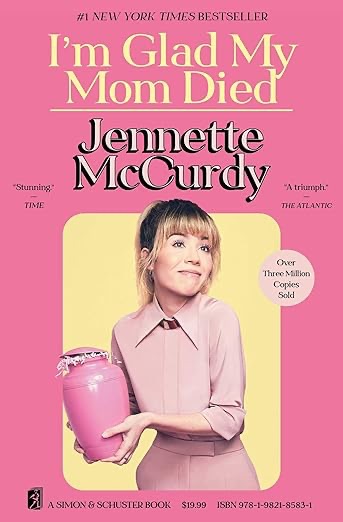
Jennette McCurdy was only six years old when she had her first acting audition. Her mother’s dream was for her only daughter to become a star, whatever it took, and Jennette would do anything to make her mother happy. So she went accepted what her mother called “calorie restriction”, plus weighing herself five times a day and eventually shrinking down to 89 pounds. She endured endless at-home makeovers using knockoff whitening strips, hot curlers, eyelash tint, and gobs of bleach to enhance her “natural beauty.” She was showered by her mother until she was sixteen while sharing her diaries, an email account, and all her earnings. The dream finally comes true when Jennette is cast in a new Nickelodeon series called iCarly and is thrust into fame. But for Jennette, the dream is a nightmare. Overnight, her fake smile and cheesy airbrushed hair-do is plastered on billboards across the country. Of course her mom is ecstatic, ordering her to smile for the paparazzi (with whom she’s on a first-name basis) and sign endless autographs for fans who only know her by her character’s name, Jennette is riddled with anxiety, shame and self-loathing, which manifest into eating disorders, addiction and a series of unhealthy relationships.These issues only get worse when Jennette’s mother dies of cancer. Finally, after discovering therapy and coldly examining the relationship with her mother, Jennette embarks on recovery and decides for the first time in her life what she really wants. Told with raw honesty and equal parts gravity and humor, I’m Glad My Mom Died is a shocking, devastating, and ultimately inspiring story of resilience.
After the Eclipse by Sarah Perry
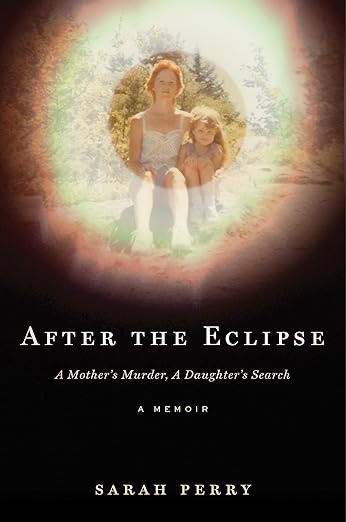
When Sarah Perry was twelve, there was a partial eclipse – supposedly a good omen for her and her mother, Crystal who were living in rural Maine. But that moment of darkness was a foreshadowing moment: two days later, Crystal is murdered in their home. It then took twelve years to find the killer. In that time, Sarah had to learn how to rebuild her life despite the obvious abandonment issues and the toll of the police interrogation and effects of trauma. She looked forward to the eventual trial, hoping that afterwards she would feel a sense of closure, but it didn’t come. Finally, she realised that she understanding her mother’s death wasn’t what she needed. She needed to understand her mother’s life. So, drawn back to Maine and the secrets of a small American town she begins to investigate. I was stunned by what Perry does with such a dark subject matter. This could have been a tragedy but Perry manages to create warmth and humanity from her story. I was honestly surprised by how hopeful it felt, despite the grief and a search for understanding. Perry shows how the working poor overcome challenges and how strong mothers make choices we can’t imagine in terrible circumstances. With clarity and kindness Perry explains the motivations of people in poverty and is even understanding towards the men in her mother’s life, while managing to make the link between misogyny and violence against women. Something that’s both a cause of violence and a factor in investigating crimes against women. She presents her hometown with so much warmth and the landscape of Maine provides a stunning backdrop to her childhood. This was a beautiful and authentic read.
Little Fires Everywhere by Celeste Ng

Everyone in Shaker Heights was talking about it that summer: how Isabelle, the last of the Richardson children, had finally gone around the bend and burned the house down.
In Shaker Heights, a placid, progressive suburb of Cleveland, everything is meticulously planned – from the layout of the winding roads, to the colours of the houses, to the successful lives its residents will go on to lead. And no one embodies this spirit more than Elena Richardson, whose guiding principle is playing by the rules. Mia Warren is an enigmatic artist and single mother, who arrives in this idyllic suburb with her teenage daughter Pearl. She rents a house from the Richardsons and soon Mia and Pearl become more than just tenants. Soon and in different ways all four Richardson children are drawn to this mother-daughter pairing. But Mia carries a mysterious past and a disregard for the unspoken rules that threatens to upend this carefully ordered community. The catalyst for conflict comes when an old family friend of the Richardsons attempts to adopt a Chinese-American baby and a custody battle erupts that dramatically divides the town. A divide that puts Mia and Elena on opposing sides. Suspicious of Mia and her motives, Elena is determined to uncover the secrets in Mia’s past. But her obsession will come at an unexpected and devastating cost. This is an unputdownable thriller that shows us two very different ways of mothering. One is very ordered and focused on achievements, having goals and knowing the right people. The other is more intuitive and emotionally authentic, but also carries baggage from previous lives. It also shows how individual children can’t be approached or parented in the same way. Finally with the adoption storyline she brings in the economic impact of becoming a mother, meaning it’s a hard or impossible choice for some women. Utterly gripping.
Oranges Are Not The Only Fruit by Jeanette Winterson
This is the story of Jeanette, born to be one of God’s elect: adopted by a fanatical Pentecostal family and ablaze with her own zeal for the scriptures, she seems perfectly suited for the life of a missionary. But then she converts Melanie, and realises she loves this woman almost as much as she loves the Lord. How on Earth could her Church called that passion Unnatural? While this is categorised as a queer coming of age story, it is not Jeanette’s relationship with Melanie that I remember but the relationship between her and her mother. Perhaps because I grew up in an evangelical church environment after being a Roman Catholic until I was ten years old, those scenes at the church and just how intransigent her mother was, stayed with me. This was a book and a tv series I shared with my mother and possibly played a part in her realisations about the church she was in. There’s a horrifying zeal to her mother’s actions. Her religion dominates the life of her household and has effectively placed a barrier between her and her husband. Jeanette’s childhood is a litany of brainwashing that starts the moment she gets up and only stops when she goes to sleep. There is no room to manoeuvre within her rules and expectations, but when Jeanette becomes friends with Melanie it emboldens her to ask the question. If her love for Melanie feels so authentic and natural, how can it be wrong? This thought and the kindness of others in her community is her lifeline. This book showed me what I already suspected was wrong with the teachings of my own mother’s choice of church and how much it had taken over my parent’s lives – thankfully not for too long. I didn’t know at first that this was auto-fiction but I admired Jeanette Winterson so much for writing it, not just because it was a queer love story, but because it questioned evangelical religion and showed how it can devastate the relationship between mothers and daughters.
Breath, Eyes, Memory by Edwidge Danticat
I always recommend this debut novel of Edwidge Danticat’s. I first read it at university as part of my post-colonial and American literature modules and set off a lifelong interest in Haiti. Sophie has always lived with her aunt in Haiti, but at the age of twelve, she is sent to New York to be reunited with her mother, who she barely remembers. Feeling completely out of place in New York’s Haitian diaspora she longs for the sights and tastes of home, with a mother who only wants to forget. She doesn’t understand why her mother bleaches her skin and doesn’t eat very much, only that she misses her home. There are also her mother’s boyfriends who seem to make the gulf between her and her mum even wider, leaving them no time to get to know each other. After a while she makes friends with a boy in their apartment block and starts to feel heard, but this friendship is a catalyst for terrible actions, family secrets and a legacy of shame that comes from trauma. Sophie knows this can be healed only when she returns to Haiti – to the women who first reared her. What ensues is a passionate journey through a landscape charged with the supernatural and scarred by political violence.
Danticat evokes the wonder, terror, and heartache of her native Haiti through the women of this family. She depicts the enduring strength of Haiti’s women – with vibrant imagery and a narrative that bears witness to their suffering.
Amazing Grace Adam’s by Fran Littlewood
Is this the best worst day of her life?
Grace is stuck in traffic, it’s a boiling hot day and she’s melting. All she wants to do is get to the bakery and pick up the cake for her daughter’s birthday. Lotte moved out and is living with her father. This is one hell of a birthday cake, not only is it a Love Island cake; it has to say that Grace cares, that she’s sorry, that will show Lotte she loves her and hasn’t given up on their relationship. It’s shaping up to be the day from hell and as Grace sits in a tin can on boiling hot tarmac, something snaps. She decides to get out of the car and walk, leaving her vehicle stranded and pissing off everyone now blocked by a car parked in the middle of a busy road. She’s peri-menopausal, wearing trainers her daughter thinks she shouldn’t be wearing at her age and she’s had enough. So, despite the fact her trainers aren’t broken in, she sets off walking towards the bakery and a reunion with Lotte. There are just a few obstacles in the way, but Grace can see the cake and Lotte’s face when she opens the box. As she walks she recounts everything that has happened to bring her to where she is now, including the secret of how they all got here.
The truth when it comes is devastating, but feels weirdly like something you’ve known all along. Those interspersed chapters from happier times are a countdown to this moment, a before and after that runs like a fault line through everything that’s happened since. As Grace closes in on Lotte’s party, sweaty, dirty and brandishing her tiny squashed cake, it doesn’t seem enough to overturn everything that’s happened, but of course it isn’t about the cake. This is about everything Grace has done to be here, including the illegal bits. In a day that’s highlighted to Grace how much she has changed, physically and emotionally, her determination to get to Lotte has shown those who love her best that she is still the same kick-ass woman who threw caution to the wind and waded into the sea to save a man she didn’t know from drowning. That tiny glimpse of how amazing Grace Adams is, might just save everything.
In A Thousand Different Ways by Cecilia Aherne
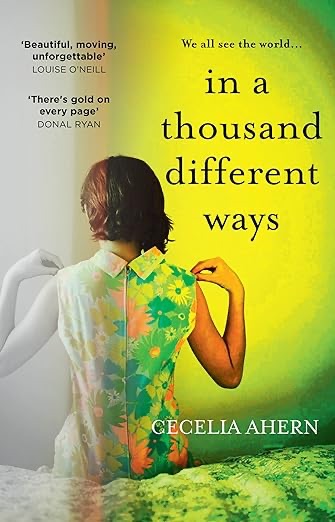
She knows your secrets. Now discover hers…
You’ve never met anyone like Alice. She sees the best in people. And the worst. She always seems to know exactly what everyone around her is feeling: a thousand different emotions. Every. Single. Day. In amongst all that noise, she’s lost herself.
But there’s one person she can’t read. And that’s the person who could change her life.
Is she ready to let him in? While this is Alice’s story it all hinges on the relationship she and her two brothers had with their mother. Alice has a form of synasthaesia – an ability to see people’s character and emotions in colour. These auras help to inform her of the mood her mum is in, so she knows when to keep her head down or get out of the way. Alice and her older brother are desperately trying to keep their family together despite their mother’s mental health and the alcohol she abuses to self-medicate. Alice can tell the highs, when her mother might go into a frenzy of baking or creating, imagining she could run her own business. Then there are days she can’t even make it out of bed. The children don’t want to be found out and split up, perhaps even taken into care. Until one day Alice comes home and sees a dark blue colour hovering over her mum and knows she must take action. Alice’s childhood affects her ability to trust, to form relationships and even value herself but one thing she does know is what kind of mother she will be. Years later, Alice’s mother re-enters her life with a terminal illness. She wants to meet her grandchildren and make amends. Can Alice trust her and will she finally be able to process the trauma of her childhood? This was a great read from a writer I don’t usually read. It captures the fear of going home for a child whose parent struggles with their mental health an addiction. It also explores the complexities of time away from that parent, how it can be healing but also difficult to draw those boundaries. It also brings up forgiveness and how it can be just as healing.

 The Lotus Readers
I’ve read a couple of these. Mother-daughter relationships are always so interesting to read about.
LikeLiked by 1 person
So complicated x
LikeLiked by 1 person
“After the eclipse” and “little fires everywhere” sound like very gripping reads. Thanks for the recommendations.
LikeLiked by 1 person
Hope you enjoy them x
LikeLike