
What an absolute privilege it was to read this incredible story a couple of years ago and it was my book of the year. It is truly the best book Maggie O’Farrell has ever written and I’m a huge fan. I’ve loved her previous novels, especially The Vanishing Act of Esme Lennox. The scary part was trying to do this incredible work justice in my review. Something that director Chloe Zhao must have thought before embarking on the film version, due out on the 9th January. The responsibility of taking something so precious and recreating it for the cinema must have weighed heavy on the cast too. I watched an interview with Jessie Buckley a few days ago where she divulged that at first she didn’t know how to be. Not how to capture Agnes but how to portray something she’d never had in real life – to embody the role of being a mum when she wasn’t one and to capture the enormity of losing a child. I think her reticence and how she searched for those emotions show that Agnes is in safe hands with Buckley. I’ve been a fan since her debut you on the BBC series I’d Do Anything and to see the wonderful Paul Mescal cast opposite her took away any concerns I might have had about the book being ruined. Here though I want to tell you about this beautiful book and encourage people to read Maggie O’Farrell’s masterpiece.
Despite his place in literature as our most famous playwright, not a lot is known about Shakespeare’s life with his wife and children. Until reading this, and despite doing a module in Renaissance Literature at university, my only knowledge was of a wife called Anne Hathaway. Any other knowledge has rather embarrassingly and erroneously come from Upstart Crow, which depicts his eldest daughter Susannah as an intelligent, outspoken and boy crazy teenager. I also remember that many years ago I was shown the outside of a picture perfect cottage that belonged to Anne Hathaway. This was Hewlands where Anne was born, and after her marriage, the home of her brother Bartholomew. There has always been this hole in my knowledge, and when watching the totally inaccurate Shakespeare in Love I do remember wondering whatever happened to his wife. Did he love her and if so, how did he spend so much time away from her and their family? Also, with his success down in London, what did Anne do with her life? I wondered whether she was weighed down with the care of children, as well as her elderly in-laws with whom they lived.

For the author it was a different absence that became her way into the story. She had always wondered why the Black Death or ‘pestilence’ never featured in any of Shakespeare’s works. It’s absence seemed odd, considering that, in this time period, it killed large swathes of people. From 1575 in Venice over 50,000 people died as a result of plague over two years, thought to be caused by troop movements associated with The Thirty Years War. The beautiful cathedral Santa Maria Della Salute was built after a third of the population was wiped out in a return of the plague in 1630. The city still celebrates the Festival of the Redeemer today as a thank you that the city and some of its residents survived these pandemics. In England in 1563 the plague killed 20,000 people in London alone. Historical sources cite the plague as cause of death to extended members of Shakespeare’s family and possibly his sisters. His work was also affected, with all London playhouses closed down in 1593, 1603 and 1608. However, the biggest loss of all was his only son Hamnet, who is thought to have contracted the disease and died, aged 11, in 1596. O’Farrell takes these facts as the bare bones and fleshes out a more human story, weaving the life of a boy and his family with empathy, poetry and a touch of magic.
One of my favourite passages of the book focuses on the transmission of this horrific disease via some fleas and the beautiful millefiore glass beads crafted on the Venetian island of Murano. It takes accident, upon chance, and coincidence to carry the deadly disease all the way back to Stratford. A glassmaker burns his hand, so someone else packs his beads into some soft rags he finds lying around, instead of their usual packaging. A merchant ship bound for England has docked and a cabin boy searches Venice for cats to combat rats on board, when he is diverted by a monkey in a waistcoat. The keeper roughly pulls him away, but left behind are a few fleas, some of which make their way onto the cats an a crew member who tends to sleep with cats in his cabin. He doesn’t report for duty and has a fever plus the telltale ‘buboes’ or swelling of the lymph glands. These swellings turn black and the smell of the dead man is so repugnant that other crew members are relieved to heave him overboard for burial. He isn’t the last. Only five crew members remain as the ship docks in London and one box of beads from Murano makes its way to a Stratford dressmaker, where a customer is determined that only Murano glass beading would do for her new dress. The dressmakers assistant unpacks the beads from their ragged packaging and as she does a flea jumps from the fabric to its new host. The dressmaker’s assistant is Judith Shakespeare, Hamnet’s twin sister. This is typical of the author’s signature style of layering description to create depth and its effect is like an assault on the senses. I can smell the sweat of the glassmaker, feel the fur of the monkey, hear the creak of the boats in the canals and the shouts in the market, and feel the swell of the waves and ruts in the road as the package takes its journey, delivering both beauty and death at the same time.

In one timeline Judith and then Hamnet succumb to the plague, while unwittingly the family go about their usual day. There is a clever nod to the cross dressing in Shakespeare’s comedies here in the likeness of the twins, but this is anything but funny, it’s a disguise to cheat death. As the family slowly discover what fate has in store, our timeline jumps into the past following Agnes and Hamnet’s father. Although she is more widely known as Anne, she was recorded in official records as Agnes so the author chose to stick with that name. She always refers to him as the tutor, the husband or the father and never by name. The absence of his name creates a sense of two people; the London celebrity playwright and the family man. We start to see what an extraordinary woman Agnes is in her own right. The object of gossip in town, people say the daughter at Hewlands is a very singular character. She has a friend who is a priest, she has her own hawk and can charm bees. In truth she knows a lot of old country ways such as foraging, hawking and bee keeping as well as what plants to grow for household ailments. She often roams barefoot in the forest and her stepmother Joan despaired of her a long time ago and is jealous of the love her husband held for his late wife. When Agnes meets her brother’s Latin tutor, she uses her method of reading people and pinches the flesh between his thumb and forefinger. Here she sees depths and universes within, that his surface youth and inexperience don’t even hint at. It is this promise, these unseen layers, that she falls in love with. For his part, it is her difference he finds intoxicating. He realises that he will never see another woman who walks barefoot, with lose hair and a hawk on her arm. However much they accept each other, will their families accept their choice and will those untapped depths come between them?
I enjoyed the way these two timelines intersected, each informing the other and adding layers of understanding. How both families assimilated and worked together over time was really interesting. In each generation sibling relationships were particularly important, with their rivalries, but also their unspoken trusts and understandings. The idea of ‘doubling’ and disguise around siblings, especially where there are different genders such as Judith and Hamnet, makes us think again about a play like Twelfth Night. Disguise allows women to do things they would normally be excluded from and O’Farrell shows that in the industriousness of women in the novel. This isn’t just based around domestic matters but planning and running businesses. Agnes grows medicinal plants and creates cures, with people often knocking on the door to be seen. As a country girl I also liked the depiction of her relationship with the land. When I stand on the bank of the River Trent, I feel an urge to go barefoot and ground myself. I was born there, so when I moved next to the river recently grounding and feeling the earth felt so powerful. Agnes is the same with the land at Hewlands, particularly the woods, and she chooses to give birth there to Susannah. Agnes feels cradled by the earth, it protects, cures and grounds her. She also has great ‘countrycraft’ such as being able to control bees – something I’ve seen my own father do with a swarm – there’s a practicality but also a mysticism to these abilities.
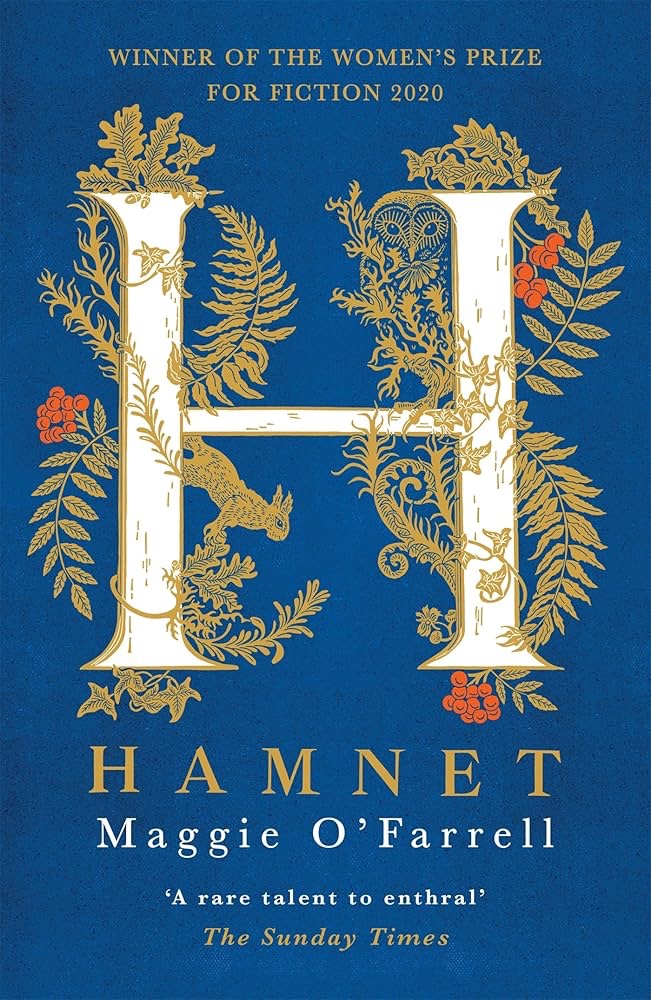
Underpinning all of this, I am in love with Maggie O’Farrell’s flow. It’s a hard book to put down because it reads like one long poem to love, family, and home. Then there is the tension that comes when a member of this family follows their dream and is taken away from that unit. How does a father balance his roles as lover, son, father and still follow his dreams? Especially when those dreams are so big. When he gets that balance wrong will he be forgiven and will he be able to forgive himself? The book is full of contrasts, from passages so vibrant and full of life, to the devastating silence of Hamnet’s loss. From birth scenes to death scenes. Wild country lanes and the leafy woods compared with the noise and enclosure of town. The routine of daily family life as opposed to a chaotic life in the theatres of London. All of these contrasts exist within one family, and no matter what we know about our most famous and celebrated playwright, this is about family. Finally, the author’s depiction of grief is so moving. Whether quiet and contained, or expressed loudly, we never doubt its devastating power. We never overlook the boy-shaped hole in the life of this family. Whether our response to grief is to run from it, distract ourselves from it or deny it, eventually we do have to go through it. In the life of this couple, will their grief be expressed differently and if so, can they ever make their way back to each other? This is a simply stunning piece of work. Moving, haunting and ultimately unforgettable.
I’ll keep you posted for the film version but I know I’ll be taking lots of tissues.
Hamnet is in cinemas on January 9th.

 The Lotus Readers
I think you would enjoy reading Shakespeare’s Wife by the inimitable Germaine Greer!
https://anzlitlovers.com/2014/06/18/shakespeares-wife-2007-by-germaine-greer/
LikeLike
Thank you, I’m sure I would. I’ve seen it so I’ll pop it in my basket xx
LikeLiked by 1 person
I loved this too although I’m worried I might find the film too sad!
LikeLiked by 1 person
Oh I’ll have a three foot puddle around my cinema seat 😂😂
LikeLiked by 1 person