
Hello Readers,
Spring is here!! Finally. Today is warm -ish, but sunny with daffodils and jasmine brightening up the garden. My other half is cutting the lawn and washing is going on the line for the first day this year. I’ve had a lot of chances to read this month as I still can’t move far, so I’ve taken on some new and some older reads too. My favourites of the new books I’ve read this month are a balanced mix of historical fiction and crime novels. Our historical offerings take us to the South of France and the home of Henri Matisse, to Paris on a train that might be lucky to arrive and a Scottish island that’s closer to Norway. The crime novels are set in two of my favourite places, Snowdonia and Northumberland, while the final one is a Scandinavian setting, written by two talented authors it’s an unforgettable novel.
Hope you’re all enjoying this beautiful weekend.

When in Northumberland I visit a couple of bookshops, Barter Books in Alnwick for second hand finds and Cogito Books in Hexham for their non-fiction and new releases. Last time I had some book vouchers so I went to Hexham and was recommended Mari Hannah’s Stone and Oliver series. I bought the first one then found more of the series in charity shops, but hadn’t got round to reading them yet. So when a publisher offered this I wondered whether I should, but I can’t resist and now Im setting aside time to read the rest of this series.
Frankie Oliver and David Stone have been working together in the same MIT for the a few years, but this book starts in a much darker place when another detective was called to a body found on some waste ground. Horrified, he drops to the floor unable to contain his devastation. The body on the ground is his daughter. It’s such a powerful and emotive opening, leaving us in no doubt that this is a defining event for the loved ones of this girl. An absence that the Oliver family feel every day. It’s arguable that this case is the very reason that Frankie Oliver became a detective. She and David Stone are an incredible team at work and have the potential to take their relationship further. It’s clear there’s been some ‘will they won’t they’ over the course of the previous novels. Now Frankie is taking a break from the team in Newcastle, a promotion to DI means she must fill a post back in uniform based out of the most northerly police station in the county, Berwick-Upon-Tweed. Frankie accepts and the team organise a leaving ‘do’. It’s there that Dave overhears an argument that immediately propels him back to the murder of Joanna, Frankie’s sister. What’s said between the two men outside the venue sparks an idea in Dave’s mind. He has had an idea of how to investigate the cold case, but knows that he doesn’t want to bring more pain to the family. Hopefully Frankie’s secondment to Berwick means they won’t have to.
Meanwhile Frankie’s first job is an RTC on the A1 and in the total chaos she finds a little boy handcuffed in the back of a van. The driver and passenger are dead and the van is a write off so Frankie can’t believe this little boy has survived. As she rescues him, an onlooker tells her that a man escaped out of the back doors straight after the crash. This opens up a trafficking case that might take her straight back out of uniform again. The boy, Amir, takes to Frankie. Possibly the first person in a long time who has made him feel safe. As for the relationship between Frankie and Dave, I was very much invested despite not knowing everything that’s gone before. The setting is beautifully captured in it’s contradictions: the modernity and buzz of Newcastle with the contrast of the wild countryside and beautifully rugged coastline. This really is a nail-biting story, written in very short chapters that are easy to devour very quickly. So many have a brilliant cliff-hanger ending too. I can’t wait to read more.
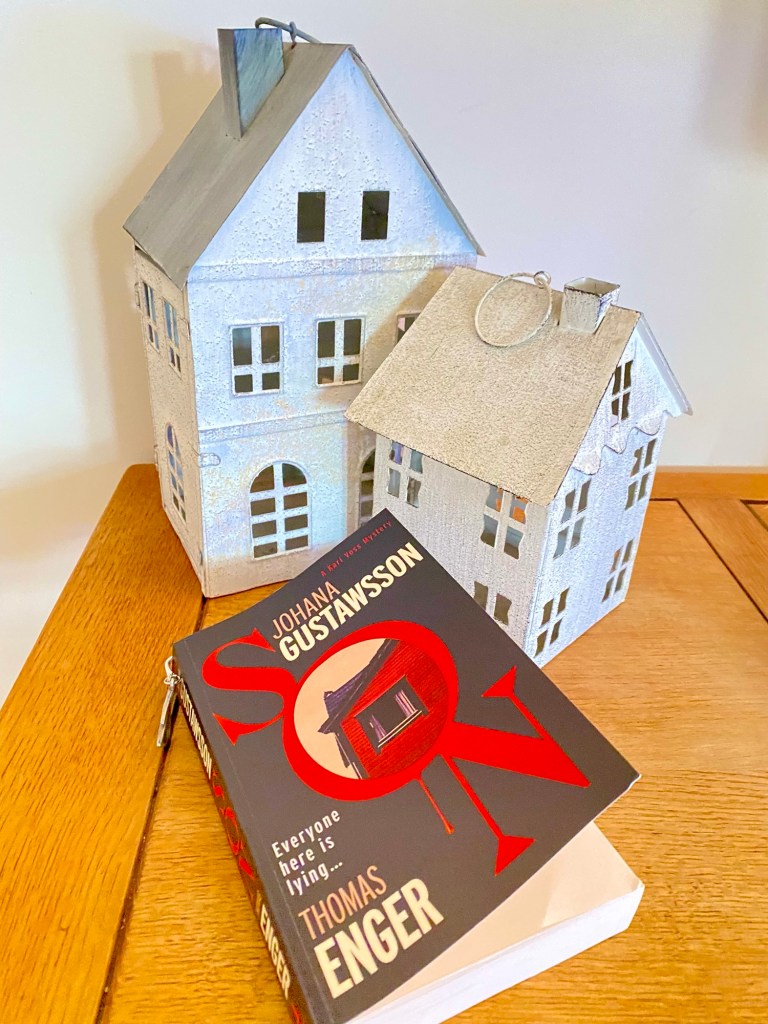
The blurb on the back of this novel promises an electrifying blockbuster that will be the start of a ‘nerve shattering’ new series. So there’s a lot to live up to, but Son definitely delivers. To use a rather inelegant phrase, this novel is a therapist’s wet dream of a novel – hidden characters, unexplained black outs, grief, trauma and an investigator who is dubbed The Human Lie Detector. I was definitely in my element here. Kari Voss is the centre of this tangled web, a psychologist who specialises in memory and body language and acts as a consultant to Oslo’s police force. When two girls are brutally killed in a summer house in the village of Son, it’s a crime that’s closer to home than she would want. The girls, Eva and Hedda, were best friends with Kari’s son Vetle when they were younger. In fact it was while on a holiday seven years ago that Vetle disappeared in nearby woods and was never found. The girls are now teenagers and were planning a Halloween party for their friends, but were found tied to dining chairs with their throats cut. They were found by a third friend, Samuel Gregson, when he turned up to start the festivites and it is also an old friend of Vetle’s that police chief Ramona Norum arrests and starts to question. When Kari is asked to consult she knows this will be difficult, not only is she friends with the girl’s families, their lives are inextricably linked to her missing son. How will she negotiate all the emotions this case will unleash and find the girl’s killer?
No one is what they appear here. As Kari starts to ask questions about Eva and Hedda, it turns out that they aren’t always the polite children or young teenagers they appear to be. The authors are very clever about the amount of introspection they use, creating a hidden layer to the crimes and a breathing space between the character driven chapters and the ones filled with nail-bitingly intense action. There’s even subterfuge in the title, Son is a place slightly north of Oslo, steeped in Nordic history and full of that unsettling atmosphere that I find Nordic Noir is so good at. Yet it’s also a person, so missed by those who love him and inextricably linked to this landscape, that has potentially become his final resting place. I was compelled to read this to the end, taking it everywhere with me on holiday so I could grab a chapter in a coffee shop or even in the car. This is an engrossing and addictive start to a promised new series and I’m already craving the next instalment.
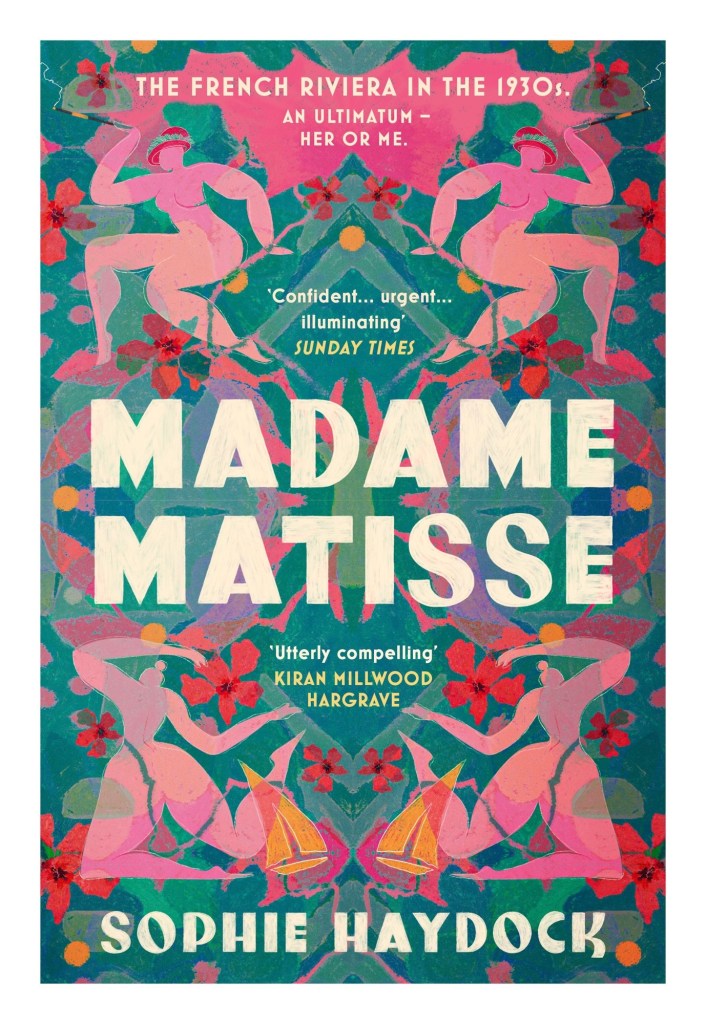
This is the story of three women – one an orphan and refugee who finds a place in the studio of a famous French artist, the other a wife and mother who has stood by her husband for nearly forty years. The third is his daughter, caught in the crossfire between her mother and a father she adores. Amelie is first drawn to Henri Matisse as a way of escaping the conventional life expected of her. A free spirit, she sees in this budding young artist a glorious future for them both. Lydia Delectorskaya is a young Russian emigree, who fled her homeland following the death of her mother. After a fractured childhood, she is trying to make a place for herself on France’s golden Riviera, amid the artists, film stars and dazzling elite. Eventually she finds employment with the Matisse family. From this point on, their lives are set on a collision course. Marguerite is Matisse’s eldest daughter. When the life of her family implodes, she must find her own way to make her mark and to navigate divided loyalties.
Based on a true story, Madame Matisse is a stunning novel about drama and betrayal; emotion and sex; glamour and tragedy, all set in the hotbed of the 1930s art movement in France. In art, as in life, this a time when the rules were made to be broken. I loved reading about these fascinating women, all of which step outside the traditional role of most women of the time. Sophie beautifully situates Matisse within his peer group, especially his great rival Picasso. Then situates each woman perfectly within their history, the most in depth being Lydia’s Russian background and Marguerite’s incredible bravery in WW2. I thoroughly enjoyed looking up the paintings mentioned and seeing Matisse’s representation of the three women who were closest to him and I found myself reading articles about him and Picasso. It left me with a sense of anger and empathy for how much women sacrifice so that men can excel at what they do, realising their ambitions while their wive’s ambitions are forgotten or buried under a suffocating mental load – still the thing women in my group talk about most. These women never take the limelight away from Matisse, even while stripped bare for people to view. The focus is always on the painter, their brush strokes, choice of colour and artistic decisions. I love that in this novel they are more than body parts, they’re shown as the vital, brave, complex and generous women they clearly were.

Set in 1895 when a train did crash onto the platform at Montparnasse, Donoghue places us very definitely in the fin de siecle, with every little detail. It isn’t just her description of the train, which I could picture very clearly, it’s the character’s clothing and their attitudes. There’s certainly evidence of a shift in the Victorian ideals that held firm throughout the 19th Century. In one journey we can see women being more outspoken, having a definite sense of purpose, and a need to determine their own destiny. Women are travelling alone or for work, in the case of Alice she is travelling with her boss as the secretary for his photographic business. She takes the opportunity to talk to him about moving pictures, she has researched the subject and thinks it could be a new market for the firm. Marcelle is researching in the field of science and huge fan of Marie Curie who is so work focused that she went to get married in an everyday blue dress and returned to the lab.I was absolutely fascinated with Mado. She stands out more than she realises, with her androgynous clothing and short hair, not to mention the lunch bucket she’s clutching as if her life depends on it. She’s a feminist, an anarchist and seems to have an interest in reading other people. Her own internal struggle is so vivid that I could feel the tension in her body as I read. She seems contemptuous of many of her fellow passengers, particularly the men, knowing that the Victorian feminine ideal is simply a role women are forced to play. To step outside of the norm is brave and a deliberate outward show of her inner strength and determination to change women’s place in the world. How far might she go to show her resolve?
Gradually I was compelled to keep reading because the tension was rising with every new passenger and because as the reader I was omniscient: Donoghue gives her reader the full story and we know the potential fate of every character on this train. Brilliant as always!

1843. On a remote Scottish island, Ivar, the sole occupant, leads a life of quiet isolation until the day he finds a man unconscious on the beach below the cliffs. The newcomer is John Ferguson, an impoverished church minister sent to evict Ivar and turn the island into grazing land for sheep. Unaware of the stranger’s intentions, Ivar takes him into his home, and in spite of the two men having no common language, a fragile bond begins to form between them. Meanwhile, on the mainland, John’s wife, Mary, anxiously awaits news of his mission.
Against the rugged backdrop of this faraway spot beyond Shetland, Carys Davies’s intimate drama unfolds with tension and tenderness: a touching and crystalline study of ordinary people buffeted by history and a powerful exploration of the distances and connections between us.
Clear is so beautifully set within some very significant events. In the 19th Century evangelical worshippers moved away from the Church of Scotland to form the Free Church of Scotland. Also, there was a second wave of Scottish landowners driving their tenants from the land, choosing to make a better profit grazing sheep. This was just one part the Highland Clearances. Our characters are deeply involved with these events. This is such a gentle story that contains so much. Instead of pushing an agenda or viewpoint, the author just lets it play out naturally. Ivar is part of this island, a bear of a man with only his animals for company. There’s a purity to his life that’s almost spiritual, an interesting contrast to John’s organised religion. There’s so much under the surface of the story, told in the tiny details of everyday life: their gestures, the intimacies they share and how those connections change as a language is formed between them. It’s interesting to see the established dynamic of John and Ivar affecting how Mary settles into the cottage. The men’s connection brings the three of them into a unit, so that they don’t feel like a married couple and a lone man any more. Each of them forms a strong connection with each other and the landscape. I found reading this an almost meditative experience, because it’s so slow and calm, until the sudden end.

Living and working in Snowdonia was always retired detective Frank Marshal’s dream. Until a phone call asking for his help turns it into his worst nightmare. Retired detective Frank Marshal lives in a remote part of Snowdonia with his wife Rachel who is suffering from dementia. Working as a park ranger, Frank gets a phone call from close friend Annie, a retired judge. Her sister Meg has gone missing from a local caravan park and she needs his help to find her.
As Frank and Annie start to unravel the dark secrets of Meg’s life, it seems at first that her disappearance might be linked to her nephew and a drug deal gone wrong. In a shocking twist, their investigation leads them to a series of murders in North Wales from the 1990s and a possible miscarriage of justice. Can Frank and Annie uncover the sinister truth so they find her sister in time to save her? Or will a brutal serial killer add Meg to his list of victims?
I’m always complaining about thrillers and crime novels that rely on their twists and turns without any depth to the characters or the story. I couldn’t complain at all here. There are twists, including one I only started to suspect few pages before it was revealed. This book was full of emotion: Frank and his wife sitting in bed and looking at old photos was so poignant since both know her dementia is progressing and she is slowly forgetting it all; the beautiful relationship between Frank and his grandson; Annie’s grief over her sister’s disappearance and her nephew’s accident. All felt like fully realised people, even those only in the novel a short time. I could see Frank locking horns with police chief Dewi in the future or the scouse drug dealers. I loved the setting too, the author has managed to capture it’s beauty and it’s bleakness. This was a cracking mystery that crept up on you slowly then didn’t let you put it down. I’m looking forward to many more adventures with Frank Marshal.
So that’s all for March, but next month’s reading is busy as always. Here are a few books still lurking on my TBR for April. It’s going to be a great month.


 The Lotus Readers