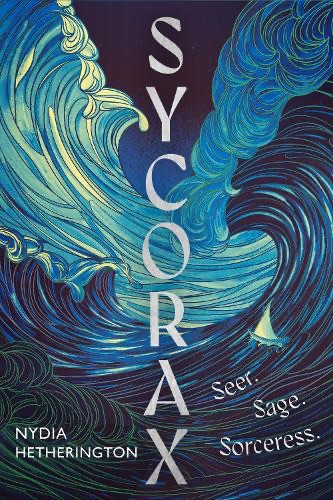
Seer. Sage. Sorceress.
“I know the power of stories and of voices. Even silenced ones. So let me end mine with what I have seen of Sycorax, and assure you again that once, she had a voice, and it was loud and melodious and filled with magic”.
I was entranced by this beautifully lyrical tale of the unseen sorcerous of Shakespeare’s The Tempest. This is my favourite Shakespeare play because I love its atmosphere and the use of musical sounds to conjure up this enchanted island, ruled by the magician Prospero. Sycorax isn’t even present in the play, but is mentioned as a sorcerous and mother of Caliban, who is depicted as a monster and a slave to Prospero. The author wants to give Sycorax a voice, one that she doesn’t have in the play, to tell us in her own words what it was like to be treated with suspicion and cruelty. Sycorax’s story is an emotional one as she wrestles with her identity, her powers and the loneliness of being an outcast. Each time her powers grow the more isolated she becomes.The author is clearly so passionate about this book and giving her central character a voice and I think she achieves it beautifully.
The story unfolds slowly while the author immerses us in the world Sycorax inhabits, at first with her parents. Taking her cue from Shakespeare her prose is lyrical and poetic. I really felt like I was in the presence of a magical being and it was the sounds that really grabbed me – the tinkle of sea shells on her mother’s anklets, the sounds of the sea, the lazy buzz of the honey bees they keep. I felt as if I was cocooned on a Caribbean island and strangely relaxed too. Everything is so aligned with nature and nothing interrupts, because even the market is just laying a blanket at the side of the road and selling in the open. By creating this mindful and harmonious background the author makes sure that when something does interrupt, it tears through this idyll and comes as a shock. So when Sycorax goes down to the marina and sailors are unloading goods, the noise is a huge contrast and the roughness of these men who are filthy and covered with lice makes us realise what a feminine energy the rest of the book has. This assault on her senses is violent and the unmistakably male. Despite the beauty of it’s language there are tough subjects here, that are based in misogyny and how women with healing skills are misunderstood by society. There’s also an element of colonialism here, over women’s bodies as well as where they live.
“Women are used as an instrument of war. Our bodies are another land to be invaded, destroyed and conquered.”
There’s a big hint that her mother was aware of men’s need to conquer and control. In fact, her mother blindfolds Sycorax from a young age, covering the incredible violet colour – I imagined them like Elizabeth Taylor’s amazing eyes. Yet she doesn’t hide them because something is wrong with them, but more because they are extraordinary and it might draw male attention. This could mean a sexual possession, such as the attention Sycorax experiences from Afalkay the Beautiful. However, nothing makes men more fearful than a woman with knowledge and if she won’t behave or remain hidden might they attempt to silence her? In spite of everything she faces, Sycorax remains strong, a strength that could be attributed to her upbringing with her tenacious and otherworldly mother. Sycorax’s ongoing inner strength and determination to find her own identity in a world that shuns her, is something to truly admire. Because of this she is vehemently hated among the townsfolk, especially men because she won’t disappear.
I admired Sycorax’s strength, just her ability to keep getting up each day and going on. Everything they try to be rid of her just doesn’t work. Described as born of the sun and moon and shaped by fire and malady gives us a sense of her resolve, she’s hard as forged iron. Of course my main interest would be disability and chronic illness, being a fellow sufferer. I wrote my English Lit dissertation on disability representation and my Renaissance literature exam on Caliban and a potential reading of his character as someone with a disability. Yet somehow I hadn’t picked up on his mother and here we see her as stiffened, bent over and in chronic pain. This is Nydia’s purpose in writing this story, she beautifully dedicates her book to readers with chronic illness. This is so moving to me because we’re so rarely seen these days in an empathic or positive way. We’re so rarely seen at all. I mean really seen by someone who knows our struggle. It’s important to point out that Sycorax is a woman with chronic illness and this is a very different experience to a man – it’s shown in research that women’s pain is taken less seriously when presenting at A and E. Even when when women visit multiple times, doctors are slower at ordering tests or referring to a consultant.
There’s a constant sense of give and take between Sycorax and her universe. Strangely the more she’s affected by illness, the more powerful she becomes. The power comes in the shape of wisdom, because people with chronic illness understand things about life that other people won’t get in a lifetime. It’s also about resilience, something that comes with time and getting to know how your illness affects you. By working with it, Sycorax knows what her body can do and how much activities will take out of her. Everything is a bargain and when she has to take to her bed she counts rest as an activity. I love that Nydia puts her own wisdom into the character, in the need to measure out energy daily and live with constant pain. Everything Sycorax goes through and learns about her illness, we follow and it was moving to hear words that have gone through my own head. I’ve woken up in agony, out of nowhere, trying to work out what tasks are absolutely necessary and which can wait. I was moved when Sycorax was taken to a woman in labour by a friend of her mother’s, teaching her how to help and support. The woman is screaming and thrashing, so Sycorax goes and kneels by her head, holding it gently and singing a song in a rhythm. She slows down the woman’s breathing and draws her attention to the ebb and flow of the pain. It calms the woman and allows her to work with contractions rather than fight them. This is something I do when in pain and something I’ve taught clients with chronic pain. Even severe pain is rarely continuous agony. It has a pattern, a shift, an ebb and flow. If you tune into the ebb and flow of pain you can go with it rather than fight it. That’s what I’m going to take away from this beautiful book, to remind myself of the ebb and flow in life and in my own body. Nydia has written a beautiful piece of work that takes us full circle to The Tempest. She’s managed to bring 21st Century injustices to the forefront without losing any of the magical beauty of the original play.
Meet the Author

From Leeds — although born on Merseyside and spending the first few years of life on the Isle of Man — Nydia Hetherington moved to London in her early twenties to embark on an acting career. Later she moved to Paris where she created her own theatre company. When she returned to London a decade later, she completed a creative writing degree graduating with first class honours.

 The Lotus Readers