
I don’t often read short stories, because I’ve always got a novel on the go. So if I read them it’s usually in the same way I read poetry – keep them by the bed for when pain and insomnia hit and I want something short, that won’t have me tempted by one more page late at night. Or I carry them in my handbag for when I’m in a waiting room or on the train. I haven’t read a collection in one go since university when my American Fictions module introduced me to Katherine Mansfield, Zelda Fitzgerald and of course, Virginia Woolf. I’m so glad I read this collection in one go, because they are interrelated, but also because each story is like a jigsaw puzzle piece that once put together gives a picture of the lives lived by a group of young Black British Londoners.
Akilah’s writing is immediate: there are small visual chunks of description like Insta posts; short snappy dialogue like Tweets; never a character or a word too much. Yet they’re also incredibly romantic, something I didn’t expect from the Tinder generation. The opening introduction of a girl catching sight of a man on the Tube reading her favourite book is so lovely. She has a yearning to talk to him, but as she plucks up the courage to approach him she’s interrupted by a woman who notices she’s dropped her new bookmark. She’s intrigued by a man who chooses to read fiction and wonders what insights he might have. It’s a tiny moment of connection in an otherwise dislocated existence. Other passengers stay in their own bubble, either keeping their head down studying their phone or cut off by their AirPods. Some just have their eyes closed. There’s something almost intrusive about having to share space with others at this time in the morning, anything that creates some distance will do. I felt the chaos of the city in this opener, probably more pronounced because I’m 50 years old and live in a northern rural village that still has a little red phone box. I can opt out of the world whenever I want and I really felt that gap while reading – these young people have to live in this reality. It took me into a generation for whom life is lived in snippets of information whether it be a tweet, a WhatsApp or SnapChat message. Somehow they flit between them and keep it all in their head. As our narrator says, she can swap between iMessage and work mode with ease knowing that eventually her year will be all parcelled up in a Spotify playlist.
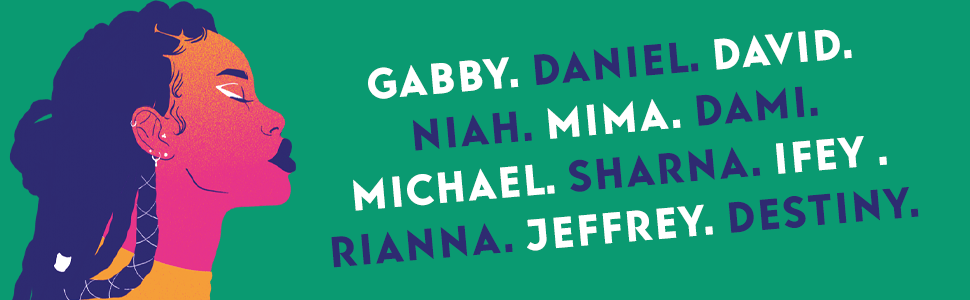
My heart broke for Gabby, in Good, Goodbye. At the age where everyone is getting married she’s always the bridesmaid – six times this year. She’s so obviously single that aunties commiserate with ‘your huzband is coming’. Obviously from the same friend circle, Jonathon is the resident clown, up for dancing, singing and even last minute MC’s duties. He played hard that summer and took so many photos for his Twitter Wedding Enjoyment posts. Yet he freezes at today’s wedding when he sees Gabby looking ‘like a goddess’. Gabby is the one who walked away from him five years ago. She felt like she wasted so much time on him and finally met up with him and drew a definite line under their ‘on again, off again’ relationship. I loved Gabby’s thoughts on the Maya Angelou quote about believing who people are the first time they show you. It’s a quote I kept in my mind in my younger, dating years, but a hard lesson to learn. Yet we also hear Jonathon’s thoughts – that Gabby was the one person who understood him and that actually he knows now she was the making of him. There’s such a gulf between what this young man says and what he deeply feels. He’s hiding behind polite conversation but inside remembers a wedding from years before, when her sister got married and he realised Gabby was the one. I yearned throughout this beautifully romantic story for one of them to tell the truth about their feelings.
We see more of Jonathon in a story called Ghana in December and we see the struggle of being split between London and the place that feels like home. The young men in the story are missing the food and the sun. He thinks about the expectations placed upon him as a young black man, especially once his father’s mental health declined, something he’s always kept to himself. He had to step up at home, be the man of the house and felt so much guilt for wanting to go to university. He tells his friend David that the London life ‘kills us in so many ways’. David gets it. It’s the micro-aggressions that chip away. Jokes passed off as banter. The hostility he felt from white and Caribbean kids. How he was talked down to as if all Africans are primitive and come from mud huts. He could never speak of his brother’s suicide and how returning to Accra brings out that grief. When he smells the food and sees the difference in the light he somehow feels united with him. It’s the place he needs to be in order to feel and allow himself to cry on a friend. I loved how the author shows the depths of these young men’s feelings and how they cope with this split identity. I really came up against my own privilege as the author wove the pandemic into her stories. There was so much able-bodied people took for granted in that period of time, my disability meant I had to shield for a year and become isolated from everyone. Yet black people were four times more likely to die from COVID than white and one story character is keen to set up a work support group for the 33% of employees who are black. She talks about the proportion of black and ethnicity minority people who work on the front line, the financial straits of the pandemic, the higher infection rates and she spends her spare time educating the employer about the disproportionate effect on black employees. Yet afterwards, when she’s encouraged to apply for a senior equalities post it goes to a white man. I could feel her powerlessness and the injustice of this decision. Our character doesn’t want to believe she’s facing racism and I’ve heard excuses made for these types of choices – it’s happened to me and I didn’t want to call it ableist in my younger years, but now I would. It’s a case of calling something what it is. Not letting yourself be gaslit about it.
My joy was unbounded when Gabby and Jonathon appear in the final story, set around a party. I had everything crossed for them, yet the author had other surprise reunions that I hadn’t expected. The stories that follow the pandemic have captured that sense of change. The reminder that we need to wear ‘proper clothes’ again made me smile because I’ve been aware of a big change in my wardrobe towards outfits that are really secret pyjamas. There’s nothing formal anymore, no high heels and certainly no work wear. There’s the strangeness of being with others, whilst knowing more social interaction is probably good for me. The author drops in these little clues and reminders of other places: the kente cloth bookmark; Ghana casually described as ‘home’; music used as a reminder of wider family and celebration. The references ground these stories within the community, the African diaspora in London. Not everything ends how we expect, but that just heightens the sense of realism and authenticity. This is a warm, inviting and illuminating collection that shows the pressures on young, Black British people. It was a different world from my own, a busy, urban city full of these sparky characters whose ambitions and dreams are so admirable, even if they are also tough on the character trying to achieve them. It shows how having your community and friends around you is vital, even if some of their expectations are grounded in a different time and place. Finally, it struck me how important it is to tap back into that home country through family, food, music or traditions because it’s something that keeps them grounded and replenished.
Out now from Magpie Publishing
Meet the Author

Shani Akilah is a Black-British Caribbean writer and screenwriter from South London. She is a book influencer, co-founder of the Nyah Network, a book club for Black women, and was a literary judge for the Nota Bene Prize 2023. Shani has a Masters degree in African Studies from Oxford University. For Such A Time As This is her debut short-story collection.
Thank you to the author, Magpie publishing and The Squad POD Collective for my copy of this collection.

 The Lotus Readers
Thank you for reading this book and sharing your thoughts, as a Black British young woman its always great to see others taking an interest in our world and how we do things, the same way we take an interest in other people’s worlds every day.
Another great suggestion for you if you liked this would be Small Worlds by Caleb Nelson (apologies if you have already read it!).
LikeLike
What a lovely message Demi, thank you. I love reading about other people’s worlds and I really enjoyed this one. I will look up the book you suggest and maybe feature it for one of my throwback Thursdays where I look at older books. Xx
LikeLike