Posted in Netgalley, Publisher Proof

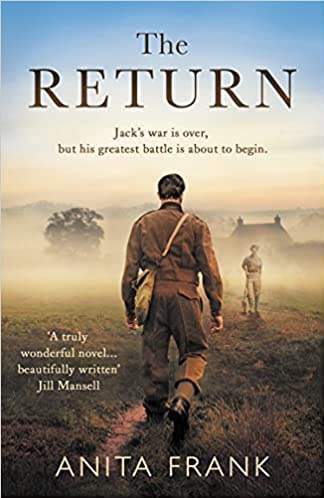
The Return by Anita Frank.

This beautiful story has just made it under the wire as I was compiling my Top 21 Books for 2021 and it truly deserves it’s place next to the others on the list. I was gripped by the story of Jack, who makes a very different promise to his new bride Gwen on the eve of WW2. Most soldiers are promising to see them again, to return, but Jack is quite clear. If he should survive the war, he won’t be back this way again. Gwen prays he keeps to his promise, but as they celebrate VE Day she does keep looking over her shoulder. What if he reneges on his promise? War has changed Jack and he is no longer the man who made that bargain. He wants to return and claim Gwen as his bride again, but little does he know that this could set in motion a chain of events that will leave he and Gwen fighting for what they love most.

We go back and forth in time throughout the book, but begins with Jack fleeing his home city on the night train, shielded by a friend who’s working on this nightly service down south from Newcastle. Jack is like many other young men in Newcastle, he’s a riveter in the shipyards and lives in a terrace house with his Mum and sister Jenny. One moment life is trundling along as normal, then the next a terrible twist of fate leads to a violent act of revenge. Stowing away on the night train, Jack plans to hop off somewhere far away where he can find work. So, as if from nowhere, he appears round the bend of a country lane to find a young woman who has fallen from her horse, but has her foot trapped in the stirrup. He hurries to help Gwen as her skittish horse takes off in the direction of the village. He takes her home to her family farm, where she helps her Dad with the dairy cattle and any other jobs that need doing. Lucky for Jack he’s arrived at a busy time on the farm, so while he stays for a home cooked meal to thank him for his service, Gwen’s dad Jim asked if he would like to stay and work. Jack accepts and as Gwen shows him his bed in the tack room, he thinks he may have fallen on his feet for the summer. What he doesn’t know is that Gwen is about to put him in a very difficult position. As he investigates a noise in the stack yard at night, he finds Gwen trying (and failing miserably) to quietly retrieve a ladder. She can’t pass her father’s door because the floor boards squeak. Reluctantly, he helps her climb up into her room, knowing that she must be meeting someone secretly and is surprised by how that bothers him.

I grew to like Jack, who is a young man of principles, only resorting to violence when someone he loves is hurt. He has an inbuilt moral compass, especially in his dealings with women and is very critical of anyone who doesn’t meet those standards of behaviour. He knows that in circumstances where young men lead women on and make false promises, it is the woman’s life and reputation that is ruined while the man just carries onto the next victim. He is a gentleman in his behaviour, even if he isn’t in position. I loved how he doesn’t have that family structure at home, but finds it with Jim and Gwen, and even housekeeper eventually. I didn’t always understand Gwen, although she is very young at the start of the novel and thanks to Jim’s overprotective nature, she’s quite naive. Something I did understand was her loyalty to the land and farm, it’s a way of life that’s in her blood and she isn’t afraid of hard work. She takes a very active part in the farm, from early morning milking, to driving tractors and locking the livestock up late at night. I thought the differences between gender and class were very pronounced in the novel. The women were far from passive in this rural community, with Gwen and Norah as great examples. It was interesting to see how the women from the hall were very separate from this industriousness – something that works against Gwen when it comes to being a mother.

The author creates a beautiful link between Gwen’s wholesomeness and the countryside – she’s miles away from the girls Jack has encountered in the city. She’s a young girl between places in society, she’s not in the lower classes but she’s not good enough for the landed gentry to consort with. At least not in public anyway. In the wartime sections of the book she’s well contrasted with land girl Norah, who has a cynical and knowing way about her. If they go the pub or an event, she soon disappears into a crowd of enthusiastic young men and seems completely at home flirting and telling stories that make them roar with laughter. Gwen is quieter, worried about how the farm will keep going with just her and Norah, wanting desperately to hold on to her father’s legacy. Besides, she knows the lies young men tell and the damage they can do. In those wartime sections, I felt the land and the countryside around it contrasted with the imagined battlefield far from here and the changes that farming had to come. Land was commandeered by the Ministry of Agriculture and fallow fields ploughed up for crops to feed the country. It was the beginning of the end for that quiet time when two ponies pulled the plough and two workers would weed the crop using a hoe. These passages of man working quietly within the countryside soon gives way to more modern farming methods which feel at odds with nature, rather than being harmonious. The author’s descriptions of animal and bird life are like a hymn to the old ways. I understood Jack’s need to return to this life, to feel at peace within it and allow the noise of battle, lodged in his head, to die down. However, I couldn’t see how he could stay either. I wondered constantly when the past would catch up with him and whether Gwen’s secrets could possibly remain hidden. This was a different slant on WW2, full of beautiful pastoral scenes and a relationship I was wishing would turn to love. A simply gorgeous read.

Meet the Author

Born in Shropshire, Anita studied English and American History at the University of East Anglia. She now lives in Berkshire with her husband and three children.

Posted in Netgalley, Publisher Proof

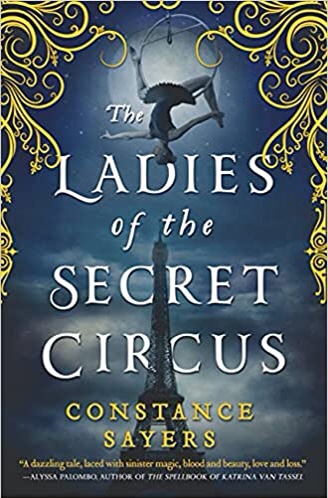
The Ladies of the Secret Circus by Constance Sayers.

The opening of this book, where Lara enchants her own wedding dress so it’s more to her liking, showed promise for the rest of the novel. Her marriage to Todd is the next morning, but as she’s waiting for her groom some bad news arrives. His best man is local law enforcement officer Ben and he tells her that Todd can’t be found. His car is found abandoned at a bend in the road where thirty years earlier another young man disappeared without a trace. Pete was in a band with Lara’s father, who has always been affected by the loss of his friend. Surely there’s a connection? Lara’s search for answers leads them to a journal written by her great-grandmother and the tale of a secret circus, where they perform using real magic. In Belle Èpoque Paris we follow the story of Cecile Cabot, Lara’s great grandmother, the subject of one in a series of three paintings by artist Émile Giroux. Cecile’s life is bound to the circus as is her sister Esme’s, but why are they cursed in this way and is it a price that the women in the family are still paying to this day?

From Lara’s wedding day onwards, the first section of the book set in idyllic Kerrigan Falls didn’t quite have the spark of that first scene. I worried that the book might be a bit saccharine sweet for my taste. It was typical small town America, but with barely any crime or unpleasantness. Residents seemed to get along easily and everyone cared about the town’s history, it’s beautiful period buildings and stunning setting. Lara bought the local radio station, her love of music coming from her famous musician father. I didn’t quite believe how lovely the place and it’s people were and I suspected there was a darker underbelly. This was hinted at in the the disappearances of these young men, but also the strange happenings in Lara’s life that started when she was a young girl and saw an unusual looking man and woman in their field who disappeared into thin air. Schooled by mum Audrey to keep her powers under wraps, Lara is sad about how her premonitions affect people. When she hears a vaguely familiar song, lurking underneath a track on one of her dad’s albums, she plays it on her guitar. The refrain is like a nagging tooth ache, but when her father hears it he goes white. It was one of Pete’s songs and they never recorded it.

I found it sad that these powerful women were having to hide their real selves to be accepted, especially when it came to love. Audrey’s marriage to Lara’s dad was blighted by Peter’s disappearance and now Todd was gone too. I really enjoyed Lara’s relationship with Ben, who was Todd’s friend and is just as invested in knowing what happened as Lara is. They’ve grown close trying to solve the mystery, but their relationship is full of unspoken feelings and guilt. When Audrey gifts Lara with a painting of her great-grandmother, to put up in her new home, the framer recognises it as a lost painting of Giroux. They then travel to Paris to meet an expert on the painter and have it’s provenance confirmed. It’s here that the story really took off for me, because the sense of place is wonderful and there’s a real momentum in their search for answers. The circus is the perfect antidote to the sweetness of Kerrigan Falls. I won’t ruin your discovery of this world, but it is truly fascinating, macabre, beautiful, magical and horrifying all at the same time. I was hooked by the scene the author was describing and fascinated by Lara’s family history. The small details, such as the circus only appearing to those with a personal invitation which bled if it was torn, were quite disturbing. The magic practiced there had parallels with Lara’s skills – simple tabby cats turned into ferocious big cats. There were surprises I hadn’t expected and Cecile’s final diaries are the vital first hand account of the circus’s history, as well as her own love story. I was immersed in this magical tale and didn’t really want it to end.

Published on 9th November 2021 by Redhook.

Meet The Author.

Constance Sayers is the author of A Witch in Time. A finalist for Alternating Current‘s 2016 Luminaire Award for Best Prose, her short stories have appeared in Souvenir and Amazing Graces: Yet Another Collection of Fiction by Washington Area Women as well as The Sky is a Free Country. Her short fiction has been nominated for the Pushcart Prize and Best of the Net. She received an MA in English from George Mason University. She lives outside of Washington D.C. Like her character in The Ladies of the Secret Circus, for many years, she was the host of a radio show from midnight to six.

Posted in Netgalley, Publisher Proof

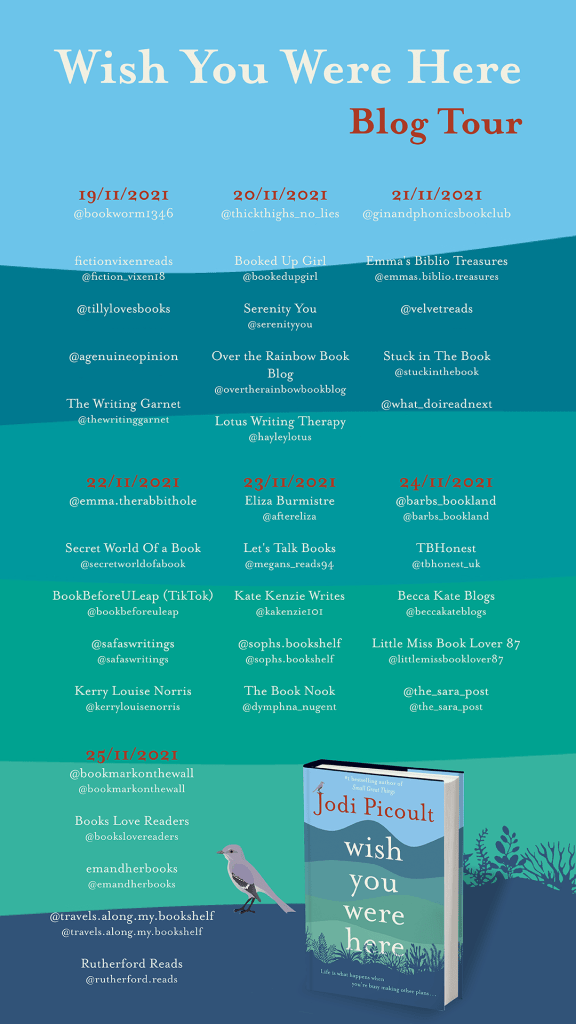
Wish You Were Here by Jodi Picoult

This was my first full on pandemic book. Others have mentioned or touched upon the changes of the last eighteen months, but this was full immersion!

I’ve been disappointed with the last two of Jodi Picoult’s books. They were still well written, but for some reason I felt detached from everyone in A Spark of Light – maybe because in the U.K. abortion isn’t such a contentious issue? The Book of Two Ways felt almost so full of detail that I was reading a textbook and losing interest in the story itself. This was a glorious return of form that I truly loved. Diana and her boyfriend Finn live in New York City, he is a doctor and she works at an auction house for fine art, on the verge of promotion to become an Art Specialist at Sotheby’s. She’s trying to acquire a Toulouse Lautrec painting that hangs in the bedroom of a Japanese artist -loosely based on Yoko Ono. Then, everything changes. Finn and Diana have a very set life plan and part of that was an upcoming visit to the Galápagos Islands. However there are rumours flying around in the medical community of a strange new virus in Wuhan, China. It seems like SARS in that it affects breathing, because it causes pneumonia and requires huge amounts of resources to keep patients alive. Diana’s boyfriend feels torn, as a doctor he’s worried and thinks they should be preparing but the president is on TV telling everyone it’s no worse than flu. What’s the truth?

. She meets Abuela’s granddaughter Beatrice who appears to have secrets and an inner pain that brings out a maternal instinct Diana didn’t know she had. Tour guide and Beatrice’s father, Gabriel, is the perfect person to be stranded with. He knows every corner of the island and has no work, so he can show Diana some of the sights she would never have seen ordinarily. The islands sound miraculous and here Picoult really does create an incredible sense of place. The seals lazily basking on the jetty, the sea turtles and their nests buried in sand, lush vegetation and lizards lying around intertwined. I could see and taste the salt air. I loved the islanders too – their openness to Diana, the bartering market set up when the island quarantined itself from the world. Everything is vivid and almost hyper-real. Then came the twist!! Oh my goodness I did not expect that at all. This was brilliantly done and shocked me. Yet it was all too plausible.

Diana has one link to the world beyond the Galapagos and that’s the occasional email from Finn. In it we see the reality of the COVID-19 epidemic in New York City. They have so many people being admitted and not enough people recovering and moving through rehabilitation. What do you do when the resources simply run out? Finn is exhausted, has permanent bruises on his cheeks, because they have to keep their masks so tight and is struggling mentally. He describes to her the patients lost, ones he can’t forget, because there are too many to remember them all. This was tough reading and I’ll be honest, I learned things about the virus I’d never heard before such as vascular compromise, bowel necrosis and neurological deficit. There were points where I felt a bit breathless and panicky. As someone who had to shelter from the virus, it made me think twice about going out in a couple of places. Anyone who thinks it’s just a ‘bit of flu’ should be locked in a room with the audio book playing on repeat! Please don’t let this put you off though. It’s beautifully written and the insight it gives into how hard things have been for those in the medical profession is priceless. We owe it to them to read such well-researched and thoughtful accounts of the pandemic. The Galapagos sections are like paradise in comparison and this was the space where I could take a long deep breath.

This book is Picoult at her best, in that it has an interesting storyline, and characters as well as an issue she could really get her teeth into. As the book started I was prepared for it to be set within the art world and I was already curious to see her relationship with Kito – the Japanese art collector – because they seemed to be on a similar wavelength. I thought we might end up embroiled in a legal battle over ownership or whether the painting was a forgery. Then everything she’d built at the beginning became subsumed by the pandemic and it became a totally different story. The structure effectively echoes how our lives have been interrupted and changed forever. There are people who went into the pandemic with a job that no longer exists. People have lost friends, family members and partners. The pandemic has changed people, they are looking at how they live and making changes. We moved into the country, and I’m sure others have done similar, focusing on enjoying life and working to live instead of living to work. There are people like me, who were disabled, but felt like part of society still. Gradually, over the last 18 months, I have become a recluse and I’ve felt more and more separated from people. Especially those people who say the vulnerable should be kept inside, so that ‘normal people’ can have their lives back. I’ve felt like an inconvenience, and like we’re holding the rest of the country to ransom. I’m hoping these feelings change with time, but who knows? I could understand Diana’s decision at the end of the novel, it might have seemed illogical but I got it. When you’ve been through something momentous you change, and part of that is re-evaluating life and choosing what makes you happy. It’s trying to recapture hope. I don’t want things to ‘go back to the normal’; I want this pandemic to mean something and I want things to get better. Diana takes that decision for herself and I found that both brave and uplifting.

Meet The Author


Jodi Picoult is the author of twenty five internationally bestselling novels, including MY SISTER’S KEEPER, HOUSE RULES and SMALL GREAT THINGS, and has also co-written two YA books with her daughter Samantha van Leer, BETWEEN THE LINES and OFF THE PAGE. She lives in New Hampshire with her husband and three children. 

Her most recent adult novel, A SPARK OF LIGHT first published in the UK on 30th October 2018, and was a #1 Sunday Times and New York Times bestseller. 

Follow Jodi Picoult on Twitter @JodiPicoult and find out more at http://www.jodipicoult.co.uk or on Facebook/JodiPicoultUK.

Posted in Publisher Proof

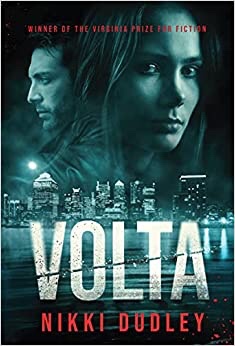
Volta by Nikki Dudley

When Briony Campbell confesses to killing her boyfriend, a straightforward crime of passion soon turns into a baffling mystery. Haunted by demons from his past, lawyer S.J. Robin is assigned to the case. But as confusion – and the body count – rises, he’s forced to question who is guilty and who is innocent. Can he see justice served and hold on to the woman he loves?

I’ve been slightly daunted by writing the review for this thriller, because I’m desperate not to give anything away. Volta really is a fast paced read, with a plot full of twists and turns and an engaging central character. Even more unusual, is the distinct thread of romance throughout. From the moment Briony wakes up covered in blood, I was drawn into the story. There’s an almost cinematic quality to the writing, because we’re totally in the moment as Briony wakes up and as her senses take in the terrifying situation she’s in so do ours. It’s a moment of of stillness that’s rare in the book. Then we pan out and see our other character’s reaction to the crime. Briony makes an statement to lawyer S. J. Robin that seems clear cut, but he soon realises the case is not that simple and as it becomes ever more entangled, it even brings his own demons to the surface.

The novel has three narrators: S.J, Briony and Mari. Mari is both Briony’s therapist and possible love interest to S.J, in a complicated coincidence. From the first time we see them together, it’s clear that S.J and Mari have history. Even more complexity comes in, when we realise that the investigator, Aris, is Mari’s brother – and they are a really convincing pair of siblings. It’s a small interrelated group of characters, and it creates a slightly claustrophobic feel. S.J relates his tale in the first person, and for some reason that makes me think he’s giving a true version of events. It’s an unconscious bias that I think comes from being a counsellor and ‘prizing’ the client’s account, never showing judgement or disbelief. However, I do love it when a novel’s narrator proves to be untrustworthy and as the story unfolded I started to feel a little unsettled by some aspects of the story – specifically S.J and Briony’s narratives. They each had an experience of trauma in their respective childhoods; from this it is easy to draw parallels between them. However, when a narrative’s in the third person we can see others interacting with our character, having inner thoughts about them and possibly being aware of their back story. A first-person narrative has no corroboration and though the difference in narrative perspective seems subtle it does have a large impact. S.J is intriguing. We learn very early in the novel, that he’s dealing with past trauma and his positioning as a victim also elicits sympathy from the reader – that is until doubts start to creep in. We learn that his psychological trauma could be permanent or at least difficult to heal, and this could create a further bond between him and Briony that is possibly unhelpful, both personally and in the investigation. I was left questioning what exactly had happened in Briony and S.J’s pasts? Did what happened with Briony relate to those circumstances? Can the victim have justice if S.J wins justice for Briony – are they the same thing? In between is the push and pull of S.J and Mari, whose attraction gave the book more of a light-hearted feel

Although the novel moves along at an incredible pace, I could identify certain threads or themes running throughout, always at the back of my mind like a constant nagging voice. I seemed to be thinking constantly, even when I wasn’t reading the book! Make no mistake these are complicated characters, with psychological damage that’s affecting their everyday lives and their work. Their relationships are difficult, or even broken. The author’s grasp of the consequences of trauma are nicely nuanced and I felt safe in the hands of a writer who understood psychological trauma well. In fact the reader works as a fourth character, bringing their own bias and assumptions to their assessment of Briony. The word ‘Volta’ is defined as a literary device, used in poetry. It’s a rhetorical shift, or a dramatic change in mood, emotion and tone. That’s how this book feels as a reading experience, I found myself shifting constantly in my assessment of Briony based on how one of the other characters viewed her or when a twist in the narrative turned everything on it’s head. This would be a great book club choice, because I imagine every reader has a different perspective. This is a strong, intense and clever thriller with characters to match.

Meet The Author


Nikki is a novelist and poet who grew up in London. She attended state school in Camden and spent her time hiding in the library. She is managing editor of streetcake magazine, which publishes innovative writing. She also runs the streetcake writing prize and MumWrite, a development programme for mums. Her novel, ‘Ellipsis’ was published by Sparkling Books in 2010. Additionally, she has been published in magazines and online. Her chapbook ‘exits/origins’ and collection ‘Hope Alt Delete’ are published by The Knives, Forks and Spoons Press. She won the Virginia Prize for fiction 2020 and her novel, Volta, was published by Aurora Metro Books in 2021. Her pamphlet, ‘I’d Better Let You Go’ was published by Beir Bua Press in 2021.

Nikki loves mysteries, thrillers and things that make her think. Some of her favourite books are Catch-22, the Raymond Chandler books, How to Life Safely in a Science Fictional Universe and anything by Yoko Ogawa. 

Her other interests include watching many genres of films and attending events such as poetry readings, sport, and gigs. You can start conversations with her by discussing your favourite type of cake, your favourite Avenger or telling her a fun fact. She loves travelling and trying local cuisines.

Posted in Netgalley, Publisher Proof

My Name is Jensen by Heidi Amsinck

This was a great opener in a new Scandi noir series, that left me looking forward to getting to know these characters a lot better. Jensen is a journalist living in Copenhagen after spending several years in London as the British correspondent for a Danish newspaper. She still hasn’t quite found her feet in the city, and knows that she’s very lucky to still have a job considering the cuts at work. Her editor Margrethe has faith in her ability to sniff out a story and one morning, while cycling to work.Jensen stumbles across the body of a young man with a large placard saying guilty on his chest. His eyes are covered with new fallen snow and it’s clear that he has several stab wounds to the abdomen. He’s also homeless, Jensen calls her ex-lover Detective Henrik Jungerson to report the murder, even though she’s been trying to avoid him since her return. Jensen doesn’t want to exploit such a sad death for newspaper headlines. Nor will she sensationalise it, However as more bodies are found it’s clear a serial killer is on the loose. Why would someone choose the homeless as their victims? Jensen has to investigate further.

I really enjoyed Jensen’s character. She’s rather mysterious and I think the author was clever to drop clues and hints about her in this first book of the series. It left me wanting to discover more and delve into her past, not least her relationship with Henrik. It certainly isn’t over. She’s determined and dogged once the story has piqued her journalistic interest and it’s probably true to use the word ‘obsessed’ when describing how she investigates. She feels very real because of the way she’s written – it’s like slowly getting to know a new acquaintance rather than having a fully formed person. She’s also a bit prickly and is very used to navigating a rather male dominated workplace. Her tension with Henrik leaps off the page and I’m very interested to see where their relationship goes next, as well as unearthing a bit more about their past.

“clues and hints about her in this first book of the series. It left me wanting to discover more and delve into her past, not least her relationship with Henrik. It certainly isn’t over. She’s determined and dogged once the story has piqued her journalistic interest and it’s probably true to use the word ‘obsessed’ when describing how she investigates. She feels very real because of the way she’s written – it’s like slowly getting to know a new acquaintance rather than having a fully formed person. She’s also a bit prickly and is very used to navigating a rather male dominated workplace. Her tension with Henrik leaps off the page and I’m very interested to see where their relationship goes next, as well as unearthing a bit more about their past.

The fact that Jensen focuses on finding out about the killer’s victim rather than the killer suggests a lot of empathy and a keen sense of social justice underneath the spikiness. She leaves Henrik to look for the killer and he’s soon connecting it to a previous suspicious death. They are a good team in this way, each with their own methods, but sharing information along the way. I think the book touches on a lot of current problems in our society, particularly how the world’s economic structure is creating horrendous poverty. Issues such as mental health, drug abuse and of course, homelessness are featured in the book and I thought the author wrote about this with understanding borne out of real life experience and conviction. The story was fast paced and very compulsive reading. There are twists and turns along the way in the investigation and moments where Jensen feels inundated with information, but none of it is making any sense. The tension builds towards the conclusion and these are the really addictive parts that I found myself reading in the car, the hospital waiting room and till 2am while on holiday! This was a fantastic opener to, what is now, a much anticipated series and I have to mention that gorgeous cover. It’s so beautiful I want to put in a frame and hang it on the wall.

Published by Muswell Press 31st August 2021.

Heidi Amsinck, a writer and journalist born in Copenhagen, spent many years covering Britain for the Danish press, including a spell as London Correspondent for the broadsheet daily Jyllands-Posten. She has written numerous short stories for radio, including the three-story sets Danish Noir, Copenhagen Confidential and Copenhagen Curios, all produced by Sweet Talk for BBC Radio 4. A graduate of the MA in Creative Writing at Birkbeck, University of London, Heidi lives in London. She was previously shortlisted for the VS Pritchett Memorial Prize. Last Train to Helsingør is her first published collection of stories. Her crime novel My Name is Jensen, set in Copenhagen, will be published in August 2021

Posted in Publisher Proof

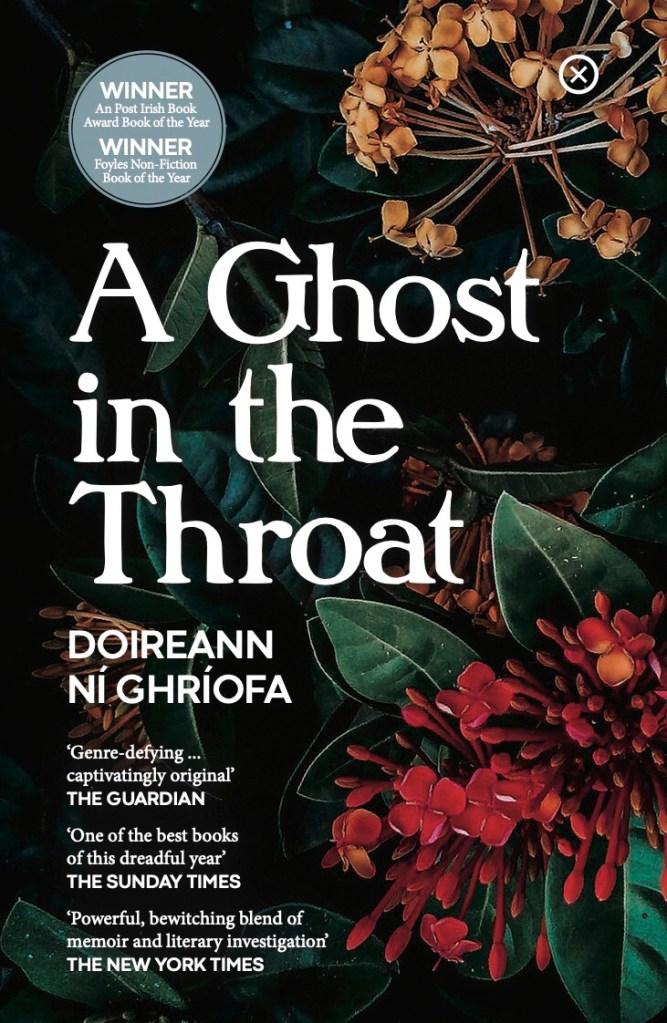
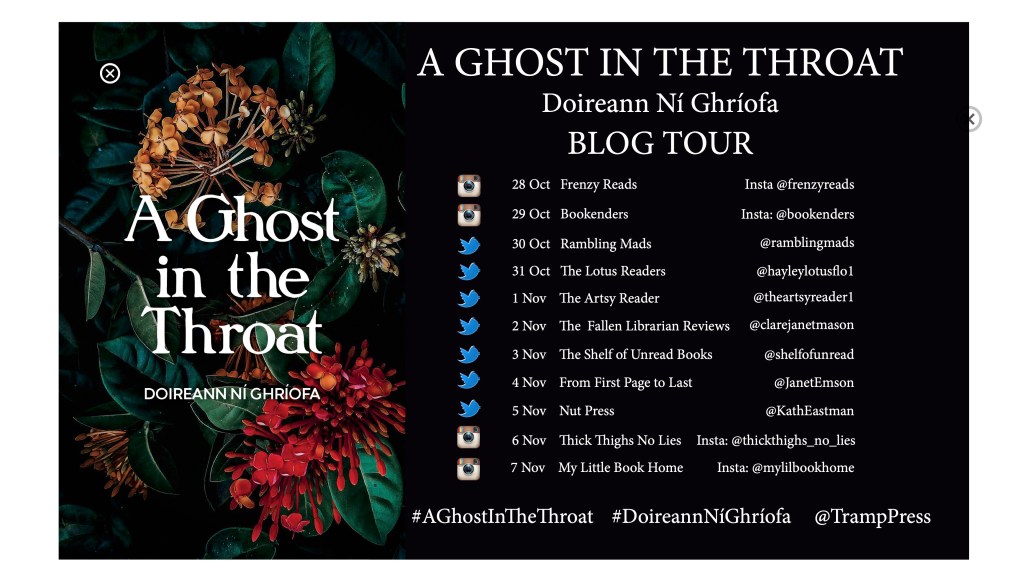
A Ghost In The Throat by Doireann Ní Ghríofa.

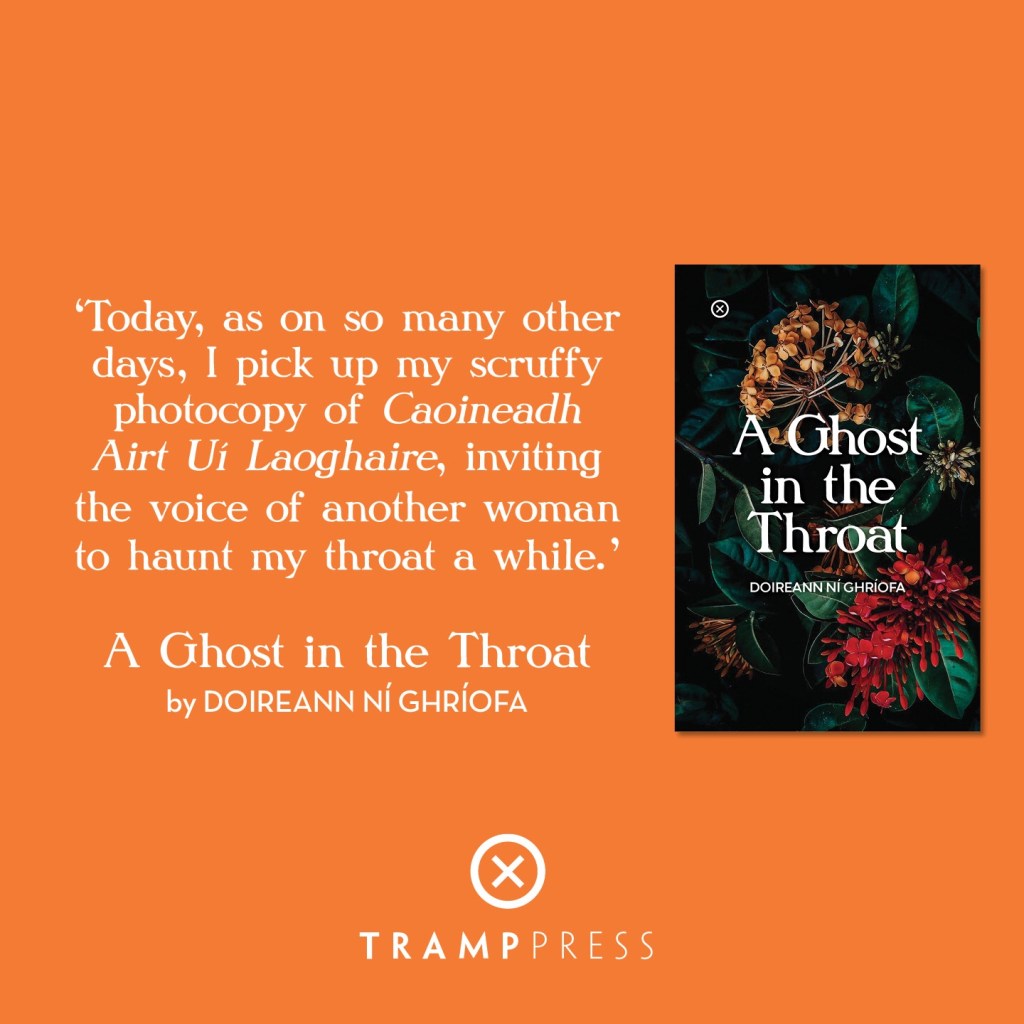
“This is a female text, composed while folding someone else’s clothes. My mind holds it close, and it grows tender and slow, while my hands perform innumerable chores.”

This novel is exceptional. It’s beautiful, moving and speaks about women’s experience in such a unique, but brutally honest way. The author has written an incredible piece of auto-fiction, which is half memoir and half novel but all poetry. While I can’t claim to be anything like the writer, I know this is the way I’m currently writing at the moment – as close to poetry as prose can get. I have always referred to it in my notes as a patchwork quilt of different images stitched together to make the whole. Our narrator is a mother of three small children and she has a fascination with the Irish poem ‘Caoineadh Airt Ui Laoghaire’ where an Irish noblewoman laments the death of the her murdered husband. Such is her passionate grief, that on finding his body, she drinks handfuls of his blood and then composes this extraordinary poem. For our narrator, the poem has echoed down the centuries and is her constant companion. As she reads it aloud the poet’s voice comes to life. The author writes her own life to its rhythms and wants to discover the truth of the poem’s story.

Entitled a ‘dirge and a drudge song’ the author details that drudgery, the minutiae of her day and her boredom and satisfaction in the endless tasks she ticks off the list. Repeating ‘this is a female text’ creates a refrain throughout the list, emphasising not just the physical but the mental load. She comments on it gaining importance through the written page, an importance that’s usually reserved for male stories. Women’s skills and stories have previously lacked importance because they are passed down orally, from mother to daughter along with home making skills like recipes and patterns. I loved this context because it’s inspiring. It tells us that our stories are important too. Just because they’re domestic doesn’t mean they’re less than. They are simply a social history rather than a military or political one. This is shown in the fact that, despite the poem being described as ‘the greatest poem written in these islands in the whole of the eighteenth century’ the history of the poet herself is hard to uncover. In the family, a tragedy almost occurs, and in the aftermath the author’s interest in the poet grows. However, it’s a very broken and hidden trail to find her.

I loved how her recording of 21st Century motherhood is treated as an epic. I loved the sense of a collective consciousness running through the book. As if her words join hundreds and thousands of others in a never ending stream of female consciousness. This isn’t just about putting your experience into the world, it’s about having a source of female wisdom to draw from whenever you need it. The poem is part of that consciousness, but so are many other papers we don’t think about as historical documents. In my work I’ve used the care sheets that I kept every day for my late husband, because they show what I was doing and I loved connecting them to more lyrical documents like my journal. The author adds to these collective documents, with her ‘family calendar scrawled with biro and pencil marks, each in the same hand – this is a female text. Month after month after month of appointments, swim lessons, half-days, bake sales, fundraisers, library returns, a baby’s due-date, birthday parties, and school holidays. Tick. Tick. Tick.’ They are not accounts of battles or elections won, but there are a thousand small victories here. If we think about how we leave our mark on this world we should think about all the ways we record our lives on this earth, from our Spotify playlist, our status updates, our Instagram photos, our Pinterest boards. All of these are a form of journal, the quiet way we express who we are and what’s happening in our worlds. We write ourselves into the cross stitch we do, the crocheted blankets, and the patchwork quilt we made for a new baby. We stitch ourselves into the tapestry of life, and the author emphasises this, with words so descriptive I could picture her and the family she works so hard for. This is a female text and in it’s search for the meaning of women’s lives it is reassuring, it lets us know we’re not alone, but it also inspires us all to create meaning. To add our voice to the women’s wisdom, expanding that collective consciousness and making our mark.

Meet The Author.

DOIREANN NÍ GHRÍOFA is a bilingual writer whose books explore birth, death, desire, and domesticity. Doireann’s awards include a Lannan Literary Fellowship, a Seamus Heaney Fellowship, the Ostana Prize and the Rooney Prize for Irish Literature. She is a member of Aosdána. A Ghost in the Throat is her prose debut.

Posted in Publisher Proof

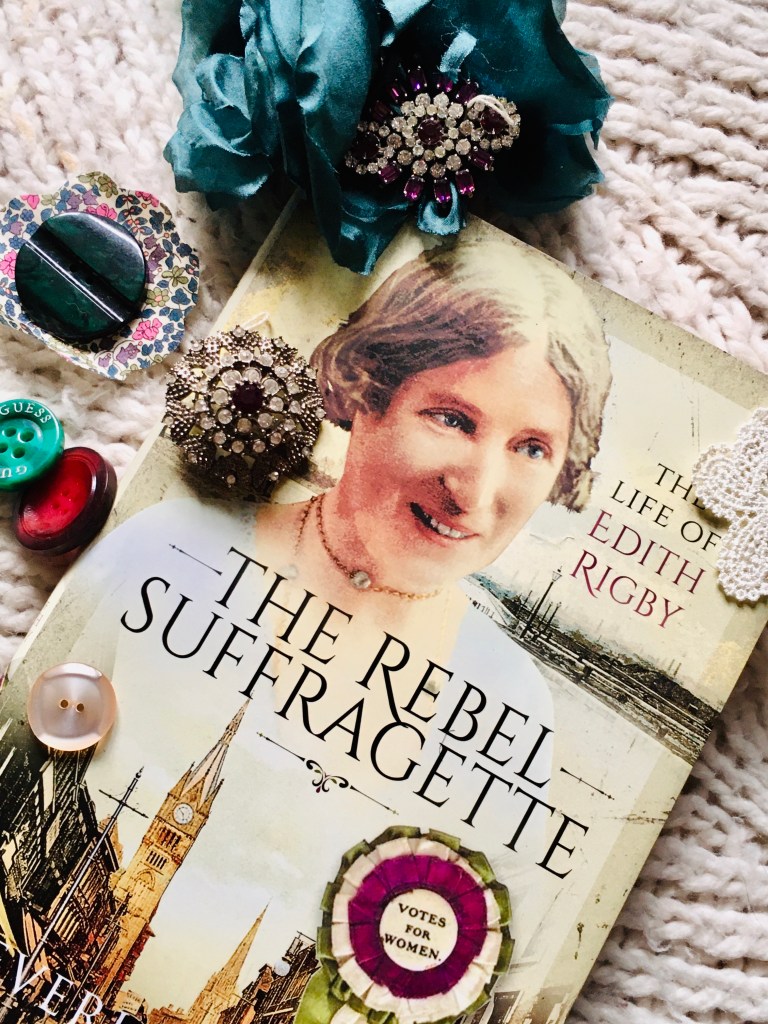
The Rebel Suffragette: The Life of Edith Rigby by Beverley Adams.

When I was asked if I’d like to join the blog tour for a book about a suffragette I thought I pretty much knew what to expect. When I received my copy and I read the blurb on the inside cover I was really excited. First of all she was a Northerner like me and even better, she threw a black pudding at an MP. That’s about as Northern as it gets. Everything we’re taught about the movement focuses on the Pankhurst’s and the rallies based in London. What this author does is reframe the movement to the North West, where Edith Rigby founded the Preston branch of the Women’s Social and Political Union. In doing this, the author reminds us that this was a nationwide movement, but also introduces us to a fascinating woman who was ahead of her time.

This is a well written and well researched autobiography about a fascinating woman who wouldn’t be told what her place was. Born to a lower middle class family in Preston, Lancashire, they lived in a dual purpose house which was part home and part doctor’s surgery where her father was doctor to the local mill working community. I enjoyed learning about how Edith grew up, because it was possibly this stable and happy environment that influenced her thirst for knowledge, individuality and equality. She saw how gender, and particularly class, affected children’s future circumstances and because she was so caring she went out of her way to help – even saving up her pennies to give gifts to local children on Christmas morning. While her actions within the Suffragette movement were fascinating reading, I really found the other aspects of her life interesting too. She was the first woman in her area to ride a bicycle and persisted in riding it, despite being heckled and pelted with vegetables, and even preached against by the local vicar. She liked the freedom her own transport gave her. Luckily, she found a man who enjoyed her vivacious and free spirit because she set out her stall from the wedding day. She was also adamant she was keeping her Christian name, so that instead of being named Dr and Mrs Charles Rigby they became Dr Charles and Mrs Edith Rigby. Having kept my own surname when married I felt a kinship with Edith and I also share her love of North Wales. Her determination to live by her principles was inspiring and it’s clearly this that informed her work with the school for young women that she founded. It also inspired the lengths she went to for the suffragette cause including arson, planning a bombing in Liverpool and going on hunger strike in prison. I applaud the author for bringing this incredibly strong woman to our attention and I recommend the book highly.

Posted in Publisher Proof

The Secret Life of Albert Entwhistle by Matt Cain.

I don’t know how many of you are Strictly Come Dancing fans, but I hope there are a few of you out there. Last weekend we watched the third episode of this series and the professional dancers did one of their group numbers at the top of the show. Johannes was a handsome Prince and a ball was being held in his honour. As he entered the ballroom he saw the couples dancing on the floor, but seemed isolated and alone. Until a male dancer, Kai, stepped forward and asked him to dance. As they started to move round the floor his face lit up and so did mine. The other couples on the floor reformed until the ballroom was full of same sex couples. It was a joyous dance about acceptance for who we are and the ability to be open about our sexuality. It really brought tears to my eyes to see how happy Johannes was to do this dance. So, for me this was exactly the right week to read a book I’ve seen doing the rounds of BookTwitter for since January. I know I’m seriously behind most people in reading this little gem from Matt Cain, but I couldn’t miss a chance to talk about it- just in case there are other people living under a rock like me who haven’t encountered Albert Entwhistle yet.

The books sits perfectly next to the Strictly dance I mentioned, not just because of the subject matter, but because both are simply little parcels of joy! I felt uplifted every time I sat to read a few pages of this wonderful story. There’s a further little link to Strictly too, as Albert reminisces about a trip to Blackpool with his friend George. They were both young men at the time and they visit the iconic tower ballroom, where George is taken with the dancers whirling round the floor. He asks Albert to think of a world where they could take a turn round the floor like every other couple there. George exclaims how romantic it is and Albert agrees. It would be romantic, but it’s inconceivable for two men to partner up and take to the floor. In fact it seems so taboo that Arthur imagines there’s a written rule against it. Years later, when he’s 64, he revisits the ballroom to show his friend Nicole and sees a couple of men his own age, waltzing round the floor with no one batting an eyelid. A realisation follows; how can anything change while gay men remain hidden? It takes trailblazers, people willing to be uncomfortable and face public displeasure, to make things change. This gives him the courage he needs to face his fears and perhaps even alter the lonely future he imagines. Maybe he could find his friend George and talk again? He doesn’t dare to hope that the feelings could still be there, but there is a small nugget of longing for that dream. Why not? After all, he still feels the same way about George.

Until now Albert has lived very closed off from the rest of society. He’s a postman, and has a routine of arriving at the sorting office at the same time each morning, organising and sorting his load for that day. He doesn’t really interact much with his colleagues, beyond normal pleasantries. We see his lonely life at home, with rare moments of joy when he puts on a show tune and dances with his cat Gracie. So, I loved how Albert’s search for George opened him up to other experiences, particularly his friendship with single mother Nicole. He’s never been to a soft play centre before or even been this close to children. Yet she doesn’t let him hesitate or worry, and just places her daughter on Albert’s knee before he can argue. He’s never been to a pub quiz before either, but once he takes the plunge, he’s surprised how much he enjoys these new experiences. It also makes him more aware of other people’s loneliness and he starts to make little changes to try and make their lives better. His dread about revealing his sexuality to people seems disproportionate, because we live in more tolerant times. Yet, when we think back to Albert’s teenage years, homosexuality was still a crime. It’s amazing to think it was as recent as Sam Gyhima’s stint as justice minister in 2017 for a government pardon to be made to everyone jailed for their sexuality. This followed a royal posthumous pardon in 2013, for the mathematician Alan Turing. The writer’s trips back into Albert’s past, remind the reader that there are years of prejudice behind these uplifting stories. Strictly’s same sex dance routine elicited tears of emotion, because what’s now accepted enough to be on family television at prime time on Saturday night, used to elicit abuse, rejection and even criminal charges. So I found this book moving and I really did fall utterly in love with Albert. The story was heartfelt and uplifting. I would really recommend it to anyone looking for beautiful characters to engage with and story full of human emotion.

Published 27th May 2021 by Headline Review

Meet The Author


Matt Cain is an author, a leading commentator on LGBT+ issues, and a former journalist. He was Channel 4’s first Culture Editor, Editor-In-Chief of Attitude magazine, and has judged the Costa Prize, the Polari Prize and the South Bank Sky Arts Awards. He won Diversity in Media’s Journalist Of the Year award in 2017 and is an ambassador for Manchester Pride and the Albert Kennedy Trust, plus a patron of LGBT+ History Month. Born in Bury and brought up in Bolton, he now lives in London.

Posted in Netgalley, Publisher Proof

We Are All Liars by Carys Jones.

The ‘Fierce Five’ have always been the best of friends. Gail, Allie, Emily, Stacie and Diana are all different in character, but have complimented each other. Gail is the organised one who tends to get them altogether. Allie is quiet and tends to be more introspective than the others. Emily is the traditional one, with her twins and husband Adam at the centre of everything she does. Stacie has been married twice, someone who is proud of being straight talking, but is still holding a lot inside. Finally there’s Diana who came from a more deprived background than the others and has a more cynical or realist’s perspective on life. They are all invited by Gail to celebrate her 35th birthday at her cabin, an isolated and atmospheric spot in the Scottish Highlands. The girls plan on catching up, having a drink and enjoying the remote location where they’re removed from their everyday lives. However, when a snow storm threatens to cut them off completely, events are set in motion that no one expected.

This was my first book from Carys Jones and she certainly knows how to ratchet up the tension. This wasn’t my first remote chalet thriller this year because there have been a few books with a similar premise such as Catherine Cooper’s The Chalet and Ruth Ware’s One by One. I found this story compulsively readable, with well-drawn characters and a real sense of surprise and menace. The story is told in two timelines, the current stay in the cabin and then back into the girl’s pasts where we could explore their past interactions and the events that shaped who they are. These sections were not necessarily chronological, but each section informed the situation in the present. A third section is written as the transcript of a police interview with an unnamed person of interest. Since one of these transcripts starts the book off, we know how important they are to the story and that something very very wrong has happened on the girl’s weekend.

The storm is menacing and I felt like the author depicted it like a sixth character in the novel. Even though it’s outside, it seems to influence what happens inside, so as the storm builds so do the friend’s emotions. When the storm is at it’s height the secrets, and lies of the book’s title, come to the surface and events take a drastic turn. I loved the way the author depicted this complicated friendship, because it was realistic. Often large friendship groups like this do have factions – two of the group who are closer than the others, another pair keeping a secret from the group or one member feeling isolated from the others. It’s impossible for groups like this to weather the years without changes happening. Individual experiences shape and change us over time and that might mean friendships wax and wane, but in groups like this those changes can cause resentment and jealousy. This happens especially if two people bond over an experience they’ve both had, switching allegiances such as friends who’ve both have children tending to gravitate towards one another. As the secrets come tumbling out and the girls battle to cope with the revelations and the effects of the storm things reach boiling point. Which of the friends will snap? This is an entertaining novel about old friendships that might just put you off your next school reunion. Tense, claustrophobic, and an unexpected ending. I’ve been reading this in a remote cabin in North Wales and it definitely added to the experience!

Author Carys Jones

Posted in Publisher Proof

Dinner Party A Tragedy by Sarah Gilmartin.

At the turn for the Northside quays, the bus missed the lights. A woman in front of Kate said to the person next to her, ‘There’s so much traffic we’re going backwards.’ The seatmate agreed and the conversation went relentlessly round, each of them talking over the other, saying the same things, until Kate felt that she might never get off the bus. The windows had fogged again and the vents at her feet piped sour heat up to her face. She popped a button on her coat, elbowing popped a button on her coat, elbowing the man beside her by mistake. ‘Sorry,’ she said. He ignored her and leaned forward for another bite of his breakfast bap. The yolk split, smearing the ketchup like pus into blood. Kate moved as far away from him as she could, which was not very far at all. Her right ear started to ring, a kind of static fuzzing inside her head. Across the aisle, a toddler screamed, his sharp little cries sucking the light right out of the sky.’

This book was one of those ‘slight’ novels but it really does pack an emotional punch. As I started to read Dinner Party, my brain meandered back to my university days and the first time I read Mrs Dalloway by Virginia Woolf, which was like nothing I’d ever read. The above quote, following Kate through the city as she shops for the dinner party she’ll be holding that evening, reminded me of the scene where Clarissa Dalloway takes the omnibus. The writing is simply beautiful, we’re on a bus ride so nothing much happens but everything happens all at once. We get such a sense of Kate from this short passage: her anxieties, her fears, the irritability with other passenger’s foibles, the disgust with food and how her senses become overloaded to the extent that a baby crying takes all the joy out of her.

Today Kate is cooking a meal for her siblings to mark the sixteenth anniversary of their sister Elaine’s death. Every year the Gleeson siblings gather, but this year is a little different. Elaine was Kate’s twin, and she still feels utterly bereft:

‘But a twin can never get over a twin. It was like someone asking you to forget yourself.’

Kate has decided to host the dinner party for her two brothers and her sister-in-law in the flat she plans to leave soon after. As the four settle round the table, to enjoy the food Kate has taken so much trouble over, they begin to talk about their mother. Peter defends her as he always does, but Ray and his wife Liz challenge his excuses for her cantankerous nature. When they leave, earlier than she expected, Kate performs the mental ritual of counting the number of bites she’s taken. Several life events seem to have plunged her into a crisis. She has just been rejected by the married man she’s been having an affair with, which somehow seems worse now she’s thirty-three. Her work holds no challenge and could be done by a junior colleague and she has fewer friends to support her. This is not her first mental crisis, they started in her third year at university when she was hospitalised for anorexia. Counting bites and controlling her food offered an escape from the pain of loss that never seems to go away, not to mention her mother’s anger and constant criticism. The author then takes us to a year later, as another dinner party marks the seventeenth anniversary of Elaine’s death but this time things are different for all three siblings.

This is a psychologically complex novel and I loved that, being a therapist. Kate is constantly over-thinking, re-evaluating and performing rituals in an exhausting monologue that seems constant for her. As the product of a critical parent, her self-talk is largely negative. She has internalised her mother’s criticism and now carries it with her wherever she goes. It stifles her ability to self-soothe, a vital skill for adult life that allows us to make ourselves feel better. Instead she needs constant input and encouragement from something outside herself, often a person who shows merely a hint of kindness or approval. However, another means of gaining approval is through achievement and Kate is definitely an over achiever, constantly setting herself standards and markers against which she can better herself and feel more valued:

‘She could never pin down the problem; it was a shifty kind of thing, something to do with routine. Shopping in the same supermarket, buying the same foods, wearing the same outfit in different colours, or even with things she enjoyed like music or exercise, running the same stretch of beach, having to reach the railing she’d reached the day before—all these arbitrary markers of success or failure that seemed to somehow captivate and imprison her. Devika said it was just the break-up blues making her feel inadequate, but the truth was, it had been going on for years, long before Liam, this impulse to do things to exhaustion. It was extreme living. Or it was living for two. Wringing the sponge, Kate felt the energy leave her body. She sat on a stool and began to count. Three. Then five—no four—it was only four. And a sprout. Less than ten bites in total, a miracle with all the food.’

The author has created incredible multi-dimensional characters here with all their flaws and imperfections on show. We spend a lot of time inside Kate’s head and it’s a very tiring place to be. Even shopping and cooking for this simple dinner becomes a marathon as she stretches her culinary abilities with a Baked Alaska for dessert that doesn’t make the table. However, don’t think this is a litany of misery. The author’s depiction of the sibling’s dreadful mother is almost comical in it’s awfulness. Yes it’s a very dark sense of humour, but I understand it. This is just one of the defensive strategies the siblings have; if they find her funny it doesn’t hurt so much. Despite Kate being our doorway into this world, it’s important to remember that Elaine’s death isn’t just Kate’s loss. This is a family tragedy and everyone grieves in their own way and at their own pace. Kate seems to know that their mother’s irascibility has been heightened by the loss of her daughter. All the remaining siblings know they can’t measure up to a ghost. The Elaine their mother misses probably isn’t a real person any more. A mother doesn’t just grieve her daughter, she grieves the life she’d imagined for that child: the achievements and milestones of life like her wedding day, or a first grandchild. Death has erased Elaine’s flaws, creating a saint-like girl that no living child could live up to. Perhaps this is why the siblings hold their anniversary dinner without their mother, or maybe because her criticism has subtly damaged each of them, just in different ways. Yet, their mother isn’t a two-dimensional monster, which she could have become in a lesser writer’s hands.

I liked the structure of bookending the story with each, very different, dinner party. I could imagine the book being turned into a play or screenplay very easily. I loved the forays back into the past, to see all the siblings but mainly how Kate and Elaine related to each other. The past sections truly do inform the present, either explaining a sibling’s present behaviour or simply showing us the depth of what this family have lost. With themes of mental ill health, anorexia and suicide this isn’t an easy read at times, but nor should it be. The author is showing us how tragedy can be a legacy, one event leading to inter generational pain and trauma. I found her depiction of this moving, but also helpful in a strange way. Some parts are painful, especially if you’ve lost someone very important to you like I have. However, it’s also enlightening and leaves you feeling that you’re not alone in the world. That there are other people who have once felt and thought like you. The trick is to stop the pain passing on to the next generation, to let the trauma end with you. This is a wise and beautifully written debut from an author I’ll be watching out for in the future.

Published by Pushkin Press, 16th Sept 2021.

Meet The Author

SARAH GILMARTIN is a critic who reviews fiction for the Irish Times. She is co-editor of the anthology Stinging Fly Stories and has an MFA from University College Dublin. She won Best Playwright at the inaugural Short+Sweet Dublin festival. Her short stories have been published in The Dublin Review, New Irish Writing and shortlisted for the RTÉ Francis MacManus Short Story Award. Her story ‘The Wife’ won the 2020 Máirtín Crawford Award at Belfast Book Festival.

@sarahgbooks