Posted in Netgalley

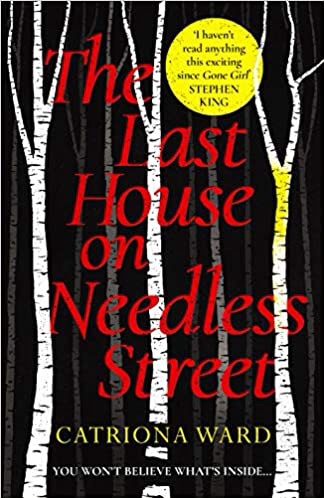
The Last House on Needless Street by Catriona Ward

Publisher: Viper (Serpents Tail) 18th March 2020

I finished this novel in a sort of shell-shocked silence. I felt like I needed to go straight back to the beginning and start again. It is extraordinary and unlike anything I’ve ever read before. It’s also very difficult to review without spoiling other reader’s experience of it, but I have to give it a go.

The house in question is the home of our first narrator Ted. As we read Ted’s view of the world we start to realise there is something unique and odd about the way he experiences the world. He made me feel uneasy. We get a sense that something is very wrong when the birds he loves to watch, are trapped and killed. Ted spends a lot of time thinking about an incident several years before when a little girl disappeared from the lake nearby and was never found. Others might have forgotten, but not Ted and not the girl’s sister who has a huge sense of guilt about her sister’s loss. Ted was a suspect at the time and it’s not hard to see why; he’s a slightly strange loner, living nearby in a ramshackle home with boarded up windows. The girl’s sister hasn’t forgotten that Ted was a suspect and decides to rent the house next door and watch him, in the hope of finally discovering where her sister is. CCTV proved Ted’s alibi at the time, but the sister’s convinced she has found the culprit.

Things take a very strange turn when we meet another narrator, Ted’s cat Olivia. In other hands this might have seemed twee or whimsical, but here it isn’t. It did give me a shock in the first instance, when a narrator I’d assumed to be human, stopped to lick the back of their legs! I loved the way the author played with language in these sections. Olivia doesn’t realised Ted is a name, she thinks it’s a word for his species, so all people are ‘teds’ and dogs are ‘brouhahas’. She describes her love for another of her species, a beautiful cat with emerald eyes that she sometimes spies preening herself, through the cat flap. She also has a belief system, including her very own god who she refers to as LORD. Yet there are aspects of this cat, that are distinctly not cat-like and I started to wonder if all wasn’t as it seemed. Could this cat be someone or something else entirely?

Other narrators are introduced and I was sometimes thoroughly confused, but never contemplated putting the book down. The beauty of the language and cleverness of the structure kept me going, determined to work out what exactly was going on. I was starting to be unsure which sections were real and what was illusion. The author is clearly hugely skilled at creating that sense of the uncanny – when everything seems normal and recognisable, but there is just that sense that something is off-kilter and sinister. This was so psychologically clever and I enjoyed Ted’s visits to the ‘bug man’ who appears to be some sort of psychotherapist, until he appears where we don’t expect him. I was so involved in this world of Ted’s that I was starting to forget the original crime, the loss of a little girl on the beachfront of the lake. The writing is so involving that I was inside Ted at times and the uneasy feeling is that you will never be able to get out. I guessed some of what is going on, but not the whole and I love the ambition and audacity. This is a unique, original and deeply creative piece of work that enthralled and stunned in equal measure. Ward is a writer of immense imagination and talent and I feel privileged to have been given the chance to read this before it hits the shelves and becomes a phenomenon.

Meet The Author

CATRIONA WARD was born in Washington, DC and grew up in the United States, Kenya, Madagascar, Yemen, and Morocco. She read English at St Edmund Hall, Oxford and is a graduate of the Creative Writing MA at the University of East Anglia. Her next gothic thriller, The Last House on Needless Street, will be published March 2021 by Viper (Serpents Tail). 

Ward’s second novel, Little Eve (Weidenfeld & Nicolson, 2018) won the 2019 Shirley Jackson Award and the August Derleth Prize for Best Horror Novel at the 2019 British Fantasy Awards, making her the only woman to have won the prize twice, and was a Guardian best book of 2018. Her debut Rawblood (W&N, 2015) won Best Horror Novel at the 2016 British Fantasy Awards, was shortlisted for the Author’s Club Best First Novel Award and a WHSmith Fresh Talent title. Her short stories have appeared in numerous anthologies. She lives in London and Devon.

Posted in Netgalley

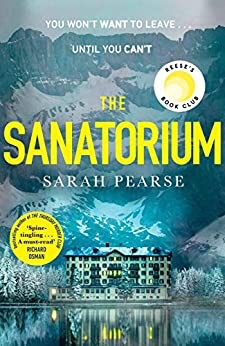
The Sanatorium by Sarah Pearse.

I’ve been a little late to the party reading this thriller set in the Swiss Alps. Now I have, I can see why other bloggers have enjoyed it so much.It left me feeling chilled and genuinely claustrophobic. Elin’s brother Isaac invites her to celebrate his engagement to girlfriend Laure at a luxury hotel in Switzerland. The newly renovated hotel is Laure’s workplace and has a complicated history. An architectural triumph for the owner Lucas, the hotel was once a sanatorium for people with tuberculosis. Locals objected strongly to the project due to its position and liability to become cut off by avalanches, but there was also some disquiet about its history and the appropriateness of its new use. Elin and Isaac have a strained relationship, dating back to the accidental death of their little brother when they were children. However, she has been looking forward to trying again with Isaac and is excited to show her architect boyfriend Will around the hotel. Will is looking forward to relaxing with Elin after a tough year including her long sabbatical from work as a police officer. Elin is a detective, but isn’t currently working after an incident lead to her suffering flashbacks, panic attacks and other symptoms of PTSD. Can Will and Elin relax and enjoy their break, or will echoes of the past get in the way?

The author creates a edgy atmosphere immediately. We find out that Lucas’s business partner Daniel disappeared just as the hotel opened, thought to be swallowed up by an avalanche while taking his morning exercise. The remoteness is immediately apparent and I loved the way the author situates the hotel as a huge edifice almost doing battle with the surroundings. Guests can gaze directly out into the woodland and mountains. However, once the night falls and the lights are on, the hotel must be visible for miles. Guests can’t see out, but anyone could be looking in. The decor isn’t plush and ornate like a lot of hotels, but instead hints at the hotel’s past; almost like a luxury monk’s cell. There is nothing superfluous or showy about the bedrooms. There are also little glass display boxes where artefacts from the hotel’s archive are put on show. Elin doesn’t know whether they honour the past in a respectful way or whether they’re distasteful. There’s a real sense of the cold from outside, but also in the hotel’s decor. There’s nothing cozy or welcoming to offset the harsh weather.

It’s not just the venue that has a complicated relationship with the past. This whole visit is shrouded in secrets. Elin hasn’t told her brother that she’s taking a break from the police force. She also hasn’t told her partner Will about her previous friendship with Laure. Although it soon becomes clear that she’s not the only one keeping secrets. Her silence on certain subjects made me doubt her as a narrator creating an edgy reading experience. The venue seems to have tension built into its very foundations and I sensed something evil had happened there. Whatever had happened left an energy that rubbed off on the staff and guests. The author builds on the claustrophobic theme, by layering the imagery throughout the narrative. There is the history of patients literally struggling to breathe within these walls. Then there are Elin’s panic attacks, intensified by the scene where she is pushed into the plunge pool at the spa and struggles to force her way back to the surface. In flashbacks we learn of the tragic day at the beach when Isaac and Elin’s brother died, it’s always there simmering in the background and even Elin doesn’t seem to know the truth of what happened. There’s also the remote location, and the constant threat of avalanche. The author allows these feelings to build towards moments then describes moments of pure terror as an unknown assailant attacks, wearing a black rubber gas mask that makes a strange sucking and whistling noise. There were moments where I literally had to close the book and have a break with a cuppa!

There are a series of questions within the book, so there are a series of answers we’re chasing towards the end of the novel. Will we discover the truth of what happened when the hotel was Sanatorium du Plumachit? Will we find out what truly happened on the beach between Elin and her brothers? Who is behind the attacks at the hotel and what is their motive? The author has created a mystery that’s like a set of Russian dolls, moving from the present back to past events that still have a devastating hold on the here and now. The strange souvenirs left by the killer in glass boxes, are just like the exhibits from the archive, so there must be a link. I read the last few chapters in one go, because I simply had to know what was going on. There was a definite disregard for the next day that night as I was up till 3am racing through the revelations. I thought this was a brilliant thriller, full of atmosphere and with some genuine scares along the way. I absolutely loved it and would recommend it very highly.

Meet The Author

Sarah Pearse lives by the sea in South Devon with her husband and two daughters. She studied English and Creative Writing at the University of Warwick and worked in Brand PR for a variety of household brands. After moving to Switzerland in her twenties, she spent every spare moment exploring the mountains in the Swiss Alpine town of Crans Montana, the dramatic setting that inspired her novel. Sarah has always been drawn to the dark and creepy – remote spaces and abandoned places – so when she read an article in a local Swiss magazine about the history of sanatoriums in the area, she knew she’d found the spark of the idea for her debut novel, The Sanatorium. Her short fiction has been published in a wide variety of magazines and has been shortlisted for several prizes. You can find Sarah on Twitter @SarahVPearse and Instagram @sarahpearseauthor

Posted in Netgalley

One Night, New York by Lara Thompson.

At the top of the Empire State Building on a freezing December night, two women hold their breath. Frances and Agnes are waiting for the man who has wronged them. They plan to seek the ultimate revenge.

Set over the course of a single night, One Night, New York is a detective story, a romance and a coming-of-age tale. It is also a story of old New York, of bohemian Greenwich Village between the wars, of floozies and artists and addicts, of a city that sucked in creatives and immigrants alike, lighting up the world, while all around America burned amid the heat of the Great Depression.

It’s hard not to fall in love with Frances. It only took a few chapters and I was with her wholeheartedly – she simply feels so real. The narrative bounces back and forth from the top of the Empire State Building, all the way back to Frances leaving rural Kansas, but it is always Frances’s point of view we follow. As a poor girl in a thin dress and broken sandals she is noticed by a couple of bohemian types on the train, a photographer and journalist. They are looking for stories and characters that will appeal to a wealthy NYC elite, and poverty stricken farmers are making headlines as the Depression bites. They see something in Frances and want to photograph her, but she is meeting her brother at the station so she takes their card instead. We see her settled into Stan’s tenement flat, taking embroidery in for Mrs Bianchi next door. How does she go from this to contemplating an act of violence at the Empire State?

What we’re seeing is an awakening. It’s not so much a loss of innocence – I realise that went a long time ago when she relates the things she’s seen and suffered. In NYC, although she’ll still experience trauma, she also gains so much strength and self-knowledge. There’s an awakening that’s sensual as she learns to love the feel of fine fabrics on her skin and the joy of moving her body to music. She gains a love and understanding of art, responding emotionally to the most complex modern pieces as well as the photographs she takes with new friend Agnes. There’s also an awakening of sexual desire, something she has never experienced before.

The structure brings an amazing tension to the novel. We might think we’ve worked out what is going on, but it’s so much worse than I imagined. We are drip fed the events leading up to the present moment, and the author doesn’t reveal the man Frances and Agnes have lured to the building until right at the very end. The girls become friends before realising they are both affected by the ambitious men who will build this city. Women are disappearing and men have all of the power in this world. It is the resulting male privilege, such arrogance and certainty, that lures their victim to this precarious and windy place. Agnes and Frances are going to draw a line under this, a fatal one. It really chills to the bone when we find out the true extent of what these ‘disappeared’ women have gone through. Within this we also learn the reality of the Depression in Kansas, and the reality of Frances’s life with a brutal father, only curbed by the presence of Stan. I was so deeply sad for Frances. Dicky and Jacks constantly talk about Frances being wise beyond her years, with surprise. It’s no wonder, she’s been through so much.

This book really is an incredible debut with brilliant historical detail and decadent 1920s feel. The gap between the rural areas of the US and and up and coming city like NYC is wide, but we also see the massive poverty gap between NYC neighbourhoods from the Upper East Side into East Harlem. There’s a decadence here that’s evident from the parties at Jacks and Dicky’s home. These people are new money and the mix of bohemian artists, showgirls, businessmen and politicians is rife with exploitation. I was suspecting everyone of ulterior motives, wondering if anyone is untouched by the taint of money and debauchery. The wholesome and motherly Italian lady Mrs Bianchi gives an impassioned speech about leaving her homeland, only for her sons to be drunk and brawling every weekend. There’s a sense that the pinnacle of this age has been reached; this lifestyle cannot be maintained forever. By the closing chapters I was willing Frances to escape this terrible place, not unscathed of course, but at least alive and free to pursue some happiness with the person she loves. Once I’d finished, I found it hard to start a new book, because my head was firmly in NYC. My heart was still with Frances and that is always the sign of a great book.

Posted in Netgalley

Our Little Cruelties by Liz Nugent

Published: Penguin Paperback Edition 21st Jan 2021

Never have the famous words of Phillip Larkin – ‘they fuck you up your Mum and Dad’ – been so apt. Reading this book was a very interesting experience and patience definitely paid off. Had I given in to my impulses and thrown the book down in frustration during the first part, I would have missed out on a great read. The story of three brothers over their lifetimes is compelling, interesting and a great study in how mental health difficulties can be passed on from one generation to the next.

The structure of the novel is what I had difficulty with at first. The first section was narrated by the eldest brother, Will. Written in short chapters, slipping between decades, we see aspects of his childhood through to the present day where he is a successful movie producer. He meets his wife Kate through his brother Brian,when she’s brought to a family dinner. They have a little girl called Daisy, but Will is much more focused on work than he is his family. We get the sense that Kate is a long suffering woman who gets more support from Brian, who is now Daisy’s godfather as well as her uncle. Brian is there for the birthdays and school concerts and has a great rapport with Daisy. Will is dismissive of Brian and his lack of ambition. He is also dismissive of Luke, despite Luke’s success as a pop star in his late teens. This section was difficult to read because I disliked him from page one. I didn’t think I could stand to listen to his perspective for a whole book. This made me think about my own bias and prejudice – what would I have done if he was a client and I was his counsellor? My main interest was in how close Will was to his Mum and through flashbacks we see she favours him, quite openly.

Luke, by contrast, really gets the brunt of their mother’s moods. He is the youngest, the weakest perhaps, but he is attractive and in his teenage years soon finds real success as a pop star. However, in the later fragments of his life he has times of struggle, where his mental health is poor and he turns to drink or experiments with drugs. He is an unusual child with a religious fixation to the extent where the family priest thinks he has a vocation! The other boys use his goodness against him, he is manipulated by them and by blaming him, they get extra food and attention. Only his Dad seemed wise to this, and just how poisonous the brothers, particularly Will, can be. There are moments where it seems his life is on track and he could be happy, but others where I wondered if he was just not meant for this world.

Finally, there’s Brian the middle brother. If Will is his Mum’s favourite and Luke is doted on by his Dad, who is left for Brian? He does seem mentally torn between both parents, but is without a champion in the same sense his brothers have one. Will is very dismissive of him, even though Brian does so much for his niece. He’s not grateful when Brian stands in for him, but instead is scornful that Brian has nothing more important to do. Will only recognises material success, not the strength or reward of happy relationships. Brian is the one who looks after Luke when his mental health deteriorates, but Will never recognises or appreciates this. In fact Brian’s relationship with Will becomes so destructive that other family members get caught in the crossfire.

The genius of this book is in the knowledge of family dynamics and how destructive they can be, but also in it’s clever structure. As mentioned, during the first part, narrated by Will, I was ready to put the book down. I couldn’t stand him. He was arrogant, self-centred and treats women appallingly. If the whole book had been his viewpoint I might have thrown it out of the window. Just when I was at the point of giving up, I saw Luke’s name across the next section and it was such a relief. As the tale goes back and forth in time and perspective we see a tiny bit more of the whole. At a Bob Dylan concert at a local castle, Will ends up in a fight and is taken to hospital with Dad and Luke following behind. Mum is left behind at the castle and doesn’t arrive at the hospital till late. We think that maybe she’s been caught out here, or that she simply cares more about enjoying herself than her son. But, this is Will’s perspective, for once his Mum has let him down. However, through Luke’s narrative we learn the truth, that something terrible happened to her, something that explains so much about how she behaves. When we finally get Brian’s section we see what a lifetime of being in the middle feels like; he feels overlooked, unconsidered and brushed aside. We find out things we already suspected and other things that surprise and enlighten us. Every single strand of this novel teaches us that we are only ever a small part of the picture and we must step back to see the whole.

This brings me to the second line of Larkin’s poem This Must Be The Verse and easily the best; – ‘they do not mean to but they do’. There are parts of this novel, particularly the way Dad behaves, where genuine mistakes are made and misunderstandings occur in the same way they do with any family. No parent, however hard they try, will get it completely right. However, there are other situations where the mental damage seems deliberate, especially in their mother’s attitude to Luke. Will’s intervention in Luke’s relationship, and the treatment of Will’s daughter Daisy towards the end of the novel are not mistakes. These acts are more than little cruelties. They are deliberately causing lifelong psychological disturbance. This is a complex and interesting novel that deftly moves from one narrow perspective to another, finally giving us all the pieces of the emotional jigsaw puzzle that makes up this family.

Meet The Author

Before becoming a full-time writer, Liz Nugent worked in Irish film, theatre and television. Her three novels – Unravelling Oliver, Lying in Wait and Skin Deep have each been Number One bestsellers in Ireland and she has won four Irish Book Awards (two for Skin Deep). She lives in Dublin with her husband.

Posted in Netgalley

The Night Hawks by Elly Griffiths.

It was lovely to be back in the world of one of my favourite literary heroines, the archaeologist and academic Ruth Galloway. I always feel at home in this space Elly Griffiths has created, with an evocative feeling of Norfolk at its centre. She presents the wide skies, marshlands and seascapes and their flora and fauna so clearly I feel like I know it. Yet there’s always that sprinkling of the mystical, the pagan, and the long buried beliefs of a Norfolk long ago. This mix of the earthy, real and scientific as opposed to the mystery and magic is something also echoed in her characters: the craggy, straightforward, Nelson; the Druid Cathbad with his cloak, sayings and pronouncements; Ruth somewhere in-between – appreciating the science and procedure of her work, but not fully dismissing the beliefs and mysticism that surrounds the burials she visits and excavates.

The Night Hawks of the title are a local metal detecting group, who stumble upon a burial site out on the marshes towards the sea. Ruth has been here before, excavating a ‘henge site’ with her then professor, Eric – a man whose conflict between mysticism and science still hangs over this place. The group finds a hoard of Bronze Age weapons, but nearby they also find a body. Nelson thinks it might be an asylum seeker, desperately trying to cross the channel in tiny boats and fallen overboard. He rings Ruth anyway, because he knows she’ll be able to date the weapon find and know if there’s any link. The body turns out to be a local boy, Jem Taylor, who has just been released from prison and has a distinctive tattoo of a snake on his neck. Cathbad suggests this may be a nod to the local legend of the Norfolk Serpent. This could be an accidental drowning, but the second body suggests murder. There are no real clues to who might have wanted Jem dead.

The second case Nelson is called to investigate is that of a couple who seem to have died in a murder-suicide at a local farm. Black Dog Farm is linked to another local legend, that of the Black Shuck, a large black ghostly dog that is said to appear to people before they die. Nelson is sceptical of course, but since the suicide note ends with the ominous ‘he’s buried in the garden’ he asks Ruth to excavate. Ruth has already had a strange encounter with a large animal on a country lane, so her mind starts whirring when she finds large animal bones. Maybe Cathbad has more wisdom than they give him credit for. As Nelson and Judy talk to the couple’s children and Ruth thinks about the farm, it seems clear that there’s something very wrong about Black Dog Farm, something that might signal serious danger for all concerned.

I never stop talking about how much I love Ruth Galloway and here she’s back to herself after a period of time living with her partner Frank in Cambridge. Norfolk is in Ruth’s bones it seems. She and Kate seem to belong in the small cottage that looks out to the coastline, with their cat. Ruth seems to be still recovering and I love how Griffiths writes Ruth’s inner thoughts as she contemplates the choice she made: to be true to her love for someone unavailable, leaving her alone at times. As we’re all a bit battered by love and relationships as we hit our forties, I found her contemplation of loneliness within and without relationships truthful and moving. What I love most about this character is her authenticity. She doesn’t dumb down her intelligence, she doesn’t change her style and when absorbed in a really mucky dig can be decorated with mud from head to foot but doesn’t care. She is resigned to live on the fringes of Nelson’s life and knows his loyalty must be with his wife Michelle, but this case is a tricky one and may bring them close to danger once again. If one of of their lives is at risk, what will happen to those loyalties?

This was a great addition to the Galloway series and has all the ingredients I enjoy: a potentially sinister group of men, the appearance of a mystical creature, the mix of hard science, history and pagan ritual. All my favourite characters are present – I’m always intrigued with the attraction between Judy and Cathbad. There are new people too. There’s a new man in Ruth’s department at the university, a researcher whose very keen to take charge of the Bronze Age site and seems to be everywhere they turn on this case. Could he be a threat to Ruth’s settled life, her accord with Nelson, her academic prowess or something even more sinister? I found myself suspicious of him throughout. I was recently having a chat on Twitter, including Elly Griffiths, and we discussed casting for a potential TV series ( come on BBC what are you waiting for?). Ruth Jones seemed to be the choice for Ruth, David Tennant for Cathbad and either Debra Stephenson or Leanne Best as Michelle. Nobody had a good idea for Nelson. We all agreed he needed to be older, a bit craggy but somehow attractive, with a twinkle in the eye. I’m putting forward either David Morrissey or Phillip Glenister – both would have the necessary Northern bluntness I think. Till then I’ll wait patiently for the next instalment, when I expect big changes for my favourite archaeologist.

Meet The Author

I’m the author of two crime series, the Dr Ruth Galloway books and the Brighton Mysteries. Last year I also published a stand-alone, The Stranger Diaries, and a children’s book, A Girl Called Justice. I have previously written books under my real name, Domenica de Rosa (I know it sounds made up).

The Ruth books are set in Norfolk, a place I know well from childhood. It was a chance remark of my husband’s that gave me the idea for the first in the series, The Crossing Places. We were crossing Titchwell Marsh in North Norfolk when Andy (an archaeologist) mentioned that prehistoric people thought that marshland was sacred ground. Because it’s neither land nor sea, but something in-between, they saw it as a bridge to the afterlife; neither land nor sea, neither life nor death. In that moment, I saw Dr Ruth Galloway walking towards me out of the mist…

I live near Brighton with Andy. We have two grown-up children. I write in a garden shed accompanied by my cat, Gus.

Posted in Netgalley

For When I’m Gone by Rebecca Ley.

Publisher: Orion. 3rd September 2020.

There is never enough time. Even when a loved one has been ill for so long and the prognosis is terminal, that moment when they’re gone is seismic. Everything in your world shakes up and resettles around you, but in a totally different shape. When my husband died it had been coming for a long time. He was also suffering. His MS had affected his ability to swallow so he was PEG fed and kept hydrated with a tube directly set into his stomach. He would aspirate saliva, then develop pneumonia in an endless cycle till he decided not to treat it anymore. He’d spent months in hospital, before I received the call from the hospital. Listening to him struggling for breath for 12 hours was torturous. Yet when he took his last breath at 5.15 am, my first thought was ‘no, I wasn’t ready.’

Rebecca Ley’s novel is about a life cut short in this way. Sylvie is given a terminal cancer diagnosis at the age of 38. She and Paul have a marriage that seems perfect. He is a doting husband and father, and loves Sylvie’s intelligence and beauty. There is a certain prickliness to her character, which could make her difficult, but they seem to compliment each other and are great parents to their children Megan and Jude. When Sylvie receives her diagnosis she knows she must help Paul with the aftermath. He needs a manual that helps him deal with a domestic life that’s more complicated than he realises. She also needs to disclose a secret that she’s been keeping for the whole of their married life. As Paul uses her manual to try and negotiate life after Sylvie, he begins to realise just how much she did for them, and how much more indebted he is than he realised. Ley writes about reconciling a life only half lived, but also those compromises made in a marriage and as a mother. This is where he truly gets to know his wife in a way he couldn’t when she was alive.

The book is divided into past and present chapters, so we can be let into Sylvie’s life, but also to form a contrast with after she’s gone. The manual is confessional and written in the first person. Then we have the third person viewpoints of both Paul and Sylvie. Through this we see the beginning of their relationship where everything is romantic to the trickier aspects of their shared life together. I liked that Sylvie isn’t perfect, it’s easy to make a lost loved one into a saint, but Ley avoids that here and it’s all the better for that. Throughout we see that same spiky element to her nature, it’s attractive in a way, but could be seen as hardness or being difficult. As we read through the manual though, after she’s gone, we see a reason for that hardness – Sylvie is this family’s structure, their backbone, and without it what do they have to keep them upright and together?

There is the constant tension of what Sylvie’s long held secret may be, but it wasn’t the thing that kept me reading. It was the slow revelation of her character that held my attention. In Sylvie, Ley has written a truly modern female character who has flaws and makes mistakes, but isn’t cast as a bad person. Often in books about cancer patients, or mothers, there is that temptation to turn them into saints and martyrs. I love that the author made a conscious choice not to do that. Through Sylvie’s choices and her inner monologue as she makes them, we see the complexity of being a woman, a mother and a wife. Sylvie is complicated, sometimes she hurts people and I didn’t always like, or understand her. She is so ‘real’ that I started to think about her in terms of my own friends and family; we don’t always like what they say or do, but we still love them. I felt like I’d got to know a real person and this only added to the devastation when she was gone. I would like to see more women like this in fiction.

The supporting characters were also well written, three dimensional people. I felt particularly for Megan who withdraws as the book goes on. There was also a great contrast between Sylvie and Paul’s mothers, with one very traditional Mum and the other very far from conventional. Ley shows us the chaotic, random and difficult nature of life. This brings home the fact that we never know what’s going to happen next, something people who’ve experienced loss and illness know only too well. I always make sure I tell my new partner and stepdaughters that they should take care and I love them, every time they leave the house. I never want them to wonder how I feel about them, or for something to happen when I haven’t reminded them how much they mean to me. I felt deeply for the family at the heart of this heart-breaking story and it will stay with me for a long time. This extraordinary book is Rebecca Ley’s debut, so I will be following her writing closely to see what’s next.

Meet The Author

I am new to being an author, but the idea that people might read my work and want to connect with me about it is honestly my biggest dream. I would love to hear what you think of For When I’m Gone. You can find click the ‘follow’ button on Amazon, or find me on Twitter or Instagram, where I share fragments of my life raising three children in Hackney, east London. I grew up by the sea in Cornwall and never expected to be raising a family in the inner city, but here we are! I have spent the last sixteen years working as a journalist. I’ve worked on staff at The Times, Sun and Daily Mail, as well as writing a column in The Guardian about my father’s dementia. I’ve also freelanced for a variety of other papers and magazines, including The Telegraph, Psychologies, Mother and Baby and Grazia. And I write scripts for an animation company too.

Posted in Netgalley

The Snow and the Works on the Northern Line by Ruth Thomas.

What a wonderful surprise this novel was. I’m clearly getting worse, we’re only three weeks into January and I’m already in love with a new literary heroine. I absolutely adored Sybil and felt so at home in her company that I just kept reading all day. I finished at 11pm and was bereft, because I wouldn’t be with Sybil any more. Yes, this is what happens to avid readers. We fall head over heels with a character, can’t put the book down, then suffer from book withdrawal. All day I’ve been grumpy and reluctant to start a new book.

Sybil’s life is puttering along nicely. She has a job she enjoys at a London museum – Royal Institute of Prehistoric Studies (RIPS). There she produces learning materials, proof reads and indexes archaeological publications, and helps people with research enquiries. She has a great boyfriend, Simon, who is a chef and likes to make her bread from obscure grains. Her quiet, settled life is turned upside down when she, quite literally, bumps into an old nemesis from her university days. Sybil and Simon have gone ice skating, where they spot Helene Hanson, Sybil’s old university lecturer. Sybil doesn’t want to say hello, after all Helene stole some ideas from her dissertation and put them into her research on the Beaker people. They make their way over, very unsteadily, and end up careering into Helene’s group and in Sybil’s case banging her head. She has a nasty bang, and from there her life seems to change path completely. Only weeks later, Helene has stolen Sybil’s boyfriend and in her capacity working for a funding body she has taken a huge interest in RIPS who will be selling her Beakerware (TM) in the gift shop and welcome her onto their committee as chair of trustees. Sybil’s mum suggests a mature exchange of views, but Sybil can’t do that. Nothing but all out revenge will satisfy how Sybil feels. She’s just got to think of a way to expose that Helene Hanson is a fraud.

First of all I want to talk about the structure of the novel. As Sybil’s life starts to unravel, so does her narration. A suggestion from a friend leads Sybil to a poetry class at her local library, so prose is broken up with poetry and very minimal notes of what Sybil has seen that she hopes to turn into haiku. This is a Japanese form of poetry with a set structure of thirteen syllables over three lines in the order of 5, then 3, and then 5 syllables. Having lived next to a Japanese meditation garden for several years I started to write and teach haiku as a form of meditation. It’s a form linked to nature and is very much about capturing small moments. So if Sybil sees something that might inspire her, it makes its way into her narration. I loved this, because I enjoy poetry but also because it broke up the prose and showed those quiet still moments where Sybil was just observing. She works with found objects – most notably a little teacup, left on a wall, that has ‘a cup of cheer’ written on the side. There’s a very important reason for the fragmentary narration, that I won’t reveal, but I loved it and thought it was so clever. Many of my regular readers will know why I connected with it though. These changes could just be a visible symptom of the chaos in Sybil’s mind as she goes through a massive shift – physically from one flat to another – but a mental shift towards living alone, to coping with her nemesis constantly popping up at her work space and to experience the heartbreak. We’ve all been there so her situation is easy to relate to.

The characters are brilliantly drawn, funny, eccentric and human. Sybil’s boss Raglan Beveridge – who she observes sounds like a cross between a knitted jumper and a hot drink – is such a lovely man, easily swayed but kind and tries to ensure that Sybil is ok. I enjoyed Bill who she meets several times across the book, in different situations. He’s calm, funny, thoughtful and shows himself to be a good friend to Sybil, even while she’s barely noticing him! Helene seems to hang over everything Sybil does, like an intimidating black cloud promising rain to come. She is a glorious villain in that she has very few redeeming features, and tramples all over Sybil’s world at home and at work. The author cleverly represents this in the very structure of RIPS. Sybil likes her slightly fusty, behind the times little museum. There’s a sense in which it is precious, that the spaces within shelter some eccentric and fragile people. They’re like little orchids, who might not thrive anywhere else.

Helene’s organisation brings much needed funding, but with it comes obligation. As chair of the trustees, she wants to change the structure of the building and all these precious spaces might be sacrificed. Her commercial enterprise, recreating Beakerware (TM) for the museum gift shop, means the shop expanding into other areas. Exhibits that have been on display for years will be moved into storage to make room and Sybil dreads Helene using Simon as the face of the range. Imagine giant posters of your ex greeting you every morning at work. To add insult to injury she inserts herself into Sybil’s everyday job by insisting on adding a section into Raglan’s upcoming book, meaning that Sybil has to index Helene’s writing. Could there be a chance here, for Sybil to gain some satisfaction? As Sybil’s mum hints though, revenge can be more damaging to the person seeking it.

This was a quiet book. As I was reading it, I was engrossed and the outside world was muffled for a while. It reminded me of those mornings after snowfall, when the outside world is silenced. I felt a deep connection with Sybil. She’s offbeat, quirky and has a dark sense of humour. We meet her at her lowest point and we’ve all been heartbroken, but it was much more than that. I’ve been this broken by life, I was a like a vase, smashed into so many pieces I didn’t know if I could pull all those pieces back together. Even if I did, I knew I would never be the same person. My loss felt so huge that it affected my actions – I left doors unlocked when I went out, forgot to pay bills, and started to make mistakes at work. I had always prided myself on being very ‘together’ and here I was falling apart. I discovered Japanese art that healed me in some way – it’s called Kintsugi and it’s the art of repairing broken ceramics with liquid gold or other contrasting metal. It shows the cracks, that the piece has been through something, but it’s still whole. I felt that this applied to Sybil’s journey and the book’s structure too. Sometimes, broken things can be even more beautiful than they were before.

A piece of Japanese kintsugi

Meet The Author


Ruth Thomas is the author of three short story collections and two novels, as well as many short stories anthologised and broadcast on the BBC. Her writing has won and been shortlisted for various prizes, including the John Llewellyn Rhys Award, the Saltire First Book Award, the VS Pritchett Prize and the Frank O’Connor International Short Story Award. She lives in Edinburgh and is currently an Advisory Fellow for the Royal Literary Fund. The Snow and the Works on the Northern Line is her third novel.

Why not go back and check out the other reviews from the blog tour:

Posted in Netgalley, Random Things Tours

The Art of Dying by Ambrose Parry.

Today, I’m happy to be on the closing day of this blog tour for The Art of Dying. This interesting mix of murder mystery, historical/ medical drama and romance, creeps up on you slowly, until you’re determined to keep reading and see whether a killer is stalking the sick of Edinburgh. In fact at what point I couldn’t decide what I wanted to know more: would the killer face justice, would Raven reconcile with the woman he loved, who was stealing money from the surgery, would Sarah live and what the hell was Quinton up to? It’s hard to sleep with all that going round in your brain! I hadn’t read the first novel featuring Dr. Wilberforce Raven, but it was easy to catch up with this instalment set in Edinburgh in 1849. We really do hit the ground running as Raven is attacked in an alley way in Prague. In the dark and confusion one of the attackers draws a gun, Raven draws his knife and a shot rings out ricocheting off the narrow brick walls. Raven slashes his knife in the air from left to right. He thinks he made contact with an attackers throat, but he doesn’t know if he struck a fatal blow and doesn’t know who is shot.

This chaotic existence seems to be the way Raven lives, but will it follow him back to the streets of Edinburgh. He’s been offered a place under the prestigious obstetrician Dr. Simpson, who he trained under at medical school. He’s looking forward to being back in Edinburgh and in the hospitable, but slightly chaotic, family household. He’s also looking forward to getting away from the guilt that he may well have killed a man in Prague. The only downside involves women. He will be leaving Gabrielle behind – the woman he’s been seeing in Prague – but they’ve both known it was a short term relationship. More pressing than that, he’s wondering whether Sarah is still part of Dr. Simpson’s household. Sarah was originally the Simpson’s housemaid, but did assist the doctor in clinic at times. Raven was attracted to her intelligence and determination. They seemed drawn together by an invisible bond and the closer he gets to his old city, he can feel that bond tugging again. They way they’d been in the past, Sarah might have confidently expected a proposal and had it just been about love, Raven would have had no qualms. However, as a young doctor starting out in a profession where reputation is everything, could he risk marrying a house maid? What would Edinburgh society think and would he be risking his career?

I can’t say I warmed to Raven as a character. I found him arrogant and apt to jump to conclusions, especially where it would benefit him. More importantly, I found him cowardly. Especially in his dealings with Sarah. I had such a moment of satisfaction when he enquired after Sarah when arriving, using her maiden name. When the new house maid explains she is now Mrs Sarah Banks, I actually smiled. To find out that her new husband, Archie Banks, is also a doctor and has a comfortable lifestyle, is a huge life lesson for Raven. Here was a man with strength of his convictions. He had loved Sarah and married her, with no regard to his position or social standing. Of course, we find out later on, that Archie has a reason for not caring about such things but he’s still a man of honour. Sarah is an intelligent, but also perceptive woman, and this is her advantage as she and Raven come together to restore Dr Simpson’s reputation. During a difficult delivery, Simpson is rumoured to have missed a haemorrhage and the dead woman’s mattress was said to be so soaked with blood it had to be disposed of. Simpson expressly asks Raven not to look into the matter and certainly not to bother the grieving widower in his defence. Raven even has the odd worry about Simpson himself, especially his potential overuse of chloroform – Raven is served a drink laced with it on his first evening. Sarah, however, feels that Simpson is a good doctor and that there is something else underlying this need to discredit him.

This is not the only investigation going on in the household. A new employee, Mr. Quinton, is there to look after the admin and keep the books for the practice. Unofficially, he is trying to find the culprit for money going missing in the house. He wants to book drugs in and out too, and research patterns in the practice’s spending. There’s something about his persnickety nature and constant presence that’s very off putting. He doesn’t work in harmony with the house, but rather against it. He isn’t at the Uriah Heap level of obsequiousness, but that’s who I kept thinking of when he came into the story. I liked how the author brought in all these levels of surveillance. Quinton watches the household and practice, but he’s been under the steely eye of the butler since he arrived. Sarah is watching both Dr. Simpson, but also stumbles into another investigation while trying to clear his name. Raven is being watched, but is also watching others with Sarah. Their focus is split though: Sarah thinks Simpson’s name can be cleared and as the deaths pile up, the same name keeps cropping up, a nurse called Mary who has cared for people who seem to have lost their lives in suspicious circumstances. A sudden illness that involves seizures, unconsciousness, fatigue and weakness appears out of the blue, killing people in a matter of hours. Could this Angel of Mercy be an Angel of Death? Or could there be a rare new disease for Raven to discover? He daydreams about the acclaim it could bring if he has uncovered an unidentified disease. With the title Raven’s Malady running through his head, the two are on the look out for different things, but who will be proved right? More importantly will the investigators themselves be safe, as they trail all over Edinburgh to find answers?

If we add to this: a moneylender with a giant as his right hand man and some unexpected debtors on his books; a pregnancy; a bereavement; and a breakneck race to save someone’s life. The book is definitely jam packed with incident and tension, whether that be the tension of the race to find our culprit or the more ‘slow burn’ tension between Raven and Sarah. Our writers leave us with enough answers to feel satisfied and enough cliffhangers to look forward to the next book. This isn’t an easy balance to strike and I felt it was well – judged here. I was intrigued by the period detail when it came to surgery and obstetrics. I found myself won over by most of the characters. Sarah leapt off the page and when I read Mary’s chapters I was drawn into her upbringing and the terrible effect this had on her psychologically. This is a series I will look forward to revisiting and maybe even Raven might win me over next time.

Meet The Authors

This book is the second in the series featuring Dr Raven. This one is published by Canongate (Blackthorn) and will be available on March 2nd 2021. Ambrose Parry is a pseudonym for a collaboration between Chris Brookmyre and Marisa Haetzman. The couple are married and live in Glasgow.

Chris Brookmyre is the international bestselling and multi-award-winning author of over twenty novels, including Black Widow, winner of both the Theakston’s Old Peculier Crime Novel of the Year and the McIlvanney Prize for Scottish Crime Novel of the Year.

Dr Marisa Haetzman is a consultant anaesthetist of twenty years’ experience, whose research for her Master’s Degree in the History of Medicine uncovered the material upon which The Way of All Flesh was based.

Posted in Netgalley

Beneath Cornish Skies by Kate Ryder.

Published: 7th Jan 2021 Aria and Aries ISBN: 978-1800245983

I felt like I’d stepped into a little oasis when I picked up this ARC. I had been reading a very bloody crime novel just before so this was like a balm for the soul! Cassandra appears to have everything she could want in life. She lives in an incredible refurbished farmhouse on the South Downs with attached stables. Her long term partner, David, is a successful businessman who just happens to be charming and good looking. They have money and she can spend her time schooling horses then dressing for dinner from her beautiful walk-in wardrobe. David calls her Sandie and they’ve been together over ten years – in fact ever since she was involved in a car crash that killed both of her parents. David was first on scene and helped her out of the wreckage. They’ve never been apart since. He was attentive in the days following the accident, there for her therapies and as she was wheeled out of the hospital it seemed only sensible to stay with him – there being nowhere else to go. So why is she feeling dissatisfied and as if she’s drifting?

He catalyst comes as she’s out riding one morning and stops for a breather in one of the top fields behind the house. As she looks down to the farmhouse she sees David, who is working from home, and their cleaner Melanie coming to sit outside with a cup of coffee. She wonders to herself about the last time David paused his day to have a moment with her. Then she sees Melanie rest her hand on his arm, in a familiar way and she starts to sense that there’s more going on she realised. The incident brings to the forefront of her mind many things about her life that she’s unhappy with. David is all about appearances, so the house must be kept tidy at all times. She’s almost trained to wash a cup or plate immediately after she’s used it. He likes to come in and find the house immaculate. He calls her Sandie or Sandra when her full name is Cassandra and he likes her to dress well especially if they’re going to a party or function for work. Even then she can’t let loose, no dancing or drinking excessively, nothing that might show him or the business in a bad light. Yet, that very evening at a barbecue, she sees him exiting a private bit of the house, again with Melanie in tow. When she finds an earring in their bedroom, she can’t ignore things any longer. It’s not just the obvious infidelity. She needs something different.

On impulse she picks up The Lady magazine, drawn in by the cover photo of a man walking from a tunnel of trees. The man is a writer, Hunter Harcourt, and his article about ancient byways and the magic they possess. Within the adverts though she finds an advert that catches her eye; a family in a Manor House in Cornwall need help with the stable yard and a growing family for six months. This might be just the breathing space she needs. With David seemingly unrepentant about his affair, Cassandra finally asks him the one thing she has always wanted to know – will he ever be willing to have the children she has always wanted? David is adamant, children are not in his future. So, early one morning Cass hitches the horse box to her Range Rover and takes a leap of faith. She drives to Cornwall, only stopping at Melanie’s home to return the earring. What she finds in Cornwall is space enough to think, but activity enough not to dwell on what has happened. She falls in with the Kinsman family and their gorgeous children very easily. The Manor House and grounds are beautiful and Caspian soon finds his feet with the other horses. Cass finds solace in the rugged Atlantic coastline and the time spent with the children. She is shocked when, on her day off, she is looking for something to fill the hours when she happens on a talk on local history by a local author, Hunter Harcourt, otherwise known as Luke. Their meeting begins a friendship that seems so natural, almost as if they’d met before.

There was so much to like about this book. I love Cornwall and I felt as though I was there, with the descriptions of the villages, the beaches and those ancient places that seem to hold magic. I loved watching Cass unfurl in her new environment as she fits in so beautifully with the Kinsman family, the landscape and the new friends she makes such as surfer Robin. This is about someone awakening and finding their authentic self, something she’s never been able to do before, having been so busy fitting around David’s standards and timetable. Cass went straight from her parent’s household to David’s with no gap between. This is the first time she has stood on her own two feet and her confidence grows. The relationship with Luke seems so predestined that it was a huge disappointment to find out he’s married to the feisty Amanda. We soon see the cracks in their marriage though, not just her infidelity, but their differing views on where to live seem insurmountable. The natural way Luke and Cass seem to fit together seems to be pre-ordained – this is where I felt more could have been made of the supernatural aspect of the story.

Soon after arriving Cass finds that the manor is haunted by several ghosts, but the one she seems to see most is the young girl who had fallen in love with the gamekeeper. Cass feels that, just like the ancient byways, there are spaces within the fabric of time at the manor, where ghosts may appear. Cass has an affinity with the the young woman in her peacock blue dress, but could it be more than that. It felt like the author was flirting with the idea of Cass and Luke being a reincarnation of the couple – the references to her gypsy soul, the sense they have of meeting before, the apparition Cass sees and hears. I think this could have been explored even more than it was. Cass clearly has some psychic ability; she experiences the ghost of a maid, has vivid dreams about places and people from another time, and at one point hears a ghost ship. I found myself wanting more of this and would have loved to know more about the daughter of the house and the gamekeeper, possibly in another time frame. Luke is a dream of a man, gentle, intelligent, loves the outdoors and animals and seems to know himself very well. His marriage seems to be one made when young, when differences in outlook seem to matter less and we think love can overcome anything. Sadly, Luke finds as he gets older, the more he needs the pace of life in the country whereas Amanda is a city girl who needs the bustle and the noise.

Of course I wanted David to get some sort of comeuppance for his awful behaviour. Even in absence he tries to push Cass’s buttons by ordering her home, then pleading that he loves and misses her while mentioning someone he’s having casual sex with in the next breath. He is arrogant, fussy and I couldn’t think of a single reason Cass should return to him at the end – other than habit and conditioning. I won’t ruin the end, but it does keep you hooked to the final pages when a terrible secret emerges. This was a gentle romance, set in a beautiful part of the world and is as much about Cass falling back in love with herself as it is anyone else. It’s a voyage of self-discovery, where slowly she heals and finds her authentic self. I found it thoroughly enjoyable and a little oasis of calm in a busy month.

Meet The Author

Kate Ryder

Kate Ryder is an Amazon Kindle international best seller who writes timeslip and romantic suspense in a ‘true to life’ narrative. On leaving school she studied drama but soon discovered her preference for writing rather than performing. Since then, she has worked in the publishing, tour operating and property industries, and has travelled widely.

A member of the Romantic Novelists’ Association and The Society of Authors, in 2017 Kate signed a 4-book contract with Aria (digital imprint of award-winning independent publisher, Head of Zeus). Originally from the South East of England, today Kate lives on the Cornish side of the beautiful Tamar Valley with her husband and a collection of animals.

Keep in touch with Kate:
http://www.kateryder.me
Twitter: https://twitter.com/KateRyder_Books
Facebook: https://www.facebook.com/kateryder.author
Instagram: @kateryder_author

Posted in Netgalley

The Lamplighters by Emma Stonex.

Published: 4th March 2021 Pan Macmillan (Picador)

I loved this book so much that I went to bed early two nights running so I could finish it uninterrupted. I was so drawn in by the isolation of this lighthouse, that it was just standing directly in the sea and no one could come on or off until the relief boat came. Inspired by true events, the story is set in two time frames. In one we learn that a writer is researching a book on a famous disappearance of three lighthouse keepers. In 1972, miles off the coast of Cornwall a relief boat arrives at the Maiden, to find the door locked from the inside, the clocks stopped and no sign of the Principle Keeper or his two assistants. He contacts the women left behind by these men: Helen, wife of the Principle Keeper, Arthur; Jenny, wife of Bill his deputy; Michelle, girlfriend of the new recruit Vince. They have all received money from Trident, the company who employ the keepers, but with that came a directive, not to talk about the events surrounding the mystery. At the time, Vince came under the most suspicion. New to the area and with a criminal past, he seems the likely candidate to have harmed the others. Yet, why would Arthur write of a huge storm in the log, when seas had been calm all week? What became of the small boat rumoured to have sailed near the Maiden? There were also whispers about a mechanic sent to carry out repairs at the Principle Keeper’s request. It’s hard, years later, to distinguish between rumour and truth. Will any of the women speak to the writer and will they finally solve the mystery of what happened to the men?

This felt like an intriguing mix of mystery and love story, with a hint of the supernatural. There was a real difference between the sections on land and those at sea. As we meet the women, there is a grounded reality about their stories and their lives. Whereas the sections out in the sea are surprising, although there’s routine in the keeping of a lighthouse, it still feels like an escape, cut off from the real world. As they look out surrounded by waves they could be in any time and the struggles of the world can’t reach them. The sea narrative has a disjointed feel at times, they shift and turn, we’re sometimes unsure what is reality and what is fantasy. The women’s recollections feel more based in fact, they’re relating their own history whereas the keepers seem firmly in their present- only reacting and dealing with what is in front of them. This shows the huge disparity in how these couples were living their lives back in 1972. I could really imagine that jolt of having the person you spend your life with leave for several weeks, then just as you’re used to their absence they return again. It made me think of military marriages that often flounder because of this. Just as the home has a routine, it’s disrupted by someone returning again, changing the dynamic and wanted to do things differently. I felt particularly for Jenny, who has children to cope with in this remote area with little support and I could see how resentment might build.

These have not been easy relationships and living with the uncertainty of what happened to their men has affected them differently. Helen has experienced so much loss, losing Arthur after losing her only child who drowned when he was a toddler. The sea has claimed everything she loved and while she is matter of fact in stating the men must be dead, her certainty is brittle and she hasn’t fully let go of the events at Maiden. Helen feels that even when Arthur was home, he wasn’t fully present. Something of him always stays out on the sea – in fact perhaps, it’s the only place he truly makes sense. The Maiden is always there, towering between them like a mistress. Arthur does love to be out there, but for reasons Helen hasn’t realised. There is a sense that this couple have stopped talking and just below the surface there are secrets, some that perhaps explain Jenny’s animosity toward her. Jenny can’t seem to accept that her husband Bill has gone and welcomes someone trying to find out the truth. There is a hatred of Helen that runs deep, but it takes some time to find out whether she has reason to resent her so much. Michelle has moved on and is now married with children. She is very pragmatic about her life choices, she knows she doesn’t love her husband as she loved Vince but it can work and they have a family. Although there were so many rumours, Michelle is adamant in her defence of her first love. Yes, he had committed a crime and had often mixed with the wrong people. She could believe the rumour of the mechanic, despite Trident claiming they didn’t send anyone. Perhaps this was Vince’s past catching up with him, dressed in a mechanic’s overalls?

I loved the descriptions of the sea, and how it was a character in its own right. Sometimes calm, deceptively so, until a sudden swell could catch you by surprise. There are storms where waves batter the tower almost all the way up to the light itself. The sea is capricious, relentless and must be respected. The little touches of the supernatural add to the puzzle and intrigue the reader. Arthur’s sighting of something glinting silver in the sea or the little sail boat that passes by. Bill’s strange story of seeing the same man twice as he’s driving along and has to stop for him to cross – somehow he knows this isn’t a lookalike, it is exactly the same man. Is there a link between this strange story and the mechanic who turns up and seems to know all about them? This is where I started to wonder what was real? I wasn’t sure whether one of the keepers was having a mental health crisis and we were privy to his inner thoughts and delusions. Bill also has a strange attachment to Helen and I wasn’t sure whether his affections were returned or whether he was obsessed. Just enough little creaks, bangs and noises about the place are also making Vince jumpy. Could the isolation have proved too much for him?

The author weaves an unsettling tale and I wasn’t sure we would ever know what really happened. I was surprised, but incredibly satisfied by the ending. I thought the depiction of complicated grief in all the women felt real and honest. The glimmer of hope for their future was very welcome. I was left though, with an eerie feeling and a sense that the lighthouse might still be holding some secrets. That perhaps if you sailed nearby on a clear day you might see a father and his small boy looking out to sea, together forever in this one place outside of time.

Meet The Author


Emma Stonex is a novelist who has written several books under a pseudonym. THE LAMPLIGHTERS is her debut under her own name and has been translated into more than twenty languages. Before becoming a writer, she worked as an editor at a major publishing house. She lives in the Southwest with her family.