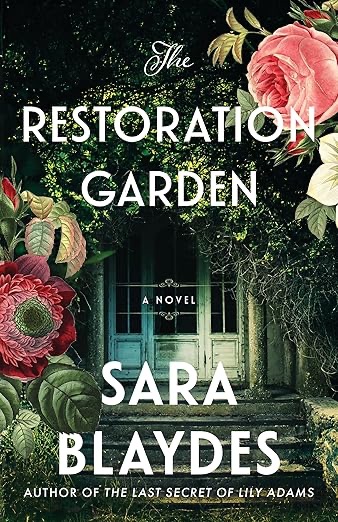
I love spending time in beautiful gardens. One of my favourite childhood places was Chatsworth House, mainly because I had delusions of grandeur and wanted people to ask ‘have you seen Hayley?” “This morning she was in the library.” I also loved the garden because it has such an incredible mix: cozy hiding places (I think I’ve always been Jane Eyre hiding in the window seat), highlights like a bronze willow tree that sprinkles water and creates rainbows, huge tropical conservatories and grand vistas that open up to reveal incredible views of the Peak District. My favourite place was The Grotto, a stone building next to a large pond that was like a bandstand with a pointed roof and open sides. I imagined sitting there and reading, able to look out over the valley below. Gardens are powerful places that can evoke so many different emotions and I was fascinated with our heroine Julia who is a garden restorer. This means having all the landscaping skills and plant knowledge of a gardener with an emphasis on the history of the place. It gives Julia’s job an added emotional element whether the client is trying to recreate a garden from their ancestral past or a garden that existed within the client’s lifetime, potentially bringing up the feelings it once evoked and whatever led to it’s destruction or decline. Here it is WW2 that interrupted the garden’s original beauty, particularly the moonlit garden that was repurposed as a kitchen garden to supplement rationing. Based mainly around greenery and white flowering plants, the emphasis was placed on plants the would reflect moonlight or only flowered at night. Julia’s client Margaret does remember the garden from before the war, but is struggling to convey to Julia the details. The 92 year old lady of the manor is rather enigmatic, but steadfast in her instructions that it should be exactly as it was. So Julia must do some digging into the family’s historical documents and photos so she can hopefully give Margaret those feelings once again. However, digging into the archives will unearth more than plants as family secrets come to light.
“Moon gardens were often believed to be deeply spiritual places, where the barrier between the dead and the living thinned.”
The author tells the story in a dual timeline with two narrators. In the present day timeline we follow Julia’s perspective and her strange position of living in Havensworth Manor with her nephew while she fulfils her contract. It’s a slightly awkward situation, with Julia worrying about the disruption of the house’s quiet, slightly stifling atmosphere. Margaret is her client, but she is often restricted from seeing her by Andrew, Margaret’s nephew who is also a GP. Bringing a curious and excited child into the mix does bring its moments, but there’s a sense of these newcomers bringing the manor back to life again. Sam bursts into this careful and structured home with all the innocence, excitement and curiosity you’d expect from a small boy and he’s a delightful character. Where Julia feels she has to be careful around Margaret, Sam asks the questions that Julia can’t, having been steered away from certain topics like the war by Andrew. More specifically the family don’t talk about Margaret’s sister Irene, but it’s clear that Irene and the garden have a strong link. When Julia finds a sketchbook filled with botanical drawings she is fascinated. In fact the book is a florilegium – where specific flowers are drawn together with their meanings underneath. The Victorians were fascinated by the language of flowers and this artist had a gift for expressing meaning through her flower drawings. We learn that Margaret’s elder sister Irene was the artist, but the two became estranged during the war when Irene fled the family home and brought disgrace on her family. Having both lost a sister, Julia and Irene could connect, with Julia still unable to separate the disparate emotions of grief and anger. Might this common experience help her with the garden?
I felt like the book was a little slow to reveal things in the first third and I didn’t connect with Julia, who sometimes felt more like the catalyst for Irene’s narrative than a fully rounded character in her own right. However, Irene’s story immediately grabbed me as we heard how her life unfolded in her own words as compared to the family version in which she never saw her family or the manor again. All Irene wanted to do was go to art college but her parents refused, even though she was talented enough to be accepted. Art was a pastime for a lady, not a profession. Irene’s life at Havenworth is limited, leaving her both naive and frustrated. This is the perfect combination for James Atherton, a handsome RAF officer to sweep her off her feet, when he comes to stay with her brother. She has her head turned by his flattery, especially when it’s about her work and the romantic symbolism and sentiment of flowers and gestures. When he asks her to run away to London and marry him she only pauses to think about how hard it will be leaving Margaret. She’s soon in the thick of London nightlife, meeting new friends and shopping in Selfridges never stopping to wonder where the money is coming from. London is now in the thick of the Blitz and Irene will have to face the reality of her new life, especially when she’s asked to make a choice she could never have imagined. Her narrative gives the book its urgency and drama as WW2 slices through the life of this family like a knife. The author brings home the differences between life before and during the war, both at Havenworth and in the city, particularly for women. There’s a sense in which Julia and Sam’s presence thaws this family riven with secrets, they bring life into a largely silent house and although Julia worries that Sam might be too much, he seems to work his charm on Margaret and Andrew. As the garden starts to come back to life so do they, actually connecting as a family when it finally gives up its secrets.
Out now from Lake Union Publishing
Meet the Author

Sara Blaydes has been obsessed with books ever since she demanded her parents teach her to read at four years old so she could steal her older brother’s comic books. It was only natural she start crafting stories where she, a perpetual daydreamer, could escape into worlds of her own creation. She currently lives in British Columbia with her handsome husband, two amazing children, and an overly anxious Boston terrier. She believes books are magic, summer is the best season, and parsley is never optional.

 The Lotus Readers