
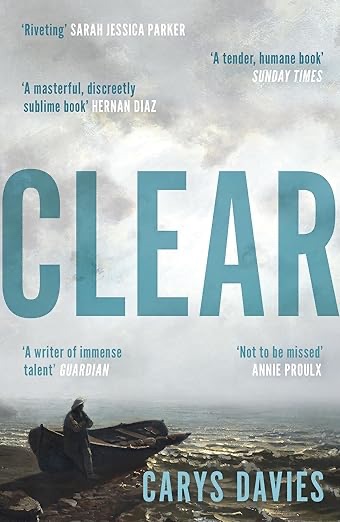
1843. On a remote Scottish island, Ivar, the sole occupant, leads a life of quiet isolation until the day he finds a man unconscious on the beach below the cliffs. The newcomer is John Ferguson, an impoverished church minister sent to evict Ivar and turn the island into grazing land for sheep. Unaware of the stranger’s intentions, Ivar takes him into his home, and in spite of the two men having no common language, a fragile bond begins to form between them. Meanwhile, on the mainland, John’s wife, Mary, anxiously awaits news of his mission.
Against the rugged backdrop of this faraway spot beyond Shetland, Carys Davies’s intimate drama unfolds with tension and tenderness: a touching and crystalline study of ordinary people buffeted by history and a powerful exploration of the distances and connections between us.
Clear is so beautifully set within some very significant events. In the 19th Century evangelical worshippers moved away from the Church of Scotland to form the Free Church of Scotland. Also, there was a second wave of Scottish landowners driving their tenants from the land, choosing to make a better profit grazing sheep, know as the Highland Clearances. Our characters are deeply involved with these events. John Ferguson has been a minister in the Church of Scotland, but his conscience draws him away towards the Free Church. This leaves him without an income since the new church isn’t yet established. John’s wife Mary may be the answer, because her brother-in-law asks a landowner if he could offer John a job. The job has one purpose, travelling to a remote island in the North Sea close to Norway. There he has to evict the landowner’s last remaining tenant, a man named Ivar who is barely scratching a living with a handful of livestock. However, Ivar doesn’t speak English, but an old dialect that’s a mix of Norwegian and Gaelic. John has just one month till the boat returns to take both of them back to Shetland. How will he convince Ivar to leave?
The story is focused on the relationship these two men have to develop with each other and it starts in a way neither expect. The bailie’s house is empty as he’s already left the island so John plans to make it his base, but needs to find somewhere locally that he can wash. He finds a spring and decides to bathe, but he slips and falls down a cliff. Ivar finds the unconscious man and takes him to his own hut. As John slowly regains consciousness and begins his recovery, the two man have to work out a way of speaking to each other and eventually John has to explain what he’s there for. As we watch their relationship grow and how they work on communication, Mary has grown worried about John. She thinks he may have taken on the task without enough preparation and she decides to travel out there and join him. The narrative felt like being a fly on the wall to to these events. Once the three are together I had the strange feeling that this was really happening and I was simply watching history, bearing witness to the emotions flowing between them.
This is such a gentle story that contains so much. Instead of pushing an agenda or viewpoint, the author just lets it play out naturally. Nature is so much more than just a setting, it’s life itself. The island is mercurial, with it’s changeable weather creating the mood. Ivar lives entirely off this land, his life a routine of hard work and at home he spins wool or knits. Even the regular agent who collects rent for the landowner is paid in wool, feathers or wrack. Ivar is part of this island, a bear of a man with only his animals for company. There’s a purity to his life that’s almost spiritual, an interesting contrast to John’s organised religion. There’s so much going on under the surface of the story, told in the tiny details of everyday life: their gestures, the intimacies they share and how those connections change as a language is formed between them. It’s interesting to see the established dynamic of John and Ivar affecting how Mary settles into the cottage. The men’s connection brings the three of them into a unit, so that they don’t feel like a married couple and a lone man any more. Each of them forms a strong connection with each other and the landscape. I found reading this an almost meditative experience, because it’s so slow and calm. The ending came suddenly and was a shock.
Published by Granta 7th March 2025
Meet the Author

Carys Davies’s debut novel West (2018) was shortlisted for the Rathbones Folio Prize, runner up for the Society of Authors’ McKitterick Prize, and winner of the Wales Book of the Year for Fiction. Her second novel The Mission House was first published in the UK in 2020 where it was The Sunday Times 2020 Novel of the Year.
She is also the author of two collections of short stories, Some New Ambush and The Redemption of Galen Pike, which won the 2015 Frank O’Connor International Short Story Award and the 2015 Jerwood Fiction Uncovered Prize. She is the recipient of the Royal Society of Literature’s V.S. Pritchett Prize, the Society of Authors’ Olive Cook Short Story Award, a Northern Writers’ Award, a Cullman Fellowship at the New York Public Library, and is a member of the Folio Academy. Her fiction has been translated into nine languages.
Born in Wales, she grew up there and in the Midlands, lived and worked for twelve years in New York and Chicago, and now lives in Edinburgh.

 The Lotus Readers
I really enjoyed this, the few words a d memories shared that establish the human connections and context that then allow events to unfold. I also appreciated the abundance of historical references that are there if you’re interested or add to the decor if not, the Comrie earthquake, the Robert Adamson calotype photo, the painting of the assembly, the Norn language, such erudite richesse.
LikeLiked by 1 person
It’s a simple story beautifully written with all the layers of history grounding it in place. You express it beautifully.
LikeLiked by 1 person
That’s exactly what I thought reading your review, so beautifully expressed!
LikeLike
This is an author I need to check out! I love the sound of this one. I wonder how I’ll feel about the ending 👀
LikeLiked by 1 person