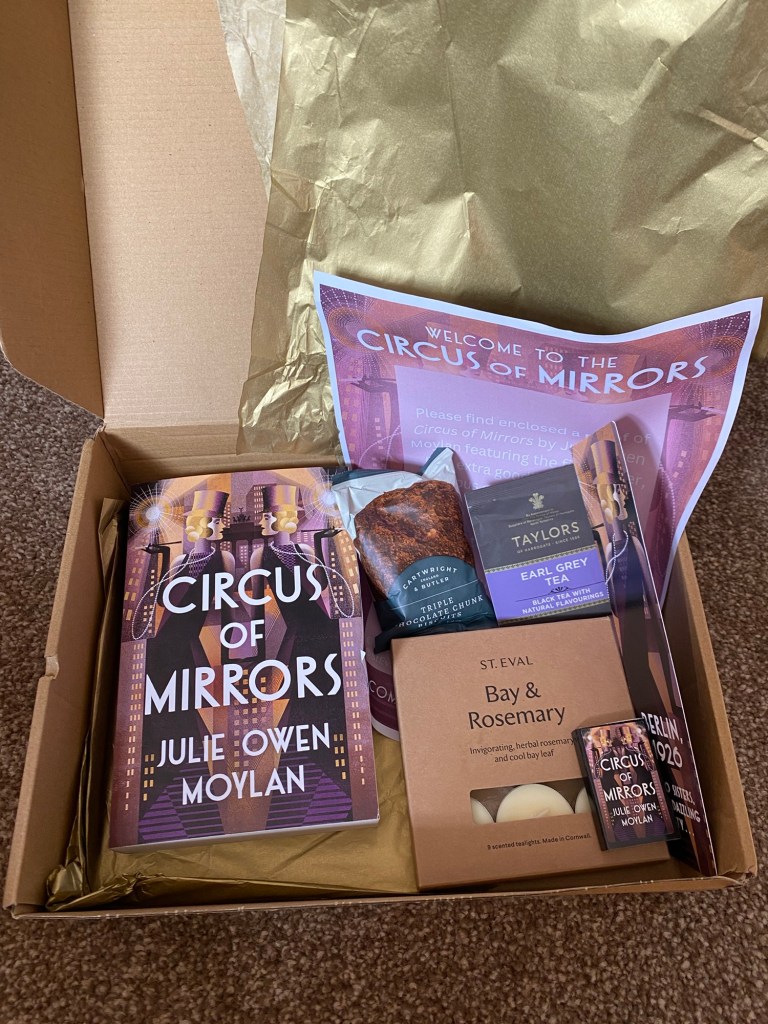
I really have been blown away by this story set just after WW1 and progressing to the mid-twentieth century. Our characters are two German sisters Leni and Annette who live in Berlin and are the last living members of their family. When we first meet them they’re in dire straits, living in a makeshift shelter in an abandoned garden. Thanks to war and the influenza epidemic they’ve lost their family, so are totally reliant on each other. Leni, the older sister, gets a chance to earn some money at a notorious and rather seedy cabaret club called Babylon Circus. There the naive and rather shy Leni becomes a cigarette girl in a second hand and pinned costume that just covers her modesty, but she is at first shocked by what she sees. With shades of the musical Cabaret the author creates a club that is a mirage of clever lighting, fairground mirrors and risqué musical numbers. It’s enchanting by dark and unwelcoming by day, but it doesn’t matter because this is the type of fun that can only be had at night. The girls are shameless on stage and nudity is everyday in the dressing room, but Leni sees something attractive in their boldness, bawdy gossip and loud raucous laughter. They have a freedom she’s never seen before in women, they’re not afraid of taking up space. The illusion extends to the girl’s costumes, covered at first glance but offering a cheeky glimpse here and there. This is what the crowd turn up for, but one girl manages to shock the audience by crouching on the table of a misbehaving customer and pissing in his face. Everything is overseen by owner Dieter, a man with his own disguise. He rarely enters the cabaret room, but sits in his office with it’s resident cat. Having left half his face on a battlefield he wears a tin mask which chafes at his wounds and leaves his expressions slightly lopsided. This gives a certain sense to the fairground mirrors, if everyone is distorted then no one stands out.
It’s Paul the pianist’s good looks that capture Leni; his talent, his smile and the lock of hair that escapes onto his forehead. When he starts to walk her home she’s evasive, how can she tell him he doesn’t have one? She invents a family, but then has to keep Annette out of her business. Paul’s also in trouble, as his brother has run up debts he can’t repay and the lenders are leaning on him to pay instead. After a warning in the form of a beating he knows he must leave, but what will he do about Leni? Leni and Annette now have rooms, with a landlady who doesn’t mind watching Annette in the evenings while Leni works. I had so many questions. Would Paul ask Leni to go with him? Does he even feel that strongly about her? Where would Annette fit into this? Even after all these questions are answered, jealousy and fate intervene changing everything.
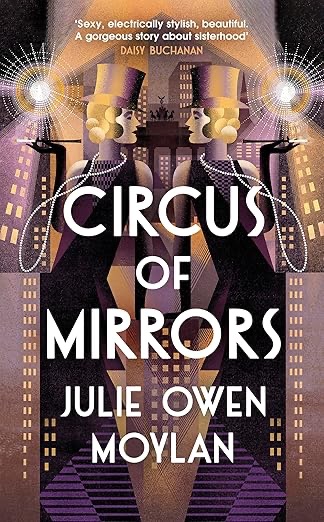
In our second timeline we’re in the midst of the Cold War and a middle-aged Leni is living in Berlin with her teenage daughter, following the death of her husband. She’s surprised by a sudden visit from her sister Annette who now lives in the USA. She seems agitated and anxious, spending all her time in flat brooding and smoking. Leni’s daughter is in the throes of first love, using the guise of drama rehearsals to meet her boyfriend. With nowhere to go they find solace in a strange old cabaret club where there’s a fairground mirror amongst the ruins. This is the perfect place for secret assignations. Leni is concerned that with her sister here the past seems closer than it’s been for years. So many secrets are being kept between these women and when Leni sees a face from the past, it could all come tumbling down like a pack of cards.
Julie writes mid-century women like no one else. I feel like I know them. This is my grandmother’s generation and my grandad actually went to Germany after WWII to help rebuild the country. I remember being shocked by the utter devastation of German cities when they were depicted in the film The Aftermath. I was haunted by a woman getting her daughter ready for school, brushing her hair in their normal routine, but with the outer wall blown away. It was like looking into a doll’s house. The author made me feel the contrast of that wild decadence in the 1920’s with the Cold War period where everything feels grey and routine with nothing to look forward to. The bleakness of Leni’s flat really comes across as it seems to echo the desolation of Annette. Even the once rowdy and colourful club is now derelict and abandoned. I love the way the author plays with place and identity in this way, as well as how the characters see themselves. Their internalised sense of how they look forming part of their identity, but is often at odds with how we see them. Dieter and the girls at the club are almost gaudy grotesques, using appearance and performance to mask true feelings. As for Dieter, I kept thinking about his inability to express emotion in his face and how that affected his ability to connect with others. If we can’t express what we feel what effect does that have on our identity? Dieter can’t look at his new face because it doesn’t reflect the image he has of himself in his mind. It’s only once everyone else becomes distorted that he fits in, only the cat accepts him utterly as he is.
The secrets between the sisters are beautifully constructed. Annette’s adult behaviour is a faint echo of her childhood feelings. Her jealousy and fury when she discovers Leni with Paul is the fear of a child who has almost lost everything and everyone she knows. She only has Leni and what if she leaves her too? As an adult, pulling secrets or feelings from her is almost impossible. She has been holding the past inside herself so tightly and for so many years I was unsure if she would bring it’s truths to the surface without breaking. Towards the end, as another terrible event outside their control looms over Berlin, my heart was in my mouth! Not knowing whether the ending would be what I wanted had my heart racing. I couldn’t bear either sister to suffer any more heartache and this is the beauty of Julie’s writing. She makes you believe in this world and these characters so much, that you’re able to shed real tears for them. This novel is easily one of the best I’ve read this year and I’m in no doubt it will feature in my end of year list too. I’ve loved Julie’s first two novels, but this is certainly Julie’s best novel so far.
Published by Penguin on 12th September. Thanks to Julie and the Squad POD Collective for including me in this month’s book club.
Meet the Author

Her debut novel That Green Eyed Girl was a Waterstones’ Welsh Book of the Month and the official runner up for the prestigious Paul Torday Memorial Prize. It was also shortlisted for Best Debut at the Fingerprint Awards and featured at the Hay Festival as one of its TEN AT TEN debuts.
73 Dove Street was recently named as a Waterstones’ Book of the Year and Daily Mail Historical Fiction Book of the Year with the paperback still to come in April 2024.
As a filmmaker Julie won the Celtic Media Award for her graduation film “BabyCakes” before going on to win Best Short Film at the Swansea Film Festival.
Her writing and short stories have appeared in a variety of publications including Sunday Express, The Independent, New Welsh Review and Good Housekeeping.
She has a Masters in Filmmaking and an additional qualification in Creative Writing & English Literature. Julie is an alumna of the Faber Academy. Circus of Mirrors is the third novel.

 The Lotus Readers
One thought on “Circus of Mirrors by Julie Owen Moylan”