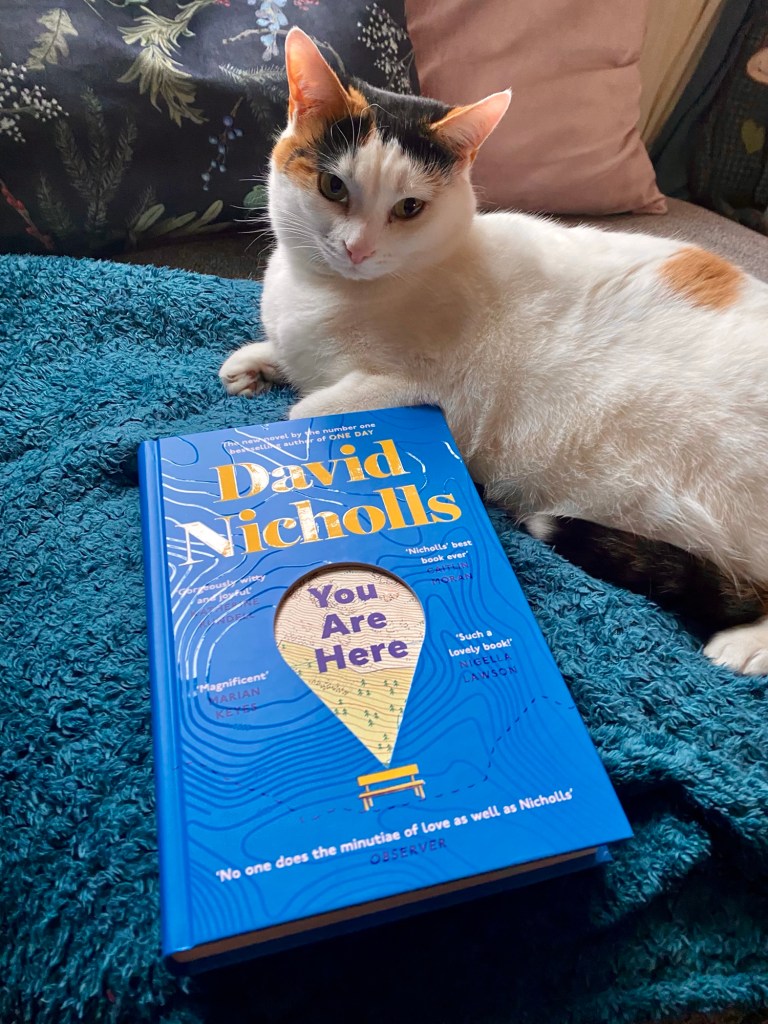
I have had the joy of reading two books, each by one of my favourite authors, back to back on my holidays and I have genuinely loved it. David Nicholls has been a household name thanks to the new production of One Day on Netflix. The beauty of Nicholls’s novel about friends Emma and Dex makes it one of my favourites of all time and I’m definitely not alone. There was a time back in the 2000s where if you were on a train journey most of the people in your carriage were reading One Day. It was a book that utterly broke my heart because I believed in those characters so much and the shock of what happened is still with me, to such an extent that I haven’t been able to watch the last two episodes of the series. I can’t bear what’s coming. Similarly, both the book and BBC adaptation of his novel Us was deeply moving but utterly real. With the wonderful Tom Hollander as his lead, we become so emotionally invested in this couple, then just as they’re ready set to out for a once in a lifetime trip his wife asks for a divorce. Their plan, to spend all summer travelling around Europe, would be their last trip as a family, before their son leaves home for university. Can they set aside this bombshell and continue with their holiday? The set up in both these earlier novels is so simple and You Are Here is no different. A group of friends travel from London to the Lake District to walk some of Wainwright’s routes through Cumbria towards the Pennines. Cleo has invited four single friends; Conrad is meant for copy editor Marnie and Tessa is intended to get on with geography teacher and dedicated walker Michael who is extending his trip to walk the entire coast to coast, ending in Robin Hood’s Bay. Michael is still getting over separating from his wife so finds these social occasions difficult, much preferring solitude. Marnie spends much of her time alone too, so this will be a step out of their comfort zone for both of them. When the others bail out after a day of endless rain, Marnie and Michael are left to walk together. Can they both strike up a friendship?
David Nicholls has this amazing ability to articulate the minutiae of conversation and communication between the opposite sexes. He’s also brilliant with those tiny moments of shared humour, stolen glimpses and the body language of love. It may seem strange that a whole book is about two people walking across the country, but everything happens within that time spent together. After a couple of days Michael can see that Marnie is an inexperienced walker but determined, intelligent and well-read. She has been in relationships that eroded her confidence, has a keen sense of humour but tends to lose it a little when tired and hungry. Marnie is surprised by Michael. Although she knows little about geography she can appreciate how passionate he is about his subject, he wears his beard as a mask so that people keep their distance, is perfectly comfortable in his own company and is hurt very badly by the break-down of his marriage. This isn’t two young people swept up in the blind passions of love at first sight. This is a slow burn. It’s a potential romance that grows slowly and unexpectedly for both of them. It’s lovely to read a ‘real’ love story about people who are older and have been kicked about a bit by love in the past. Nicholls has alternated each character’s chapters, so we’re also taken into Marnie and Michael’s inner worlds. Within these chapters we have flashbacks through their lives and their past relationships, slowly learning what has built these people who are in front of us, trying to bring their lives together. We are also privy to private thoughts that let us know this couple could be perfect for each other. When bullied into social activity by friends we can see that they’re both introverts. Michael agrees to a plan just to make Cleo shut up. She means well, it’s just that for her the answer to a empty weekend is the presence of others, while it’s their absence that floats his boat. Similarly Marnie knows that a bit of socialising is expected, however…
‘She had become addicted to the buzz of the cancelled plan […]for the moment no words were sweeter to Marnie than ‘I’m sorry, I can’t make it.’ It was like being let off an exam that she expected to fail.’
I understood Marnie. I was the kid at school who was so excited to have finished the reading scheme by age eight, because while everyone else was reading to the teacher I had free library time. I would pull up a beanbag and disappear into the world of the Little Women or Jane Eyre, loving that I was alone, out of the hustle and bustle of the classroom I was free to be anywhere just by opening a book and stepping through a wardrobe. Marnie gives a similar description of her early reading years to mine, the weekly library visits and the devouring of anything I could find and making no distinction between what was deemed literature and what wasn’t. My only criteria was that I enjoyed it. I learned to enjoy activities with friends – ice skating, horse riding, cinema – but nothing beat that thrill of knowing a delicious book was waiting in my room.
‘Private, intimate, a book was something she could pull around and over herself, like a quilt.’
Reading is a little like Michael’s walking in that it takes me on a journey, but also helps me unplug from the stress of daily life. If I’m reading a physical book it’s even more separate from the world because it’s not alerting me to things on social media, emails or messages from friends with cat videos. Marnie wonders if her reserve and need for alone time comes from her upbringing with parents she’d describe as cautious and timid:
‘At no point did her parents move house, gamble, use an overdraft, change jobs, have affairs, go abroad, shout in public, park illegally, eat on the street or get drunk, and while they must have had sex at some point, this was covered up as carefully as a past murder. Marnie was the only evidence.’
Michael is taking in the world around him, but at a totally different pace. He can stop and concentrate slowly on a beautiful bird song or the reflection of the hills in a still lake. He is a Romantic with a capital ‘R’, perhaps not a flowers and surprise trip to Paris sort of man, but he can see poetry in the everyday. As they stroll the hills he truly does understand the Romantic poets, engaging Marnie in conversation about routes that William Wordsworth and his sister Dorothea might have taken. He tries to feel the state of the sublime and thinks he often finds it in a spectacular view that couldn’t have been seen any other way than walking off the beaten track. He is still so caught up in the breakdown of his last relationship, still to some extent thinking as part of a couple although it’s clear to his friends that his wife has definitely moved on. He’s been so disconnected from his wife, for so long that he didn’t know anything was wrong and the shock of the split was seismic. This is why Cleo invites him on the weekend in the first place, to try and point him forwards, rather than backwards. This is a spiritual and mental journey for him, as well as a physical one. Michael has that symptom of depression where you feel like you’re looking at the world through a thick pane of glass, removed from reality. This is a protective barrier too, he keeps his pain so deep inside himself he thinks no one can see it. It stops him from being able to express himself and he finds Marnie so performative at first. She rails against her sore feet, the weather, the mud – all things that are so part and parcel of hiking it wouldn’t occur to him to do the same. Her humour does break through occasionally.
‘You’re funny, but I’m the one with the lighter rucksack so who’s laughing?’ ‘That is true. I’ve got twelve pairs of pants in here, for three nights.’ ‘Why?’‘I don’t know. Maybe I worried I might shit myself four times a day.’ ‘Has that ever happened?’ ‘Not since my honeymoon.’
By the end my heart was breaking for these fledglings. I so wanted them both to be happy, even if they simply ended as friends. David Nicholls throws in one last obstacle that takes us by surprise, even while my heart was racing I could see how much it was needed for that character to have a final epiphany. He’s brilliant at creating that bittersweet feeling that comes as we’re older and have romantic baggage. At first when we lose someone the shock and pain is everything, then after time and doing a little bit of work on ourselves a day hopefully comes where we can look back and it not hurt. We can acknowledge the pain but not let it overwhelm us. In fact, eventually, we can look back and smile about the good times, the love that was shared and how glad we are that we experienced it. That we’re able to move forward and enjoy new adventures. I really understand this from my own life and I genuinely closed the book with a smile on my face, knowing that both Marnie and Michael have so much life to look forward to whether together or apart on their journey.
Out now from Hodder & Stoughton (Sceptre)
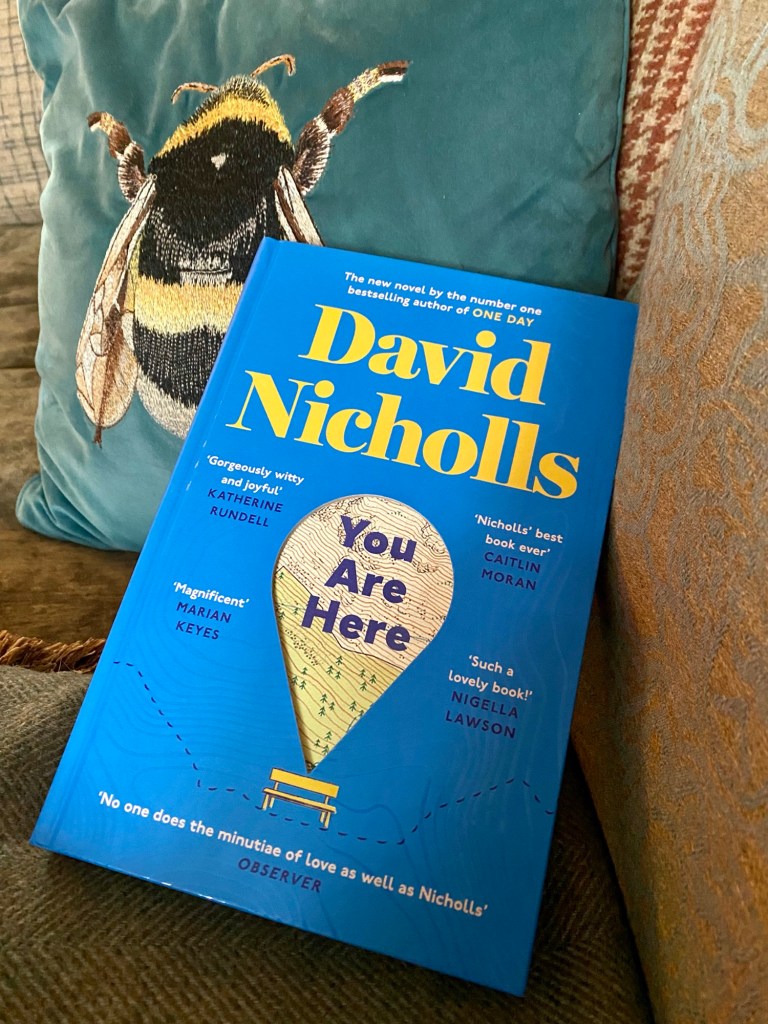
Meet the Author

David Nicholls is the bestselling author of Starter for Ten, The Understudy, One Day, Us, Sweet Sorrow and now You Are Here. One Day was published in 2009 to extraordinary critical acclaim: translated into 40 languages, it became a global bestseller, selling millions of copies worldwide. His fourth novel, Us, was longlisted for the Booker Prize for Fiction.
On screen, David has written adaptations of Far from the Madding Crowd, When Did You Last See Your Father? and Great Expectations, as well as of his own novels, Starter for Ten, One Day and Us. His adaptation of Edward St Aubyn’s Patrick Melrose, starring Benedict Cumberbatch, was nominated for an Emmy and won him a BAFTA for best writer.
He is also the Executive Producer and a contributing screenwriter on a new Netflix adaptation of One Day. His latest novel, You Are Here, is out now in hardback.

 The Lotus Readers
Waiting for this from the library – or a Kindle deal – I might be waiting some time. Great to read your review!
LikeLiked by 1 person
I used NetGalley in the first instance, then bought a copy because I loved it. Xx
LikeLiked by 1 person