“Peach. Its shape floats on Mr Bell’s mouth. The pinch of the p, followed by a rounded push of the lips, sending the last syllable hard across the tongue. My hand nearly reaches for my pocket, as if the feather from our lessons might still be found there. It’s been a long time since I thought of the feather. I would balance it on my knuckles and make it quiver with the puff of my ps. Puh-puh-puh. I stop myself just in time, folding my hands against my skirts.”
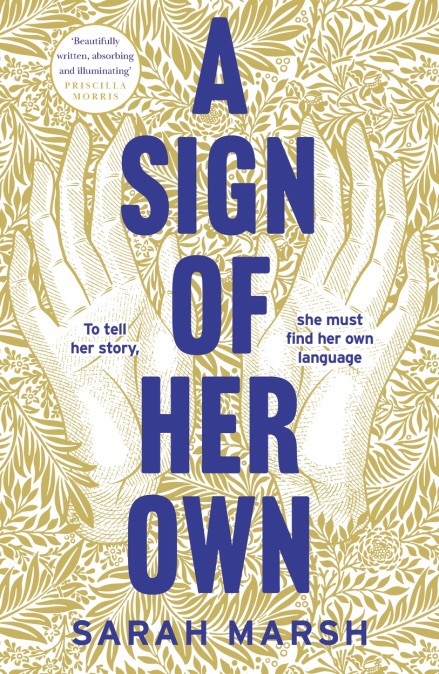
I found the opening scene of this novel incredibly moving and so skilful, placing us so close to our heroine that we understand the barriers she faced being deaf at that point in history. In it, Ellen and her fiancé receive an unexpected visit from Alexander Graham Bell. As the two men converse, Ellen is picking up body language and tone of voice which indicate a serious topic but she notices a repeated word ‘peaches’. Her attention moves to the beautiful jar of peaches preserved by her mother on the dining table. Yet she’s wrong, as she passes Mr Bell the jar and urges him to take it he tells her no, the word he was saying was ‘speeches’.
As Ellen reminisces, so did I. I was propelled back to the early years of my nephew Charlie, who was born visually impaired. Before we knew the full implications of his sight loss, we’d noticed he was behind in his development. He wasn’t moving round much, had put on weight and wasn’t speaking. It then occurred to us. In order to learn something for the first time, we tend to copy it. If you can’t see, you can’t imitate others and just as Ellen is struggling to get the full meaning of Mr Bell’s conversation, Charlie couldn’t form the words if he didn’t know how to use his mouth to make the noises. So Mum used the same technique she’d used with us when we were small. When a specific noise was needed like the ‘puh’ sound in the book, Mum would raise his hand to her mouth and make the sound against his fingers. He would then put his fingers to his own mouth a copy her. It was lovely to relive that memory and feel perhaps a tiny bit of what Ellen is feeling too.
A Sign of Her Own is narrated by Ellen Lark across two timelines and it’s an incredible feeling to be in her world, because it’s so different from the world we know. It felt similar to when actress Rose Ayling-Ellis did Strictly in 2021 and performed a ‘Couple’s Choice’ dance with Giovanni Pernice, choreographed to bring the audience into Rose’s world. At a certain point, the music stopped but the couple continued to dance and we realised that this was Rose’s world. For us the music would return, but she carried on dancing into the silence. She somehow used her trust in Giovanni and read his body to perfect her dance routines. It was moving, disorienting and a complete revelation so it was no surprise to me that they were winners of that year’s BAFTA for a memorable TV moment.
Ellen’s inner world is also a revelation and the author communicates it so beautifully. She lost her hearing as a child during a bout of scarlet fever and communicated with her mother using a language of signs they made up as they went along. It broke my heart to read how the sound of her speech was viewed by local children. Restricted to vowel sounds, because she couldn’t hear the precision of the consonants, Ellen feels shame about how she sounds. Her personal sign language seems to suit her, but it’s her grandmother who comes up with the idea of using Alexander Graham Bell’s ‘Visible Speech’. Students of his method were banned from using any sort of sign language, but were allowed to use a notebook. Family politics played their part in the decision, because the family were in debt to their grandmother. Luckily Ellen enjoyed studying and proved to be incredibly clever, even if she was unsure about Bell’s method and his motives. She has to be perceptive and learns to read people very quickly, including Bell. As we move into the present day, Ellen and her fiancé are visited by Bell who is embroiled in a fight to be recognised as the sole inventor of the telephone. He wants Ellen’s support as a character witness, but Ellen doesn’t have good memories of her time under his tutelage. She feels like he betrayed her and other deaf students for his own fame and recognition. How can she support him when she feels so conflicted?
During the later timeline Bell’s fight becomes all consuming. He is full of determination and I felt torn about his character because on one hand he appears to be paying attention to a group of people rather alienated by the rest of society so his work could be seen as altruistic. On the other hand it’s as if the people he’s helping don’t really matter to him. There’s a narcissism or selfishness in his character that means he only sees his students in terms of how they can help him potentially find fame. I felt like he didn’t appreciate their characters or individuality. I found myself disliking him intensely. By contrast, Ellen is instantly likeable and intelligent. Through her we are invited into the deaf community and the debate over sign language and visible speech is fascinating. As someone who has studied disability theory, I was very aware that some people don’t consider their deafness a disability. If they sign, they simply see themselves as speakers of a different language. I was interested in the politics and ethics of a speaking world imposing a method of communication on the deaf community, rather than the community coming to society with their own choice of language or speech method. I think there are many readers who might never have considered these issues and wondered how the book is being received in the deaf and/or disabled community. I was impressed that the author wanted to bring these issues to the fore and loved the enthusiasm she clearly has about her subject and her heroine. This is a well researched debut clearly inspired and informed by her own experiences of deafness as a child. It puts us into the centre of that experience and I came away feeling like I had a renewed awareness of sensory disability.
Thank you so much to the Squad Pod Collective and Tinder Press for my copy of A Sign of Her Own, published on Feb 1st 2024
Meet the Author

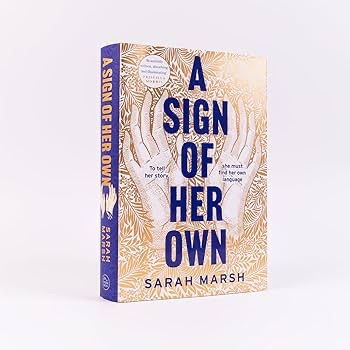
Sarah Marshwas short-listed for the Lucy Cavendish Prize in 2019 and selected for the London Library Emerging Writers Programme in 2020.A Sign of Her Ownis her first novel, inspired by her experiences of growing up deaf and her family’s history of deafness

 The Lotus Readers