
‘Holding her robust infant, Beatrix murmured a prayer in her native Dutch. She prayed that her daughter would grow up to be healthy and sensible and intelligent, and would never form associations with overly powdered girls, or laugh at vulgar stories, or sit at gaming tables with careless men, or read French novels, or behave in a manner suited only to a savage Indian, or in any way whatsoever become the worst sort of discredit to a good family; namely, that she not grow up to be een onnozelaar, a simpleton. Thus concluded her blessing — or what constitutes a blessing, from so austere a woman as Beatrix Whittaker.’
Some people didn’t know Liz Gilbert until the film ‘Eat, Pray, Love’ came out, in fact I was surprised to learn how many people hadn’t known about or read the book. I’d really enjoyed the book and found the film ok, but thought it didn’t dwell enough on the psychological and spiritual aspects of her journey. It had a mixed reception at my book club where some really identified with her character, but others were screaming how lucky she was to have a publisher willing to fund her trip of a lifetime during her divorce as many have to continue getting the kids to school, going to work and only having the millisecond before sleep hit them to have anything resembling a spiritual or self-aware thought. I’d not expected the anger and jealousy that it evoked in some readers. So it was with trepidation that I approached her novel The Signature of all Things. If I’m honest I probably wouldn’t have sought it out, but I was in one of my favourite bookshops while on holiday in Wales and I saw it in the second hand section. It was such a beautiful book that I had to buy it and I flicked through it back at the holiday cottage, then was sucked in very quickly and all my planned reading went out of the window. I was stunned to be sailed around the globe from London to Amsterdam, Peru and Tahiti. Even more exciting was the heroine, Alma Whittaker, daughter of a famous explorer, plant hunter and botanist. I was drawn to her intelligence, her busy mind, her assertion that she is the equal of any man and the depths of her feelings.
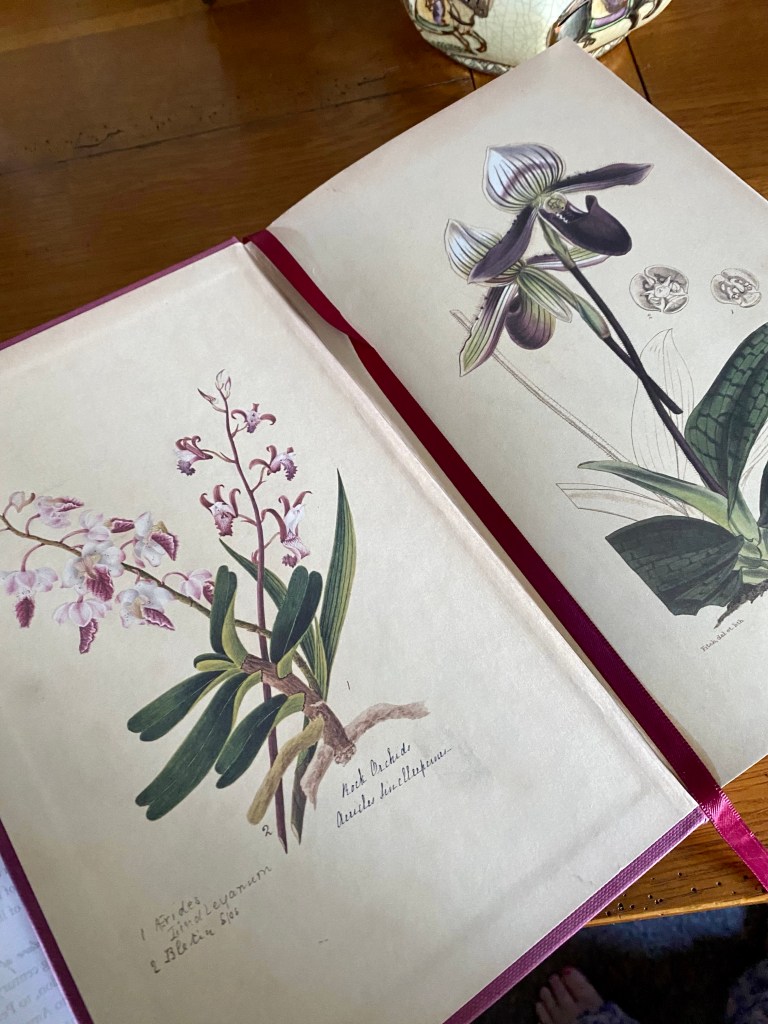
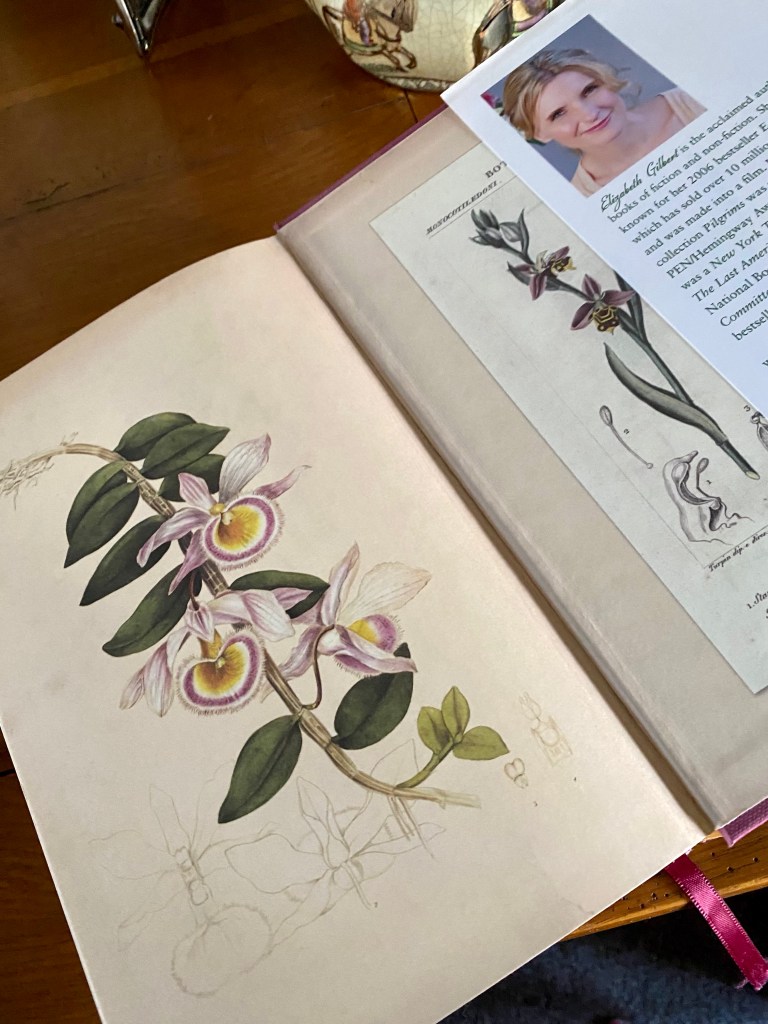
The book begins be setting up Alma’s early life and family situation, so we meet her father and his beginnings in botany as a boy apprentice to a plant hunter- actually a punishment for some very sneaky thefts from Kew Gardens. His incredibly enterprising ideas mean that by the time Alma is born he is a very rich man, with a mansion in Philadelphia. His fortune has been made in the quinine trade, a medicine extracted from the Cinchona tree found in Peru then traded and grown around the world to produce a drug for malaria. At his home, White Acre, he and his wife have two daughters: Prudence their adopted daughter who follows an extraordinary path into abolitionism and Alma. Alma is a tall, large-boned girl who is described as ‘homely’, but is intelligent, determined and secretly contains well pools of sexual curiosity, all qualities that seem unusual for her gender in this time period. Her father’s belief that all people should be given the opportunities that enable them to manage others and excel in their own chosen field governs the household. ‘All’ really does mean all in William’s case and his daughters are given a thorough education at home, rivalling any man. Both he and his Dutch born wife are clearly progressives and Alma flourishes with the opportunities they give her to become a very accomplished botanist in her own right and perfectly able to develop her own projects and command the voyages necessary to hunt for the plant she has set her heart on. Unexpectedly, at an age when scholarly spinsterhood is expected to be her path, a painter visits White Acre and Alma falls deeply in love. This painter believes Joseph Boehme’s philosophy that all of nature contains a divine code, every flower and every creature – such as the Fibonacci sequence. Their two interests combine and while Ambrose is a utopian artist, often found to be painting orchids rather than studying them in a lab, they do have the same passion for nature. Where he saw life as divine and a guardian angel watching over him, Alma saw a life as a struggle where only the fittest survived, something she found out for herself when exploring:
“Then — in the seconds that remained before it would have been too late to reverse course at all — Alma suddenly knew something. She knew it with every scrap of her being, and it was not a negotiable bit of information: she knew that she, the daughter of Henry and Beatrix Whittaker, had not been put on this earth to drown in five feet of water. She also knew this: if she had to kill somebody in order to save her own life, she would do so unhesitatingly. Lastly, she knew one other thing, and this was the most important realization of all: she knew that the world was plainly divided into those who fought an unrelenting battle to live, and those who surrendered and died.“
Of course, this love is not the end of Alma’s story. Liz Gilbert isn’t going to let a man eclipse Alma or create a sappy rom-com ending to such a strong, feminist story. Alma and Ambrose represent two great schools of thought in the 19th Century, that of the spiritual and the scientific. These two schools of thought had equal status and often intermingled to this point, but as the century progressed a complete separation occurred where spirituality became a belief without reason and science became fact without a divine sense of wonder. Could the common ground that Ambrose and Alma thrive upon at first, survive the divide between their two disciplines? Make no mistake though, Alma is the protagonist here and she’s one of my favourite characters ever. I loved her drive (sadly lacking in this writer) and her preservation of it, no matter what. She can speak five languages at five years old! Oh and two dead ones. Her educational achievements aside, it was her confidence and self-belief that stood out to me. Yet here we are two centuries later in a crisis of confidence, with an epidemic of imposter syndrome and doubts about how to be women. Alma is wholly herself, even when at times that might seem steely, reserved and abrupt. She believes that everyone is the master of their own self, including women. It is sad that the introduction of Prudence to their family is the catalyst for Alma experiencing negative self- thoughts. She wishes to keep Prudence, who has been staying with the Whittakers since a family tragedy, but her presence is an opportunity for comparison – the ultimate thief of joy. Alma realises for the first time that she is not beautiful. She retreats into her work at moments of doubt or unhappiness, even extreme heartbreak and loss. It is her refuge and the one area of life that she can control and that she continues to be confident in. I truly admire her ability to continue. To live.
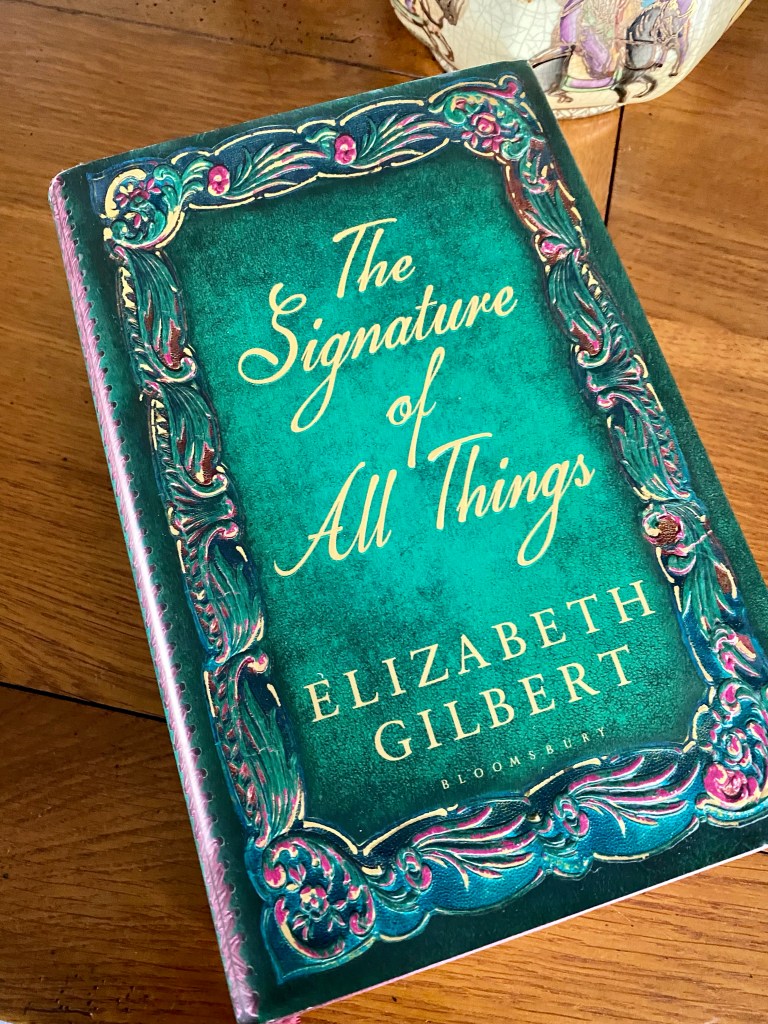
The research that Liz Gilbert must have undertaken for the verisimilitude of this novel is colossal. She writes with a 19th Century sensibility, keeping Alma completely grounded in her place and time. The first rule of creative writing – show, don’t tell – is so strongly in place that I felt like I was with Alma, only seeing or hearing things at the same moment she does. This brings such an immediacy to the novel that it gallops on at quite a right, especially considering this is the story of a 19th Century dowdy and academic spinster. It’s a book that a lot of people might not consider reading from the blurb, which is why it needs to be highlighted in this way. It ranges across biology, exploring, business, philosophy, science, the mystical and yes, the sexual. There are secrets kept all the way to the end that I really didn’t expect at all. I have to say that my favourite review of this book is a negative one. Mainly because it made me laugh out loud, but also because it unwittingly makes you want to read it.
“I was actually enjoying this and then at 49% a spinster has a spontaneous orgasm from holding hands with a dude in a closet.”
left by Goodreads Member, Sylvia, October 2nd 2015
I don’t know about you, but I’d want to read that book!
Meet the Author
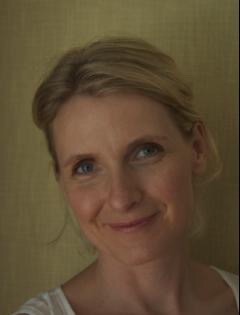
Elizabeth Gilbert is the #1 New York Times bestselling author of Eat, Pray, Love, as well as the short story collection, Pilgrims—a finalist for the PEN/Hemingway Award, and winner of the 1999 John C. Zacharis First Book Award from Ploughshares. A Pushcart Prize winner and National Magazine Award-nominated journalist, she works as writer-at-large for GQ. Her journalism has been published in Harper’s Bazaar, Spin, and The New York Times Magazine, and her stories have appeared in Esquire, Story, and the Paris Review.

 The Lotus Readers
This sounds excellent and that cover is gorgeous. I loved Eat, Pray, Love and the follow up looking at marriage traditions across the world. I think I’ve read one of her novels but can’t remember which.
LikeLiked by 1 person
I’m waiting for her new one. She recalled it and I’m not sure when it’s coming out now, I loved this one x
LikeLiked by 1 person