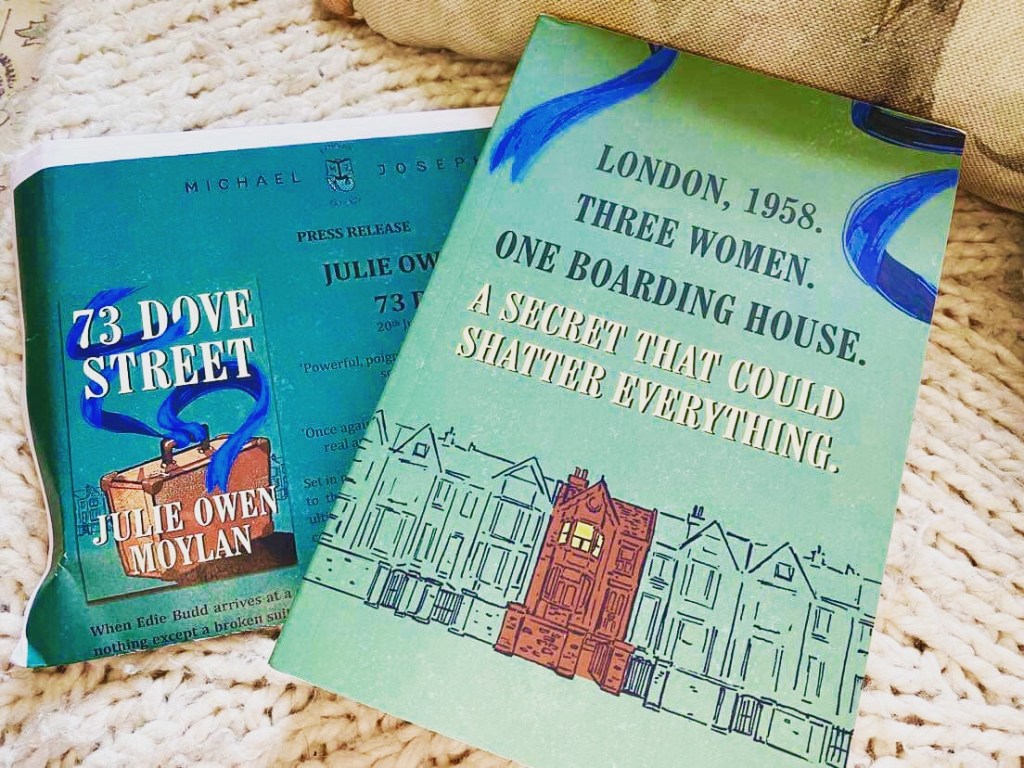
What an incredible writer Julie Owen Moylan is, because within a few pages of starting her new novel I was absolutely immersed in 1950’s London. This is a London I haven’t visited too often in literature, the haunted and broken post-WW2 period rather than the supposed glory or the drama of the the war itself. Here the war has a ghostly presence, shown by children climbing piles of rubble or an incomplete street that looks like a mouth with one of it’s teeth missing. The story is told through three women; Edie, Tommie and Phyllis. It’s Edie we follow to 73 Dove Street where she hopes to look at a room, with just a single suitcase and an envelope full of cash. Edie is almost put off by the mattress and pile of men’s clothes burning fiercely just outside the yard, but a voice summons her from an upstairs window and she recognises a place she can lie low. What is she hiding from? Tommie lives in the room below and works for an eccentric socialite who was once wealthy and popular. Outside work Tommie is lured to the seedy nightlife of Soho and the man she can’t quit. Phyllis is the landlady of 73 Dove Street, burning her husband’s belongings in the street after she discovered a terrible betrayal. She puts on a good front, an armour that she needs to cope with a past she won’t talk about.
This author is absolutely brilliant at creating a feeling and time period, from the dark and depressing post-war London to the interiors of both No 73 and the more upmarket house where Tommie works.
“It was one of those London streets that had become a canvas of tatty boarding houses: windows filled with crooked pieces of cardboard saying ‘Room to Let’. The houses all looked the same: bay-fronted with scruffy front gardens filled with dustbins, and children loitering on doorsteps with their runny noses and scraped knees.“
She makes a beautiful observation about these streets, that where once there were hints of colour, London is now bombed back to dreary black and white. People are trying to drag their lives out of wartime monochrome, but fail every time. There are houses with the front ripped off and the contents still inside, looking like a grotesque full-size doll’s house. Through Tommie’s childhood experiences we can see what it was really like to be in one of those houses as she remembers a direct hit on her family home and being sat in the suffocating dark rubble until a hand breaks through to save her. These memories are so powerful and evocative, they really bring the reality of the Blitz to life. It’s clear that one of the reasons why London is so bleak is that it’s people are traumatised and numb. As well as the lack of money, rationing and their surroundings, these people haven’t even begun to recover. They’re vulnerable and in the case of our main characters, they’re trying to battle on alone.
I was immediately on board with Edie and loved the way the author built up her relationship with Frank. It was one of those situations where I could clearly see what was going to happen and I was mentally screaming at Edie to walk away. This is a man who knows how to choose the right woman, the one who will fall for his charms and become hooked on the way he operates. He likes to keep a woman on edge, waiting for his affection and easily moulded to what he wants by withholding that affection. Sadly it’s a pattern that’s only noticeable when you’ve been through it and Edie is a quiet, inexperienced girl who’s bowled over by his subtle manipulations. She’s so unformed and brought out such a protective mode in me. In a typical pattern he follows any glimpse of anger or violence with apologies and huge gestures.
“Frank’s pale blue eyes never left Edie’s face. Pleading with her without saying a word, desperate to make everything right between them. ‘Will you marry me, Edie? Say you will . . .’ The words tumbled out before Edie could stop and think about them. ‘Yes, of course I will.’ Her arms wrapped around his neck; her good wrist covering the bruises on the other one. His mouth felt tender and warm on hers and for that moment she couldn’t hear the daft comments or applause from the pub, it was just her and Frank”.
The abuse Edie suffers is a hard read, but such an authentic representation of domestic violence in all it’s forms. I am from a working class family, with some very strong women on both sides especially in those aunties old enough to get married during the war. They often comment on how the generations beneath theirs are too quick to split up or divorce and that marriages in their generation tended to stay together. Yet, when I hear the reality of some of their marriages – the drinking, gambling, physical and sexual violence, financial abuse and infidelity – I wonder what’s the point of a long marriage that has only left them grieving and traumatised? The author shows how economic and psychological difficulties prevented women from leaving terrible relationships. I was interested to read the author’s comments about her own family and how the strong women in it had given her inspiration for the book.
I haven’t spoken about Phyllis much, although towards the end of the book it was her experience that had tears pouring my down my face. At the beginning we see through Edie’s eyes the burning pile of men’s clothes outside No 73 and we could guess at what had happened in her marriage. She’s full of anger at her husband, but as the story develops we get the feeling there is something more underlying her feeling of being wronged. We get the picture of a marriage rather like the bombed out houses – a facade remains but it’s been empty for some time. When we hear the full story it is so emotional, I found it deeply moving and could identify with this woman whose abrupt manner is simply the amount of protection she needs to get through each day. It isn’t just the bombed houses that are missing. There are people locked in wartime, trying to carry on by avoidance, distraction or stepping around something there’s only one way through. I found this part of the book so beautifully rendered and deeply felt. Julie has dedicated this book to her grandmother and the strong, working class women in her family. She has really done them proud with this wonderful historical novel.
Published by Michael Joseph 20th July 2023
Meet the Author

Julie Owen Moylan was born in Cardiff and has worked in a variety of jobs, from trainee hairdresser and chip shop attendant at sixteen to business management consultant and college lecturer in her thirties.
She then returned to education to complete her Master’s degree in Film before going on to complete a further Master’s degree in Creative Writing. Julie is an alumna of the Faber Academy’s Writing a Novel course. She lives in Cardiff with her husband and two cats.
Julie can be found on Twitter: @JulieOwenMoylan

 The Lotus Readers