Posted in Random Things Tours

The Peacock Room by Anna Sayburn-Lane.

#RandomThingsTours #BlogTour #ThePeacockRoom

Literary sleuth Helen Oddfellow has started her new job as a lecturer in an English Literature department of the university and is hoping for a quiet life. What she gets is anything but. When she is asked to cover a module for Professor Petrarch Greenwood she expected the students to be a little underwhelmed. He is something of a literary celebrity, having followed his lifelong love of William Blake into TV opportunities and book deals. Yet his students behaviour seems strange to Helen. They are subdued and one is genuinely emotional about him, which rings alarm bells to Helen. Petrarch is flamboyant, holds swish parties at his London flat and has very little time for new feminist theories regarding his hero. On the dark web, a strange literary obsession is being used to stir unrest in its largely male following, and an underground police officer is trying to break into the online community by sharing a love of Blake. Their focus is a an artist who produces a graphic novel based on a Blake character, with a disrespectful and violent attitude towards women. How many of his followers even know or understand Blake? As this unrest grows will Helen be able to come between the innocent and a disturbed gunman bent on making his point with bloodshed?

This is one of those times when I really didn’t need to have read the first novel to enjoy this second instalment in the Helen Oddfellow series. The start was slow but I was intrigued with the larger than life and potentially dangerous Petrarch Greenwood. He’s clearly living a rather decadent lifestyle of bedding young students, and stretching his professional ethics. Officially Helen is covering his classes as he has a book deadline to meet, but we get the sense that really he’s being removed to cover up a scandal. The university can’t afford to lose him as he’s their celebrity professor but they also can’t be seen to do nothing. I sensed a really unpleasant character underneath the charm and wondered if he or his assistant was behind the Blake website.

Running through the book is the treatment of women, from the misogyny on the dark web to gender politics within the university. Helen recounts her own reading on Blake and his wife. The question of how involved his wife was in his work is one that’s been at the forefront of feminist theory, something Professor Greenwood is very dismissive about. He’s dismissive about women in general, in fact one is being physically dismissed from his office when we meet him. The behaviour of the female students in his class is worrying too, some are very subdued and don’t want to meet Helen’s eyes. There’s an unpleasant atmosphere, and an undercurrent that I feared didn’t bode well for some of these women. The story started to focus around the events of Professor Greenwood’s party and this is where the book gripped me.

I’m clearly very dark, because when the truth of the party was revealed I was pleased the author had pushed the story to such a disturbing place. It was a great contrast to the tamer beginning of the book and I think it needed it. I didn’t manage to guess all that had happened so I was able to enjoy all the twists and turns to the end. I enjoyed guessing who had the talent and knowledge to be behind the artwork, but the mind to plan such a terrible act of mass murder. However, this wasn’t the only person with secrets and it seemed only Helen was who she professed to be. She is like the calm centre to the novel, but everything around her felt chaotic and changeable. I worried early on that this would be a novel where women were victims, but actually the ending was quite empowering. The women took control, which was a great way to end. I would have liked to know more about some of the characters so maybe some differing perspectives on events would have been interesting. However, I think it was deliciously dark and turned a light on the type of misogyny that seems to be a constant undercurrent on the internet these days. This was intelligent, surprising and as a literary mystery, quite unique.

Meet The Author

Anna Sayburn Lane is a novelist, short story writer and storyteller, inspired by the history and contemporary life of London. Her first two novels introduce the literary sleuth Helen Oddfellow.
Anna shares Helen’s love of literature – mysteries surrounding the Elizabethan playwright Christopher Marlowe and the Romantic poet William Blake feature in the books. She’s pleased her History and English Literature degree finally came in handy!
Anna has published award-winning short stories in magazines including Mslexia, Scribble and One Eye Grey.

Posted in Random Things Tours

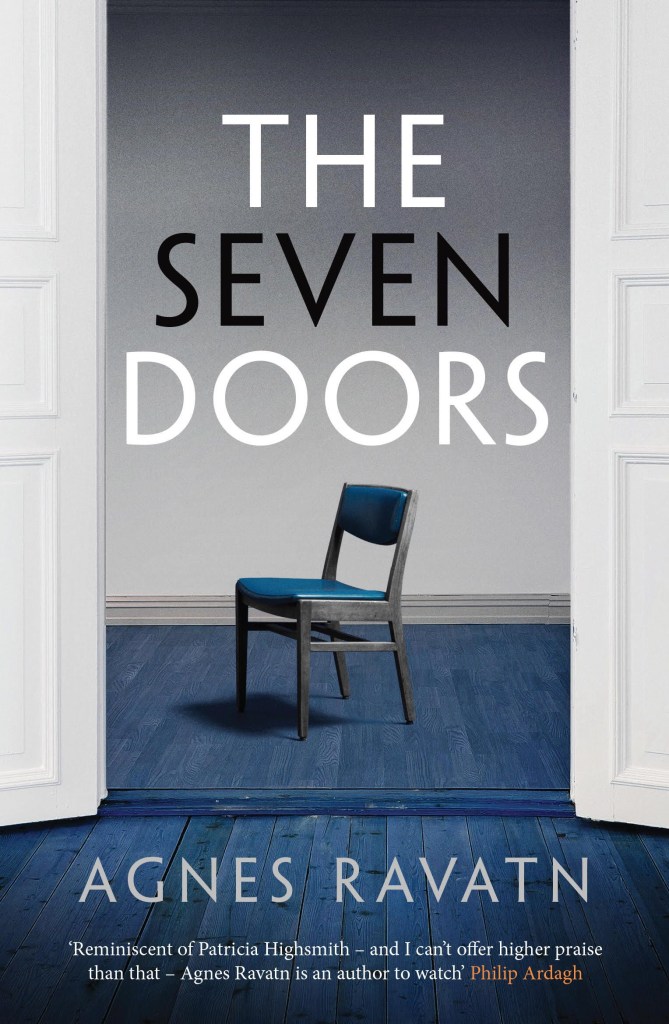
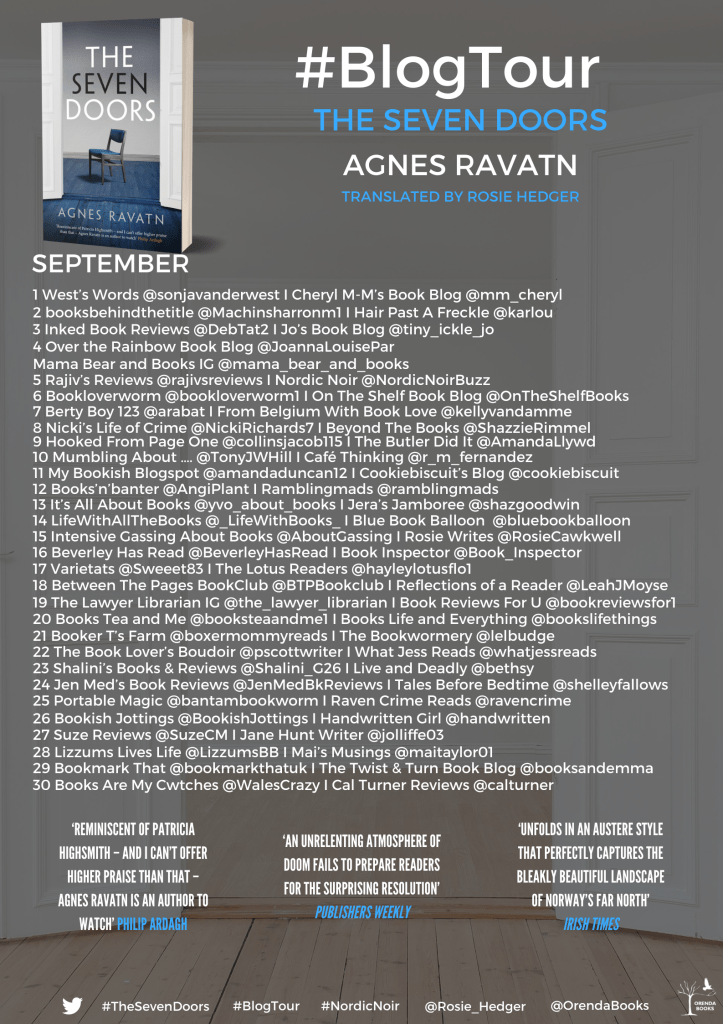
Seven Doors by Agnes Ravatn.

#OrendaBooks. #RandomThingsTours #blogtour #SevenDoors

While reading this book I had one of those odd reading experiences that only happens on Kindle or other e-reader. When I’m reading a proper physical copy of a book, I’m constantly aware of how much book is left. I’m literally holding it in my hand. I read this in one sitting, only realising how quickly time had passed when I stopped to mark a page and saw 93% in the bottom corner! Time really flew because I was so absorbed into Ravatn’s world.

Set in Bergen, Oslo, this is a thriller with so many possible outcomes. Our main character Nina follows a labyrinthine trail to find the killer of a musical prodigy. Nina is a professor of literature and gives a speech at a symposium about the futility of studying literature. Lit students are following their own, selfish lines of academic enquiry she argues, but their study doesn’t help anyone or bring anything important to the world. It doesn’t make a difference, except to the student. She proposes that in order to be useful, literature students make them self available as investigators to the police force. They are trained to analyse documents, to read between the lines, to apply psychoanalytic theory to texts and understand character’s motivations. All skills that might be useful when investigating a crime. Little does she know, she will soon be using those very skills in the real world.

Nina and her husband Mads have an absolutely insufferable daughter Ingeborg. When she announces that her home has silverfish, and she is three months pregnant, she asks Nina to intercede with Mads for an advance on her inheritance. Nina idly observes they have a house in town that belonged to an aunt, but she needs to talk to Mads. They are in their own difficult living situation, as their home is being compulsory purchased to make room for a railway. This is affecting Nina much more than Mads because of the emotional attachment; it was her family home, she grew up there. They are negotiating a settlement with the council, but Nina can’t see any property she would want to purchase. She needs to live in something with soul, not a slick waterfront retirement pad. Ingeborg convinces her mum that they should go and look at the house, but Nina warns that there is a tenant that they shouldn’t disturb. Despite the tenant telling her it’s a bad time, Ingeborg goes bustling in, badgering the tenant about the end of her lease and offering her money to leave as quickly as possible. The tenant, a single mother with a little boy, is blindsided by this forceful woman. Nina feels terrible and makes her apologies, sure that the tenant looks familiar to her.

Later, she realises where she has seen the woman. Their tenant is concert violinist Mari Bull, world renowned and now dropped out of sight. Strangely, she then does the same thing again, exiting the property within a couple of days and leaving no forwarding address. Surely this can’t be solely to do with their visit? Not long after, her disappearance is reported by local then national newspapers. She went to her parents place out on one of the islands, where Nina has a holiday cabin, but left her son and went for a walk, never to return. Nina finds herself intrigued by the case and follows clues, from the opera her ex-husband plays as her requiem to a small notebook with musical terms she finds in a box at the house. Fairytales also play a role in the book and like most literature students I am familiar with the work of Bettelheim quoted by Nina. Using this and Freud’s work on transference Nina starts to construct a theory and follows each clue like the breadcrumb trail of Hansel and Gretel. I liked the play on our usual ideas about fairy tales, which tend to be very Disney-fied, and everything comes to a completed happy ending. The original tales Nina starts to tell her granddaughter Milja are far more dark and bloodthirsty. In fact, the darker they are the sooner Milja will quiet down and go to sleep. They include anxious, suicidal hares and a murderous husband who gaslights his wives then kills them when they find out the truth.

From a psychological perspective there are interesting theories around transference and counter-transference, not just in the therapeutic relationship but in any relationship with a power balance that’s heavily in one person’s favour. I was also interested in the theorising around the Oedipus and Electra complexes. Nina is discussing the theory with her students and they don’t see the point of learning about a concept that started in Ancient Greek theatre and seems to bear no relevance to the present day. Yet, there’s a definite unease in Nina’s own relationship with her daughter – Ingeborg has been more likely to confide in or ask favours from her father. For Mari too there is a complicated mother – daughter relationship in that her parents sacrificed their own relationship to make sure their daughter had opportunities with the best teachers and orchestras. Mari and her father were often away together, touring Europe, leaving her mother at home. There is resentment over this and a definite coolness between mother and daughter.

Ravatn’s writing is spare, it gets to the point quickly and without poetry. She can establish a feeling or setting in just a few words, such as how the light changes when it snows or how it must feel to give ourselves up to the water, like Virginia Woolf with the stones in her pockets. Her characters are well defined and psychologically complex, such as Ingeborg’s narcissism and inability to gauge other’s feelings. I have real worries for her daughter Milja, a future psychopath if ever I met one. As I felt the book build in pace and tension towards the end, I knew Nina was getting close to the answers, but is the answer getting closer to her? The end, when it comes, is satisfyingly unexpected and shocking. I love Nordic Noir and this was a great addition to my collection. This was a clever and psychologically literate thriller. I would love to read more of Nina in the future.

Posted in Netgalley

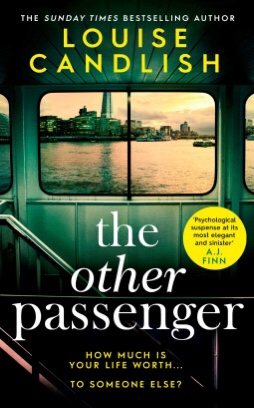
The Other Passenger by Louise Candlish

#TheOtherPassenger #NetGalley #SimonandSchuster

I’ve started to think of Louise Candlish as one of my ‘go to’ authors for classy thrillers with unexpected twists. As always she drew me in with the characters, but at first I wasn’t quite feeling it. I was curious, but I found myself waiting for something to happen. Then there was a moment – if you’ve read it you’ll know where I mean – where everything changed and I realised everything I thought I knew about a character was wrong! After that I had to keep reading, and I kept reading till I finished at 3.20am precisely.

Our narrator is Jamie Buckby, who lives with his partner Clare in a beautiful home near the River Thames. Clare is a partner in an estate agency and Jamie.. well, Jamie is between jobs at the moment. After an incident on the tube made him infamous, he is working as a barista in a small, independent coffee house. Since the tube incident, Jamie has been commuting to work on the riverboat. Open air, a beautiful view of the city and a great way to relax on your way to work. Also, passengers aren’t crammed in like sardines, sweating in the heat, stuck in a tunnel, panicking and pulling the emergency cord. Anyway, the book begins in that weird week begin Christmas and New Year when two detectives meet Jamie off the boat before work. They’re concerned about the whereabouts of one of Jamie’s fellow passengers, Kit. However, Kit isn’t simply a fellow passenger. Clare and Jamie have been together a while and felt in need of some excitement, so invited one of Clare’s new employees and her partner over for drinks. Melia and Kit are young, attractive and have that hint of danger. They drink, but also dabble in a bit of coke. Melia is stunningly beautiful and on one evening in Clare and Jamie’s kitchen, she corners Jamie and says she finds him attractive. Jamie is twice her age at 50 years old and very flattered, but has a lot to loose. Not only his long standing relationship with Clare, but everything that comes with it – her family, her financial support, and the large Georgian house with communal garden that they share, but Clare owns. Will he be tempted to risk everything?

The book’s structure brings us back and forth, to the Christmas week and Kit’s disappearance, then back into the past few months and what’s really been going on in plain sight and in secret. Then, just when I was starting to get a handle on what’s really happened, Candlish pulled the rug right out from under me! Then I had to reevaluate everything I’d read before.

I love books that surprise me. Especially when I’ve become very invested in the story and have started running up my own theories on what’s going on. I became very interested in Jamie’s partner Clare. To some degree she has led a very privileged lifestyle both in London and back in her family’s home in Edinburgh. However, she has been a great partner for James and has supported him through the tube incident, his period not earning and even further into the novel as the questioning about Kit’s disappearance becomes more focused on James. Her strength and dignity shows when she still firmly supports him, despite their relationship being on shaky ground at times. Meanwhile, Melia is a master manipulator and actress – I will never trust anyone who’s performed Cat on a Hot Tin Roof. This is not just a book about being deceived though. This book is about self-deception. About thinking you can party like twenty year olds when you’re middle-aged. About ignoring the reality of your situation, your finances, the roof over your head. About ignoring the reality of how attractive and how desirable you are. It was great to read a book where the women have all the power, whether it’s because they’re young, smart and beautiful, or whether they’re classy, wealthy and dignified. Even the seemingly quiet, unassuming, riverboat passenger Gretchen, has some tasty secrets of her own. This is a very taut, well-written thriller, that is difficult to put down and even harder to second guess.

Posted in Personal Purchase

Invisible Girl by Lisa Jewell.

#InvisibleGirl #LisaJewell #bookbloggers

Lisa Jewell is another favourite thriller writer of mine. I know with her books I’m going to get that addictive, dark and ‘unputdownable’ novel I’ve been craving for solid weekend of reading. In actuality I finished this in five hours straight. I don’t know if it’s because I am a counsellor, but I love it when psychological professionals are depicted in novels – I instantly know I’m getting one of two things; a great counsellor with a messy personal life or a creepy manipulator who isn’t what they seem. In this case I got both, plus plenty of other complex characters to get my teeth into it.

The central relationship of this novel is that between child psychologist Roan Fore and his previous patient Saffyre Maddox. Saffyre has lost both parents and lives in a London tower block with her uncle Aaron. They spend three years as doctor and patient until she’s made so much progress it’s time for Roan to discharge her. Yet Saffyre doesn’t feel fixed. She has simply learned to wear masks. She’s studied the girls at school and now knows how to be an ordinary girl, she has a bunch of friends and at home seems the content family member. Once her grandfather dies, it soon becomes clear that no one knows or sees the true Saffyre. She’s become invisible.

Another narrator is physiotherapist and mother Cate. Cate probably appears to have everything. A long marriage to a fellow professional, two teenage children and an apartment in a huge mansion house until the renovations are completed on the family home in Kilburn. For now she’s getting used to her new flat, and life in Hampstead village. However, it’s not long before the novelty of life in this new neighbourhood wears off, when one of her daughter’s friends is sexually assaulted on her way home. This is not the first incident either. Could it be that the attacker is hiding on the building plot next door, which has seen very little activity apart from one JCB placed on site. The foxes are more active and can be heard screaming at night. Cate wants to keep her children safe, asking her teenage daughter Georgia to be careful coming home, especially at dusk onwards. Her son, Josh, is younger but is becoming increasingly difficult to pin down. She doesn’t always know where he’s been and who with, but can’t bring herself to imagine her kind, tender boy doing any harm. Cate’s husband is running, at all different hours and sometimes for whole afternoons. Should she be worried about where he is? That is aside from the affair she’d convinced herself was happening this time last year.

Our last narrator is Owen, a young, single man lodging with his aunt Tess down the road. Cate hates to generalise but he is the archetypal sexual predator. In his thirties, but with no relationship and seems like a bit of a loner. In fact the truth is even more worrying as we learn that Owen works at the local college and has been suspended for sexual harassment. Having turned down a course on creating a safer workplace, Owen decides to quit but now he has even more time on his hands. He finds himself drawn into the murky world of ‘incel’ websites – a group of men who are termed involuntary celibates because women won’t sleep with them. He makes contact with one charismatic leader within the movement and they meet for a drink, but Owen finds his extreme ideas frightening. He believes in enforced impregnation, to get past this conspiracy barring men like them from having a sex life or their own families. Worryingly, and without being asked, he gives Owen a bottle of rohypnol. Mortified, Owen takes them but hides them in his drawers at home. Put off by the incel extremists, Owen decides instead to join Tinder and ends up on a date with a woman on Valentine’s Day. Little does he know that the events of that evening will become very important and may impact the rest of his life.

I liked the way Lisa Jewell takes us inside these characters while also letting us know how others see them. Cate sees Owen as an odd character who seems to stare and appears awkward around women. Saffyre sees Cate as the blonde skinny wife, with a life that revolves around her husband and children. Owen notices Saffyre hanging around the building plot and watching Cate’s family. All these disparate threads come together when Saffyre is reported missing. The author makes points about our biases in the case of Owen. When questioned by the police Cate mentions him as someone who’s odd, who watches people and suggests they question him. It made me think of the case of the 2010 case of Joanna Yeates who went missing in her home town of Bristol. The police took her landlord, Christopher Jeffries, in for questioning and his face was plastered all over the nation’s press. Even when released from questioning there were those that still found Jeffries suspicious. His only crime it seemed was to look a bit odd and unkempt and be described as a loner. Jeffries won substantial libel damages. On the other hand, is someone has the air of respectability through their profession or financial position they can get away with murder under our noses.

Saffyre is an interesting character and although I didn’t fully understand the reasons for her choice to live outdoors – I like my comforts – I can see how the flat becomes claustrophobic for her. Eight storeys up and the heat from all the surrounding flats becomes stifling. I wondered if it was a type of grounding she was seeking? I understand that. I have a need to feel the earth with my bare feet, particularly one specific piece of earth have almost always lived next to since I born. I was born on a farm across the road from the River Trent, and although I’m moving further south on that river as the years go by, I still take off my shoes and stand bare foot on the river bank. It’s like a communion with the river and it’s boundaries – a way of letting it and me know I am home. For Saffyre it’s the stars, the being able to wrap up warm while feeling cold nip your face, the quiet communion with a visiting fox, the feeling that perhaps, like the fox, she is wild. Inside there are many things she has to face, like the loss that surrounds her, the self harm, and the terrible thing a boy at school did when she was much younger. Outside she’s free from these things and it is no coincidence that outside is where she first trusts someone enough to share those painful experiences. She’s incredibly perceptive for her age and is the only one to realise that Cate’s life is largely dependent on one man, and Saffyre is perfectly placed to see the potential for future pain in that choice.

Lisa Jewell is great at throwing red herrings into the plot and I didn’t recognise all of them, happy to go where the story took me rather than furiously trying to work it all out. I knew which way I wanted the plot to go and I was largely rewarded, with just one surprise for good measure. I always want to ask authors whether they know how their novels will resolve, which way each character will go and who will take the blame. I’m sure I’d get a variety of different answers. I do give my heart away to characters and I was desperately hoping Joshua wasn’t involved the sex attacks in the area, because I wanted him to be the sweet, kind boy I had built him up to be. What a story like this one tells us is that we are all a couple of decisions away from a completely different life. Georgia could walk out one night and meet the attacker. Owen could take his date rape drugs on his Valentine’s date. Cate could have left Roan years before when he cheated on her and promised to never do the same again. It made me think of the parallel lives we could have, if we just changed our minds. From a therapist’s standpoint it made me think a lot about fitness to practice and how we make the choice to see or not see a client. How we decide when to end therapy. Mainly, I wondered how we can be expected to help other people find their broken pieces if our own life is falling apart, and what impact that knowledge has on a young client like Saffyre. The novel felt timely, thoughtful and a great weekend read.