Posted in Netgalley

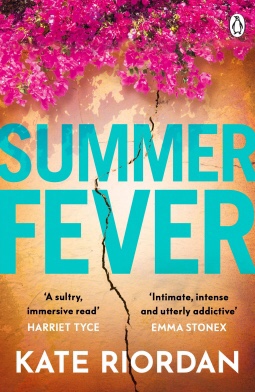
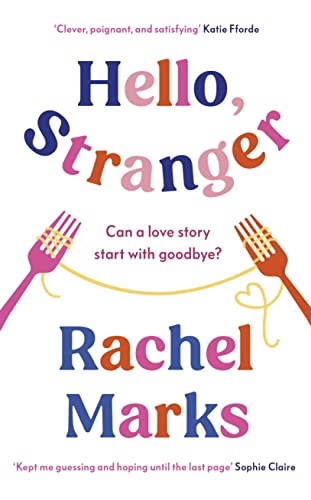
Summer Fever by Kate Riordan

This is a real sizzler of a novel! Hot in every sense of the world, set in picturesque Italy with a sense of growing menace all the way through. I read this one in the garden, with a Pimms in hand and with every chapter became more convinced of the old saying; the grass is never greener on the other side. Laura and Nick have been through a lot. Back in London they were struggling with infertility and Laura hadn’t felt like herself for a long time, the fertility drugs pumping her full of hormones and the grief of miscarriage left her feeling broken. When she discovers a betrayal, after Nick accidentally leaves his phone at home, she’s angry and resentful too. In his eagerness to make it up to her, Nick suggests they do what Laura has always wanted, move to Italy and create a holiday hideaway for couples. They discovered Luna Rossa on a visit to Italy several months ago, after which Laura suffered a third miscarriage. It is in the Marche region, a largely unknown area of Italy next to Tuscany, but less expensive. Luna Rossa is wonderfully isolated and just dilapidated enough to still be charming. It includes a pool, a small derelict cottage and beautiful grounds that fall away steeply gifting the house with incredible views across the countryside. Only a few months later they are preparing to welcome their first couple for a three week stay. It seems idyllic, but they’re taking a risk in welcoming complete strangers into their home. Laura has stalked her guest Madison on social media and she seems very outgoing and glamorous. Laura and Nick could be underestimating how disruptive it can be to have strangers living in your home, especially these strangers…

I felt the author set out Nick and Laura’s back story and state of mind very well. Nick is contrite and desperate to make it up to Laura for his indiscretion, but he’s sacrificed a lot to follow her dream and might have been desperate to make it happen at all costs. Laura is still resentful of Nick’s mistake and the trauma of infertility has left her a little lost, unsure of who she is anymore. With hormones still not back to normal and the sadness of losing a child she’s very fragile and could easily be manipulated. I got a sense that she wanted to recapture herself, the person she was before their fertility journey began. It’s as if she wants to take off her experiences like taking off a costume and simple be who she was before. It takes time to process trauma and assimilate the experience into your sense of self, something she’s barely started. There’s a reckless feel to her actions, almost a need to self destruct. I thought the author’s description of the miscarriage experience was brilliant, I’ve been there and recognised Laura’s confusion at some of the euphemism’s used by medical staff to avoid emotive language; using ‘products of conception’ rather than baby and ‘come away’ rather than loss. It rang so true and I had empathy for her. As we start seeing flashbacks of her life at university and her relationship with the man she loved, I found her curiously passive. This annoyed me, although I did realise later on that it might be a coping mechanism. She seems to slip away in her mind and so any trauma or difficult experience only happens to her bodily rather than emotionally, hopefully leaving her able to cope. Sadly it just leaves her divorced from her emotional self, like an observer rather than someone truly living that moment and feeling it. Shutting emotions out never works and her destructive behaviour is the bodily experience of those repressed emotions.

Once their guests arrive, Madison and husband Bastian, the tone is set for their stay. Gregarious and sociable Madison seems to suck Laura and Nick into her orbit and they’re soon acting like friends visiting rather than paying guests. This is inexperience on the couple’s part and ordinarily they might learn from it, but there’s an air of menace in the way Madison ‘plays’ with Laura. She dresses Laura up, is overtly sexual and likes to play mind games with her husband. Is it for herself, or Bastian’s pleasure that she does this? At a neighbour’s pool one afternoon Madison comes on to Laura with Bastian watching. He’s clearly enjoying himself, but is it just the titillation or is he enjoying Laura’s discomfort and confusion too? In these moments of challenge Laura is again curiously passive, going along with the moment rather than causing a fuss. There’s also a feeling of unease around the builders who turn up to see Nick, their disdain of Laura very evident in the way they dismiss her objections as if she knows nothing about her own house. Is this simply a chauvinistic attitude or is something more sinister going on? The tension is often at fever pitch, accentuated by the physical temperature and constant need to cool off. The author then adds sections of unbearable tension, such as the slightly ‘Don’t Look Now’ masquerade feel of the town’s medieval festival. The heat is unbearable and Laura is never sure who is behind the costume and has the uneasy feeling that they could have stepped back in time; the permanence of the ancient buildings seeming to mock her for feeling untethered and temporary. The author also drip feeds a little bit of stress into everyday life, such as Madison’s wardrobe making Laura feel she has to make an effort too. Nick notices she’s now wearing make- up every day and styling her hair whereas she wouldn’t normally bother. These changes show that Laura isn’t comfortable in her own skin, this pair have some sort of hold or influence but what is it? We are taken back in time to her university days for the answers and then the shock revelations surrounding the guests start to unfold. With secrets being kept about Luna Rossa too, the conclusion is explosive to say the least. This will make you wish you were in Italy, but not with these people.

Meet The Author

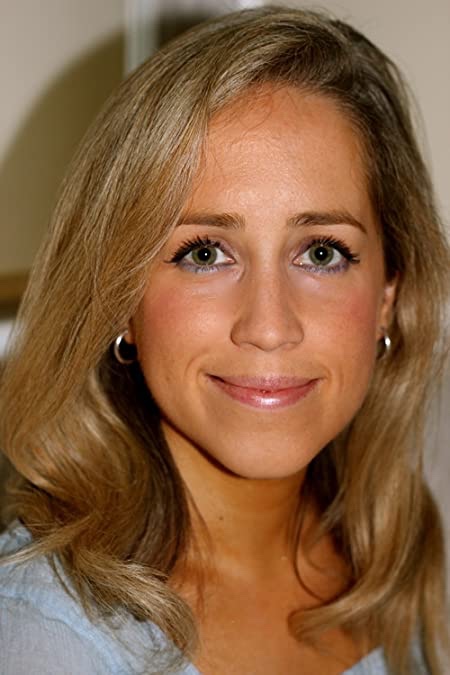
Kate Riordan is a writer and journalist. She is an avid reader of Daphne du Maurier and Agatha Christie, both of whom have influenced her writing. She lives in the Cotswolds, where she writes full-time. The Heatwave is her fourth novel

Posted in Squad Pod

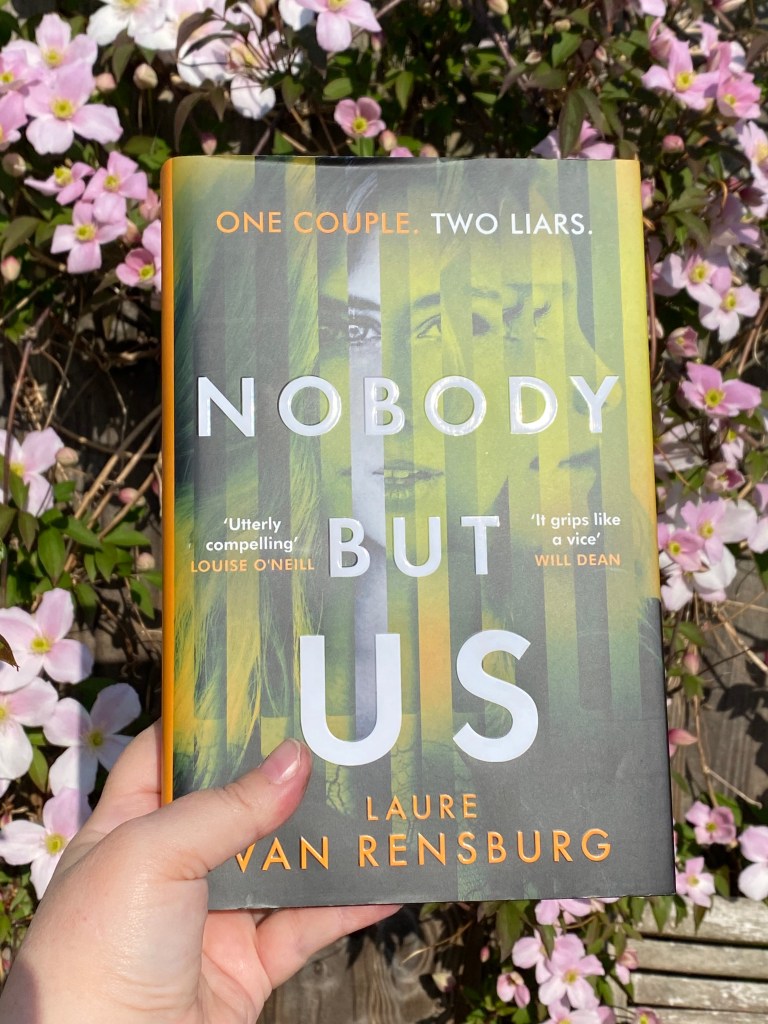
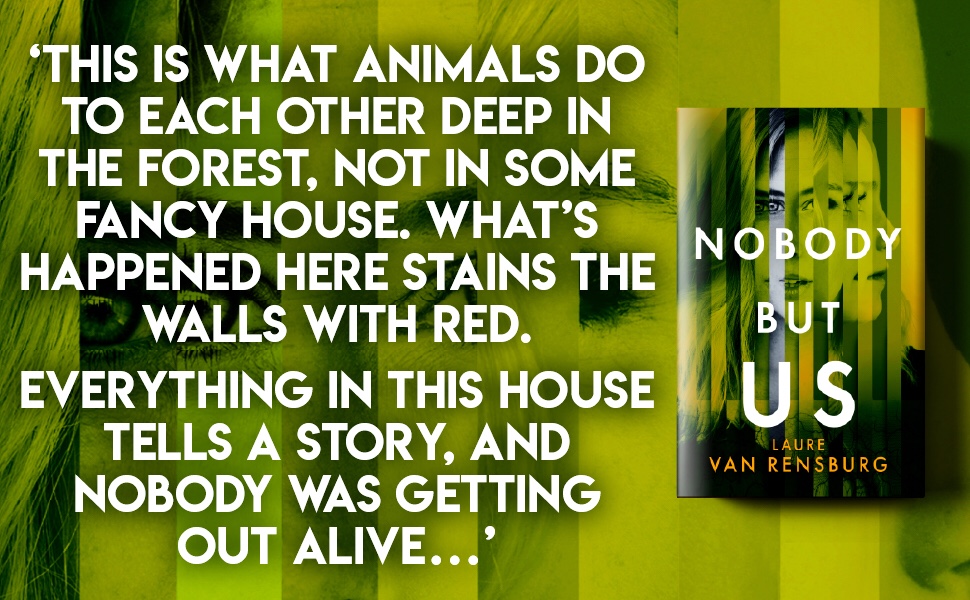
Nobody But Us by Laure Van Rensburg

I heard such great things about this dark thriller that I’ve been chomping at the bit to read it asap! It was our Squad Pod read for last month and as usual I’m late. The blurb grabbed me right away and my mind went immediately to Gone Girl so I expected some twisted people and storylines. That tagline is designed to draw us in, but also has a hint of humour as if she’s mocking the genre – meet 2022’s most f*cked up couple. I was waiting for a gap in blog tours and managed to get a sunny weekend, my day bed set up in the garden and a willing slave to keep me supplied with drinks and adjusting my parasol. It didn’t take long to hook me.

Ellie and Steven have finally managed to find a gap in their busy schedules to get away for a few days and celebrate their six month anniversary. They’re heading to an isolated cabin in the woods, many miles away from the hustle and bustle of New York. It will be the perfect opportunity to spend some quality time together and really get to know each other. A perfect weekend for a perfect couple. Except, that’s not quite the truth. Ellie and Steven are far from perfect. They both have secrets. They’re both liar. Steven isn’t who he says he is. But then neither is she …

The setting was clever too, usually I’d expect a log cabin in the woods or a period house as a background, but this is a contemporary, architect’s house. I didn’t think a modern house could be scary, but I found it’s glass and steel exterior very unwelcoming – there’s nothing cosy about this weekend. In fact the perfection, the materials used and the sheer amount of space seem strangely oppressive. The contrast with the forest outside is jarring, the natural surroundings make it feel like the owner is pitting his house against the elements, imposing man made order on the natural chaos outside. Yet, when the storm sets in, nature seems to be getting it’s own back, with the large glass panels showing the storm’s fury. Trees are lashing against each other and the snow is coming thick and fast. In fact the weather adds to the sense of isolation, no one is coming to save them, no matter how much they scream.

The story is told by the two characters in turn, relating the details of their weekend away, but also drifting into their pasts so we get some idea of how Steven and Ellie came to this point. Still, the biggest revelations are kept back from us so we don’t have the full picture. This drip feed of information kept me hooked. I needed to know what happened next and who the characters really were under their facades. Mostly though I wanted to know what had set these dramatic events in motion. I couldn’t love these characters, so I wasn’t invested in one side or the other at first, but as the flashbacks came I was surprised to find I did have flashes of sympathy for Ellie or Steven, depending on what had happened to them.

I enjoyed the way the author played with that edge, between what was once acceptable and now isn’t. In light of the #MeToo movement many women in my 40+ age group who can look back at events from the 1990’s and think they wouldn’t be acceptable now: a stolen kiss at a party; a hand on the backside while waiting on a table; pressure to go further sexually than we might have been comfortable with. Now, relationships where there is any form of power imbalance are viewed as wrong. The married man and the teenage babysitter, the older boss and young employee, or student and tutor relationships were happening around me at that time and I don’t remember thinking they were intrinsically wrong, just a bit dodgy. Now, thirty years later, the mood is very different. But of course that’s only one aspect of this complicated story. This is a gripping, atmospheric and explosive novel. If you love thrillers this should definitely be on your summer reading list.

Laure Van Rensburg
Posted in Netgalley

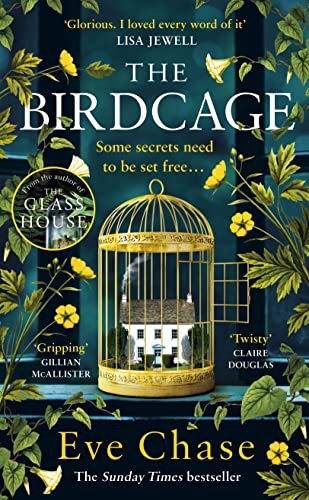
The Birdcage by Eve Chase

Eve Chase’s new novel had all the ingredients of a perfect read for me – quirky bohemian family, unconventional artistic father, large Cornish house and family secrets that have haunted his daughters for years. It’s the psychological impact of these family secrets that really make the novel. The story is told in a dual timeline, in the present Lauren, Kat and Flora are returning to Rock Point, her father’s mansion house on the Cornish Coast. He has invited them after many years away from the house, following a terrible incident that occurred on the day of the eclipse in August 1999. The events of this day are told in our second timeline. Lauren is the youngest by a few years, and on that day she was an adolescent , while her half-sisters Flora and Kat are older teenagers. Each girl has a different mother and their overlapping ages show the sexual profligacy of their father Charlie, a well-known artist. As he sits down with his three adult daughters, Charlie has a big announcement for them. The girls are expecting an illness or plans concerning his artwork, but they have a shock in store.

The complexity of this family’s relationships is at the core of this novel and I really enjoyed going back in time to work out why and how each woman’s personality was formed. On the surface Flora is the most conventional sister, with a husband and young son Raff, but is everything at home as happy as it seems on the surface? Kat is the most career minded sister having developed a well-being app. She is constantly checking her phone and looking for a reliable signal so she can work, but is she just busy or is the world of well-being more stressful than it should be? Lauren has had the most recent difficulties in life, nursing her mother Dixie who was terminally ill. After moving into a local hospice Dixie died, and although Flora invited her for Christmas Lauren didn’t come. These women are anxious to be together again. Flora and Kat used to tease Lauren, even bully her a little bit. The reasons for this become clearer, but Lauren has always thought it was about Dixie. Dixie was different to me 6 hCharles’s usual choice in women, she was unadorned apart from piercings, kept her hair shorter and was artistic in her own right. Indeed Charlie is touchingly affected by her death and seems to regard this separation as something he most regrets in life. Each sister’s personality fits perfectly with their back story: Flora’s hesitancy and submissive nature; Kat’s avoidance and distraction, creating workaholic tendencies; Lauren’s phobias, which are usually under control, but thanks to Bertha the parrot and the wealth of seabirds surrounding their home it can be a problem. The parrot has other tricks as well, mimicking the house’s occupants with phrases that only one person knows are true or false.

I thought the pace was clever, becoming more urgent in the past and present day at once propelling the reader towards the eclipse event and the effect of it’s revelations in the present. What was particularly clever was the way some people are only revealed in all their complexity, in the present. Angie, who worked as their au pair, was disliked by Lauren when she was a child. Lauren sensed her duplicitous nature and knew she wasn’t really there for them, describing her as hungry to get to Charlie like an art groupie. However, as an adult Lauren can see that this was more complicated and how she didn’t understand adult relationships. There’s a shift in years and awareness, where Lauren and her sisters can now see that Charlie wasn’t just a man beleaguered by women throwing themselves at him. He is an active participant in these complicated affairs and in bringing these girls into the world. He’s even passive at their visits, always pleased to see them but never negotiating with exes, or organising the logistics. Their gran does all the work, leaving Charlie free to paint in his studio, a place where only his models and Lauren are welcome. He’s never taken responsibility for his actions and as events unfold it’s possible that those actions have created a perfect storm of sibling jealousy and conflict.

That eclipse summer, Charlie has asked his three daughters to sit for a painting with the large ornamental birdcage. It’s the painting that will become his most well known and most valuable, in fact the girls are sorry it’s gone to art collector because as far as they know it’s his most personal. There’s a wealth of imagery in this painting, starting with the three sister’s pose, sitting together but not touching, like three separate islands. There’s the solemnity behind it too, the girls are not talking or cracking a joke and all three are staring out towards the viewer. Or is it towards the painter? In feminist readings of visual arts the bird within a cage represents the imprisonment of women, but also the gilded frame through which we view femininity. We can’t know the painter’s intention, but by painting it next to his daughters is he acknowledging their freedom? Or could he be pointing out a sexual double standard? He has been free to create these overlapping lives without censure, whereas their mothers and the girls have borne the gossip, shaming, poverty and hardship that comes with being a single parent. They’ve had to hear the whispers and insults about their morals, while he has been free to carry on with only the reputation of being bohemian to his name. Or could the birdcage contain his secret? The consequences of this secret we see on eclipse day, although it isn’t fully revealed until the present when it puts Lauren and her nephew Raff in danger. Only then will Charlie have to deal with how his behaviour has affected others, like ripples on a pond. This was an engaging tale of complex family ties and the psychological effect of a parent’s action. It has all the bohemian glamour of a country house occupied by an artist and a gorgeous atmospheric setting in beautiful Cornwall. I was gripped to the final page, having felt an affinity with Lauren and Flora I wanted to know how their stories turned out and the epilogue brings a satisfying ending to this family saga.

Published by Penguin on 28th April 2022

Eve Chase is an author who writes rich suspenseful novels about families – dysfunctional, passionate – and the sort of explosive secrets that can rip them apart. She write stories that she’d love to read. Mysteries. Page-turners. Worlds you can lose yourself in. Reading time is so precious: I try to make my books worthy of that sweet spot – she says on her Amazon.com author page.

Her office is a garden studio/shed with roses outside. She lives in Oxford with her three children, husband, and a ridiculously hairy golden retriever, Harry. She invites readers to say hello. ‘Wave! Tweet me! I love hearing from readers’.

Eve is on Twitter and Instagram @EvePollyChase and on Facebook, eve.chase.author.

Posted in Publisher Proof

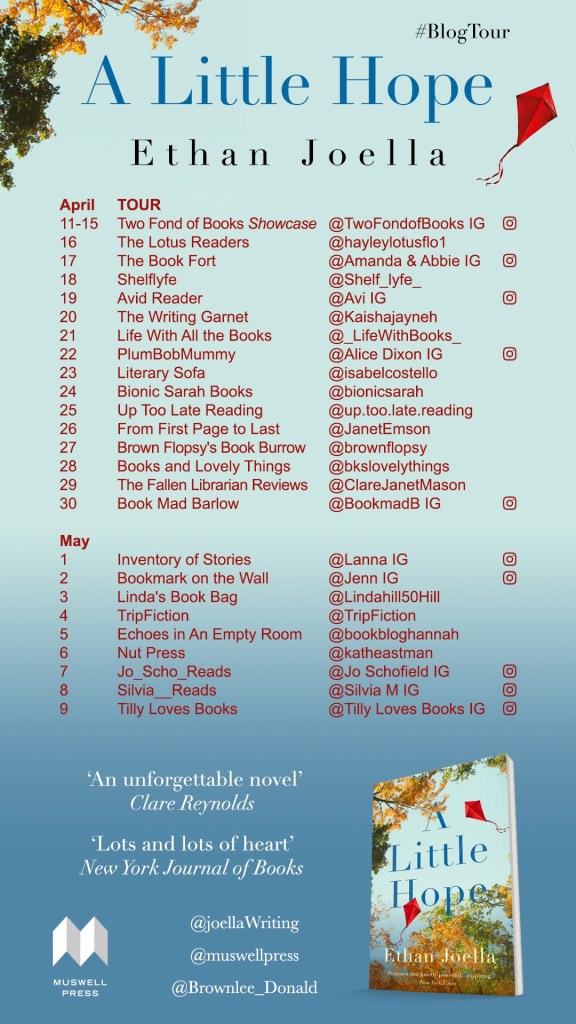
A Little Hope by Ethan Joelle

Set in an idyllic Connecticut town over the course of a year, A LITTLE HOPE follows the intertwining lives of a dozen neighbours as they confront everyday desires and fears: an illness, a road not taken, a broken heart, a betrayal.

Freddie and Greg Tyler seem to have it all: a comfortable home at the edge of the woods, a beautiful young daughter, a bond that feels unbreakable. But when Greg is diagnosed with a rare and aggressive form of cancer, the sense of certainty they once knew evaporates overnight. Meanwhile, Darcy Crowley is still coming to terms with the loss of her husband as she worries over her struggling adult son, Luke. Elsewhere, Ginger Lord returns home longing for a lost relationship; Ahmed Ghannam wonders if he’ll ever find true love; and Greg’s boss, Alex Lionel, grapples with a secret of his own.

Ethan Joella’s novel feels perfect for this moment in life. Since 2020 our world has changed irreparably, for some this means that every day life has changed so they no longer work in an office full of other people, or they’ve missed going out over the past two years, or had their exams cancelled. For others it means learning to live with loss, coping mentally with the work they did on the NHS frontline or dealing with the challenges of long COVID. For me it has meant still being super careful when I go out, avoiding large and crowded gatherings and my mobility being reduced because of treatment that’s been postponed indefinitely. Thanks to long periods of isolation, we are all used to living in our own world and can even be overwhelmed by what we’re facing inside our own front doors. To some degree, the plight of the Ukrainian people has brought us out of our own concerns and back into a collective again. We want to help and take action. It has given us perspective. This novel works in the same way. It feels inspired by the realisation we are only a small part of the jigsaw that makes up life. It’s the literary equivalent of that feeling I always get on the train in the dark, when I can see the human theatre of everyday life through the glowing windows of people who don’t shut their curtains. Every passing window is a snapshot of life. Ethan Joelle gives us a different life per chapter, as we meet the residents of the small US town of Wharton, Connecticut. Each chapter is separate, but related, and through the author’s lens we are granted access to the extraordinary lives captured within each unremarkable window.

We start with Freddie, who is coping with the fact that husband Greg has just been diagnosed with a cancer of the white blood cells called multiple myeloma. Not only that, they haven’t yet told their young daughter Addie. Freddie is just trying to process the news, but is worrying about what Greg’s diagnosis will do to their daughter at the same time. The author then takes us into Greg’s world, into his working life, where he has concerns that haven’t even crossed Freddie’s mind yet. His worries are caught up with what kind of man he is if he can’t work and provide for his family. His boss is trying to support him, but there’s a wall of denial and false optimism to get through, and what if that wall is the only structure holding him up? We weave through the lives of other Wharton residents, such as Iris, Darcy, Ginger, Luke and Ahmed. Each life is so preciously unique, their take on their world so different and beautifully human.

We are all familiar with the hashtag #BeKind and memes that remind us we never know what others are going through. Through these stories this really is brought home to the reader, as our characters touch on each other’s lives, sometimes without knowing what they’re coping with just under the surface. Yet, while taking us through every experience from infidelity to loss, the book never feels overwhelming or melancholy. Yes I wanted to shed tears from time to time, but somehow there is always a ray of hope. It reminded me that things like community, friendship, shared experiences and compassion can change everything. The author doesn’t hold back on how difficult and painful life can be, but yet always finds some element of joy that reminds us what a gift it is too. This book is poetic, achingly beautiful and full of empathy for the human condition.

Meet The Author

Ethan Joella teaches English and Psychology at the University of Delaware and specialises in community writing workshops. His work has appeared in River Teeth, The International Fiction review, The MacGuffin, Delaware Beach Life and Third Wednesday. He lives in Delaware with his wife and two daughters and is of Irish heritage.

Posted in Back of the Shelf

Back of the Shelf! The Taxidermist’s Lover by Polly Hall.

A modern Gothic tale of a woman obsessed with her lover’s taxidermy creatures and haunted by her past.

One stormy Christmas, Scarlett recalls the ebb and flow of a yearlong love affair with Henry, a renowned taxidermist. Obsessed with his taxidermy creatures, she pushes him to outdo his colleague and world-famous rival in a crescendo of species-blending creativity. Scarlett will not be able to avoid a reckoning with her own past as Henry’s inventions creep into her own thoughts, dreams, and desires.

Drenched in the torrential rains of the Somerset moorland and the sensual pleasures of the characters, The Taxidermist’s Lover lures you ever deeper into Scarlett’s delightfully eerie world.

Bram Stoker Award Shortlist for Superior Achievement in a First Novel • IPPY Awards 2021 Gold Medal Winner

Anyone who knows me well is aware that I have a weird penchant for antique taxidermy, so I jumped at the chance to read this. This was an eerie story of obsession from a writer I’ve not come across before, but will look out for in the future. I expected the feel of a historical novel, with something a little spooky about it and I wasn’t disappointed. Dipping in and out of the past, Scarlett addresses her lover Henry, who is hoping to my find a foothold in this niche world of taxidermy. I loved these forays into the past, as it allows us to witness a developing tale of obsession and the macabre, in the tradition of gothic fiction – one of my favourite genres. There’s a strange sensation that you are reading a Victorian novel instead of a contemporary story. Hall’s writing is haunting and sensual, and sets a dark, forbidding tone. Although it’s a second person narration it feels very personal.There’s a sense of foreboding and I kept wondering about the veracity of Scarlett’s story. Would Henry tell us a different tale? Despite it’s potential unreliability, I felt drawn in and I simply couldn’t guess how all this would play out. I think it is so compelling because of that personal feel; writer is echoing that feel of obsession by deliberately keeping her focus narrow.

Scarlett and Henry’s relationship was very fast moving, with them moving in almost immediately and getting married very soon after. She becomes involved in his career and suggests he try something different; chopping and changing animal parts to create totally new creatures, rather like the jackalope. To say Scarlett is obsessed would be an understatement really, not with Henry, but with his taxidermy. It seems very unhealthy, but when we hear about Scarlett’s twin brother Rhett and the death of her parents, this obsession with body parts starts to make sense. However, it’s sense of a very disturbed kind. There’s a Frankenstein element to the tale, both in the jumbled creatures and the sense we get that the process of making them might be more satisfying than the finished product. It’s become more about the ability of the creator than the actual creature. Some readers might feel sorry for Scarlett and I did understand how life events might have overwhelmed and damaged her psyche. I found it satisfying to delve so deeply under a character’s skin, because we don’t often get the chance to really analyse someone this way in fiction.

This is a slow story so if you’re looking for fast thrill rides this isn’t the book for you, but that said it’s strangely satisfying. If you like character, quirkiness and having all your senses engaged, then this is your book. The menace builds inexorably until you’re desperate for the worst to happen, just for it to be over. The twists come thick and fast, until you’re finally faced with the horror ending. This is dark, twisted and very unique, with an atmosphere that will stay with you long after the final page is turned.

Published by Camcat Books 8th December 2020.

Meet The Author

Hall’s writing is lush, filled with startling conclusions about the nature of art and love and death. . . [A] shudder-inducing debut.” ~ The New York Times

Polly Hall is author of The Taxidermist’s Lover, conceived while studying for an MA in Creative Writing at Bath Spa University.

Her flash fiction, poetry and stories have been included in national and international anthologies and collaborative arts projects. 

You can find her @PollyHallWriter on Instagram, Facebook and Twitter.

Praise for The Taxidermist’s Lover:

.

Posted in Throwback Thursday

A Short History of Tractors in Ukrainian by Marina Lewycka.

Synopsis

‘Two years after my mother died, my father fell in love with a glamorous blonde Ukrainian divorcee. He was eighty-four and she was thirty-six. She exploded into our lives like a fluffy pink grenade, churning up the murky water, bringing to the surface a sludge of sloughed-off memories, giving the family ghosts a kick up the backside.’ 


Sisters Vera and Nadezhda must aside a lifetime of feuding to save their émigré engineer father from voluptuous gold-digger Valentina. With her proclivity for green satin underwear and boil-in-the-bag cuisine, she will stop at nothing in her pursuit of Western wealth. But the sisters’ campaign to oust Valentina unearths family secrets, uncovers fifty years of Europe’s darkest history and sends them back to roots they’d much rather forget . .

My Thoughts

The second phone call came a few days after the first. ‘Tell me, Nadezhda, do you think it would be possible for a man of eighty-four to father a child?’

I love this unexpected question early on in the novel, coming from Nadezhda’s elderly father out of the blue. It’s not the sort of question I’d expect from my father, but as our narrator Nadezhda points out, her father is always straight to the point and when he’s in the grip of a big idea never bothers with small talk or enquiries about her health. My mum read this first and told me I needed to read it. Within a couple of pages I knew why, Nadezha’s father was an elderly Ukrainian engineer, widowed for several years, with a penchant for tractors and straight talking. I was laughing out loud within pages, I couldn’t believe Marina Lewycka had conjured this man out of her imagination, especially since he was sitting on my sofa reading his daily paper.

My father-in-law came to live with us in Spring 2004. The plan was that he would spend summers with us and winters in New Zealand with his other son and family. My husband’s family were from Poland, relocated as children from Poland to England, his father escaped from a labour camp in Siberia. So, not exactly the same story as Nadezhda’s father, but his speech, mannerisms and preoccupations were eerily similar. I should just say that my father-in-law would have been horrified to be propositioned by a woman thirty years his junior. He wore his wedding ring until the day he died, at least twenty years after his wife was killed in a car accident. We didn’t always see eye to eye. However, some of the things that drove me insane when we lived together, became rather endearing and even downright hilarious with time. Blunt speech was a trademark of his, to the point of seeming rude in some cases. Yet, when told someone was offended by his comment, he would say ‘but it was correct, yes?’

One favourite lunch party dissolved into disbelief and giggles when he addressed his godson’s wife and suggested she might be more comfortable sitting on his chair than the kitchen stool since she had a ‘much larger’ bottom than him. He was bewildered by the reaction, believing he was being chivalrous by offering her the dining chair and because she did, in fact, have a much larger bottom. I realised this was a preoccupation of his when he came to visit us proffering a carefully cut out article from his daily paper for me. The subject was scientific research that found women with larger bottoms had longer lives than apple shaped women who stored fat round their middle. He was very happy with his discovery, humming away to himself in the kitchen, as my father and I shut ourselves in the bathroom laughing uncontrollably so we didn’t offend him. I hadn’t realised he was very appreciative of this body type until he asked me to look up the journalist Victoria Derbyshire. He had been listening to her on the radio for some time, but had never seen her in person and despite his son being the director of the media lab at a university he wasn’t up to speed with using the internet yet. I showed him her photograph and he shrugged his shoulders mournfully saying he’d expected her to be a much rounder woman in general but specifically with a ‘much bigger bottom.’ It dawned on me that he felt this was a compliment, something he thought was vital to his idea of female beauty.

He also had a way of making even the most positive things sound like a problem. At a fancy dress party my husband and I threw at home, he watched me working all day to put together a buffet for the guests. Finally, just before people started arriving, he asked if he could take a picture of the buffet table. My husband seemed to think he was impressed by the spread, but his face seem to suggest he was inwardly struggling with what to say. Finally he sighed deeply and said ‘but so much food, how can one possibly choose?’ Later, I received in the post a printed copy of his photograph of the food, showing me that it was important to him. After learning more about his family struggles during the war, and the death of his brother as they were hiding in the Siberian forests, I understood more deeply his utter disbelief at so much choice when weighed against the constant hunger he remembered feeling. Nadezhda tells us about her father’s specialty of ‘Toshiba’ apples – chopped Bramley apples nuked so thoroughly in the microwave they became apple sauce. This was a speciality of my father-in-law with apples that were so hot, they were still cooking in the desert bowl half an hour later. If he wanted to cool food he had a brilliant idea. My brother-in-law had been living. with his father for many years. He was a tree surgeon and had built what they called ‘the cage’ attached to the back of the house. This was a dog run, padlocked and used as a store for chainsaws and other equipment. Any food that needed to cool was placed in the cage on an upturned tree stump, open to the elements on all sides, but sheltered by a roof and away from foraging animals. This made perfect sense in practice, but always caused questions at the dinner table from guests baffled by the instruction ‘fetch the pie from the cage’.

Nadezhda’s father is proud of his late wife’s ability to forage and preserve food to last into the winter season. There is a pantry of store bought supplies, boxes of preserves and fermenting alcohol under the bed, plus a deep freeze full of vegetables and individually portioned meals. Everything labelled and rotated by date.

The only way to outwit hunger is to save and accumulate, so that there is always something tucked away. […] What she couldn’t make had to be bought second hand. If you had to get it new, it had to be the cheapest money could buy, preferably reduced or a bargain. Fruit that was on the turn, tins that were dented, patterns that were out of date, last year’s style. It didn’t matter, we weren’t proud, we weren’t some foolish types who wasted money for the sake of appearance, Mother said, when every cultured person knows what really matters is what’s inside.’

It took three visits for me to work out that what I thought was a kitchen island, in Aleks’s kitchen, was actually a deep freeze with a loose work top laid over it. When he was out we looked in it to find portioned meals labelled by Jez’s mother who had died ten years previously. I thought it was grief that kept the freezer lid closed and it was in part. It was also a survival instinct of someone who had known hunger and that those closest to you, the people you depend on, could be taken from you without warning. All starting with a terrifying knock on the door. Aleks’s father was in the Polish military, shot by the Russians and his family marched to a Siberian labour camp. By the time they escaped and joined the Resistance in a forest camp there was only Aleks and his mother left alive. Behind the comic elements of her book, the author is telling a similar story of political fanaticism, social upheaval, hunger, displacement and terrible loss. I was more understanding when I he told me about his conversation with my sister -in-law who had just bought a property in New Zealand. Apparently, he was most impressed by how quickly his son had ploughed up the tennis courts and planted potatoes.

The part I find most sad, both in the book and for my father-in-law, is that the homeland they crave and hold in their hearts and minds no longer exists. Alek would have been ten when he left Poland, but the Poland he left isn’t there waiting for him. Nadezhda’s father talks at length about a Ukraine that was forty or even fifty years ago. He wants to save one person from the tyranny of communism and give them the freedom of a life in this country. In his head he imagines tyrannical politicians controlling the people, but also the Pastoral beauty of his home country. He will rescue Valentina and in return she will bring to him the Ukraine of his youth with golden wheat fields, lush forests and flowing rivers. Nadezhda who has visited more recently remembers concrete tower blocks and polluted rivers full of dead fish. She tries to tell him that the people are no longer noble peasants, they are consumers longing for Western designer goods. Within weeks of them marrying Valentina has insisted on her own car – ‘not just any old car either. Must be good car. Must be Mercedes or Jaguar at least.’ She also wants second car, for when she’s in the Ukraine. Then it’s the cooker, three rings are not working, but ‘it must be prestigious cooker, must be gas. Must be brown.’ When Nikolai objects because the brown one isn’t on offer, she won’t let it go. He wants her to have ‘crap cooker’ because he is ‘no good meanie’. In the meantime Nadezhda starts to ask for legal advice on her father’s behalf, because there must be a divorce and they can’t bear the thought of this woman owning half of their mother’s things.

I thank the Lord we never had a Valentina to contend with. We sometimes hoped he would find someone, to ease the loneliness and take his head out of the past. The wardrobes full of his mother’s furs and Hanna’s side of the bed, left as if she’d be coming back any moment. We simply didn’t understand each other. If my friends came round it was my welcome break from the care routine – my husband had MS and he was on palliative care – a space to unload a bit, but I couldn’t do that if my father-in-law was also pulling up a chair and joining in. Although I did have it easier than my sister-in-law who found he was in the room when she was on all fours in labour. We had long conversations on the phone where we would both complain that he found us too loud, too opinionated and in my case, a bit too Northern. She would complain that he never shared any praise or positive thoughts about her and I felt exactly the same. I did realise though that he was telling other people – I would tell Jenny that he was proud of her mothering skills and the way she was bringing up his grandsons. She would tell me that he was amazed at the strength I had to keep going, to look after Jerzy every day and not panic if things went wrong. I found that Alek and I bonded more after my husband died, with a shared grief and on his part an understanding and gratitude for the years I spent nursing ‘his boy’. He would ring me every Sunday morning until his eyesight failed him and I missed those calls so much when they were gone. Even now, when I think of him stroking the back of my head as I told him how his son died, it brings a lump to my throat. Every time I read this book it’s a bittersweet experience. It makes me laugh still. I think of all those funny stories and the times we shared, even the hard parts when we didn’t get along. I would do them all again just to spend time with this incredible man. As for Nadezhda and her father Nikolai, I won’t ruin the ending, but there are more twists and turns along the way. For me, every time I pick this book up, I get to spend a little more time with an incredible man who I miss every day.

Published by Penguin 2nd March 2006.

Posted in Sunday Spotlight

Sunday Spotlight! Romance, Love and One Day by David Nicholls

I wouldn’t say I’m a fan of romantic novels on the whole, not as a genre anyway. However, I’m also that annoying person who writes outside the boxes on forms, resists the Census and ticks ‘rather not say’ if there’s an option to do so. My objection is to categories and putting things in boxes. I don’t object to a love story, in fact some of my favourite books are love stories. It’s just I don’t like it when love stories are packaged as romantic fiction or women’s fiction, given candy pink or baby blue covers, and characters who have little depth or motivation beyond the ‘meet cute’. I understand that, since Shakespeare, there’s been a set formula to the love story, but this can be taken to extremes. I actively hate simple love stories with manufactured obstacles and I definitely hated Fifty Shades of Grey (which was in no way a love story, but marketed as one). Perhaps my problem isn’t with love, but with romance; a much more contrived hearts, flowers and happy endings sort of place.

I like real obstacles: the terrible coincidence in Rosie Walsh’s The Man Who Didn’t Call; the limits posed by Will’s attitude to his disability in Me Before You; the mad wife in the attic in Jane Eyre; the girlish mistake of refusing a proposal in Persuasion. My favourite romcom is When Harry Met Sally so I do enjoy a ‘friends to lovers’ scenario, but it’s also witty with snappy dialogue and Billy Crystal making a woman miaow in bed. I love stories that are based within a historical or time-slip setting like the Outlander series of novels by Diana Gabaldon. I also like it when characters are so real it’s painful like Sally Rooney’s awkward teenage fumbling in Ordinary People. The characters must have depth, genuine problems or some meaty psychological issues to get my teeth into. I enjoy love stories set in other cultures or those that could be written as forbidden. I loved the viewpoint of a man coming to terms with his homosexuality in A Place Called Winter by Patrick Gale and the transgressive love affair of D.H. Lawrence’s Lady Chatterley’s Lover. I enjoyed how love blossomed from a marriage of convenience during the Windrush era in Andrea Levy’s Small Island. I also loved the bittersweet tale of love gone wrong in David Nicholls’s other novel Us where our protagonist’s marriage breakdown comes into focus on a trip through Europe, interspersed beautifully with scenes from when they fall in love.

Several years ago, like thousands of others, I was blindsided by One Day. There was a time when you couldn’t move on public transport without knocking into someone reading this book. It’s a simple premise. Dexter and Emma were at Edinburgh University and as they graduate they spend the day together and forge a friendship, they climb Arthur’s Seat in their cap and gowns and talk about what they want for their futures. Dex would like to work in television and Emma would like to be a writer. The book then follows their story on the same day each year, sometimes together and sometimes apart, we see how life has changed them and the circumstances they find themselves in. Of course we know that Emma and Dex should be together, but will they ever find the right time or the courage to try?

I’ll be honest, at first I didn’t feel ‘grabbed’ by their story. My interest was mainly in their individual lives, especially considering that the book is set so that they’re both a similar age to me. I recognised the era, the reference points and also the struggles of life as they go through them. I thought Dex was a bit of a dick to be honest. He’s a player, egotistical and at times downright unpleasant. I really bonded with Emma though. A northern girl, she has a brand of kindness and an ability to see through bullshit that I liked. I saw some of me in her and I have always wanted to be a writer, but also went into teacher training (and didn’t finish). She clearly loves Dex, but will he ever see her? Mostly he sees her as a consolation prize, a shoulder to cry on, an advice giver and sometimes the great big kick up the arse he deserves. I can honestly say I hoped they never got together at several points in the book, because I didn’t think he deserved her. There’s a point where Emma has gone through a really tough time. She breaks off her engagement and goes through moving out and separating from her fiancé emotionally and financially. She goes out to Paris for a while and starts to write a children’s book. She has her hair cut short. She makes friends. I loved this Emma and I thought she’s built a new life from the ground up with no help from anyone. I wanted her to stay there.

As I know all too well, our love lives never simple. Often, where the decisions to be together seem very easy to make, it’s the right person. It’s reciprocal and committed. When we’re younger we’re learning about who we are in a relationship. We don’t know how much to compromise and how much to stick firmly to who we are or what we want for ourselves. We can get tangled up in relationships that are no good for us, are abusive, are with people who cheat, or people who put up obstacles and change their minds. We love people who aren’t ready, or who are too busy adding notches to the bed post. We can be so unsure of ourselves in our teenage years (and beyond) that we accept relationships that aren’t good for us and allow behaviour that’s demeaning or grinds down our self-worth. It’s also hard to love someone who doesn’t love you or who claims they can’t be with you. That great line from Sex and the City springs to mind – ‘he’s just not that into you’ – because when they are into you, they move mountains to be there. I felt that Dex was scared of real love and preferred empty encounters with beautiful women. Emma doesn’t value herself enough to set boundaries or ask for the love she deserves.

Everybody who knows the book will know the line I’m talking about. That one line I read and spontaneously burst into tears. That rarely happens with a book, but it did here. That’s when I knew this book had got me. My emotions were so invested in these characters that I had such a spontaneous response. I’m not sure how David Nicholls managed it, but I’ve spoken to other people who were similarly emotional. I think it’s the way he writes these two characters, they’re real and flawed. They struggle with life. We go through so many highs and lows with them, because even though we meet up with them on one day, we’re drawn in to how they got where they are. They’re not perfect either, far from it. Nichols weaves in addiction problems, affairs, career disasters and the difficulties of being a parent. There’s also huge loss to, and how the characters deal with these setbacks. One Day is a love story. Love is the primary theme of the novel. However, it’s also about being honest with ourself and others about our feelings and about recognising what love actually is. Perhaps I love One Day because it does go beyond the ‘falling in love’ stage, that even after years of yearning and kidding themselves about their feelings, Emma and Dex can still wake up one morning unnecessarily grumpy and tense with one another. Life is full of obstacles and love doesn’t stop them coming. Love isn’t always excitement, flinging your clothes off and swinging from chandeliers. Real love is always about being with your best friend.

Meet The Author


David Alan Nicholls (born 30 November 1966) is an English novelist and screenwriter. Nicholls is the middle of three siblings. He attended Barton Peveril sixth-form college at Eastleigh, Hampshire, from 1983 to 1985 (taking A-levels in Drama and Theatre Studies along with English, Physics and Biology), and playing a wide range of roles in college drama productions. Colin Firth was at the same College and they later collaborated in And When Did You Last See Your Father?. He went to Bristol University in the 1980s (graduating with a BA in Drama and English in 1988) before training as an actor at the American Musical and Dramatic Academy in New York. Throughout his 20s, he worked as a professional actor using the stage name David Holdaway. He played small roles at various theatres, including the West Yorkshire Playhouse and, for a three-year period, at the Royal National Theatre. He struggled as an actor and has said “I’d committed myself to a profession for which I lacked not just talent and charisma, but the most basic of skills. Moving, standing still – things like that.”

Since then, David has turned to writing full-time, and is the author of four novels. ‘One Day’ was an international bestseller and the follow-up, ‘Us’, was long listed for the Man Booker Prize. He’s also a screenwriter and TV dramatist; his credits include adaptations of ‘Far From The Madding Crowd’, ‘Great Expectations’, ‘Tess of the D’Urbervilles’ and feature film version of his own novels. ‘One Day’ and ‘Starter for Ten

Posted in Netgalley

The Glimpse by Lis Bensley.

This was a complicated and fascinating book about art, but also how difficult the relationship can be between mothers and daughters.. I really believed in this story and it’s portrayal of the difficulties in making art. I was not surprised to read that the author had been an art writer, because of the detail and truth in the process of creating. Set in the art world of NYC, Lisa is a painter in the Abstract Expressionist era of the 1950s. She starts to be sidelined when she becomes pregnant, but truly believes she can be a mother and still create great art. Studying in NYC is a dream and I think she really felt she’d found her people, her tribe. Fellow artist and lover Hank, goes up against her for an exhibition and is surprised when it’s Lisa’s work that really gets noticed. We then jump to 1966.

When her daughter Rouge was born, Lisa found herself butting up against the male dominated art world, surprised to find it quite conventional after all. I loved the feminist take on what we imagine to be a fairly free and bohemian world. It was an area of life that I’d imagined had less barriers. I really felt for Lisa and understood her disillusionment when her ex-lover is suddenly a new darling of the movement. Especially considering how similar their work is. The psychological effects of this realisation include resentment building between mother and daughter. The resentment is felt, even where it isn’t knowingly expressed or acknowledged. Lisa ends up teaching in college to pay the bills, she also starts to drink more heavily and take risks. Years later, when her daughter Rouge takes an interest in art she chooses photography as her medium. She looks for a mentor and finds Ben Fuller, who happens to be one of Lisa’s old lovers. This acknowledgment, and from a male member of the art world, adds another layer of resentment between mother and daughter. If Rouge’s photography is going to be noticed, how will Lisa cope and what lengths will she go to in order to deal with these negative feelings? Would she consider sabotage?

When she was pregnant Lisa could have chosen another road, she could have walked through a door of her choosing and be living a different life. She hasn’t intentionally made Rouge feel unwanted, but the choice to stop creating art held within it so much self-sacrifice, that it’s some unconscious negativity and even anger has come through to her daughter. Now her daughter is going to take the acclaim that Lisa feels is rightfully hers. However, Rouge is also angry, about the drinking and the revolving door of lovers who come in and out. She is so dismissive of her mother’s choices that she’s very surprised to find one of these lovers had anything useful to teach her. If her photography is good enough, she can imagine doors opening for her. It could be an escape from home and her mother.


I loved that all those elements and difficulties of a woman creating are expressed through Lisa’s world and it’s likely the author has felt similar constraints herself – they haven’t really gone away half a century later. I still feel guilty if I’m writing instead of doing the housework, or doing something for the family. I even find it hard to tell friends I can’t see them because I’m writing. Writing isn’t seen as real work until you’re published, but if you can’t write that never happens. Everyone thinks it can just be moved to tomorrow, and I know I’m not alone in putting it off. Some of that could be imposter syndrome, but it’s also saying it out loud. If I tell people I’m writing, then it’s real with all it’s chance of failure. However, the difference between the 1950s and the 1960s is a huge one culturally, There’s the pill for a start, leaving women in developed countries in charge of their own fertility. Between that and the more permissive attitudes in society it’s clear to see why Lisa would feel there is a huge gap between her generation and her daughter’s. Rouge is free to network and really sell herself. She can curate her own image as an artist, whereas mothers already have one. The author depicts the artistic journey so well – that imposter syndrome, the dreams, the crushing reality and self-sabotage are all seen in these two women. The author shows, quite beautifully, how mothers and daughters misunderstand each other: not knowing the cultural differences between their generations; not even understanding, never mind appreciating, the sacrifices made and the love behind them. This book is about that distance between mothers and daughters, a distance that can only be bridged through openness and honesty, as well as space and time. This was a fascinating and psychologically complex read.

Meet The Author.

Lis Bensley is a writer living in Santa Cruz, CA. She has worked as a journalist at The New York Times and The International Herald Tribune, when she lived in Paris and studied cooking at the Cordon Bleu. Subsequently she wrote The Women’s Health Cookbook. To entertain her children, she wrote The Adventures of Milo & Flea about the antics of their cat and dog. She is currently hoping to publish her novel The Glimpse and is working on sequels to the Milo and Flea story.

Posted in Random Things Tours

The Black Dress by Deborah Moggach.

I truly enjoyed Deborah Moggach’s last novel The Carer thanks to it’s depiction of family dynamics. She showed the problems common to ‘the middle’ where both children and parents need us in equal measure, but mostly that difficult decision about ‘caring’ for an elderly relative and the compromises we have to make. This novel concentrates more on growing older in the 21st Century with all it’s difficulties and choices to face. More people over 50 are facing huge life changes and are emerging from broken relationships into a world that’s moved on several decades. They face the daunting prospect of internet dating, cat-fishing, swiping right and learning to navigate through it all. I think we all imagine there’s an age where we grow up and become adults. We expect wisdom to set in, the risks and mistakes to be less and for us to be settled in who and where we are. Of course I’ve reached middle age and don’t feel any where near being a real adult. I’ve realised I’m still the same heart on sleeve, leap of faith, in love with love, risk taker that I’ve always been. There’s growth from experience, but my essential character has not changed. However, I identified with Pru, who is weathering this massive life change, then sees a black dress in a charity shop and wonders what if I was someone different for a while?

Pru’s husband has walked out and has set up home in their little holiday cottage by the sea. Her only consolation is her friend Azra, always a little too wild and boho for Pru’s husband’s taste, but a great solace as she contemplates living the rest of her life without her other spoon. To be honest with herself, it’s not really him that she misses. She misses their life together – the past memories of playing on the beach with the children, always having someone next to her in bed, and those in-jokes that they would only get together. Now the bed feels huge and Pru feels numb and bewildered. In something of a daze, she has to attend the funeral of an old friend, but at the church she notices that something’s not quite right. There are people she expected to see, who aren’t here. As she listens to the hymns and the eulogy she wonders why it doesn’t sound like the friend she knew. Then the penny drops – she’s at the wrong funeral. Yet somehow she gets swept along with it and finds she has a good time, conversation, a few drinks and banter with some of the other guests. So when she sees the black dress hanging there, she allows herself to wonder why not? Maybe she will meet a nice widower to bring some excitement into her life. With this in mind she starts to buy the paper and circle the obituaries.

It is Azra who points out that what Pru is experiencing is grief. The loss of a decades long marriage is enormous and it’s very clear she’s not thinking straight. Whenever she talks to her husband she doesn’t get a clear idea about why he wanted to leave. This is what she feels she needs to know and understand, before she can move forward. Yet, as she finds out, sometimes the truth is worse than not knowing. Now she can add anger to the list of emotions cycling through her head. In the midst of this she attends her first chosen funeral. The deceased is a woman of her own age and used to be a nurse, so her story will be that they lost touch after doing their nursing training together all those years ago. The widower seems a lovely man, devastated by his wife’s death and eager to hear stories about nursing college. Pru is welcomed back to the family home and meets the couple’s grown up children. She thinks there might be something there with this man, given a little time and the right encouragement. That’s if she had a reason to go back to the house of course? As she leaves her wrap behind as well as her number, in case he ever wants to talk some more.

Pru’s audacity really grabbed me. Yes, what she’s doing is crazy and there’s a good chance one of her escapades will go wrong. In that sense it’s a bit like watching a car crash, you can’t bear to look but you can’t look away either. Of course at first she’s looking for comfort, someone who understands the loss she has experienced maybe, and there’s an element of acting out on the anger she feels about her husband’s lies and betrayal. However, the sheer nerve it would take to walk into a stranger’s funeral and play another version of yourself for the day shows she has some sass and attitude. Whenever it goes wrong, and it does, she doesn’t stop taking those leaps of faith just to move forward. Yes, there are less messy and dangerous ways of grieving a lost relationship, but this is Pru’s way. It doesn’t matter where the next step takes her, as long as it’s away from those painful feelings and fear of loneliness. It’s in these early stages that a lot of the comedy lies too, just in the situations she places herself. There’s a kind of bravery in her actions, but a hint of madness too and I wasn’t sure which way Moggach would take her story. As it turns out, a much darker direction than I expected, but so very delicious too.

As Pru takes more risks and trusts the wrong people, her solutions take a darker turn. There were times when I wanted her to keep still for a moment and think, or even better, to feel the conflicting emotions she’s trying to stuff deep down inside. There’s a moment, where one of her beaus takes her on a helicopter ride down to an uninhabited island formed from sandbanks. As she steps onto this pristine sand, where no one else has been, there’s a brief spell of peace. Once the rotors stopped turning and she stops for a moment, I felt a sense of relief that everything was quiet. She’s in a space between places, somewhere she’s never been and that holds no memories. This moment feels like a metaphor for how Pru’s journey could have been, if she’d taken more time and space to think and explore how she really wanted the rest of her life to look. In the spiral of activity she’s missed things; if she’d struck up a friendship with that first widower, rather than a relationship, they might have been a comfort to each other, she brushes aside overtures of friendship from Pam across the road who’s always seemed a bit boring, but might have proved to be a great friend, and she might have come to terms with what happened. Now though, she’s in a spiral downwards.

It’s hard to categorise this novel, because although it feels like a light, easy read, it’s incredibly complex. I would struggle to place it in a genre, because it’s drama, tragedy, comedy, and thriller. Despite covering themes of infidelity, coercive control, death and grief it’s also warm and witty. The author does an excellent job of lampooning middle class morés, shown when Pru takes a rough diamond of a boyfriend to a party with friends. Moggach then pulls off an incredible reveal, worthy of any thriller and I really hadn’t seen coming. So much so that I had to go back and look for how I’d missed it. It was brilliantly well done. Then there’s Pru herself, a central character you can’t help but fall in love with. She’s far from perfect, in fact at times she’s conniving, manipulative and full of revenge, but she’s also warm, caring, funny and at her best she’s full of zest for life. Yet underneath it all, she’s lonely and very vulnerable. There are darker moments towards the end that made me worry for Pru, and they show how easy it is to be preyed upon by others when we’re this vulnerable. I loved being able to read about a woman of a certain age still having an exciting life, when often women over 50 are dismissed as uninteresting. Pru enjoys socialising, dressing up and having sex too. Despite her faults, I was hanging on till the last page hoping that Pru battled through – even if her methods were … unexpected. This wonderful book cements the author’s reputation with me, as a writer whose next book I would buy without hesitation.

Meet The Author

Deborah Moggach, OBE, is a British novelist and an award-winning screenwriter. She has written twenty novels, including Tulip Fever, These Foolish Things (which became the bestselling novel and film The Best Exotic Marigold Hotel), and The Carer. She lives in London.

Posted in Publisher Proof

Another Life by Jodie Chapman.

Published by Michael Joseph, 1st April 2021.

Nick and Anna work the same summer job at their local cinema. Anna is mysterious, beautiful and from a very different world to Nick.

She’s grown up preparing fot the end of days, in a tightly-controlled existence where Christmas, getting drunk and sex before marriage are all off limits.

So when Nick comes into her life, Anna falls passionately in love. Their shared world burns with poetry and music, cigarettes and conversation – hints of the people they hope to become.

But Anna, on the cusp of adulthood, is afraid to give up everything she’s ever believed in and everyone she’s ever loved. She walks away and Nick doesn’t stop her.

Years later, a tragedy draws Anna back into Nick’s life.

But rekindling their relationship leaves Anna and Nick facing a terrible choice between a love that’s endured decades, and the promises they’ve made to others along the way.

Wow! I expected a love story and received so much more from this wonderful read. Jodie Chapman has managed to capture all of life’s stages as we to and fro through the years with Anna and Nick. Told mainly by Nick, we begin on Christmas Eve in NYC 2018, then we tumble back through the years: to when he meets Anna; to his childhood years and everything beyond. Everything we come to learn about Nick’s personality, his closed off manner and inability to let anyone close, is made clear by one childhood event. So dreadful and emotional that it brought me up short. I had to close the book for a moment to process it and think about what such a loss could do to a young boy.

Nick and Anna first meet in their early twenties, while working at their local cinema. In the heat soaked days of summer 2003, their love burns with a similar intensity, as only young love can. They seem opposites. Nick is quiet and has a solidity to his character. Anna is more intense and emotion driven. These differences could balance each other out, but instead they mean the relationship never fully catches light. Anna’s fervency could come from her deeply religious upbringing. Her beliefs are strong and part of her, not just as a religion but as a culture, a way of being. If she’s to throw that life away she doesn’t just lose her church, she loses her friends, her family, her certainty in the way she sees the world. Only promises of Nick’s real feelings could persuade her to let go of these ties. Yet Nick isn’t built for such intensity of feeling. His calmness and solidity come from a place of not wanting to feel such extremes of emotion. He closes off just when Anna needs assurances. It is a short lived romance that never fully gets off the ground. Yet, this is not the last time they will meet, as they are thrown together again several times over a lifetime.

Love in all its forms is celebrated here, not just romantic love, but sibling love, family love, and love of a religion or way of life. Nick and his brother Sal have such a special relationship, condensed into that opening section, which is set in Manhattan. Nick pours a lifetime of shared love and memories into just a few pages and it grabs you, it pulls you into the story. In a way Sal is more like Anna, more fiery and quick to share his thoughts and feelings. Despite this difference in their characters the brothers are very close. We’re taken deeper into their lives together later in the novel, almost as if Nick has had to take the time to open up to the reader. These chapters are infused with nostalgia for the late eighties and early nineties – probably because I was a teenager back then, but also because they have the feel of faded home movies and I could almost here the sound of an old-fashioned projector running in the background. The author lulls us into a sepia toned dream and then shatters our emotions again as we revisit that terrible life changing event, but in greater detail. We see that this has affected both brothers, but in different ways. It also feels like one of those moments where everything clicks into place and our understanding of Nick’s behaviour and personality opens up completely.

I understood the young Anna well, because I was brought up within the confines of religion. My primary school years were spent partly in Catholic school and I made my first communion and confession, then inexplicably my Mum jumped to an evangelical church which became all encompassing. It was our Sundays, then weekly prayer meetings, house group, youth group and social events. In hindsight I was being indoctrinated and at times my parents actually scared me, because their behaviour was so out of character. If I liked a boy, my head would start whirling with how much my parents might disapprove, how they would act, the constant teaching of purity and dating exclusively within the faith and its rules. Often I found myself in the painful position of ‘just friends’ with someone I really liked, because I was too frightened to go out with them. I understood that Anna needed to hear more about how Nick felt. Did he love her? She couldn’t wait and let things play out because she didn’t have the freedom.

Personally, I realised that I needed to face whether or not I believed in this system of religion, independent from my parents. Not for a relationship, but for me. Then, although we didn’t always agree, I could make my own life choices based on my moral compass and not someone else’s. This is something Anna needed to learn too, whether she wanted that religious life or something different for herself in the future, because within some religions there is no compromise. I did appreciate the author’s autobiographical influence here, because I learned more about the Jehovah’s Witnesses and their faith. It gave me a more nuanced picture than I had previously and helped me understand Anna’s choices. I also loved the touch of having Anna’s emails and poems throughout, because it is the only way we hear her voice unmediated by Nick.

The background of Nick’s parents marriage was a great addition to the novel, because it shows us how two very different people can be together. Eve is one of those people whose warmth can light up a room. She’s also keenly intelligent, not just intellectually but emotionally too. She can definitely read the men in her life. Her husband Paul is hard to like, because he’s more austere and can be unpredictable. It’s as if he’s resentful of something, and while it’s hard to understand what that might be at first, Nick does eventually discover why his father was so difficult. From the outside, people would shake their heads and wonder why this couple are together and how the relationship works. Marriage is a secret room, and only the two people inside it truly have the key to open its door. This book also feels like a key. A key to the inside of Nick and how he sees his life and relationships. A privileged and rare look into how he truly thinks and feels, but only for those who open it’s pages. I feel very lucky to be one of those few and I hope you will too.

Meet The Author

Born and raised in England, Jodie spent a decade as a photographer before returning to her first love of writing. She lives in Kent with her husband and three sons. Another Life is her first novel, coming April 2021.

Instagram: @jodiechapman
Twitter: @jodiechapman