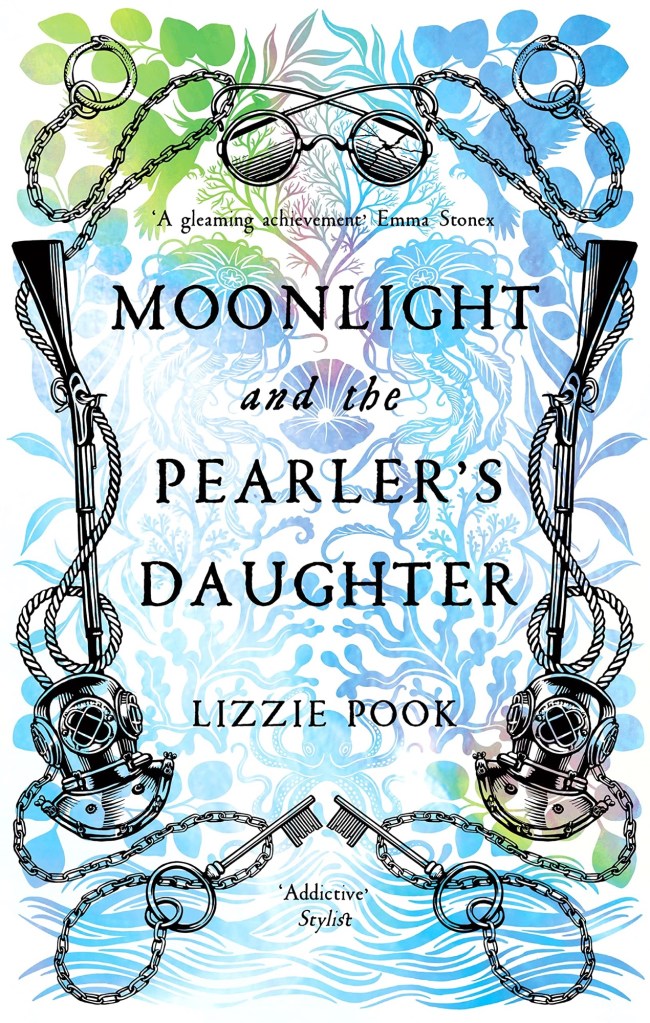
Fortune favours the brave . . .
It is 1886 and the Brightwell family has sailed from England to make their new home in Western Australia. Ten-year-old Eliza knows little of what awaits them in Bannin Bay beyond stories of shimmering pearls and shells the size of soup plates – the very things her father has promised will make their fortune. Ten years later, as the pearling ships return after months at sea, Eliza waits impatiently for her father to return with them. When his lugger finally arrives however, Charles Brightwell, master pearler, is declared missing. Whispers from the townsfolk point to mutiny or murder, but Eliza knows her father and, convinced there is more to the story, sets out to uncover the truth. She soon learns that in a town teeming with corruption, prejudice and blackmail, answers can cost more than pearls, and must decide just how much she is willing to pay, and how far she is willing to go, to find them.
Since this week’s Sunday Spotlight takes us on holiday Down Under, I thought I’d re-share my review of Lizzie Pook’s debut novel set in Australia. This incredible debut is richly atmospheric from the get go, throwing us straight into the strangeness of 19th Century Western Australia as if it is an alien landscape. In fact that’s exactly what it is for the Brightwell family, particularly Eliza whose childhood eyes we see it through for the the first time and in a particularly disgusting parody of baptism she is reborn as an Aussie when a bucket of fish guts is launched in their direction. Of course the fisherman apologises for the accident, but we’re left wondering if it’s anything but as he says the words ‘welcome to Bannin Bay’. It foreshadows an immediate imbalance between those who do the work and those who aim to make the money. Eliza’s father has been full of dreams, not just of pearls but the pearl shells to be turned into buttons, hat pins and pistol handles. Yet their unsuitability for this rough and ready environment can be seen as soon as they arrive in their fine clothing they must lift up from the red earth compared to the stevedores dirty vests and cut off trousers. Eliza describes her mother as ‘a dragonfly, once resplendent, marooned in a bucket of old slop water.’ Delicate Victorian ladies are not built for this environment that stinks of sweat, fish guts and the mineral tang of sea kelp. With this totally alien landscape the author creates a vivid backdrop for the incredible historical detail of her story, but also brings a mythic, almost fairy tale quality.
Only ten years after the prologue we meet an older Eliza, wiser to the ways of the Bay and she has developed into a interesting character. Women are either categorised as society women -‘white glove wearers’ – or harlots and it’s a source of irritation to the women in the community that she refuses to be either. Eliza is ploughing her own furrow, and whereas her friend Min’s childhood dreams developed from adventure on the high seas to the type of sailor she might marry, Eliza still craves adventure. She can see no use for a husband, although she doesn’t deny an interest in men which is quite a scandalous notion, even if her main interest is the contents of his library. Eliza’s knowledge of sailing and pearl diving is forensic in its detail and through exploring with her father she has developed a keen interest in the areas flora and fauna too. She is quite unlike the respectable women who still look like wedding cakes in the impossible heat. Her father has been on a voyage for the past three months and a lonely Eliza has been looking forward to his return, but as she sits and waits doubt starts to set in about whether the ship is returning. The light is fading as his lugger appears on the horizon, but her stomach fills with dread when she realises something is wrong. The ship’s flag is at half-mast. When her brother Thomas emerges she learns that her father is gone. While Thomas rushes to secure the business Eliza is left to find out the truth and while she’s told he went overboard, there are also tales of mutiny and murder. Eliza has to visit the sergeant to convince him that she suspects their father’s death was not an accident. Sergeant Archibald Parker is an unpleasant racist and his immediate action is to arrest aboriginal man Billy Balaari, but Eliza is told that Billy wasn’t even on the boat. When Billy escapes, the sergeant is completely focused on finding him, leaving Eliza to do the detective work herself. She finds her father’s diary and eventually sets sail on Father McVeigh’s lugger Moonlight with Axel Kramer and an aboriginal boy called Knife, determined to find the truth of what happened.
I wasn’t surprised to know there was a very seedy underbelly to the trade where Eliza’s father hoped the build the family fortune. Where incomers make large amounts of money, there is always exploitation and in this case the workers have a very tough working life. Of course it’s the naive Australians who are exploited the most and the author doesn’t pull her punches when it comes to portraying the terrible treatment they receive. Families are torn apart as the strong are enslaved for labour on the Pearler’s boats, usually as pearl divers, the most dangerous job on board. The sheer weight of their gear is terrifying as they don lead boots and copper chest plates. It felt so claustrophobic to imagine them sinking slowly to the bottom of the sea, with only a line connecting them to the ship above. The imagined relief of being winched back to the surface was tempered by the danger of the bends, the pressure of resurfacing quickly forcing organs upward in the body leading to suffocation or leaving the diver ‘agonisingly crippled’. It made me feel a little bit anxious as I was reading their potential fates. If this wasn’t enough, aboriginals were treated as worthless, beaten and even killed without consequence. Eliza has to negotiate her way through the community’s corruption, violence, blackmail and the criminal elements of the pearling business. All the while reading her father’s diary for clues and guiding us to some fascinating characters, some of which are based on historical figures. I loved Eliza’s early feminist stance and her sense of adventure, and the twists and turns her journey takes are gripping and pull you deep into the story. This is a fantastic debut, full of life and death, just like it’s setting. The richness and depth in her storytelling marks Lizzie Pook out as a writer I’ll be watching out for in the future.
Meet the Author

Lizzie is an award-winning writer and journalist. She has written for the Guardian, The Telegraph, The Times, The Evening Standard and Stylist. She is the author of Moonlight and the Pearler’s Daughter, a STYLIST and WOMAN & HOME ‘Best Books of 2022’ pick.
Lizzie began her career in women’s magazines, covering everything from feminist motorcycle gangs to conspiracy theorists, before moving into travel writing, contributing to publications including Condé Nast Traveller, Lonely Planet and the Sunday Times.
Her assignments have taken her to some of the most remote parts of the world, from the uninhabited east coast of Greenland in search of polar bears, to the trans-Himalayas to track snow leopards. She was inspired to write Moonlight and the Pearler’s Daughter, her debut, after taking a road trip through Australia with her twin sister after the death of their father. A chance visit to the Maritime Museum in Fremantle led her to an exhibition about a family of British settlers involved in the early pearl diving industry. Thus began an obsession and a research journey that would take Lizzie from the corridors of the British Library to isolated pearl farms in the farthest reaches of northwest Australia.

 The Lotus Readers