
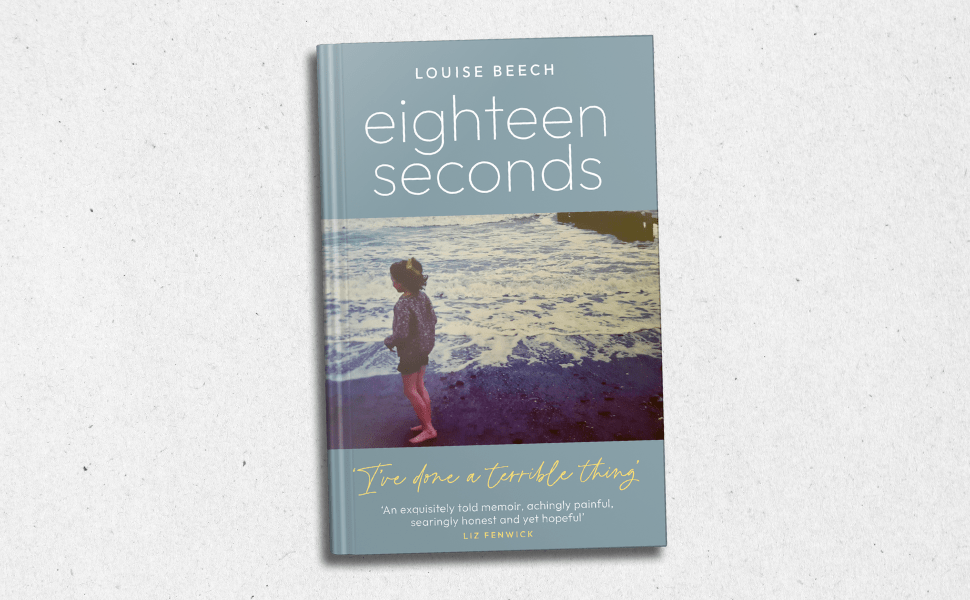
My mother once said to me, ‘I wish you could feel the way I do for eighteen seconds. Just eighteen seconds, so you’d know how awful it is.’
I was reading this raw and painful memoir to discuss at my local book club Pudding and Pages. Sadly, my health wasn’t great that day and I wasn’t able to go. So I decided to tell all of you about it instead, because I love Louise’s writing and I identified very strongly with some of her experiences. This is such a psychologically astute story, from someone who has done a lot of work on their childhood trauma, even while being traumatised anew with the shock that comes on an ordinary morning. Normally, Louise would take her children to school and then have a walk along the path at the side of the River Humber and underneath the bridge itself. Her husband asks if she will take her walk earlier than normal as he has a package being delivered later and needs her to be home. She agrees, completing her walk earlier than usual, and returning home to a call from one of her sisters. Their mother has thrown herself off the Humber Bridge, it’s only by changing her schedule that Louise didn’t witness it. This call hits the reader like a punch to the gut and I’m sure that’s how she must have felt. If you’ve ever had a similar call you’ll know it hard to communicate the force of that moment. Your mind is still at home holding the phone while your body is grabbing the car keys and scrambling to reach A+E as soon as possible.
Honestly, the siblings are shocked to find their mother alive when they reach the hospital. She landed, not in the water but on the path, causing multiple broken bones, internal bleeding and head injuries. As they navigate those first few hours Louise contrasts them with inserts that are flashbacks to their childhood. Their mum’s first suicide attempt flashes through her mind. The three girls were placed with grandma for several month, but Baby Colin had to be taken into foster care. Although losing their mum was terrifying for Louise’s younger twin sisters it must have been desperately traumatic for Colin who lost his whole family that day. She describes these months with grandma as the safest and most loved she ever felt. Their return to their mother heralded the worst years of their childhood, the abuse ranged from neglect to prioritising her own needs and emotions over that of her children. New relationships always came first, placing them in grave danger as she plunged headfirst into alcoholism. For Louise, as the eldest, it meant being a second mum to the other three while mum partied. In a way Louise became the identified problem of the family – she’s miserable, no fun and constantly moaning according to her mother and her male friends. It was an immense struggle to keep the younger ones happy, especially the girls who worried every time the door closed that their mother would ever come back. The didn’t know she was choosing to be in the pub. Louise’s attempts to get her mother to see what effect her alcoholism was having on the twins were met with either silence or insults, depending on which friend was drinking with her at the time. She just wants her mum to be responsible for her own children.

This is such a hard read in parts but it isn’t without humour and hope. Once her mum is recovered enough to talk again, her sense of humour is restored and she is remarkably charming when she wants to be. I loved how the siblings handled her, with a patience and humour she barely deserves at times. I loved the sibling’s family WhatsApp group, including their Uncle Edwin who’s in Australia. Their ability to share gallows humour, even in the worst of circumstances reminded me a little of my family. Their discussions about her underwear and accusing Colin of sneaking it away, descends into uproar when he tells them it looks better on him. ‘Well you haven’t seen it on Edwin’, one of his sister’s hits back. My family and I used gallows humour all the time when my husband was dying. From my own experience I recognised the bulldozing that happens in MDT Discharge meetings, where everyone is agreeing to a plan you haven’t said yes to. Once I was told by an NHS Continuing Care nurse that my opinion didn’t really count because I wasn’t a nurse. No consideration to the fact that the care was happening in my house and I was the only full-time carer. In fact I was carrying out medical tasks such as pump feeding, suction and catheterising, so to all intents and purposes I was nursing him. The horror of realising there was nowhere for my husband to die broke me, because he didn’t have cancer so couldn’t go to a hospice. He wanted to come home but I couldn’t do it alone, Louise writes about similar issues in a very matter of fact way, because that’s the only way to be at times like this – blunt and forthright. Then in between the family uses humour to deal with a hurt that can’t heal and can’t change.
I read this at a difficult time for my family, because my mum and her two sisters are dealing with care for my 90 year old grandmother, who has been a very difficult woman. My mum has felt completely overlooked by her mother, often left out of decisions or not considered when it comes to family memories or possessions. As the only daughter with any memory of her grandma (always referred to as Mother) she had hoped to be given her engagement ring when the time came, with her sisters receiving the wedding and engagement ring of their own mum. She was really upset to find her middle sister had been given Mother’s ring, with the other two going to her youngest sister. It wasn’t the item as much as the memory, not helped by my grandma saying ‘well the others really wanted them and I knew you wouldn’t make a fuss’. This total lack of consideration opened a Pandora’s box of hurt, including a terrible decision made when the family returned from a spell in Australia in the late 1960s. Having to accept housing away from their home city of Liverpool, they settled in Scunthorpe but both of my grandparents needed to work. My mother was twelve and her two sisters were pre-school age, so my grandma didn’t register my mum for school and left her at home caring for the younger children. This lack of education was devastating for my mum who felt like she was sacrificed for the good of her sisters and also felt ashamed that she had few qualifications. It affected her opportunities but also her confidence, leading to life long mental health issues. Despite this my mum shows incredible intelligence, is well-read and has had a lot of psychotherapy. I think that at the age of 72 she is very in touch with her authentic self and knows that she needs to ration the time spent with her mother, place careful boundaries around herself and us and accept a relationship that’s very one sided. I recognised a lot of my mum in Louise’s personal growth and that motherly relationship with her younger siblings. This book made me realise there are families like ours where intergenerational trauma is a very real part of life. I think the book holds out a lot of hope that with boundaries, solid friendships, somewhere to express the negative emotions and a lot of humour it’s possible to survive narcissistic parenting. Lastly, I admire Louise’s honesty and openness in writing this memoir so beautifully and I hope it has proved both cathartic and healing for her too.
Meet the Author

Louise Beech lives in East Yorkshire and grew up dreaming of being a writer but it took many years and many rejections for her to finally get a book deal in 2015, aged 44. Her debut, How to be Brave, got to No4 on Amazon and was a Guardian Readers’ Pick; Maria in the Moon was described as ‘quirky, darkly comic and heartfelt’ by the Sunday Mirror; The Lion Tamer Who Lost was shortlisted for the Popular Romantic Novel of 2019 at the RNA Awards and longlisted for the Polari Prize 2019; Call Me Star Girl was Best magazine’s Book of the Year 2019; I Am Dust was a Crime MagazineMonthly Pick; and This Is How We Are Human was a Clare Mackintosh Book Club pick. In 2023 her new novel, End of Story, will be published under the pen name Louise Swanson. Louise regularly writes short stories for magazines, blogs, and talks at universities and literary events.

 The Lotus Readers