‘Evil demanded little of me. It merely asked me to stay silent – to do nothing. And I complied.’
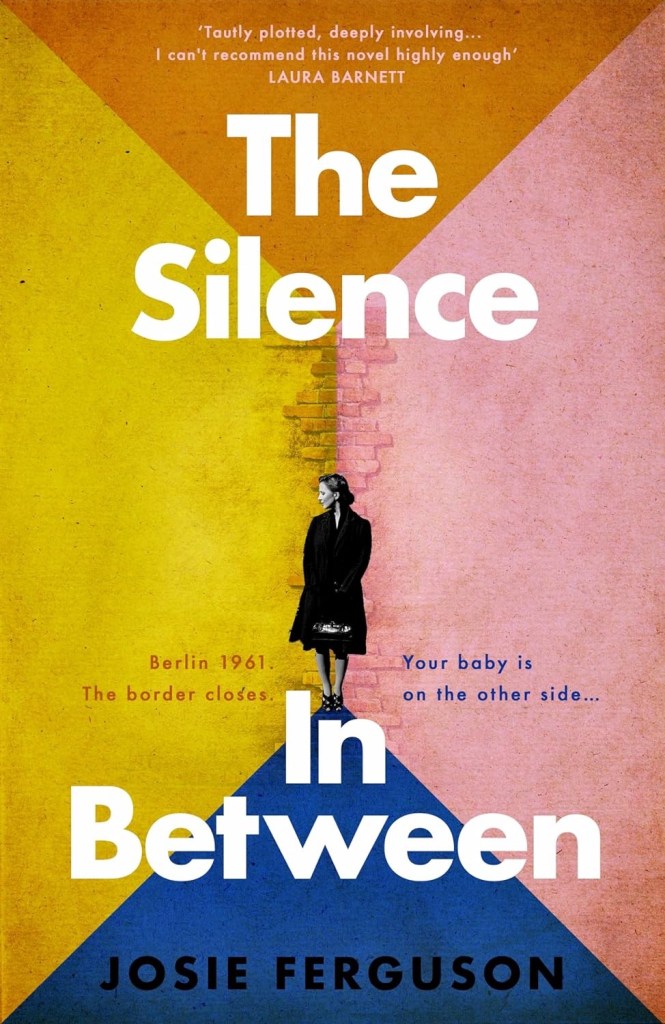
Imagine waking up and a wall has divided your city in two. Imagine that on the other side is your child…
Lisette is in hospital with her baby boy. The doctors tell her to go home and get some rest, that he’ll be fine.
When she awakes, everything has changed. Because overnight, on 13 August 1961, the border between East and West Berlin has closed, slicing the city – and the world – in two.
Lisette is trapped in the east, while her newborn baby is unreachable in the west. With the streets in chaos and armed guards ordered to shoot anyone who tries to cross, her situation is desperate.
Lisette’s teenage daughter, Elly, has always struggled to understand the distance between herself and her mother. Both have lived for music, but while Elly hears notes surrounding every person she meets, for her mother – once a talented pianist – the music has gone silent.
Perhaps Elly can do something to bridge the gap between them. What begins as the flicker of an idea turns into a daring plan to escape East Berlin, find her baby brother, and bring him home….

This book filled me with such complex and difficult emotions I had to put it aside for a couple of weeks and read it when I felt stronger. I don’t know whether it was the theme of baby loss, something I’ve sadly experienced, or whether it was because I felt unwell but the response was visceral. There’s a scene in Friends where Joey finds the emotion of Little Women so upsetting he has to put the book in the freezer, something he’s only done with books that terrify him before. As I clicked out of my digital ARC and snapped the cover of my iPad closed with a snap, I felt like I needed to bury it under a few pillows so it couldn’t reach me. As Lisette realises that she can’t get to her son, I felt that maternal bond stretched to it’s limit. Until it begins to tear. When I started to feel better I restarted it and it really is an exceptional piece of writing. If you love historical fiction and work that really burrows into the human psyche and our complex emotions then this is an absolute must read for you. The quote above really hit home with me because this is something Lisette expresses when she sees Jews being marched out of Berlin to an unknown but terrible fate. In fact the family seem to avoid rumour and talk about them being placed somewhere else, whether that’s another city or country. During the war, when Lisette stumbles across the mass movement of Jewish people from her neighbourhood a woman calls out in desperation, pleading with Lisette to take her baby. Lisette feels so much guilt for looking away, for pretending not to hear, but I put myself in her shoes and couldn’t see what else she could do. If she’d been seen taking the baby she could have been arrested or killed. I thought she was so hard on herself.
The author sets her story across two timelines: one at the end of the WW2 and the other is set in the months following the erection of the Berlin Wall in 1961. She starts her story in the hours between Lisette leaving her sick baby son in the West Berlin hospital and the authorities beginning to build the wall. It really is a matter of hours. The panic when she realises she can’t get back to him is devastating and I felt her grief so deeply. Then we go back Berlin in 1945, when the war is really beginning to bite. The promised victory seems more and more distant: food is scarce; more men are being called up; bombs are starting to fall on Berlin. This is where ordinary German people, at least those who haven’t bought into Hitler’s rhetoric, are starting to realise that victory is a long way away. Maybe, they might even lose. Often in dual timeline novels I am drawn to one story line more than the other, but here the author strikes a perfect balance. Both timelines are compelling, evocative, terrifying and deeply moving.

The depth of research behind these wonderful characters and their devastating story is clear from the outset. It was brilliant to be able to read more in the author’s notes because if you’re like me and only remember the Berlin Wall coming down, there’s a lot to learn here. Firstly I had no idea of the geography. In my brain there was a wall running through the capital because Berlin was fairly central to Germany. That is not the case at all. The county was divided, but Berlin was within the East German side of the country. Previously, people living in East Germany could openly travel to the West of the country. Comparing the two sides, Lisette is aware of her side of Berlin seeming like a monochrome version of the world but they could travel across to the more colourful and vibrant side. This colour wasn’t just to do with Western money, Lisette is aware of living in fear of the Stasi, a network of agents who spy on their own citizens. I had no idea that West Berlin was essentially split amongst the allies so there were distinct areas patrolled by the French, American and British forces. It’s the small horrific details that hit home though – there were streets on the edge of the new barrier that provided an escape route if you passed through one of the houses but as the days go by the windows are slowly bricked up. These facts ground the author’s story in it’s time and place, both timelines showing a city divided. From the rhetoric of 1945 that slowly separates the Jewish residents using derogatory language and propaganda, the targeting of their businesses and homes, forcing them to wear a yellow star and subjecting them to violence before removing them from their neighbourhoods towards the trains that will take them to Belsen and Auschwitz. Then we’re thrust into the paranoia of the 1960’s where even your neighbour might be a Stasi spy and I had my suspicions about their neighbour with her budgie in it’s cage – a metaphor for the new cage they find themselves in. They sell the wall as an ‘anti-fascist barrier’ with strange echoes of Putin’s excuses for the invasion of Ukraine. Elly’s father isn’t the only one who realises that this is not for keeping others out, it’s for keeping them in. The city’s buildings are still peppered with bullet holes and bomb damage, a visual representation of it’s residents who bear the internal scars of war. War is indiscriminate. Once it comes to ordinary people there’s never a bad and good side, every resident is affected by poverty, trauma and loss.
I loved the more unusual aspects of the characters, such as Lisette’s daughter Elly, who has a synaesthetic way of encountering the world. She knows that the people of this city have lost their music. She experiences others in terms of a melody only she can hear that expresses their emotional state. It is the first thing that connects her to the Russian soldier she meets. They don’t speak each other’s language but Elly can feel his music and for the first time it combines with hers creating a beautiful harmonious melody. Along with her mother’s silenced voice, people have lost that unique way of expressing themselves through sound. In East Germany there are many ways to be silenced and the Stasi have instilled a fear in their own people, that they’re always being listened to. I loved reading the notes at the end of the book and it has already inspired me to read further. I knew about the Berlin Wall of course but not where it was situated and how the rest of Germany was divided was totally new to me. I sort of knew one side was communist and the other wasn’t, but that was all. I hadn’t even realised that Berlin was situated inside the East part of the country. I’d imagined just one long dividing wall down the country that also separated Berlin, with a no man’s land between. I hadn’t known that until the 1960’s people could pop easily between East and West Berlin, giving them the possibility of escaping into the west permanently. With the hospital on one side of the wall and their home on the other Lisette starts to fall apart, but not all was rosy in this household to begin with. We get a glimpse into how things have been for all three generations in the flat, there are so many memories weighing these people down, one more haunting than the other. Yet we are given a little hope when one family decides they must get to the other side. Adventurous and thrilling as it is, their life is at stake, something that really hits home when they see someone try to swim across. The author takes us effortlessly back and forth in time to understand this family and my heart kept breaking for them over and over for. While I struggled to read this at first, I’m so happy that I went back to it because it was breathtaking. It was as if someone had bottled both moments in time and simply poured them onto the page, raw and confronting. This is an absolute must read for historical fiction fans and a book I will definitely go back to in the future.
Meet the Author

Born in Sweden, to a family of writers and readers, Josie Ferguson moved to Scotland when she was two. She returned to Sweden in her twenties, where she completed a vocational degree in Clinical Psychology (MSc). Upon graduating, she moved to London to pursue a career in publishing, something she had dreamed about since delving into fictional worlds as a child, hidden under the duvet with a torch.
She later moved to Asia in search of an adventure and a bit more sun. She currently works as a freelance book editor in Singapore, where she lives with her husband and two young children. While training to become a clinical psychologist, Josie learned about the complexity of human nature, something she explores as a writer. She believes books about the past can change the future and she aspires to write as many as possible. The Silence in Between is her debut.


The more I read about this book, the more I want to read it!
LikeLike
It’s a must read! 😊😊
LikeLiked by 1 person
I’ve ordered it from the library!
LikeLiked by 1 person
Thanks for the blog tour support x
LikeLiked by 1 person