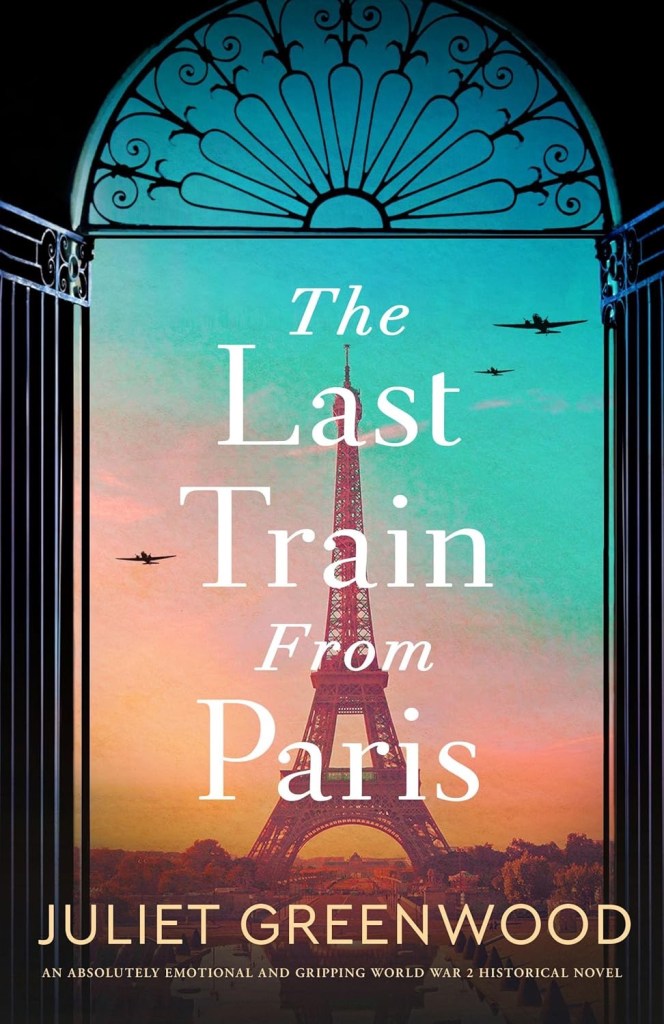
The year is 1939, and in Paris, France a young woman is about to commit a terrible betrayal…
For Iris, each visit to her mother in St Mabon’s Cove, Cornwall has been the same – a serene escape from the city. But today, as she breaths in the salt air on the doorstep of her beloved childhood home, a heavy weight of anticipation settles over her. Iris knows she’s adopted, but any questions about where she came from have always been shut down by her parents, who can’t bear to revisit the past.
Now, Iris can’t stop thinking about what she’s read on the official paperwork: BABY GIRL, FRANCE, 1939 – the year war was declared with Nazi Germany.
When Iris confronts her mother, she hits the same wall of pain and resistance as whenever she mentions the war. That is, until her mother tearfully hands her an old tin of letters, tucked neatly beside a delicate piece of ivory wool.
Retreating to the loft, Iris steels herself to at last learn the truth, however painful it might be. But, as she peels back each layer of history before her, a sensation of dread grows inside her. The past is calling, and its secrets are more intricate and tangled than Iris could ever have imagined.

I always say that we read books at the right time. Having COVID has left me in bed with very little to do except read between doses of Sudafed! So I’ve been catching up on some of those books still languishing unread on my NetGalley shelf, which is always overstuffed. How strange then that this pick had a link to a blog tour book I’m reading this month, both featuring mothers separated from their children but one set in a Cold War Berlin and this one set in pre-WWII Paris. I love books filled with emotion and those based in pivotal moments of history, especially disability history, so this one would sit perfectly within that Venn diagram. I was drawn in immediately by this gripping story, set across two timelines; one set in 1939 and the other in the 1960s. It didn’t take me long at all to get into ‘The Last Train From Paris’. In fact by the time I got to the end of the first few pages, I knew that I was in for a treat and from then on, I found it increasingly difficult to put the book to one side for any length of time. I was spot on too! I was moved by the story and by the bravery of these remarkable women. Nora and Sabine meet and a form a strong friendship in pre-war Paris, after Nora travels from the UK to join a catering course. In the later timeline, the early 1960s, we meet Iris, a young woman who has questions about the circumstances of her birth.
Juliet is a new author to me and I really enjoyed her style. Her characters feel genuine and show such bravery in turbulent times. She doesn’t stint on the gritty detail of wartime life in Paris and the darkness of occupation. She focuses on an aspect of the Nazi’s eugenicist policies that I think is only just coming to light in fiction. Many families were desperate to escape Europe, as the Nazis plans for the Jewish population start to become clear but Sabine’s little family have a different reason. To give you some background, it’s a lesser known fact that the Nazis targeted those with physical and mental disabilities by inciting a belief that they were a burden to the state. A programme of euthanasia was devised at a Tiergartenstrasse 4, the building giving the name of the plan as T4. In 1933 they passed a piece of legislation called The Law for the Protection of Hereditarily Diseased Offspring pushing forced sterilisation of those regarded as ‘unfit’. Their list ranged from conditions like epilepsy, but also suspected long-term illness and mental illness such as schizophrenia or addictions. They targeted nursing homes, asylums and special schools for their victims and over three years, even before the outbreak of war, had sterilised 360,000 people. Once war broke out they started to kill disabled children and adults, for this book the author has concentrated on the children. Children under three who had illnesses like Down’s Syndrome or Cerebral Palsy (or were thought to have an illness) were forwarded to a panel of medical experts to be assessed and approved for euthanasia. Parents were misled, told their children were receiving expert or enhanced care, then told they had died of illness or natural causes. The truth was they killed at least 200,000 people with disabilities in gas chambers that were also used to kill other marginalised people including, overwhelmingly, Jewish people from across Europe. This truth is deeply moving and horrifying to me as a disabled person and as someone who has spent their working life trying to support people coping with long term illness and disability. It is also why the disabled community fight so hard and shout so loud about any rhetoric from government that denigrates or devalues people with disabilities in today’s society. It is why many disabled people breathed a sigh of relief at the recent change in government as many perceive Conservative austerity measures and rhetoric to have led to the deaths of 180,000 disabled people since 2006. So you can imagine why this subject really spoke to my heart and my values.

If this sounds a little heavy, it really isn’t. The author weaves these historical facts into the story beautifully so we see it through the eyes of one of these horrified parents. Many of whom tried different ways of keeping their child away from the T4 programme, especially those who were developing disabilities. In 1939, as the Nazi march on Paris began, Nora is still in the middle of her chef’s training. This dream she has been realising has come to an end as she realises she has to take a last chance to escape. She really has left it until the last train leaving Paris before enemy arrives. As she gathers her things to leave and says goodbye to Sabine, out of the blue her friend has a last request. Having only just given birth, Sabine knows she must leave Paris too and will be travelling away from the city with her husband. She suspects one of her twins may have a disability and has heard about the T4 programme. She knows what could await her daughter if she’s right. Although it will break her heart, she has to put her daughter’s life first and asks Nora if she will take the baby back to England with her. She knows Nora well enough to be satisfied that her little girl will be safe, loved and well cared for. Nora agrees and takes the heart-wrenching choice to say goodbye to one of her daughters. Iris lives away from home, but often visits her adoptive parents in the the little fishing village in Cornwall where she grew up. She has always known she was adopted, but whenever she asks questions about the circumstances surrounding her birth her parents avoid or shut down the discussion. It has left Iris unsure about her identity and that inner feeling she has that something is missing. I kept thinking about the bond that twins have and how not knowing your other half would affect Iris’s sense of self. I desperately wanted her to find the answers she was looking for, but could understand how Nora might worry about how she would take the truth. I could also empathise with Sabine who must be desperately worried about how her daughter feels and also feel a desperate sense of loss for all those moments she wasn’t there. Would Iris feel betrayed? Would she understand the dangers they believed she was facing under occupation?
This was a story about an evil and previously unimaginable situation, faced by two friends whose trust in each other was absolute even at their most terrified. Most readers would empathise with Sabine’s sacrifice, but I could also see the sacrifice that Nora made. She expected to finish her training in the culinary capital of Europe and become a chef, instead she sacrificed all that out of love for her friend and for a little girl who could perhaps be saved from the fate of so many others. As Iris visits her mother, this time, Nora hands over a box full of letters and mementos, and Iris slowly discovers the true story of her life. She must also face the cruelty of what happened to children with disabilities in those years before the Germans invaded Iris’s origin story is one of bravery and a mother’s desperation, with secrets in store. These young women come alive in this story of a deep commitment made from one mother to another. It’s evocative and moving, reminding those of us who have never been in this position that such young women were capable and willing to make decisions like this that were heart-wrenching and ultimately life-saving. It reminds us that duty, often seen as such a dry word, is sometimes an expression of love and hope for the future.
Out now from Storm Publishing
Meet the Author

Juliet Greenwood is the author of eight historical novels, published by Orion and Storm Publishing. She has been a finalist for The People’s Book Prize, and her books have been top 100 kindle bestsellers in the UK and USA.
She has long been inspired by the histories of the women in her family, and in particular with how strong-minded and independent women have overcome the limitations imposed on them by the constraints of their time, and the way generations of women hold families and communities together in times of crisis, including during WW2.
Juliet now lives in a traditional quarryman’s cottage in Snowdonia, North Wales, set between the mountains and the sea, with an overgrown garden (good for insects!) and a surprisingly successful grapevine. She can be found dog walking in all weathers working on the plot for her next novel, camera to hand.

 The Lotus Readers