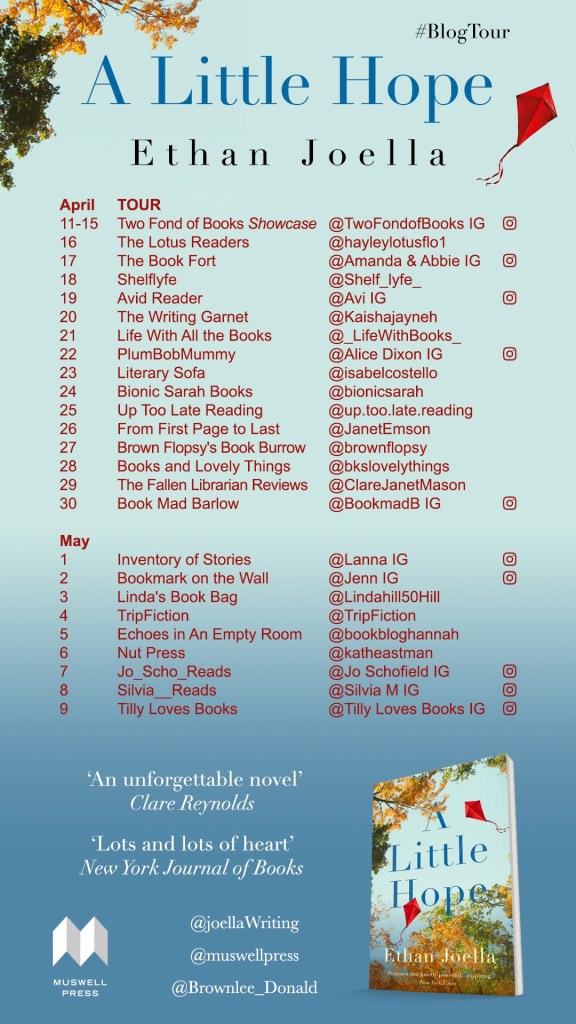
Set in an idyllic Connecticut town over the course of a year, A LITTLE HOPE follows the intertwining lives of a dozen neighbours as they confront everyday desires and fears: an illness, a road not taken, a broken heart, a betrayal.
Freddie and Greg Tyler seem to have it all: a comfortable home at the edge of the woods, a beautiful young daughter, a bond that feels unbreakable. But when Greg is diagnosed with a rare and aggressive form of cancer, the sense of certainty they once knew evaporates overnight. Meanwhile, Darcy Crowley is still coming to terms with the loss of her husband as she worries over her struggling adult son, Luke. Elsewhere, Ginger Lord returns home longing for a lost relationship; Ahmed Ghannam wonders if he’ll ever find true love; and Greg’s boss, Alex Lionel, grapples with a secret of his own.
Ethan Joella’s novel feels perfect for this moment in life. Since 2020 our world has changed irreparably, for some this means that every day life has changed so they no longer work in an office full of other people, or they’ve missed going out over the past two years, or had their exams cancelled. For others it means learning to live with loss, coping mentally with the work they did on the NHS frontline or dealing with the challenges of long COVID. For me it has meant still being super careful when I go out, avoiding large and crowded gatherings and my mobility being reduced because of treatment that’s been postponed indefinitely. Thanks to long periods of isolation, we are all used to living in our own world and can even be overwhelmed by what we’re facing inside our own front doors. To some degree, the plight of the Ukrainian people has brought us out of our own concerns and back into a collective again. We want to help and take action. It has given us perspective. This novel works in the same way. It feels inspired by the realisation we are only a small part of the jigsaw that makes up life. It’s the literary equivalent of that feeling I always get on the train in the dark, when I can see the human theatre of everyday life through the glowing windows of people who don’t shut their curtains. Every passing window is a snapshot of life. Ethan Joelle gives us a different life per chapter, as we meet the residents of the small US town of Wharton, Connecticut. Each chapter is separate, but related, and through the author’s lens we are granted access to the extraordinary lives captured within each unremarkable window.
We start with Freddie, who is coping with the fact that husband Greg has just been diagnosed with a cancer of the white blood cells called multiple myeloma. Not only that, they haven’t yet told their young daughter Addie. Freddie is just trying to process the news, but is worrying about what Greg’s diagnosis will do to their daughter at the same time. The author then takes us into Greg’s world, into his working life, where he has concerns that haven’t even crossed Freddie’s mind yet. His worries are caught up with what kind of man he is if he can’t work and provide for his family. His boss is trying to support him, but there’s a wall of denial and false optimism to get through, and what if that wall is the only structure holding him up? We weave through the lives of other Wharton residents, such as Iris, Darcy, Ginger, Luke and Ahmed. Each life is so preciously unique, their take on their world so different and beautifully human.
We are all familiar with the hashtag #BeKind and memes that remind us we never know what others are going through. Through these stories this really is brought home to the reader, as our characters touch on each other’s lives, sometimes without knowing what they’re coping with just under the surface. Yet, while taking us through every experience from infidelity to loss, the book never feels overwhelming or melancholy. Yes I wanted to shed tears from time to time, but somehow there is always a ray of hope. It reminded me that things like community, friendship, shared experiences and compassion can change everything. The author doesn’t hold back on how difficult and painful life can be, but yet always finds some element of joy that reminds us what a gift it is too. This book is poetic, achingly beautiful and full of empathy for the human condition.
Meet The Author
Ethan Joella teaches English and Psychology at the University of Delaware and specialises in community writing workshops. His work has appeared in River Teeth, The International Fiction review, The MacGuffin, Delaware Beach Life and Third Wednesday. He lives in Delaware with his wife and two daughters and is of Irish heritage.
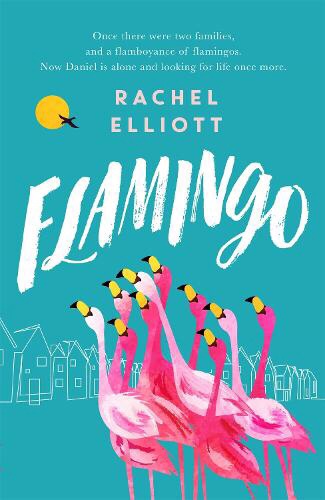
We bloggers like lists. Every year we list our favourites, then we list the books we most anticipate for the following year and to an extent that can dictate what we read. When we leave ourselves some gaps in the TBR to have a breathing space, browse and pick up what we fancy we can find unexpected gems. That’s what happened with Flamingo, the latest novel from Rachel Elliot and it really is a gem. I don’t know if I can find the right words to express how much I loved this book and why. I knew, just a few pages in, that it was going to be a joy to read. In split time frames, narrated mainly by Eve and Daniel we hear the story of two families who once lived next door to each other. Eve, and her six year old son Daniel, move in next door to Leslie and Sherry who have two daughters Rae and Pauline, and some ornamental flamingoes on their front lawn. Eve isn’t used to making friends because she and Daniel move around a lot, but for some reason Eve feels compelled to make an effort. She goes to a specialist off-licence to find just the right bottle of sherry as a witty present to take to her new neighbour. Sherry is delighted and immediately welcomes the wandering pair into her home. That summer is the happiest Eve and Daniel have ever had, as they are enveloped by this wild, eccentric and loud family – Eve uses the word rambunctious to describe them. Then Eve and Daniel leave and all the colours seem to bleach out of the world. We then meet Daniel as an adult, wandering and broken. Deeply affected by some kind words and affection from a woman in a public library, he decides to return to where he was happiest. He stands at Sherry’s door and it feels like coming home, but where is Eve and what is the real story underneath the fragments Daniel knows.
It’s disconcerting to read a character’s narration, and feel as though the author has opened up your head and borrowed your thoughts. That’s how I felt when reading Eve’s sections of the novel. I have a jumble of thoughts and ideas all at once, and I’ve learned that I need periods of quiet to counteract the amount of stimulation I have. If I go to London for the day and see a show, its exhausting and it can take a couple of days to quiet the jumble of sights, sounds, and inspiration. In fact it was using journal writing to process these thoughts that inspired me to use writing therapy in my practice as a counsellor. For years I thought everyone had my ‘busy brain’. When Eve visits the off—licence and meets the owner, Franklin, they have a shot of rum togther and she’s intoxicated by his shop, the coloured glass, the smells, the guitar playing and the wall of paintings in a back room. Eve notices all these things in seconds and Franklin asks if she likes the place.
“She tells him she likes it. It’s sort of hypnotic, like being in a chemists and a bar and a gallery all at once, and also sort of like being in church somehow, not that she ever goes to church, not that she’s religious, not that she ever goes to church, but a tiny old church in France maybe, not that she’s ever been to France”.
I loved the way the author expresses the speed of Eve’s thoughts and speech, where they come out too quickly for punctuation and you know she would have to take a deep breath at the end. I recognised it straight away, because it was me when I get enthusiastic and excited about something. In fact I sounded similar when telling my partner how much I loved the book. I know when I’m doing it, because it usually makes people smile. We learn so much about who Eve is from that one quote. I loved her enthusiasm, her eye for colour and her ability to make things. Sherry marvels when she mends Rae’s cords, by sewing a patch of Wonder Woman underneath the tear. Rae’s reaction is pure joy and Sherry is astounded that Eve has thought of such a thing, but to Eve it’s normal. She simply knew the cords needed mending and she had remembered that Rae loved Wonder Woman. It’s these little bursts of creativity and thoughtfulness that make her so endearing as a character. It probably stood out to me because I have just embroidered denim jackets for my stepdaughter’s birthdays – one of Frida Kahlo and one of Alice in Wonderland. What’s so special to Rae is that Eve has seen her, listened, and created something she would love.
These parts of the novel, where the characters connect, are its strength and it was no surprise to find out the author is also a psychotherapist. Rae is an introvert and Eve has seen and understood. She knows from Rae’s shining face that she loves the cords but understands the that Rae doesn’t want to be effusive about it, because it just isn’t her.
‘It’s her way to play things down; she is naturally reserved, understated or so it seems. Her mother, who expresses every emotion with intense theatricality, who takes up all the space, calls her eldest daughter the quiet one, as if this quietness is a kind of fragility – not a powerful act of disobedience and unruliness’.
Sometimes, in a house of very loud voices, whispering is the only way to be heard. Rae’s head is crammed with thoughts and it takes an awful lot of effort to keep them in sometimes and Eve has seen a kindred spirit in her.
Daniel is also a fascinating and the dynamic between him and his mum, suggests there’s more to their back story than meets the eye. He has an anxiety around people that concerns Eve and she is protective. Before they go to Sherry’s house for the first time, she prepares him for the social interaction. She wants to prepare him, but she also wants to be careful and avoid her own anxiety rubbing off on him. She explains that this is a thing people do, take a gift to their new neighbours and introduce themselves properly. At Sherry’s door she stands back with a reassuring hand on Daniel’s shoulder and talks about the ornamental flamingoes on the lawn. She tells him their collective noun is a flamboyance of flamingoes, a little game they play together. Eve is so surprised when Sherry opens the door and her boy walks straight in – ‘shy little Daniel stepping towards a stranger.’ Eve doesn’t seem to realise that Daniel is struggling with the impermanence of their lives; they have moved every year since Daniel was born. This was another thing I could identify with since we moved six times before I was in secondary school. I know how difficult it was to walk into a new classroom and see thirty pairs of eyes looking at you. Eve has a map on the kitchen wall and from time to time would simply close her eyes and pop a pin in it to choose their next destination. When she gives Daniel the chance to choose, it’s too much and his imagination runs haywire: what if there are monsters where he chooses? What if its horrible? What happens to their home? Will strangers take their things?
‘Trouble was she hadn’t left it up to chance. She had left it up to a six year old boy, who already hated that map on the wall. In some homes a map would evoke an atmosphere of learning, open-mindedness; lets be aware of the world, there are more places than home. But for Daniel it triggered fear and a sense of transience; always on the go, never know when’.
There are so many touching moments in the book I can’t possibly list them all, but the budding relationship between the boy Daniel and Sherry’s husband Leslie is just so moving. The confidence he gets from time spent with Leslie (who is not a girl) playing cards and learning to swim is obvious. When Leslie leaves the broken fence down so Daniel can appear from his garden and scare them at the window it feels different from other places they’ve been. Daniel blooms with this unconventional extended family and describes it to his Aunty as like having two homes. I was dreading the map coming out again. We meet adult Daniel at a crossroads in life physically and emotionally. As their tenancy ends on their flat, Daniel’s girlfriend Erica decides this is a good time to reassess their relationship and leaves. Instead of picking himself up, Daniel seems unable to cope with this double loss and ends up walking the streets with a rucksack and only a ceramic sheep for company. When he turns up at Sherry’s door she is blown away by the man he’s become, like a ‘matryoshka’ where she can see the boy inside the man and the woman inside the boy. I loved this description because it beautifully describes the ever changing selves inside us, but also the effect of previous generations and incarnations of who we are. Daniel is carrying so much more than his rucksack, but also the baggage of being left behind by the women in his life, the loss of this family where he felt at home and the original secret, the one that always compelled Eve to move them on, from place to place. Can this family, once again, give Daniel the space to heal and process a lifetime of hurt?
This is a slow burn novel, told in fragments like half forgotten memories and with such beauty it could be a poem. The writer conveys perfectly how certain people can hold space for and heal wounds in each other. Even if they’re only with us for a short time. In light of recent events it’s important to remember that to live fully we must connect with each other. The book shows humans in their best light and at their most powerful, when showing love and accepting others for who they are. When Daniel is a child he is taught that flamingoes are not actually born pink, but attain their colour through their diet. Their beauty comes from what’s put into them and humans are the same – we are the sum of what we are fed from parents and caregivers right through to a kind woman in a library acknowledging Daniel’s suffering. Through Daniel, and Rae to an extent, there’s an acknowledgment of how painful this life can be, but that healing and change is possible. I was enchanted by this story and it will keep a special place in my heart.
In the garden, there were three flamingos. Not real flamingos, but real emblems, real gateways to a time when life was impossibly good. They were mascots, symbols of hope. Something for a boy to confide in.
Meet The Author
Rachel Elliott is the author of WHISPERS THROUGH A MEGAPHONE (2015, Pushkin Press, longlisted for the Women’s Prize for Fiction 2016) and DO NOT FEED THE BEAR (2019, Tinder Press). Her third novel, FLAMINGO, was published on 3 Feb 2022 by Tinder Press and is out now in hardback, ebook & audiobook. She is also a psychotherapist.
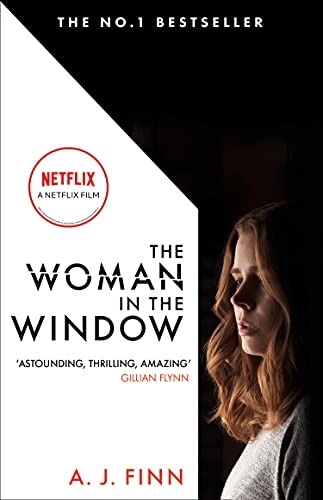
I reached to the back of the shelf for this 2018 paperback copy of The Woman in the Window. There’s a strong Rear Window vibe to this thriller, as our lead character Anna Fox, is trapped within her house, only living through the lives of her neighbours, who she watches through her binoculars. Instead Rear Window’s physical disability, she is restricted by her mental health, which has suffered a response to extreme trauma. Some unknown traumatic incident has resulted in agoraphobia and she has spent ten months inside her large New York house, like a ghost. Before this, Anna was a successful psychologist and the fact that her affliction is a mental health issue really muddies the waters here. How far can we trust what she sees and experiences? Does her training mean we trust her more, or less?
No longer living with her own husband and daughter, she becomes obsessed with the Russell family across the road. A mother, father and teenage son. She is especially interested in the son, and his mother who she meets and names Jane Russell because of her likeness to the beautiful movie star. Her world is filtered through binoculars and her only interest seems to be the black and white movies she watches religiously most evenings. Then one night, as she surveys the neighbourhood, she sees something horrifying at the Russell’s. A scream rips through the evening air and alerts Anna to the Russell’s windows and all she can do is watch in horror. She can’t go out, so rings the police. What follows has everyone questioning Anna’s judgement, including herself. As she starts to suspect someone is getting into her house, her fears increase and she continually talks to her husband and daughter to assuage her anxiety. As she does we start to wonder, where exactly are her family? Why did they leave and will they ever return?
This is one of those thrillers that I can devour in one sitting. It has an elegance and old-fashioned feel that Hitchcock would have optioned on the spot. Incidentally, there is a Netflix series that I’m now dying to watch. Anna is intriguing. I wanted to trust her, but my head was constantly full of questions. I was instantly suspicious of her charming and handsome downstairs lodger too, as well as Mr. Russell. The depiction of Anna’s panic attacks was so realistic and had me holding my breath. The severity of her symptoms, on the few occasions she does try to go beyond the front door, had me fearing the revelations about her past. The pacing was perfect, the tension never let up and I found myself taking it everywhere so I could squeeze in a few more pages whenever I got the chance. I was so impressed when I found out this was a debut, because it feels like a classic. I also made the assumption it was written by a woman, which showed up my reading prejudice about men writing women characters. In all this was an enjoyable and enthralling tale, with a nod to film noir that was very satisfying for this black and white movie lover. I can’t believe that this has been at the back of my shelf until now and I’m glad I decided to give it a go.
Meet The Author
A.J.Finn
THE WOMAN IN THE WINDOW has been sold in 43 territories around the globe. The film adaptation, starring Amy Adams, Gary Oldman, and Julianne Moore, will be released worldwide in autumn 2019. The movie directed by Joe Wright, written by Tracy Letts, and produced by Scott Rudin.
I spent a decade working in publishing in both New York and London, with a particular emphasis on thrillers and mysteries. Now I write full-time, to the relief of my former colleagues. THE WOMAN IN THE WINDOW was inspired by a range of experiences: my lifelong love affair with suspense fiction, from the Sherlock Holmes stories I devoured as a kid to the work of Patricia Highsmith, whom I studied at the graduate level at Oxford; my passion for classic cinema, especially the films of Alfred Hitchcock; and my struggles with depression and mental health. The result, I hope, is a psychological thriller in the vein of Gillian Flynn, Tana French, and Kate Atkinson, among others.
Stuff I love: reading; swimming; cooking; dogs; ice cream; travel. (Note that third semicolon. It’s crucial. I do not love cooking dogs.) I collect first-edition books and enjoy spending time with my French bulldog, Ike.
‘At the turn for the Northside quays, the bus missed the lights. A woman in front of Kate said to the person next to her, ‘There’s so much traffic we’re going backwards.’ The seatmate agreed and the conversation went relentlessly round, each of them talking over the other, saying the same things, until Kate felt that she might never get off the bus. The windows had fogged again and the vents at her feet piped sour heat up to her face. She popped a button on her coat, elbowing popped a button on her coat, elbowing the man beside her by mistake. ‘Sorry,’ she said. He ignored her and leaned forward for another bite of his breakfast bap. The yolk split, smearing the ketchup like pus into blood. Kate moved as far away from him as she could, which was not very far at all. Her right ear started to ring, a kind of static fuzzing inside her head. Across the aisle, a toddler screamed, his sharp little cries sucking the light right out of the sky.’
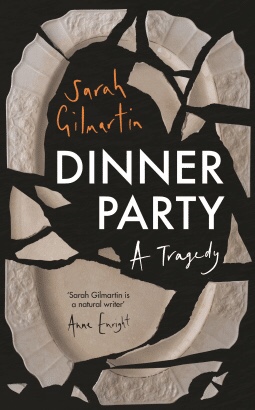
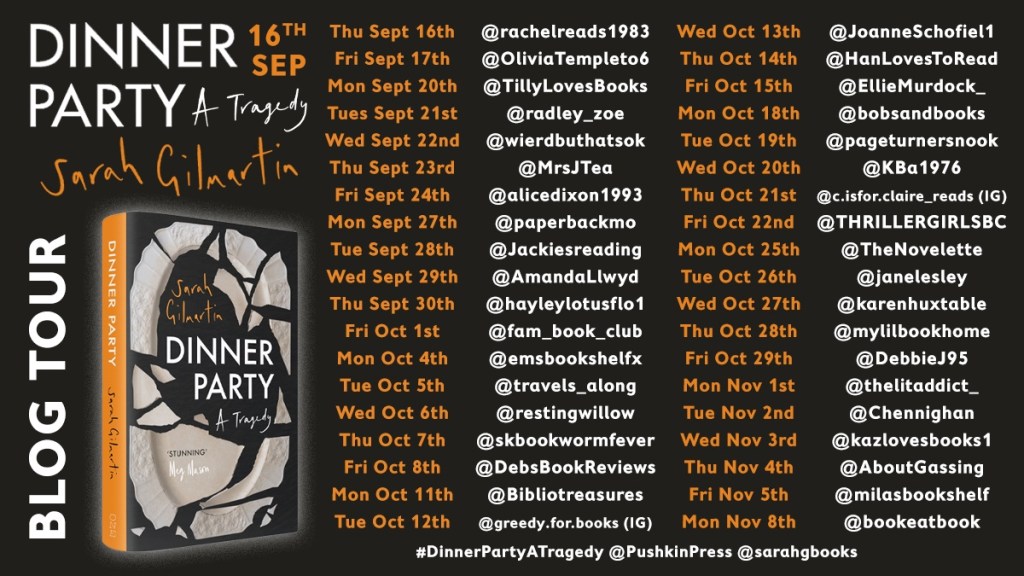
This book was one of those ‘slight’ novels but it really does pack an emotional punch. As I started to read Dinner Party, my brain meandered back to my university days and the first time I read Mrs Dalloway by Virginia Woolf, which was like nothing I’d ever read. The above quote, following Kate through the city as she shops for the dinner party she’ll be holding that evening, reminded me of the scene where Clarissa Dalloway takes the omnibus. The writing is simply beautiful, we’re on a bus ride so nothing much happens but everything happens all at once. We get such a sense of Kate from this short passage: her anxieties, her fears, the irritability with other passenger’s foibles, the disgust with food and how her senses become overloaded to the extent that a baby crying takes all the joy out of her.
Today Kate is cooking a meal for her siblings to mark the sixteenth anniversary of their sister Elaine’s death. Every year the Gleeson siblings gather, but this year is a little different. Elaine was Kate’s twin, and she still feels utterly bereft:
‘But a twin can never get over a twin. It was like someone asking you to forget yourself.’
Kate has decided to host the dinner party for her two brothers and her sister-in-law in the flat she plans to leave soon after. As the four settle round the table, to enjoy the food Kate has taken so much trouble over, they begin to talk about their mother. Peter defends her as he always does, but Ray and his wife Liz challenge his excuses for her cantankerous nature. When they leave, earlier than she expected, Kate performs the mental ritual of counting the number of bites she’s taken. Several life events seem to have plunged her into a crisis. She has just been rejected by the married man she’s been having an affair with, which somehow seems worse now she’s thirty-three. Her work holds no challenge and could be done by a junior colleague and she has fewer friends to support her. This is not her first mental crisis, they started in her third year at university when she was hospitalised for anorexia. Counting bites and controlling her food offered an escape from the pain of loss that never seems to go away, not to mention her mother’s anger and constant criticism. The author then takes us to a year later, as another dinner party marks the seventeenth anniversary of Elaine’s death but this time things are different for all three siblings.
This is a psychologically complex novel and I loved that, being a therapist. Kate is constantly over-thinking, re-evaluating and performing rituals in an exhausting monologue that seems constant for her. As the product of a critical parent, her self-talk is largely negative. She has internalised her mother’s criticism and now carries it with her wherever she goes. It stifles her ability to self-soothe, a vital skill for adult life that allows us to make ourselves feel better. Instead she needs constant input and encouragement from something outside herself, often a person who shows merely a hint of kindness or approval. However, another means of gaining approval is through achievement and Kate is definitely an over achiever, constantly setting herself standards and markers against which she can better herself and feel more valued:
‘She could never pin down the problem; it was a shifty kind of thing, something to do with routine. Shopping in the same supermarket, buying the same foods, wearing the same outfit in different colours, or even with things she enjoyed like music or exercise, running the same stretch of beach, having to reach the railing she’d reached the day before—all these arbitrary markers of success or failure that seemed to somehow captivate and imprison her. Devika said it was just the break-up blues making her feel inadequate, but the truth was, it had been going on for years, long before Liam, this impulse to do things to exhaustion. It was extreme living. Or it was living for two. Wringing the sponge, Kate felt the energy leave her body. She sat on a stool and began to count. Three. Then five—no four—it was only four. And a sprout. Less than ten bites in total, a miracle with all the food.’
The author has created incredible multi-dimensional characters here with all their flaws and imperfections on show. We spend a lot of time inside Kate’s head and it’s a very tiring place to be. Even shopping and cooking for this simple dinner becomes a marathon as she stretches her culinary abilities with a Baked Alaska for dessert that doesn’t make the table. However, don’t think this is a litany of misery. The author’s depiction of the sibling’s dreadful mother is almost comical in it’s awfulness. Yes it’s a very dark sense of humour, but I understand it. This is just one of the defensive strategies the siblings have; if they find her funny it doesn’t hurt so much. Despite Kate being our doorway into this world, it’s important to remember that Elaine’s death isn’t just Kate’s loss. This is a family tragedy and everyone grieves in their own way and at their own pace. Kate seems to know that their mother’s irascibility has been heightened by the loss of her daughter. All the remaining siblings know they can’t measure up to a ghost. The Elaine their mother misses probably isn’t a real person any more. A mother doesn’t just grieve her daughter, she grieves the life she’d imagined for that child: the achievements and milestones of life like her wedding day, or a first grandchild. Death has erased Elaine’s flaws, creating a saint-like girl that no living child could live up to. Perhaps this is why the siblings hold their anniversary dinner without their mother, or maybe because her criticism has subtly damaged each of them, just in different ways. Yet, their mother isn’t a two-dimensional monster, which she could have become in a lesser writer’s hands.
I liked the structure of bookending the story with each, very different, dinner party. I could imagine the book being turned into a play or screenplay very easily. I loved the forays back into the past, to see all the siblings but mainly how Kate and Elaine related to each other. The past sections truly do inform the present, either explaining a sibling’s present behaviour or simply showing us the depth of what this family have lost. With themes of mental ill health, anorexia and suicide this isn’t an easy read at times, but nor should it be. The author is showing us how tragedy can be a legacy, one event leading to inter generational pain and trauma. I found her depiction of this moving, but also helpful in a strange way. Some parts are painful, especially if you’ve lost someone very important to you like I have. However, it’s also enlightening and leaves you feeling that you’re not alone in the world. That there are other people who have once felt and thought like you. The trick is to stop the pain passing on to the next generation, to let the trauma end with you. This is a wise and beautifully written debut from an author I’ll be watching out for in the future.
Published by Pushkin Press, 16th Sept 2021.
Meet The Author
SARAH GILMARTIN is a critic who reviews fiction for the Irish Times. She is co-editor of the anthology Stinging Fly Stories and has an MFA from University College Dublin. She won Best Playwright at the inaugural Short+Sweet Dublin festival. Her short stories have been published in The Dublin Review, New Irish Writing and shortlisted for the RTÉ Francis MacManus Short Story Award. Her story ‘The Wife’ won the 2020 Máirtín Crawford Award at Belfast Book Festival.
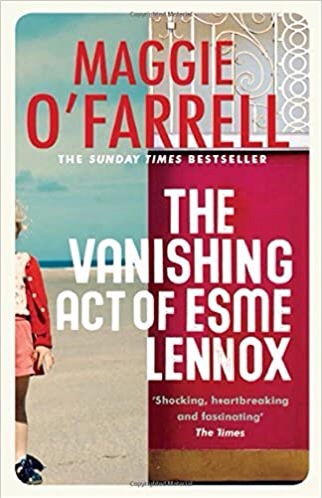
Edinburgh in the 1930s. The Lennox family is having trouble with its youngest daughter. Esme is outspoken, unconventional, and repeatedly embarrasses them in polite society. Something will have to be done.
Years later, a young woman named Iris Lockhart receives a letter informing her that she has a great-aunt in a psychiatric unit who is about to be released.
Iris has never heard of Esme Lennox and the one person who should know more, her grandmother Kitty, seems unable to answer Iris’s questions. What could Esme have done to warrant a lifetime in an institution? And how is it possible for a person to be so completely erased from a family’s history?
This book was the first Maggie O’Farrell I ever read, and it really is a little gem. I fell head over heels for the confused and bewildered Esme, discharged from the mental health unit she’s been in for almost sixty years. Great niece Iris, is contacted out of the blue, to be told that the unit is closing and patients are ok to be looked after in the community. Iris had no idea she even existed. In a dual timeline we learn how she and Iris get on, but also how this family managed to remove Esme from their tree so completely. Where does it begin?
Let us begin with two girls at a dance… Or perhaps not. Perhaps it begins earlier, before the party. Before they dressed in their new finery, before the candles were lit, before the sand was sprinkled on the boards, before the years whose end they were celebrating first began. Who knows? Either way it ends at a grille covering a window, with each square exactly two thumbnails wide.
The beauty of Maggie O’Farrell’s description here is typical. A layering of small details captured in the narrator’s mind, that takes us to the preparations for the party towards the end of the book, but also how it appears in our narrator’s field of vision. We drift across three narrators: Esme, her sister Kitty and their great-niece Iris. They stumble across each other sometimes, one pushing in before the other’s quite finished as families tend to do. Esme was a feisty, wild little girl in a time when there were rules about how little girls should behave. In a household overseen by their rather austere grandmother, with her mother and father struggling to control her. This is the 1930s, so their methods are cruel, tying her to a chair for example and forgetting about her. One day they leave her home while they go on a trip out, not wanting to deal with her behaviour. While she and her baby brother Hugo are alone, something terrible happens and from then on, their mother will barely look at her.
We hear through Kitty’s narrative, how differently the family treats her. Now in a nursing home, suffering from dementia, Kitty has always told her great niece that she was an only child, but Esme’s papers prove she is Kitty’s sister. Kitty remembers in fits and starts, disjointed scenes that come to her, then drift away again. This is beautifully managed by the author, who creates a fragile lace work of memories, that shed further light on the sister’s relationship. Kitty was the conforming child, moulded to the will of the family. Esme was more inventive, creative and has constant questions. Finally there’s Iris’s narrative and she really had enough on her plate already, without having a great-aunt with psychiatric problems dropped on her without warning. She has a vintage shop, a married lover who won’t make a decision and a grandmother with dementia to visit. Now she’s fascinated with what she’s discovered, while trying to understand what happened to Esme. She trawls the records at the old Cauldstone Hospital, discovering a list of women and the reason for their admittance to the asylum. She reads with horror, that within these walls, were women who had wandered from the house at night, another who had taken too many long walks, refused too many offers of marriage or had eloped with a legal clerk. All of these reasons deemed enough to commit a woman to time in the asylum, often forgotten about.
What slowly emerges is a heartbreaking secret, so terrible it stuns Esme to silence. I love the way that the author understands how psychological trauma can affect someone. In Esme’s case a build-up of traumatic incidents and abusive behaviour slowly breaks her down. It’s distressing to see a girl with such spirit, slowly being broken like a wild horse. After sixty years inside she has turned into this mute, biddable old lady. Having worked in mental health for over twenty years, I understand the dilemma of what to do with people who are so institutionalised they can’t cope outside the walls of their prison. I looked after some of these people in the 1990s as homes closed and terrified people were being pushed out into the community. Perhaps because of them, Esme is one of those characters I fell in love with. What she experiences is so hard to overcome and I found myself at turns furious and devastated for her. The ending was perhaps inevitable, but still took me aback. This book has stayed with me for years and I think it always will.
Meet The Author
Maggie O’Farrell is the author of the Sunday Times no. 1 bestselling memoir I AM, I AM, I AM, and eight novels: AFTER YOU’D GONE, MY LOVER’S LOVER, THE DISTANCE BETWEEN US, which won a Somerset Maugham Award, THE VANISHING ACT OF ESME LENNOX, THE HAND THAT FIRST HELD MINE, which won the 2010 Costa Novel Award, INSTRUCTIONS FOR A HEATWAVE, which was shortlisted for the 2013 Costa Novel Award, THIS MUST BE THE PLACE, which was shortlisted for the 2016 Costa Novel Award, and HAMNET which readers will know was my favourite book of last year. She lives in Edinburgh.
I truly enjoyed this story based around the music scene in Glasgow, most specifically Hope Street where Richie Carlisle works in a music shop. We first meet him after he’s had his big musical break and is now back in his home town. Despite working all day alongside musical instruments he doesn’t play much these days, so it’s only when Ally comes into the shop with an idea for a community music group using the local pub as a venue that he thinks of picking up the guitar again. Richie has settled into his life, where he lives alone,but has his son Finn on weekends and has Sunday dinner round at his mums. He knows everyone on Hope Street by name and it feels as if Richie has a little community around him.
It’s a far cry from a few years before when one night playing in the local pub’s Friday Night Jukey! changes the course of his life. A handful of musicians would come ready to play and the audience would shout out requests – always starting with the Proclaimers o”f course. On this night Richie notices a beautiful woman and when she asks for Crowded House he decides to go for a more obscure track, w.hich gets them talking afterwards. There’s something special about her. On the same night he is approached by a manager in the music industry looking for a vocalist for Karl King’s band. He thinks Richie might fit the bill, despite having a complicated past with Karl. Here are two chances in one night: to start a relationship with Penny and see where it goes, or to head down to London and the possibility of music stardom. He tries a compromise and promises to give it five months, and if the band hasn’t taken off he will come back to Glasgow. Penny agrees to a long distance relationship and when his song Let in the Light is recorded both of them think this is it, they are bound for the charts. However, that isn’t what fate has in store for them.
Richie is such a likeable character, in the present day it’s clear he cares about his family and his much older boss at the music shop. He still cares about Penny, even though they’ve broken up and their son Finn ( the Finn brothers from Crowded House) is his absolute world. He’s a little melancholic and stuck in a routine, so the music group could be good to take him out of that head space. It may also shake off his fear of performing, performing in front of others causes huge anxiety ever since he seize up on stage years before at a festival. It’s like he can feeling his throat closing and he can’t even gasp for breath, never mind get out a tune. Ally’s group seems to bring him out of himself and as he closes his eyes to sing he feels at one with performing again. He’s noticed Ally, giving out a bit of encouragement here and listening to another person’s problems there. Whenever she pops into the shops she’s a little ray of sunshine and I started to get the feeling she might be very good for Richie. Yet, he still can’t get Penny out of his mind. When she suddenly announces that she might return down under to her home country of New Zealand Richie can’t believe that she would take Finn away with her.
Everything is changing. The pub may be closing. His old music manager is back in the picture with news about Karl King. Penny puts the house up for rent. He’s at his most vulnerable when he’s asked to perform one final gig at the pub in Hope Street. Can he do it? This might seem a light story, and the writing certainly is. It’s funny in parts too. Yet it has a central message about being true to who you are, and where you’re from. It’s very positive about mental health and how it’s possible to find ways to manage these emotions when they get out of proportion. It suggests looking to our communities for help and support too, many other people have the same struggles and can have the best tips. I really wanted Richie and Finn to succeed. However, I did find myself a bit irked with Penny. So much so I was hoping he’d end up with Ally. When Penny decides to move back home, it’s like she hasn’t even thought of how devastating this will be, not just for Richie, but for the wider family. Finn belongs to all of them and needs them all in his life. The story of Karl King, tells us that we need roots and ways of belonging to get by in life. None of us can stand alone. This is a great novel, with moving, realistic characters and an enjoyable musical plot. Now I need to go and create a Spotify playlist of the songs featured and inspired by reading this book.
Meet The Author
Gerard was born and raised in Edinburgh, Scotland. He moved to England in his 20s and worked in various northern towns before settling in beautiful Yorkshire with his family and two guinea pigs. He has written three albums (two of which will never be released!) In 2019, he attended a writing class to help him generate ideas for further songwriting, but, instead, started writing a novel.
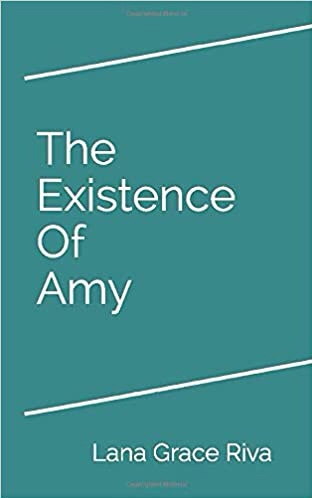
This book is a great insight into something a lot of readers will relate to, especially at the current time when we’re in the middle of the third lockdown of this pandemic. Mental health referrals are soaring, particularly for anxiety, OCD and depression, and although I’m not counselling at the moment I know there are clients who would really benefit from reading this book. It definitely helped me too. Some people expect counsellors to have their mental health in tip top condition, but often we’re ‘wounded healers’ who have experienced mental ill health. I’ve had bouts of depression and anxiety in the past, and so do others in my family, which lead me to a career in mental health. I encourage clients to read books like this one. There’s a great sense of solidarity in knowing you are not alone, gaining an insight into what someone else’s inner thoughts are like, and how they affect their day to day lives.
Amy is the narrator of the novel and despite functioning well on the surface, she has all three of the conditions I’ve already mentioned. Amy works full time, has a home to maintain and manages to keep up with friends. On the outside she is coping. Inside though, she is battling against a constant, exhausting, barrage of intrusive and dark thoughts. I thought the author did an incredible job of creating this relatable and loveable character, because it helps the reader empathise with her daily difficulties and journey moving forwards. It’s a very difficult balancing act to show the reader how it feels to be in Amy’s shoes while creating an easy and engaging read that never felt too heavy. The writer shows us how simply daily living, like going on a bus journey. Amy has to somehow negotiate paying, balancing while the bus is moving, and getting the bus to stop while all the time her brain is screaming ‘Don’t touch that handrail’ or ‘don’t press the button’. Then the hardest part of all is keeping a serene, swan-like surface so that nobody around her notices anything different. Followed by the constant worry about whether people noticed or thought she was weird.
I felt Amy was in a position a lot of people with these mental health conditions face; she could identify her anxieties and concerns as ‘wrong thinking’ but she needed coping strategies for day to day. At lot of readers might identify this as a time when they were part way through therapy, or when facing a flare-up of their symptoms and needing to update or refresh their coping skills.
I found Amy very difficult to leave within the pages of the book when finished. She played on my mind for a few days as I thought about her struggle and what insights I’d gained from the novel. Therapists read case studies all the time, but it was impactful to experience Amy in the format of a novel. Clients bring to therapy their frame of reference. The therapist sees events through their eyes and accepts their account as their ‘lived experience’ without judgement. There are times when we might sense another version of events, and this is what the novel gave me. I felt more immersed in her life, could see how she functioned with family and friends, and in her work situation. The author stripped away all the medicalised jargon and the impersonal language of a case study and instead gave me a fully-fledged person to know inside and out. I did find myself running through how I would help and support Amy.
The novel emphasised something I’ve always thought vital for someone experiencing these conditions; the existence of a strong, support network. In fact, Amy hits her lowest point when her closest friend announces she’s moving overseas. When we’re feeling mentally unwell we don’t always recognise or feel able to accept offers of help. Being honest with friends and family about how we feel and allowing them to support and help us as we move on is so important I felt a lot of hope for Amy going forward, and for the clients I will be able to help more fully after reading her journey.
Meet The Author
Lana Grace Riva has written two books, one nonfiction the other fiction, both based on her experiences of mental health. Her first book ‘Happier Thinking’ is a short collection of tips and exercises to maintain a healthy mind. Her second book ‘The Existence Of Amy’ is a fictional story based on a very real depiction of mental illness.
What an incredibly emotional read this was for me. I found myself having a good old cry at 4am over Jen and her family’s story. It begins when Jennifer is adopted by a childless couple and four years later gets an unexpected little sister. Kerry is a determined, mischievous and curious little girl and the pair are incredibly close. In adulthood, the two are still inseparable. Jen now has husband Ed and two children while Kerry has a long term partner in Nessa, who she is hoping to propose to. When a terrible accident happens while the sisters are on a shopping trip for an engagement ring, Kerry is killed. Now Jen needs to find a way to carry on living, but the survivor’s guilt and grief are very strong. As Jen starts to lose herself in her memories of her sister, it becomes clear that Jen can’t let Kerry go. Yet, by keeping hold of her sister, will she end up losing her own family?
This is my second book by Emma Cooper and after reading this she has been bumped up to my list of favourites – those authors where I know I’m guaranteed a great story, emotional impact and believable characters. She has the talent to combine a big emotional punch, with a sprinkling of humour which isn’t easy to do. I honestly fell in love with these characters and their relationships with each other. Jen is a very organised and capable woman, who loves spending time with her family and creating a beautiful home. I loved her with Ed and the way the author has created a balance of the romantic and the mundane into their relationship. There’s enough of a love story to draw us in, but we see the normality too as they get the children ready for school, do the grocery shop and get involved with school activities. Underneath the daily grind though is a strong love and passion for each other. Yet it is becoming tested by changes in Jen. Ed has noticed that Jen doesn’t seem as organised as usual and is often staring off into space. Then at other times she is almost over-excited and far be it from him to complain about more sex, but well, he wasn’t complaining exactly… it just isn’t like his wife. He worries, but labels these changes as part of the grieving process. He doesn’t know what we know. Jen can still see Kerry and talk to her. Kerry has been fuelling the recklessness he’s seen such as daring Jen to leap off a cliff into the sea. There’s a point when Ed realises that this isn’t just getting lost in memories. For Jen, Kerry is as real as he is or even the children and what will he do when this starts to affect them?
This was a tough, but loving and humorous portrayal of the journey relationships take when one partner is struggling mentally. I found the alternate chapters between Jen and Ed so effective because we can see the same events through both sets of eyes, sometimes with very conflicting results. I was so torn because I loved both of them, I wanted them to be together but I could understand each viewpoint too. Ed wants his wife back, the person he fell in love with and his best friend. He wants to be a family, but wants to protect their children too. Jen has a heartbreaking dilemma. Does she follow medical advice and take the pills that might make Kerry disappear forever? The psychiatrist who sees Jen and diagnoses complicated grief understands what she’s feeling. This is survivor’s guilt; Jen wonders why she survived and Kerry didn’t. Kerry saved her life by pushing her away from the oncoming vehicle. In Jen’s mind she’s already killed her once. Now she feels like she’s killing her all over again.
This was a tough read because I struggle with complicated grief. In 2007, as regular readers will know, my husband died from pneumonia as a complication of Primary Progressive Multiple Sclerosis. It had been coming for some time, but for the final year of his life I was his carer for 24 hours almost every day, unless I had a Marie Curie nurse. He was dependent on me for food, drink, medication and all bodily functions, even breathing. Three months before he died I agreed that he needed to be admitted to a nursing home from hospital. One of our carers was injured and I couldn’t have managed alone. I knew when I made that choice it was very likely he would die. For a few weeks after his death, I would see him out of the corner of my eye, sitting in his wheelchair looking out into the garden. I could also hear the mechanism of his wheelchair and a little beep it used to make. I realised that this wasn’t really Jerzy, this was me being unable to let go. In therapy I talked about survivor’s guilt and how I felt I had killed him by sanctioning the nursing home. I knew rationally I couldn’t have done anything else, but emotionally it’s been very hard to accept my own choice. I also have multiple sclerosis but in a milder form and I discuss choices and possibilities at length with my new partner, because I would hate him to go through the same thing. Reading this was emotional, I did cry, but I also felt less alone with my experience.
The author has taken a really tough subject, but made it warm and humorous. I love the way Kerry is often doing things she did as a little girl like standing on her head or blowing bubblegum. She also sits in the oddest places and actively tries to make Jen laugh. The wider family were lovely too, willing to support and help out with the children or Jen. Her mum is always full of good sensible advice and their acceptance of this peculiar phenomenon is brilliant. The final scenes choked me up. They made me sad for what I lost back then as well as for Jen. I was desperate for her and Ed to make it and come back together as a family. The night I finished the book I was an angling widow! My partner and my brother went night fishing, so I was alone for the final chapters. I had a good cry on the dog – he’s very absorbent. I found myself very thankful for the new chance of love that I’ve had with my partner over the last couple of years. All I wanted to do was hold him close and tell him how much I loved him. This is an honest story about how complicated grief can be, but never lets us forget that where there is grief there is always great love.
Biography
Emma Cooper is a former teaching assistant, who lives in Shropshire, with her partner and four children. Her spare time consists of writing novels, drinking wine and watching box-sets with her partner of twenty-four years, who still makes her smile every day.
Her debut, The Songs of Us was snapped up in multiple pre-empts and auctions and is now being translated into seven different languages. Her last novel The First Time I Saw You was also a bestseller.











 The Lotus Readers