Posted in Netgalley

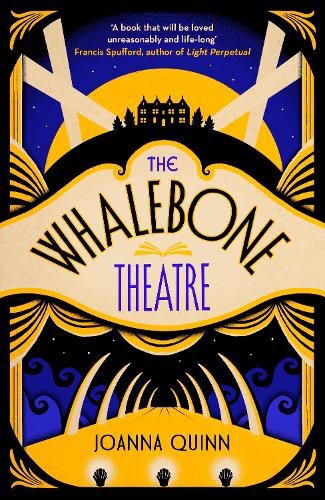
The Whalebone Theatre by Joanna Quinn

This book feels like an epic. A familial version of The lliad, the very first play that Cristabel puts on in the family’s theatre by the beach, formed from the jawbones of a whale. It washed up on the beach and was claimed for the Seagraves by Cristabel who is the orphan cousin of the family. Cristabel doesn’t really fit anywhere. She loves adventure, activity, and endeavours, climbing, running and conquering the Seagrave estate rather than being the lady her stepmother would expect, if she could be bothered. The Seagrave children are an odd bunch, brought up by staff and each other, while their parents stay in bed late, are never without houseguests and like to drink as early as it is socially acceptable to do so. This is the story of the heir and the spare. Jasper Seagrave brings his new wife home to the Chilcombe Estate and Rosalind is thrown into being mistress of the house and stepmother to his daughter Cristabel. There are definite vibes of Rebecca in this beginning, with a much younger wife slightly overawed by her new home and struggling to find her place. The ghostly presence in this case being Cristabel, creeping round corridors and the attic, having ‘boy’s own’ adventures with imaginary friends. Rosalind is happy to have bagged an aristocratic husband, considering they’re in very short supply since the war. That is until the ‘spare’ arrives. Willoughby is everything his elder brother isn’t, a dashing war hero fascinated by speed whether it’s a new car or learning to fly. There’s an immediate attraction, deepening when Rosalind is on bed rest in the last stages of pregnancy and Willoughby keeps her company. Is the Chilcombe estate about to lapse into scandal and what will become of Cristabel?

Joanne Quinn’s incredible debut begins at the end of WW1 and takes us all the way through WW2. The attention to detail is incredible and I felt completely immersed in this family’s history and the times they’re living in. This period saw huge changes for the aristocracy, often forced by the loss of two generations and bankruptcy due to death duties. Estates were sold off or had their use changed in order for the family to survive. The class boundaries became blurred as servants and masters fought together and unexpected bonds were created. Women had grown used to different roles, possibly nursing or working in factories or shops, and not all wanted to go back to a domestic role. There were also less men, so the marriage market changed and many society women, like Rosalind, had to be open to marrying men they might have previously overlooked. The author reinforces this sense of change by echoing it in the setting. When Rosalind first arrives at Chilcombe she is disappointed in the old fashioned country decor, all wood panelling and animal heads. She gradually brings the house into the 1920s with glamorous furniture and wallpaper, perhaps more suited to a London house than the country estate. The animals are banished to the attic, including a stuffed baby elephant on wheels intended as a gift to Cristabel from her mother. In fact Cristabel herself is treated rather like an unwanted piece of decor, stuffed into the attic with only the maid Maudie for company, her tomboyish ways out of step with her elegant and ethereal stepmother. As war looms again, the estate changes accordingly, with its garden turned over to vegetables and the people left behind pulling together as a team whether they are a Seagrave or the servants. They find themselves communing together in the kitchen, with all the elegant furniture sitting around like a piece of jewellery that’s too dressy for everyday wear.
The Seagrave children are the main focus of the novel, Cristabel, Flossie and Digby, each one a cousin or half-sibling they cleave together tightly due to parental neglect. Flossie is the child of Jasper Seagrave and Rosalind and I did find my heart warming to her. Nicknamed ‘The Veg’ thanks to an unfortunate resemblance to a vegetable when she was a baby, I sensed Flossie’s vulnerability. Her mother is beautiful and willowy, a perfect shape for her time, rather like an Art Deco statuette, but Flossie hasn’t inherited that elegance or poise. She’s rather like her father Jasper, a little bit awkward and not very good at asserting herself. WW2 tests Flossie’s metal and she responds with duty, grit and determination. It’s as if by pulling on her old clothes, mucking in with the servants and creating her garden at the whalebones she finds herself and becomes okay with who she is. Her friendship she cultivates with the German prisoner of war is so touchingly beautiful and fleeting. She’s a good person who can see the best traits in someone and bring them out. With both siblings away on special operations, it’s Flossie who has to find a way of keeping Chilcombe and run the estate. Digby, the son of Rosalind and Willoughby Seagrave, has the advantages of being the son and heir, but also seems like the one Seagrave who was wanted. Cristabel, belonging to Jasper and his first wife, is almost invisible. The chapter where her parents meet is unbelievably touching and I found myself bereft for Cristabel, because she would never know how much she was loved and wanted. Flossie is perhaps a reminder of those months when Rosalind was Jasper’s wife, something she seems to view with distaste. Digby could have been resented by his siblings, but both girls adore him. His love for acting shines through from being a little boy, when the theatre has a profound effect on him. So much so, that he’s still on the stage years later. To some extent, Cristabel is his parent and he looks up to her, happy to follow on in whatever escapade she has planned next.

It is Cristabel who is the hero of this book, from the child who has to crawl in bed with one of the maids for comfort and affection, to a special operative in occupied France, she is a survivor. Full of ideas, her determination to claim the beached whale is almost comical, couched in the very male language of expedition and discovery. Once only the bones are left, it takes someone equally creative and energetic to help establish the Whalebone Theatre. A visiting artist, scandalously living in the cottage with his wife and identical twin lovers, imagines walking through the creatures jawbone to reach the theatre (a space repurposed for Flossie’s vegetable garden during WW2). They create a script from Homer’s work and utilising Rosalind’s skills and interest in design, make a seating area and light the way to a stage that has the sea as a backdrop. Their plays succeed in bringing everyone together in the endeavour, each with a part to play whether it’s on stage, setting up, or making flyers for the village. These happy parts of her childhood take on such a nostalgic element, especially years later when she’s crouched in a ditch in occupied France trying to survive. There’s a sense in which the whole ensemble and even the villagers bring up this little girl and I loved the knowing way people would assume some daring escapade was the work of Miss Cristabel. I felt most sorry for her when we learn that her story could have been so different. Jasper is knocked off his feet by this woman who wants to talk to him at the hunt and appears immune to the charms of his notorious brother. The paragraph where Jasper recalls how in tune they both were and how brilliant and capable she was of running the estate with him. I can see a great deal of her mother in Cristabel and I was moved by the joy they felt in finding out they were going to be parents. The stuffed baby elephant they install with wheels for their baby shows that they imagine her like a little Maharaja, riding her elephant around the house.

Cristabel’s war years are incredibly intrepid and there are scenes where I was scared for her. The languid inter-war years seem decadent by comparison with these more sparse and disjointed episodes showing all three Seagraves in different parts of the world. I thought the pace really picked up as we followed Cristabel on her missions, parachuting into occupied France as a messenger, often with German soldiers a hair’s breadth away from discovering her. One scene with a German officer is so real I felt sick for her! She proves that her ‘adventures’ were not just an affectation. She is willing to put herself on the line, proving her aptitude for work as a operative, but also such incredible bravery. The final days of Nazi rule in Paris are tense, nail-bitingly so, but I didn’t fear for her. I had a sense Cristabel would survive no matter what. I thought this was an incredible depiction of life through the war, whether from Flossie’s more domestic side including service as a land girl to Cristabel and Digby’s seemingly more dashing exploits. His sister’s determination to find Digby showed that these children loved and cared for each other so deeply, probably because they had been left to their own devices. For Cristabel, it is servant Maudie who shows her what a mother’s love should look like and she in turn, mothers her little brother and sister. The author shows what a toll both wars took on people and the rapid changes they forced on society. I won’t reveal whether any of our characters survive, but Cristabel remembers a saying, that war can bring out the best in people. There are those who shine through difficult days and in their own ways I think the Seagrave children all stepped up to the mark. Most importantly the loving bond they had as children, stood firm and could not be broken.

Published 9th June 2022 by Fig Tree (Penguin)

Meet The Author

Joanna Quinn was born in London and grew up in Dorset, in the South West of England, where her “brilliant, beguiling” debut novel The Whalebone Theatre is set. 

Joanna has worked in journalism and the charity sector. She is also a short story writer, published by The White Review and Comma Press among others. She teaches creative writing and lives in a village near the sea in Dorset.
Posted in Netgalley

Memphis by Tara M. Stringfellow

Joan can’t change her family’s past.
But she can create her future.

Joan was only a child the last time she visited Memphis. She doesn’t remember the bustle of Beale Street on a summer’s night. She doesn’t know she’s as likely to hear a gunshot ring out as the sound of children playing. How the smell of honeysuckle is almost overwhelming as she climbs the porch steps to the house where her mother grew up. But when the front door opens, she does remember Derek.

This house full of history is home to the women of the North family. They are no strangers to adversity; resilience runs in their blood. Fifty years ago, Hazel’s husband was lynched by his all-white police squad, yet she made a life for herself and her daughters in the majestic house he built for them. August lives there still, running a salon where the neighbourhood women gather. And now this house is the only place Joan has left. It is in sketching portraits of the women in her life, her aunt and her mother, the women who come to have their hair done, the women who come to chat and gossip, that Joan begins laughing again, begins living.

Memphis is a celebration of the enduring strength of female bonds, of what we pass down, from mother to daughter. Epic in scope yet intimate in detail, it is a vivid portrait of three generations of a Southern black family, as well as an ode to the city they call home.

There’s a point in this book where Miriam remembers her mother Hazel waking her up, leaving her little sister August asleep in bed, then she fixed her a breakfast fit for a king. There were green tomatoes and grits, spicy pork and scrambled eggs, and they were chatting like a normal day. Miriam was distracted by the delicious meal and didn’t notice her mother running the tap. Then suddenly she threw a whole jug of cold water over her daughter. Miriam thought her mother had lost her mind. All she said was ‘you ready’ and that afternoon took her to her first activist’s sit in. Miriam’s experience is similar to the one I had reading this incredible book. I’d just settled into the story when suddenly something was revealed that was so momentous I would have to take a moment, blind-sided by what had just happened. Memphis is the home of three generations of African-American women from grandmother Hazel, her two daughters Miriam and August, and Miriam’s daughters Myra and Joan. Their personal lives are set against a backdrop of American history from the early 1950s through to the 2000s, taking in world-changing events like the Kennedy assassinations and 9/11. Told in sections from each woman’s viewpoint, Stringfellow takes us back and forth across the 20th Century. Each step back in time informs the present, showing us where Joan has come from and each day forward moves Joan into her future.

I loved the earliest years where grandmother Hazel meets Myron and they fall in love. Their courtship is so sweet and has an innocence about it and I think that’s what makes later events such a shock. The fact that Myron has come so far and become part of law enforcement in those times feels like such an incredible achievement. Your fellow officers are supposed to be your brothers, but despite working alongside him, this all white squad don’t count him as one of them. We don’t see the lynching, but we don’t need to. Our place is with the women of this story. Hazel is nine months pregnant, filled with grief, anger and a frustration borne from knowing that whatever you achieve, however loud you scream, your achievement and voice mean nothing. The author managed to deeply touch me with that sense of powerlessness. There’s such a maelstrom of emotions when she gives birth: knowing this little girl will never know her daddy; wishing Myron was there to support her; the fear of knowing she’s alone as a parent and her girls depend on her; the joy of this new life coming into the world. These women feel so real because Stringfellow cleverly evokes the complexity of human emotions, it’s rare that we only feel one at a time. In grief we can still feel moments of joy and even if we are happy, there can be moments of doubt or fear. Such moments of inner conflict follow us into the second generation of women, sisters Miriam and August. When Miriam escapes domestic violence, returning to the house Myron built in Memphis, she’s torn in two directions. She really has nowhere else to go and she longs for home and the consolation and support of her sister, but Joan has a moment of recognition. Have they been here before? The truth is they have.

The women in this family are strong and they need to be. Some of what happens to them over their three generations is terrible and you will probably have a good cry like I did. I was touched by what Hazel, Miriam and Joan go through, but there were also quieter struggles that touched me such as August’s decision to care for her mother, the loneliness she must feel with both her mum and sister gone, the fear she feels for her son Derek, growing up as a black man in a place where shootings and gangs are commonplace. Her mixed feelings of guilt, anger and love that come with being a mother of a son who does things that are unforgivable. I also loved the camaraderie of her salon and the strength she gets from the women who are her customers and her community. I was touched by her ability to take pleasure and solace when it’s offered, despite it not being the love and companionship she craves – from the women in her life. The pain these women go through makes the good times even more enjoyable and I really felt the joy and relief when they came out of a tough time. The author manages to capture that sense of peace I have seen in my counselling room, when the long held fear, anger and shame that comes from trauma is finally let go. That need for revenge finally silenced. The chance for joy and celebration to fill the void left behind and communing with others who know your journey.

“𝘛𝘩𝘦 𝘧𝘳𝘢𝘮𝘦𝘥 𝘳𝘦𝘤𝘰𝘳𝘥 𝘤𝘰𝘷𝘦𝘳𝘴 𝘰𝘯 𝘵𝘩𝘦 𝘸𝘢𝘭𝘭𝘴 𝘴𝘩𝘰𝘰𝘬 𝘸𝘪𝘵𝘩 𝘵𝘩𝘦 𝘭𝘢𝘶𝘨𝘩𝘵𝘦𝘳. 𝘓𝘢𝘶𝘨𝘩𝘵𝘦𝘳 𝘵𝘩𝘢𝘵 𝘸𝘢𝘴, 𝘪𝘯 𝘢𝘯𝘥 𝘰𝘧 𝘪𝘵𝘴𝘦𝘭𝘧, 𝘉𝘭𝘢𝘤𝘬. 𝘓𝘢𝘶𝘨𝘩𝘵𝘦𝘳 𝘵𝘩𝘢𝘵 𝘤𝘰𝘶𝘭𝘥 𝘣𝘳𝘦𝘢𝘬 𝘨𝘭𝘢𝘴𝘴. 𝘓𝘢𝘶𝘨𝘩𝘵𝘦𝘳 𝘵𝘩𝘢𝘵 𝘤𝘰𝘶𝘭𝘥 𝘶𝘱𝘭𝘪𝘧𝘵 𝘢 𝘧𝘢𝘮𝘪𝘭𝘺. 𝘈 𝘤𝘢𝘤𝘰𝘱𝘩𝘰𝘯𝘺 𝘰𝘧 𝘉𝘭𝘢𝘤𝘬 𝘧𝘦𝘮𝘢𝘭𝘦 𝘫𝘰𝘺 𝘪𝘯 𝘢 𝘭𝘢𝘯𝘨𝘶𝘢𝘨𝘦 𝘱𝘳𝘪𝘷𝘢𝘵𝘦 𝘵𝘰 𝘵𝘩𝘦𝘮.”⁣

Meet the Author

Former attorney, Northwestern University MFA graduate, and Pushcart Prize nominee Tara M. Stringfellow’s debut novel Memphis (Dial Press, an imprint of Penguin Random House) is a multi-generational bildungsroman based on the author’s rich Civil Rights history. A recent winner of the Book Pipeline Fiction Contest, Memphis was recognized for its clear path to film or TV series adaptation and is due out in 2022. Third World Press published her first collection of poetry entitled More than Dancing in 2008. A cross-genre artist, the author was Northwestern University’s first MFA graduate in both poetry and prose and has been nominated for two Pushcart Prizes, as well as Best of the Net. Her poems have appeared in Collective Unrest, Jet Fuel Review, Minerva Rising, Women’s Arts Quarterly, Transitions and Apogee Journal, among others.

If she isn’t writing, she’s gardening. If she’s isn’t in Memphis, she’s in Italy.

Posted in Netgalley

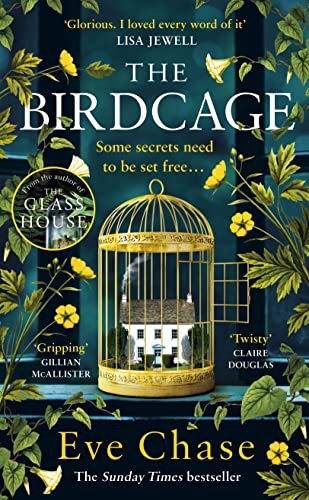
The Birdcage by Eve Chase

Eve Chase’s new novel had all the ingredients of a perfect read for me – quirky bohemian family, unconventional artistic father, large Cornish house and family secrets that have haunted his daughters for years. It’s the psychological impact of these family secrets that really make the novel. The story is told in a dual timeline, in the present Lauren, Kat and Flora are returning to Rock Point, her father’s mansion house on the Cornish Coast. He has invited them after many years away from the house, following a terrible incident that occurred on the day of the eclipse in August 1999. The events of this day are told in our second timeline. Lauren is the youngest by a few years, and on that day she was an adolescent , while her half-sisters Flora and Kat are older teenagers. Each girl has a different mother and their overlapping ages show the sexual profligacy of their father Charlie, a well-known artist. As he sits down with his three adult daughters, Charlie has a big announcement for them. The girls are expecting an illness or plans concerning his artwork, but they have a shock in store.

The complexity of this family’s relationships is at the core of this novel and I really enjoyed going back in time to work out why and how each woman’s personality was formed. On the surface Flora is the most conventional sister, with a husband and young son Raff, but is everything at home as happy as it seems on the surface? Kat is the most career minded sister having developed a well-being app. She is constantly checking her phone and looking for a reliable signal so she can work, but is she just busy or is the world of well-being more stressful than it should be? Lauren has had the most recent difficulties in life, nursing her mother Dixie who was terminally ill. After moving into a local hospice Dixie died, and although Flora invited her for Christmas Lauren didn’t come. These women are anxious to be together again. Flora and Kat used to tease Lauren, even bully her a little bit. The reasons for this become clearer, but Lauren has always thought it was about Dixie. Dixie was different to me 6 hCharles’s usual choice in women, she was unadorned apart from piercings, kept her hair shorter and was artistic in her own right. Indeed Charlie is touchingly affected by her death and seems to regard this separation as something he most regrets in life. Each sister’s personality fits perfectly with their back story: Flora’s hesitancy and submissive nature; Kat’s avoidance and distraction, creating workaholic tendencies; Lauren’s phobias, which are usually under control, but thanks to Bertha the parrot and the wealth of seabirds surrounding their home it can be a problem. The parrot has other tricks as well, mimicking the house’s occupants with phrases that only one person knows are true or false.

I thought the pace was clever, becoming more urgent in the past and present day at once propelling the reader towards the eclipse event and the effect of it’s revelations in the present. What was particularly clever was the way some people are only revealed in all their complexity, in the present. Angie, who worked as their au pair, was disliked by Lauren when she was a child. Lauren sensed her duplicitous nature and knew she wasn’t really there for them, describing her as hungry to get to Charlie like an art groupie. However, as an adult Lauren can see that this was more complicated and how she didn’t understand adult relationships. There’s a shift in years and awareness, where Lauren and her sisters can now see that Charlie wasn’t just a man beleaguered by women throwing themselves at him. He is an active participant in these complicated affairs and in bringing these girls into the world. He’s even passive at their visits, always pleased to see them but never negotiating with exes, or organising the logistics. Their gran does all the work, leaving Charlie free to paint in his studio, a place where only his models and Lauren are welcome. He’s never taken responsibility for his actions and as events unfold it’s possible that those actions have created a perfect storm of sibling jealousy and conflict.

That eclipse summer, Charlie has asked his three daughters to sit for a painting with the large ornamental birdcage. It’s the painting that will become his most well known and most valuable, in fact the girls are sorry it’s gone to art collector because as far as they know it’s his most personal. There’s a wealth of imagery in this painting, starting with the three sister’s pose, sitting together but not touching, like three separate islands. There’s the solemnity behind it too, the girls are not talking or cracking a joke and all three are staring out towards the viewer. Or is it towards the painter? In feminist readings of visual arts the bird within a cage represents the imprisonment of women, but also the gilded frame through which we view femininity. We can’t know the painter’s intention, but by painting it next to his daughters is he acknowledging their freedom? Or could he be pointing out a sexual double standard? He has been free to create these overlapping lives without censure, whereas their mothers and the girls have borne the gossip, shaming, poverty and hardship that comes with being a single parent. They’ve had to hear the whispers and insults about their morals, while he has been free to carry on with only the reputation of being bohemian to his name. Or could the birdcage contain his secret? The consequences of this secret we see on eclipse day, although it isn’t fully revealed until the present when it puts Lauren and her nephew Raff in danger. Only then will Charlie have to deal with how his behaviour has affected others, like ripples on a pond. This was an engaging tale of complex family ties and the psychological effect of a parent’s action. It has all the bohemian glamour of a country house occupied by an artist and a gorgeous atmospheric setting in beautiful Cornwall. I was gripped to the final page, having felt an affinity with Lauren and Flora I wanted to know how their stories turned out and the epilogue brings a satisfying ending to this family saga.

Published by Penguin on 28th April 2022

Eve Chase is an author who writes rich suspenseful novels about families – dysfunctional, passionate – and the sort of explosive secrets that can rip them apart. She write stories that she’d love to read. Mysteries. Page-turners. Worlds you can lose yourself in. Reading time is so precious: I try to make my books worthy of that sweet spot – she says on her Amazon.com author page.

Her office is a garden studio/shed with roses outside. She lives in Oxford with her three children, husband, and a ridiculously hairy golden retriever, Harry. She invites readers to say hello. ‘Wave! Tweet me! I love hearing from readers’.

Eve is on Twitter and Instagram @EvePollyChase and on Facebook, eve.chase.author.

Posted in Random Things Tours

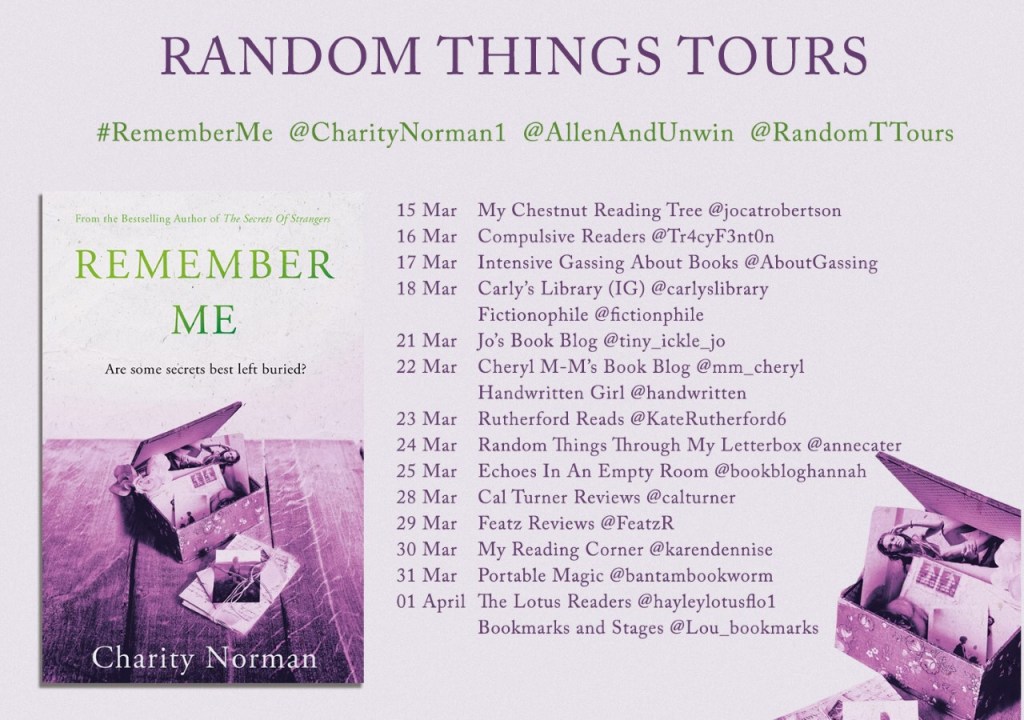
Remember Me by Charity Norman

Emily is a children’s illustrator, who spent her childhood in Hawke’s Bay but now lives in London. One evening she receives a call from her father’s neighbour, Raewynn, letting her know that his Alzheimer’s has progressed and he needs a little help. Despite both her brother and sister still living in New Zealand, Raewynn thinks Emily is the one best disposed to make the right decision. Emily’s father is well known in the area and is still known as Dr. Fitzgerald despite his retirement. He still lives on the family’s homestead with his two dogs and next door Raewynn and her son Ira who rents and farms the Arapito land. Until now they’ve managed to look after Dr. Fitzgerald, but trusting Raewynn’s opinion Emily decides to travel to New Zealand and check on her father.

When she arrives she knows all is not well. She realises her father has become very adept at seeming okay. He’s worked out which stock questions to ask when someone’s on the phone, using listening skills to let the caller think they’ve had a deep conversation. She thinks he’s rather like a magician, creating a Dr Fitzgerald who everyone knows and recognises, while underneath feeling confused, bewildered and frightened. As Emily spends time in her childhood home, memories rise to the surface: the unhappiness of her mother; her father’s distraction and avoidance of his family; the terrible state of Manu, Raewynn’s husband, who deteriorated and died from Huntington’s; the disappearance of Raewynn’s daughter Leah, who was lost on their range of mountains and has never been found. Emily was the last one to see Leah alive and the loss of this vibrant and beautiful girl still haunts the whole valley, including Emily’s father.

Norman writes about Alzheimer’s with knowledge and compassion. I spent some time working in nursing homes and Dr Fitzgerald is in the cruellest stage of his disease; he knows it is happening and he’s embarrassed, scared and exhausted from trying to appear like his old self. As Raewynn observes, it will be a blessing when he’s gone past this stage and reaches the place where he doesn’t remember his old self any more. It’s like watching the tide recede and as Emily settles in she can see this happening, layers and layers of what she recognises as her dad slowly drifting away towards the evening and then rolling back in the next morning when he’s at his most lucid. She can see the symptom of ‘sun downing’ as her dad becomes more anxious and confused in the evening. Then there are terrifying nights where he wakes screaming, doesn’t recognise her and can become violent. Then there are the family conflicts over care, as her brother and sister feel he would be better off in the ominous sounding St. Patrick’s where he’d be safe. Of course the other benefit to St.Patrick’s is that the house and land could be sold, meaning they would receive their inheritance. Emily doesn’t want to think her siblings are mercenary, but they have always stuck together and don’t have any interest in the land or the family’s long relationship with Raewynn and Ira who farm their land.

I had a huge soft spot for Raewynn, she feels like a real ‘earth mother’ type of woman and is a pillar of quiet strength. It takes a strong woman to come through the slow deterioration of her husband’s health, until he wasn’t the man she loved any more. She doesn’t complain and they all loved him fiercely, but those who know the family closely, know how much Manu’s illness took out of them all. For them to go through the loss of Leah only two years later seems unspeakably cruel. For Emily there is survivor’s guilt and her sadness for Ira, who was her best friend. Now there may be change coming, on the twenty year anniversary of her disappearance. Raewynn and Emily are interviewed, in the hope of jogging someone’s memory, that a change of allegiance might urge someone to talk, or that someone’s conscience finally forces someone to speak. In the meantime Emily is battling her siblings over her father’s wishes. Firstly, he gives her a living Will drawn up by his solicitor and much to her surprise, the person he wants to speak for him at the end, is Emily. It’s a revelation that her rather remote and unavailable father trusts her to do the right thing. It’s also a revelation that he’s been keeping a file of her memories in the box next to his bed, all the way back to her hospital baby bracelet. However, this isn’t the only revelation in the box and what Emily finds here will blow so many lives wide open.

This is what Charity Norman does best. She shows how relationship dynamics change and even break when something unexpected happens. Her characters are real, because they are so well constructed psychologically. Her sense of place is also incredible from the forbidding mountain range that backdrops the farm, to the bitter cold and the incredible micro-climate of a lush gully and waterfall hidden away. Oh how unbelievably emotional I felt at the end of this book, not just a lump in my throat, but actual tears. Yet I also felt such a feeling of ‘rightness’ that it ended the way it should. I was also deeply touched by the unique combination of Haka and bagpipes at Leah’s memorial. The New Zealanders I know seem to celebrate people for their unique traits and this memorial took me back to my brother in law’s funeral in Gisborne where a chainsaw and work boots adorned the coffin and the guttural roar of a stag heralded his departure. This writer is one of my favourites, because she understands the uniqueness of human beings, their incredible strengths and their hidden weaknesses. There is such emotional intelligence in this latest novel and it was my absolute pleasure to read it.

Meet The Author

Charity Norman was born in Uganda and brought up in successive draughty vicarages in Yorkshire and Birmingham. After several years’ travel she became a barrister, specialising in crime and family law. In 2002, realising that her three children had barely met her, she took a break from the law and moved with her family to New Zealand. REMEMBER ME is her seventh novel.

Posted in Random Things Tours

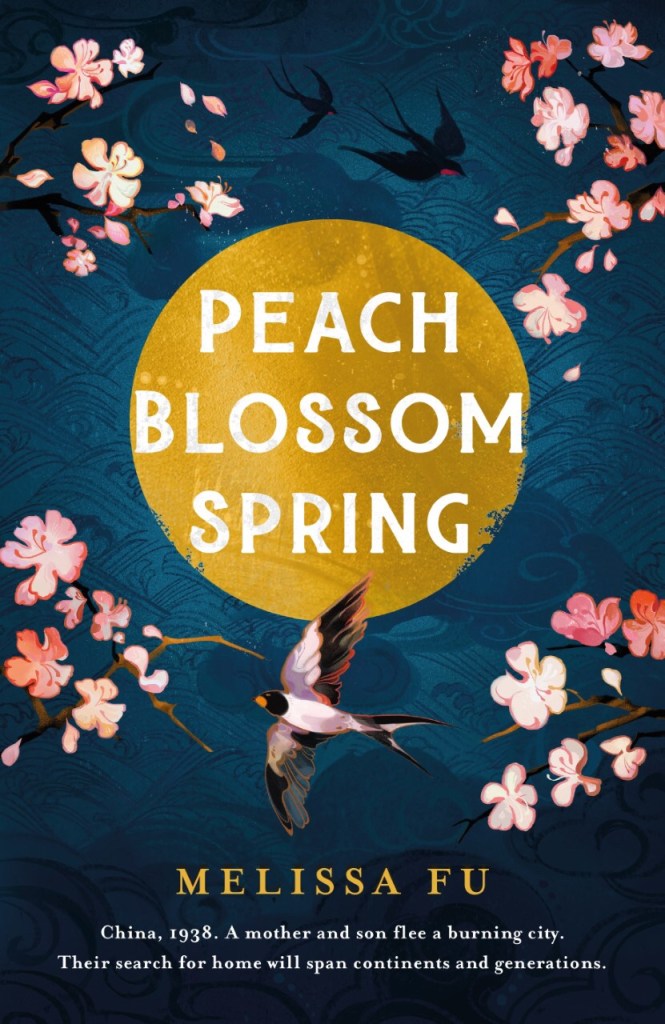
Peach Blossom Spring by Melissa Fu

With every misfortune there is a blessing and within every blessing, the seeds of misfortune, and so it goes, until the end of time.

It is 1938 in China, and the Japanese are advancing. A young mother, Meilin, is forced to flee her burning city with her four-year-old son, Renshu, and embark on an epic journey across China. For comfort, they turn to their most treasured possession – a beautifully illustrated hand scroll. Its ancient fables offer solace and wisdom as they travel through their ravaged country, seeking refuge.

Years later, Renshu has settled in America as Henry Dao. His daughter is desperate to understand her heritage, but he refuses to talk about his childhood. How can he keep his family safe in this new land when the weight of his history threatens to drag them down?

Spanning continents and generations, Peach Blossom Spring is a bold and moving look at the history of modern China, told through the story of one family. It’s about the power of our past, the hope for a better future, and the search for a place to call home.

As they are torn from the only home he has ever known, Renshu’s mother Meilin, tells him stories from a scroll she has carried with them as their most precious possession. One story she tells is that of Peach Blossom Spring, a fisherman passes through a cave that becomes so narrow he can only just squeeze to the other side. There he finds a kind of Eden, with flowering peach trees and the all the wonders of nature. It’s a peaceful place, but eventually there is a dilemma to solve. Once he leaves this place, he cannot return. If he stays, he can never return to his old life. Meilin tells him the fisherman stays and builds a life in this new place, leaving everything that came before. The book is divided into sections from WW2 to the latter part of the 20th Century, as we follow events from China when Renshu is a little boy, to his middle age and the life of his daughter Lily in the USA. This structure shows how his early experiences shape the man he becomes, but also the parent he becomes and the daughter he shapes along with his wife Rachel. The author weaves together themes of identity, women’s history, politics and conflict, as well as inter- generational trauma so beautifully, yet all the while framing Renshu’s life through this ancient Chinese story that’s still relevant today.

I think that reading this while watching the horrific images of war in Ukraine, really brought the plight of Meilin and her son more vividly to life for me. That fear, the desperation of grasping what you can, then running with only the things you carry. I’ve been thinking about it a lot. The trauma and displacement these characters, and the real people who inspired them, went through fleeing from city to city as the war crept closer and the only option was escape to Taiwan. The author’s descriptions of fire bombed cities, cramped underground shelters, and the terrifying trip down the white waters of a narrow river in a deep ravine conveyed the panic and desperation of Meilin and her family. I found the descriptions of sheltering underground so claustrophobic, with that many people crammed into the space the air becomes limited and the bombs above so loud you can’t even think. I could imagine being a child in that situation, totally powerless and trying to make sense of what you’re being told – that the dark, cramped space that scares you more than anything is the only thing that might keep you alive. Renshu’s panic is described so well I felt it, so it was no surprise when these panics resurfaced in middle age. Renshu (or Henry as he becomes known) is a curious, intelligent boy who loses his father before really knowing him and is reliant on his Mum for his very survival. We read these early turbulent experiences through Meilin’s eyes and what stayed with me so strongly was her quiet strength. There are situations where it is impossible to have a voice, where all she can do is endure. Through her section of the books what stayed with me is that the price of war is very different for women than it is for men.

Meilin does not even have time to process the loss of her husband, and has to live under the charity and protection of her brother- in -law. Even though he constantly tells her that they are family and it is his pleasure to look after them, she knows his wife does not feel the same way. She’s uncomfortable and thinks of returning to her own family, but in the chaos of conflict how does she know they’re even alive? The risks she takes to be independent from her husband’s family are huge and they don’t always pay off. I was particularly affected by the ordeal she endures while trying to sell their family scroll – the only thing of value they have left. Yet she’s resourceful, always looking for work and a roof over their heads, working hard to keep Renshu safe and financially provided for. All the sacrifices she is making for him, to go to a good school and university, are clouded by the painful realisation that every step of her effort will take him further away from her. She must be lonely, especially when the companionship and support she receives from other women is broken when their men slowly return. She learns to rely on herself instead of others, especially men who always want something in return and curtail her freedom. She only relies on her brother-in- law where she knows his government connections will help Renshu get to school in America. Yet she doesn’t take any of his offers for herself, of marriage and she never asks for anything from Renshu either. In the 1970s when President Carter wins the US election, then officially recognises the communist government of China, it’s Renshu who worries about bringing her to the US. In fact when they realise there’s a mix up in his own official paperwork, Meilin is quietly resigned to living out her days in Taiwan. She doesn’t seem angry at the ‘mistake’ made by her brother-in-law, even though I felt it was a deliberate ploy to keep her close by. All she asks is for Renshu to plant an orchard, but it will take several years for him to fully understand her meaning.

The settings are so incredibly full of life and it was fascinating to compare Renshu’s surroundings in China and Taiwan with his new home in America. I experience synaesthesia and I found the settings of Shanghai and Taiwan an overload on the senses. In fact when Renshu reached his lodgings in America it felt like a sudden silence as if I’d gone deaf. Renshu himself has to go outside and marvel at the quiet of his empty street with everyone inside their homes. Compared to Meilin’s visit to market, filled with people, vendors shouting, the colour and variety of produce, it seems to lack colour and life. I saw one place in colour and one in black and white. I wondered if the noise and bustle had simply followed on from the noises of war for Renshu, but in his first months in the US it is simply the sound of home. He might have experienced less culture shock in a bustling city like New York or Chicago, but in the mid-west it must have felt like the colour and music had been drained from the world. However, quiet doesn’t necessarily mean safe and there are insidious dangers in an anti-communist America of the 1950’s with McCarthyism in the air. Renshu’s Uncle has given him a contact in America who warns him of the dangers of seeming too sympathetic to his home country and it’s politics. He suggests he stick to Henry, the Western name that Renshu chose on a friend’s advice, but also to avoid gatherings with other Chinese students. Anything anti-Communist could see him in trouble with the government at home, whereas anything pro-Communist might mark him out as trouble to the American authorities. So, even as Henry, he is walking a tightrope, constantly on alert and perhaps missing out on friendships that might have made him less alone. His regular listening to Chopin in the university library is an expression of his emotions, he feels an affinity with the music as if it articulates something he can’t as yet.

In this epic story the author has beautifully portrayed inter-generational trauma, something that can’t be escaped no matter how many oceans you put between you and your past. There is a psychological theory that society’s seemingly expanding mental health issues are caused by trauma from as far back as the early Twentieth Century and is a legacy of two world wars. Men who went to war became distant and emotionally closed off fathers, a problem that then passes to another generation who don’t know how to be affectionate, emotional and available. The effect of that stiff upper lip mentality of the 1940s can be seen in a generation’s rebellion of the 1960’s. Just as the author describes the giant destructive force of the two bombs dropped on Hiroshima and Nagasaki, trauma creates a shockwave that rapidly spreads outward affecting everyone in its path. It takes a strong person to stand up and say I will not pass this trauma on to my children. Renshu is traumatised by war. His existence started with minute to minute thinking, the mind fully occupied with the basic needs of food, shelter and safety. Never in one place for long, Meilin and Renshu are powerless and can never really stop to enjoy any period of good fortune, because they know it can be taken away from them again in a click of the fingers. Meilin understands this. She sees that her boy has struggled to move fully away from that short term thinking – he has been able to have some aspirations though and the relative luxury of safety, a constant income and roof over his head, a long and happy marriage. Yet she sees that he still struggles to trust it all. This is why Meilin tells him to plant an orchard, because a man who plants an orchard knows there will be a tomorrow and that he will still be in the same place, watching them grow.

Meet The Author

Melissa Fu grew up in Northern New Mexico and now lives near Cambridge, UK, with her husband and children.With academic backgrounds in physics and English, she has worked in education as a teacher, curriculum developer, and consultant.
Melissa was the regional winner of the Words and Women 2016 Prose Competition and was a 2017 Apprentice with the London-based Word Factory. Her work appears in several publications including The Lonely Crowd, International Literature Showcase, Bare Fiction, Wasafiri Online, and The Willowherb Review. In 2019, her debut poetry pamphlet, Falling Outside Eden, was published by the Hedgehog Poetry Press. In 2018/2019, Melissa received an Arts Council England, Developing Your Creative Practice grant and was the David TK Wong Fellow at the University of East Anglia.

Posted in Publisher Proof

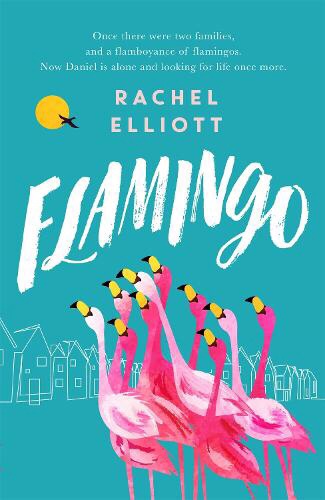
Flamingo by Rachel Elliot.

We bloggers like lists. Every year we list our favourites, then we list the books we most anticipate for the following year and to an extent that can dictate what we read. When we leave ourselves some gaps in the TBR to have a breathing space, browse and pick up what we fancy we can find unexpected gems. That’s what happened with Flamingo, the latest novel from Rachel Elliot and it really is a gem. I don’t know if I can find the right words to express how much I loved this book and why. I knew, just a few pages in, that it was going to be a joy to read. In split time frames, narrated mainly by Eve and Daniel we hear the story of two families who once lived next door to each other. Eve, and her six year old son Daniel, move in next door to Leslie and Sherry who have two daughters Rae and Pauline, and some ornamental flamingoes on their front lawn. Eve isn’t used to making friends because she and Daniel move around a lot, but for some reason Eve feels compelled to make an effort. She goes to a specialist off-licence to find just the right bottle of sherry as a witty present to take to her new neighbour. Sherry is delighted and immediately welcomes the wandering pair into her home. That summer is the happiest Eve and Daniel have ever had, as they are enveloped by this wild, eccentric and loud family – Eve uses the word rambunctious to describe them. Then Eve and Daniel leave and all the colours seem to bleach out of the world. We then meet Daniel as an adult, wandering and broken. Deeply affected by some kind words and affection from a woman in a public library, he decides to return to where he was happiest. He stands at Sherry’s door and it feels like coming home, but where is Eve and what is the real story underneath the fragments Daniel knows.

It’s disconcerting to read a character’s narration, and feel as though the author has opened up your head and borrowed your thoughts. That’s how I felt when reading Eve’s sections of the novel. I have a jumble of thoughts and ideas all at once, and I’ve learned that I need periods of quiet to counteract the amount of stimulation I have. If I go to London for the day and see a show, its exhausting and it can take a couple of days to quiet the jumble of sights, sounds, and inspiration. In fact it was using journal writing to process these thoughts that inspired me to use writing therapy in my practice as a counsellor. For years I thought everyone had my ‘busy brain’. When Eve visits the off—licence and meets the owner, Franklin, they have a shot of rum togther and she’s intoxicated by his shop, the coloured glass, the smells, the guitar playing and the wall of paintings in a back room. Eve notices all these things in seconds and Franklin asks if she likes the place.

“She tells him she likes it. It’s sort of hypnotic, like being in a chemists and a bar and a gallery all at once, and also sort of like being in church somehow, not that she ever goes to church, not that she’s religious, not that she ever goes to church, but a tiny old church in France maybe, not that she’s ever been to France”.

I loved the way the author expresses the speed of Eve’s thoughts and speech, where they come out too quickly for punctuation and you know she would have to take a deep breath at the end. I recognised it straight away, because it was me when I get enthusiastic and excited about something. In fact I sounded similar when telling my partner how much I loved the book. I know when I’m doing it, because it usually makes people smile. We learn so much about who Eve is from that one quote. I loved her enthusiasm, her eye for colour and her ability to make things. Sherry marvels when she mends Rae’s cords, by sewing a patch of Wonder Woman underneath the tear. Rae’s reaction is pure joy and Sherry is astounded that Eve has thought of such a thing, but to Eve it’s normal. She simply knew the cords needed mending and she had remembered that Rae loved Wonder Woman. It’s these little bursts of creativity and thoughtfulness that make her so endearing as a character. It probably stood out to me because I have just embroidered denim jackets for my stepdaughter’s birthdays – one of Frida Kahlo and one of Alice in Wonderland. What’s so special to Rae is that Eve has seen her, listened, and created something she would love.

These parts of the novel, where the characters connect, are its strength and it was no surprise to find out the author is also a psychotherapist. Rae is an introvert and Eve has seen and understood. She knows from Rae’s shining face that she loves the cords but understands the that Rae doesn’t want to be effusive about it, because it just isn’t her.

‘It’s her way to play things down; she is naturally reserved, understated or so it seems. Her mother, who expresses every emotion with intense theatricality, who takes up all the space, calls her eldest daughter the quiet one, as if this quietness is a kind of fragility – not a powerful act of disobedience and unruliness’.

Sometimes, in a house of very loud voices, whispering is the only way to be heard. Rae’s head is crammed with thoughts and it takes an awful lot of effort to keep them in sometimes and Eve has seen a kindred spirit in her.

Daniel is also a fascinating and the dynamic between him and his mum, suggests there’s more to their back story than meets the eye. He has an anxiety around people that concerns Eve and she is protective. Before they go to Sherry’s house for the first time, she prepares him for the social interaction. She wants to prepare him, but she also wants to be careful and avoid her own anxiety rubbing off on him. She explains that this is a thing people do, take a gift to their new neighbours and introduce themselves properly. At Sherry’s door she stands back with a reassuring hand on Daniel’s shoulder and talks about the ornamental flamingoes on the lawn. She tells him their collective noun is a flamboyance of flamingoes, a little game they play together. Eve is so surprised when Sherry opens the door and her boy walks straight in – ‘shy little Daniel stepping towards a stranger.’ Eve doesn’t seem to realise that Daniel is struggling with the impermanence of their lives; they have moved every year since Daniel was born. This was another thing I could identify with since we moved six times before I was in secondary school. I know how difficult it was to walk into a new classroom and see thirty pairs of eyes looking at you. Eve has a map on the kitchen wall and from time to time would simply close her eyes and pop a pin in it to choose their next destination. When she gives Daniel the chance to choose, it’s too much and his imagination runs haywire: what if there are monsters where he chooses? What if its horrible? What happens to their home? Will strangers take their things?

‘Trouble was she hadn’t left it up to chance. She had left it up to a six year old boy, who already hated that map on the wall. In some homes a map would evoke an atmosphere of learning, open-mindedness; lets be aware of the world, there are more places than home. But for Daniel it triggered fear and a sense of transience; always on the go, never know when’.

There are so many touching moments in the book I can’t possibly list them all, but the budding relationship between the boy Daniel and Sherry’s husband Leslie is just so moving. The confidence he gets from time spent with Leslie (who is not a girl) playing cards and learning to swim is obvious. When Leslie leaves the broken fence down so Daniel can appear from his garden and scare them at the window it feels different from other places they’ve been. Daniel blooms with this unconventional extended family and describes it to his Aunty as like having two homes. I was dreading the map coming out again. We meet adult Daniel at a crossroads in life physically and emotionally. As their tenancy ends on their flat, Daniel’s girlfriend Erica decides this is a good time to reassess their relationship and leaves. Instead of picking himself up, Daniel seems unable to cope with this double loss and ends up walking the streets with a rucksack and only a ceramic sheep for company. When he turns up at Sherry’s door she is blown away by the man he’s become, like a ‘matryoshka’ where she can see the boy inside the man and the woman inside the boy. I loved this description because it beautifully describes the ever changing selves inside us, but also the effect of previous generations and incarnations of who we are. Daniel is carrying so much more than his rucksack, but also the baggage of being left behind by the women in his life, the loss of this family where he felt at home and the original secret, the one that always compelled Eve to move them on, from place to place. Can this family, once again, give Daniel the space to heal and process a lifetime of hurt?

This is a slow burn novel, told in fragments like half forgotten memories and with such beauty it could be a poem. The writer conveys perfectly how certain people can hold space for and heal wounds in each other. Even if they’re only with us for a short time. In light of recent events it’s important to remember that to live fully we must connect with each other. The book shows humans in their best light and at their most powerful, when showing love and accepting others for who they are. When Daniel is a child he is taught that flamingoes are not actually born pink, but attain their colour through their diet. Their beauty comes from what’s put into them and humans are the same – we are the sum of what we are fed from parents and caregivers right through to a kind woman in a library acknowledging Daniel’s suffering. Through Daniel, and Rae to an extent, there’s an acknowledgment of how painful this life can be, but that healing and change is possible. I was enchanted by this story and it will keep a special place in my heart.

In the garden, there were three flamingos. Not real flamingos, but real emblems, real gateways to a time when life was impossibly good. They were mascots, symbols of hope. Something for a boy to confide in.

Meet The Author


Rachel Elliott is the author of WHISPERS THROUGH A MEGAPHONE (2015, Pushkin Press, longlisted for the Women’s Prize for Fiction 2016) and DO NOT FEED THE BEAR (2019, Tinder Press). Her third novel, FLAMINGO, was published on 3 Feb 2022 by Tinder Press and is out now in hardback, ebook & audiobook. She is also a psychotherapist.

Out now from Tinder Press

Posted in Throwback Thursday

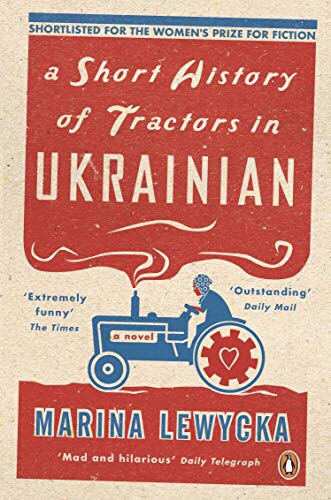
A Short History of Tractors in Ukrainian by Marina Lewycka.

Synopsis

‘Two years after my mother died, my father fell in love with a glamorous blonde Ukrainian divorcee. He was eighty-four and she was thirty-six. She exploded into our lives like a fluffy pink grenade, churning up the murky water, bringing to the surface a sludge of sloughed-off memories, giving the family ghosts a kick up the backside.’ 


Sisters Vera and Nadezhda must aside a lifetime of feuding to save their émigré engineer father from voluptuous gold-digger Valentina. With her proclivity for green satin underwear and boil-in-the-bag cuisine, she will stop at nothing in her pursuit of Western wealth. But the sisters’ campaign to oust Valentina unearths family secrets, uncovers fifty years of Europe’s darkest history and sends them back to roots they’d much rather forget . .

My Thoughts

The second phone call came a few days after the first. ‘Tell me, Nadezhda, do you think it would be possible for a man of eighty-four to father a child?’

I love this unexpected question early on in the novel, coming from Nadezhda’s elderly father out of the blue. It’s not the sort of question I’d expect from my father, but as our narrator Nadezhda points out, her father is always straight to the point and when he’s in the grip of a big idea never bothers with small talk or enquiries about her health. My mum read this first and told me I needed to read it. Within a couple of pages I knew why, Nadezha’s father was an elderly Ukrainian engineer, widowed for several years, with a penchant for tractors and straight talking. I was laughing out loud within pages, I couldn’t believe Marina Lewycka had conjured this man out of her imagination, especially since he was sitting on my sofa reading his daily paper.

My father-in-law came to live with us in Spring 2004. The plan was that he would spend summers with us and winters in New Zealand with his other son and family. My husband’s family were from Poland, relocated as children from Poland to England, his father escaped from a labour camp in Siberia. So, not exactly the same story as Nadezhda’s father, but his speech, mannerisms and preoccupations were eerily similar. I should just say that my father-in-law would have been horrified to be propositioned by a woman thirty years his junior. He wore his wedding ring until the day he died, at least twenty years after his wife was killed in a car accident. We didn’t always see eye to eye. However, some of the things that drove me insane when we lived together, became rather endearing and even downright hilarious with time. Blunt speech was a trademark of his, to the point of seeming rude in some cases. Yet, when told someone was offended by his comment, he would say ‘but it was correct, yes?’

One favourite lunch party dissolved into disbelief and giggles when he addressed his godson’s wife and suggested she might be more comfortable sitting on his chair than the kitchen stool since she had a ‘much larger’ bottom than him. He was bewildered by the reaction, believing he was being chivalrous by offering her the dining chair and because she did, in fact, have a much larger bottom. I realised this was a preoccupation of his when he came to visit us proffering a carefully cut out article from his daily paper for me. The subject was scientific research that found women with larger bottoms had longer lives than apple shaped women who stored fat round their middle. He was very happy with his discovery, humming away to himself in the kitchen, as my father and I shut ourselves in the bathroom laughing uncontrollably so we didn’t offend him. I hadn’t realised he was very appreciative of this body type until he asked me to look up the journalist Victoria Derbyshire. He had been listening to her on the radio for some time, but had never seen her in person and despite his son being the director of the media lab at a university he wasn’t up to speed with using the internet yet. I showed him her photograph and he shrugged his shoulders mournfully saying he’d expected her to be a much rounder woman in general but specifically with a ‘much bigger bottom.’ It dawned on me that he felt this was a compliment, something he thought was vital to his idea of female beauty.

He also had a way of making even the most positive things sound like a problem. At a fancy dress party my husband and I threw at home, he watched me working all day to put together a buffet for the guests. Finally, just before people started arriving, he asked if he could take a picture of the buffet table. My husband seemed to think he was impressed by the spread, but his face seem to suggest he was inwardly struggling with what to say. Finally he sighed deeply and said ‘but so much food, how can one possibly choose?’ Later, I received in the post a printed copy of his photograph of the food, showing me that it was important to him. After learning more about his family struggles during the war, and the death of his brother as they were hiding in the Siberian forests, I understood more deeply his utter disbelief at so much choice when weighed against the constant hunger he remembered feeling. Nadezhda tells us about her father’s specialty of ‘Toshiba’ apples – chopped Bramley apples nuked so thoroughly in the microwave they became apple sauce. This was a speciality of my father-in-law with apples that were so hot, they were still cooking in the desert bowl half an hour later. If he wanted to cool food he had a brilliant idea. My brother-in-law had been living. with his father for many years. He was a tree surgeon and had built what they called ‘the cage’ attached to the back of the house. This was a dog run, padlocked and used as a store for chainsaws and other equipment. Any food that needed to cool was placed in the cage on an upturned tree stump, open to the elements on all sides, but sheltered by a roof and away from foraging animals. This made perfect sense in practice, but always caused questions at the dinner table from guests baffled by the instruction ‘fetch the pie from the cage’.

Nadezhda’s father is proud of his late wife’s ability to forage and preserve food to last into the winter season. There is a pantry of store bought supplies, boxes of preserves and fermenting alcohol under the bed, plus a deep freeze full of vegetables and individually portioned meals. Everything labelled and rotated by date.

The only way to outwit hunger is to save and accumulate, so that there is always something tucked away. […] What she couldn’t make had to be bought second hand. If you had to get it new, it had to be the cheapest money could buy, preferably reduced or a bargain. Fruit that was on the turn, tins that were dented, patterns that were out of date, last year’s style. It didn’t matter, we weren’t proud, we weren’t some foolish types who wasted money for the sake of appearance, Mother said, when every cultured person knows what really matters is what’s inside.’

It took three visits for me to work out that what I thought was a kitchen island, in Aleks’s kitchen, was actually a deep freeze with a loose work top laid over it. When he was out we looked in it to find portioned meals labelled by Jez’s mother who had died ten years previously. I thought it was grief that kept the freezer lid closed and it was in part. It was also a survival instinct of someone who had known hunger and that those closest to you, the people you depend on, could be taken from you without warning. All starting with a terrifying knock on the door. Aleks’s father was in the Polish military, shot by the Russians and his family marched to a Siberian labour camp. By the time they escaped and joined the Resistance in a forest camp there was only Aleks and his mother left alive. Behind the comic elements of her book, the author is telling a similar story of political fanaticism, social upheaval, hunger, displacement and terrible loss. I was more understanding when I he told me about his conversation with my sister -in-law who had just bought a property in New Zealand. Apparently, he was most impressed by how quickly his son had ploughed up the tennis courts and planted potatoes.

The part I find most sad, both in the book and for my father-in-law, is that the homeland they crave and hold in their hearts and minds no longer exists. Alek would have been ten when he left Poland, but the Poland he left isn’t there waiting for him. Nadezhda’s father talks at length about a Ukraine that was forty or even fifty years ago. He wants to save one person from the tyranny of communism and give them the freedom of a life in this country. In his head he imagines tyrannical politicians controlling the people, but also the Pastoral beauty of his home country. He will rescue Valentina and in return she will bring to him the Ukraine of his youth with golden wheat fields, lush forests and flowing rivers. Nadezhda who has visited more recently remembers concrete tower blocks and polluted rivers full of dead fish. She tries to tell him that the people are no longer noble peasants, they are consumers longing for Western designer goods. Within weeks of them marrying Valentina has insisted on her own car – ‘not just any old car either. Must be good car. Must be Mercedes or Jaguar at least.’ She also wants second car, for when she’s in the Ukraine. Then it’s the cooker, three rings are not working, but ‘it must be prestigious cooker, must be gas. Must be brown.’ When Nikolai objects because the brown one isn’t on offer, she won’t let it go. He wants her to have ‘crap cooker’ because he is ‘no good meanie’. In the meantime Nadezhda starts to ask for legal advice on her father’s behalf, because there must be a divorce and they can’t bear the thought of this woman owning half of their mother’s things.

I thank the Lord we never had a Valentina to contend with. We sometimes hoped he would find someone, to ease the loneliness and take his head out of the past. The wardrobes full of his mother’s furs and Hanna’s side of the bed, left as if she’d be coming back any moment. We simply didn’t understand each other. If my friends came round it was my welcome break from the care routine – my husband had MS and he was on palliative care – a space to unload a bit, but I couldn’t do that if my father-in-law was also pulling up a chair and joining in. Although I did have it easier than my sister-in-law who found he was in the room when she was on all fours in labour. We had long conversations on the phone where we would both complain that he found us too loud, too opinionated and in my case, a bit too Northern. She would complain that he never shared any praise or positive thoughts about her and I felt exactly the same. I did realise though that he was telling other people – I would tell Jenny that he was proud of her mothering skills and the way she was bringing up his grandsons. She would tell me that he was amazed at the strength I had to keep going, to look after Jerzy every day and not panic if things went wrong. I found that Alek and I bonded more after my husband died, with a shared grief and on his part an understanding and gratitude for the years I spent nursing ‘his boy’. He would ring me every Sunday morning until his eyesight failed him and I missed those calls so much when they were gone. Even now, when I think of him stroking the back of my head as I told him how his son died, it brings a lump to my throat. Every time I read this book it’s a bittersweet experience. It makes me laugh still. I think of all those funny stories and the times we shared, even the hard parts when we didn’t get along. I would do them all again just to spend time with this incredible man. As for Nadezhda and her father Nikolai, I won’t ruin the ending, but there are more twists and turns along the way. For me, every time I pick this book up, I get to spend a little more time with an incredible man who I miss every day.

Published by Penguin 2nd March 2006.

Posted in Random Things Tours

The City of Tears (The Burning Chambers 2) by Kate Mosse.

I’ve been reading Kate Mosse since Labyrinth all those years ago and I’m always impressed by the level of detail and knowledge of French history she weaves into her books. Every detail is considered and you have the impression straight away that you’re in safe hands. In The City of Tears she combines her fictional narrative with fascinating real events focusing on the Catholic and Huguenot conflicts of the 16th Century. This is the second book in the Burning Chambers series and I did choose to go back and read the first book. However, due to Mosse’s ability to immerse you in her world, I think this could be read as a stand alone novel. It continues the adventures of Minou Reydon-Joubert and Piet Reydon, characters caught up in a period beset by complicated religious and political wars. Mosse walks the tightrope between these warring factions carefully, illustrating that there is honour and corruption on both sides, but keeping the focus on the family at the centre of these conflicts.

We return to the Languedoc region of France and the wars have now raged for ten years. It’s May 1572 and Minou and Piet travel with their two children, Marta and Jean Jacques, to Paris for the royal wedding of Charles IX’s sister, Catholic Marguerite de Valois, and Protestant Henry III of Navarre. This wedding has the political and religious benefits of uniting both Catholic and Protestant factions, so could mark the start of peace, but it’s a fragile accord. Piet’s old acquaintance Cardinal Valentin (Vidal) is in Paris too, but he’s now an enemy, unbeknownst to Piet he has a plan to kill all important Huguenots during the celebrations. The terrible violence that follows was known as the St Bartholomew’s Day Massacre and thousands of Huguenots were murdered. Seven year old Marta is separated from her parents in the chaos and goes missing. It’s a parent’s worst fear, but unable to find her, Minou and Piet have to flee the city without her. The pair are devastated as they cross the border and make their way to safety in Amsterdam. I loved the way Mosse depicted the strain this decision places on the couple’s relationship. They have managed to ensure the safety of their two year old son, but are filled with guilt for leaving their daughter behind.

Minou and Piet only return to France twelve years later after hearing of a woman who bears a resemblance to Minou. Could it be Marta? They have to take a chance and search for their daughter, but danger is still everywhere. They don’t know that family enemy Vidal is there, with his collection of fake relics, that he intends to use with the ambition of gaining power and position. He believes Piet is in possession of a stolen relic and is driven by bitterness and revenge. His evil nature and conviction he is carrying out God’s work, is beautifully offset by Minou who is a strong willed and opinionated woman doing the best for her family rather than a religion. Piet is also more logical and open-minded, he’s a Huguenot by religion, but doesn’t believe there is only one way to God, particularly when religious difference is used as an excuse to oppress and murder. The couple’s return has raised the tension and jeopardy for all their friends and family, and Mosse delivers some suspense filled twists and turns where the hunted and hunter just miss each other.

I felt like I was in the hands of a master storyteller here. Mosse is able to bring historical fiction to life, and really makes the reader care about the lives of people long gone. She delivers the drama at such a pace, her characters barely have time to draw breath. The depth of her research is truly impressive, even if sometimes I found myself having to read very carefully so I didn’t become confused – but that’s my failing, not hers. The family are so well drawn I truly cared about their outcome and the dynamics between them are written with emotional intelligence. The character’s emotions feel so real and add depth to an already absorbing story. My heart broke for Minou at the loss of her daughter, and I was so invested in her grief that I couldn’t see how she would adjust to living without her. The strain they were under and the constant danger they’re in added an intensity to Minou and Piet’s relationship that was so romantic. Mosse’s incredible skill is to make the reader care about and feel a connection with people who lived in the 16th Century. They are so different to us in dress, daily life and beliefs but the themes of family, parenthood and loss are so universal that they cross the centuries. It will be interesting to see where these fascinating characters go next.

Check out the other reviews from these great bloggers:

Meet The Author

Kate Mosse is a number one international bestselling novelist, playwright and non-fiction writer. The author of eightnovels and short story collections –including the multimillion-selling Languedoc Trilogy (Labyrinth, Sepulchreand Citadel) and Gothic fiction The Winter Ghosts and The Taxidermist’s Daughter, which she is adapting for the stage –her books have been translated into thirty-eightlanguages and published in more than forty countries. She is the Founder Director of the Women’s Prize for Fiction and a regular interviewer for theatre & fiction events. Kate divides her time between Chichester in West Sussex and Carcassonnen in south-west France.

Posted in Random Things Tours

The Impulse Purchase by Veronica Henry

I spent a lovely escapist couple of days reading about this interesting family of women all at a crossroads in life. Julia, great-grandmother and owner of the beautiful Wisteria House in the village of Rushbrook, has died. She has left behind four generations of women: grandmother Cherry who was a model in the 1960’s; mother Maggie, the redoubtable owner of a food PR company; daughter Rose who is a new mum and volunteers at the local homeless charity; finally there’s Gertie, three years old and the apple of everyone’s eye. Aside from great-grandmother Julia’s death and Gertie’s birth, this is a family facing a lot of change. Maggie is still mourning the death of the love of her life, husband Frank. It’s been a couple of years now, but both Maggie and Rose miss him every day. Maggie also faces change at work, as her apprentice has absconded taking some of the business with her. Rose has struggled with grief, but her job is giving her more confidence even though she cares and gets involved more than she should. Cherry is organising a party to celebrate her husband’s retirement, something she’s very good at. Mike is an artist and photographer, retiring from teaching and looking forward to spending more time travelling with Cherry. They just need to finish the sale of Cherry’s childhood home at Wisteria House, but Cherry sees something at the party that changes her mind and sets in place a new plan for all the women of the family.

The Swan is Rushbrook’s public house and has been a family haunt for as long as they can remember, from Cherry’s teens to recent family celebrations with her mother. In fact, even though they live in Avonminster, this village is very important to the women. Rose was particularly close with her great-grandmother and when she’s feeling anxious closes her eyes and imagines the smells of the roses in her garden. In fact Gertie is even named after two of her favourite roses from the garden at Wisteria House. The Swan has become run down since the landlord’s wife has been ill and on an impromptu visit he tells Cherry he’s going to sell The Swan. Cherry has just completed on Wisteria House and partly because of Mike’s party, but also because she wants to take on a project for herself, she buys the pub on impulse. She knows she can make it work, but what will Mike think? Also, how will she do this on her own? With both Maggie and Rose at a crossroads too, they decide to help and all three women uproot themselves and move to the boathouse behind the pub. Soon all three are busy: Cherry with the refurb; Maggie in the kitchens; Rose in the gardens. Can this team of women make The Swan a success?

I found this book a delight from start to finish, so uplifting and full of formidable female characters. Cherry is a ray of sunshine and I enjoyed going back to the 1960’s to her meeting with Mike. They’re a lovely couple who have been devoted to each other for years, but as they both face changes and keep secrets from one another, they might be looking at a different relationship going forward. Maggie is a force of nature, hard working and full of ideas for the menu. She’s also coping with complicated feelings, that pull between missing the person you’ve lost while also becoming excited about moving forward with your life. She’s attractive and dynamic so isn’t short of attention from men, but finds dipping her toe in the water more complicated than she expected. I loved Rose, she has such a big heart and is stronger than she imagines. Her move to Rushbrook is something of an escape from overstepping the boundaries with a homeless client. Rose’s story arc is uplifting and joyful, especially her struggles to understand anxiety and live with her negative inner voice. She also has a tiny hint of romance for good measure.

One of the most powerful aspects of this novel is the inter generational relationships, so it was interesting to read this alongside my Mum. These women are wonderfully open with each other, they give each other support both emotionally and to succeed in life. Their support for Rose as she becomes a young single mum is crucial to Gertie being the carefree little soul she is. I know this because my parents, especially my Mum, did the same for my brother as he became a father at 17. I know that the way my mum helped bring up my niece and nephew, has been the inspiration and example for my niece now that she’s an incredible mum to two small boys. People think it’s instinctive, but I can see both my parents in the way she plays with her boys and encourages their development. We are in the lucky position of having four generation of family and I love seeing my dad playing football with his great-grandsons.

I have a similar, very open relationship with my mum and now I’m older we really are friends. People are often surprised when I say my parents would be the first names I’d put on any party list and my mum comes to my book club, workshops and we go to meditation together. Then I sit back and watch how she nurtures the younger members of these groups, particularly those who struggle with depression or social anxieties. In the same way, I enjoyed reading about the effects these women have on the residents of the village, particularly the lovely Chloe. They provide work for some, start unexpected friendships with others and give the inspiration for some to make changes of their own. They really are a force for good and I was hoping they could make the pub a success, that it would become a community hub for the village and that Cherry and Mike would find a way to assimilate The Swan into their relationship. These relationships are underpinned by an incredibly picturesque village, wonderful descriptions of interior designs and stunning gardens that feed all the senses. This is a gem of a book, full of hope and with a great sense of fun. I loved reading and discussing it with my mum too. I found myself smiling all the way through and at the end I felt like I’d been on a lovely weekend away.

Meet The Author

Veronica Henry has worked as a scriptwriter for
The Archers, Heartbeat and Holby City amongst many others, before turning to fiction. She won the 2014 RNA Novel of the Year Award for A Night on the Orient Express and is a Sunday Times bestselling author of over twenty books. Veronica lives with her family in a village in north Devon and can often be found
cooking up the perfect seaside feast.
Find out more at veronicahenry.co.uk or follow her on social media:
@veronica_henry @veronicahenryauthor @veronicahenryauthor

Posted in Random Things Tours

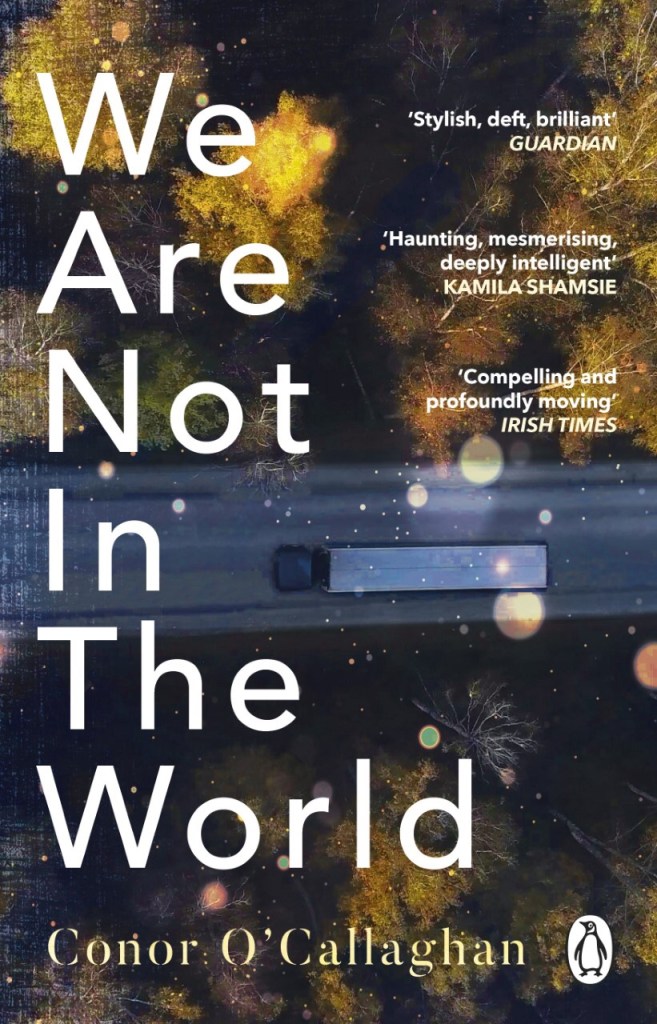
We Are Not In The World by Connor O’Callaghan.

‘The cargo door opens. It opens incrementally. It falls forward, away from us, into foreign day. There are men down there, stevedores in hi-viz and hardhats shouting to one another. I rotate the ignition to halfway, to check for evidence of light. The instrument panel flashes and falls still. There are chains. There is shrieking of iron like gates of hell. Then this fluorescence gradually floods the floor between rows and creeps towards us and feels warm.’

As soon as I read these lines, following Paddy as he and his lorry emerges from the ferry and out into the light, I knew the writing was going to be spectacular and that this was a poet’s novel. Paddy is travelling from England to France, with his stowaway daughter in tow. It’s hard to explain, but this is a book that manages to be both bitter and beautiful. There’s a bleakness to Paddy’s existence, but such a richness in the language used to describe it. It feels bang up to date too, despite the fact no pandemic is mentioned, the author captures a sense of unreality that is all too commonplace these days. The feeling that the world we know and understand has gone, and we are plunged into something other, like Alice down her rabbit hole. We Are Not In The World is an apt title indeed. We follow Paddy on his mundane journey, punctuated by graphic brief encounters and interactions with his daughter Kitty. However, we are also taken into Paddy’s memories of the past and into his relationships, which are largely disastrous. This is an intelligent rendering of psychological damage wrought within families. His marriage is broken, his brother is more successful than he is and there is a complex, almost Oedipal, relationship between him and his mother – also named Kitty. His daughter is wild and rebellious, and in another nod to Paddy’s mother, she wears her gran’s mink coat at all times.

This is not an easy read, but the right readers will love it. Having searched out some of the author’s poetry, it’s clear that the novel touches on some of the same themes. Family and sibling rivalry are represented in Paddy’s relationship with his brother. There’s a jealousy of his apparent successes, but Paddy has still made him the godfather of his daughter. There’s a sense that family is inevitable and no matter how much we wish to escape it we can’t. Separation is explored too – separateness from the land where he grew up, from family and even from his own self. There’s a sense of wanting to be home, but not being able to and the feeling of homesickness that pervades Paddy’s daily existence. He describes it as like a ‘low level virus’ that he permanently lives with. To me it felt like a low-level depression, one that would drop under the radar of most GP’s charts, but is debilitating nonetheless. There’s a numbness in Paddy. He’s on auto-pilot in his daily life, only living in his head until an interaction jolts him out of his memories. The separateness he describes is something I’ve felt when depressed or going through grief. I was physically in the world, but felt no connection to my surroundings or other people. It was like looking at the world through glass.

The only thing Paddy seems to look forward to is some sort of homecoming. He looks at the family home of Tír na nÓg as both a rose-tinted past and a future redemption. Situated on a shingle beach in Ireland, it feels like his chance of happiness or at least a respite from the homesickness that plagues him. Can it be a place of things coming full circle? A completion of this endless mental push and pull between past and future. It feels like a pipe dream, far removed from the reality he’s in and the way he thinks about certain family events, referred to by him and Kitty as ‘the thing we never mention.’ There are times when I wondered if Kitty was real, or whether her birth from the hiding place of his bunk behind the cab was purely metaphorical. I had moments of confusion, moments of being unsure how these fragmented memories and feelings fit together. I was even unsure of what was real and what was imagined occasionally. However, I loved the feelings it induced in me and the sheer beauty of the prose. There’s a haunting quality to the novel that will stay with me. It was a reading experience that I let wash over me, rather like listening to an opera or viewing a beautiful painting. This is for those readers who like their novels to be strange, and bleak, but beautiful at the same time.

Published by Doubleday 18th February 2022

Meet The Author

Conor O’Callaghan is originally from Dundalk, and now divides his time between Dublin and the North of England. His critically acclaimed first novel Nothing on Earth was published by Doubleday Ireland in 2016.