Posted in Publisher Proof

The Lying Club by Annie Ward

If you love a juicy gossip about your fellow villagers or friends, or watching rich people’s lives implode, then this is definitely the book for you. Based around an elite Colorado private school, a tangled web connects three women. Brooke, the archetypal private school mum, fiercely protective and an filthy rich heiress with a creative approach to her wedding vows. Asha is a realtor, staging and selling houses while juggling children, hormones and an increasingly distant husband who she fears is having an affair. Then there’s Natalie, a lowly office assistant, watching the parents and children at the school taking for granted a life she could only dream about. Brooke has probably passed Natalie hundreds of times since she started working at the school, but probably doesn’t even know her name. Asha has noticed her, but only because Natalie has turned up at lots of her open house events. This is strange because there’s no way she could afford the types of properties Asha is selling. These women are bound by their relationships with the handsome, charming assistant athletic director Nicholas. Brooke wants him, in the way she wants any handsome man to notice her, but also because he has the contacts to get her daughter Sloane into one of the best colleges based on her talent at football. Asha uneeds him to get daughter Mia ready for the competitive world of college applications, because the best school won’t take two girls from the same school and Brooke seems several steps ahead. Natalie’s motives are the purist, she’s falling in llove with him and he’s making all the right noises, but is it just lip service? When two bodies are carried out of the school early one morning, it looks like the jealousy between mothers and daughters, or rival lovers, or the haves and have-nots has boiled over. The truth will shatter the surface of this isolated, affluent town, but whose version of the truth counts in a town where people will stop at nothing to get what they want?

I’ll be honest, it was hard to like anyone in this novel. Even the kids were awful; they were spoiled, entitled and self-centred. Asha’s daughter Mia, being the best of the bunch, is unsure what it will take to get into a good college until Brooke brings it to the family’s attention when she buys a state of the art camera to film Sloan’s soccer matches and create a reel for her application. Once Asha realises and approaches Coach Nick for help, Brooke becomes furious, worried that Mia’s Indian heritage will ensure her a place thanks to the positive discrimination built into the application process. Meanwhile, it’s clear there’s something brewing in the girl’s social circle of students who are particularly gifted at sport. I was shocked by just how sophisticated their sports programme was with gym work, massages, physiotherapy, and even anti-inflammatory injections happening on school premises. Are these kids simply rebelling over the level of control the coaches seem to have in their lives? I wondered whether they were plotting revenge against Coach Nick. Sloan’s boyfriend Reade, is fed up with Nick’s control over his athletes, hinting that he may want to get rid of Nick or at least have him reprimanded and he wants to recruit Mia to their plan.

Natalie is meant to be the most sympathetic character I think and on the morning she drives to the school to find it swarming with police she is in genuine shock. Then we go straight back to her reasons for being in Colorado; her brother had an accident and broke his leg so badly he couldn’t get around. So Natalie has been caring for him and took the job at the school when he started doing more for himself. She’s a painter by trade, with a shop on Etsy selling quirky pet portraits. She starts seeing Nick, almost accidentally, after a bit of flirtation at her desk when he’s been in to se the Headteacher. He invites her to his home and Natalie is blown away by how beautiful it is. Yet I was seeing red flags everywhere about their relationship going long term: Nick is a lot older and possibly wants different things; he’s previously been a womaniser; they never go anywhere but his place; he asks Natalie to keep their relationship secret. Yet Natalie seems to be falling in love and I had to admit he talked a good game. Is Nick just super careful because of his teaching role and what are these private sessions he seems to be conducting with elite kids?

The best thing about not really warming to anyone in the novel meant I could genuinely enjoy the tension and these people getting their comeuppance! The structure worked really well with an excerpt from a police interview, then going back to the events in question. The move back in time a few months illuminated the case going forward and the interview drew together many of the things I’d been concerned about. The drip feed of new information definitely kept me reading and gave me sudden changes of opinion on some characters. I was so invested in what the kids were up to and why Mia seemed to be under pressure from the others to join in. I kept wondering if they really had the measure of their opponent or was someone going to get hurt? I was also wondering if the mystery of the memorial Natalie had seen on her walk would be explained? Who was the crying woman and would new revelations shed light on this old story? With it’s luscious settings, opulent homes and beautiful people the best way to describe the book is to say this was like a particularly indulgent dessert. Strangely, even though the subject matter is dark, it’s delicious, decadent and rather thrilling.

Published by Quercus 3rd March 2022.

Posted in Random Things Tours

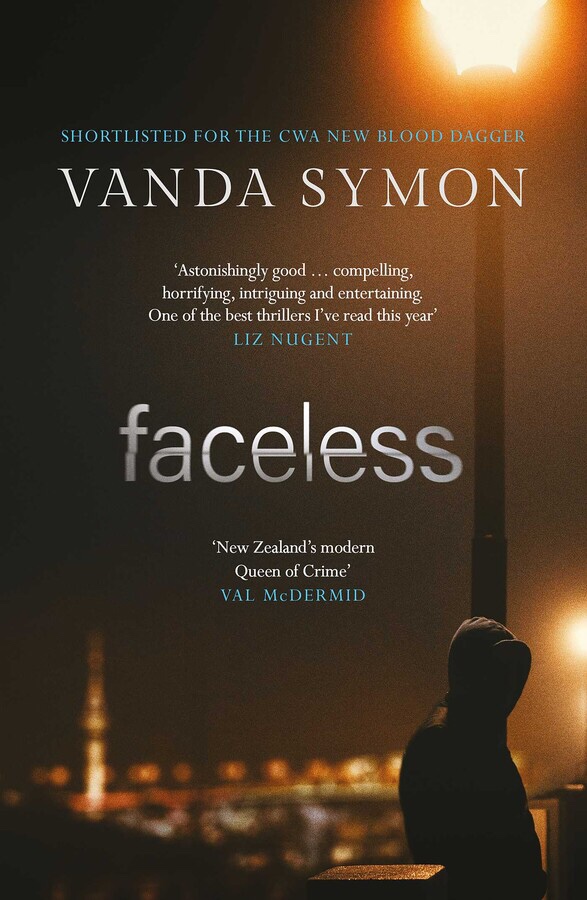
Faceless by Vanda Symon.

I devoured this fast paced novel set on the streets of Auckland and focused on a young street girl called Billy and a hardened homeless veteran called Max. Ever since Billy stumbled into the same doorway one cold night, she and Max have had a connection. He showed her how to use cardboard boxes to keep warm and where to find the best thrown out food. They have a pact to take care of each other and wherever they go in the day, they always make their way back to the same adjoining doorways at night. So, when Billy doesn’t appear one night, Max knows something is wrong. He needs to find her, but where to start in a city of this size and will anyone take him seriously?

Meanwhile, Billy has stumbled into the path of someone having a very bad day. Bradley is exhausted. Over-mortgaged, overworked and under appreciated, he is reaching the end of his tether. Having neglected his family all weekend to work, Bradley has been in the doghouse with his wife Angie. Yet it’s not enough for his boss who doesn’t seem to appreciate that five people used to do the same job Bradley is now doing alone. Bradley sees the prostitutes on their usual patch as he drives home, wondering idly what sort of man actually has the nerve to drive up and do it, to actually pay a woman to do what he wants. He wouldn’t have the nerve. Then he sees a young, tomboyish girl standing a little way from the others. She’s not a regular and he is less intimidated by her. So he picks her up and she directs him to an industrial area where no one will disturb them. He doesn’t know what impulse drives him to hit her, possibly the amusement in her eyes when he isn’t ready for her, but the feeling it gives him is better than anything he’s felt in a long time. There’s a rush of power and it’s intoxicating. So he takes her to an empty industrial unit he owns and using cable ties he makes sure she doesn’t escape. He might come back tomorrow.

Told from both Max, Billy and Bradley’s points of view in short chapters that prove rather addictive, the story unfolds of how both these people ended up on the streets and how an ordinary family man becomes a monster. I was constantly thinking ‘just one more chapter’ until I was half way through the story in my first sitting. I finished the book the next morning. The story is gritty. It doesn’t pull its punches when it comes to describing life living on the streets, or the realities of being kidnapped and left with nothing for your comfort. I could actually feel the cold, smell the mustiness of not showering for several weeks, and understand the shame of being left with no toilet facilities. It is vivid and because it’s a first person experience it’s very confronting in parts. I was so caught up in Max’s search for his friend, linked somehow to an old trauma and another young girl, and how desperate he becomes to have someone listen to him. So desperate that he has to overcome embarrassment and maybe even face whatever terrible experience has kept him running all this time. Billy is running too, but being alone and captive gives her ample time to explore what’s happened to her. Although it will take the police investigation to find out the full truth of Billy’s need to run. Through these two people we see just a couple of the reasons that people end up on the streets, but no matter why it’s a tough life that no one would choose unless they were desperate.

As for Bradley, he raises a lot of questions about the making of violent offenders, particularly those who commit crimes against women. Would anyone in Bradley’s position make the same choices he does? Or was there something latent in him, triggered by stress and what he saw as a girl from the streets looking down on him? He doesn’t fully understand the changes himself, all he knows is that the more he takes out his stresses and strains on Billy, the better he feels. He also seems to have regained his libido too, as he and Angie cavort like teenagers. He has just the right sort of happily married suburban man vibe to get away with what he’s done. I found myself rooting for Billy and whatever strength she could summon to survive just long enough for Max to find her. The visions of her grandmother are touching, providing context for Billy and an insight into her culture. Auckland is a strong presence in the novel too, from the rough, deserted areas where Billy creates her spray paint portraits of mythical women to the over-mortgaged suburbs where Bradley is lucky enough to live. We see the multi-cultural mix of kids hanging out in the park and the life of a suburban wife with their book club, exercise class lifestyle. It’s very clear that for most people in this life how you look and what you have defines you. Thankfully thats not the case for everyone and I loved Meredith, a snappy and intelligent detective who would rather wear heels than the regulation shoes. She looks beyond the surface and her investigative skills are the best, but she doesn’t have much to go on. Through her we get Max’s back story and her respect and trust in him doesn’t depend on his status – although she does insist on a shower. This book will keep you up at night to find out what happens to these characters. There isn’t a word wasted here and the pace is perfect. If you like your crime gritty, with great characterisation and empathy then this is for you. I loved it.

Meet The Author

Vanda Symon is a crime writer, TV presenter and radio host from Dunedin, New Zealand, and the chair of the Otago Southland branch of the New Zealand Society of Authors. The Sam Shephard series, which includes Overkill, The Ringmaster, Containment and Bound, hit number one on the New Zealand bestseller list, and has also been shortlisted for the Ngaio Marsh Award. Overkill was shortlisted for the CWA John Creasey (New Blood) Dagger.
Twitter @vandasymon, Instagram @vanda-symon, Facebook, @vandasymonauthor, http://www.vandasymon.com.

Posted in Publisher Proof

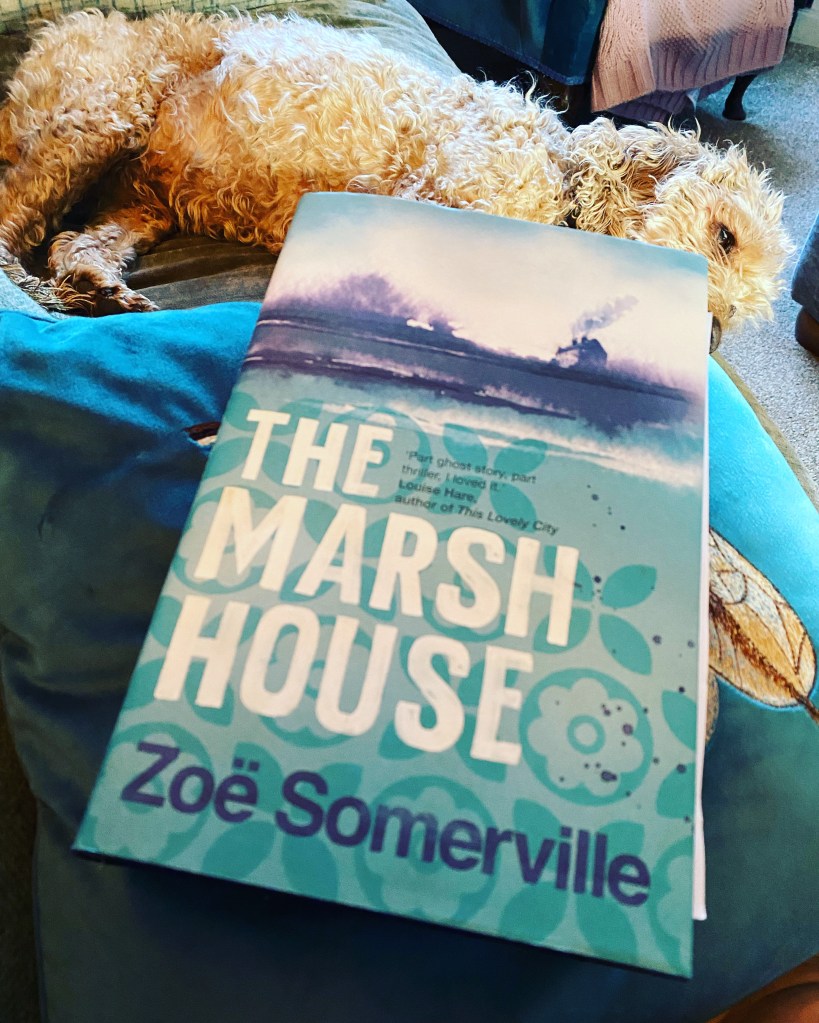
The Marsh House by Zoë Somerville

I simply loved this book. In fact, a finished copy arrived through the post and I started browsing the first page then couldn’t stop reading. So I read it straight through, finishing at 2am. It’s a split timeline story, beginning with Malorie and her daughter deciding to spend Christmas in a cottage on the Norfolk coast after an argument with her boyfriend. Malorie feels like a bad mother and wants to get one thing right – an idyllic holiday cottage Christmas for her daughter. Maybe if she achieves this one thing, she can convince herself she’s not as useless as she imagines. The sense of foreboding hits the reader immediately as the weather promises snow and Malorie becomes disoriented in the fog. She skids and ends up wedged into a hedge. The Marsh House itself is damp, dark and neglected. They cannot even see the sea through the mist. Malorie begins to wonder if this is a bad idea, but finds a pair of journals in the attic while searching for Christmas decorations, and she begins to read. Written by a young woman called Rosemary, who lived in the house, the journals tell a tale of a young woman’s crush on the boy from the big house. This young woman’s story paints a picture of 1930’s rural Norfolk, becoming a young mum and her husband’s link to fascism and Oswald Moseley in particular. Malorie can’t put the journals down, but alongside the house’s strange atmosphere, they are having an effect on her sleep and her state of mind.

I felt for Malorie straight away and her sprite of a daughter. Malorie is very hard on herself and has a negative inner voice, not helped by an over critical partner at home. Here she is capable, ordering logs and a turkey, rigging up a Christmas tree with vintage ornaments from the loft, and even managing real candles in their holders. However, even when she’s barely started the journals, the locals are giving her the house’s sordid history. That whiff of fascism becomes stronger when Malorie finds leaflets in the attic and the girl in the village shop asks if she knows what happened at The Marsh House? Tales of lost cocklers cut off by the tide that can still be heard screaming in the fog don’t help her state of mind. The house itself holds some scary relics too including a weird picture of women who perhaps lived here, one with bright green eyes that bore into you. I loved how the author drip fed these little bits of information, adding to the house’s history but also to the creepy tension that keeps building. It’s Malorie’s kinship with Rosemary, the writer of the journals, that drives the story forwards. The more she understands about the writer’s life, the more confused she becomes between fantasy and reality leading to some truly terrifying visions in the night. Why does she feel so connected with someone she’s never met who lived here thirty years before? Who is the strange woman with the large dog she sees from time to time, and why does she seem to be looking after the family by leaving logs to keep them warm?

I did enjoy Rosemary’s story too, her innocent crush on the boy from the family at the big house. She fantasises about what it would be like to have him like her too, to kiss her on the cheek and choose her above the more well to do girls in society. There does seem to be a part of him that is attracted to Rose, but she might also suit his purposes – a compliant country wife at home to keep the line going while he gallivants in London with Moseley’s social circle. Having read a bit about the Mitford sisters and Unity in particular, I had already known how popular fascism was in the ranks of the aristocracy and how some of our great country houses were used as meeting places for talks on appeasing Hitler. I hadn’t known of it’s hold in Norfolk and found this aspect of the book interesting. As time goes on and Rosemary is treated very badly by her husband it was clear that something terrible was going to happen, but the final revelations are truly shocking. I loved the way she delved into the complicated, emotional experience of becoming a mother. She opens up the inner world of these women, with their constant questioning of whether they’re good enough, or are they failing at this job we’re led to believe should come naturally? There is a special skill in weaving real historical events with fiction and this author is so talented and creative. She brings this area of England to life and makes the reader want to visit and search it out for themselves. The atmosphere was so evocative I spent two days with a ‘book hangover’ – unable to start another book because my emotions and senses were so embedded in Malorie’s story. I loved this so much I could have happily gone back to the first page and read it over again.

Published by Apollo 3rd March 2022

Meet The Author

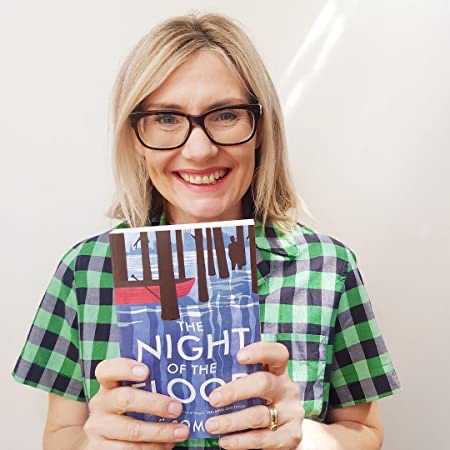
Zoë Somerville is originally from Norfolk, but has settled with her husband and children in the West Country. She works as an English teacher. Zoë began her debut novel, The Night of the Flood on the Bath Spa Creative Writing MA in 2016. It was published in September 2020. Her second novel, The Marsh House, a ghost story and mystery is published in March 2022. She is currently writing her third novel.

Posted in Random Things Tours

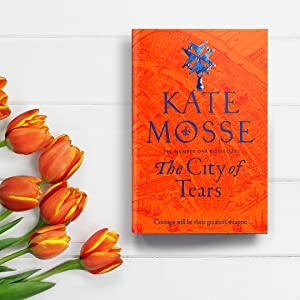
The City of Tears (The Burning Chambers 2) by Kate Mosse.

I’ve been reading Kate Mosse since Labyrinth all those years ago and I’m always impressed by the level of detail and knowledge of French history she weaves into her books. Every detail is considered and you have the impression straight away that you’re in safe hands. In The City of Tears she combines her fictional narrative with fascinating real events focusing on the Catholic and Huguenot conflicts of the 16th Century. This is the second book in the Burning Chambers series and I did choose to go back and read the first book. However, due to Mosse’s ability to immerse you in her world, I think this could be read as a stand alone novel. It continues the adventures of Minou Reydon-Joubert and Piet Reydon, characters caught up in a period beset by complicated religious and political wars. Mosse walks the tightrope between these warring factions carefully, illustrating that there is honour and corruption on both sides, but keeping the focus on the family at the centre of these conflicts.

We return to the Languedoc region of France and the wars have now raged for ten years. It’s May 1572 and Minou and Piet travel with their two children, Marta and Jean Jacques, to Paris for the royal wedding of Charles IX’s sister, Catholic Marguerite de Valois, and Protestant Henry III of Navarre. This wedding has the political and religious benefits of uniting both Catholic and Protestant factions, so could mark the start of peace, but it’s a fragile accord. Piet’s old acquaintance Cardinal Valentin (Vidal) is in Paris too, but he’s now an enemy, unbeknownst to Piet he has a plan to kill all important Huguenots during the celebrations. The terrible violence that follows was known as the St Bartholomew’s Day Massacre and thousands of Huguenots were murdered. Seven year old Marta is separated from her parents in the chaos and goes missing. It’s a parent’s worst fear, but unable to find her, Minou and Piet have to flee the city without her. The pair are devastated as they cross the border and make their way to safety in Amsterdam. I loved the way Mosse depicted the strain this decision places on the couple’s relationship. They have managed to ensure the safety of their two year old son, but are filled with guilt for leaving their daughter behind.

Minou and Piet only return to France twelve years later after hearing of a woman who bears a resemblance to Minou. Could it be Marta? They have to take a chance and search for their daughter, but danger is still everywhere. They don’t know that family enemy Vidal is there, with his collection of fake relics, that he intends to use with the ambition of gaining power and position. He believes Piet is in possession of a stolen relic and is driven by bitterness and revenge. His evil nature and conviction he is carrying out God’s work, is beautifully offset by Minou who is a strong willed and opinionated woman doing the best for her family rather than a religion. Piet is also more logical and open-minded, he’s a Huguenot by religion, but doesn’t believe there is only one way to God, particularly when religious difference is used as an excuse to oppress and murder. The couple’s return has raised the tension and jeopardy for all their friends and family, and Mosse delivers some suspense filled twists and turns where the hunted and hunter just miss each other.

I felt like I was in the hands of a master storyteller here. Mosse is able to bring historical fiction to life, and really makes the reader care about the lives of people long gone. She delivers the drama at such a pace, her characters barely have time to draw breath. The depth of her research is truly impressive, even if sometimes I found myself having to read very carefully so I didn’t become confused – but that’s my failing, not hers. The family are so well drawn I truly cared about their outcome and the dynamics between them are written with emotional intelligence. The character’s emotions feel so real and add depth to an already absorbing story. My heart broke for Minou at the loss of her daughter, and I was so invested in her grief that I couldn’t see how she would adjust to living without her. The strain they were under and the constant danger they’re in added an intensity to Minou and Piet’s relationship that was so romantic. Mosse’s incredible skill is to make the reader care about and feel a connection with people who lived in the 16th Century. They are so different to us in dress, daily life and beliefs but the themes of family, parenthood and loss are so universal that they cross the centuries. It will be interesting to see where these fascinating characters go next.

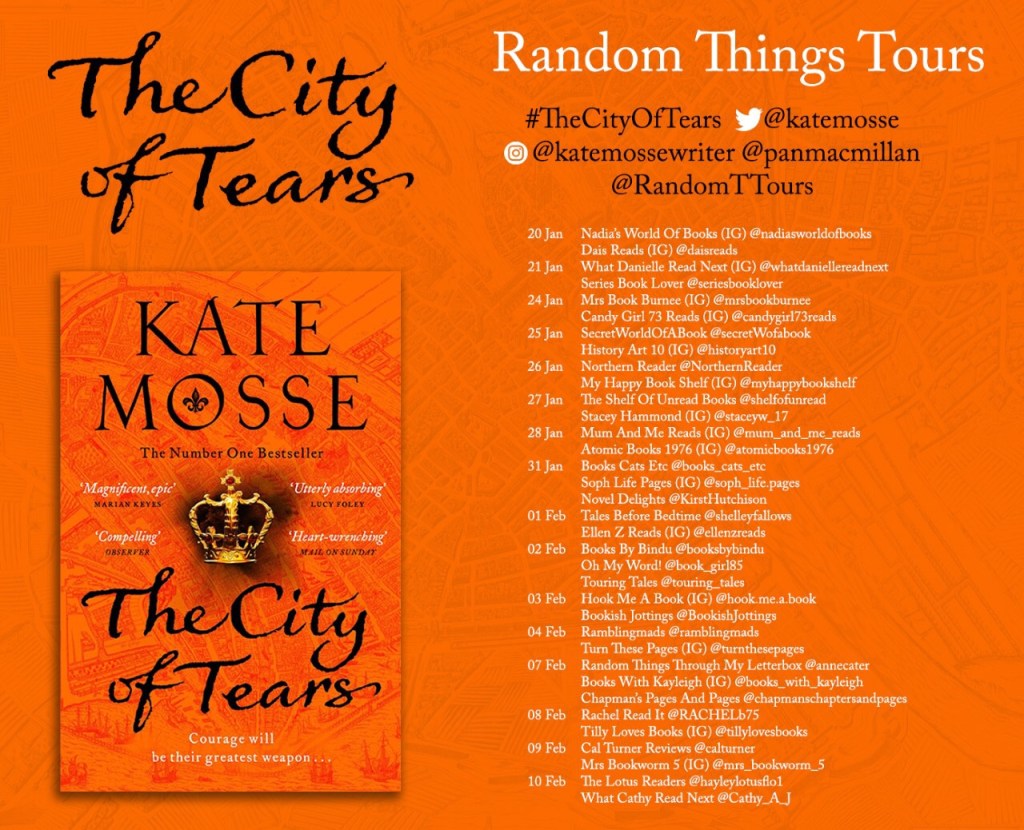
Check out the other reviews from these great bloggers:

Meet The Author

Kate Mosse is a number one international bestselling novelist, playwright and non-fiction writer. The author of eightnovels and short story collections –including the multimillion-selling Languedoc Trilogy (Labyrinth, Sepulchreand Citadel) and Gothic fiction The Winter Ghosts and The Taxidermist’s Daughter, which she is adapting for the stage –her books have been translated into thirty-eightlanguages and published in more than forty countries. She is the Founder Director of the Women’s Prize for Fiction and a regular interviewer for theatre & fiction events. Kate divides her time between Chichester in West Sussex and Carcassonnen in south-west France.

Posted in Random Things Tours

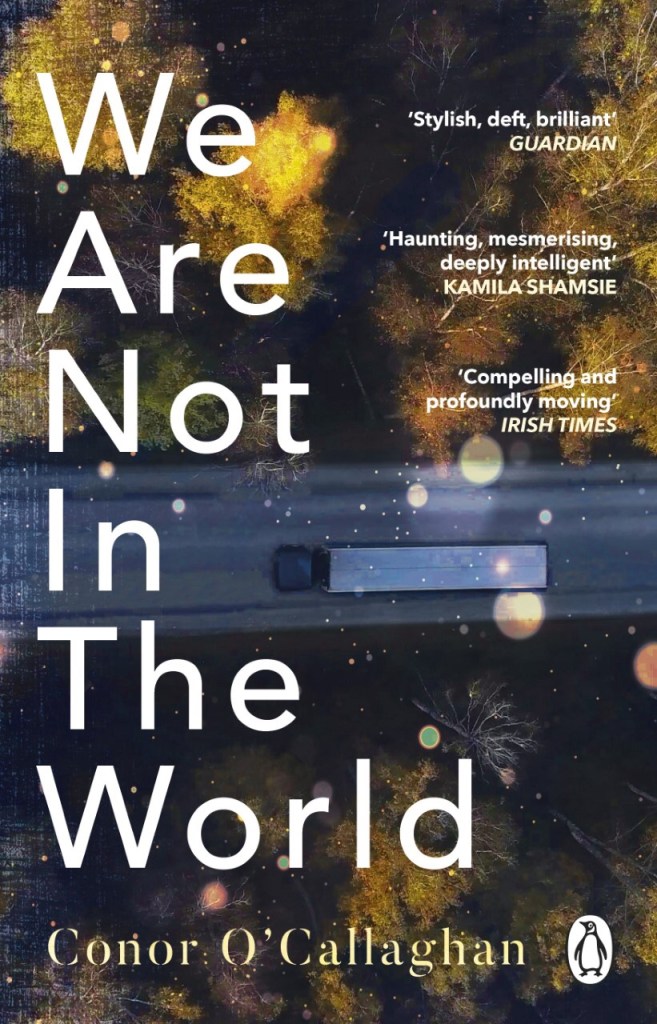
We Are Not In The World by Connor O’Callaghan.

‘The cargo door opens. It opens incrementally. It falls forward, away from us, into foreign day. There are men down there, stevedores in hi-viz and hardhats shouting to one another. I rotate the ignition to halfway, to check for evidence of light. The instrument panel flashes and falls still. There are chains. There is shrieking of iron like gates of hell. Then this fluorescence gradually floods the floor between rows and creeps towards us and feels warm.’

As soon as I read these lines, following Paddy as he and his lorry emerges from the ferry and out into the light, I knew the writing was going to be spectacular and that this was a poet’s novel. Paddy is travelling from England to France, with his stowaway daughter in tow. It’s hard to explain, but this is a book that manages to be both bitter and beautiful. There’s a bleakness to Paddy’s existence, but such a richness in the language used to describe it. It feels bang up to date too, despite the fact no pandemic is mentioned, the author captures a sense of unreality that is all too commonplace these days. The feeling that the world we know and understand has gone, and we are plunged into something other, like Alice down her rabbit hole. We Are Not In The World is an apt title indeed. We follow Paddy on his mundane journey, punctuated by graphic brief encounters and interactions with his daughter Kitty. However, we are also taken into Paddy’s memories of the past and into his relationships, which are largely disastrous. This is an intelligent rendering of psychological damage wrought within families. His marriage is broken, his brother is more successful than he is and there is a complex, almost Oedipal, relationship between him and his mother – also named Kitty. His daughter is wild and rebellious, and in another nod to Paddy’s mother, she wears her gran’s mink coat at all times.

This is not an easy read, but the right readers will love it. Having searched out some of the author’s poetry, it’s clear that the novel touches on some of the same themes. Family and sibling rivalry are represented in Paddy’s relationship with his brother. There’s a jealousy of his apparent successes, but Paddy has still made him the godfather of his daughter. There’s a sense that family is inevitable and no matter how much we wish to escape it we can’t. Separation is explored too – separateness from the land where he grew up, from family and even from his own self. There’s a sense of wanting to be home, but not being able to and the feeling of homesickness that pervades Paddy’s daily existence. He describes it as like a ‘low level virus’ that he permanently lives with. To me it felt like a low-level depression, one that would drop under the radar of most GP’s charts, but is debilitating nonetheless. There’s a numbness in Paddy. He’s on auto-pilot in his daily life, only living in his head until an interaction jolts him out of his memories. The separateness he describes is something I’ve felt when depressed or going through grief. I was physically in the world, but felt no connection to my surroundings or other people. It was like looking at the world through glass.

The only thing Paddy seems to look forward to is some sort of homecoming. He looks at the family home of Tír na nÓg as both a rose-tinted past and a future redemption. Situated on a shingle beach in Ireland, it feels like his chance of happiness or at least a respite from the homesickness that plagues him. Can it be a place of things coming full circle? A completion of this endless mental push and pull between past and future. It feels like a pipe dream, far removed from the reality he’s in and the way he thinks about certain family events, referred to by him and Kitty as ‘the thing we never mention.’ There are times when I wondered if Kitty was real, or whether her birth from the hiding place of his bunk behind the cab was purely metaphorical. I had moments of confusion, moments of being unsure how these fragmented memories and feelings fit together. I was even unsure of what was real and what was imagined occasionally. However, I loved the feelings it induced in me and the sheer beauty of the prose. There’s a haunting quality to the novel that will stay with me. It was a reading experience that I let wash over me, rather like listening to an opera or viewing a beautiful painting. This is for those readers who like their novels to be strange, and bleak, but beautiful at the same time.

Published by Doubleday 18th February 2022

Meet The Author

Conor O’Callaghan is originally from Dundalk, and now divides his time between Dublin and the North of England. His critically acclaimed first novel Nothing on Earth was published by Doubleday Ireland in 2016.

Posted in Publisher Proof, Random Things Tours

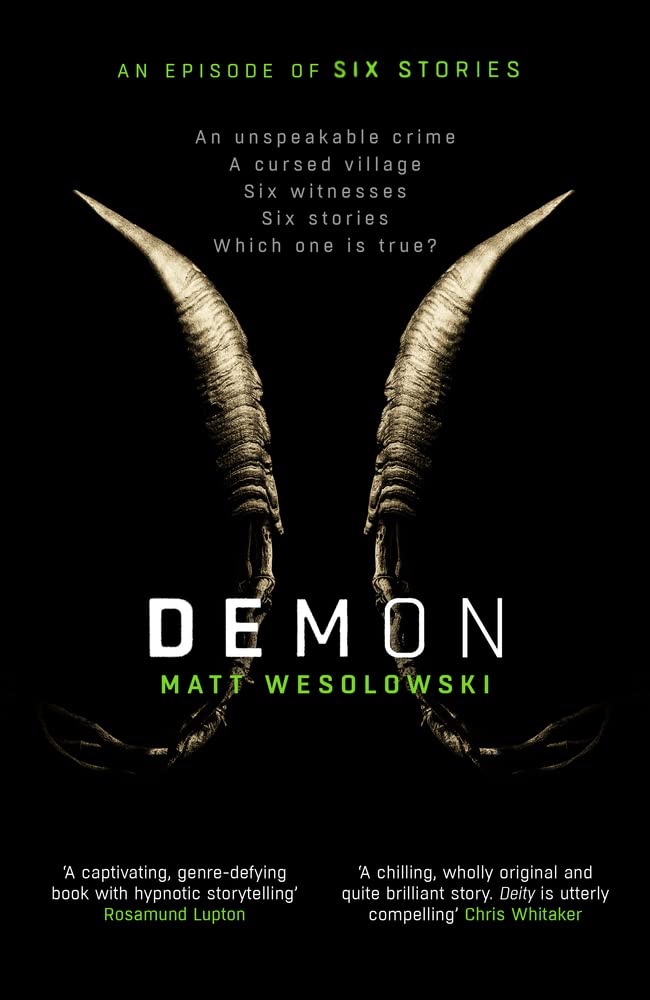
Demon by Matt Wesolowski

I was fascinated and blown away by this sixth novel in the author’s Six Stories series. As always the novel’s structure is based on a podcast format, where Scott King presents his investigation into a true crime case. Each podcast consists of six stories told by six people associated with the case, with additional emails, news reports and documents on the crime. This time King has chosen a highly emotive crime that reminded me of the James Bulger case. The novel takes us to the old mining village of Usslethwaite in Yorkshire, where a terrible crime was committed, one that shocked the world. In 1995 the murder of twelve year old Sidney Parsons, by two boys his own age, was front page news. The murderers were dubbed the ‘Demonic Duo’ by the press and as well as the usual speculation about both the boy’s upbringing and mental state, there was a whisper of something more sinister. The hills above Usslethwaite were reknowned as a place where witches congregated, all the way back to the 17th Century when witch-hunting was rife. Rumours of something dark and disturbing lurking in the caves near the crime scene had plagued the village for centuries, as well as more contemporary plagues of flies, animal deaths and a strange black shape seen nearby. Is there something supernatural and demonic about this crime? Or are they just hysterical excuses for a crime so savage no one can understand it? Now that the murderers have reached adulthood, they’re quite possibly rehabilitated and living somewhere in the U.K. Maybe now it’s time to hear the truth about what happened when Robbie and Danny formed a friendship and proceeded to commit this unspeakable crime.

I love the originality of this author’s work and his audacity in writing about subjects other writers might avoid. I was 20 years old when Robert Thompson and Jon Venables lured James Bulger away from his mother at a Liverpool shopping centre, then murdered him and left him on the train line in Walton. Everything I remember from that case also comes up in the course of King’s interviews about Usslethwaite. I remember being shocked by the murder, the age of Thompson and Venables, but also the savagery of the press and public towards the accused who were still children. Whilst the anger the crime aroused was understandable, I couldn’t understand grown men gathering outside a court to attack the prisoner transport. I kept wondering what their goal was. What would they do if they actually broke through to those boys? Even now, the mention of either boy, their incarceration or the new lives they now have kicks up a frenzy of controversy and rage. While Demon isn’t based on the Bulger case I did wonder if Wesolowski had it in mind, because he has managed to capture a lot of those conflicting feelings in this novel. Through his podcast guests we can look at different aspects of the Usslethwaite murder, and consider the differing perspectives on what happened. Although there is outrage that Scott King is even featuring this case, I can see that all he is trying to do is answer that universal question: Why? What drove these two boys to kill?

The psychological and paranormal aspects of the case are carefully intertwined here. Robbie is a newcomer to the village, fostered by a lovely, community minded couple who haven’t been able to have children. There is speculation on what Robbie went through before he was taken into care and whether he is the disruptive force behind the crime, with Danny simply taken along for the ride. However, Danny is quite a sad, lonely and disturbed little boy even before Robbie comes along. He found his mother when she had hung herself from the rafters of the barn. Rumours abound about his mother who was a herbalist and reiki healer – something rather frowned upon and misunderstood by some members of the village. In fact she was well regarded by her patients and it could be said that the suspicion was raised due to her occupation and how lucrative it seemed to be, more than anything she did. There were reports of her coming down from the caves with another person, scandalously naked. She was also thought to set fires and dance around them. However, to Danny she was the parent who brought warmth, love and softness to his life. Without her, he is left in the care of his father who is not a bad man, but is absorbed by work and struggles to show affection. Danny visits the caves to speak to his Mum, and thinks he might hear her, but in this dark place it’s hard to know who or what might reply.

The author is incredibly skilled at ratcheting up the tension, whether with more detail of the case or the next eerie happening. I often found myself reading yet another chapter so I could find out what was next. I found the paranormal elements clever, I wasn’t scared at first, but after a while the atmosphere built and I found myself uneasy. One night, my other half asked me to turn the bedside light off since it was late and I found myself unsure whether I wanted to carry on reading in the dark. The strange happenings in Robbie’s room at his foster home were very unsettling, from phantom footsteps to flies and a horrible smell that seems to permeate everything. There’s so much in this village that can’t be explained and is witnessed by lots of different people. Were these boys influenced by demons or was this a case of two very mixed up and lost boys doing something so terrible it would destroy the village, the victim’s family, and the rest of their lives. I loved the varied perspectives, especially those unexpected ones that took our understanding to another level. While never losing sight of the victim and his family’s loss, we get to explore the ideas of rehabilitation and how a perpetrator lives with their crime, especially ones so young. Can they ever make a life for themselves and get over the guilt? Or are they forever doomed to keep moving, constantly looking over their shoulder for fear of being exposed? I was fascinated with the question of whether a demon influenced these boys or whether we could call the boys demons. They are labelled monsters, but are they? Perhaps we just label them this way, because we can’t accept one human being could do this to another, let alone a child. This is another incredible read from this inventive and original author. I devoured it so quickly that I’m buying the whole series with this month’s book budget.

Meet The Author.

Matt Wesolowski is an author from Newcastle-Upon-Tyne in the UK. He is an English tutor for young people in care.

‘Six Stories’ was published by Orenda Books in the spring of 2016 with follow-up ‘Hydra’ published in the winter of 2017, ‘Changeling’ in 2018, ‘Beast’ in 2019 and ‘Deity’ in 2020.

‘Six Stories’ has been optioned by a major Hollywood studio and the third book in the series, ‘Changeling’ was longlisted for the Theakston Old Peculier Crime Novel of the Year, 2019 Amazon Publishing Readers’ Award for Best Thriller and Best Independent Voice.

‘Beast’ won the Amazon publishing award for Best Independent voice in 2020.

Posted in Random Things Tours

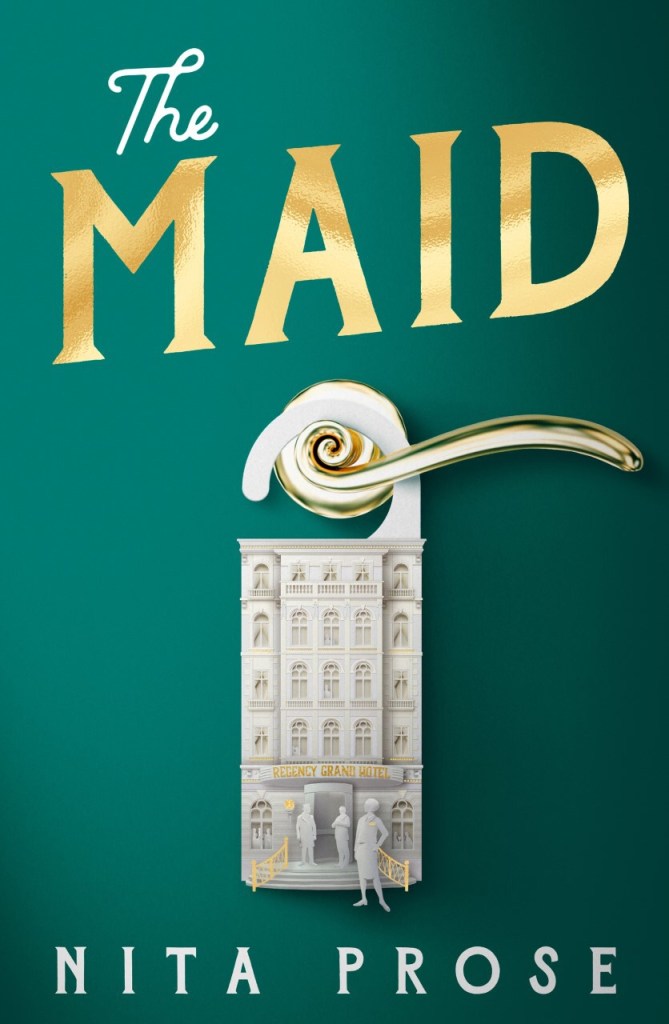
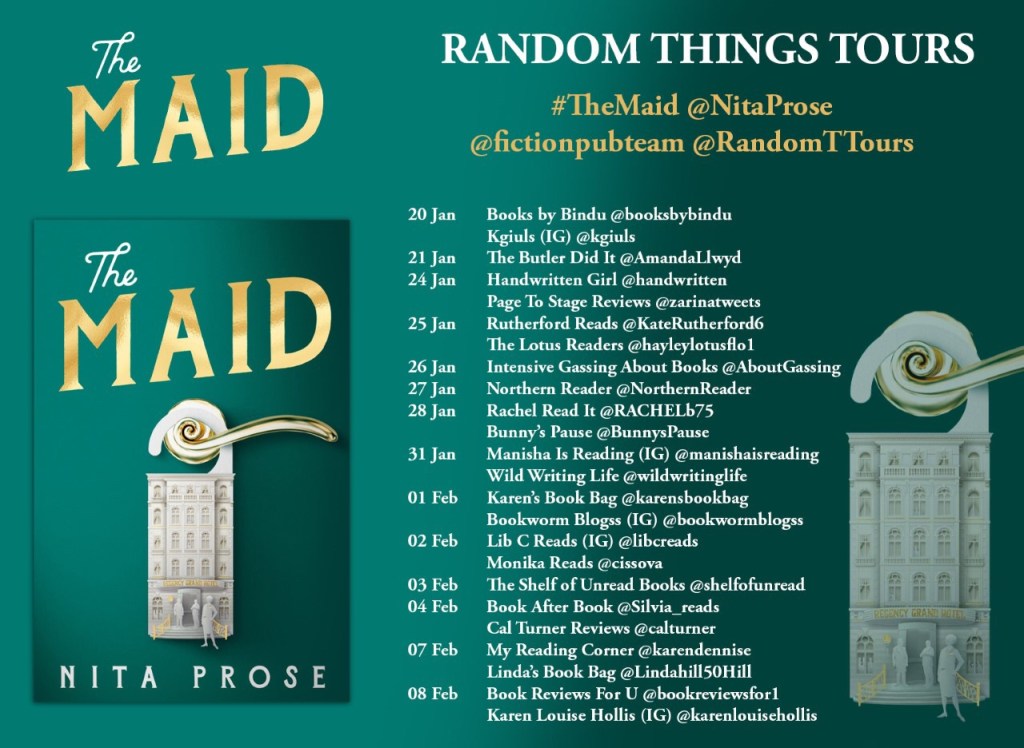
The Maid by Nita Prose.

I’m an absolute sucker for books where the narrator addresses the reader directly. I loved Molly the Maid from the first page and the book was an absolute delight from start to finish. Molly works as a maid at the Regency Grand Hotel and she is very proud of her skills as a cleaner, skills she learned from her grandmother who died a few months ago. Many of her colleagues find Molly a little bit odd – in fact she knows they call her Roomba after a robot hoover – but she thinks they call her Rumba after the dance on Strictly although she doesn’t know why. Molly likes things to follow a routine, things must be in their place and there are ways to clean everything. In fact her Gran said that cleanliness was next to Godliness. Even at home they had a cleaning schedule, something different each night before dinner, and Molly has carried that into her work. She does have some friends, Mr Preston who works on the door, Juan who washes dishes in the kitchens and Rodney who works behind the bar. Her friends are very important to her and if it does good, it’s occasionally okay to bend the rules. So, when Rodney takes her out for a meal and asks for a favour she’s only too happy to help.

Juan has lost his work visa and needs a place to stay, so could she slip him a key each day to an unoccupied room? Rodney gives her a bag, she doesn’t check, but assumes they are Juan’s things and deposits them in the chosen room on her rounds. Her last friend is Giselle, the glamorous second wife of Mr Black, who stays in a suite at the hotel so regularly that Giselle and Molly have interacted a lot. She has all those qualities that Molly values in a person – she acknowledges the little people, she’s polite and treats Molly like a real human being, rather than looking past her. The story begins as one day Molly doubles back on her normal route to clean the Black’s bathroom. She’s done the rest of the suite, but Giselle was in the shower. Molly makes her way through the suite, noticing that cushions are disturbed, the safe is open and Mr Black is taking a nap on the bed. Yet when she looks closer, perhaps he isn’t sleeping? Maybe he’s dead?

This was a clever way of merging a thriller, with a genuinely uplifting story about someone who has gone through an enormous change in her life. I truly felt gripped by the thriller aspects of the story, but also touched by the personal journey that Molly is facing. She has lost someone close to her and is learning to negotiate life as a fully fledged adult. She doesn’t have that ability to read people’s moods and motivations so she’s perhaps an easy mark for people who want to exploit her. I thought the author had a very difficult line to tread with the tone of the novel. We know that Molly thinks in an individual way and there are times when we do understand more than she does about what’s going on at the hotel. Molly refers to this with a jigsaw analogy – she knows she has all the pieces, but hasn’t put them in the right order yet. This could have been disastrous if the reader was superior to Molly, but we never are. The author keeps us firmly with our heroine, even while other characters treat her badly and underestimate her intelligence. The story was gripping and I wanted to know what was really going on at the hotel, and which of Molly’s friends were truly fighting her corner. Molly is a heroine who will stay with me a long time. Even though the goings on at the hotel are sleazy and dangerous, her personal story is touching, charming and ultimately joyful.

Meet The Author.

NITA PROSE is a long-time editor, serving many bestselling authors and their books. She lives in Toronto, Canada, in a house that is only moderately clean.

http://www.nitaprose.com
@NitaProse

Posted in Random Things Tours

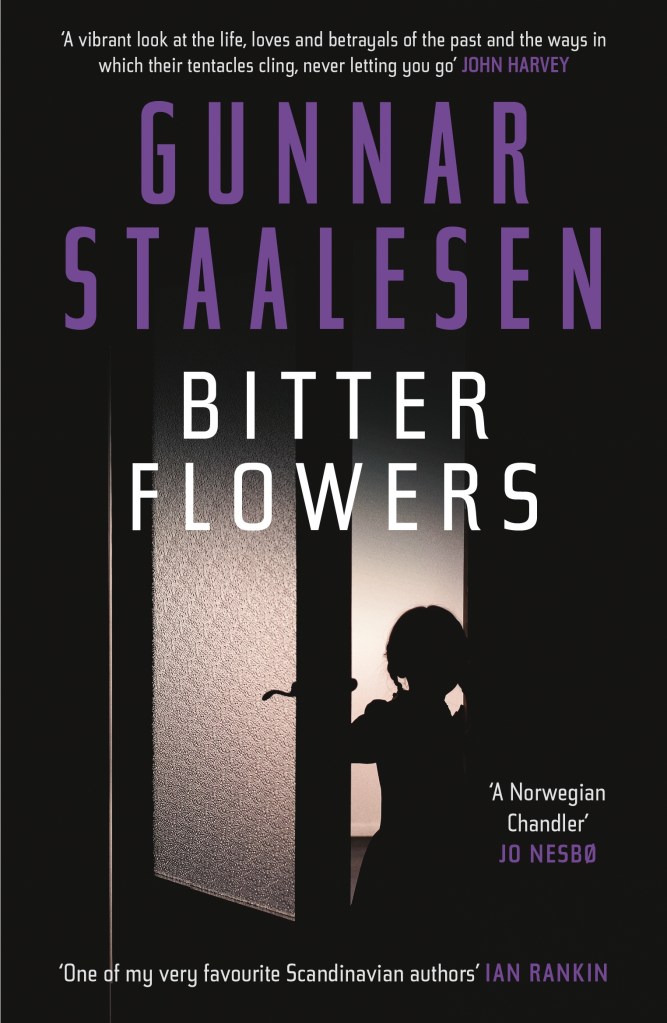
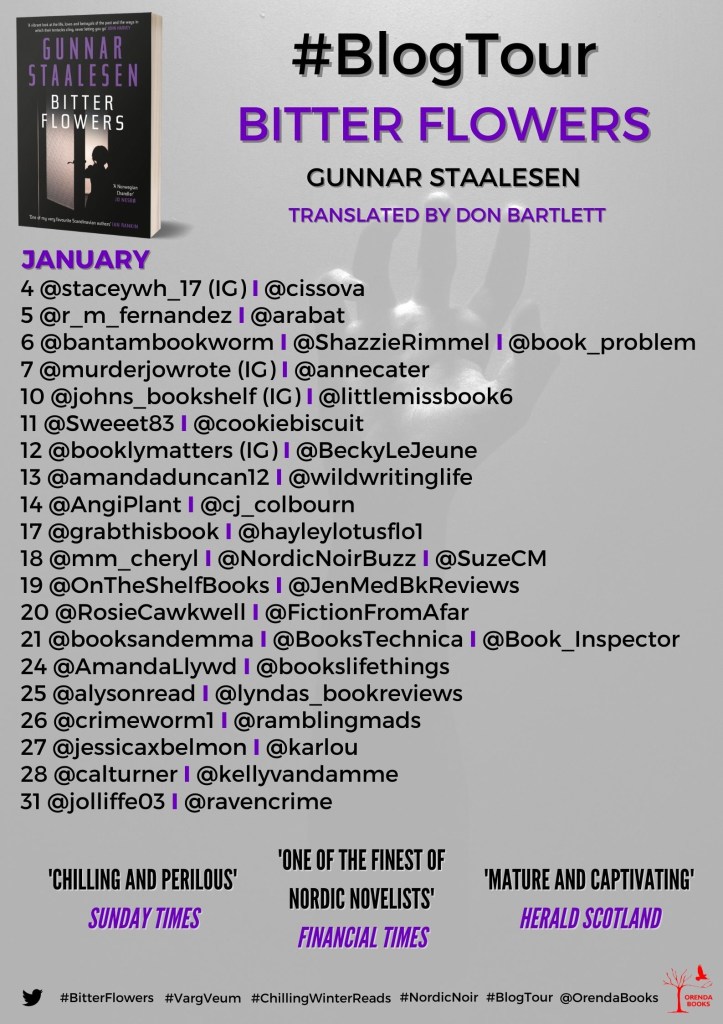
Bitter Flowers by Gunnar Staalesen

PI Varg Veum has returned to duty following a stint in rehab, but his new composure and resolution are soon threatened when a challenging assignment arrives on his desk. He is offered a job by his physical therapist Lisbeth, with whom he has built a friendship during treatment. She has a friend who needs a house sitter and she drives Varg out there to look around, only to find a man dead, floating in the elite swimming pool. As Varg leaps in to check for signs of life, Lisbeth goes missing. Most chillingly, Varg Veum is asked to investigate the ‘Camilla Case’: an eight-year-old cold case involving the disappearance of a little girl, who was never found. As the threads of these apparently unrelated crimes come together, against the backdrop of a series of shocking environmental crimes, Varg Veum faces the most challenging, traumatic investigation of his career.

This is one of those slow burn thrillers and we find Veum at a pivotal moment in his life, just out of rehab and fighting a reliance on Aquavit. Whilst not fully back to his investigative peak, Lisbeth’s idea of a simple house sitting would have suited him perfectly, with no pressure. The circumstances he then finds himself in are really not going to help his recovery, it’s enough to find himself embroiled in a murder investigation, but even worse, could he actually be a suspect? Instinct takes over though and Varg can’t help looking into the victim’s life, once he is identified as Tor Aslaksen. He is also very concerned about the disappearance of Lisbeth, as he battled to save the dead man’s life. Needless to say he faces some very awkward questions from Inspector Hamre about how he ended up there, alone in a strange house with a dead man. His digging reveals a connection to a case from some years before, that of a missing child. As if that wasn’t enough, when he looks into the victim’s employer, his company is under suspicion for environmental crimes, namely the alleged improper disposal of toxic waste. There are noisy protestors demonstrating on site and within the conflict there are two brothers, who were childhood friends of Aslaksen and stand on opposing sides of the demonstration. These strands seem so disparate, but the author cleverly threads them back to the murder victim with so much care, taking his time to unwind the truth. Yet, he also keeps a steady tension and occasionally surprises the reader as Varg’s curiosity takes him into dangerous and threatening places. is enough to heighten Veum’s interest. Nobody’s fool and uncompromisingly persistent, Veum is intrigued enough to take a closer look, thereby uncovering a connection to the unsolved disappearance of a seven-year-old girl nearly a decade earlier in the dead of night. Casting his net wider and following the threads back to their fruition, Veum tries to make sense of the past and it’s significance on current events, specifically the murder of Tor Aslaksen and all that follows.

Gunnar Staalesen

I gradually started to bond with Varg, possibly due to the first person narrative; we’re with him all the way because we make discoveries at exactly the same time he does. His narrative can be abrupt at times, but always questioning and challenging those around him. As we experience his inner voice, unedited and raw, we can feel his struggles and the way his personal demons affect his life and his investigations. Yes, he has weaknesses, but his intelligence and determination are undimmed. I felt that, despite these struggles, I was safe with him as a narrator. I was firmly on his side throughout and didn’t doubt his innocence once. I didn’t work out the reasons for the murder, nor the tragic events which followed, but I did feel a constant sense of foreboding even from the first chapter. The author has a good grasp of human nature and how trauma affects people in very different ways. The psychology of addiction was also well observed and I enjoyed seeing Varg’s progress as he tries to recover while investigating a complex and emotional case. His developing relationship with Karen and friendship with Siv are handled with care and a gentleness I didn’t expect.

The case itself is emotive, allowing the reader to learn about Varg’s fragility, as he faces the horror of a child missing for eight years. By taking us back into Varg’s past, we can really see progression in his character; how did he get from there to his current stint in rehab? His previous career in child welfare has left him cynical, but he isn’t completely jaded yet. Everything he has experienced makes him more humane with an automatic reflex to fight for the underdog. I loved his underlying thirst for social justice too, something that could remain hidden from others, behind that calm and focused exterior. Staalesen provides the reader with a steady drip feed of Varg’s discoveries and this pace helps us understand the key characters better, especially where he becomes a nuisance by popping up to question certain people time and again. Even threats and constant police pressure can’t stop him from interfering and he is dogged in his determination to discover the truth. This is not a high octane thriller, but it’s more thorough and compelling because of that. Varg is not one of those showy, ‘on the edge’ investigators either, but the gradual opening up of his character allows us to trust him and truly know him. This felt like to me like a real PI might have worked back in the 1980’s, investing the time and noting the small details that crack a case. We never get the sense, as with other, flashier, P.I. characters, that he is more important than the case. There’s only a hint of fast action and real danger, but it has more impact and authenticity because of that restraint. This is complex, intelligent and authentic storytelling with a hero I enjoyed getting to know.

Posted in Random Things Tours

The Family by Naomi Krupitsky

A captivating debut novel about the tangled fates of two best friends and daughters of the Italian mafia, and a coming-of-age story of twentieth-century Brooklyn itself.

Two daughters. Two families. One inescapable fate.

Sofia Colicchio is a free spirit, loud and untamed. Antonia Russo is thoughtful, ever observing the world around her. Best friends since birth, they live in the shadow of their fathers’ unspoken community: the Family. Sunday dinners gather them each week to feast, discuss business, and renew the intoxicating bond borne of blood and love. But the disappearance of Antonia’s father drives a whisper-thin wedge between the girls as they grow into women, wives, mothers, and leaders. And as they push against the boundaries of society’s expectations and fight to preserve their complex but life-sustaining friendship, one fateful night their loyalty to each other and the Family will be tested.

I loved the way Naomi Krupitsky embedded me emotionally into the heart of Sofia and Antonia’s world, two little girls belonging to two Italian immigrant families. However, the term ‘family’ has two meanings in this community: your immediate family, or that you are a family with connections. Sofia Colicchio and Antonia Russo, live in side by side apartments and are best friends. Of course it was pre-ordained that they’d be best friends, because their fathers work together and their mothers were pregnant together. We join them at an innocent time in their lives and they’re both oblivious about what their fathers do, even if they do notice their mother’s tension and even tears when their fathers work late. Sofia and Antonia are focused on playing together, making each other laugh by making up silly games. By bringing the reader into their lives at this age we feel their innocence, and I found myself thinking about my girls and other young family members. I felt bonded to these girls and immediately felt a strong sense of foreboding. What fate might their parents have wrought on these girls?

They have been enough for each other and haven’t needed a wider group of friends, but when they start school that they notice that they are treated differently. On the first day they make friends with two other little girls from the neighbourhood and run towards their mothers at the school gates holding hands with their new playmates. Next day they’re excited to see their new friends again and are surprised when they don’t reciprocate, pointedly joining different girls at lunchtime. It seems that mothers will warn their sons and daughters to stay away from Antonia and Sofia and gossip about their fathers. However, the girls are mostly innocent to the to the world they live in. They don’t know that in 1920s New York City ‘The Family’ and their influence spreads far and wide. They know that on Sundays they have to join other families for lunch with their father’s boss in his huge Manhattan apartment. These children play with them and they’re told to call the men ‘Uncle’, but these people are not blood family, no matter what they call them. The truth shatters their lives one day when Antonia’s father goes missing and his body is never found. Of course the girls don’t understand what the adults know; the reason for the sudden fracture between the Russos and the Colicchios. Of course the truth does come out over the following years, but will the two girls struggle to keep that friendship?

As she turns into a woman, Antonia becomes reserved and sees a different life for herself. She can’t live with the people she knows were responsible for her father’s death. Her mother doesn’t recover from the trauma and as a result Antonia lives a very lonely life. This absence of parental support allows Antonia to slip away from reality into the worlds of her books. She wants to go to university and be someone other than herself. However, not even the loss of her father and the warnings of her mother can stop her heart being won by a Family man. It is love that takes her back to where she comes from. As for Sofia, she never left. She is in awe of The Family and has grown up bold and ambitious. Sofia seems fated to make dangerous, reckless, decisions. Their friendship is distant at times, eroded by the past, but it never seems to break. Underneath the trauma and complicated history, inside these women are two little girls who swore friendship and loyalty to each other. What they have is like a marriage, a promise to always be there even when life’s at it’s toughest. Perhaps it’s an even stronger bond than that. I love how this is a family drama, with the tensions all families have, but the author concentrates on that very specific tension between mother and daughter. Then there’s that outer layer of family, applying yet more pressure and creating a massive fissure between these girls born into something they never asked for. The Mafia is not open to everyone, but once you’re in that’s it. This is family with extra power and benefits, but with a sense of fear that always keeps you looking over your shoulder. With power comes terrifying risks and the knowledge there’s only one way to leave.

This is unlike any other Mafia story I’ve ever read because it concentrates on what it’s like to be female in this most macho of worlds. Here the gender roles are predetermined due to the time period and the set rules of the organisation. It’s a coming-of-age novel where these two girls are always going to be chafing against the confines of the roles the Family will allow. As the story moves from the 1920’s into 1940’s and WW2, we can see how Antonia and Sofia change from young girls to women, but also how society’s expectations of women change in that time period. Krupitsky also writes a realistic portrait of how the Mafia changed during the war. This historical detail and the character of Saul made me think about people fleeing Europe who bring with them their own strong sense of identity. Can they identity survive in a new place, where the opportunities may not always be the escape they were looking for? This made me think of my late husband’s family who ended up displaced separately, affected by their loss and wanting to grow up honouring their heritage, but finding themselves shaped by the society they’ve joined too. I felt so involved in these girl’s lives and the organisation they’ve grown up in, schooled in the essentials of staying loyal and keeping secrets. It was strange to leave their world and I wonder if there will be more from Antonia and Sofia in the future. This is a great Mafia novel, one that sets the organisation in social and historical context, but also gives us a rare female perspective on growing up as a mob daughter.

Meet The Author

Naomi Krupitsky attended NYU’s Gallatin School of Individualized Study and is an assistant editor at the Vida Review and a bookseller at Black Bird Bookstore. She lives in San Francisco
but calls many places home. The Family is her first novel.

Posted in Back of the Shelf

Books At The Back Of My Shelf

One of my book shelves.

As I go through other blogger’s fantastic end of year book lists, it strikes me how many brilliant books I haven’t had time to read. That’s not because I’m one of life’s busy people – I don’t work, the girls are only with us part-time, I’m still semi-shielding, and I have a carer/cleaner – I’m hardly plagued with Virginia Woolf’s worries and yes, I do have a room of my own. I could be reading more, but mainly I could be making better choices. The problem is I become distracted. I’m distracted by the same things a lot of other book bloggers are: should I be on Tik-Tok? Should I be chasing this year’s hottest release? Do I have enough Twitter followers? Is a photograph better than a review? How do I stay relevant? Is anyone even reading this? It’s so easy to spend half your day on Twitter or Instagram looking at other people’s beautiful and creative content and thinking ‘should I be doing that too?’

The only answer is to do what you love. I’m never going to be a major book influencer with followers in the millions, merchandise and a whole new income stream. So I have to think, what is it I enjoy about book blogging? Well, I love the Book Twitter community, the bloggers, blog tour organisers, the publishing assistants and other writers. By talking to writers over the last few years I’ve had so much encouragement and advice about my own writing, that I could see myself actually finishing my own book. People have been generous and kind with their time and their tips on how to be a book blogger. I love reading, discovering new authors and broadening my reading choices. I love writing about characters, their stories, their psychology and really championing those books that make my heart sing. I can do all of these things without putting myself under pressure, without chasing every new book, without joining every blog tour or buying every special edition. I can do this without pressuring or challenging myself even more than last year.

My village book exchange

That’s not to say I don’t appreciate those who take stunning Insta photos, or know a flat lay from a stack, because I do. Some people are absolute artists! I also admire those who worked hard to remain up to date and relevant, but it’s not always me. It takes me a long time to understand and adopt new apps and methods of getting the book love across. So in short, I’m going to worry less and read more of the books I already have. Stress less and enjoy this more. I’m going to spend more time writing my own work, putting new books into our village book exchange, and reaching to the back of the shelf for those books I didn’t get to this year. I’m going to write about those back of the shelf books and celebrate what I have as much as the new. I can’t believe I haven’t yet read The Appeal by Janice Hallet or Still Life by Sarah Winman, but they are both tucked away on the shelf. I’m going to look forward to those books I’ve highlighted for 2022, but not worry if I don’t get to them all. I’m also including my NetGalley shelf in this, which I’m afraid to say, is cluttered with forgotten gems and new books due to be published as far away as next summer!

It’s easy to forget why we do this. I need to remember those reasons, to simply enjoy being part of this great book community. To relax and celebrate the journey, rather than stress and strain towards an unknown goal. Here’s wishing you all a deliciously bookish 2022 and I look forward to chatting and sharing with you all this coming year. ❤️📚