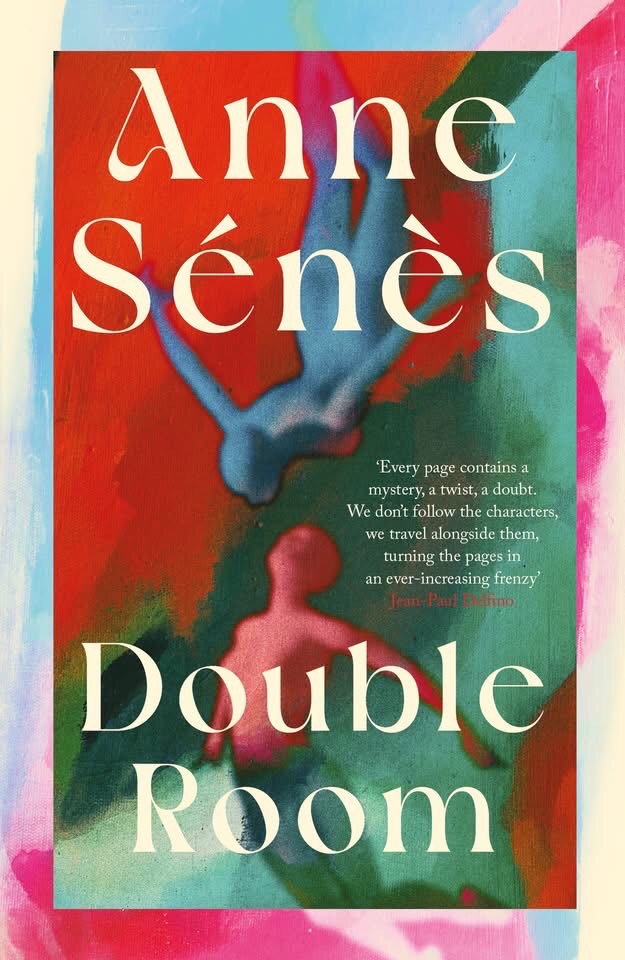
London 1990s – An up and coming French composer called Stan is invited to arrange music for a stage production of Dorian Gray. Although the play is never staged, he does meet Liv and she becomes the love of his life. They live together, joined by a daughter called Lisa. Their happiness fuels his senses with vibrant colours and melodious music.
Paris, Present Day – Stan lives in France at the Rabbit Hole, a house left to him by his aunt. He now shares his life with Babette, a lifeguard and mother of a teenage boy of Lisa’s age. They also share their home with Laïvely, a machine built by Stan and given Liv’s voice. As Stan becomes more engrossed in his past Laïvely starts to take on a life of her own. His life is about to implode.
This is, at heart, a love story. Told in flashbacks Stan reminisces over a golden period of his life when he and Liv fall in love. It’s no accident that they meet through a production of Dorian Gray because the author does bring it’s style and it’s moral into her novel. The first thing I noticed was the fact that Stan has synaesthesia, a fascinating neurological condition where colours or images evoke tastes or smells. The opening of Dorian Gray is so heady with scent it could conjure a symphony:
“The studio was filled with the rich odour of roses, and when the light summer wind stirred amidst the trees of the garden, there came through the open door the heavy scent of the lilac, or the more delicate perfume of the pink-flowering thorn.”
Some of Stan’s descriptions, as colour turns to scent and then turn to melodies, bring the senses alive in a similar way. For Stan, music is simply an extension of his sensory abilities, like a form of ESP. There is also the doubling aspects of both novels, captured in the book’s title. Dorian Gray’s portrait is the sum of his dissolute lifestyle, freeing him to experience more and more without it showing on his face. Stan presents his life in two narratives, the present in France and the past where he was at his most creative, happy and in love. His relationship with Liv is almost idyllic. They seem to be naturally suited, in total harmony and without a cloud in the sky. Anything he relates of his present can only suffer in comparison. We learn that he and Babette are compatible, but there is none of the life and vivid colour that comes from his reminiscence. We are all nostalgic about the past, but no relationship can be perfect especially when cramped into the average London apartment with a small baby. While it is touching and romantic, the cynic in me wondered was this a true picture? As for Liv, she is in technicolour in Stan’s flashbacks with her vivid red hair. However, all that life is now reduced to a communication device and no matter how Stan cuddles Laïvely to him, she is inanimate, merely a machine. In what way is this a fitting representation of the love of his life? It seems like, in the present, neither Stan or Liv is truly alive. When Stan trips one morning the giggle that comes from the device is strange, a laugh he’s not a encountered before. Could it be there is a hint of malice?
The other book mentioned heavily is of course Alice in Wonderland, inspiration for the name of Stan’s home in France. Another book where there are versions of the self and a blurring between what is real and unreal, something the author has carried into this novel successfully. Stan’s past has all the colour that his present is missing, but there’s something equally unreal about his present. It’s not that there isn’t a fulfilling life to be had. It’s just that Stan isn’t fully engaged. I felt as if the rest of his family had a life, but Stan has started to detach from it. The author’s layers of description evoke the 1990s in a nostalgic way, something I’m apt to do from time to time because it was my era. Laïvely is meant to bring Liv into the here and now, but it feels more like a conduit to the past dragging Stan further and further away from reality. He rarely mentions his or Babette’s child, until he and Téo have a row. He tells us Babette organises everything: celebrations, days out and holidays. Is this a natural division of their lives or is it simply that if Babette didn’t do it their life would run aground? Their relationship seems more about companionship and choice rather than love. It’s as if he has found a calm, steady presence who won’t overpower his senses.
The author cleverly fragments things, very slowly. When I turned a page and realised Stan had been injured by a cupboard door, I had to go back and work out how this had happened. The story continues in past and present chapters but the past starts to feel more coherent and real. Loss is a strange thing, even when you’ve moved on in life because the previous one is still there, haunting you. It becomes a parallel existence where you think about what life would be like now if you hadn’t lost that person. Stan can tell us long detailed passages about what Liv was wearing, the colour of her hair barrettes. He can relate details of their friend Henry’s visits, the eccentric musician has a good relationship with Stan’s daughter Lisa and is there to the end of their relationship. At Rabbit Hole Stan is becoming as inanimate as Laīvely. He’s eating and playing music, often in the same room as his family without hearing a word they say. At times he seems almost catatonic, unable to answer Babette when she knocks at his door. Then she tells him she has booked a holiday without him, choosing to take her son. Stan says nothing, the tension rising. I felt we were building towards something with our past timeline catching us up to why he and Liv are no longer together. I could understand him coming apart a little as he relives his story but this is complete disassociation. I was ready to be heartbroken for him and his daughter, but things are not always as they seem.
The author brings the truth to light brilliantly and I feared Stan’s mind was splitting. He has always remembered his and Liv’s relationship as an ideal. Often when we lose someone the tendency is to rewrite history and paint them as a good person who everyone loved, even glossing over addictions, criminality and all manner of bad behaviour. I’ve occasionally been to a funeral and wondered if the speaker and me knew different people. I can’t see the point of remembering something that isn’t real. Stan seems to imagine that he and Liv would have lived in this harmonious way forever, then as the truth emerges Stan’s perception of himself starts to shatter. Babette finds him catatonic and soaking wet, having to place him in a hot bath and slowly bringing him back to himself. It’s the most nurturing, selfless and loving part of the book and it’s all the more sad that he hasn’t before recognised or rewarded her love and loyalty.
“My partner has behaved like a mother, a loving and devoted wife. She had cared for me, comforted me, given me all the tenderness she could muster”.
He also realises that there were times he was too distant and distracted with Liv, that he stopped paying her attention. It was as if he had imagined them always walking towards a common goal but truthfully, he knows they were out of pace with one another. As the ‘tick, tock’ of the clock at the Rabbit Hole reminds us that the end is approaching we fully comprehend this heartbreaking story. This is no ordinary loss and it’s clear that Stan has never faced the truth of their final days until now. This is an emotional end that has one final twist to impart and it is devastating. It seems that Stan has always held on to Liv’s portrait, but is was a ‘painting turned against the wall’, keeping it’s secrets until that final terrible reveal.
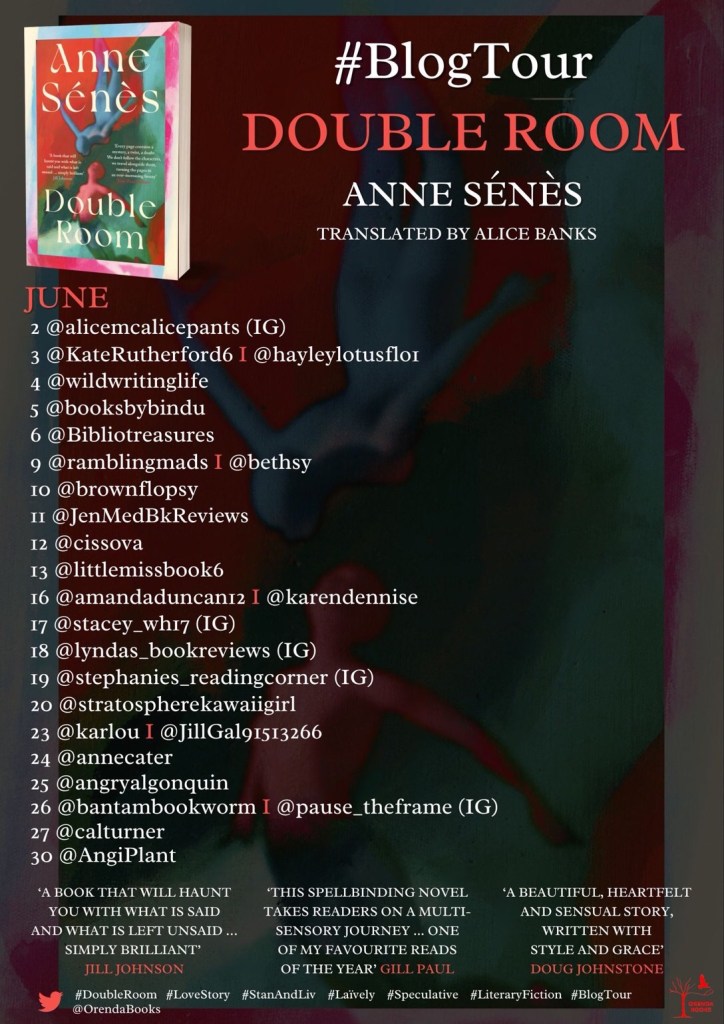
Out Now From Orenda Books.
Meet the Author
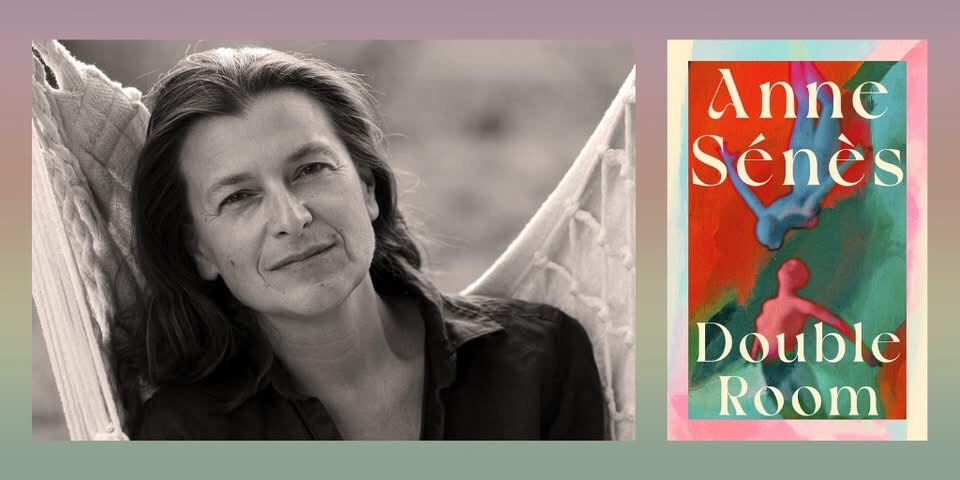
Anne Sénès is a writer, translator and former journalist. She was born in Paris and studied at the Sorbonne, where she obtained a PhD in English studies. Her passion for Anglo-Saxon literature and culture has taken her all over the world, from London to Miami, via the south of France. She is currently based on the French Mediterranean coast. Chambre Double (Double Room) is her first literary novel.

 The Lotus Readers
Thanks for the blog tour support x
LikeLike