
Our story starts in 1768 on a sugar cane plantation in Jamaica, where a slave rebellion has been brewing. The signal will be sent to all the slaves by drum and Daniel has heard their rhythm. He needs to get to the house where his sweetheart Adanna works for the mistress, the house slaves aren’t in on the secret and he wants to get there in time. The field slaves might harm the house slaves along with their masters, perceiving their lives to be easier and their loyalties divided. When Daniel realises the house is already ablaze he leaves with his little sister Pearl, hoping to find a way to get off the island. His story then jumps to 1782 and the aftermath of the War of Independence where free slaves who fought for the British were promised a new life in England. Daniel was one such soldier fighting with the British under Major Edward Fitzallen, whose life he saved. Edward and his wife Elizabeth have taken Daniel and Pearl under their wing, meaning that both brother and sister have a level of education and independence one might think unusual for Jamaican slaves. When Edward is wounded he knows he won’t make the voyage home and calls Daniel to his side. He wants to ensure that Daniel and Pearl have a future in England and calls witnesses to his signature on a new will and testament. It hands all his worldly goods over to Daniel, telling him to call on his brother James to inform him of Edward’s demise and Daniel’s new position as his heir. Daniel naively expects the Fitzallen brothers to be equally honourable and he underestimates James who drugs Daniel, then throws the new will and all proof of Daniel’s claim and rank into the fire. Now Pearl and Daniel are abandoned in London with nothing.
There were many black soldiers shipped over here with the promise of a new life, without any provision made for them when they arrived. Many ended up in the area of St Giles, home to the infamous Rookery which was a warren of corridors and rooms under Covent Garden and accessed through St Giles church crypt. Here lived those forgotten black slaves, Irish immigrants escaping famine and others who had no means to live. People like Daniel and Pearl were outcasts from civilised society and known as the Blackbirds of St Giles, living in dark caves where sewage ran in channels through the rooms. The book was so beautifully detailed, taking us effortlessly into the late 18th Century like time travellers. I could sense absolutely everything from the steady thrum of the drums in Jamaica to the smells of London squalor and it’s poorest residences. The divide between those in poverty and those who are rich is a deep canyon, all the more shocking to Daniel who has become used to a certain deference and to Pearl who barely remembers the plantation and has grown up by Elizabeth Fitzallen’s side with all the privileges of a middle class young woman. Daniel and Pearl’s new home is a dark underground cave where it’s a choice between breathing or being cold because smoke from the fire can’t dissipate and simply sits in the room with them, making them cough and their eyes water. The rooms are filled with a sense of dark foreboding, worsened when Daniel sees the first ceremony with their self-styled King. I loved how the Black Apollo club is a haven by contrast with such an open and accepting feeling. Here black men are relaxed, having a drink or playing chess with friends. It’s a glimpse into the far future, because many of their customers can only dream of a time they’re not a servant, regarded with suspicion or hidden as a dirty secret. There’s also a contrast with Elias’s lodgings as King of the Rookery, he doesn’t share the dark caves of his subjects but instead enjoys plush lodgings policed by a beautiful, prowling cheetah called Infanta.
The sense of terrible injustice is palpable and I was desperate for Daniel to get what is owed to him. Daniel and Pearl have been defrauded and it all feels worse because of the dignity and command he’s had under Edward Fitzallen. I found myself rooting for them both pretty quickly. Their friendship meant that Pearl was always well-dressed and learned to read, something of a privilege for a young black woman born into slavery. The only man who could have corroborated Daniel’s claim is back on his ship by the time Daniel wakes from being drugged. There’s no way to get what he’s owed now. It’s only when he starts training with ex-boxer Melkie Trimme at his St Giles gym that Daniel starts to feel a sense of purpose and pride again. If he can beat the European champion then he and Pearl can get better lodgings and start to repay the kindness shown to them by young girl Jen who has organised their place at The Rookery, brought them food from her pub job and introduced him to some of the most influential men she knows. Daniel is drawn to her, but is still plagued with guilt about Adanna.

For me the women were particularly interesting. In the literature written or set in the 18th Century we’re used to the upper and middle classes, not people like these at the bottom. If we think of the Regency novels of Jane Austen and the more contemporary Bridgerton series the women are accomplished, but it’s all focused on making a good marriage. Women who are poor have no time for accomplishments as they’re too busy surviving, but they have more agency and autonomy. Jen is such a pretty girl but she’s fiery and used to making her own decisions. She has very little but she’s surviving and shows kindness and generosity to those she cares about. Having survived an horrific childhood she is keen for rebellion and knows that Daniel might have what it takes to lead people out of The Rookery and end Elias’s tyranny. She also takes Pearl under her wing and guides her into earning her own money for herself. Daniel wants to protect Pearl and keep her in the middle-class propriety she’s been used to, but this is no use to her when they’re living in a squalid underground cavern. Pearl really rises to the occasion with very little complaint, starting to work at the pub with Jen, then sneaking out in the evening for singing engagements. She has a beautiful voice and Jen thinks it might be her ticket out of the slums. As for the Marquise, she has used her beauty and poise to get where she is. When we’re let into her opulent townhouse Daniel is shocked at the squalor most black immigrants are living in compared to her. How could a black woman reach the heights she has? That’s without mentioning the residence in France or her wardrobe, full of all the gowns and perfumes she can wear. Could there be hints of a darker truth underneath the opulence?
All in all this is a fantastic historical novel; vivid and dark, but ultimately hopeful. I love it when authors take a character and write them back into the period of history they’ve been erased from. Middle class writers would rarely write about the people of The Rookery. Even Charles Dickens didn’t hint at this underground life, despite his interest in those living in poverty. Obadiah is such a great character, a disabled resident of the Rookery whose intellect and philosophies are articulate and inspiring. The fact that he runs the brotherhood at the Black Apollo and has a place at the head of the planning table is amazing. The other men do look up to him as their oracle. It seems strange to imagine that the novels of Jane Austen are only a few years away, because in them we never hear of people like this. It’s easy to forget that not everyone lives in the countryside and working class women are out there making things happen, working everyday and not at home with an embroidery hoop on their lap hoping for a gentleman caller. There’s no one from a different country and even the poor are ‘distressed gentlefolk’. Comparing this world with Austen’s shows how urban, dynamic and exciting London is, especially if women and people of all races have an opportunity to create their own future. Some did, like Olaudah Equiano who was enslaved to a master and a role in the Royal Navy. He came to Britain at the same time as Daniel and once he’d bought back his freedom had become a merchant. Sadly he had to stop travelling when he was almost captured and sold back into slavery in Georgia. However, he did write a memoir that’s still in print today. I came away from this book with everything crossed for Daniel and Pearl, as well as Jen. I was so immersed in the story that it felt strange to look up and find myself back in my own living room.

Meet the Author
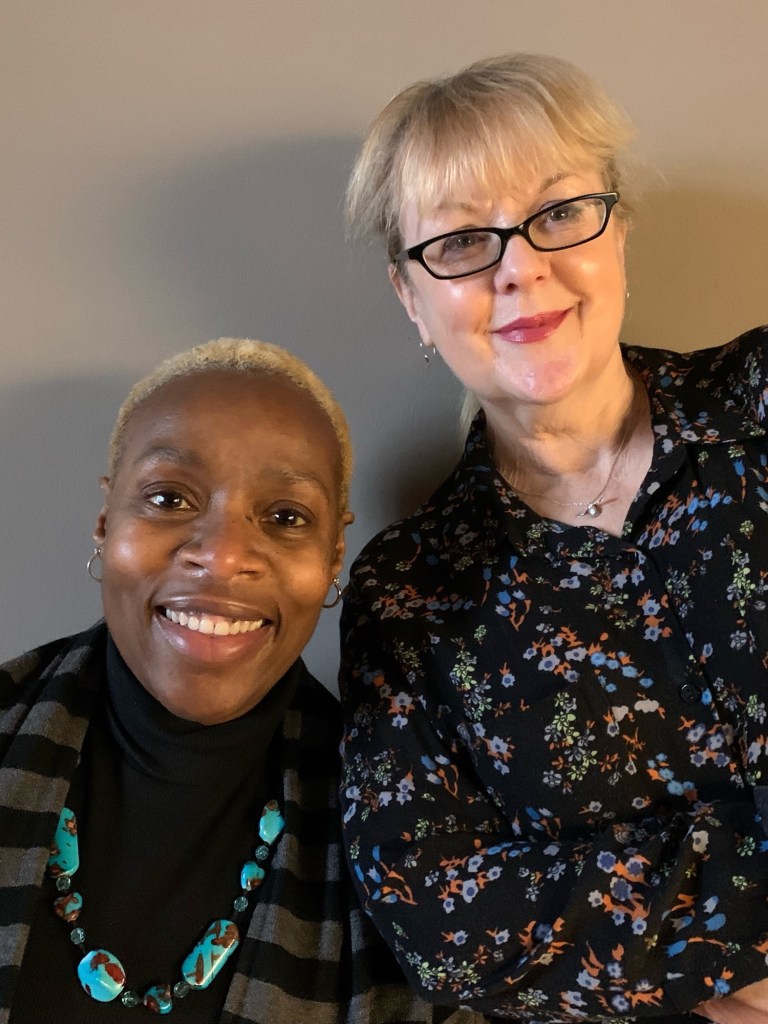
Writing together as Lila Cain, Marcia Hutchinson and Kate Griffin are the co-writers and creators of The Blackbirds of St Giles, the first of two books centred on the lives of members of the little-known black community in Georgian London. United by their passion for history and a strong desire to tell an unfamiliar – and hugely resonant – story, Kate and Marcia are delighted that ‘Blackbirds’ and its sequel will be published by Simon & Schuster.
Marcia Hutchinson worked as a lawyer before founding educational publishing company Primary Colours and was awarded an MBE for services to Cultural Diversity in 2010. Her solo debut novel Mercy is due for publication in summer 2025.
Kate is the author of Fyneshade (Viper), a stand-alone Neo-Victorian gothic novel of witchcraft in a house of dark secrets. She is also the writer of the popular Kitty Peck thriller series (Faber and Faber) set in the Music Halls of Victorian London. After studying English Literature at university, Kate worked as assistant to a London antique dealer, as a journalist and in PR. Until recently she was Head of Communications for Britain’s oldest conservation charity, The Society for the Protection of Ancient Buildings (SPAB). Her love of old buildings and the stories they tell continues to inspire her.

 The Lotus Readers
Great review! This sounds like it could be a good change of pace for readers of historical fiction.
LikeLiked by 1 person
Thank you 😊 I love when historical fiction gives us a different perspective on time periods we think we know. Lianne Dillsworth does this really well too. X
LikeLiked by 1 person