Posted in Netgalley

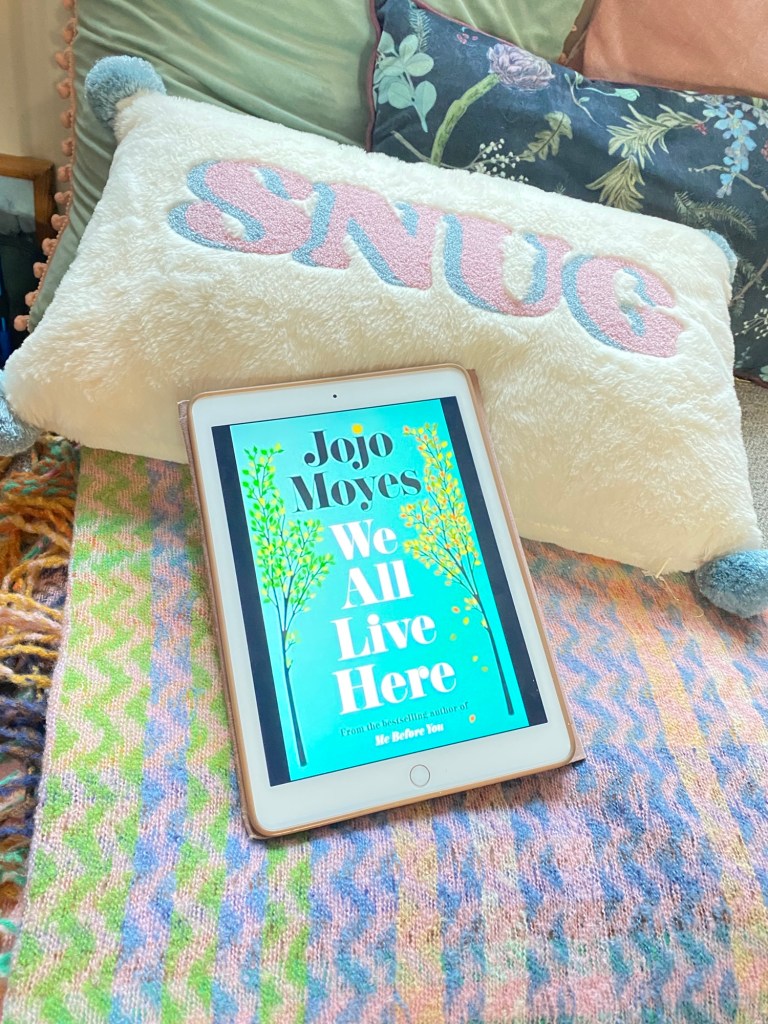
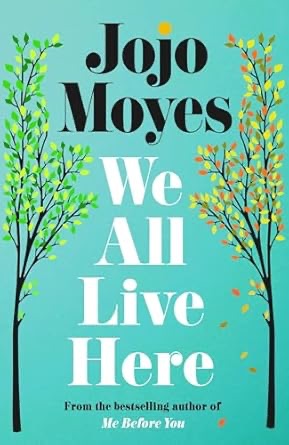
We All Live Here by Jojo Moyes 

Lila’s life is built on shifting sands at the moment. Lila is a single mum to Celie and Violet since her husband died revealed his affair with Mayja, a yummy mummy from the school gates. His betrayal was made worse by the fact Lila was promoting her book, on how to have a successful marriage. Her mum died recently and stepdad Bill and has slowly moved himself from their bungalow a few doors away, into Lila’s house along with his piano and healthy eating regime. To add a further unexpected surprise her biological father Gene turns up looking for a bed. Gene is a hellraiser, a drinking and partying actor whose claim to fame is playing the captain of a starship in a 1960’s sci- fi series. He’s still living off that fame and Lila is unsure whether she can trust him. Bill and Gene can’t stand each other. However, she gives him the sofa bed in her office, where she’s trying to produce three chapters of a new book that her agent is chasing. Lila wanted to write something honest, but the publisher is looking for the humorous and sexy exploits of a newly divorced woman. How can she write in one dad’s bedroom, while her other dad is practising his piano and planning garden renovations. Not to mention dreading school pick-up and having to see her husband’s girlfriend wafting around like a butterfly, waiting for her son Hugo. The final nail in the coffin comes when Mayja announces she’s pregnant. The last thing Lila feels like doing is pursuing romance, but to keep her agent and publisher happy and the roof over their heads she is going to have to come up with some sexy exploits. Enter Jensen the gardener and Gabriel the architect, but can Lila carve out any time for them or herself? 

Lila’s house is something quite rare in fiction, which sometimes feels full of American fridge freezers and Quooker taps. It has quirks like ancient coloured bathroom suites and a toilet that blocks regularly. Celie is 16 and clearly dealing with something at school that she won’t talk about. Violet has had to cope with a boy in her class now being her step-brother, not to mention no longer being the baby. Pressure builds for them all as Mayja becomes unwell and has to be at hospital until the birth of their baby. They are living of the last of Lila’s money from her first book, but it won’t last forever and submitting one of the most raw and honest pieces of writing she’s ever done only to see it rejected, is very hard to take. I had my hear set on Jensen from the minute he came to do the garden because there’s no barrier or mask with him, what you see is what you get. As he and Lila start to talk about Bill’s plans for the garden, often sharing a brew outdoors and chatting, there’s a clear friendship growing. He’s so easy to talk to and remarkably open. Gabriel is his polar opposite in a lot of ways, there’s an instant attraction for Lila and a lot of messaging back and forth but I could sense that he wanted to be in control of their interactions. I am very wary of men who pick you up and then put you away when they’re done, like a worn and boring plaything. There’s a lot of humour in Lila’s attempts to gather sexploits for her book, but there’s clearly potential for people to get hurt too. I also learned a few terms, most notably ‘bread crumbing’ which I’ve been subjected to a couple of times. Similarly, a previous partner described me as ‘too much’ so I had a t-shirt made with ‘too much’ on it and wore it proudly, sad for myself that I spent time on someone who wasn’t enough. This is something Lila comes to realise, maybe Dan’s affair was a symptom of their relationship going wrong? If only she’d known it was ok to take up space.

‘She thinks sometimes that she always felt she was a little too much for him, too needy, too angry, too sad, too hysterical.’
I really fell in love with this family, as unwieldy as it is somehow it does work. I admired Lila, who tries her best to be on board with the changes in her life especially around her marriage. She knows that the girls will have a sibling but can she accept Dan and Mayja as part of that family? Their relationship does hurt her, but her feelings aren’t going to stop them becoming parents and she wants her girls to have a good relationship with the baby. I thought she was incredibly brave to try and put herself back in the dating pool, something I’ve always avoided. I used to say that if someone comes into my life that’s fine, but I’m not wasting my free time on people I potentially don’t like, especially when there are good books waiting on my TBR! Luckily my husband did just that. He walked (fell) into my front door and I feel like we’ve never stopped talking since. You can see the work Lila has done on herself as she dispenses little bits of wisdom on the way: 

The dynamic between Gene and Bill is funny too, it’s immediately antagonistic but their bickering made me smile. Bill is angry thanks to all the things Lila’s mother, Francesca, has told him and for his desertion of his wife and daughter. Bill sees Lila as his daughter and has never had any competition for her affections. There’s obviously a fear that Gene will pick Lila up and then drop her again, even worse there’s now Celie and Violet to consider. Bill has always shown love in the way he cooks healthy meals for the girls, picks them up from school and spends time with them. Gene wants to have fun with them, Violet is especially fond of snuggling up on the couch after school and watching her new Grandad’s old sci-fi series. Celie is more difficult to befriend, but Gene is surprisingly perceptive and works out what’s wrong, giving her good solid advice that works. Far from this being a bed for a couple of nights, Lila can actually see him fitting in with their family and that scares her. Especially when she finds out there are secrets about his relationship with her mother that surprise her and potentially hurt Bill. 
I read this books so quickly because I felt I was observing a real family, with all the chaos and the rollercoaster of emotions that comes with it. I loved that in a family with so many people, there was always someone who could be there for somebody else, like Gene is there for Celie. There’s so much acceptance in this novel and it’s a great message for a New Year where we are pushed into thinking we need to detox, eat less, go the gym, run 5k and all that other rubbish. Lila learns to accept the change in her life, but will she move on when she’s ready, rather than for a book deal? She also has to accept that a person can have huge flaws, but still have a place and the ability to be a support for others. Bill has to accept Francesca is not coming back and the Gene who hurt Francesca all those years ago isn’t the Gene in front of him now. Both the girls have to accept that they now share their father, but could build a new relationship with Mayja and their new sibling that enhances their life. There are so many breakthroughs here that I can’t list them all, but I did identify hugely with a scene where Lila finally takes some time for herself and has a massage, encouraged by her friend. In the final throes of my last relationship I visited a Bowen Therapist and had a similar experience. 

‘something wells in her, an emotion unlocked by the reality of another human being touching her, listening to Lila’s body, feeling its pain and its tensions and carefully remedying them. Suddenly, she feels a great swell of something overwhelming her. Grief ? Gratitude? She isn’t sure. She becomes aware that she is weeping, the tears running unchecked through the hole where her face is nestled, dropping onto the floor, her shoulders vibrating with an emotion she can no longer hold back.’

This was a beautifully written moment where someone is just there for Lila and the weight of holding everybody up can fall from her shoulders. It’s the first time she has taken for herself and all the emotions she’s kept in check can come out. I love how Jojo Moyes writes women and the mental load we carry for everyone around us. A load more exhausting than childcare, housework, career all rolled into one. Here she lets go and it’s the point at which she starts to rebuild her life. Does she pick the gardener or the sexy architect? I’ll leave that for you to find out. 

Out on 11th Feb from Michael Joseph.

Meet the Author

Jojo Moyes is a novelist and journalist. Her books include the bestsellers Me Before You, After You and Still Me, The Girl You Left Behind, The One Plus One and her short story collection Paris for One and Other Stories. The Giver of Stars is her most recent bestseller and Reese Witherspoon Book Club Pick. Her novels have been translated into forty-six languages, have hit the number one spot in twelve countries and have sold over thirty-eight million copies worldwide.

Me Before You has now sold over fourteen million copies worldwide and was adapted into a major film starring Sam Claflin and Emilia Clarke. Jojo lives in Essex with her family.
Posted in Throwback Thursday

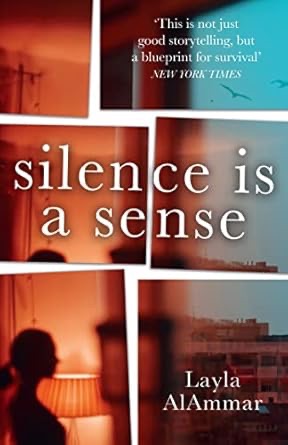
Silence Is A Sense by Layla AlAammar

Even though I’m so late reading this book, in a way I’m glad. For the past two years we have been embroiled in the aftermath of the previous government’s decision to house asylum seekers at the the now closed RAF base close by. While many of the community were worried about the issue, our reasons for concern were very different. When a local meeting descended into a heated exchange, it became clear that despite our concerns for the asylum seekers, we couldn’t voice them because of the sheer weight of people strongly opposing the plan for other reasons. Local concerns became lost in the wider debate on refugees. The campaign was targeted by far right organisations that didn’t really care about reasonable concerns, they just wanted to use the opportunity for their own political gain. Known fascists became interested and the gate to the base became a makeshift camp festooned with flags, stop the boats banners and others claiming asylum seekers were paedophiles. It became really hard to drive past and see all this racism and misinformation on the gates of such an iconic base, ironically known for it’s fighting against a fascist regime taking over Europe. We became part of an organisation set up to support the asylum seekers as they arrived into this hostile environment. When the new government changed course with the policy, we were relieved to know that there no longer fascist organisations camping out up the road. This book gave me more insight into a refugee’s journey.

The writer cleverly chooses a fragmented structure to tell her heroine’s story. Named ‘The Voiceless’ she writes about her experience as a way of processing her story and communicating it to other people as far as she can. Her memory comes in snippets, so her narrative moves back and forth in time and might seem a bit sketchy. Imagine everything you have is taken away from you. Your home is rubble, everything you owned that said something about who you are is gone with it. You have no documents to prove your identity or your education. Everyone you have known is either dead or scattered to the wind. She has escaped Aleppo with nothing. If you think about how your belongings, choices of clothing and your photographs say something about who you are, now imagine it gone. How do you keep a sense of self? Especially when you’re seeing or subjected to atrocities like killing, abuse and rape. Your psyche becomes shattered. Our narrator is trying to record those fragments, to bear witness and also to put the bits of herself back together. It might feel strange, even jarring at first but it’s supposed to be. It’s meant to confront and make you think.

The author shows us how she tries to embark on a future and make connections. She’s starting a journey of self-discovery, rebuilding herself in this new environment. She writes from home and watches her neighbours, keeping her eye on them. It’s called hyper-vigilance and it’s hard for her to drop these habits even though she’s now safe. Her muteness isolates her from others, in fact many people assume she’s deaf as well. She takes small steps outside, using the shop and going to the mosque and starts to meet people. Her observations of her neighbours are quite humorous as she gives them names that reflect their behaviour – the Juicer and No Light Man. Her insight into us is brilliant. She has that outsider’s gaze and because she doesn’t want to reveal too much about herself at first, she can use these observations. She writes about the people she sees, the strange way of life she can observe with so much scrutiny because it’s alien to her.

Slowly she starts to process and share her own story. She once had a somewhat privileged upbringing, she was well-educated too but war has left her with nothing. Then there’s the war, loss and the terror of trying to get to a place of refuge; a refuge that isn’t always the safe place it seems. She slowly makes space for new people in her life. I felt like her writing and sharing was helping her heal, remembering the trauma and processing it fully helps make room for growth. As someone who advocates writing therapy I found this so moving. The author has captured this process so beautifully as the writing becomes less fragmented and less about the past. This is such an important story and I’ll be buying the book for a few friends who I know will want to read it and maybe a few who wouldn’t. The sections of her time in Syria and travelling to the UK is so evocative, I defy people not to be moved by the raw truth of her experience.

Posted in Netgalley

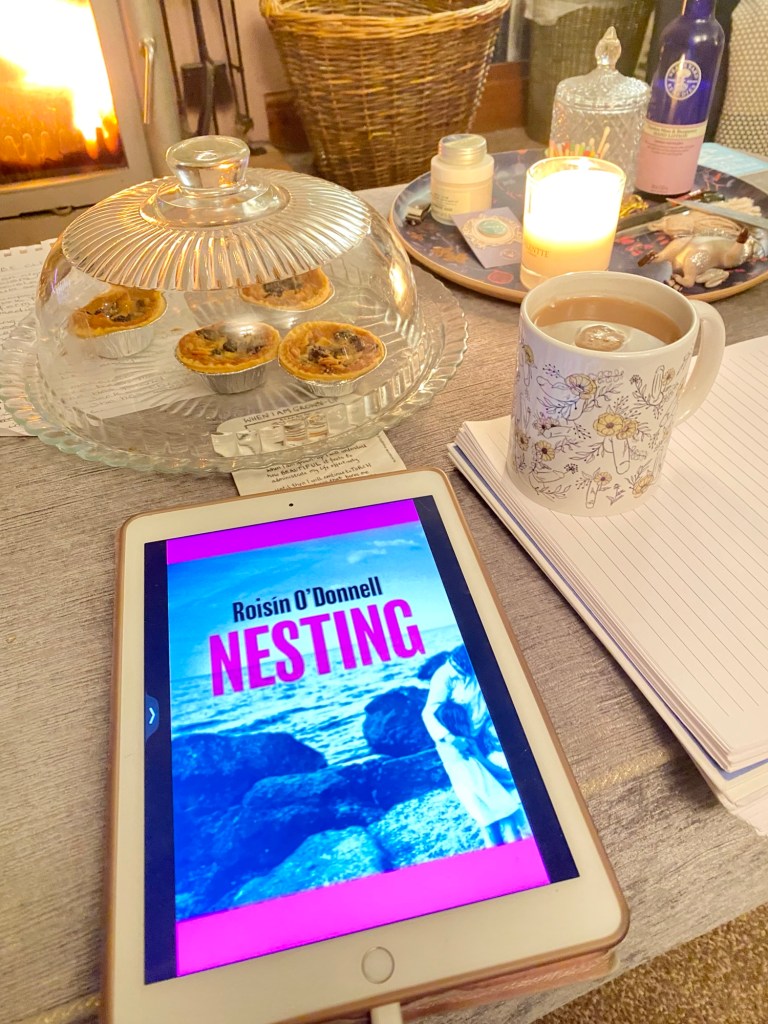
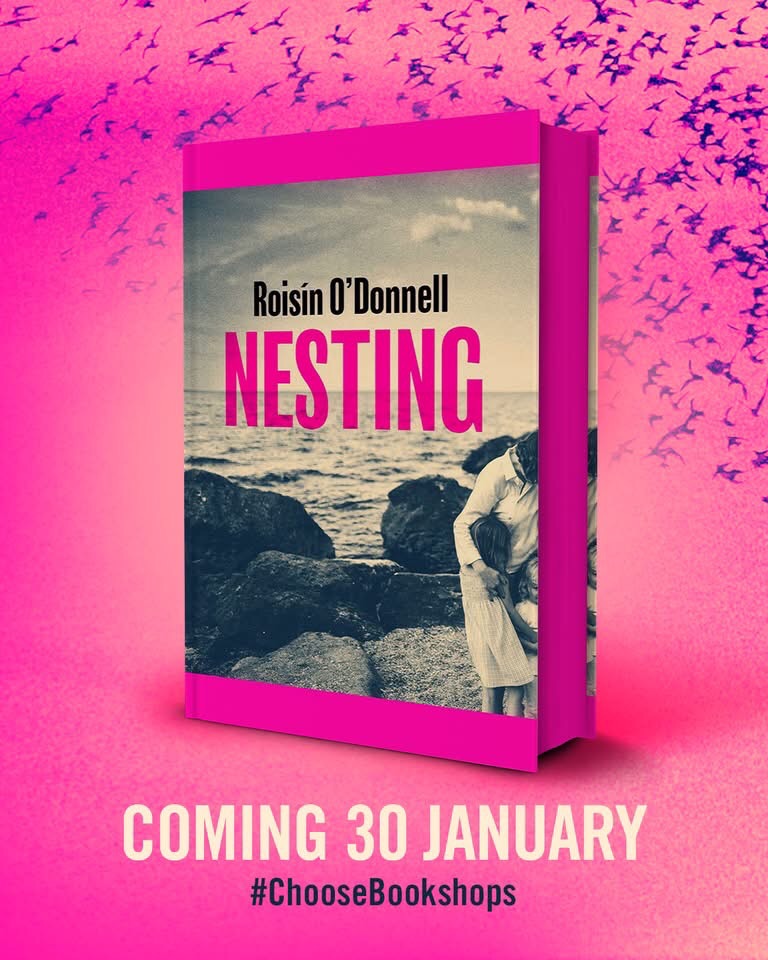
Nesting by Roisin O’Donnell


This book was so beautifully written and so deeply painful that I was out of breath towards the end. When I put it down I had to sit in silence for a while and just digest it all. It’s the story of a woman trying to leave a relationship that is tying her down and eating her alive. Everything she was before – bright, intelligent and full of life – has been worn away. Enduring her husband’s treatment, as well as having two children in four years, mean Ciara has had enough. She can see his behaviour as a pattern and despite being absolutely terrified she needs to find the strength to go. Ciara has no real support, her family is Irish but live in London and despite her yearning to see her mum sister the law states that she can’t take the children out of Ireland without the written permission of their father. Her only option is the housing office, present as homeless and hopefully get some emergency accommodation. As she meets other women in the same situation, she founds out that emergency and temporary have a very different meaning to the housing department. They offer her a temporary hotel room, but some women on the floor have lived there for a year so it’s going to be a long slog. This small double room with one bed and no view is the first place they’ve felt even remotely safe, even if they do have to go down a separate staircase so they don’t bump into tourists. Will Ciara have the strength to stay away and build a new life for herself? 

Money is something else she needs to work on because she knows nothing will come from him, even when she knows she is pregnant for a third time. They can’t live on what the government provides. It’s only going to cover day to day subsistence and she needs to be able to put money aside, to rent somewhere that’s a new home for them all. She needs to find a place where they can put themselves back together. I loved the solidarity between the women living in the hotel. They work together, being there for each other’s kids when they need to interview or view houses. They make each child’s birthday special, as well as decorating the whole corridor for Halloween and Christmas. Some of the hotel staff help too, particularly the porter Diego. Ciara lands a job doing what she did before the girls, teaching English as a foreign language and having to learn Irish on the side. It’s a hard way to live, having to get about on foot and working on her Irish after she’s put the girls to bed. I was saying in my head ‘please don’t go back’ over and over. 

Ciara’s husband terrified me. He follows a pattern, having love-bombed Ciara in a whirlwind romance he changes straight after she moves to Ireland and they’re married. His restrictions and rages, plus the birth of both girls have left Ciara stuck at home, friendless and a constant target. I recognised the fear she was feeling on a daily basis, quietly tip-toeing around him, desperate to avoid igniting his unpredictable rage. Trying to keep her girls shielded from the worst. I have to make an admission here so that you can understand the strength of my reaction to this novel. For four years, after I lost my husband, I was in an abusive relationship. I was incredibly vulnerable and although he didn’t touch me physically I was terrified of him. I was subjected to manipulation, rage and withdrawal of affection all because I was terrified of being left alone. I was so scared he would leave if I didn’t keep him happy and then I’d be left alone with my grief. I’d needed a happy ending so badly, I sleepwalked into a nightmare. I allowed myself to be totally disrespected and abused. I know it wasn’t my fault. He is responsible for his own actions, but I still felt so much guilt about when the relationship was failing. So for me this book was really personal and it was so well-written that I felt Ciara’s story bodily. When I finished my chest was tight and my throat was sore. I felt absolutely wrung out. 

Ciara wondered what would happen when he was awarded visitation by the courts? She knows he won’t hurt the girls but he might use them against her. What if he doesn’t bring them back? This particular fear heightens after she goes into labour early. How can she hand over a completely defenceless baby? It’s clear to see his misogyny when he reacts to finally having a son and I feared that he might keep him. I felt really uncomfortable about the nestling crows he brings home to Ciara when they’re still together. They’re in their nest, barely a few days old and he wants to hand rear them. They are so bald and vulnerable and I was scared he would hurt them, but he seems to enjoy the control he has over these helpless creatures. After Ciara flees he is left with one crow, now feathered and able to leave the nest he keeps it in the house, shitting and shedding feathers everywhere. He tethers it with a long lead outside, showing it the freedom it could have but keeping it for himself. It feels unbearably cruel. It’s such a clever and chilling metaphor. This is not a comfortable read, especially if you’ve been through an ordeal like Ciara’s. What helps is when an author is brave enough to use their own experience or research to get it right for readers who’ve survived abuse. He author has written this so carefully and made Ciara’s life so real that I felt seen. I find that the more I read about other experiences of coercive control and psychological abuse the stronger I feel. Yes, I was left with tension, but I was also left with triumph. It is possible to leave men like this. It’s possible to live a full and happy life. I read on hoping with all my heart that Ciara would make it through and build a new life for her and her children. Underneath my fear I was storing up hope for her. I hoped she knew how much strength she had. She could leave. After all, I did.

Out on 30th Jan from Simon & Schuster

Meet the Author

Roisín O’Donnell is an award-winning Irish author. She won the prize for Short Story of the Year at the An Post Irish Book Awards in 2018, and was shortlisted for the same prize in 2022. She is the author of the story collection Wild Quiet, which was longlisted for the Edge Hill Short Story Prize and shortlisted for the Kate O’Brien Award. Her short fiction has featured in The Stinging Fly, The Tangerine, the Irish Times and many other places. Other stories have been selected for major anthologies such as The Long Gaze Back, and have featured on RTÉ Radio. Nesting is her first novel. She lives near Dublin with her two children.

Posted in Squad Pod Collective

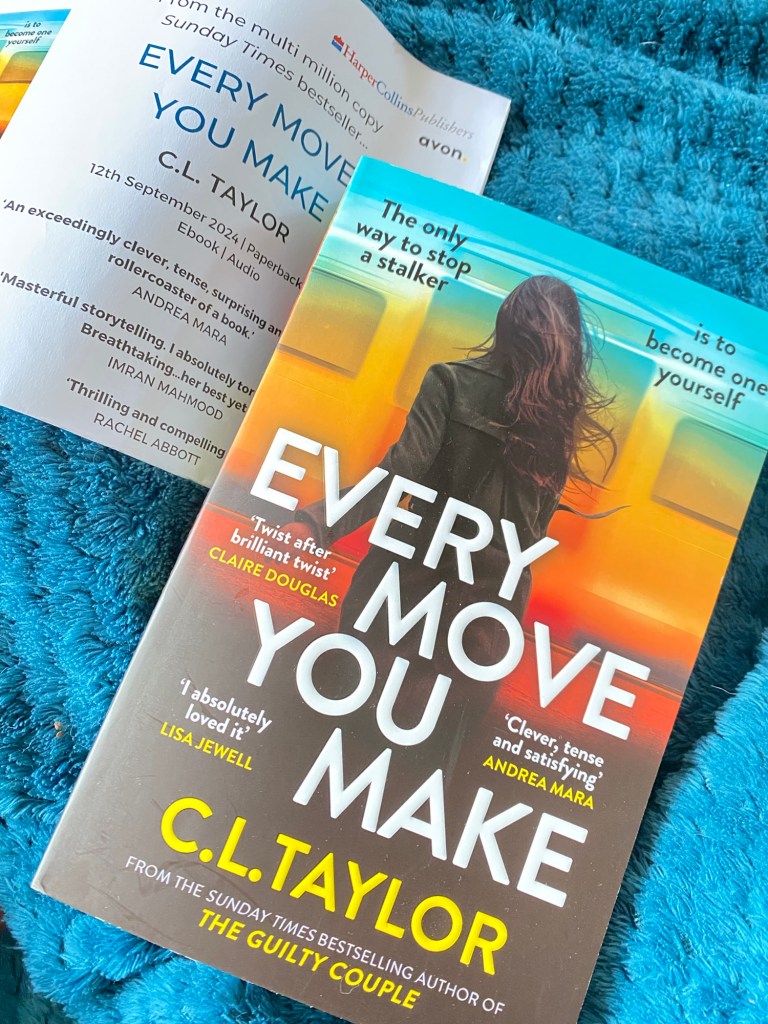
Every Move You Make by C.L. Taylor 

Alexandra, Lucy, Bridget, River and Natalie. Five friends who wish they’d never met. Because the one thing they have in common is the worst thing in their lives: they are all being stalked.

When one of their group is murdered, days after their stalker is released from prison, time stands still for them all. They know their lives could end just as brutally at any moment – all it takes is for the people they fear the most to catch up with them.

When the group receive a threat that one of them will die in ten days’ time, the terror that stalks their daily lives becomes all-consuming. But they know they don’t want to be victims anymore – it’s time to turn the tables and finally get their revenge.

Because the only way to stop a stalker is to become one yourself…

After starting the novel with a tense and terrifying narrative of a woman being stalked, the author jumps forward and shows us how the loss of Natalie has affected those around her so deeply. For a handful of mourners, her loss is a terrible reminder of how they met and increases the fear of their own fate. Natalie’s friends tell their stories through the WhatsApp group they share. Alex, Lucy, Bridget and River are all victims of stalking. They formed their group to support each other and as a way of looking out for each other, using it to check in when outside their homes and when they return. However, when a very clear threat is made against them, they have to protect themselves. What lengths will they go to? The structure takes us between characters giving us a little bit of their story each time. Each of their stories slowly weaves together to create a whole; the phrase ‘one more chapter’ is very apt for this book. Sometimes you get caught up in a particular story, reach a cliffhanger and realise you have to read through three more chapters to find out what happened. It’s a interesting mix of characters, choosing women of different ages and a man shows us that it’s not only young women who are victims of stalking. I could sense that there were secrets to unearth with all of them and I found myself unable to fully trust anyone. They were complex and I thought the author explored their character and the group dynamics really well. I found myself switching between who I mistrusted and why. This suspicion did ramp up the tension not to mention the thrilling action scenes. 

The other aspect of this novel that is brilliantly executed is the description of the psychological impact that the stalking has on each character. We can see each character dealing with their situation differently, based on their personality, past experiences and who is stalking them. Some know exactly who their stalker is, while others are stalked by a complete stranger. The author manages to put across the constant vigilance, that feeling of always looking over your shoulder and the fear of what the stalker might do next. She shows how some stalkers escalate, keeping their victim behind closed doors, terrified to venture into the outside world alone. There’s also an element of victims taking their power back and carrying out acts of retaliation. The remaining four of the group do this by tagging their stalkers so they can monitor their whereabouts at all times. To do this without the stalker realising is incredibly dangerous. As each chapter counts down to the potential murder of one of the victims, the sense of fear really does set in and keeps those pages turning. 

Reading this in the same week that Louise, Hannah and Julie Hunt’s killer was found guilty of their murder really hit home. Misogyny and violence against women seems to be on the rise at the moment. Often violence follows months or even years of abuse, coercive control and stalking. It also seems that women are losing trust in the system that’s designed to protect them, especially since Sarah Everard was killed by a serving police officer. Here the characters are avoiding telling the police and I was left wondering it was disillusionment with the police force or whether some characters had something to hide. For the person who once professed to love you, to exhibit such abusive behaviour, must be terrifying. In fact it is often walking away from the relationship and cutting off communication that leads to escalation, just when the victim is settled and starting to feel safe again. The author’s writing brings the truth of this issue to light, because it shows how important it is to have all the parts of a story. The problem is, stalking is often a case of one person’s word against the other. The book’s structure shows how one person’s account either illuminates or throw suspicion on someone else. Whether they’re guilty or not can depend upon their eloquence and ability to charm others. This is such a timely novel and it was interesting to read how the author’s research and personal experience informed her story. For me it was this personal insight that made her story feel so authentic.

Available now. Published by Avon Books

Meet the Author

C.L. Taylor is an award winning Sunday Times bestselling author of ten gripping psychological thrillers including EVERY MOVE YOU MAKE, a Richard and Judy Book Club pick for autumn 2024, THE GUILTY COUPLE, (Richard and Judy Book Club 2023) and SLEEP (Richard and Judy Book Club 2019).

C.L. Taylor’s books have sold over two million copies in the UK alone, hit number one on Amazon Kindle, Audible, Kobo, iBooks and Google Play, and have been translated into over 30 languages and optioned for TV.

Her books are not a series and can be read in any order:

Posted in Squad Pod Collective, Sunday Spotlight

Spotlight On The Dallergut Department Store Series by Miye Lee. 

Dallergut Dream Department Store.

I’m a little late and probably too old for the sudden popularity of Korean culture. I’m aware of BTS and Squid Game, but have never listened to or watched either of them. Despite that, I’m aware from my step-daughters, nieces and nephews that Korean music and film-making are innovative and unique, two words I’d apply to these novels. I loved the premise, that there is a department store that supplies people with dreams. Our heroine Penny gets a job at the Dallergut Dream Department Store, somewhere she’s dreamed of working. There’s something hypnotic about the world this author has created, because it’s fantastical and unlike anything I’ve read since childhood. As Penny finds her feet we start to see the way the store works: the communication between the menagerie of unusual creatures who run each department and the actual dream makers who craft their dreams to the individual. These are the upper echelon of the organisation, craftsmen who have to weave a narrative that answers life’s questions, builds hope of love in the air and solves problems. When the dreamer comes in they are served by one of the staff in the store. As soon as I realised this, my mind drifted to the hope they were wearing pyjamas. Some don’t and have to be given something to put on, which maybe explains the strange clothes I’m often wearing I’m my dreams. After a spell of flying dreams I always wear pyjamas!

I really loved the quirkiness of how the store and the system worked. Each sleeper then discusses their needs or can be given hints by those who work in the store – sort of like an Apple Genius, but with dreams. We’re also shown how their dreams pan out with in the real world and whether they help the dreamer make a decision or help them unravel a sticky situation. The dreamer does have to pay for their nighttime adventure and they pay with emotions, which are then recycled by the dream-makers into even more detailed and elaborate dreamscapes. I’m such a sucker for whimsical stories and characters that are complex and quirky. The author delivers on both fronts here.

Return to Dallergut Dream Department Store

If you wish to delve deeper into the Dallergut Dream Department Store this is the second instalment. It takes the reader back to Penny and her colleagues drafting dreams. Penny has finished her first year at the store which means she is now officially part of the dreams industry. She can now go behind the scenes to the Company District, on a special express train of course, where the raw materials for dreams are stored. She’s hoping to have some of her questions answered by this peek behind the scenes. She wants to understand more about customers, especially those that buy a dream but don’t return to the store. It would be great if she could find a way to improve repeat custom. As always though, when we delve deeper behind the scenes of any industry, we see it’s darker side. There is a complaints process for customers and they end up at the Civil Complaints Centre where Penny starts to find answers about those non-returning customers. Their concerns were very relatable and it was interesting to see how customers with disabilities were being accommodated. They are striving to be inclusive and I loved that, having had many discussion with friends who have disabilities about whether they have a disability in their dreams (sometimes I do and sometimes I don’t). Alongside the emotional and slightly darker elements was the usual whimsical and quirky world of the first book, alongside the tiniest hint of romance. Ultimately, this is a warm-hearted fantasy that’s like a hug in a book.


Posted in Random Things Tours

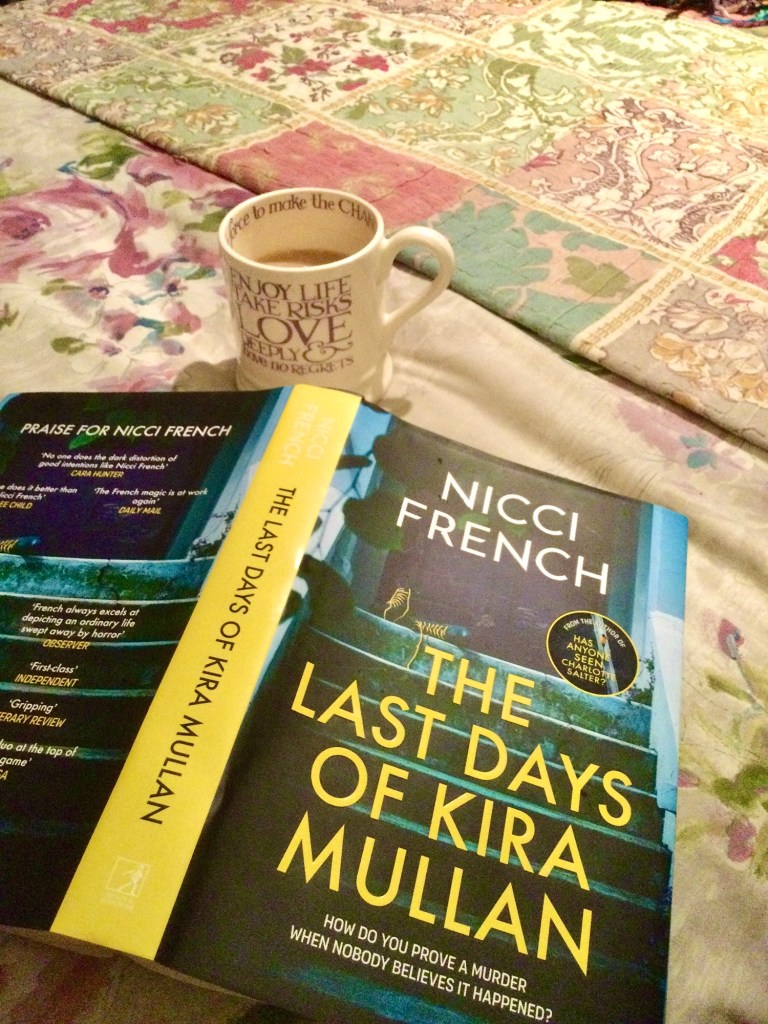
The Last Days of Kira Mullan by Nicci French

I always jump at the chance to read a new Nicci French book. Also they’re so prolific that it’s easy to find earlier novels in charity shops. This novel is set in a Victorian house split into flats and it’s newest residents are Nancy and her boyfriend Felix. Nancy is recovering after a psychiatric episode and a stay in hospital. Thankfully her voices have subsided but she’s fragile and moving to a new part of London has been destabilising. After venturing out for a walk she starts to experience voices again and in her confusion she rushes back to the flat. At the front door she bumps into a young woman wearing very striking green boots with yellow laces. The woman speaks to Nancy but it doesn’t make sense and it doesn’t help that she’s trying to distinguish between which voices are real. All she knows is that the woman was distressed and possibly needed help. Only 24 hours later the young woman is found hanging in the basement flat. Her name was Kira Mullan. Everyone seems sad that Kira committed suicide but for Nancy, something feels off. She isn’t sure that Kira did kill herself. How can she convince the others that she’s telling the truth when nobody trusts her?

This novel was absolutely gripping with brilliantly written main characters and a haunting central victim in Kira. I loved the idea of following the story through Nancy who has been struggling with her mental health and a clever, perceptive detective in Maud. The authors have cleverly placed Nancy on shifting sands – not only has she had a period of psychosis but she’s moved house and into an entirely strange area of London. She’s also lost her livelihood as a chef and could be living in a building with a murderer. She’s also without a touchstone in her life. I know exactly who to go to and ask whether I’m the asshole? I have friends who will tell the truth about whether I’m over-reacting or if something is genuinely wrong. This was invaluable when I found myself in an emotionally abusive relationship. I’d hoped that Nancy’s boyfriend Felix would be that person but I’d noticed a few red flags. He’s very attentive and seems to want her wrapped up in cotton wool, but Nancy is doing all the right things. On the day after she’s heard voices she asks to see the psychiatrist who changes the dosage of her medication and goes for counselling. She’s resting and doing her breathing exercises. In fact there’s very little else she can do. The authors leave us constantly wondering about her; is she paranoid or are the other residents out to get her?

Felix claims he only wants people to look out for her but Nancy feels like her space and autonomy are being encroached on. Felix tells the other residents everything about her history, including the psychosis, even the doctor who lives across the hall. He even gives next door neighbour Michelle their door key so she can let herself in, much to Nancy’s shock. His actions have actually left Nancy more vulnerable, leaving her open to abuse from others that they can deny. Who’s going to believe the mad girl? Nancy doesn’t think she’s paranoid but can see that her actions might seems excessive: she goes through Kira’s bin; steals a used condom from the flat and goes to look at the apartment with an estate agent; she also tells the police and Kira’s mother that she doesn’t think it was suicide. Just as she thinks she’s getting close to answers she is sectioned again after Michelle informs Felix that she threatened her. The authors show us how vulnerable mentally unwell women are in the care system and NHS, even though they’re designed to protect them. Not only is her liberty taken away and she’s prey to unscrupulous carers and nurses. In this upside down world, the more she protests her sanity the worse things become. She loses whole days to medication and is told by one male nurse that her life would be easier if she was ‘nice’ to him. So Nancy bites him. She has only one choice here. Be obedient, ignore the barbs and smile sweetly through visits she doesn’t want. It’s the only way she’ll be free. 

I loved the relationship between the detective Maud and Nancy. Maud is so perceptive and their experiences do mirror each other in a way. Maud knows that as a woman in the MET she is in the minority and she’s fully aware of the type of man that can be hiding behind a uniform or a title. In their respective institutions Nancy and Maud are trapped within a system they can’t change. Maud knows that if she becomes emotional or passionate about a particular case she will be seen as an irrational or hormonal woman. If she’s assertive and asks for what’s rightfully hers she’ll be called a bitch. In order to get the cases she wants and stand up for women like Kira and Nancy she has to play the game. It seemed to me that Maud saw the red flags with certain people whether in the flats or the house next door. She never holds Nancy’s illness against her and accepts that although she’s been struggling, she still might have something useful for solving the case. She also has a network of women within the system who will do her favours, such as looking over autopsy results and giving a second opinion. I loved the way she handles herself and her confidence in very dangerous circumstances. This was a gripping and psychologically brilliant read. I’d didn’t work out all of what had happened in Kira’s final days but the end was satisfying and I reached it very quickly because this is quite the page turner. 

Out in hardback from Simon & Schuster on Jan 16th 2025

Meet the Author

Nicci French is the pseudonym of English husband-and-wife team Nicci Gerrard and Sean French, who write psychological thrillers together.

Posted in Squad Pod Collective

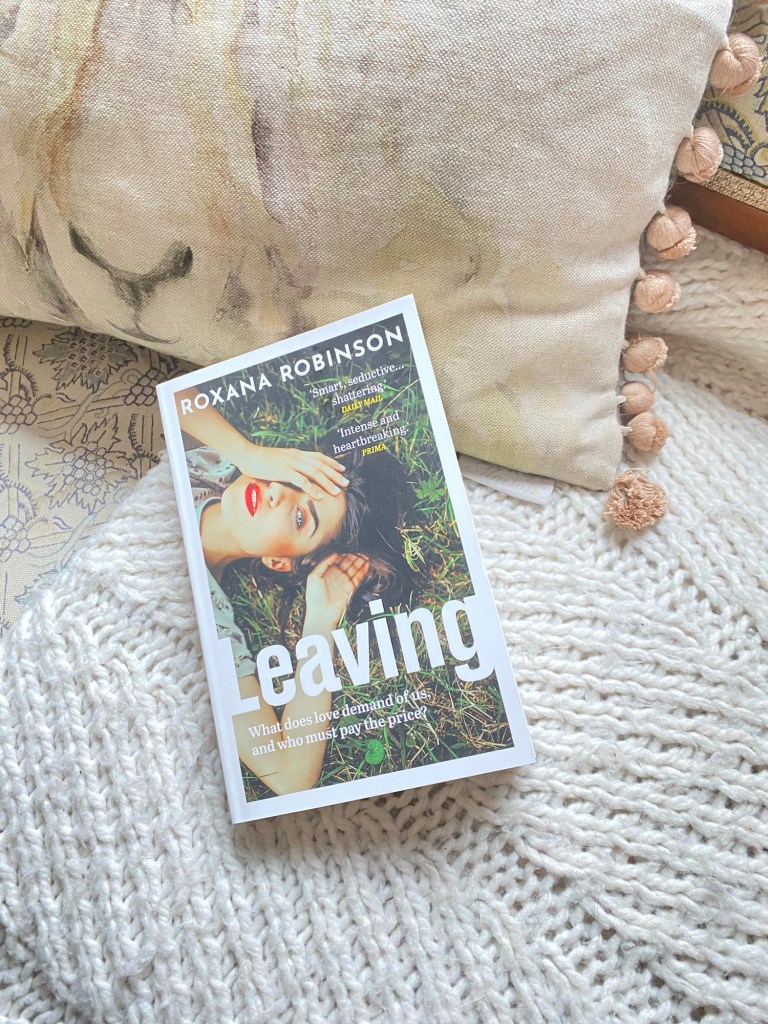
Leaving by Roxana Robinson. 

For years and years, when I’m asked the question which book has hit me hardest emotionally I’ve always had to say One Day by David Nicholls. It’s the last book that made me cry spontaneously for one of the characters. I still remember the exact line. Now I’ll be able to say Leaving was the last book that absolutely tore my heart out. Sarah sees Warren, who she dated for a while in their college years. She had ended it, unsure whether they were a good fit. Yet they never stopped thinking about each other. Sarah is divorced now and lives alone in her country home with her dog Bella for company. She has a daughter who’s married and lives a distance away with her husband and two children. Sarah works at a gallery, currently putting together an exhibition about the Bloomsbury Group. Warren lives just outside Boston and has his own architectural practice in the city. He’s married to Janet, exactly the sort of wife he has needed: attractive, a good hostess and great mum to their daughter Kattie who is an older teenager. However, his wife is also a snob, very aware of who should be in their social circle and how things should be done. They don’t talk about current affairs together, listen to an opera or read the same books. Perhaps their marriage has always been like this, but it feels empty since he saw Sarah again. Can he spend the rest of his life in this marriage as he promised or can he be with Sarah? If he leaves what price will he have to pay? 

This novel is so clever in the way it engages with your morals and emotions. I was so caught up with the romance of Sarah and Warren, so much sweeter because it is second time around. I felt their urgency. It’s unthinkable thar they shouldn’t grab, what feels like, a last chance of happiness. I felt so much for Sarah, who is an intelligent and self-sufficient woman post divorce. She has such a solitary life, seemingly with a handful of friends. Her life is made up of her job, her home with poodle Bella and occasional visits with her daughter and son-in-law. I loved the tender moments she has with her dog, something I understand completely and just as important as anyone else when considering big life decisions. It feels like she’s where she belongs on the edge of the reservoir walking with her canine companion, so in tune together. She does feel a little remote from her daughter, wanting to be like other grandmothers who look after their grandchildren regularly and have one multi-generational family. Sarah doesn’t quite feel invited into her daughter’s life. I didn’t feel any dislike for her or begrudge her happiness with Warren, even though it comes at the cost of his wife’s happiness. They felt easy and uncomplicated together. Sarah thinks of his wife but doesn’t feel like the other woman because he was hers first. Their relationship is a continuation of something started long ago, or is this simply their justification for something outside their normal moral code. The author beautifully captures those heady romantic moments of a new relationship with simple moments, the joy of receiving flowers or the secret smile that comes from a loving text in the middle of a working day. Sarah doesn’t lie to her own children, she tells them she’s seeing someone from her past. That he’s married. They are happy for her. 

Warren’s life is more complicated. The author takes us between his and Sarah’s inner thoughts seamlessly. They are two halves of a whole. By comparison his married life feels mundane and rather one note, but it’s unfair to compare a new love or even a recaptured love with thirty years of married life. A few deft touches show us a marriage that’s become routine, Janet’s red house dress being just one. The reappearance of a frozen chicken pot pie is a beautifully used example. It appears early on, only to be replaced with a beautifully cooked beef bourguignon as Janet tries to win her husband back. It promises so much, this is how it will be from now on. Only to revert to chicken pot pie again, but it isn’t just a pie, it signifies a marriage that’s fallen back into a well worn groove. It screams ‘is this it?’ Janet has done nothing wrong, they haven’t had a bad marriage and when Warren feels the weight of those years there’s a fondness, a gratitude for all those shared moments that make up a marriage. He is both grateful for them and buried beneath them. Does he deserve to climb out from underneath them? Or is it an unforgivable betrayal of everything they’ve shared as a couple and a family? 

I loved some of the subplots to the main love story. I found Sarah’s work fascinating. I remember talking to someone ar the V & A about one of their fashion exhibits and the process of creating something with such impact. I hadn’t known a job existed where you could sit and discuss a artist’s work, then choose the pieces you want to tell a story. I thought the quandary over whether to go with a well- known scholar on the Bloomsbury group versus a newer academic voice echoed the love story so completely. The best known scholar may promise something new but will likely deliver something competent but safe. The newer voice might offer something dynamic and new but they aren’t a very big name yet, is newer always better? Sarah’s daughter’s third pregnancy isn’t easy and terrible news brings Sarah deeper into their lives and closer to her grandchildren. I also loved how Kattie’s wedding placed stress on her whole family, especially where Janet wants the big, formal society wedding and her daughter starts to feel overwhelmed. The wedding planner tells them that a wedding is basically a microcosm of society, the one of which their family is a part. People aren’t perfect, so weddings never are either. Neither is marriage.

Everything about this novel rings true, from the details that set each scene to the love story that binds everything together. It’s exquisitely written, drawing you in so very slowly, then unravelling quickly to it’s emotional conclusion. There’s a point in the book where I have never wanted to slap a character more! Even though their actions are understandable and possibly morally justified, I was still absolutely furious and had to share the story with my husband whose immediate response was exactly the same. Once an affair starts to turn into something more, so many decisions have to be made and the sacrifices those choices will create become stark and very real. Sarah has imagined living with Warren, but she’s always thought of them at her home. This is where she rebuilt herself after her divorce. It’s a place she loves and doesn’t think she can give up. Arguably, Warren’s choices are even more difficult. He knows if he does this, his relationship and happiness with Sarah will come at the cost of someone else’s feelings. On the scales does one happiness outweigh another? Or are some costs simply too great? I simply loved this book and although it’s only January but I have no doubt this will be in my best books list come the end of the year. I would happily read everything else the author’s ever written.

Published by Magpie Feb 2024

Meet the Author

Roxana Robinson is the author of eleven books: seven novels, three story collections, and the biography of Georgia O’Keeffe. Four of these were New York Times Notable Books. 

Robinson was born in Kentucky, but grew up in Bucks County, Pennsylvania. She attended Bennington College and graduated from the University of Michigan. She worked in the art world, specializing in the field of American painting, before she began writing full-time. Her novel, Cost, was a finalist for the NEBA, was named one of the five best fiction books of the year by the Washington Post and received the Fiction Award from the Maine Publishers and Writers Association.Her novel, Sparta, was named one of the ten best books of the year by the BBC, and won the James Webb Award for Distinguished Fiction from the USMC Heritage Foundation, and the Fiction Award from the Maine Publishers and Writers Association. Her fiction has appeared in The Atlantic, The New Yorker, Harper’s, Tin House, Best American Short Stories, and elsewhere. Her non-fiction has appeared in The New York Times, The Washington Post, Bookforum, Harper’s, and elsewhere. She was twice a finalist for the NBCC Balakian Award for Criticism and has received fellowships from the National Endowment for the Arts and the Guggenheim Foundation. She teaches at Hunter College, has twice served on the board of PEN, and was President of the Authors Guild, where she continues to serve as a member of the Council. She lives in New York and Connecticut, and spends as much time as she can in Maine.

Posted in Blogger Life

Bright New Year! Bright New Books!

If you’re anything like me you probably spent the last days of December looking at lists of books you should be reading in 2025. I’ve even made my own list of the ones I’m most looking forward to. It’s also the time of year where we choose how we’re going to track our reading and whether we’re going set ourselves a challenge. There’s the Goodreads annual challenge where you try to read even more books to meet your target, there’s Storygraph which I don’t know anything about. I do Goodreads mainly because there’s a record of what I’ve read so I can do my end of year posts. There are other ways to challenge ourselves, such as choosing to read more classics or the Agatha Christie challenge where you read through her works during the year. As those of you will know I’m struggling with my health at the moment so I decided to take a hiatus from blog tours and Squad POD activities to read by mood for a while and be free from obligations. I’m really enjoying it, even if I am missing the camaraderie of the squad at times, that excitement of all reading a book together and talking about it is hard to beat. 

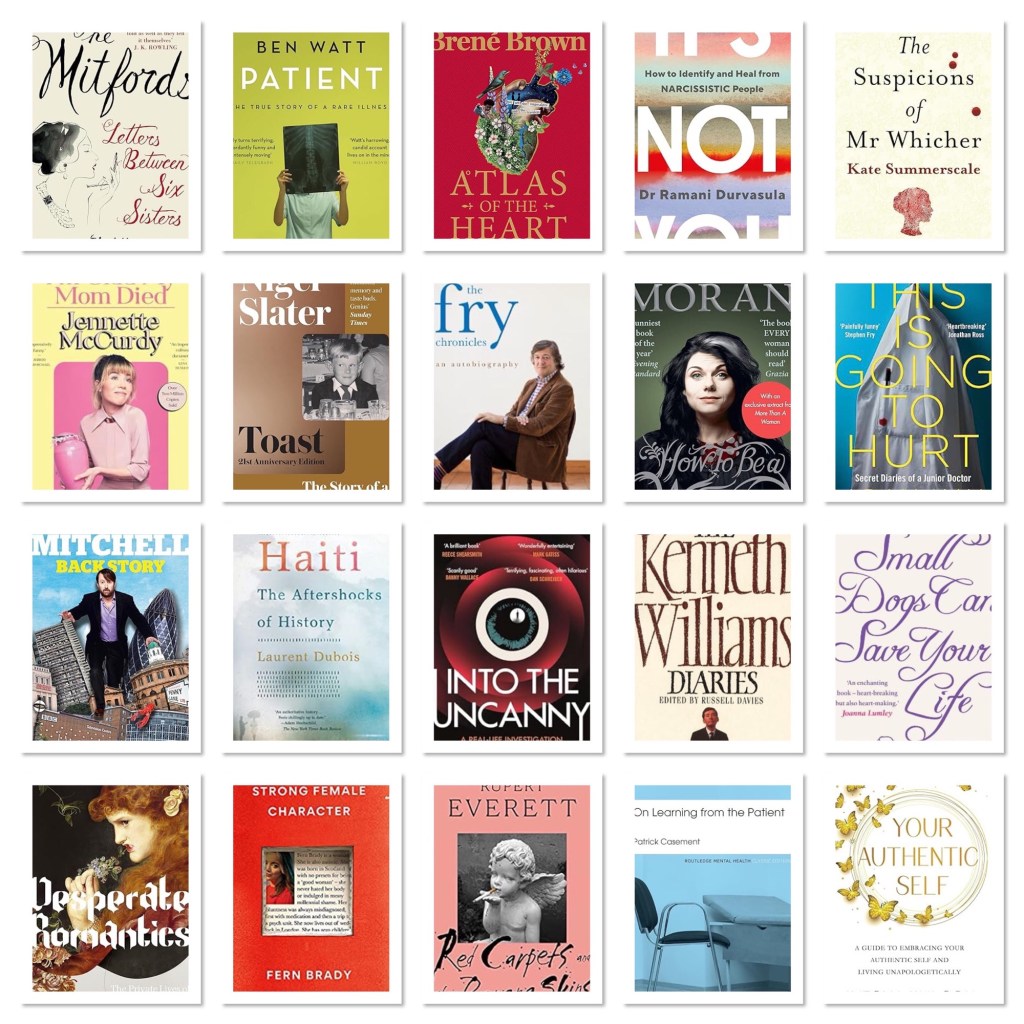
Some non-fiction favourites of mine.

I’m not big on New Years Resolutions, it’s the wrong time of year and too much pressure.  So my only change for this year is to act on something I noticed from struggling so much this year. When I’m in a reading slump I noticed that I managed to get going again by reading non-fiction. It seemed to be a mix of memoir, humour, crime, history and fashion. Over the past couple of years I’ve been reading books by celebrities, often comedians and actors: Phillipa Perry, Lou Sanders, David Mitchell, Rupert Everett and Miriam Margoyles to name a few. I’ve read some brilliant memoirs on illness and death such as Patient by Ben Watt, Lucky Man by Michael J. Fox and Christopher Reeve’s memoirs. I loved reading memoirs by comedians Lou Sanders and Fern Brady who both detailed difficulties they faced being late diagnosed with autism and ADHD. I also found myself drawn to books of letters or diaries and I’ve loved reading Virginia Woolf’s diaries but also Kenneth William’s diaries which happen to be hilarious and sad at the same time. I have a thing about the Mitford sisters and dip in and out of their letters to each other regularly. So this year I’m going to read a non-fiction book every month. Ive found twelve non-fiction books I haven’t read yet and I’m going to pick one every month to read and review. I’m excited to get started on them. I wish you all a Happy New Year and I hope you enjoy all the challenges you’ve set yourself this year. 

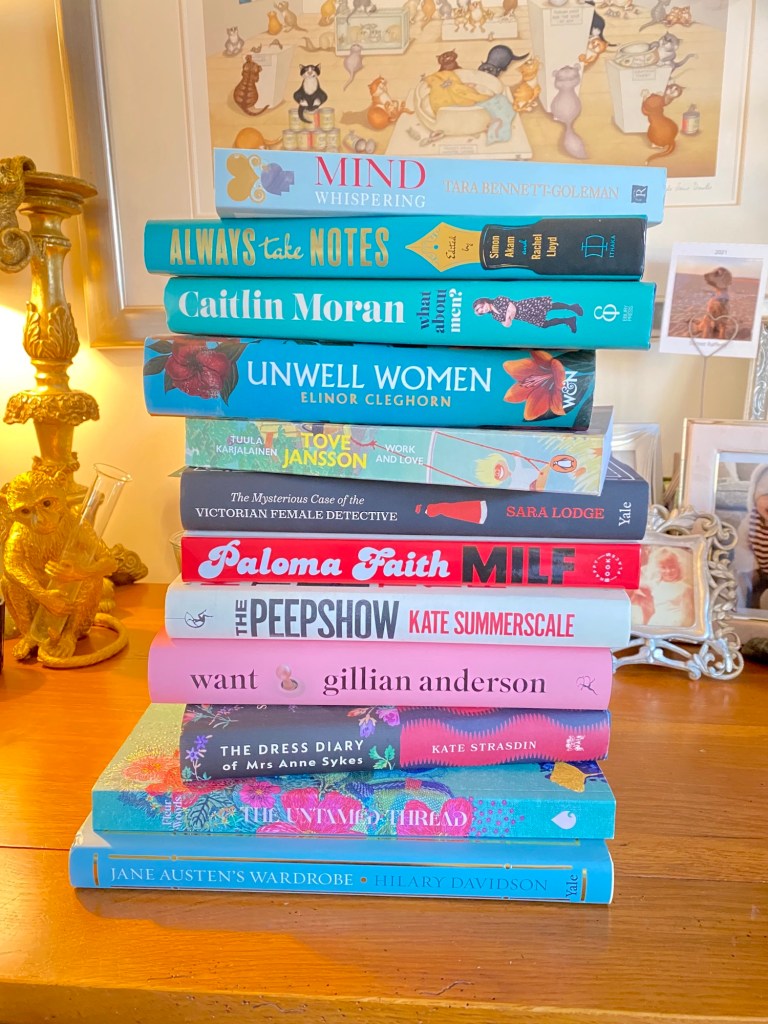
Here’s the info on my choices:

Mind-Whispering by Tara Bennett-Goleman from Ebury

Always Take Notes: Advice From The Worlds Greatest Writers. Simon Akam and Rachel Lloyd. Ithaca Press from Bonnier Publishing

What about Men? By Caitlin Moran. From Ebury. Penguin Publishing

Unwell Women by Elinor Cleghorn. Wiedenfeld & Nicolson.

Tove Jansson Work and Love by Tuula Karjalainen. Penguin Books.

The Mysterious Case of the Victorian Female Detective by Sara Lodge. From Yale University Press.

MILF by Paloma Faith from Ebury Publishing/ Penguin Random House

The Peepshow: The Murders at 10 Rillington Place. By Kate Summerscale. From Bloomsbury.

Want. Written by Anonymou. Edited by Gillian Anderson. Simon & Schuster UK.

The Dress Diary of Mrs Anne Sykes by Kate Strasden. Chatto & Windus.

The Untamed Thread by Fleur Woods. By Koa Press.

Jane Austen’s Wardrobe by Hilary Davidson. From Yale University Press.

Posted in Back of the Shelf, Throwback Thursday

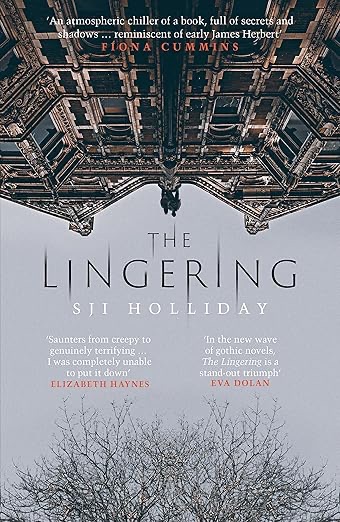
The Lingering by S.J. Holliday

In the free reading time I have towards the end of the year I’ve chosen to read the back catalogue of a few authors and S.J.Holliday happened to be someone I was really interested in. I love most of Orenda Books’s authors and I first came into contact with them through S.J. Holiday’s book Violet, which was one of my first ever blog tours. I loved the psychological aspects of the book and the way the author saw women as they really are – the heroes of their own stories, making autonomous decisions with the potential to be just as violent and chaotic as a male character. I’ve had The Lingering on the shelf for a while, but something made me take it down last week to read while soaking in the bath. Ali and her husband have made a huge decision. They’ve sold up almost everything they own and joined a commune of people living in what was an old psychiatric unit. At first they’re unsure of the group and their surroundings, but as her husband starts to settle in, his wife Ali seems less able to. Is it the strange house, with it’s abandoned wing full of old psychiatric equipment? Is it the sceptical locals? Or do Ali and husband Jack have dark secrets of their own?

The setting of this story is so gothic and atmospheric, with a dark history that slowly reveals itself both through local’s stories and the things left behind – physical and paranormal. Angela, the other narrator in our story, is the keeper of these stories and an amateur investigator of the paranormal. She has the house wired with sound equipment and cameras, particularly those areas where her sixth sense starts tingling. One of those areas is the bathroom adjoining Ali and Jack’s new bedroom, but also in the attic room above. I was slightly alarmed by the way she was watching the new couple, in a detached way almost like they were animals in an experiment. She seems like a new age, tree hugging, ethereal type of woman who has really bought into the ethos of the community. Ali notices her reverence in the rituals they share as a group and in the meditation sessions. Her name outlines her role within the group, she is the angelic and slightly naïve little sister to the others. Yet there is another side to her, the side that enjoys the stories told by locals like Mary in the shop about the house’s witches and the later rumours surrounding the asylum. She seems to enjoy the intrigue and proves to be quite the detective when it comes to Ali and Jack, showing a sneakier and unpleasant part to her character. The house itself is a labyrinth, with secret rooms and endless corridors. That strange juxtaposition of the natural and the man made felt wrong. All the hospital equipment and furniture just sitting there as if still being used, whilst the outside elements and nature are starting to encroach inside left me feeling uneasy. I felt as if any moment Ali or Angela might look in the mirror and see a busy ward behind them, like a glimpse through time.

In my closest city of Lincoln there is an old Victorian asylum on the outskirts, now slowly being developed into residential spaces. For years it remained deserted and derelict, with a strange aura around it. I wouldn’t have been surprised to see a 19th Century nurse at one of the broken windows, because it was untouched all that energy still seemed present. Local explorers did search around inside and take pictures of the iron bedsteads and old medical equipment just lying around as if someone had only just left the room. The mould, piles of rotted leaves, cobwebs and dirt added to the sense of abandonment. You certainly wouldn’t have found me in the there at night! This was exactly what was running through my mind as I was reading and it set me on edge. This house felt as if some parts were inhabited by the living and others by the dead. I won’t spoil the scary moments for other readers, but Ali’s first experience as she climbs into the bath after their long journey would have sent me running back up the drive. It has double impact because not only is it inexplicable, it’s an echo back to events that really happened in the house’s past, events that are haunting even without their ghostly context.

I didn’t trust anyone after a few chapters, despite at first happily reading Ali’s experience and trusting her account. As a reader I’m used to fictional communities like this being sinister under their surface mantras of love and light. Yet Angela makes discoveries that put the couple’s story in doubt and I began to wonder about Jack. What had forced these people to leave behind two respected professions and could it have something to do with a box of hidden news cuttings? One of the most tense sections of the book had nothing to do with the paranormal and involved some of the villagers. Late night Ali notices a 4X4 vehicle coming up the drive with a large lantern on the roof and several men inside, most of them holding a gun. As she goes outside to confront them they explain that they’re merely ‘lamping’ nearby and have an agreement to flash their late at the community leader’s bedroom window so he knows they’re nearby. Much as it seems ridiculous to flash a light in someone’s window so you don’t disturb them, their excuse is a plausible one and it’s something I often see in the fields surrounding us. Yet there is an undercurrent in their conversation with Ali and when explaining what happened she does reference Straw Dogs, a violent 1970’s film where an academic and his wife move to the country and are terrorised by the villagers. However, her reaction is excessive and made me wonder what had happened in the past to trigger her that way. The author flips us between Angela and Ali, building the tension towards some sort of confrontation. Will Ali find out that Angela has been watching them and explode or will Angela’s snooping reveal something dreadful about the new recruits? I loved the hauntings, especially the emotive little child’s wet footprints that dot around the place. Do these apparitions have a malign purpose or are they simply trapped in a place where traumatic events play over and over like a continuous cinema reel? This is a brilliantly tense and spooky read that seems perfect for autumnal evenings, but might put you off baths for a little while.

Out now from Orenda Books

Meet the Author

Susi (S.J.I.) Holliday is the bestselling Scottish author of 11 novels, a novella and many short stories. By day she works in pharmaceuticals. She lives in London (except when she’s in Edinburgh) and she loves to travel the world.

Posted in Netgalley

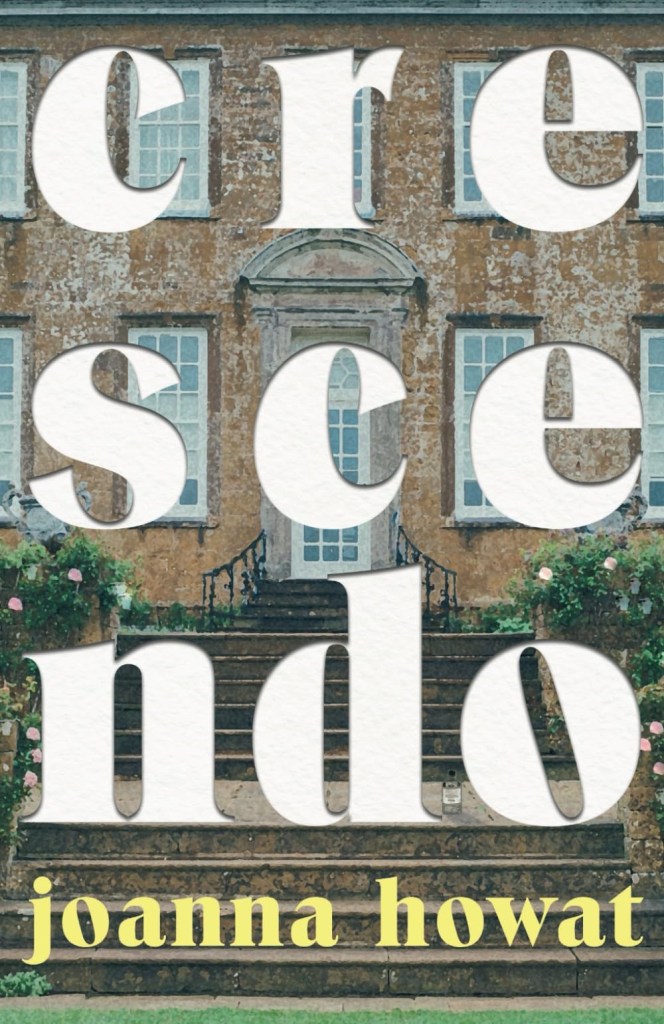
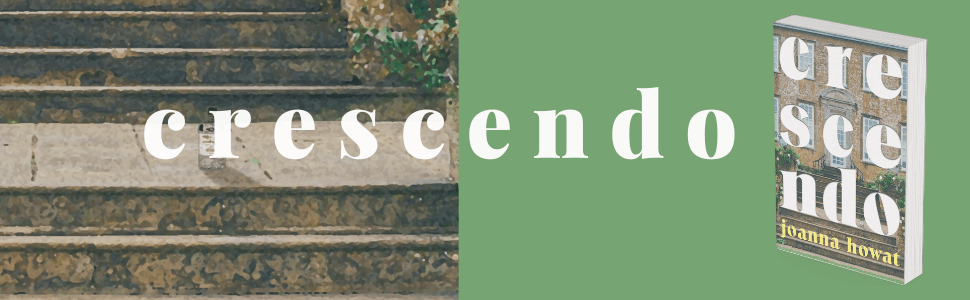
Crescendo by Joanna Howat

I love reading debuts because you’re never sure what you’re going to find and this tale of two adult siblings who lose their parents suddenly has all the family dynamics and trauma that I love to untangle in a novel. Jamie and Caz are used to their parents being top of the social scale in their area, a small village close to a market town in Yorkshire. Their family home is a hall in the centre of the village, where Jamie still lives alongside his parents having not found his career path yet. Caz has left home, but has a chequered history of teen pregnancy and alcoholism. She married husband Steve after he came to work on the hall’s electrics when her first little girl was only a baby and she had been sober for several months. Now they live in a cottage a short drive away from her childhood home and recently she’s had another baby. The catalyst to their problems is the loss of their parents. One Sunday both siblings are there for lunch when Jamie and his father clash over what he sees as his son’s fecklessness when it comes to making a life for himself. Jamie has secured a job with the local estate agents but desperately needs to sell a house this month. The best thing in his life is his recent relationship with local vet Zoe. What Jamie loves is his piano, but he doesn’t think he has the skill of a concert pianist. This Sunday he decides not to take his father’s criticism and storms out in a huff. That night the hall goes up in flames, so fast that no one could escape and the hall is burned to the ground. 

For both siblings the village now looks like a set of teeth with one missing. The huge gap left in the centre is soon boarded so no one can see the wreckage, but it doesn’t allay the shock. Caz is immediately emotional, dazed even and takes refuge with Ruth, their housekeeper who lived next to the hall. Jamie seems frozen. The only thing he wants to save is his piano but it is damaged, maybe beyond repair. Insurance will take care of it and will hopefully rebuild the hall, but do they want that? They have no idea about their parent’s wishes, for the meantime Jamie has to buy some clothes and moves in with Zoe. It’s very early in their relationship but Jamie thinks they’ll get along fine. As he moves through life like an automaton, Caz starts to slide downhill. Gin was her usual tipple, but avoiding that she thinks an occasional glass of wine won’t hurt. One glass soon becomes a bottle and as she starts to hide her stash from Steve we can see that this could be a serious relapse. So can Jamie, but he’s having his own problems. The turmoil in his life is too heavy for the early stages of a relationship. Zoe had no relationship with his parents and although she can listen, she still has her own routine of riding and looking after her horse, whereas at the moment Jamie is sleepwalking through work and every time they are intimate, visions of the hall burning down come into his mind and ruin the moment. He’s not sure if he’s dealing with his grief at all. When Zoe decides they need some space from each other, he moves out to Caz and Steve’s house. Now he’s noticing that his sister isn’t coping either and his nieces are suffering. How can the siblings best help each other to cope? 

I loved how the author shows grief hitting people in different ways. In some ways Jamie has never had to grow up. Living under his parent’s roof has enabled to try jobs and leave them with minimum consequences, while away hours in the village pub and not think beyond tomorrow. Caz has also depended on her parents, dropping out of university pregnant and with an alcohol problem. She moved home and had her baby there, until Steve actually walked through the door for a contracting job and they fell in love. For both of them, there’s now no safety net and the place filled with all those memories has gone too. Jamie also fears the loss of his piano, which has been lifted from the wreckage and been sent to a specialist repairer by the insurers. Music was the way that Jamie processed his emotions and without it he seems strangely neutral all the time, occasionally tapping out melodies using his fingers on whatever surface he find. Caz is more erratic, grabbing convenience foods instead of her usual home cooked meals and forgetting the girls activities or even to wash their uniforms. When the drinking starts Steve stays away from it, leaving Jamie with a full time job and two small children to feed and get out of the door in the open. He knows teachers have noticed the girls are a bit unkempt, but he doesn’t want to drop his sister in it. He just keeps smiling and nodding that everything’s okay. There’s only one person that won’t have the wool pulled over their eyes and that’s their parent’s housekeeper Ruth. Caz fears not letting the emotions out. Jamie thinks if he gives in and feels his emotions he might fall apart completely.

Through Jamie the author shows how grief can change our outlook on life completely. He becomes sentimental about an old couple looking for a house. He has a beautiful Georgian house on the books and he’s shown it to a rude and superior client with an enormous dog who didn’t seem interested. Then he has an adorable old couple who want to downsize and be closer to amenities, but he needs a studio to work in and it is in town. When he shows it to them he knows it should be theirs and when they offer he is ecstatic and shakes hands. Then the first woman comes back and offers 10k over the asking price, but Jamie says it’s already sold and turns her offer down, much to the fury of his manager. Jamie feels different, where once he might have taken the high offer now he can’t. Does he see his own parents in the old couple? Or is it that loss has given him a conscience? I really identified with this because after being seriously ill I returned to my work as an advertising rep only to struggle with selling newspaper space. It felt so trivial in the scheme of things I simply didn’t have the killer instinct. This was when I was sacked but went on to train as a counsellor and worked with the Mental Health Team in my area. It felt like I’d helped someone every day I went to work and it felt more in tune with my changing values. 

I really felt for Jamie and wanted him to get his piano back and be able to express himself more. I was also so happy at his care for his nieces and his loyalty to his sister. Underneath the immaturity Zoe was concerned about, he’s a kind, perceptive and caring man. I was hoping they would find a way back to each other. Similarly I wanted Steve to reconnect with his wife and family and realise that while keeping a roof over their head was important, so was spending time together as a family. The author’s setting is perfect and having lived in villages all my life, I knew they come with beautiful countryside around them, but also residents who want to know all of your business. As my parents get older I do wonder what it might be like when they’re gone and I’m now the oldest member of the family. They’re my anchor, but so is my brother and I know our relationship will probably be stronger. I think the author makes it clear how seismic a shock it is when someone close to us dies. I loved the play on musical terms because the storyline has a tempo and Jamie is our conductor, desperately trying to keep the orchestra together towards the crescendo and beyond. This is a thoughtful and real story that had a lot of heart in it. 

Out now from Flying Dog Press

Meet the Author


Joanna Howat trained as a journalist and worked as a news producer for BBC Radio 5 Live. She now lives in her native North Yorkshire with her family and two spaniels, and is a keen classical pianist. Crescendo is her first published novel.