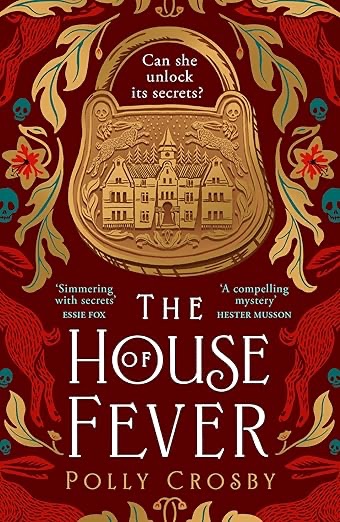
On a trip abroad with her mother, Agnes Templeton meets a handsome young doctor called Christian Fairhaven. He seems completely besotted with her and a romance soon develops. Surely his swift proposal can only mean one thing,it must be love or this a relationship of convenience? Dr Fairhaven needs a wife and a stepmother for his daughter Isobel, while Agnes needs an expert in tuberculosis for to look after her mother who is now dying from the disease. Christian is researching a new cure, something he’s working on at the institute he runs called Hedoné. He lives in a cottage alongside the institute, which is split into an infirmary for very unwell patients and ‘spa’ type accommodation for TB patients who can benefit from the fresher air and rest that the institute provides. When Agnes arrives she finds that not everything is as she imagined. The guests are more glamorous and wealthy than she expected, with their part of the building adjoined by a swimming pool, beautiful grounds and many places for parties. Their access to alcohol and gourmet food gives the place a feel of a luxury hotel. Agnes’s mother is taken into isolation, to be monitored closely and have a period of quarantine. Agnes is allowed to visit her mother’s room as she seems to be immune to TB having nursed both her father and mother through the disease without succumbing herself. As she adjusts to the contrasts of lavish dinners and the sound of partying with the very authoritarian Matron and strict quarantine restrictions, Agnes starts to notice things. Isobel seems to flit around largely unmonitored and doesn’t live with them in the cottage. The beautiful actress Juno Harrington holds court here and seems to have unfettered access to Christian, even in his office. There’s nothing Agnes can put her finger on, but she feels uneasy. She senses there are secrets at Hedoné and perhaps in her marriage too.
The book is largely narrated by Agnes, with small chapters every so often that seem to be narrated by a child. Through this we see the institute in two different ways; Agnes’s conflicting and unexpected impressions alongside those of a person who knows this place inside out and has explored every nook and cranny. I was very interested in the hare motif that repeats itself throughout the book as a symbol for the institute. It’s the keyring on which matron keeps her keys as well as the keys to the cottage, it’s on the signage and repeats throughout the building. I’m very interested in hares as a mystical symbol and a spirit animal, ever since my father found a leveret on the farm and let a four year old me touch it’s silky fur. For me it’s a symbol of huge leaps I have taken in life, some of which paid off and others that didn’t – something you have to accept if you are one of life’s ‘jump in with both feet’ people. I wondered if it had been chosen as a symbol of renewal, recovery and potentially the cure that Christian thinks he may be on the verge of discovering. However, it’s also a fertility symbol, having possible implications for his expectations of Agnes and their marriage. Agnes has jumped in to this marriage with a very short courtship away from the institute that dominates her husband’s life. There is a lot to learn about each other and where Agnes saw a competent and successful doctor, able to run an institute and bring up his daughter alone, the real picture is more complex. Isobel seems to be brought up by whoever is available, but spends a huge amount of time alone. Agnes wants to be a mother to her, but doesn’t want to impose and change what’s clearly a familiar routine. She hadn’t expected formal dinners with a new dress magically appearing each time. Who is choosing them? Christian courts investors for the institute, all drawn in by his claim of a cure. It starts to feel like the
man she met and married was something of an illusion, incidentally that’s one of the risks of taking ‘hare leaps’.
I thought the author cleverly placed doubts in the reader’s mind very slowly and strategically. I was immediately alert to a couple of characters: Juno Harrington who seems to run the social aspects of the institute and Matron, who at first gives off Mrs Danvers vibes and reprimands Agnes if she isn’t following the rules. I could see red flags popping up with Christian, who is clearly not as financially successful as the institute might suggest and the revelation that it is Juno Harrington’s family who are the largest investors answers one or two questions. Being very fond of fashion, I didn’t like the fact someone was choosing Agnes’s clothes, always placing just one new dress in her room as her only option for the evening. It showed a element of control that had my senses pinging straight away. Christian’s strange obsession with her colouring and complexion seemed odd too, constantly referring to her as his ‘English Rose’. When she finally sees a picture of Isobel’s mother, Agnes finds herself eerily similar. He’s also very quick to ask whether she could be pregnant. Agnes has been learning to enjoy their love-making and finds herself actively looking forward to it in their honeymoon period. Is his attention to her genuine or purely based on the potential outcome of having a child? He’s also very cagey about his claims of a potential cure and if the graveyard Agnes finds in the woods is a measure of his competence, it clearly isn’t working.
I wasn’t surprised when the idea of eugenics started to come up, especially considering the period the book is set. It started as a theory in the late 19th Century and was the catalyst for horrific crimes against people deemed genetically inferior. In the USA it was used as the justification for sterilising huge numbers of Native American and young African-American women, especially those living in poverty in the southern states. In the UK it became a way of herding out those who were degenerate, linking criminality to certain facial features. Obviously, the Holocaust was the single biggest crime against humanity based in eugenicist theory. Hitler’s obsession with creating an Aryan master race, was used as a justification for mass murder of those he deemed as ‘life, unworthy of life’. This was mainly those of the Jewish faith, but also included Roma people, Catholics and people with disabilities. His program of sterilising those with disabilities and removing disabled children from their families started in the early 1930’s. In this novel, eugenics are linked to the institute and possibly Agnes’s particular traits – her immunity to tuberculosis and her English Rose colouring. I was becoming worried that the graveyard where Christian’s first wife is buried, alongside so many of his patients, might be the result of experimentation or simply weeding out those too far advanced for him to cure. I loved how these ideas unfolded. We only see what Agnes does so we might suspect, but we
only discover the truth as she does which brings an immediacy to the revelations.
I loved Agnes’s burgeoning relationship with Isobel who felt to me like an abandoned little soul, wandering the grounds and all the secret spaces within the institute, trying to to help sick people where she could and spending time at her mother’s grave. Christian seems to have no plan for her and doesn’t even discuss what his parenting strategy is, probably because he doesn’t have one. He leaves Agnes to get on with it and she does well, simply assuring Isobel that she is there for her and showing a willingness to share the memories she has of her mother and their life together. I think Agnes shows her more love than anyone else. Juno Harrington seems very interested in her but treats her almost as a little pet. I thought Sippy was interesting too, a nightclub singer and the institute’s only black patient. She is valued for her entertainment potential and her voice is incredible, but I didn’t feel she was included as part of the creative and bohemian crowd. She could be on display but not one of them, and I had the sense she was quite lonely day to day. Her friendship with Agnes is based on a real understanding and connection between the women. She’s also enough of a friend to warn Agnes that everything here is not as it seems. As the closing chapters began, secrets unravelled and the tension really did build. I loved how these women helped each other and how the most help came from a totally unexpected source. It is a timely reminder that people can surprise you, especially the ones you are most afraid of. One of the most interesting things for me was the subversion of the Romantic trope of the beautiful, frail and young artist wasting away from consumption. This quote from Byron sums it up beautifully:
‘I look pale. I should like to die of a consumption’. ‘Why?’ asked his [Byron’s] guest. ‘Because the ladies would all say, Look at that poor Byron, how interesting he looks in dying.’
The pale complexion, the fatigue and the ‘rosy’ cheeks of advanced TB were a Romantic staple in fiction, whereas the truth of dying from this disease was different according to gender, race and most particularly, social status. The reality is often saved in literature for those in dire poverty and terrible living conditions. This excerpt from Liberty Hall gives a more accurate picture of the disease:
‘Her body was bent forward on her knees; the joints of this body so thin, that it was almost deformed, were swelled and red and painful. She laboured and coughed for her breath; each time that she breathed she coughed up blood …’
Despite this, TB was a Romantic fashion and the figure of the beautiful, young woman slowly giving her soul up to God was a staple of 19th Century literature – just think of Dora in David Copperfield or Beth in Little Women. I felt like these two contrasting views of TB were embodied by the two types of patient; the free, bohemian and intellectual party-going patients and those locked down in the basement, having a very different experience of the same disease. The visible parts of Hedoné are based on the Romantic ideal and the illusory cure, while the locked and hidden parts contain secrets and patients whose outlook is at best poor and with only matron to tend to them in their final hours. One is an ideal and one is the truth, rather like Agnes’s expectations of her marriage and the strange reality. As the real horror starts to unfold, I was desperate for Agnes to escape and I was desperate for that she not leave Isobel behind, because a definite bond between them. Polly nails the historical background to her story and really emphasises the fate of women between two world wars. Agnes is of a social status where earning a living as a nightclub singer like Sippy or an actress like Juno isn’t possible. In fact she seems in that liminal space where becoming a governess or nurse like matron might be her only working options. I wanted her to be free though, to explore her authentic self and make the life she wants. I wasn’t sure, right up to the final chapters, what her fate would be. This is an entertaining and interesting novel from an author who understands the nuances of relationships and always creates fascinating characters within the most unusual settings.
Meet the Author

Polly Crosby grew up on the Suffolk coast, and now lives with her husband and son in the heart of Norfolk.
Polly writes gothic historical mysteries for adults. Her first novel for young adults – This Tale is Forbidden – a dystopian fractured fairytale with hints of the Brother’s Grimm and The Handmaid’s Tale, came out in January with Scholastic.
In 2018, Polly won Curtis Brown Creative’s Yesterday Scholarship, which enabled her to finish her debut novel, The Illustrated Child.
Later the same year, she was awarded runner-up in the Bridport Prize’s Peggy Chapman Andrews Award for a First Novel. Polly received the Annabel Abbs Creative Writing Scholarship at the University of East Anglia.
Polly can be found on Twitter, Instagram & Tiktok as @WriterPolly

 The Lotus Readers