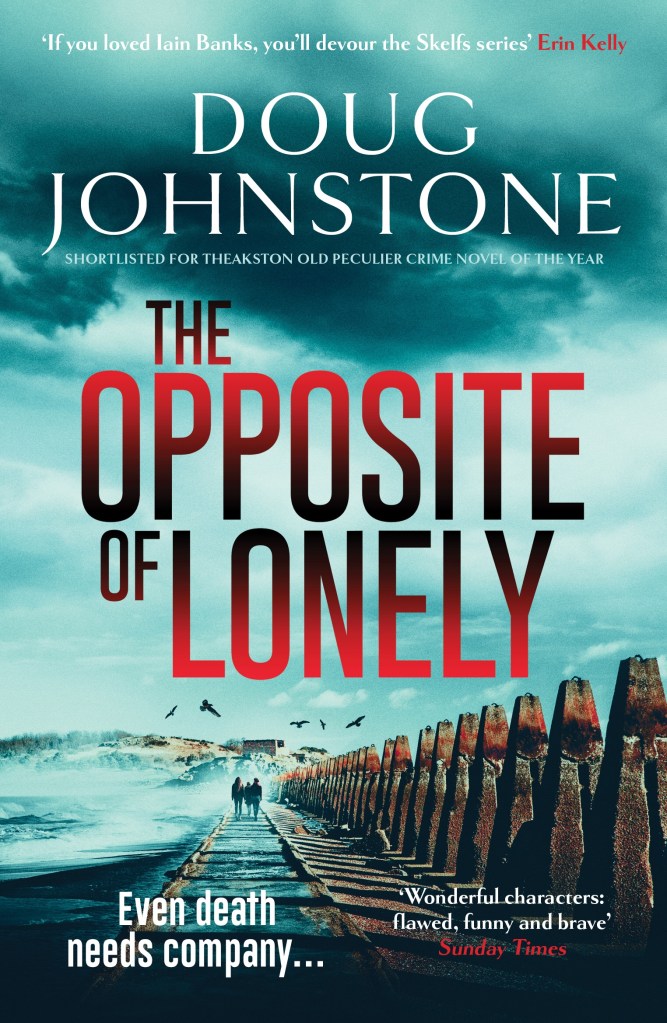
As many of you know I am a super fan of Doug Johnstone and particularly his Skelf series of novels, based in Edinburgh and following a family of women, running both a funeral home and a private investigation business. I love the Skelf women because they’re feisty, original, intelligent and incredibly compassionate. This is his fifth in the series and I’m in constant fear of it ending, though if it did this wouldn’t be a terrible way to bow out. In fact this may be the best in the series so far. As usual there’s an eclectic mix of people and cases. Dorothy is investigating a suspicious fire at an illegal traveller’s campsite, but also takes a grieving homeless man under her wing. Jenny is tasked with finding her missing sister-in- law who fled with the body of Jenny’s violent ex-husband Craig. Meanwhile, Hannah meets a women astronaut and is asked to investigate potentially dangerous conspiracy theorists who think she has returned from space ‘changed’. Add to that the new idea of water cremations, funerals for the lonely, strange happenings in space, a body lost at sea and a sexually adventurous man in a rabbit mask and you have all the ingredients to keep a Skelfaholic like me very happy indeed.
I love the Skelf’s outlook on life and other people, it chimes so well with my own family’s philosophy and is such a welcome change from the perspective of our current government. There’s an acceptance of others, whatever way they choose to live or love. They treat people with respect, in whatever circumstances they find themselves. There’s no judgement, something I especially love in Dorothy. She seems to have a knack for reading people and knowing when they’re trustworthy. She has a great track record too, having brought both Archie and Indy into the fold when both were in straitened circumstances. She has moments of exasperation when investigating, especially when she tries a pub local to the traveller camp where a fire happened. When gauging local feeling about the travellers she ends up in a long debate on their behaviour, most of which she dismisses as bigotry, but also their opinion of people ‘on benefits’, refugees, drug takers and women of easy virtue. They are the Daily Mail brought vividly to life and Dorothy notes how easy it can be for someone her age to accept the media narrative and become entrenched in their views. She doesn’t want to be like that and she’s certainly not going to be welcomed back to this pub. Jenny feels much the same.
‘everyone just trying to get to the end of the day and hoping tomorrow would be a little brighter. We didn’t need our homes torched, our dead ex-husbands disappearing, all the hate and bullshit in the world coming to kick us in the arse’.
This outlook also feeds into the sense of place Johnstone creates, something that made me drive around Edinburgh while on holiday earlier in the year. I wanted to get an idea of where these characters lived and was ecstatic to be able to walk on The Links, where Dorothy used to walk their dog and once encountered an escaped jaguar! He describes the strange juxtapositions in Edinburgh, something that happens in all big cities placing very different people up against each other. I was horrified to read once that there’s a street in NYC separating Harlem from the Upper West Side where the life expectancy differs by thirty years when you cross the street. As Dorothy and Archie drive out to Muirhouse she notices the stately home hidden by a high hedge from a caravan park, a halfway house for prisoners next to a posh golf course. It’s not planned of course, but it’s how all big cities grow and develop over time. However, what seems universal is that ‘the poorest people got the shitty end of the stick’ especially in Muirhouse. Johnstone’s current affairs and issues are bang up to the minute, here police officers become implicated in one of their cases. As the women meet for breakfast and a catch up, Jenny observes that cops tend to ‘circle their wagons’ when they’re accused of wrongdoing, especially sexual assault. She references the hundreds of sexual assault cases against police officers and the force’s mishandling of them, or even covering them up.
It’s wonderful to see Jenny in a calmer place, despite the ghost of her ex still hanging over her as she tries to find his sister. Her friendship with Archie, their mortuary assistant, has steadily become a regular part of her life. It feels like unofficial therapy, taking a long walk every couple of weeks and randomly choosing somewhere to eat. There’s something about Archie’s presence that seems soothing and she just enjoys sharing space with him. There’s nothing dramatic or addictive about it. Hannah has noticed them getting closer and observed that it seemed to have pulled her mother together somehow.
‘Maybe all you need is a friendly face once in a while, someone to listen to your bullshit and not judge. Hannah had read once about a man who succumbed to suicide on the Golden Gate Bridge. He left a note at home before walking there, which said that if one person smiled at him on the journey, he wouldn’t jump. Maybe all we need is a smile to stop us jumping’.
Hannah and Indy are tested a little by their new connection to Kirsty, an inspirational woman astronaut she met after her talk at the National Museum of Scotland. Kirsty invites Hannah and Indy to dinner where they meet her partner Mina. Mina is concerned about men who troll Kirsty online and at events, fuelled by a conspiracy theory that something happened to her on the International Space Station. Whether they think she’s had the alien probe up the butt or just some kind of first contact, the phrase used is that she ‘came back wrong’. Mina tells them they’ve had people outside the house, going through their rubbish and they’ve been doxxed. When Mina gets Hannah alone she asks her to do a little digging and to keep an eye on Kirsty. She’s been different since she came back, Mina explains and she’s worried that Kirsty is in danger. This had a strange dynamic to it and I was concerned that Hannah and Indy might be in danger too. I loved the theme of loneliness and dislocation, particularly the idea for The Lonely Funeral, sparked by the story of a middle aged woman who had no family or friends to make arrangements. Dorothy’s thinking had been inspired by projects in the Netherlands and New Zealand where they research the deceased and get a poet to write about them for the funeral. Dorothy has negotiated with the council so that the Skelf’s can carry out the funerals for the basic budget set aside. Brodie, the homeless man Dorothy meets and decides to help, tells her a moving story that I think explains how we all feel at times. I’ve certainly felt it in the depths of grief. It’s about a whale oceanographers had detected with a call that registered 52hz, a pitch that’s higher than other whales. It had no idea that other whales couldn’t hear it and it had spent decades singing out to no one. This story brought a lump to my throat and I’m not surprised that it touches Dorothy too. She decides then and there that Brodie is going to fit in.
It’s not everyday that the heroine of a book takes a walk into the woods to check out a mausoleum, taking the time to think about her father and how much she’s struggled since his death. Then in the next moment, stumbles upon a dogging scene, with one young woman and a quartet of men masked as a badger, deer, rabbit and fox. These juxtapositions keep the reader on their toes, we never really know what might come next or how it might make us feel. Johnstone can take us from tears to gallows humour in a couple of sentences. As he closes the book, with the first of the Skelf’s lonely funerals, Dorothy speaks on behalf of the man in the coffin who they hadn’t known anything about except his name and where he was born. She echoes Hannah’s astronaut friend, whose experience in a solar storm was both spiritual and grounding all at once. What she talks about is connection, in the E.M. Forster sense to ‘only connect’. To connect with others is the most vital thing we do in life. Connectedness is perhaps the best choice of word when trying to work out the opposite of loneliness. She talks about how we tend to close down as we age, to shut off from the world. I’ve observed this with people and noted recently the important of older people connecting with their younger family members using WhatsApp or Snapchat and how it brings daily joy to them, something those that who choose to dismiss new technology miss out on, to their detriment. We need to connect, both with the world we live in and with the people around us. We need to stay part of this great ‘human experiment’ in order to carry on living as fully as possible, for as long as we’re granted.
‘The idea of an impartial, unconnected observer watching the world was totally wrong. We’re all up to our necks in the universe, we can’t be separated from it’.
Out 14th September 2023 from Orenda Books
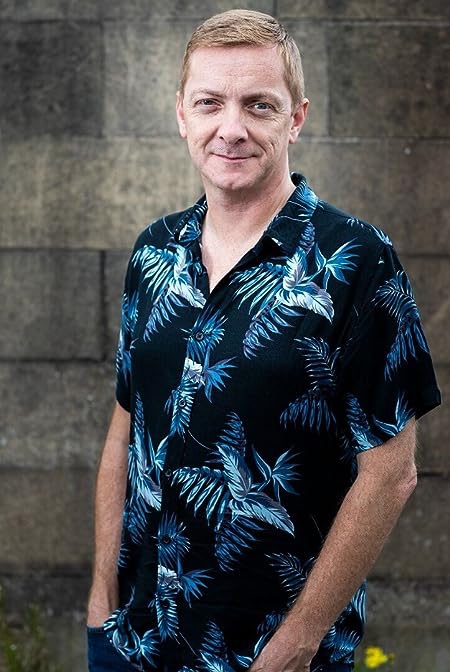
Doug Johnstone is the author of fifteen novels, most recently The Space Between Us (2023). Several of his books have been bestsellers, The Big Chill (2020) was longlisted for the Theakston Crime Novel of the Year, while A Dark Matter (2020), Breakers (2019) and The Jump (2015) were all shortlisted for the McIlvanney Prize for Scottish Crime Novel of the Year. He’s taught creative writing and been writer in residence at various institutions over the last two decades including festivals, libraries, universities, schools, prisons and a funeral directors.
Doug is a Royal Literary Fund Consultant Fellow and works as a mentor and manuscript assessor for many organisations, including The Literary Consultancy, Scottish Book Trust and New Writing North. He’s been an arts journalist for over twenty years and has also written many short stories and screenplays. He is a songwriter and musician with six albums and three EPs released, and plays drums for the Fun Lovin’ Crime Writers, a band of crime writers. He’s also co-founder of the Scotland Writers Football Club.

 The Lotus Readers
Excellent review! Looking forward to reading this one soon. I love the Skelfs too and of course the familiar Edinburgh setting.
LikeLiked by 1 person
Have you heard the good news? He’s writing two more 😆😆😆
LikeLiked by 1 person
Yes indeed! Very pleased to hear that news. 😊
LikeLike