Posted in Squad Pod

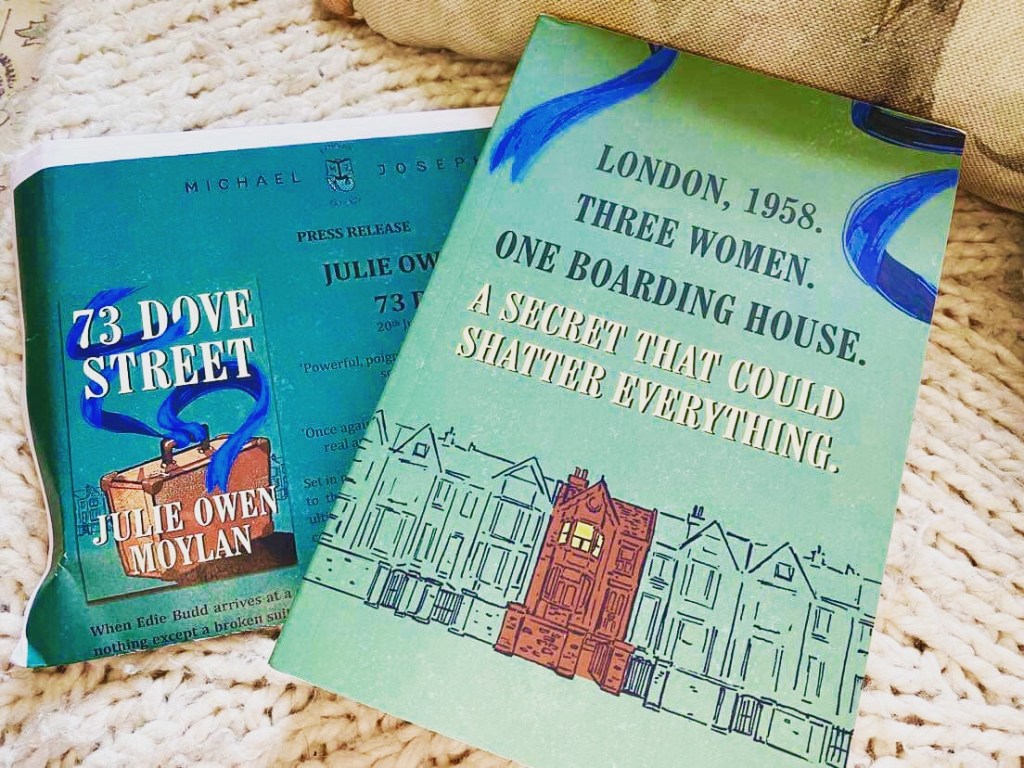
73 Dove Street by Julie Owen Moylan

What an incredible writer Julie Owen Moylan is, because within a few pages of starting her new novel I was absolutely immersed in 1950’s London. This is a London I haven’t visited too often in literature, the haunted and broken post-WW2 period rather than the supposed glory or the drama of the the war itself. Here the war has a ghostly presence, shown by children climbing piles of rubble or an incomplete street that looks like a mouth with one of it’s teeth missing. The story is told through three women; Edie, Tommie and Phyllis. It’s Edie we follow to 73 Dove Street where she hopes to look at a room, with just a single suitcase and an envelope full of cash. Edie is almost put off by the mattress and pile of men’s clothes burning fiercely just outside the yard, but a voice summons her from an upstairs window and she recognises a place she can lie low. What is she hiding from? Tommie lives in the room below and works for an eccentric socialite who was once wealthy and popular. Outside work Tommie is lured to the seedy nightlife of Soho and the man she can’t quit. Phyllis is the landlady of 73 Dove Street, burning her husband’s belongings in the street after she discovered a terrible betrayal. She puts on a good front, an armour that she needs to cope with a past she won’t talk about.

This author is absolutely brilliant at creating a feeling and time period, from the dark and depressing post-war London to the interiors of both No 73 and the more upmarket house where Tommie works.

“It was one of those London streets that had become a canvas of tatty boarding houses: windows filled with crooked pieces of cardboard saying ‘Room to Let’. The houses all looked the same: bay-fronted with scruffy front gardens filled with dustbins, and children loitering on doorsteps with their runny noses and scraped knees.“

She makes a beautiful observation about these streets, that where once there were hints of colour, London is now bombed back to dreary black and white. People are trying to drag their lives out of wartime monochrome, but fail every time. There are houses with the front ripped off and the contents still inside, looking like a grotesque full-size doll’s house. Through Tommie’s childhood experiences we can see what it was really like to be in one of those houses as she remembers a direct hit on her family home and being sat in the suffocating dark rubble until a hand breaks through to save her. These memories are so powerful and evocative, they really bring the reality of the Blitz to life. It’s clear that one of the reasons why London is so bleak is that it’s people are traumatised and numb. As well as the lack of money, rationing and their surroundings, these people haven’t even begun to recover. They’re vulnerable and in the case of our main characters, they’re trying to battle on alone.

I was immediately on board with Edie and loved the way the author built up her relationship with Frank. It was one of those situations where I could clearly see what was going to happen and I was mentally screaming at Edie to walk away. This is a man who knows how to choose the right woman, the one who will fall for his charms and become hooked on the way he operates. He likes to keep a woman on edge, waiting for his affection and easily moulded to what he wants by withholding that affection. Sadly it’s a pattern that’s only noticeable when you’ve been through it and Edie is a quiet, inexperienced girl who’s bowled over by his subtle manipulations. She’s so unformed and brought out such a protective mode in me. In a typical pattern he follows any glimpse of anger or violence with apologies and huge gestures.

“Frank’s pale blue eyes never left Edie’s face. Pleading with her without saying a word, desperate to make everything right between them. ‘Will you marry me, Edie? Say you will . . .’ The words tumbled out before Edie could stop and think about them. ‘Yes, of course I will.’ Her arms wrapped around his neck; her good wrist covering the bruises on the other one. His mouth felt tender and warm on hers and for that moment she couldn’t hear the daft comments or applause from the pub, it was just her and Frank”.

The abuse Edie suffers is a hard read, but such an authentic representation of domestic violence in all it’s forms. I am from a working class family, with some very strong women on both sides especially in those aunties old enough to get married during the war. They often comment on how the generations beneath theirs are too quick to split up or divorce and that marriages in their generation tended to stay together. Yet, when I hear the reality of some of their marriages – the drinking, gambling, physical and sexual violence, financial abuse and infidelity – I wonder what’s the point of a long marriage that has only left them grieving and traumatised? The author shows how economic and psychological difficulties prevented women from leaving terrible relationships. I was interested to read the author’s comments about her own family and how the strong women in it had given her inspiration for the book.

I haven’t spoken about Phyllis much, although towards the end of the book it was her experience that had tears pouring my down my face. At the beginning we see through Edie’s eyes the burning pile of men’s clothes outside No 73 and we could guess at what had happened in her marriage. She’s full of anger at her husband, but as the story develops we get the feeling there is something more underlying her feeling of being wronged. We get the picture of a marriage rather like the bombed out houses – a facade remains but it’s been empty for some time. When we hear the full story it is so emotional, I found it deeply moving and could identify with this woman whose abrupt manner is simply the amount of protection she needs to get through each day. It isn’t just the bombed houses that are missing. There are people locked in wartime, trying to carry on by avoidance, distraction or stepping around something there’s only one way through. I found this part of the book so beautifully rendered and deeply felt. Julie has dedicated this book to her grandmother and the strong, working class women in her family. She has really done them proud with this wonderful historical novel.

Published by Michael Joseph 20th July 2023

Meet the Author

Julie Owen Moylan was born in Cardiff and has worked in a variety of jobs, from trainee hairdresser and chip shop attendant at sixteen to business management consultant and college lecturer in her thirties.

She then returned to education to complete her Master’s degree in Film before going on to complete a further Master’s degree in Creative Writing. Julie is an alumna of the Faber Academy’s Writing a Novel course. She lives in Cardiff with her husband and two cats.

Julie can be found on Twitter: @JulieOwenMoylan

Posted in Publisher Proof

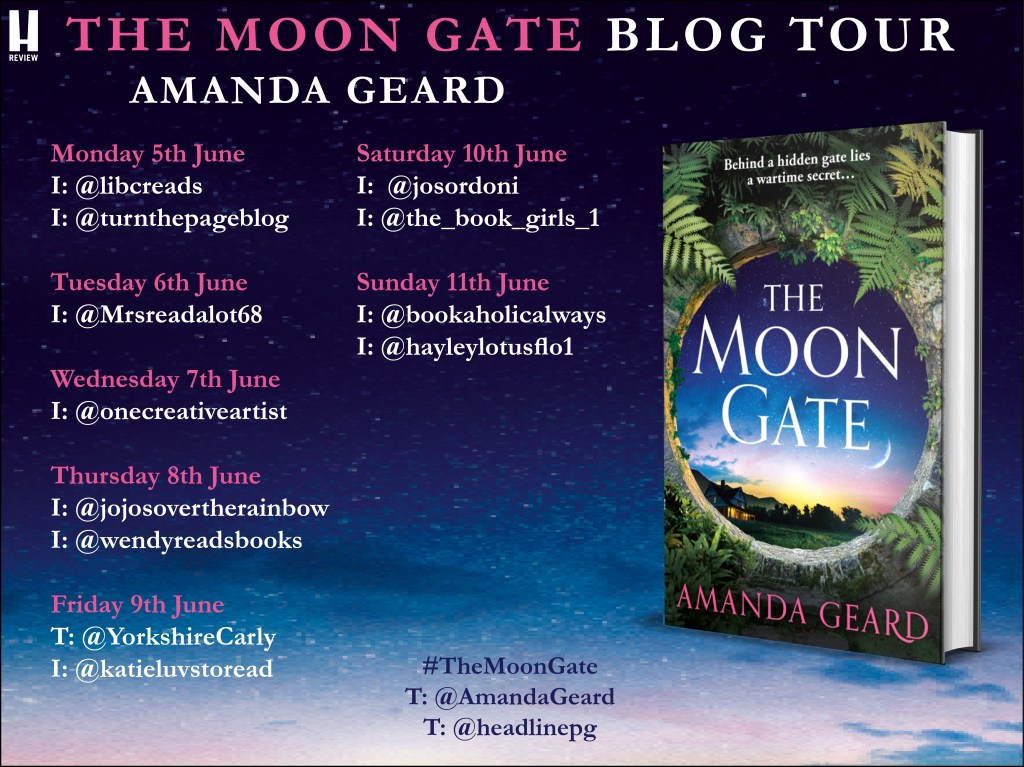
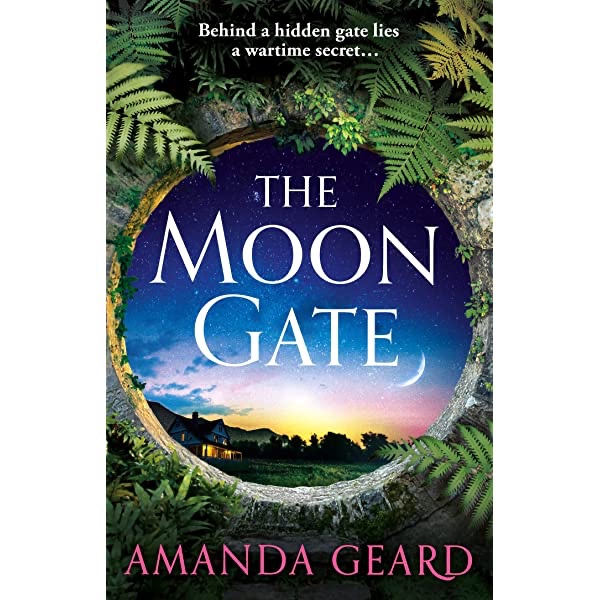
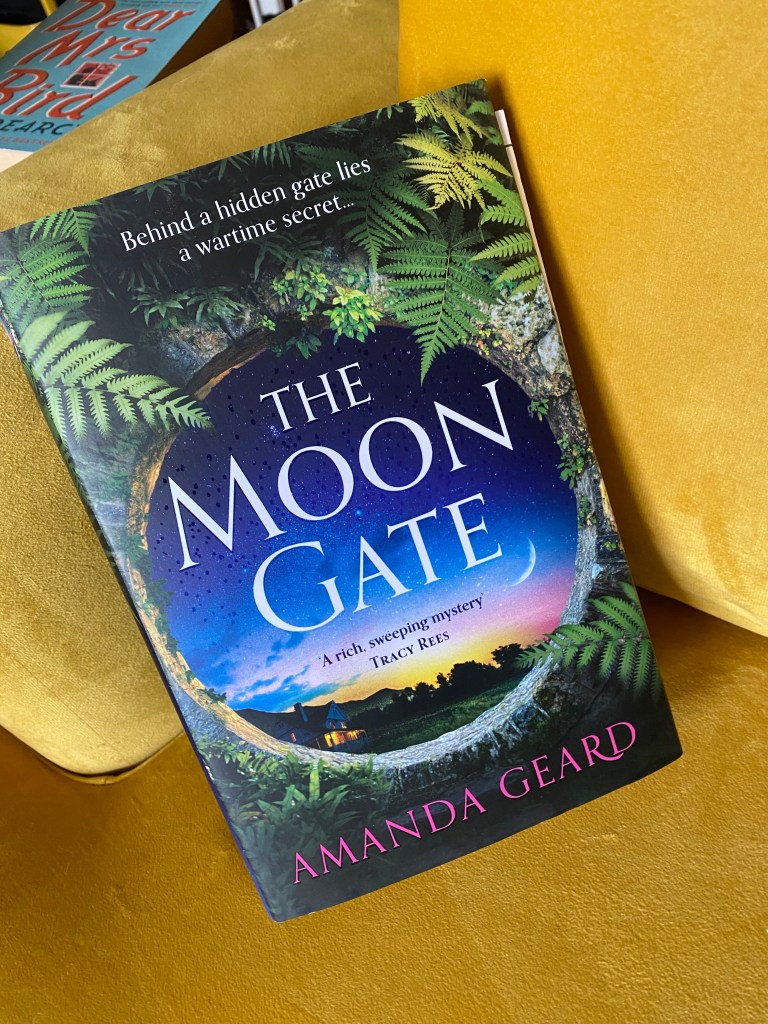
The Moon Gate by Amanda Geard.

1939 – Grace Grey lives in Grosvenor Place in London, with her mother Edeline who is a friend of the notorious Mosleys and wears the uniform of the Blackshirts. As war comes ever closer, Edeline makes the decision to send Grace and the housekeeper’s daughter Rose Munro to stay with her brother Marcus and his wife Olive in the north west coast of Tasmania. After an eight week voyage the girls are welcomed to Towerhurst, an unusual house with a whole tower where Uncle Marcus writes his poetry. Olive immediately takes to the beautiful Rose, but Marcus forms a bond with Grace over the poems of Banjo Patterson, an Australian ballad poet. Grace is reserved and shy, but is slowly coaxed out of her shell by Daniel McGillycuddy an Irish lad working at his aunt and uncle’s sawmill for Huron Pine. As war creeps ever nearer to their part of the Pacific there are dangerous emotional games at play between these young people with fall out that will extend over the rest of the century.

1975 – out of the blue Willow and Ben have been summoned to the north west of Tasmania because of a mysterious legacy. Willow has been left a house called Towerhurst, by an anonymous benefactor who placed it in trust. They decide it’s a great place for Ben to write and Willow to paint, but on their first visit Ben goes missing in the rainforest having fallen down an old mine shaft. What he finds there sends him on a quest that ends in London chasing a story about two young girls who lived at Towerhurst during WW2.

2004 – Libby has flown from Tasmania to London, wanting to claim the belongings of her father who died in the Moorgate Tube Station accident before she was born. Staying with her eccentric aunts in Grosvenor Square, she starts to follow the clues she finds in her father’s satchel: a publisher’s address, a book of ballads by poet D. McGillycuddy and the name Molly Munroe. Her quest will take her to a gentleman’s club, a narrow boat and eventually out to Ireland to solve a mystery that’s been laid buried for half a century.

I enjoyed Amanda Gerard’s first novel last year, so looked forward to reading her new one for a while. I was interested to see how her writing had developed over the last couple of years. To undertake a novel that takes in most of the 20th Century, three timelines and three different settings takes enormous confidence and she has definitely grown in confidence. This is a more complex novel, combining historical fiction with mystery and some romance too, but she pulls it off beautifully and I’ve absolutely loved it. From the historical perspective I learned a lot about living through WW2 in the Pacific Ocean, a completely different experience compared to Europe and the U.K. particularly. I thought Amanda beautifully captured how transient lives were at that time. This wasn’t just about the two English girls, Grace and Rose, uprooted from everything they knew and sent to the other side of the world. It was about the chaos of war, never knowing where your loved ones were, particularly if they were away fighting and whether they would ever come home again. For women that was especially difficult, left at home to wait but also left outside the experiences their men were having. Many women did their own war work, both to do their bit but also to feel a little closer to their men and as if they’re helping them to fight. War displaces people and there were huge shifts across the years of WW2 and afterwards as prisoners of war were slowly released and women who’d married a G.I. or perhaps a Polish airman travelled back to their native countries to start a new married life. It was a good time for people to disappear or slip away under the radar. I already knew a lot about the Blackshirts and their admiration of Hitler’s Nazi Party, but here I learned more about the women recruits and their activities. There was a breadth of research here, underpinning and enhancing the story across three different generations.

The main love story is so touching as the slightly awkward Grace is lured down to the beach by neighbour Daniel where he tries to kiss her. Sadly though it’s for a five shilling bet and as his mates turn up in a boat to witness her humiliation she runs away into the sea. It’s his friend Puds who has to rescue her, as she can’t swim and finds herself caught in an undertow. Daniel regrets his actions deeply, apologising the very next day and asking if Grace would perhaps share the book of ballads she’d been telling him about. They pass through the Moon Gate, a perfectly round doorway made of Atlantisite that leads to the waterfall and a small freshwater pool. Uncle Marcus claims that to pass through the gate is to become a new person and that certainly seems the case with Grace who not only forgives Daniel, but shares the ballad poems and agrees that he can teach her to swim. It’s so beautiful to watch them become close friends, but Grace knows that it’s Rose that Daniel finds attractive as everyone does at first. I felt for Grace deeply and I think a lot of other bookworms will too because she’s so uncomfortable in company, prefers solitude and loves words so much. My therapist side wanted to help her, because how does she learn to be herself and be confident in that, when even her own mother preferred Rose? When we’re not shown love from our parents, a child can’t understand that it’s a fault of the parent, so they learn there is something wrong with themselves. Grace is shocked by the help and affection she gets from Uncle Marcus, because her own mother is so austere and critical.

It was Rose who spent time with Edeline and became a member of the Blackshirts alongside her. Whereas Rose’s mother, the housekeeper Molly, can see something wonderful in Grace and so can her Uncle Marcus, it just needed to be coaxed out and nurtured. I was so invested in her feelings for Daniel and desperate for him to be clear about whether he had feelings for her. Rose is doing her bit in undermining and leading Grace to believe that Daniel only has eyes for her. She makes sure Grace knows when he writes from wherever he is in the world and if Grace shares news of her friend, Rose makes it clear she knew first. I’ve never wanted to slap a book character more! I wasn’t even sure that she genuinely loved Daniel, she’s just so used to getting one over on Grace that she hasn’t stopped to think it through. There are rumours in town about Rose and Uncle Marcus, she even winds Puds round her little finger but I wasn’t sure to what end? She certainly keeps her cards close to her chest, but when Rose takes up war work and isn’t around as much Grace can actually breathe. As I read I wasn’t sure what Rose was up to but I was certain there was something behind her manipulations and out of character support for the war effort. It’s a shock when her name comes up again in Libby’s investigations, was her father Ben simply interested in her fascist connections or is it something more personal?

There are definite echoes through the different time periods and motherhood is one of those themes that recurs. It’s an inter-generational trauma that starts with Edeline’s treatment of her daughter. Grace knows she isn’t her mother’s favourite, but is confused when this animosity seems to recur with her Aunt Olive. She asks a devastating question of her Uncle Marcus – ‘am I unloveable?’ because if her own mother can’t love her, why would anyone else? Willow has never known her birth parents, instead brought up with her two sisters who are twins. She never asked the question, even though she can see how different she is physically from her sisters. So when Towerhurst comes along, she starts to be intrigued by who created the trust and whether it could be one of her real parents. She finds out she’s pregnant alone, while Ben is over in London, but manages to tell him on the phone just before he is killed and they are both so happy in that moment. To then become a single parent, in such tragic circumstances must have been so difficult to come to terms with. Willow has never tried to collect Ben’s belongings despite knowing they were found and Libby clearly thinks her mother will disapprove of her choice to follow in his footsteps. Willow hasn’t been a terrible mother, just rather aloof and deeply engrossed in her work as a painter, where she demonstrates her terrible grief by only painting in black and white. She hasn’t grieved fully and I could see that Libby’s findings might bring those feelings to the surface. Luckily, Libby has had her eccentric aunts for support and it’s clear they adore her, but I hoped that Libby and Willow would have chance to talk and heal together.

As the mystery begins to unravel, there are revelations about these three generations that keep coming and a twist I truly didn’t expect. There are small disclosures, like the local police sergeant who helps the search for Ben is actually Puds, Daniel’s best friend who suffered a serious injury in the war and had to return home. How will he go about investigating what Ben finds in the mine shaft, when it might be better if they’d stayed buried? I was desperate to find the whereabouts of Rose, because all the hints are pointing to an answer I simply couldn’t bear! It seems possible that Grace never returned to England, but when Rose’s mother tells Ben she definitely saw Grace after the war he starts his search afresh. Could she have disappeared on this side of the world? I was constantly holding out a little bit of hope for the ending I wanted, so I had to keep reading – up till 2am again! There are so many layers to this story and often with dual timelines there’s a weaker section, but every timeline is intriguing, evocative and emotional. Tasmania sounds wild, dangerous, magical and atmospheric all at once. I loved the reference to the creature that lurks around the pool beyond the moon gate, could it be a shy Tasmanian devil? There’s such a massive difference between Tasmania and London, which feels more domestic than wild with very curated spaces like the old fashioned gentleman’s club and the minimalist narrow boat where Libby meets Sam. Then there’s Ireland, waiting like a promised land with all the answers and the beauty that Daniel shares with Grace right back at the beginning. We are left with an incredible tapestry of places and people full of colour, emotion and a yearning for home whether home is a place or a person.

Meet the Author

I have always loved dual-timeline novels, where stories from the past weave with those of the present day. I want to write books that transport you to another time and place, where secrets lie just beneath the surface if only the characters know where to look.

My new novel, The Moon Gate, is set across three locations I ADORE: Tasmania (my home state), London (where I rented a houseboat for many years) and County Kerry, Ireland (where I now live with my family). Each of these places is special to me and I hope you’ll feel you’re entering the temperate rainforest with Grace, opening the door to Towerhurst with Willow, walking through London’s layered history with Libby and stepping out to the heather-clad hills of County Kerry with … well, with several characters, the names of who I won’t reveal here!

The inspiration for my first novel, The Midnight House, appeared in the rafters of our Irish home, a two-hundred-year-old stone building perched on the edge of the Atlantic. Hidden there was a message, scratched into wood: ‘When this comes down, pray for me. Tim O’Shea 1911’. As I held that piece of timber in my hands, dust clinging to my paint-stained clothes, I was humbled that a person’s fingerprint could, in a thousand ways, transcend time, and I wanted nothing more than to capture that feeling of discovery on the page.

I’m also a geologist who loves to explore the world’s remote places. Luckily for me, writing novels provides a similar sense of wonder and discovery; but the warm office, fresh food and a shower in the evening make the conditions rather more comfortable! It’s also the perfect excuse to regularly curl up by a fire with a great book (often by the wonderful authors who write in my genre). I treasure my reading time, and I know you do too, so thank you for taking a chance on my books.

Come over to Instagram and Twitter (@amandageard) where I share plenty of photos of the wild settings in The Midnight House. You can also find me on Facebook (@amandageardauthor).

I love hearing from readers, so please get in touch!

From Amanda’s Amazon author page.

Posted in Squad Pod

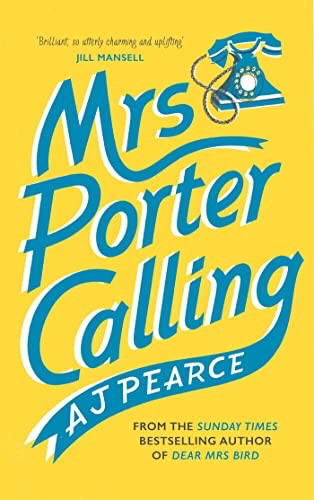
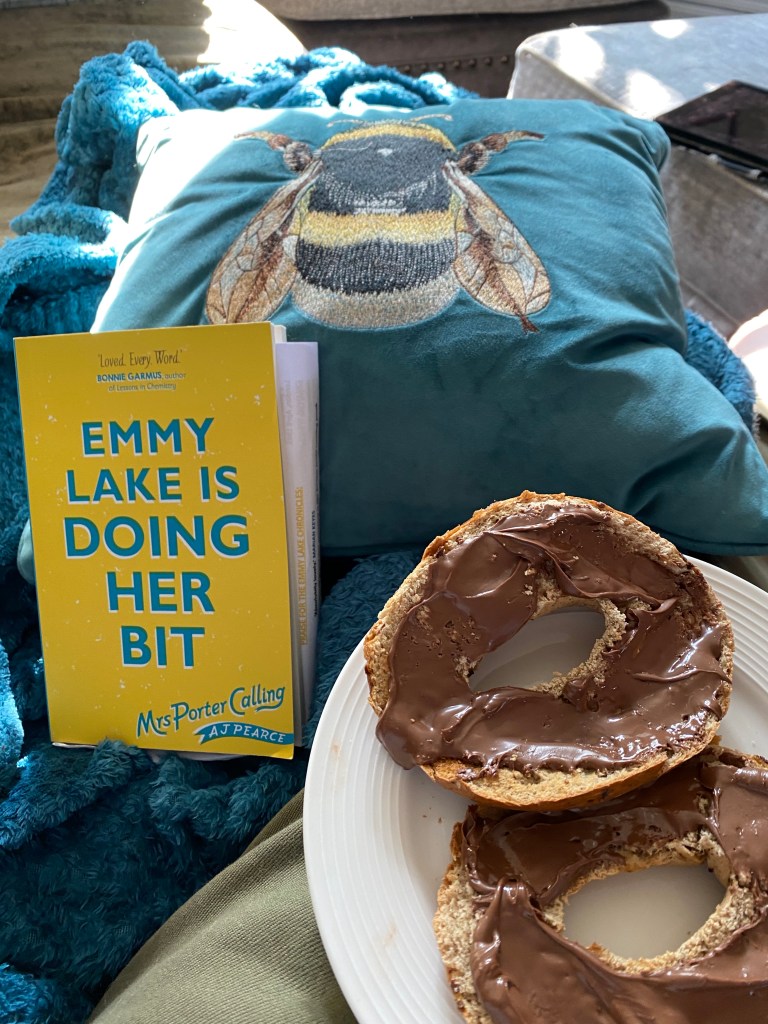
Mrs Porter Calling by A.J. Pearce.

I was new to A.J. Pearce’s world and her character Emmy Lake, so before reading Mrs Porter Calling, I decided to read the previous two novels; Dear Mrs Bird and Yours Cheerfully. Set in WW2, the books follow Emmy as she moves to London to start a career in journalism and soon finds herself in the middle of the Blitz, working for the fire brigade by night and living in her friend Bunty’s grandmother’s house. In Dear Mrs Bird, Emmy has taken up a job offer from Woman’s Friend magazine, working on the problem page. The formidable Mrs Bird is the agony aunt and Emmy must sort through the letters and weed out those that are deemed unsuitable – no funny business at all, not even a hint! Through the novel she moves from being engaged to single status, takes big risks in her job and works hard for the fire service at night dealing with the aftermath of the German bombing. I fell in love with this brave young woman who wants to move with the times and use her writing to help an extraordinary generation of women cope with the difficult situations they find themselves in. Over this and the next book, Yours Cheerfully, Emmy faces some serious challenges: being in love with someone far away and in danger; dealing with terrible loss; helping other young women who have been widowed or find themselves without a home. Yet this isn’t a tale of misery and hardship, there’s an almost relentless positivity to Emmy Lake that I absolutely loved. She’s perky, but not brittle. Her optimism and resilience seem to come completely naturally.

Yet in this latest book, Mrs Porter Calling, she will be facing some of her biggest challenges yet. Emmy has settled into being the lead on the magazine’s problem page and is continuing her series of articles on women who have taken on war work. Everything changes when the owner gifts Women’s Friend to his niece Mrs Porter in lieu of her inheritance. At first the team are optimistic about having a woman at the helm, but it soon becomes clear that Mrs Porter doesn’t want the magazine because of what it is. She wants to turn the magazine into her own scrapbook with society weddings and events alongside beauty and fashion articles that are a distraction from the war. Telling women what they should be rather than being a support. For a team who are used to teaching their readers to reuse and repurpose, this jump to expensive fashions and aspirational articles feels all wrong and Emmy thinks Mrs Porter has missed the whole point of the magazine. Women’s Friend is not aspirational, they don’t want to be dangling fripperies in front of their readers who can’t afford them. Emmy knows that if they change this much they will lose their readership. Even worse, Mrs Porter doesn’t want any more ‘dreary’ war work articles either. It seems that the realities of war haven’t reached her, the nightly bombs Emmy deals with must be muffled by all that jewellery and designer clothing. The team make a pact, to try and keep their beloved magazine as normal as possible while also introducing Mrs Porter’s ideas. In the meantime they will try everything to dishearten their new owner. Hopefully, if things become boring or difficult, she might drop her new hobby and move on. They just have to hope they have enough of a readership left when she does.

Away from the magazine, Bunty is still grieving for her fiancé and continuing her rehabilitation following the bomb blast they were caught in. However, there are signs that she is stating a tentative friendship with another fireman and Emmy has her fingers crossed that things may develop. Emmy and her husband Charles only had a two night honeymoon before he had to return to his posting, now he is moving into North Africa and Emmy depends on his letters. Both girls are forging new friendships with the women who work in a munitions factory and finding out it isn’t always easy to do your bit. I loved this aspect of the novel, because it taught me a lot about what WW2 was really like for women. Despite advocating that all women should find war work, to support their men overseas or help out on the home front, there were difficulties with this that the government seem to have overlooked. The author shows this through the factory women who have issues with childcare and finances. I was shocked to learn that when a Navy husband went missing his salary stopped immediately, but because he was missing and not dead, his wife couldn’t receive a widow’s pension. This loophole left women with no income and potentially homeless. If the factory women had children and worked awkward hours, they often couldn’t get childcare. Some women sneak their children into the factory and hide them so they can still work their shift and get paid, but if found they would be dismissed immediately. Emmy becomes involved in campaigning for factories to apply for the government grants available to set up a nursery for worker’s children. These are the women she wants to celebrate and help in her own time, but also in the magazine. These factory women don’t care about the lavish wedding of some honourable or other, they care about doing their bit, being able to keep a roof over their head and their man coming home.

Emmy has become a team player. Long gone are the early days of her career where she ran away with an idea without thinking of what it meant for those around her. What struck me so strongly was this sense of camaraderie and the sharing of everything – not just the hard stuff that the fire service go through together, but the food, celebrations, home, shelter and even families. I could see that Emmy was in exactly the right place to help when an unexpected loss devastates the factory women and Emmy herself. This tragedy could bring her the biggest challenge she’ll ever have, but I had no doubt she would rise to the occasion. I asked my partner whether he thought our current generation would pull together as well as this generation did and we weren’t sure, although we hoped so. Watching Emmy, exhausted from a day working, change into her uniform and put in a night shift on the fire service switchboard, then go home and reassure children whose house has been bombed out, made me wonder if I could do the same. The perky, excitable girl has become a woman, a woman with a core of steel. If you love historical fiction or just want an uplifting read about women dealing with daily adversity then this is the perfect book for you. I loved all three novels and have happily added them to my forever bookshelves.

Weekend breakfast and a great book. Bliss!

Meet The Author

Pearce

AJ Pearce is the author of the Sunday Times Top 10 bestseller DEAR MRS BIRD, which was a Richard and Judy Book Club pick and shortlisted for Debut of the Year at the 2019 British Book Awards. It has been translated into fifteen languages and optioned for development for TV.Born in Hampshire, her favourite subjects at school were English and History, which now (finally!) seems to be making some sense. Her novel, Yours Cheerfully is the sequel to Dear Mrs Bird and is now available in paperback. AJ has just released the third novel in the Emmy Lake Chronicles series, Mrs Porter Calling. Follow AJ on Twitter, Instagram and Facebook: @ajpearcewrites

Posted in Random Things Tours

The Walled Garden by Sarah Hardy

I found this historical fiction debut absolutely captivating from the beginning. It begins with Lord and Lady Rayne who live in the big house, Oakburne Hall, with just enough room to avoid each other as much as possible. In fact since he returned from the war, Stephen has slept in a small room in the servant’s quarters while Alice lays alone in their marital bed. She finds refuge in their garden, hoping that even in these dark post-war years some seeds of hope will grow.

‘Some secrets are too terrible to tell. And in 1946 Britain is a country where most keep silent. What you witnessed during the war, what you sanctioned, what you are still afraid of, is left unsaid. For those bitter years of conflict and separation you buoyed yourselves up on sentiment, crooning ‘We’ll Meet Again’. And we did meet again, thinks Alice Rayne, only to discover we have nothing to say to one another.‘

No one survives war unscathed and though bodies are healing, their psychological wounds run deep. Those who were left behind are just as scarred as those who left to fight. Stephen Rayne was once sweet and gentle and his wife Alice truly loved him. Yet he has returned a man that she doesn’t recognised. He is bitter and angry, destroyed emotionally by what he has seen and done, holding on to secrets Alice can only guess at. She is lonely and although she hates to admit it, she is increasingly afraid of the man her husband has become, Alice is struggling to put together the pieces of her marriage and save Oakbourne Hall from total collapse. After two lots of death duties, money is incredibly tight so she begins with the walled garden and, as it starts to bear fruit, she finds the seeds of a new and forbidden love being sown.

I had so much empathy for Alice and all women who longed for the man they loved to return, only to find their relief and joy cut short when a stranger came home in their place. I’ve read a lot of novels set post-WW1, but not many set after WW2, but the same social changes come up in 1946. People are struggling financially, at the big house two world wars have taken two heirs in quick succession and the family can’t afford to repair or develop the hall. The villagers are coping with grief, poverty and rationing, and still waiting for men who’ve not yet returned. Women have once again stepped into the breech and taken on men’s jobs, giving them even more freedom and an unwillingness to be pushed back into their traditional roles. In this village, it’s not only Stephen and Alice who are suffering and as they come up against other people’s trauma the results are profoundly moving. The social change is well explored through the character of the village GP, another changed man whose longing for social justice leads to arguments with his wife and children, not to mention Stephen. Clergyman George holds so much guilt, because his ill health meant he didn’t go to fight. How can he minister to these men who’ve been through so much, things he can’t even imagine? As Stephen isolates himself more from his wife, Alice finds solace restoring the walled garden and in talking to George with whom she strikes up a friendship. He is learning about gardens and she is learning about his love of classical music.

As the friendship between George and Alice deepens, she has to think about what she wants. She has loved Stephen for so long, but his angry and violent outbursts are scaring her. Can she love this new person? George listens and appreciates her opinions, in a way she hasn’t had for a long time. When she takes a break from Oakbourne and visits her sister in London, she meets with George in a pub where his beautiful singing voice is in demand at the piano. This interlude is like a time outside of reality, where all worries and cares are set aside. With the late hour and room for George to stay at her sister’s flat will emotion boil over? In all this time, George is struggling with his ministry and his feelings for Alice. When Stephen also confides in him he has a terrible choice to make, does he guide Stephen towards speaking to his wife and saving his marriage? On the other hand, he could advise him in a way that would benefit his feelings for Alice. It’s a terrible choice to have to make, even worse he knows that his lungs are deteriorating and if he doesn’t take up the GP’s offer of treatment abroad he has only months to live. Will he follow his heart or will he sacrifice his own feelings to minister to this couple as their spiritual guide?

This is such an emotional crescendo, especially since we’re also sent back into the war and Stephen’s time infiltrating the french resistance and helping them to fight against the Germans. There, he has to make a horrible choice in order to save someone from a worse fate. His choice haunts him, although in reality he is forced to act by his knowledge of the barbarity of the German soldiers. The Maquis hail him a hero and now want to give him an honour, setting off terrible flashbacks, insomnia and guilt. Even if he tells Alice everything, can their marriage recover? I was so involved with these characters, they were so incredibly real and full of complex emotions. I loved the walled garden as a symbol of hope for the future and Alice’s work there is an act of faith, planting her hope in a symbolic gesture to her marriage and the country as a whole. I think the most moving thing about the whole novel is that this is a war that my grandparents lived through. We are so used to seeing this generation as an example, even recently our actions through Covid and the current cost of living crisis are meant to resemble their grit and determination. I believe the famous David Cameron quote is ‘we’re all in it together’ evoking the stiff upper lip of this very generation. I think because of this nostalgic view on WW2 we forget that this generation had the same emotions and complicated relationships that we do now. This book stopped me from thinking of that generation as a whole and instead to think about individuals and what they went through, how it affected them and their families and the emotional turmoil wrought by couples being apart for years. It was the wartime sections of Andrea Levy’s Small Island that first made me think about these issues and this novel woke those thoughts up again, just in a more rural setting. No generation is better than any other when it comes to trauma, we are all human. This is a stunning debut from Sarah Hardy and I’d love to read her work again.

Meet the Author

Sarah Hardy has lived for the last 10 years on the Suffolk coast which is where her novel is set. Before that she lived in London, Dublin and the Hebrides. She has worked on national magazines and newspapers.

Posted in Throwback Thursday

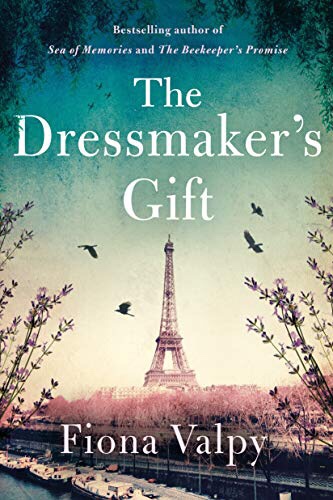
Throwback Thursday! The Dressmaker’s Gift by Fiona Valpy.

This book is a real hidden gem. I love fashion, so the idea of a dress that calls down through the years – the midnight blue satin, made of many pieces but with such tiny stitches it appears as if one piece of fabric – really appealed to me. Added to this, my in-laws history of escaping the Warsaw ghetto – at 8 years old in one case, and being sent to Siberia in the other – means I am interested in the threads of family history at a time of turmoil. My late husband’s  family has its own incredible story with repercussions that echo down the generation , so I understand that lives can be displaced and changed beyond recognition, with the results of that still being felt two generations later,

It is Harriet’s love for fashion and an old photograph that leads her to the door of a Paris fashion PR for a year long internship. She is loaned a room in the apartment above the office alongside another girl. Harriet knows this is the very apartment where her grandmother Clare lived in the 1940s. She has left behind a difficult situation!. Having finished university Harriet has been living with her father and stepmother, where she has never felt welcome. Her father sent Harriet to boarding school when he first lived with her stepmom, following her mums death. Her father seemed to find it difficult to cope with a grieving daughter and a burgeoning relationship. One of Harriet’s most treasured possessions is the photo she has of her grandmother Claire and her two best friends in Paris, Mirreile and Vivi. She also has a charm bracelet given by her grandmother and it’s charms show Harriet a story of who her grandmother was. When we are taken back into the past we learn more about these three women. All work in an atelier for the Paris fashion houses. We find out that Claire and Mirreille lived upstairs first, but are later joined by Vivi. All three are great seamstresses and are quick to become friends.

When the Germans arrive in Paris at first is it easy to carry on as normal. Yes, there are more German voices in the cafes and bars, more German vehicles in the streets, but people still order couture clothes. However, as the war really starts to bite things begin to change. The girls friendship survives Claire’s disastrous dalliance with a German officer, but afterwards she notices a difference in her friends. What mysterious work is Vivi doing in the atelier after hours? Who is the gentleman Mirreille is seen with and why is she often missing after curfew? The girls are about to be involved in the war in ways they didn’t imagined; ways that’s could mean paying the ultimate price.

Just like the stitches in a beautiful garments the threads of history are so beautifully intertwined with the fictional story of the girls. I read Alice Hoffman’s new novel in the last few weeks and it is also set in 1940s Paris so it was interesting to see the same historic events from a different viewpoint. I could see how much research the author had done and her skill in mentioning actual events without them feeling tacked on to the girls story was brilliant, I slowly came to care about each of the girls and although Vivi seems less accessible than the other two at first, it was interesting to see how central to Harriet’s history she becomes.

The detail is often harrowing to read and the idea that trauma can be passed through generations is one I’m familiar with because I’m a therapist and have read the same research as the author. She uses this beautifully in the novel, illustrating that the German’s horrendous acts of cruelty were on such a scale that it echoes down to the next generation. It is only when someone identifies the trauma in their family and gets professional help to let go of it’s effects, that someone can start to heal. I think I expected this book to be lighter and more focused on fashion from the blurb, but what I got was far superior: an incredible story of friendship and survival.

Meet The Author

Fiona is an acclaimed number 1 bestselling author, whose books have been translated into more than twenty different languages worldwide. She draws inspiration from the stories of strong women, especially during the years of World War II. Her meticulous historical research enriches her writing with an evocative sense of time and place.

She spent seven years living in France, having moved there from the UK in 2007, before returning to live in Scotland. Her love for both of these countries, their people and their histories, has found its way into the books she’s written.

Posted in Sunday Spotlight

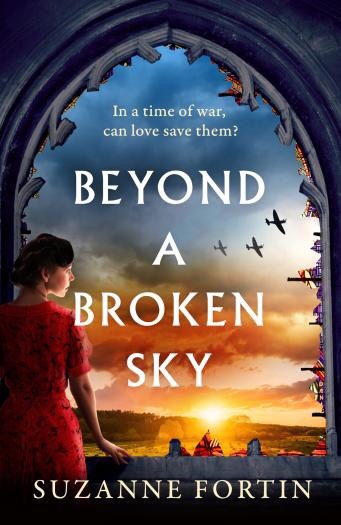
Sunday Spotlight! Beyond A Broken Sky by Suzanne Fortin.

Ever since I had the good fortune to fall upon a blog tour for The Secret Life of Arthur Pettigrew I have looked out for other works by Suzanne Fortin. It was such a well researched and emotional piece of historical fiction, it became one of my books of that year. Since then she has published two more novels, All That We Have Lost and now this novel, another piece of history from WW2 with an emotive dual-timeline story woven throughout. In 2022 we meet Rhoda Sullivan who works as a stained glass expert, called in by museums to value, then oversee and conserve important works in glass. She”s tasked to go to Telton Hall and assess a stained glass window that dates to WW2 and was designed by an Italian POW. There she end up at an impasse when the gates are blocked by an elderly man in a tractor, Jack is the hall’s last inhabitant and he’s lived there all his life. He’s making a final protest about the development at the hall, but his son Nate arrives to help Rhoda gain access. With Nate, Rhoda makes a terrible discovery – a body under the chapel’s flagstones. It has a huge effect on Rhoda who imagines someone missing this person, just as she still misses her twin brother who disappeared before their 18th birthday. A decade on she still looks for him everywhere,

In 1945 we are taken to Somerset and a young woman called Alice Renshaw. Alice is alone and pregnant. Shes been sent to a farm in Somerset where Louise Hartwell is running things with the help of POW’s. As well as the farm work, Louise helps young pregnant women. Alice soon starts to make friends, but not everyone at the hall is happy about this. As peace is declared, the war at Telton Hall is just beginning.

I’ve just started the book and I’m already hooked by Alice’s story and I love how the author pulls us straight back into the 1940’s with only a few lines. I am also fascinated by Rhoda’s job and the making and restoration of stained glass. I heartily recommend this author, even though I’ve only read a few chapters I know I’m in safe hands. If you love historical fiction and haven’t already encountered her work, go grab her first novel. You won’t regret it.

Meet The Author

Suzanne writes historical fiction, predominantly dual timeline and set in France. Her books feature courageous women in extraordinary circumstances with love and family at the heart of all the stories. 

Suzanne also writes mystery and suspense as Sue Fortin where she is a USA Today bestseller and Amazon UK #1 and Amazon US #3 bestseller. She has sold over a million copies of her books and been translated into multiple languages.

Posted in Publisher Proof

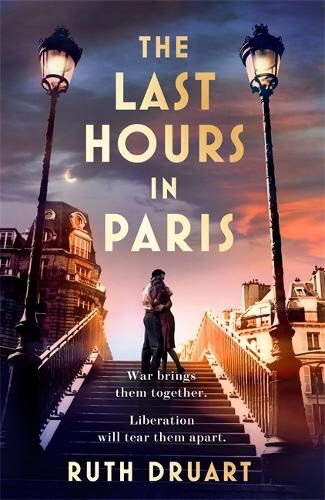
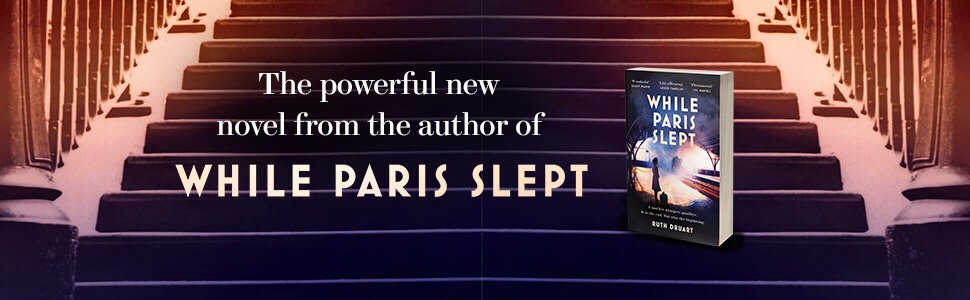
The Last Hours in Paris by Ruth Druart.

After Ruth Druart’s previous WW2 novel While Paris Slept I’d been so embedded in the story that I felt emotionally drained from the terror and trauma experienced by her characters. While that novel gave us WW2 from the perspective of a French police officer and a Jewish mother, her latest novel comes from a very interesting and possibly less explored voice of the conflict. Our novel centres around young French woman and a German soldier who cross each other’s paths due to a love of books. We roam from Paris to Brittany and to England, hearing the stories of our main characters from both points of view at different times in their lives. However, the novel starts several years later with Joséphine, a young woman who has just finished her baccalaureate and is looking forward to summer. She wants to visit England because it’s where the Beatles are from, but her mum Élise and the woman they lodge with, Soizcic seem very resistant. It’s the usual teenage argument, made all the more dramatic because the women are carrying a huge secret. One that will be uncovered if Joséphine keeps to her plan to find her birth certificate, so she can obtain a passport. She intends to go with or without her mother’s permission. Élise had always promised herself to tell Joséphine the truth she’s been hiding, but the time never seemed right and besides it was easier to keep the illusion. Élise has always told her daughter that her father’s name was Fredéric and he died in the war. The truth is more complex and shrouded in the secrecy and shame of another time. If Joséphine finds out, will she ever forgive her mother?

Our story moves back in time to the 1940’s when Élise is living in an apartment in occupied Paris with her Mum and younger sister Isabelle. She hates ‘the Boche’ who have taken over her beautiful city and filled it with fear and hatred. Jewish families have disappeared and just as hated as the German occupiers are people who collaborate with the enemy, whether they’re bar owners whose tills ring with German money or the women who serve as their mistresses. Élise has noticed them walking with officers in the gardens, wearing perfume and sporting real stockings rather than a painted and often wobbly line drawn down the back of the legs. Élise has a secret, she has been working at an orphanage and helping Jewish children escape across the border. I loved the bravery of this young woman and her ability to see most people as human beings, at a time when the hatred of others due to their race or religion was at it’s devastating worst. She meets a young German soldier in her friend Monsieur Le Bolzec’s bookshop and at first is horrified that the elderly bookseller is finding sympathy for him. Sébastian may sound German, but his mother was French and his fluency in the language means he’s working in an office translating letters. Élise is cool towards him at first, but then he warns her that she’s in danger. She has been helping Jewish children pass from an orphanage and over the boarder. Sébastian translates a letter denouncing the orphanage, he keeps it and warns Élise, even organising a car to remove the remaining children. This act of service and his willingness to put himself in grave danger brings them closer together, but will anyone accept their feelings for each other.

Ironically it’s the danger of war that brings these two characters together, but the liberation of Paris that will tear them apart. The author’s research is impeccable and I learned things I hadn’t realised about the war and particularly it’s aftermath. I had some idea of the treatment meted out by the French on women thought to be collaborators, but Ruth Druart’s vivid description brought out a huge sense of injustice in me. These women made choices due to their situation: if a German soldier approached me to be his mistress, I might do it if my children were starving or I’d lost my home. There was no mercy or insight into why such a choice might be made. I was also surprised at how long the British kept prisoners of war beyond the ceasing of hostilities. The Geneva Convention states that they should be released immediately, but here we see men kept for three years beyond the war ending. I think the author really captured the chaos of an occupying force retreating and how people have become displaced from their homes, their families and their lovers, especially where the relationship is controversial. People lost each other for decades – my mother-in-law was taken out of the Warsaw Ghetto when she was a child and was taken to England, separated from both parents. Her father looked for her and his wife straight after the war with no luck and eventually settled in America and moved on with his life, coming to terms with the fact they had probably been killed. They were still alive though and his wife was finally reunited with their daughter in England and her father’s other family in America. Druart shows how our links to each other can be lost, but for Élise there are particular betrayals that have kept her apart from Sébastian . Betrayals that are hard to forgive. I found this part of the book so poignant and I loved how Paris needed time to heal, both it’s buildings and it’s people. They had adjusted to occupation and now must rebuild their city, bringing back it’s joi de vive. As Élise observes the difference war has made to her beloved city I could almost hear the oppressive sound of jackboots echoing off the buildings and reminding every citizen they are no longer free.

I was drawn to Sébastian and truly understood his feelings of oppression. He was no more free than Élise, forced to join the Hitler Youth, he was trained as a soldier so had no choice but to serve. It was so moving to see him post-war in an English cinema watching film of what the Allies found when they liberated Auschwitz. He his horrified and is filled with guilt for serving a leader who could do this to others. He knows he is different, but to a Frenchman or an Englishman there is no difference between him and the SS; they are all Nazis and are all responsible. He carries that shame with him into all he does. I also felt for Élise and her loneliness, because despite having Joséphine and their friend Soizcic she has a solitary existence. I hoped for a happy ending for her, but I won’t spoil your reading pleasure by revealing what does happen in Joséphine’s timeline. I urge you to read it, because it has real impact. Hearing the voice of the enemy is unusual and impresses upon us that no matter what side we’re compelled to be on we’re all human. We don’t choose who we fall in love with and that love never dies, no matter how much time has passed or how far apart we are.

Published by Headline 7th June 2022.

Meet the Author

Living in Paris for the last thirty years inspired me to write, and my debut novel, While Paris Slept, came out in 2021, followed by The Last Hours in Paris, to be released in July 2022. Both books are set during the occupation of World War II, a time which intrigued me as I imagined the French having to live and work alongside the occupiers.

I love the power of story, and believe that sharing stories from different perspectives and different backgrounds can help us understand the world better. Having studied psychology at Leicester University, I have always been interested in the workings of the mind, and especially in what motivates people. I find people fascinating and love creating my own characters, each one flawed and touching in their own way. 

I don’t believe in the single story, and in my books I like to present different perspectives, leaving the reader to make up their own mind as the characters face moral dilemmas and difficult choices. I hope you enjoy reading them.

Posted in Random Things Tours

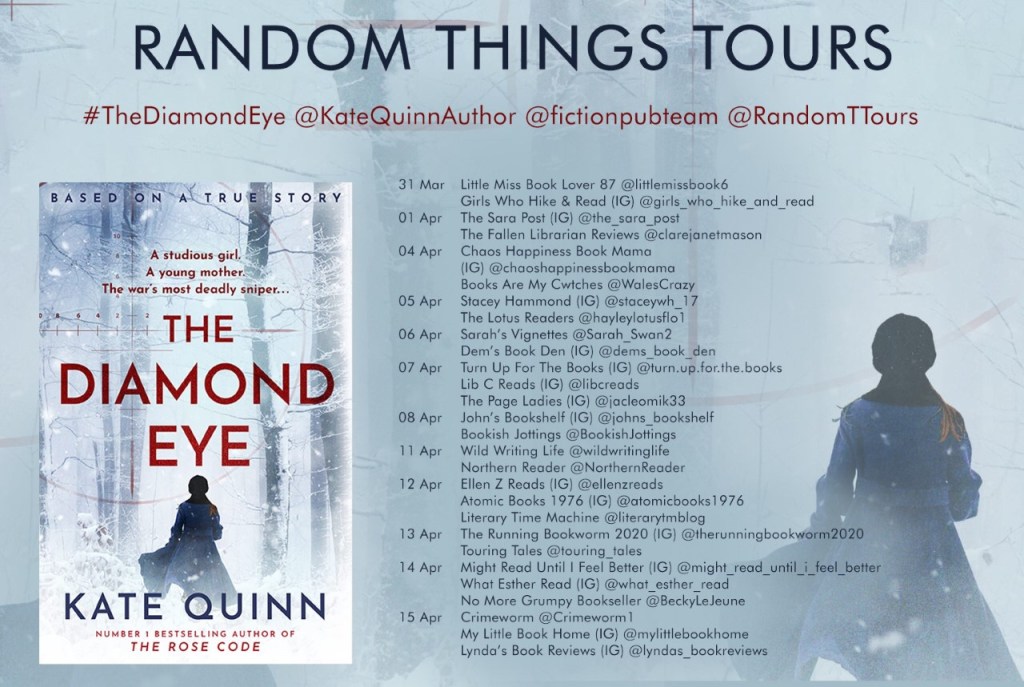
The Diamond Eye by Kate Quinn

She’s the war’s most lethal sniper. And the one they least expect…

In the snowbound city of Kiev, aspiring historian Mila Pavlichenko’s life revolves around her young son – until Hitler’s invasion of Russia changes everything. Suddenly, she and her friends must take up arms to save their country from the Fuhrer’s destruction.

Handed a rifle, Mila discovers a gift – and months of blood, sweat and tears turn the young woman into a deadly sniper: the most lethal hunter of Nazis.

Yet success is bittersweet. Mila is torn from the battlefields of the eastern front and sent to America while the war still rages. There, she finds an unexpected ally in First Lady Eleanor Roosevelt, and an unexpected promise of a different future.

But when an old enemy from Mila’s past joins forces with a terrifying new foe, she finds herself in the deadliest duel of her life.

The Diamond Eye is a haunting novel of heroism born of desperation, of a mother who became a soldier, of a woman who found her place in the world and changed the course of history forever.

I found this novel a compulsive and totally immersive read. So much so that if I was interrupted I would often look up in surprise to find that I wasn’t in a freezing cold trench, aching and covered with mud. Kate Quinn really gives us a vivid picture of WW2 in Russia, a front of the war I knew little about. In Lyudmila Pavlichenko, Quinn has a complex heroine, but she creates a nuanced, three dimensional woman, who is so much more than her nickname of Lady Death. I’d imagined a rather joyless, dour individual who was strong and almost masculine. However, instead I was shown a rather diminutive figure, with dark eyes and her long hair hacked off for practicality. This is the soldier. A woman with so much self-discipline she put me to shame, not only working on her university dissertation and looking after her son, while taking a year long marksmanship course so she could be the one to teach her son to shoot. However, when war breaks out Milla feels she must leave her beloved Ukraine and sign up for frontline duty. I loved the way the novel brought up the issues of womanhood in Russia, both Mila and her friend Lena are shocked by how few women were signed up. It never occurred to Mila to let men fight for her, she had the ability and as she mentions on her visit to Washington – Russian women are equal as human beings. I loved how Quinn focused on her vulnerability as much as her strength and the fact she’s only fighting out of necessity; she doesn’t revel in her 309 kills. She is a cultured woman, often enjoying the ballet and opera in Odessa before the war and very proud of her student status – her half written dissertation being the only personal thing she takes with her to the front.

I felt that the book wore it’s extensive research lightly. The story was grounded within the history, but doesn’t lecture or give huge amounts of exposition. This is a personal story about one woman’s war, within that larger history. Battles are mentioned and ground is won or lost, but it’s the character we focus one and those around her. I loved her relationship with Kostia, her shadow and fellow sniper, who keeps her warm on night long stake-outs by letting her lie along his back for body heat. He is of Siberian/Irish heritage, taciturn and serious, but when he finds his childhood friend Lyonya they are soon laughing and wrestling like a pair of ten year olds. Mila relationship with Lyonya was beautiful and probably the only mutual and equal romantic relationship she’d had to that point. Their story broke my heart, but it also broke for Kostia too. The detail is brutal, shrapnel injuries are described in raw, bloody ways because it’s necessary to show the dangers our characters are in. These terrible injuries also provide a contrast to the swift, clinical and clean kills carried out by Mila and Kostia. There are times where I thought their victims were the lucky ones. Mila’s ex-husband is written so well, because he infuriated me. Always with an eye on the main chance, Alexei is a brilliant surgeon and a shitty husband. Having seduced Mila at 15 years old, he then womanised his way to the divorce courts and has no intention of building a proper relationship with his son. His teasing and little digs at Mila felt like the tip of the iceberg to me and I wondered how manipulative and emotionally abusive he had been within the marriage.

The book is structured with Mila’s time fighting in Russia, sandwiched with chapters that show the delegation of students, including Mila, visiting Washington to elicit US support to open a second front in the war. Inbetween are excerpts from Mila’s diary (official and personal), Eleanor Roosevelt’s diary and notes written for her husband Franklin. There’s a humour in these scenes I enjoyed immensely, especially when Americans underestimate Mila, in her ability to understand them and her talent for sarcasm. These parts made me smile and I also loved the section where Eleanor Roosevelt drives Mila to an event personally, and navigates the streets of Washington like a racing driver! These later chapters are also tense as Mila has to learn to cope with the media, weird marriage proposals and threatening notes posted under her bedroom door by someone travelling with the delegation. The question of who they are and what they’re up to kept me alert and wary of everyone. What Quinn does so breathtakingly well is to breathe life into this woman, who I’d never heard of two weeks ago. She made me care about her and want to investigate her story more. She takes Russia’s poster girl and makes her human, a complex woman with courage, hopes and desires. She shows us that all Mila really wanted from life was to be a history professor, but war got in the way.

Meet The Author

Kate Quinn is a native of southern California. She attended Boston University, where she earned a Bachelor’s and Master’s degree in Classical Voice. A lifelong history buff, she has written four novels in the Empress of Rome Saga, and two books in the Italian Renaissance detailing the early years of the infamous Borgia clan. All have been translated into multiple languages. She and her husband now live in Maryland with two black dogs named Caesar and Calpurnia.

Posted in Throwback Thursday

Throwback Thursday! A God In Ruins by Kate Atkinson.

Following on from last week, I wanted to feature this novel which is one of my favourites from the last twenty years and shows that Kate Atkinson is truly one of our best British novelists. It follows another wonderful novel about the Todd family, Life after Life, which focused on the many possible lives of Ted’s older sister Ursula. This is written as a standalone novel, rather than a sequel and has the honour of being one of the few books that genuinely made me cry towards the end. We meet Ted as he’s a pensioner, living in York, and dealing with living his life alone after the death of his wife. However, we don’t stay there, because as with Life After Life, Atkinson mixes past, present and future with great impact. The novel is also told from Teddy’s point of view, although he does seem slightly omniscient at times, knowing things he wasn’t present for. It is such a poignant history of a man who has lived through a world war, and it feels so authentic. In true Atkinson style, it cleverly manages to be a book about fiction itself.

In Life After Life when the focus was on Ursula, Teddy seemed to be set on course to marry childhood sweetheart Nancy and their life was portrayed as idyllic. Yet in this novel we see that their relationship was far from perfect. Despite this we do follow the lives of their daughter and granddaughter too, to great effect, because it opens up all the changes Ted has seen over his long life. Teddy’s mind often wanders back to his time as part of Bomber Command – something I’ve grown up with because I live in Lincolnshire which is known as Bomber County. In fact in the course of his work as a land drainage engineer, my Dad has accidentally dug up a whole Lancaster Bomber, probably trying to limp home to RAF Blyton, only a mile and a half away. Here the bomber raids were described so authentically, they were harrowing in parts and I could imagine the anxiety of waiting back at base to count the planes back in, knowing some would be missing.

Atkinson manages to combine the personal story of Teddy’s family, with societal shifts that occurred between the wartime generation and those who came of age in the second half of the 20th Century. Teddy is an old school gentleman, often showing acts of kindness and chivalry that make him very loveable. His values are challenged by his daughter Viola, the voice of her generation, who is always looking for the next cause to adopt. She campaigned for nuclear disarmament and supported the women protesting at Greenham Common. She’s a feminist and a vegan, something very unusual until fairly recently in the 21st Century. We are shown how the generation gap creates arguments in a family, where one generation fought in a war and later generations don’t appreciate or fully comprehend the sacrifices that were made for them. Viola could be seen as an unsympathetic character, especially when compared with Teddy’s service. However I wondered if her character developed as a reaction against Teddy’s courage and heroism. Such perfection is hard to live up to. In fact, when Viola tries to reconnect with friends from her travelling days she finds one of them has died and one works in finance – far from the ideals they held before. Unlike Teddy’s generation they have had a chance to regret behaviour and change outlook. Teddy’s friends will always be the same age.

I enjoyed the interesting structure of the novel where we float back and forth in time, between characters and settings. At times Atkinson lets slip a future plot, while still in the past. All of this felt very Virginia Woolf-esque and it suited the narrative. She is such a skilled writer that this never feels overtly literary or highbrow, it remains a light easy read. There is a huge twist at the end that has a bearing on everything you’ve read so far, but it’s not there just for the sake of it. Yes, it’s an excellent example of the post-modern novel, in a similar vein to Ian McEwan’s Atonement, but that’s not all. It’s impact of the twist was devastating to me and this is where tears emerged. This unexpected direction is truly a tribute to the men of Bomber Command, especially those who didn’t come home, like the men in the Lancaster my Dad dug up who were only a couple of miles from safety. This novel is simply one way Teddy’s life could have played out and it’s all the more powerful for it. This was an intelligent, well-researched and poignant novel that I think should be viewed as a modern classic.

Meet The Author

Kate Atkinson won the Whitbread (now Costa) Book of the Year prize with her first novel, Behind the Scenes at the Museum.

Her four bestselling novels featuring former detective Jackson Brodie became the BBC television series Case Histories, starring Jason Isaacs.Her 2013 novel Life After Life won the South Bank Sky Arts Literature Prize, was shortlisted for the Women’s Prize, and voted Book of the Year for the independent booksellers associations on both sides of the Atlantic. It also won the Costa Novel Award, as did her subsequent novel A God in Ruins (2015).

Posted in Netgalley

The Metal Heart by Caroline Lea.

The sky is clear, star-stamped and silvered by the waxing gibbous moon.

No planes have flown over the islands tonight; no bombs have fallen for over a year.

___________

Orkney, 1940.

Five hundred Italian prisoners-of-war arrive to fortify these remote and windswept islands. Resentful islanders are fearful of the enemy in their midst, but not orphaned twin sisters Dorothy and Constance. Already outcasts, they volunteer to nurse all prisoners who are injured or fall sick. Soon Dorothy befriends Cesare, an artist swept up by the machine of war and almost broken by the horrors he has witnessed. She is entranced by his plan to build an Italian chapel from war scrap and sea debris, and something beautiful begins to blossom. But Con, scarred from a betrayal in her past, is afraid for her sister; she knows that people are not always what they seem.

Soon, trust frays between the islanders and outsiders, and between the sisters – their hearts torn by rival claims of duty and desire.

A storm is coming . . .

In the tradition of Captain Corelli’s Mandolin, The Metal Heart is a hauntingly rich Second World War love story about courage, freedom and the essence of what makes us human during the darkest of times.

This book is stunningly beautiful, so much so that I had to sit and think in the quiet when I’d finished it. It’s so rich in folklore, historical detail, the trauma of war and bereavement that I know I could pick it up to read again and still find something new. I immediately ordered a signed copy for my forever shelf, because it is so special. What did I love about it? The Scottish folklore, the incredible landscape, the community, the dignity of people facing the hardest times of their lives. Then amidst the chaos, violence and confinement, beauty emerges in the shape of a deep, immediate, connection and growing love between two people who can’t even speak the same language. The counterpart to this human story is the Italian Chapel, built out of the scraps of metal huts and concrete the prisoners are allowed. Yet from these humble materials a building of true beauty emerges, that still stands today. It made me emotional to think about the lovers, but also the patience and faith of these incredible men who needed a place to worship, a piece of home.

Dorothy and Constance live on Selkie Holm, a small island close to Orkney. They are isolated outcasts, strange simply because of their doubling, but also because they’re thought to have bad luck. There are myths about the island and the selkie women that might lure a man into the water. People go missing there and the old fishermen who gather in the tavern love to swap old stories about the strange shapes seen in the water. It’s said that if you live there you might go mad. Besides, the girls have had bad luck enough with the drowning of their parents as they tried to row to Kirkwall hospital in a storm. People mutter that it isn’t right for two young girls to live there alone. Surely they must need other people? Yet, that’s exactly what Con doesn’t need. They live in the bothy because of a traumatic event that happened in Kirkwall and now she’s frightened of people, particularly men. So when it’s announced at a town meeting that Italian prisoners will be housed on Selkie Holm, Con is terrified. Their protests fall on deaf ears, since the sinking of the Royal Elm, Churchill has decided barriers must be built to prevent invasion. The prisoners will build the barricades and soon there are huts and barbed wire and men with boots all in Con’s place of safety. Worst of all, Angus McLeod has been given a job as a guard on the island and the girls want to avoid him most of all.

This is a story about freedom for all three main characters. Of course Cesare is the one literally behind a wire fence, but Dot and Con’s bothy is a prison of their own making. Watching each of them try to inch towards freedom in their own ways is moving and upholds my belief as a therapist that everyone is capable of change and even in the most straitened circumstances we still have choices. Cesare finds freedom in the infirmary where he is cared for, in the Major’s office helping with correspondence, in the building of the beautiful chapel and the first time he sets eyes on Dorothy or Dorotea in Italian. His utter joy at finding something so precious amongst the dirt, the heavy labour, the biting wind and the regular beatings, is hopeful and bittersweet. Just like the unexpectedly beautiful chapel, treasures are often found in the dirt.

‘Up on the hill, the chapel gleams in the sun. I imagine the light pouring in through the window. The pictures on the walls will gleam with life. And, on the ceiling above the altar, a white dove soars through a bright blue sky. How does something so beautiful come from such darkness? The tears are flowing freely now, as I turn back to the people watching me and I force myself to say, ‘Thank you.’

‘‘Up on the hill, the chapel gleams in the sun. I imagine the light pouring in through the window. The pictures on the walls will gleam with life. And, on the ceiling above the altar, a white dove soars through a bright blue sky. How does something so beautiful come from such darkness? The tears are flowing freely now, as I turn back to the people watching me and I force myself to say, ‘Thank you.’Up on the hill, the chapel gleams in the sun. I imagine the light pouring in through the window. The pictures on the walls will gleam with life. And, on the ceiling above the altar, a white dove soars through a bright blue sky. How does something so beautiful come from such darkness? The tears are flowing freely now, as I turn back to the people watching me and I force myself to say, ‘Thank you.’

Dot finds her instant love for Cesare overwhelming, but she never questions or doubts her feelings or his. Con often reminds her what men are capable of, that she can’t trust someone she doesn’t know. Yet, for the first time, Dot places a boundary between herself and her sister, simply saying ‘I am not you’. This isn’t a criticism of her twin, but just an assertion that she is different, separate, and so is her life. She also makes a point of going to work in the infirmary, leaving Dot at the bothy. This is the first time where Con can see Dot moving into a life beyond her, their psychic or spiritual link can never be broken, but to wake up and live without her physical presence must be terrifying.

For Dot freedom means the ability to live a life separate from her sister’s, but also beyond the shadow of Angus McLeod. Dot’s trauma affected both girls and when she couldn’t go out, neither girl did. They have spent every day and night together since. This wasn’t Dot’s trauma, but she stopped living just the same. Now she dreams of sitting in the warmth of Italy, with Cesare and his family eating wonderful food. The image is a mile away from the dark, cold and stormy reality. Con sees the changes in Dot, and recognises she’s drifting away from her. Fiercely protective of her twin, it takes her a while to realise that in Cesare, Dot has found a man who is gentle and won’t hurt her. She knows she can’t hold her back, but it’s a huge wrench, like giving away part of herself when so much has been taken from her already. Watching Con’s realisations about her trauma and the potential for healing was one of the most moving parts of the novel.

The historical detail in the novel is incredible. Caroline Lea writes in her acknowledgments:

‘I wanted the love affair between my characters to be constrained by time and intensified by the precipitous and perilous nature of war, so I took many liberties with timings and action. This was a very conscious decision: I’m painfully aware of the difficulties in fictionalizing real historical events and people and selling them as ‘fact’, especially when this involves taking on the voices of ‘real’ people: I was very certain that I didn’t want to do that.’

This explains her decision to change certain things: some of the history and geography is changed; the construction of the barriers was started by Irish workers; the sinking of a ship by German u-boat features the Royal Elm, not the Royal Oak. Yet the chapel, situated on Lamb Holm, is still standing and can be visited. Even the metal heart truly exists, created by metal worker Giuseppe Palumbi for an Orcadian woman he fell in love with. He had to return home to his wife and family in Italy and left the heart behind. By doing this she has made sure that no one’s real life experiences are encroached upon. This is definitely a work of fiction, although the amount of research and love for her subject is clear to see. The descriptions of the islands are simply stunning and the relentless sea is mercurial; one moment soothing and the next a punishing, vengeful god. The inhabitants of the islands intrigued me too, in the way they slowly integrated with these prisoners of war. Even the two girls, shrouded in grief and superstition, are gently supported by this generous community. Now the chapel is part of this community’s history, with the metal heart at its centre. It shows us that light can shine into the darkest corners and choosing to love, despite the pain and grief, can be the bravest stand we can take.

‘All across Europe, bodies are falling from the sky or into the sea, or are being blown high into the air. Every explosion is a name. Every lost life is carved on someone else’s heart. Every death takes more than a single life. It takes memories and longing and hope. But not the love. The love remains’.

Published by Penguin, 29th April 2021.

Meet The Author

Caroline Lea grew up in Jersey and gained a First in English Literature and Creative Writing from the University of Warwick, where she now teaches on the Creative Writing degree. Her fiction and poetry have been shortlisted for the Bridport Prize, the Fish Short Story Competition and various flash fiction prizes. She currently lives in Warwick with her two young children and is writing her next novel. Her work often explores the pressure of small communities and fractured relationships, as well as the way our history shapes our beliefs and behaviour.