Posted in Throwback Thursday

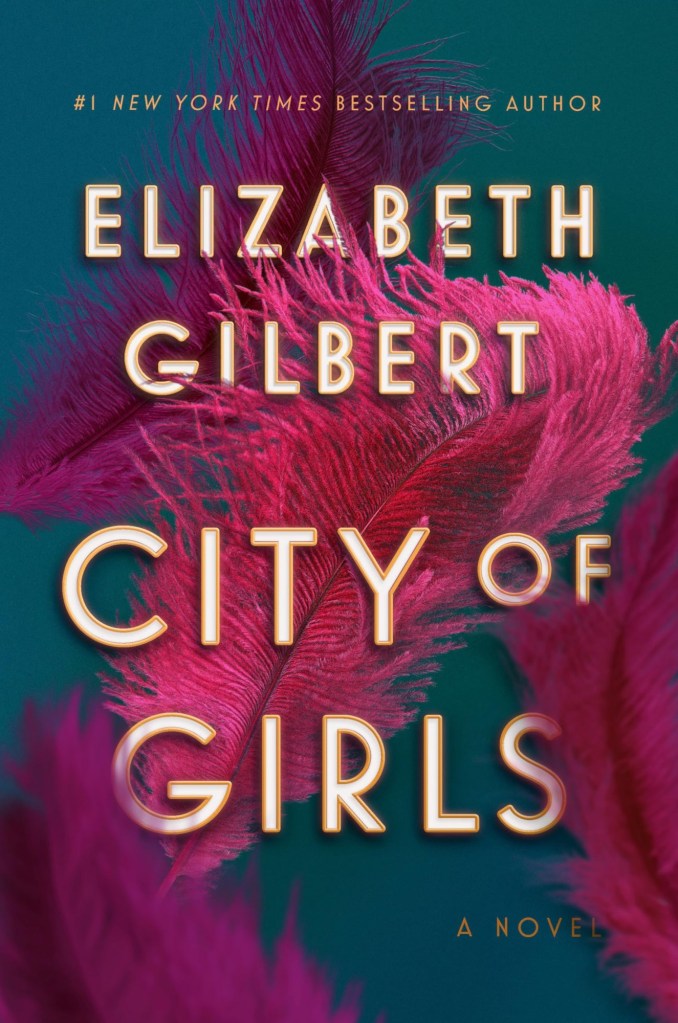
Throwback Thursday! City of Girls by Elizabeth Gilbert.

When one of my favourite authors writes a new book I always experience a confusing mix of emotions. Excitement and anticipation mix with fear; will I love it as much as I love their last book? I don’t want to be disappointed. Since there’s a new Liz Gilbert out this year I thought I’d share my review of her last novel, City of Girls. Like a lot of readers my first encounter with Gilbert’s writing was Eat, Pray, Love; a book that was nothing short of a cultural phenomenon, not to mention the following hit film. For me, it was her novel The Signature of All Things that caught the imagination. The combination of a sparky and intelligent heroine, the feminist theme and the historical detail came together in a beautifully woven story. So as the publication date approached for this new novel I desperately wanted it to live up to her first.

I shouldn’t have worried. City of Girls is a joyous, exhilarating riot of a book. Our narrator, Vivian, plunges us into 1940s Manhattan where she is sent by her parents after expulsion from Vassar. There she is placed in the care of her Aunt Peg who runs the, slightly ramshackle, Lily Theatre. I was suddenly immersed in the bohemian world of theatre people where Vivian soon finds her niche. At Vassar she made friends by creating outfits for the other girls on her trusty sewing machine. So, in her new rooms above the theatre she is soon surrounded by showgirls wanting costumes. I have an interest in fashion and sewing, so I really enjoyed the descriptions of Vivian’s creations, made on a shoestring with a lot of help from Lowtsky’s vintage clothing store downtown. Yet not everything is as it seems on the surface. Is her friendship with showgirl Celia as mutual as it appears? What influence does the matronly and doom laden Olive have over Aunt Peg? Where is Uncle Billy, whose rooms Vivian has been using since her arrival?
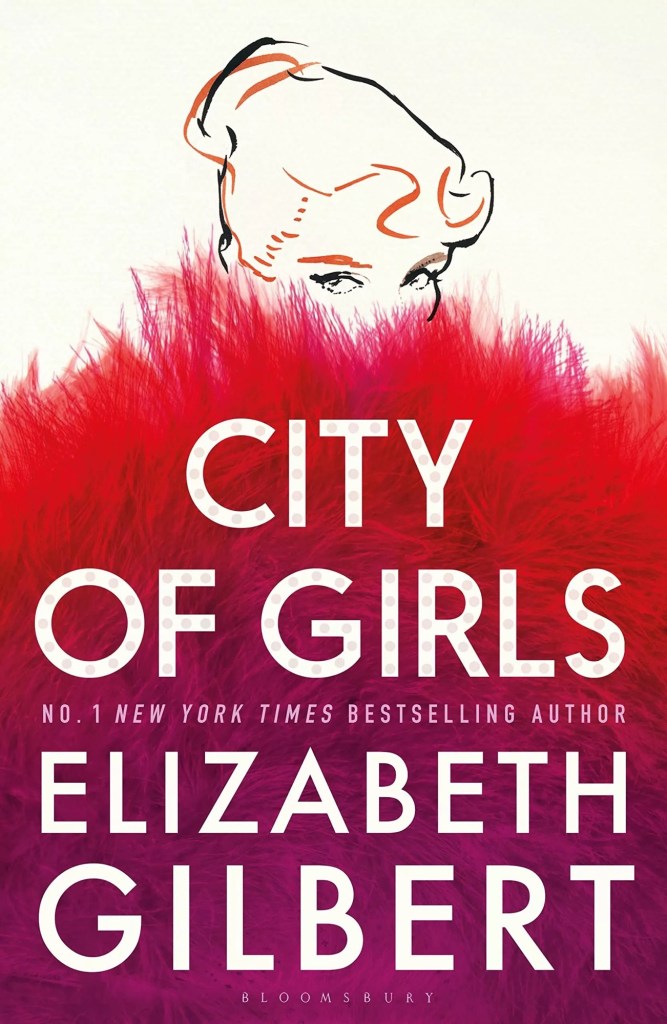
 Some of these questions are answered during the production of the brand new play City of Girls. Aunt Peg’s friend Edna Parker Watson comes to stay after losing her London home during the Blitz. Edna is a talented theatre actress who is petite, beautiful and impeccably dressed. She arrives at the Lily with her huge wardrobe and her very famous and much younger husband, Arthur. Every member of the theatre company does their very best to get this musical off the ground and make it a success. Vivian works hard on her costume designs, but also finds herself becoming an unofficial PA and friend to Edna. Determined to put on the best show they can to turn the Lily Theatre’s fortunes around, Aunt Peg agrees to audition for new actors. When Vivian meets Anthony, the new leading man, she falls in love for the very first time. But alongside the awakening of first love, Vivian will also have her eyes opened to how cruel showbiz and the wider world can be. Several revelations teach her that not everyone can be trusted, the most unexpected people can come to your aid, and Vivian realises she has been walking around with her eyes closed. As the Second World War moves ever closer to their shores Vivian is left with a reckoning of her own. Does she want the respectable, quiet life her family expects or does she want to make her own way in a city and a career that is anything but quiet?  

You will fall in love with Vivian as she takes you into her past and candidly shares her exploits in 1940s NYC. She takes you from theatre, to nightclub to a dingy apartment in Hell’s Kitchen where she conducts her first love affair. She holds nothing back and I felt her delight at encountering the bohemian characters of the theatre, her passion and ingenuity for costume work and her discovery of a city laid out before her like a playground. She allows us to experience her growing up with every triumph and mistake she makes along the way. Such an engaging central character is well matched with other beautifully drawn female characters from the dowdy killjoy Olive who has surprising depths, the enigmatic Edna Parker Watson, the brisk and sometimes foolhardy Aunt Peg to the glamorous showgirl Celia who leads our narrator into a world of nightclubs, make-up and disposable men. The women in this novel are strong, surprising and all teach Vivian something about the kind of woman she wants to be. The novel emphasises the importance of strong female role models or mentors in both our personal and working life. I found myself torn between bingeing on this book or savouring it slowly: I wanted to know what happened next but I didn’t want my adventures with Vivian to come to an end. 

Meet the Author


Elizabeth Gilbert is an award-winning writer of both fiction and non-fiction. Her short story collection Pilgrims was a finalist for the PEN/Hemingway award, and her novel Stern Men was a New York Times notable book. In 2002, she published The Last American Man, which was a finalist for both the National Book Award and the National Book Critics’ Circle Award. She is best known for her 2006 memoir Eat, Pray, Love, which was published in over thirty languages and sold more than seven million copies worldwide. The film, released in 2010, stars Julia Roberts and Javier Bardem. Committed: A Sceptic Makes Peace with Marriage, a follow-up to Eat, Pray, Love, was published in 2010. Elizabeth Gilbert lives in New Jersey, USA.
Posted in Netgalley

The Empire by Michael Ball

1922. Jack Treadwell arrives at The Empire in the middle of a rehearsal and he is instantly mesmerised. Once you look past the glitz and glamour, the true magic of the theatre lies in its cast of characters – both on stage and behind the scenes. There’s stunning starlet Stella Stanmore and Hollywood heartthrob Lancelot Drake; and Ruby Rowntree, who keeps the music playing, while Lady Lillian Lassiter, theatre owner and former showgirl, is determined to take on a bigger role. And then there’s cool, competent Grace Hawkins, without whom the show would never go on . . . could she be the leading lady Jack is looking for? When long-held rivalries threaten The Empire’s future, tensions rise along with the curtain. There is treachery at the heart of the company and a shocking secret waiting in the wings. Can Jack discover the truth before it’s too late, and the theatre he loves goes dark?

Jack is our eyes in this unfamiliar world, explaining the theatre whilst also representing the issues a man of his age would face post WW1. He outlines the theatre for the reader as a physical space first, both backstage, front of house and as a performer. There are three distinct aspects to the magic we see created on the stage. There’s the physical building and it’s structure, the artists and stagehands who build the scenery and then there’s the money. Without any of these aspects it’s impossible to create the business we call show. As Jack learns so do we and it brings a brilliant sense of wonder to the reading experience. The author also uses him to make the language of the theatre accessible to us, so we can understand everything that’s going on. Finally, Jack brings to life an aspect of life that affects all men of his age in the early twenties; learning to cope in the post war world. The trauma of war is explored through Jack and Danny Moon, with both young men very reluctant to discuss their experiences. However, as the story progresses it’s clear there are physical and emotional scars that can’t be seen.

Danny Moon in particular embodies a sad truth about war, men go into battle as one person and come out of as someone completely different, someone we may not recognise. All of the characters in the book have their own quirks and personality traits, making them feel real and individual in a large cast of characters. Often in casts like this people get lost but not here, where even if they are slightly stereotypical they’re still memorable. There’s a nice class distinction between upper and lower class characters and how they interact with each other too. The author even touched on the changes in women’s lives in the early Twentieth Century in a subtle but effective way. The issue of women’s legal and political equality was only one aspect of the volatile social change women faced at this time. In fact their social mobility had changed during the war and there were elements in society who wanted their roles to revert to pre-war tradition. Women were not so easily persuaded and the author represents this with headstrong female characters who struggle against the belief that women should return to the home. The role of actress had traditionally been synonymous with women of easy virtue and those attitudes still persist in the 1920s, as well as mistaken beliefs that women can’t think and therefore act as well as men. The women here definitely prove those theories wrong! Finally, there were returning soldiers struggling with their mental health and Billy Barlow represents this wave of men with depression, anxiety and P.T.S.D. His struggles are enacted on the stage, bringing real meaning to his performance. Of course the author isn’t aiming to make these issues the focus of the novel, but by adding it as background he has grounded the story in it’s place and time.

Whilst I’m not specifically a Michael Ball fan, I am a huge fan of musical theatre and I know what an incredible talent he is in that world. I figured if anyone knows how to put the magic of the theatre into words then it’s him. I had a certain amount of scepticism though – as a lover of books I’ve looked on with dismay at brilliant writers struggling to get publishing deals, when celebrities seem to find it easy. Just because someone is a celebrity doesn’t make them a great writer. However, here Michael Ball’s warmth and love of his subject comes across beautifully and I really enjoyed the book. For a first novel, the story is long with many different avenues to explore, but I found that despite the complexity it wasn’t hard to follow and I didn’t have to go back over earlier sections to keep track. The structure helped, because in addition to chapter breaks there were clever changes in tone, setting and description. His story immerses the reader in the world of theatre, but the author has also created sympathetic characters and opened a window on the social issues of the 1920s. I look forward to more adventures at The Empire.

Published by Zaffre 13th October 2022

Meet The Author

Michael Ball OBE is a singer, actor, presenter and now author. He’s been a star of musical theatre for over three decades, winning the Laurence Olivier Award for Best Actor in a Musical twice, he’s also won two BRIT awards and been nominated for a Grammy. Michael regularly sells out both his solo tours and his Ball & Boe shows with Alfie Boe and has multiple platinum albums. The Empire is his first novel.