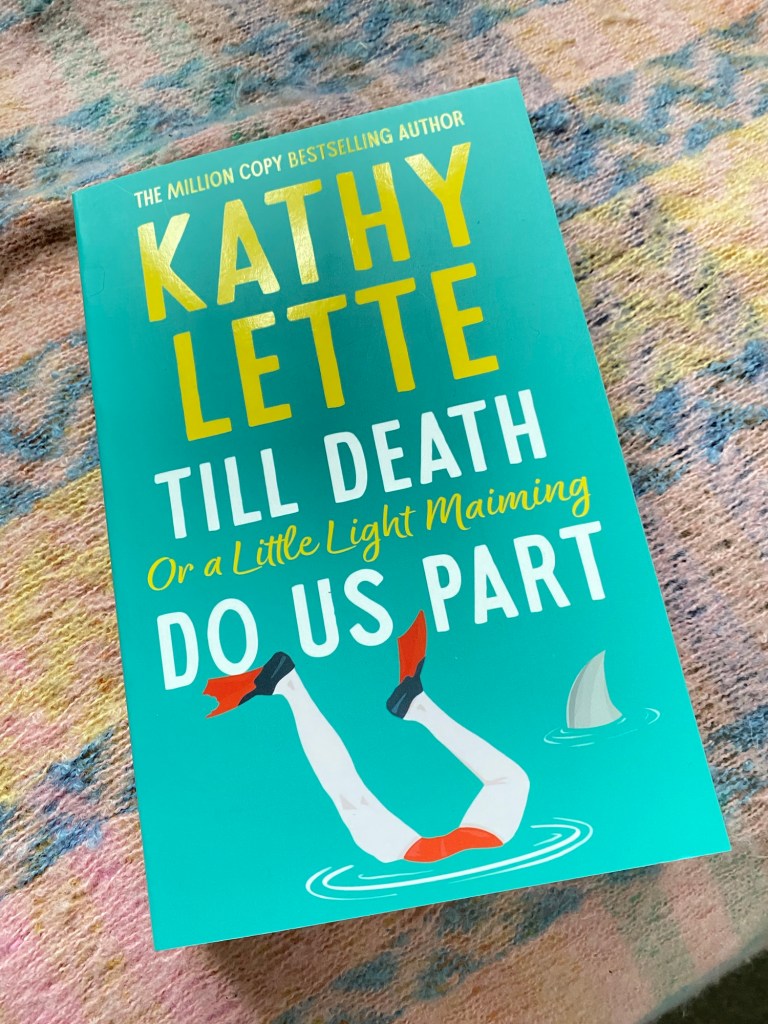
One dead husband. Three grieving widows.
When she hears a man has been killed by a Great White shark, Gwen races to the beach only to find that all that remains of her husband is his swimming cap and a piece of torn, blood-stained wetsuit. Her grief is soon interrupted by Tish, screaming for information about the accident. When Gwen reassures her that it’s her husband, Jason Riley, who’s perished, Tish’s response is earth-shattering for them both: Jason was her husband too.
The women’s mutual animosity is not assuaged when they learn that Jason recently sent all his – make that their – money to a mysterious ‘business partner’ in Egypt called Skye. But when they fly to Cairo to confront her, they find another grieving widow whose life-savings have gone missing…
As this double-crossed threesome cross continents in their search for truth and retribution, they start to realise they’re embarking on a journey of self-discovery, renewal and friendship too.
I’ve read Kathy Lette before so I was expecting ballsy women, lots of wit, perhaps some raunchy behaviour and definitely laughter. I wasn’t disappointed. I’ve seen this described as a revenge caper and that is the perfect description. Gwen has a happy life with her children and second husband Jason, who’s a real hottie. He is a big blonde surfer type with a sprinkling of grey, but a body honed to perfection by Iron Man training. She sometimes wonders how they got together. She sees herself as a rather ordinary widow nearing her sixties, while he’s a lot younger and so fit. However, tragedy comes along when Jason is training. Gwen hears on the radio that there’s been a shark attack in the bay and she makes her way there immediately. When she arrives, she knows by the scrap of wetsuit on the sand that the lost man is Jason. She hardly has time to breathe before a leather clad ball of fury catapults herself into the situation. Tish is there because she thinks her husband is missing too, she’s married to a tall, blonde hunk called Jason. Surely they can’t both be married to the same man?
Gwen wants to quietly go home and cope with the double shock of Jason’s death and the news that he’s a bigamist. Tish has the grip of a small terrier and has about a million questions that Gwen is incapable of answering. She’s totally gobsmacked by Tish’s biker girl style, they couldn’t be more different so why was he attracted to both of them? It seems that when Gwen thought he was working or training, he was with Tish and vice versa. They’ve been together a similar amount of time. They make a very uncomfortable trip to Jason’s lawyer, Tish is adamant there should be a will and she wants to see it. She invested a large amount of money in a business start-up he was working on. Gwen is keeping her cards close to her chest but she too has invested some of her widow’s inheritance in his endeavours. Where has it gone? They soon find out. His lawyer tells them that Jason signed a document that transfers their joint investment to a woman in Cairo. Tish wants to be on the next plane and wants Gwen to go with her. Can they find this woman, solve the mystery of her connection to Jason and retrieve their money?
I found the novel intriguing and funny at first. Tish is an absolute ball of energy and her power as a character did overpower everyone else slightly. I wonder if Kathy based Tish on her most extrovert side. I felt a little bit like the momentum of the story was lost in long verbal exchanges between the two women that seemed more about the jokes than developing characters or their relationships. Some are admittedly very funny, but when they come thick and fast the humour sometimes misses the mark. It’s also difficult to change the tone and I think the novel could have done with some light and shade. However, it’s a madcap caper that takes on an escapist feel as we travel all over the world with the women and try to work out if Jason faked his own death and whether they’ll be able to retrieve their money. Cairo brings even bigger surprises, leading to Tanzania, the Maldives and throughout Europe. It’s an absurd plot, but it is fun and a great escape read. I read this in one afternoon and had some laugh out loud moments. There’s also some lovely female camaraderie as these women start to come together, overcoming their differences to bond and keep chasing their love rat husband. I really enjoyed the suggestion that there’s a re-evaluation of life as women reach middle-age. A realisation that if we are going to do the things we’ve always wanted we need to start planning now. It’s the chance to throw off things that no longer suit us – not just in our wardrobes! In amongst the action and the laughs is the very profound idea that just when you learn to make the most of your life, it is almost over.
For more information on Kathy Lette and her books visit



















 The Lotus Readers