Posted in Netgalley

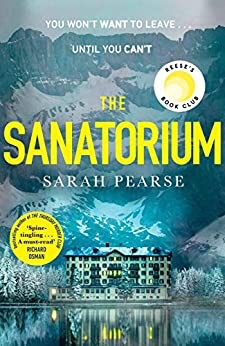
The Sanatorium by Sarah Pearse.

I’ve been a little late to the party reading this thriller set in the Swiss Alps. Now I have, I can see why other bloggers have enjoyed it so much.It left me feeling chilled and genuinely claustrophobic. Elin’s brother Isaac invites her to celebrate his engagement to girlfriend Laure at a luxury hotel in Switzerland. The newly renovated hotel is Laure’s workplace and has a complicated history. An architectural triumph for the owner Lucas, the hotel was once a sanatorium for people with tuberculosis. Locals objected strongly to the project due to its position and liability to become cut off by avalanches, but there was also some disquiet about its history and the appropriateness of its new use. Elin and Isaac have a strained relationship, dating back to the accidental death of their little brother when they were children. However, she has been looking forward to trying again with Isaac and is excited to show her architect boyfriend Will around the hotel. Will is looking forward to relaxing with Elin after a tough year including her long sabbatical from work as a police officer. Elin is a detective, but isn’t currently working after an incident lead to her suffering flashbacks, panic attacks and other symptoms of PTSD. Can Will and Elin relax and enjoy their break, or will echoes of the past get in the way?

The author creates a edgy atmosphere immediately. We find out that Lucas’s business partner Daniel disappeared just as the hotel opened, thought to be swallowed up by an avalanche while taking his morning exercise. The remoteness is immediately apparent and I loved the way the author situates the hotel as a huge edifice almost doing battle with the surroundings. Guests can gaze directly out into the woodland and mountains. However, once the night falls and the lights are on, the hotel must be visible for miles. Guests can’t see out, but anyone could be looking in. The decor isn’t plush and ornate like a lot of hotels, but instead hints at the hotel’s past; almost like a luxury monk’s cell. There is nothing superfluous or showy about the bedrooms. There are also little glass display boxes where artefacts from the hotel’s archive are put on show. Elin doesn’t know whether they honour the past in a respectful way or whether they’re distasteful. There’s a real sense of the cold from outside, but also in the hotel’s decor. There’s nothing cozy or welcoming to offset the harsh weather.

It’s not just the venue that has a complicated relationship with the past. This whole visit is shrouded in secrets. Elin hasn’t told her brother that she’s taking a break from the police force. She also hasn’t told her partner Will about her previous friendship with Laure. Although it soon becomes clear that she’s not the only one keeping secrets. Her silence on certain subjects made me doubt her as a narrator creating an edgy reading experience. The venue seems to have tension built into its very foundations and I sensed something evil had happened there. Whatever had happened left an energy that rubbed off on the staff and guests. The author builds on the claustrophobic theme, by layering the imagery throughout the narrative. There is the history of patients literally struggling to breathe within these walls. Then there are Elin’s panic attacks, intensified by the scene where she is pushed into the plunge pool at the spa and struggles to force her way back to the surface. In flashbacks we learn of the tragic day at the beach when Isaac and Elin’s brother died, it’s always there simmering in the background and even Elin doesn’t seem to know the truth of what happened. There’s also the remote location, and the constant threat of avalanche. The author allows these feelings to build towards moments then describes moments of pure terror as an unknown assailant attacks, wearing a black rubber gas mask that makes a strange sucking and whistling noise. There were moments where I literally had to close the book and have a break with a cuppa!

There are a series of questions within the book, so there are a series of answers we’re chasing towards the end of the novel. Will we discover the truth of what happened when the hotel was Sanatorium du Plumachit? Will we find out what truly happened on the beach between Elin and her brothers? Who is behind the attacks at the hotel and what is their motive? The author has created a mystery that’s like a set of Russian dolls, moving from the present back to past events that still have a devastating hold on the here and now. The strange souvenirs left by the killer in glass boxes, are just like the exhibits from the archive, so there must be a link. I read the last few chapters in one go, because I simply had to know what was going on. There was a definite disregard for the next day that night as I was up till 3am racing through the revelations. I thought this was a brilliant thriller, full of atmosphere and with some genuine scares along the way. I absolutely loved it and would recommend it very highly.

Meet The Author

Sarah Pearse lives by the sea in South Devon with her husband and two daughters. She studied English and Creative Writing at the University of Warwick and worked in Brand PR for a variety of household brands. After moving to Switzerland in her twenties, she spent every spare moment exploring the mountains in the Swiss Alpine town of Crans Montana, the dramatic setting that inspired her novel. Sarah has always been drawn to the dark and creepy – remote spaces and abandoned places – so when she read an article in a local Swiss magazine about the history of sanatoriums in the area, she knew she’d found the spark of the idea for her debut novel, The Sanatorium. Her short fiction has been published in a wide variety of magazines and has been shortlisted for several prizes. You can find Sarah on Twitter @SarahVPearse and Instagram @sarahpearseauthor

Posted in Netgalley

One Night, New York by Lara Thompson.

At the top of the Empire State Building on a freezing December night, two women hold their breath. Frances and Agnes are waiting for the man who has wronged them. They plan to seek the ultimate revenge.

Set over the course of a single night, One Night, New York is a detective story, a romance and a coming-of-age tale. It is also a story of old New York, of bohemian Greenwich Village between the wars, of floozies and artists and addicts, of a city that sucked in creatives and immigrants alike, lighting up the world, while all around America burned amid the heat of the Great Depression.

It’s hard not to fall in love with Frances. It only took a few chapters and I was with her wholeheartedly – she simply feels so real. The narrative bounces back and forth from the top of the Empire State Building, all the way back to Frances leaving rural Kansas, but it is always Frances’s point of view we follow. As a poor girl in a thin dress and broken sandals she is noticed by a couple of bohemian types on the train, a photographer and journalist. They are looking for stories and characters that will appeal to a wealthy NYC elite, and poverty stricken farmers are making headlines as the Depression bites. They see something in Frances and want to photograph her, but she is meeting her brother at the station so she takes their card instead. We see her settled into Stan’s tenement flat, taking embroidery in for Mrs Bianchi next door. How does she go from this to contemplating an act of violence at the Empire State?

What we’re seeing is an awakening. It’s not so much a loss of innocence – I realise that went a long time ago when she relates the things she’s seen and suffered. In NYC, although she’ll still experience trauma, she also gains so much strength and self-knowledge. There’s an awakening that’s sensual as she learns to love the feel of fine fabrics on her skin and the joy of moving her body to music. She gains a love and understanding of art, responding emotionally to the most complex modern pieces as well as the photographs she takes with new friend Agnes. There’s also an awakening of sexual desire, something she has never experienced before.

The structure brings an amazing tension to the novel. We might think we’ve worked out what is going on, but it’s so much worse than I imagined. We are drip fed the events leading up to the present moment, and the author doesn’t reveal the man Frances and Agnes have lured to the building until right at the very end. The girls become friends before realising they are both affected by the ambitious men who will build this city. Women are disappearing and men have all of the power in this world. It is the resulting male privilege, such arrogance and certainty, that lures their victim to this precarious and windy place. Agnes and Frances are going to draw a line under this, a fatal one. It really chills to the bone when we find out the true extent of what these ‘disappeared’ women have gone through. Within this we also learn the reality of the Depression in Kansas, and the reality of Frances’s life with a brutal father, only curbed by the presence of Stan. I was so deeply sad for Frances. Dicky and Jacks constantly talk about Frances being wise beyond her years, with surprise. It’s no wonder, she’s been through so much.

This book really is an incredible debut with brilliant historical detail and decadent 1920s feel. The gap between the rural areas of the US and and up and coming city like NYC is wide, but we also see the massive poverty gap between NYC neighbourhoods from the Upper East Side into East Harlem. There’s a decadence here that’s evident from the parties at Jacks and Dicky’s home. These people are new money and the mix of bohemian artists, showgirls, businessmen and politicians is rife with exploitation. I was suspecting everyone of ulterior motives, wondering if anyone is untouched by the taint of money and debauchery. The wholesome and motherly Italian lady Mrs Bianchi gives an impassioned speech about leaving her homeland, only for her sons to be drunk and brawling every weekend. There’s a sense that the pinnacle of this age has been reached; this lifestyle cannot be maintained forever. By the closing chapters I was willing Frances to escape this terrible place, not unscathed of course, but at least alive and free to pursue some happiness with the person she loves. Once I’d finished, I found it hard to start a new book, because my head was firmly in NYC. My heart was still with Frances and that is always the sign of a great book.

Posted in Netgalley

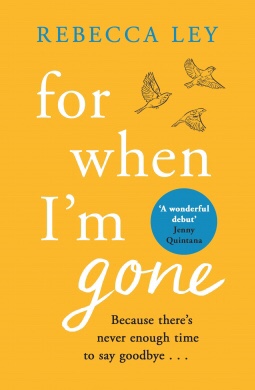
For When I’m Gone by Rebecca Ley.

Publisher: Orion. 3rd September 2020.

There is never enough time. Even when a loved one has been ill for so long and the prognosis is terminal, that moment when they’re gone is seismic. Everything in your world shakes up and resettles around you, but in a totally different shape. When my husband died it had been coming for a long time. He was also suffering. His MS had affected his ability to swallow so he was PEG fed and kept hydrated with a tube directly set into his stomach. He would aspirate saliva, then develop pneumonia in an endless cycle till he decided not to treat it anymore. He’d spent months in hospital, before I received the call from the hospital. Listening to him struggling for breath for 12 hours was torturous. Yet when he took his last breath at 5.15 am, my first thought was ‘no, I wasn’t ready.’

Rebecca Ley’s novel is about a life cut short in this way. Sylvie is given a terminal cancer diagnosis at the age of 38. She and Paul have a marriage that seems perfect. He is a doting husband and father, and loves Sylvie’s intelligence and beauty. There is a certain prickliness to her character, which could make her difficult, but they seem to compliment each other and are great parents to their children Megan and Jude. When Sylvie receives her diagnosis she knows she must help Paul with the aftermath. He needs a manual that helps him deal with a domestic life that’s more complicated than he realises. She also needs to disclose a secret that she’s been keeping for the whole of their married life. As Paul uses her manual to try and negotiate life after Sylvie, he begins to realise just how much she did for them, and how much more indebted he is than he realised. Ley writes about reconciling a life only half lived, but also those compromises made in a marriage and as a mother. This is where he truly gets to know his wife in a way he couldn’t when she was alive.

The book is divided into past and present chapters, so we can be let into Sylvie’s life, but also to form a contrast with after she’s gone. The manual is confessional and written in the first person. Then we have the third person viewpoints of both Paul and Sylvie. Through this we see the beginning of their relationship where everything is romantic to the trickier aspects of their shared life together. I liked that Sylvie isn’t perfect, it’s easy to make a lost loved one into a saint, but Ley avoids that here and it’s all the better for that. Throughout we see that same spiky element to her nature, it’s attractive in a way, but could be seen as hardness or being difficult. As we read through the manual though, after she’s gone, we see a reason for that hardness – Sylvie is this family’s structure, their backbone, and without it what do they have to keep them upright and together?

There is the constant tension of what Sylvie’s long held secret may be, but it wasn’t the thing that kept me reading. It was the slow revelation of her character that held my attention. In Sylvie, Ley has written a truly modern female character who has flaws and makes mistakes, but isn’t cast as a bad person. Often in books about cancer patients, or mothers, there is that temptation to turn them into saints and martyrs. I love that the author made a conscious choice not to do that. Through Sylvie’s choices and her inner monologue as she makes them, we see the complexity of being a woman, a mother and a wife. Sylvie is complicated, sometimes she hurts people and I didn’t always like, or understand her. She is so ‘real’ that I started to think about her in terms of my own friends and family; we don’t always like what they say or do, but we still love them. I felt like I’d got to know a real person and this only added to the devastation when she was gone. I would like to see more women like this in fiction.

The supporting characters were also well written, three dimensional people. I felt particularly for Megan who withdraws as the book goes on. There was also a great contrast between Sylvie and Paul’s mothers, with one very traditional Mum and the other very far from conventional. Ley shows us the chaotic, random and difficult nature of life. This brings home the fact that we never know what’s going to happen next, something people who’ve experienced loss and illness know only too well. I always make sure I tell my new partner and stepdaughters that they should take care and I love them, every time they leave the house. I never want them to wonder how I feel about them, or for something to happen when I haven’t reminded them how much they mean to me. I felt deeply for the family at the heart of this heart-breaking story and it will stay with me for a long time. This extraordinary book is Rebecca Ley’s debut, so I will be following her writing closely to see what’s next.

Meet The Author

I am new to being an author, but the idea that people might read my work and want to connect with me about it is honestly my biggest dream. I would love to hear what you think of For When I’m Gone. You can find click the ‘follow’ button on Amazon, or find me on Twitter or Instagram, where I share fragments of my life raising three children in Hackney, east London. I grew up by the sea in Cornwall and never expected to be raising a family in the inner city, but here we are! I have spent the last sixteen years working as a journalist. I’ve worked on staff at The Times, Sun and Daily Mail, as well as writing a column in The Guardian about my father’s dementia. I’ve also freelanced for a variety of other papers and magazines, including The Telegraph, Psychologies, Mother and Baby and Grazia. And I write scripts for an animation company too.

Posted in Netgalley, Random Things Tours

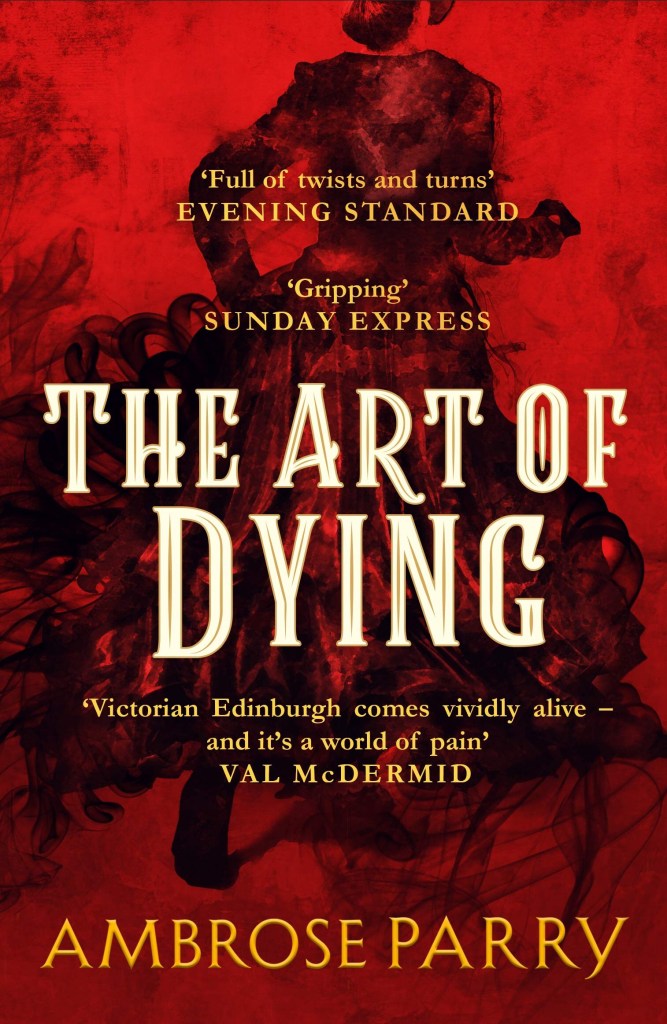
The Art of Dying by Ambrose Parry.

Today, I’m happy to be on the closing day of this blog tour for The Art of Dying. This interesting mix of murder mystery, historical/ medical drama and romance, creeps up on you slowly, until you’re determined to keep reading and see whether a killer is stalking the sick of Edinburgh. In fact at what point I couldn’t decide what I wanted to know more: would the killer face justice, would Raven reconcile with the woman he loved, who was stealing money from the surgery, would Sarah live and what the hell was Quinton up to? It’s hard to sleep with all that going round in your brain! I hadn’t read the first novel featuring Dr. Wilberforce Raven, but it was easy to catch up with this instalment set in Edinburgh in 1849. We really do hit the ground running as Raven is attacked in an alley way in Prague. In the dark and confusion one of the attackers draws a gun, Raven draws his knife and a shot rings out ricocheting off the narrow brick walls. Raven slashes his knife in the air from left to right. He thinks he made contact with an attackers throat, but he doesn’t know if he struck a fatal blow and doesn’t know who is shot.

This chaotic existence seems to be the way Raven lives, but will it follow him back to the streets of Edinburgh. He’s been offered a place under the prestigious obstetrician Dr. Simpson, who he trained under at medical school. He’s looking forward to being back in Edinburgh and in the hospitable, but slightly chaotic, family household. He’s also looking forward to getting away from the guilt that he may well have killed a man in Prague. The only downside involves women. He will be leaving Gabrielle behind – the woman he’s been seeing in Prague – but they’ve both known it was a short term relationship. More pressing than that, he’s wondering whether Sarah is still part of Dr. Simpson’s household. Sarah was originally the Simpson’s housemaid, but did assist the doctor in clinic at times. Raven was attracted to her intelligence and determination. They seemed drawn together by an invisible bond and the closer he gets to his old city, he can feel that bond tugging again. They way they’d been in the past, Sarah might have confidently expected a proposal and had it just been about love, Raven would have had no qualms. However, as a young doctor starting out in a profession where reputation is everything, could he risk marrying a house maid? What would Edinburgh society think and would he be risking his career?

I can’t say I warmed to Raven as a character. I found him arrogant and apt to jump to conclusions, especially where it would benefit him. More importantly, I found him cowardly. Especially in his dealings with Sarah. I had such a moment of satisfaction when he enquired after Sarah when arriving, using her maiden name. When the new house maid explains she is now Mrs Sarah Banks, I actually smiled. To find out that her new husband, Archie Banks, is also a doctor and has a comfortable lifestyle, is a huge life lesson for Raven. Here was a man with strength of his convictions. He had loved Sarah and married her, with no regard to his position or social standing. Of course, we find out later on, that Archie has a reason for not caring about such things but he’s still a man of honour. Sarah is an intelligent, but also perceptive woman, and this is her advantage as she and Raven come together to restore Dr Simpson’s reputation. During a difficult delivery, Simpson is rumoured to have missed a haemorrhage and the dead woman’s mattress was said to be so soaked with blood it had to be disposed of. Simpson expressly asks Raven not to look into the matter and certainly not to bother the grieving widower in his defence. Raven even has the odd worry about Simpson himself, especially his potential overuse of chloroform – Raven is served a drink laced with it on his first evening. Sarah, however, feels that Simpson is a good doctor and that there is something else underlying this need to discredit him.

This is not the only investigation going on in the household. A new employee, Mr. Quinton, is there to look after the admin and keep the books for the practice. Unofficially, he is trying to find the culprit for money going missing in the house. He wants to book drugs in and out too, and research patterns in the practice’s spending. There’s something about his persnickety nature and constant presence that’s very off putting. He doesn’t work in harmony with the house, but rather against it. He isn’t at the Uriah Heap level of obsequiousness, but that’s who I kept thinking of when he came into the story. I liked how the author brought in all these levels of surveillance. Quinton watches the household and practice, but he’s been under the steely eye of the butler since he arrived. Sarah is watching both Dr. Simpson, but also stumbles into another investigation while trying to clear his name. Raven is being watched, but is also watching others with Sarah. Their focus is split though: Sarah thinks Simpson’s name can be cleared and as the deaths pile up, the same name keeps cropping up, a nurse called Mary who has cared for people who seem to have lost their lives in suspicious circumstances. A sudden illness that involves seizures, unconsciousness, fatigue and weakness appears out of the blue, killing people in a matter of hours. Could this Angel of Mercy be an Angel of Death? Or could there be a rare new disease for Raven to discover? He daydreams about the acclaim it could bring if he has uncovered an unidentified disease. With the title Raven’s Malady running through his head, the two are on the look out for different things, but who will be proved right? More importantly will the investigators themselves be safe, as they trail all over Edinburgh to find answers?

If we add to this: a moneylender with a giant as his right hand man and some unexpected debtors on his books; a pregnancy; a bereavement; and a breakneck race to save someone’s life. The book is definitely jam packed with incident and tension, whether that be the tension of the race to find our culprit or the more ‘slow burn’ tension between Raven and Sarah. Our writers leave us with enough answers to feel satisfied and enough cliffhangers to look forward to the next book. This isn’t an easy balance to strike and I felt it was well – judged here. I was intrigued by the period detail when it came to surgery and obstetrics. I found myself won over by most of the characters. Sarah leapt off the page and when I read Mary’s chapters I was drawn into her upbringing and the terrible effect this had on her psychologically. This is a series I will look forward to revisiting and maybe even Raven might win me over next time.

Meet The Authors

This book is the second in the series featuring Dr Raven. This one is published by Canongate (Blackthorn) and will be available on March 2nd 2021. Ambrose Parry is a pseudonym for a collaboration between Chris Brookmyre and Marisa Haetzman. The couple are married and live in Glasgow.

Chris Brookmyre is the international bestselling and multi-award-winning author of over twenty novels, including Black Widow, winner of both the Theakston’s Old Peculier Crime Novel of the Year and the McIlvanney Prize for Scottish Crime Novel of the Year.

Dr Marisa Haetzman is a consultant anaesthetist of twenty years’ experience, whose research for her Master’s Degree in the History of Medicine uncovered the material upon which The Way of All Flesh was based.

Posted in Uncategorized

Life in Pieces by Dawn O’Porter

Over New Year I gave myself a short break from fiction because my concentration was poor and I couldn’t take in long, involved storytelling. This was due to a combination of events: I was affected by a mistake with my prescription medication; I was getting ready for Christmas with plans constantly changing; I had two chatty and excited stepdaughters in the house; we’d cancelled our wedding; and we’re mid – moving house. There were days that felt like nothing went right and I simply had no room in my brain or energy in my body. It felt like the ‘perfect storm’ of circumstances. This is the position that writer and broadcaster Dawn O’Porter found herself in last spring – only on a much more devastating scale. Just before the country went into lockdown Dawn received the news that her best friend, the super-talented and funny Caroline Flack, had taken her own life. She received this news out in LA where she now lives with her husband Chris O’Dowd and their two small boys. Shortly afterwards LA went into lockdown, followed by riots protesting the killing of George Floyd. Through all of this she was finding it difficult to write and like many of us decided to write a small blog each week – in Dawn’s case for Patreon subscribers. This book is the result of those blogs.

I love books like this, because they give me short sections to read that don’t require a lot of brain power. Reading like a diary, Dawn goes through the mundane, funny and terribly painful aspects of each day. Determined to keep her grief from her children, and unable to travel until the funeral date was definite, meant having to find ways of coping. Of crying in private, but being able to be mummy at a moment’s notice. She withdrew from social media and, once the funeral had taken place, the home became her whole world. It wasn’t that she could put the loss to one side, she felt Caroline in her head every moment every day. Having been very critical of celebrities who shared Caroline’s last messages after her death, the author manages to tread a fine line by joyfully reminiscing about her friend while not talking about her death and the circumstances surrounding it. This is not a book about Caroline, it is very firmly a book about Dawn and her own experience of the past year. It isn’t just about grief either, it’s about suddenly being a full-time Mum while trying to find space to create, how it feels to be British living in LA, and the huge social upheaval on their doorstep during the riots. Each section is the equivalent of a Polaroid snapshot of this extraordinary time.

Dawn has a such a definite and accessible narrative voice – she is brutally honest about her experiences whether they be physical or whether she’s relaying her complex interior monologue. I had the feeling nothing was censored and I could identify with those chaotic ‘family in lockdown’ moments even if the children in my house are more teenage than toddler. Those dilemmas of whether we bother to dress and groom or not, do we keep a set routine or do as we please, keeping up with exercise and eating well or just eating like it’s Christmas. Sadly, I think I largely failed in these challenges! I understood Dawn’s sense of only dealing with what’s in front of us – even if what’s in front of us is a shitstorm of tearful children, shitting animals, followed by puking animals and the inability to find a food delivery slot anywhere! These are common to everyone’s experience of the year. We’ve spent time with the same people every day, potentially doing the same things over and over. This heightens everything – tensions, emotions, worries. If we’re struggling with difficult emotions it forces us to face them, there’s no escape.

Between stories of disasters with the boys, food adventures and concerns about lockdown drinking, come global concerns. Dawn talks about her wardrobe and since we share a love of vintage this is something I really enjoyed, but it was interesting to think about in terms of the environmental impact of fashion – something I’ve been concerned about for a few years now. Her exploration of the riots in her neighbourhood stood out particularly to me. Again, her worries are at family level. Rioters are directly outside their home, the bins are set alight and she talks of keeping an emergency bag in case they have to leave in a hurry. Yet she is hugely sympathetic to the cause, profoundly moved by the terrible footage of a man begging for his life, and both she and Chris join the protests where they can. She writes eloquently about our white privilege, and how her black friends keep her on track when she’s not understanding something – if more of us admitted not knowing, a better dialogue would emerge. I went from laughing about a household mishap to grab a pen and note down some reading she recommended about white fragility. I think this is what I enjoy most about being in Dawn’s company – there’s room for silliness, raw honesty and emotion, then profound reflections on the bigger problems our society faces. It’s like a long evening with your best friends. My favourite anecdote involved a very famous red haired actress and our British humour about ‘gingers’ really not translating! This was a great read and I was sorry when it ended.

Meet The Author

DAWN O’PORTER lives in Los Angeles with her husband Chris, her two boys Art and Valentine, and her cat Lilu and dog Potato.

Dawn started out in TV production but quickly landed in front of the camera, making numerous documentaries that included immersive investigations of Polygamy, Size Zero, Childbirth, Free Love, Breast Cancer and the movie Dirty Dancing. Further TV work included This Old Thing, a prime-time Channel 4 show celebrating the wonders of vintage clothing. 

Dawn’s journalism has appeared in multiple publications and she was the monthly columnist for Glamour magazine. She is now a full-time writer of six books – although she would probably have written sixteen if it weren’t for her addiction to Instagram Stories. 

Most recently, Dawn has written the script for Especially for You, a jukebox musical using the infamous Stock Aitken and Waterman back catalogue. The show will open with a national tour in early 2020.

http://www.dawnoporter.co.uk
@hotpatooties
/DawnOPorter

Posted in Netgalley

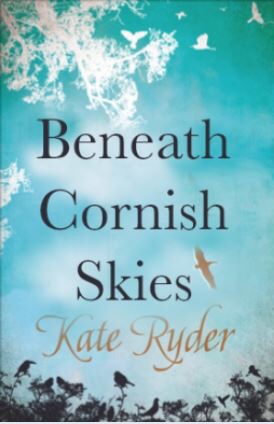
Beneath Cornish Skies by Kate Ryder.

Published: 7th Jan 2021 Aria and Aries ISBN: 978-1800245983

I felt like I’d stepped into a little oasis when I picked up this ARC. I had been reading a very bloody crime novel just before so this was like a balm for the soul! Cassandra appears to have everything she could want in life. She lives in an incredible refurbished farmhouse on the South Downs with attached stables. Her long term partner, David, is a successful businessman who just happens to be charming and good looking. They have money and she can spend her time schooling horses then dressing for dinner from her beautiful walk-in wardrobe. David calls her Sandie and they’ve been together over ten years – in fact ever since she was involved in a car crash that killed both of her parents. David was first on scene and helped her out of the wreckage. They’ve never been apart since. He was attentive in the days following the accident, there for her therapies and as she was wheeled out of the hospital it seemed only sensible to stay with him – there being nowhere else to go. So why is she feeling dissatisfied and as if she’s drifting?

He catalyst comes as she’s out riding one morning and stops for a breather in one of the top fields behind the house. As she looks down to the farmhouse she sees David, who is working from home, and their cleaner Melanie coming to sit outside with a cup of coffee. She wonders to herself about the last time David paused his day to have a moment with her. Then she sees Melanie rest her hand on his arm, in a familiar way and she starts to sense that there’s more going on she realised. The incident brings to the forefront of her mind many things about her life that she’s unhappy with. David is all about appearances, so the house must be kept tidy at all times. She’s almost trained to wash a cup or plate immediately after she’s used it. He likes to come in and find the house immaculate. He calls her Sandie or Sandra when her full name is Cassandra and he likes her to dress well especially if they’re going to a party or function for work. Even then she can’t let loose, no dancing or drinking excessively, nothing that might show him or the business in a bad light. Yet, that very evening at a barbecue, she sees him exiting a private bit of the house, again with Melanie in tow. When she finds an earring in their bedroom, she can’t ignore things any longer. It’s not just the obvious infidelity. She needs something different.

On impulse she picks up The Lady magazine, drawn in by the cover photo of a man walking from a tunnel of trees. The man is a writer, Hunter Harcourt, and his article about ancient byways and the magic they possess. Within the adverts though she finds an advert that catches her eye; a family in a Manor House in Cornwall need help with the stable yard and a growing family for six months. This might be just the breathing space she needs. With David seemingly unrepentant about his affair, Cassandra finally asks him the one thing she has always wanted to know – will he ever be willing to have the children she has always wanted? David is adamant, children are not in his future. So, early one morning Cass hitches the horse box to her Range Rover and takes a leap of faith. She drives to Cornwall, only stopping at Melanie’s home to return the earring. What she finds in Cornwall is space enough to think, but activity enough not to dwell on what has happened. She falls in with the Kinsman family and their gorgeous children very easily. The Manor House and grounds are beautiful and Caspian soon finds his feet with the other horses. Cass finds solace in the rugged Atlantic coastline and the time spent with the children. She is shocked when, on her day off, she is looking for something to fill the hours when she happens on a talk on local history by a local author, Hunter Harcourt, otherwise known as Luke. Their meeting begins a friendship that seems so natural, almost as if they’d met before.

There was so much to like about this book. I love Cornwall and I felt as though I was there, with the descriptions of the villages, the beaches and those ancient places that seem to hold magic. I loved watching Cass unfurl in her new environment as she fits in so beautifully with the Kinsman family, the landscape and the new friends she makes such as surfer Robin. This is about someone awakening and finding their authentic self, something she’s never been able to do before, having been so busy fitting around David’s standards and timetable. Cass went straight from her parent’s household to David’s with no gap between. This is the first time she has stood on her own two feet and her confidence grows. The relationship with Luke seems so predestined that it was a huge disappointment to find out he’s married to the feisty Amanda. We soon see the cracks in their marriage though, not just her infidelity, but their differing views on where to live seem insurmountable. The natural way Luke and Cass seem to fit together seems to be pre-ordained – this is where I felt more could have been made of the supernatural aspect of the story.

Soon after arriving Cass finds that the manor is haunted by several ghosts, but the one she seems to see most is the young girl who had fallen in love with the gamekeeper. Cass feels that, just like the ancient byways, there are spaces within the fabric of time at the manor, where ghosts may appear. Cass has an affinity with the the young woman in her peacock blue dress, but could it be more than that. It felt like the author was flirting with the idea of Cass and Luke being a reincarnation of the couple – the references to her gypsy soul, the sense they have of meeting before, the apparition Cass sees and hears. I think this could have been explored even more than it was. Cass clearly has some psychic ability; she experiences the ghost of a maid, has vivid dreams about places and people from another time, and at one point hears a ghost ship. I found myself wanting more of this and would have loved to know more about the daughter of the house and the gamekeeper, possibly in another time frame. Luke is a dream of a man, gentle, intelligent, loves the outdoors and animals and seems to know himself very well. His marriage seems to be one made when young, when differences in outlook seem to matter less and we think love can overcome anything. Sadly, Luke finds as he gets older, the more he needs the pace of life in the country whereas Amanda is a city girl who needs the bustle and the noise.

Of course I wanted David to get some sort of comeuppance for his awful behaviour. Even in absence he tries to push Cass’s buttons by ordering her home, then pleading that he loves and misses her while mentioning someone he’s having casual sex with in the next breath. He is arrogant, fussy and I couldn’t think of a single reason Cass should return to him at the end – other than habit and conditioning. I won’t ruin the end, but it does keep you hooked to the final pages when a terrible secret emerges. This was a gentle romance, set in a beautiful part of the world and is as much about Cass falling back in love with herself as it is anyone else. It’s a voyage of self-discovery, where slowly she heals and finds her authentic self. I found it thoroughly enjoyable and a little oasis of calm in a busy month.

Meet The Author

Kate Ryder

Kate Ryder is an Amazon Kindle international best seller who writes timeslip and romantic suspense in a ‘true to life’ narrative. On leaving school she studied drama but soon discovered her preference for writing rather than performing. Since then, she has worked in the publishing, tour operating and property industries, and has travelled widely.

A member of the Romantic Novelists’ Association and The Society of Authors, in 2017 Kate signed a 4-book contract with Aria (digital imprint of award-winning independent publisher, Head of Zeus). Originally from the South East of England, today Kate lives on the Cornish side of the beautiful Tamar Valley with her husband and a collection of animals.

Keep in touch with Kate:
http://www.kateryder.me
Twitter: https://twitter.com/KateRyder_Books
Facebook: https://www.facebook.com/kateryder.author
Instagram: @kateryder_author

Posted in Netgalley, Uncategorized

Madam by Phoebe Wynne

Publisher: Quercus (18 Feb. 2021) ISBN: 978-1529408720

Why is it always so hard to write a review when the book is so good? It’s as if I have to wrestle with it for ages, in the hope of doing it justice! All I can do is try and put across all of the reasons I liked it. In fact, I loved everything about this feminist gothic novel from start to finish. First the setting – the eerie, almost otherworldly atmosphere around Caldonbrae School, the strange weather conditions suggesting it’s own micro-climate, and the school’s position as an English outpost (or invader) in Scotland. It’s appearance is like a hulking beast on the coastline, something that shouldn’t be disturbed lest it swallow you up. Secondly, there’s our main character Rose, addressed at all times as ‘Madam’ and finally the dark secret her predecessor tried to uncover at the heart of Caldonbrae, before it was Rose’s turn to fight it’s terrible tradition.

For 150 years, Caldonbrae Hall has sat as a beacon of excellence in the ancestral castle of Lord William Hope. A boarding school for girls, it promises a future where its pupils will emerge ‘resilient and ready to serve society’. Rose Christie, a 26-year-old Classics teacher, is the first new hire for the school in over a decade. At first, Rose feels overwhelmed in the face of this elite establishment, but soon after her arrival she begins to understand that she may have more to fear than her own imposter syndrome. When Rose stumbles across the secret circumstances surrounding the abrupt departure of her predecessor – a woman whose ghost lingers over everything and who no one will discuss – she realises that there is much more to this institution than she has been led to believe. As she uncovers the darkness that beats at the heart of Caldonbrae, Rose becomes embroiled in a battle that will threaten her sanity as well as her safety.

This novel was incredible from start to finish. I loved it. Straight away I noticed echoes of two of my favourite books; Jane Eyre by Charlotte Bronte and Rebecca by Daphne Du Maurier. The younger girls school uniforms reminded me of the aprons of Lowood School. The constant references to the previous classics teacher, and the mystery surrounding what happened to her had definite echoes of Rochester’s wife – hidden from view in the attic for being other than the perfect, meek and gentle wife he wanted. What exactly does this school expect of the teachers and how did Madam fall from grace so spectacularly? The training at the school starts to feel more sinister as time goes on. It begins to feel as if they’re trying to shape young women in a very old fashioned image; teaching them how to stay it in their place and be the 19th Century ideal of the ‘Angel in the House’. Although there’s something a lot more knowing about these girls, they put on this ideal as if its a disguise, designed to please but very aware it’s a conceit sure to reap the rewards of wealth and privilege. The previous ‘Madam’, whose name is Jane, is like the ghostly presence of Rebecca, still holding sway over the girls – especially Bethany who seems to have developed an obsession with her teacher. Jane seems to be everywhere Rose turns, but tantalisingly just out of reach. The author creates an edgy and eerie atmosphere where you feel she might be just ahead of Rose, her gown swishing round the corner.

Rose tries to understand the place she’s come to teach. There is a sense in which this school is a complete culture shock – like a child affected by poverty or a tough inner city environment being expected to thrive at Oxford or Cambridge where there’s an etiquette and language that’s alien to most outsiders. She has to muddle through this aspect of life at Caldonbrae and it makes sense to her if the purpose is to educate and prepare the girls for further education and professions like the law and politics. Yet, alongside this traditional, classical education there are hints of the old ‘finishing school’ where attributes like poise, social etiquette and deportment are deemed equally important. What exactly is she preparing these girls for?

As the secret starts to come to the surface so the tension of the novel rises. Is Rose being trained too? An outsider brought in to see if new teachers can be moulded to the school’s purpose. As Bethany’s attachment to Madam becomes clearer she seems to stalk Rose. and the reader isn’t sure whether she resents Rose being in the place of her former favourite or whether she has simply transferred her affections. When she makes allegations about Rose she threatens her whole future at the school, but is Bethany trying to harm her or warn her? A strange hierarchy operates amongst the girls who know themselves to be the elite performers and those who don’t make the grade are offered inducements to improve, but these inducements can be threats as well as rewards. The horror of a young woman having her head shaved for performing badly is enshrined in patriarchal systems and is designed both to shame the woman and act as a warning to others. Rose guesses what might be happening, before the secret is fully revealed but it’s such an alien and deviant concept in modern society that she can’t believe it could be true. Could she ever be complicit in such a scheme? I found myself wondering how far the girls are ‘groomed’ into accepting this future or how many are knowingly acquiescing to it for the rewards of wealth, status and family honour. Rose is backed into a corner, by fear of what may have happened to her predecessor certainly, but also the knowledge that the school can reward her far beyond what she’s imagined. Her mother, severely disabled by multiple sclerosis, is placed within a state of the art care facility. Can Rose be bought, or will she try and walk away? However, does anyone walk away from Caldonbrae unscathed? Could Rose, as quiet as she seems, finds a way to walk away, but also bring down the whole system in her wake. This was an incredible, unputdownable, novel full of gothic atmosphere, and dark, patriarchal, purpose. However, there is also a feminist heroine ready to shine a light on long held secrets, even at the risk of that light becoming a burning flame.

Posted in Netgalley

The Book of Two Ways by Jodi Picoult

#NetGalley #TheBookOfTwoWays #HodderandStoughton

A few years ago I was lucky enough to meet Jodi Picoult, and ask her some questions. She was promoting her novel Sing You Home and the question I asked was about the ideas she has for her novels; do the characters or the issue come to her first? Most of her novels are based round a controversial issue – from childhood illness, to abortion, racism and the rights to IVF embryos. These are not easy issues to tackle, particularly in the USA. Picoult replied that it was usually the issue that came first. She would mull it over for a while and if it stayed with her for a few weeks, she would know it had the potential for a novel. Then, slowly, the characters would start to come and tell their story. I have now read all of her novels so I was really excited to have an ARC of this via NetGalley.

The background to her latest work is Egyptology, most specifically The Book of Two Ways – an ancient text that tells of the two ways a Pharoah had of successfully reaching the Underworld, one by water and one by land. Picoult uses this as the PHD research subject for our main character Dawn, but it also informs the structure of the novel. Two narratives are told side by side, representing a split in Dawn’s life where she could have turned in a different direction. So we appear to be following parallel lives. Dawn has been married to Brian for several years and they have a teenage daughter, Meret. They are comfortably sliding into middle age and a mature stage of marriage, where Dawn observes love is not just a feeling, it’s a choice. Brian is a scientist, teaching at university and Meret takes after him, also having an interest in scientific experiments. From the outside they must look like a steady, settled marriage, but as always it’s a different story beneath the surface. The catalyst seems to come when a woman at Brian’s workplace strikes up a friendship, asking him to help with DIY around the flat and eventually offering the chance of an affair. Brian doesn’t take it, but for some reason even the possibility shakes Dawn to the core. It sends her spiralling back to her graduate years when she went to Egypt in pursuit of her PhD research and met Wyatt. Wyatt was a fellow researcher, their lines of enquiry complement each other, but he’s everything she hates in a person – arrogant and privileged. However, just as their dislike turns to passion, Dawn is dragged back to the USA for her mother’s death. She leaves Egypt with no idea whether she will be able to return. Now, in light of Brian’s revelations, Dawn wonders whether she made the right choice back then and is it too late to change her mind? Our other narrative follows that route.

I was fascinated by Dawn’s job as death doula – I’m only just aware of the existence of birth doulas so this was totally new to me. Once I’d read what her job entailed, I realised it would suit my experience and skills. I have had the privilege to be with someone as they’ve died a few times, through my husband’s final weeks but also when I’ve worked in a nursing home both as carer, and years later as an advocate for people with complex disabilities. Occasionally, if there was a resident I was fond of and they had no relatives to sit with them I would go in on my day off to be with them. I was young, and not always sure of what to do but sensed instinctively that someone needed to be there as these people left the world. Dawn fulfils a role many other professionals can’t and liaises between those professionals and the patient. She makes sure that what that person wants – whether it’s ice cream at midnight or to contact a long lost love – they get. Her relationship with client Win was one of best parts of this novel for me. To respond to a dying person with total focus and compassion, whilst making sure their final wishes and their dignity is intact, is a skill that can’t be taught. It is a great example of a therapeutic relationship because the women affect each other, this isn’t a one way street. Win has wisdom and counsel for Dawn.

The women can see echoes of each other’s lives in their early passionate first loves, followed by their stable, loving and respectful marriages. The care that Win gets from her husband is a world away from the affair she had as an art student with Thane Bernard, a famous painter. It reminded me of the UEA Fanthorpe poem ‘Atlas’ which begins ‘ there is a kind of love called maintenance’ and details the many practical ways people show love. Win proposes that we each have experience of these different kinds of relationships and the one we have last is wiser, more nurturing and understanding. The things we need as we’re older are very different from our idealistic and impulsive younger years, but we must never doubt that both are types of love. The Egyptian return narrative is interesting because we’re never fully sure where it fits or even whether it’s real or Dawn’s day dreaming. It’s also fascinating to see what her reception will be. All the time we’ve been listening to Dawn’s version and now we see the effect her sudden departure had on Wyatt. The rascally Indiana Jones I’d been expecting was really Dawn’s view of him. In reality he was shattered by her choice not to return. There’s a sense of time standing still in this ancient place, not just for the Pharaoh’s tombs but for the dig itself. Dawn finds the same house, serviced by the same family, but will her hope, that Wyatt hasn’t moved on either, come to pass? Even if his feelings haven’t changed what hope is there for a relationship that belonged in this temporary home, thousands of miles away. How will Wyatt respond to her marriage and her daughter? He doesn’t seem like the kind of person who will drop his work and become the family man.

This wasn’t my favourite Jodi Picoult novel, but it’s far from her worst. The research for the Egyptian sections alone must have been painstaking and I did have a belief in her characters – particularly in sections between Dawn and Win. I did feel there was a bit too much academic Egyptian detail too early and it prevented me getting into the emotions of the story. It was an interesting background to Dawn’s current work and how death rituals are very important and vary so much in different cultures. There were also a couple of aspects of Dawn’s return to the US that I didn’t understand, such as the timing of her return and meeting Brian. The big revelation towards the end of the book seemed unlikely. I couldn’t imagine that Dawn had never asked herself or even suspected. It was also amazing that her relationship to Brian had endured despite such a hurried start. I wondered if her strong reaction to his student’s crush was more about finding a way out. Brian has been a bit oblivious to this woman’s advances, but there is something endearing about that. He wouldn’t expect anyone to be interested and as soon as it’s apparent how she feels, he leaves and tells Dawn. There is a sense that Dawn wants out of this relationship, but is struggling to be the one who ends it. She doesn’t want to be the bad guy. This worry about hurting others can be seen as she tries to carry out Win’s final wishes too.

Often with Picoult’s books you can see that the ‘issue’ has come first, and I did wonder if the exploration of Ancient Egypt was something she’d wanted to write about for some time. It sat neatly with Dawn’s job and the whole novel’s theme of the end of life. It was interesting to think about the rituals carried out by the Egyptians – I’ve always wondered how they got a whole brain out of someone’s nose – and our squeamish response to death. We don’t talk about it, so we never express our feeling about the sort of death and funeral we want. It’s almost as if our enduring fascination with the burial chambers of the Pharaohs is in direct contrast to our avoidance of the subject in relation to ourselves. Dawn’s job cuts through that and in its way is a lot like counselling, in that she asks the questions and has the conversations that the dying person can’t have with their family. Interestingly, despite her role to be open about death, Dawn isn’t being honest or open about life. She’s settled herself into a default position where she’s felt safe, but a brush with death changes everything. I think I wanted a different ending. I felt for Meret who doesn’t seem to get much quality time with her mother and I can’t remember a point in the novel where they simply have fun together as a family. She’s expected to get her head round massive changes very quickly too. I would have liked Dawn to take some time with her daughter, just the two of them and get settled on their own terms. While it just doesn’t reach the heights of Small Great Things or The Storyteller for me, there was a lot to like here. The depth of research, the themes of life and death, and her characterisation of the central characters are strong and as always with Picoult you can relax knowing you’re with an absolute master at storytelling.

Posted in Netgalley, Publisher Proof

Tsarina by Ellen Epstein.

Catherine Alexeyevna rose from peasant beginnings to become one of the most powerful women in Russia as the second wife of Peter the Great. Known as Marta to her family she was born in 1684 in the village of Livonia. Her meteoric rise from illiterate servitude to the Russian throne is one of chance, but also, as the author puts it ‘intellect, wit and sensuality’. Her parents sold her into the service of a man called Vasilly from the town of Walk. The author pulls us into the world of this nine year old girl as she experiences the town for the first time. She is overwhelmed by the number of people and all the chimneys she can see, each one representing a family. In her wonder, she loses the count and becomes mesmerised by the foods being sold by street vendors. This experience inspires her and she begins to work in the kitchen, soon able to prepare delicious meals of her own.

It’s very hard not to admire the way this incredible woman rose through the ranks of Russian high society, almost always by catching the attention of men. This was a dangerous and volatile period of history and it must have taken a great deal of resourcefulness and cunning to succeed. She was observant, able to read people and their interactions, successful at manipulation and doesn’t let herself be used by men – unless she wants to be of course. There are moments when she is struggling but the right advice or opportunity seems to come along. She takes to heart a lesson taught by Menshikov, the Tsar’s best friend:

Use life’s surprises to your advantage. See your power over men like a hand of cards; play them, to trump your life’.

I really enjoyed it when the focus was on Catherine (Marta) and her rise. When she reaches her position as Peter the Great’s wife and Empress of Russia, the story starts to open up and include others within the court. When we’re not concentrating on Catherine, I wasn’t as engaged with the book, but maybe that was just me. Her life becomes swallowed up by the demands of being a monarch’s wife – the demands on her to produce an heir resulted in twelve pregnancies! The cruelty of Peter starts to come to the fore as well as his contrary nature. He upholds religious and cultural custom to a stubborn degree and then when it suits him, simply discards custom for his own advantage. He’s a textbook narcissist. Even though Catherine is surrounded by riches, lavish banquets and incredible jewels I didn’t envy her position. She knows the dangers of being his wife, because his first wife ended up in a prison cell and her lover was impaled alive, on a spike in Red Square.

Despite this being more fiction than biography, I think the author researched her subject well and worked hard to bring Catherine to life. There are some really dark moments of rape and torture, but this is probably an accurate portrayal of very bloodthirsty time in history. Its also a very sensual book, not just the lusty moments, which I really enjoyed, but also the author’s focus on the senses. The taste of the incredible dishes she creates, the smell of the incense and incredible interiors of the Russian Orthodox Church, all the way down to the sweat and fear of the torture chambers. When Catherine’s trying to keep Peter’s death a secret in order to keep the crown, I was drawn back into the action. As he lies there, dying in the Winter Palace, Peter has to face the fact he is leaving his country without an heir. His only son Alexei, was killed under interrogation for conspiring against him. This is when Catherine undertakes her greatest political manoeuvre and becomes Queen, despite Alexei’s son being the heir apparent. I enjoyed reading from Catherine’s perspective, especially considering the way her male enemies spread misogynistic stories about her suppose voracious sexual appetite. The book did it’s work in making me want to know more about this time and place in history. I’ll be going to All4 and watching their series starring Helen Mirren to learn more about this fascinating character.

Next month I will be reviewing the author’s next novel

Meet The Author

Ellen Alpsten was born and raised in the Kenyan highlands, where she dressed up her many pets and forced them to listen to her stories. Upon graduating from the ‘Institut d’Etudes Politiques de Paris’, she worked as a news-anchor for Bloomberg TV London. While working gruesome night shifts on breakfast TV, she started to write in earnest, every day, after work, a nap and a run. So much for burning midnight oil!

Today, Ellen works as an author and as a journalist for international publications such as Vogue, Standpoint, and CN Traveller. She lives in London with her husband, three sons, and a moody fox red Labrador.

‘Tsarina’ is her debut novel. For more information about her literary life follow her on social media.

Coming Soon…

Posted in Uncategorized

The Silent Treatment by Abbie Greaves


This interesting novel grabbed me right from the start, as Maggie calmly swallows a handful of tablets, then gets up to make dinner for her husband. It takes till half way through prepping the green beans and she has collapsed suddenly, so suddenly there is no time to break her own fall. Frank is so engrossed in his study that the smoke alarm is the first sign of the tragedy that has unfolded in their kitchen. He finds their tea on fire in the oven and a little way away, Maggie is unconscious on the floor. Frank’s voice is hoarse and he’s unused to the sound as he calls the emergency services. This is when The reader first finds out that Frank hasn’t spoken to anyone, even his beloved wife, for the past six months.When I requested the novel from Netgalley it was this premise that first drew me in. Probably because, as my long-suffering partner will tell you, I never stop talking. I imagine that not chatting to the person you live with takes concerted effort. Greaves came across the premise for her novel when she read an article about a Japanese boy who had never seen his parents speak to one another. It’s intriguing and does ensure that you keep reading; I kept wondering why and how this situation could have started.

I hadn’t realised that the book was about pregnancy loss and infertility. Greaves writes about the grief and helplessness of this experience with real insight. Having been through the same experience, it was important to me that Maggie’s response feel genuine. We see the ups and downs of a long term relationship as Frank starts to reminisce, and the romantic beginnings of building their home together. As Maggie lies in a coma at the hospital, her nurse Daisy encourages Frank to talk, to say everything he can to her because the time they have left together may be limited. This Is where Frank’s secret is revealed and we know why he hasn’t spoken for six months.

I enjoyed the novel, even though there were parts I didn’t fully connect with. Although Frank’s narration is emotional I found him difficult to understand. It’s a if there is a barrier between the reader and Maggie, both because she’s in a coma and because we only see her through Frank’s eyes at first until the narrative voice changes. I found myself waiting for a contrasting chapter from Maggie’s point of view early on, then with Maggie’s letters we start to see her inner life. I found this a moving and honest portrayal of pregnancy loss and parenthood. It’s hard to imagine a relationship where all the usual day to day things happen like eating together, sleeping together and sex, without a word passing between them. I guess it shows the strength of love, that Maggie can continue to give while receiving silence. I won’t spoil the ending, but it is emotional and I can see it staying with readers. This is an intriguing debut and I would definitely look out for future novels from this author.