Posted in Netgalley

The Stargazers by Harriet Evans

The Stargazers does something I’ve been trying to put across in my own WIP. It shows us that our own story, as we have experienced it and tell it to others, is only one strand of an infinite tapestry. Sarah Fox and her husband Daniel are moving in to their new house on The Row. It’s a ‘proper house’, meaning that as you walk through it you can imagine your child taking their first steps in the hallway or using the tree swing in the garden. It reminded me of when we were looking at houses and we viewed an incredible place that felt to me like a grown up house. It had all the children’s heights written on the wall next to the kitchen door and also a little family of llamas, painstakingly cut out and coloured in, then clear varnished onto a beam in the living room. It was a proper family home and I think this is a little bit of what Sarah feels as they cross the threshold of No 7. Does this make them grown-ups? Perhaps amplified by the fact that Sarah has never known a real family home until now. Sarah and her sister Victoria (Vic) spend their early childhood in the family home of Fane Hall, one of the most splendid stately homes in the south of England. When their grandfather, the heir, dies. They are awaiting the return of Great Uncle Clive. He will become the Earl because Sarah’s mother, Iris, cannot inherit the house being a woman. Iris has doubts, but hopes that since the death of both her father and her husband, Uncle Clive will be benevolent and allow them to remain living in the west wing of Fane. Yet the man who returns from war with a new wife, Aunt Dotty, does not see things the same way. Fane is his, and instead he grants them a small flat in Kensington.

Years later, after Iris has repeated endlessly to her daughters that Fane is her house regardless of inheritance law, they fall on hard times. So she tells the girls to pack and brazenly moves into Fane, occupying a different wing to Clive. Time has been hard on Fane and it seems like her Uncle has allowed it to fall down around him. Every room feels ransacked and amazing collections like the taxidermy animals have been thrown on the floor, their glass cases broken and the smell emerging into the house. There’s also a far worse smell. Many of the toilets are blocked, the bathrooms unusable and their smell permeating throughout. This is the legacy of WW2 and Fane being used by the British forces, not very carefully it would seem. Uncle Clive is dirty, shambling and penniless. A game seems to resume between her Uncle and her mother Iris, with the girls caught in-between, often forgotten and at times completely neglected. Then Iris sends the girls to boarding school and settles in at Fane waiting for him to die. This means that for long periods Sarah has to leave her only friend in the world. The only one who understands her home situation and gets to know her one to one. They are the stargazers. Sarah climbs out of her window in the middle of the night to meet him at a large tree, big enough to sit in and watch the night sky. There they don’t have to talk about their home lives, it’s simply understood. This young boy lives with the lady who runs the post office, but she’s a foster mum. He tells her they need to look forward to their futures not their pasts, to their dreams of being a musician and a film maker.

As we work our way through these different layers of family history, it works like a set of Chinese boxes, one story tucked inside another and we learn a little more from each. Sometimes, an event in Sarah’s childhood helps us understand the present. Then we read a snippet from Iris’s past that informs us about why she treats her own children badly. The adult Sarah we meet in her house in London is very different, as her life shrinks a little. She has two small children and spends all day taking care of them. She doesn’t have time for daily music practice and her hands become stiff so she can’t stretch to pluck the cello strings. Where once she played cello professionally, it now sits in the corner of a room upstairs untouched. Husband Daniel is a bit clueless about how Sarah feels. He’s a fellow artiste, but he’s an actor and television producer and he still gets to leave the house each day. He also starts a long Sunday lunch tradition for the neighbours which seems to a euphemism for come into the house, drink all day and neglect to clear up after themselves. Sarah struggles a bit in this chaos, especially when something outside of their daily routine happens – like her sister turning up to stay when Sarah had completely forgotten them. Instead of embracing the chaos and simply saying ‘I’ve forgotten completely, come on into the madhouse’ she tries to cover the fact that she’s not remembered, putting untold pressure on herself.

There’s a saying in counselling that no two children have the same parent, that applies strongly to Vic and Sarah. They are very different people, possibly due to the way they responded to emotional abuse as children: one was compliant and the other, despite being scared, was defiant. Not only was Iris psychologically damaging, she was neglectful. She is constantly forgetting to feed them, doesn’t buy them the right clothes for school and ensures they are seen as different both by the children of the village and even their school friends. At school Vic becomes a huge hit with the popular group and seems worshipped by the younger girls. When asked to show her loyalty to the group she doesn’t hesitate, even when that loyalty means shunning her little sister. There is bullying that’s uncomfortable to read and gave me the shivers. In choosing the popular girls, Vic has ensured her safety but has also signed up for a lifetime of putting on a front. Sarah may be shunned but at least she can be herself. I felt sorry for Vic, after all she is also the product of abuse, but in turning into an abuser herself she started to lose my sympathy. Especially when it comes to their treatment of Sarah’s music teacher and an act that has lifelong repercussions.

I thought this book was fascinating from a psychoanalytic perspective showing how we find ways of surviving abuse childhood that become part of our personality. In a twist I didn’t expect, a Sunday dinner at Sarah and Daniel’s goes south fast when their little girl disappears. The reasons why surprised me, because I was never quite sure where the stories were going to join up or who might be lurking from the past. Sarah’s eventual return to Fane in adulthood doesn’t work out in the way she might have hoped, but it helps her finally face up to what happened there. The final paragraphs show us the irony of Iris clinging to Fane and to life. She is still muttering to herself that Fane is hers and what would have happened had she been a boy? Did she get what she wanted in the end? Is the estate viable or have terrible compromises been made? As we find the answers to these questions we also see Iris’s decline as compared with the little girl she must have been when she first visited the house. This final flashback is brilliantly thought out and placed. That first visit can’t fully vindicate Iris, there is never an excuse for her actions towards her own children, but it could shed some light on what happened to set these wheels in motion. It might even explain her unshakable belief that Fane is hers. This is a great book about family, intergenerational trauma and the adults we grow up to be, because of the children we once were.

Published by Headline Review 14th September 2023

Harriet is the author of thirteen novels, two of them are Richard and Judy book club selections, several have been Top Ten Bestsellers, one won the Good Housekeeping Book of the year prize, but the accolade she’s most proud of is the lady on Twitter who wrote last month that she thought my books were real ‘knicker grippers’. As Harriet says on her Amazon author page ‘I suppose that’s all you can hope for isn’t it?’

Her first novel, Going Home, came out in 2005 and her last was The Beloved Girls, published in paperback in April 2022. She wishes she’d tried another job sometime but she can’t imagine not writing. She has written since she was a child, first on books I stapled together with paper then notebooks, then a laptop that crashed and lost all of the novel she was writing in secret back in 2002. (So now she backs her work up properly) Her first novels were more about relationships and people in London and had more chicklit themes and the later ones are darker and more about families and secrets and houses and the past. Those themes have always been in her books, but as she’s grown older she’s enjoyed exploring them more. She has so many stories in her head all the time and adores knowing that her job means that she can carry on telling them.

If asked how she’d describe her books she’d say she wants them to be gripping, involving, heartwarming stories about families and mysteries in the past with a Gothic tinge. This one definitely fits that description.
Posted in Publisher Proof

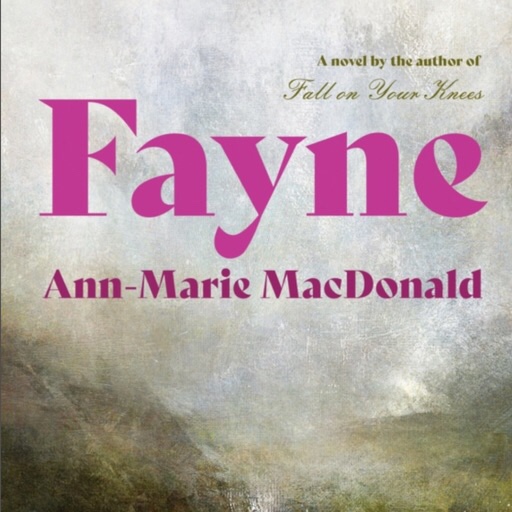
Fayne by Ann-Marie MacDonald

Fayne by Ann-Marie Macdonald

‘I do not wish to be a woman.’

‘My dear. I’m afraid we none of us has the choice.’

I do not wish to be a lady, then.’

‘I cannot blame you.’

The vast estate of Fayne lies to the southern border of Scotland, ruled by the Lord Henry Bell, Seventeenth Baron of the DC de Fayne, Peer of Her Majesty’s Realm of the United Kingdom of Great Britain and Ireland. The mysterious Lord Bell keeps to his rooms by day, appearing briefly at night to dote over his beloved and peculiarly gifted child. But even with all her gifts – intelligence, wit and strength of character – can Charlotte overcome the violently strict boundaries of contemporary society and establish her own place in the world? Fayne is the page-turning queer story of longing and belonging you’ve been waiting for.

I must admit to being slightly daunted when this novel came to the door. I say ‘to the door’ because it wouldn’t fit through the letterbox or into our postbox. It’s an absolutely brick of a novel, so much so that I had trouble holding it. Feeling a little overwhelmed I spoke to a fellow blogger who suggested that I mark it off into readable sections of about 150 pages. It was great advice and I’m glad I persevered with the novel, because it really was intriguing and original. Set in the late 19th Century and written in a similar style to a Victorian novel, Fayne is the story of Charlotte Bell. Charlotte is a precociously intelligent young woman with an insatiable curiosity that is starting to overcome the bounds of what her father and the estate’s library can teach her. This could be a dream existence, but there are shadows in her childhood. Charlotte’s mother died giving birth to her and her brother, the heir to Fayne House died at the age of two. Her father makes a break with tradition on her twelfth birthday, when a young woman would usually have a governess, he hires her a tutor instead. Lord Bell gives him one command for the education of his daughter, to teach her ‘as you would my son, had I one’. Charlotte’s only restriction up till now has been staying within the bounds of the estate. This is because she has a mysterious condition that may make her prone to catching illnesses from others. However, when she takes her tutor out to the bog, they find an unexpected artefact and take it home. Lord Bell suddenly announces he has arranged for her to be cured of this condition, turning Charlotte’s world completely upside down.

There is a feyness to her character, with her love of the boggy moorland and it’s mysterious mists that envelop walkers. She has learned both the ways of the bog and local folklore from Bryn, an elderly servant who seems to come with the estate. Yet the artefact she finds seems to be a mystery. The other mystery that confused me from the outset was the nature of Charlotte’s condition. Also, despite her curiosity about everything else, Charlotte seem strangely unaware of what it is and how it manifests. Her old nurse tells her there are all manner of miasmas and droughts that might carry off her ‘darling pet’. I kept waiting for her to ‘feel’ ill but that never seemed to happen. Another curiosity was her mode of dress, at a time when women were terribly restricted by their clothing which would have included a corset, possibly a bustle, and long cumbersome skirts and petticoats. Yet Charlotte is leaping around the moor, seemingly wearing a form of trousers, that she describes as a scarlet tunic and leggings. I was totally intrigued, imagining a type of female Robin Hood. In fact Charlotte herself says that if she did miss her footing in the bog and was discovered years later, she might be mistaken for a Roman centurion complete with a cape! She’s such an interesting and completely different Victorian female character I was fascinated with her. While still wondering what the mystery around her was, I became beguiled by her wit, intelligence and her endless wonder. As the answers started to come I was rooting for her to escape the rigid gender boundaries of her time and fulfil her potential. The author’s assertion that Charlotte is normal, it’s the world that’s trying to impose it’s order upon her, chimed very strongly with my disability theory background. The social model of disability asserts that all bodies are normal, but the way society is organised creates the disability. For example, if all exits and entrances to a building were ramped everyone can use it. It doesn’t matter if you’re sitting or standing.

It’s clear that the landscape at Fayne and Charlotte are inextricably linked. Despite eventually travelling away from it’s borders, it stands out as the one place she was allowed to be her true self with no restrictions or arbitrary boundaries. She didn’t have to choose who she was at Fayne, she could just be Charlotte. Fayne is a liminal space, existing somewhere between mythology and reality, between England and Scotland. I loved the way the author positions Fayne and the estate’s old folklore as authentic, as natural as Charlotte is before she moves to Edinburgh, which is a sharp contrast to the wilds of her childhood. I was desperate for Charlotte to retain this authenticity, but everything about a city imposes order – the signs, the roads, the hard surfaces. Then there’s ‘society’ and it’s arbitrary rules about gender. There are so many rigid ideas about how a woman should look and behave. The imprisonment of a Victorian woman’s clothing is so stifling that when we think of Charlotte’s tunic and leggings, it feels like being restrained. Yet there are other ways of being, even here, you just have to know where to look. It was great to be on that journey with Charlotte, as she finds that other people also defy expectations. There is so much more to the novel, different viewpoints and characters as well as some plot twists and turns. However, I was always happy to come back to the ever curious and irrepressible Charlotte. It will take all of Charlotte’s ingenuity and intelligence to unearth her family’s secrets and discover her own identity. In some ways I was reminded of another novel with an intersex character delving into her family history, Middlesex by Jeffrey Eugenides. I enjoyed both character’s journeys to find themselves, but also each book is so rich and full of history. I have read Middlesex more than once and Fayne will also benefit from a re-read, hopefully at a slower pace, as I’m sure there’s so much I missed or didn’t fully appreciate on first reading. Ann-Marie MacDonald is an extraordinary storyteller and I’m now interested to explore her other novels.

I knew from a very young age that I was wrong in the world. And the idea of looking through the eyes of somebody who’s born with an intersex trait has been quite compelling to me for a very long time. It’s not an exotic quality. That’s why I’ve decided not to treat it as a “spoiler.” That’s just who Charlotte is, that’s her body. That’s normal. It’s the world that has a problem and is going to make it a problem for her’.

Ann-Marie MacDonald Press Release from Tramp Press.

Meet the Author

Ann-Marie MacDonald is a novelist, playwright, actor and broadcast host. She was born in the former West Germany. After graduating from the National Theatre School of Canada in Montreal, she moved to Toronto where she distinguished herself as an actor and playwright. In 1996 her first novel Fall On Your Knees became an international bestseller, was translated into nineteen languages and sold three million copies. It won a Commonwealth Prize, the People’s Choice Award and the Libris Award. In 2002 it was an Oprah’s Book Club choice. In 2023, The Way the Crow Flies appeared and in 2014 Adult Onset, both of which had international success. In 2019 she was made an Officer of the Order of Canadafor her contribution to the arts and her LGBTQ25+ activism. She is married to theatre director Alisa Palmer with whom she has two children.

Posted in Sunday Spotlight

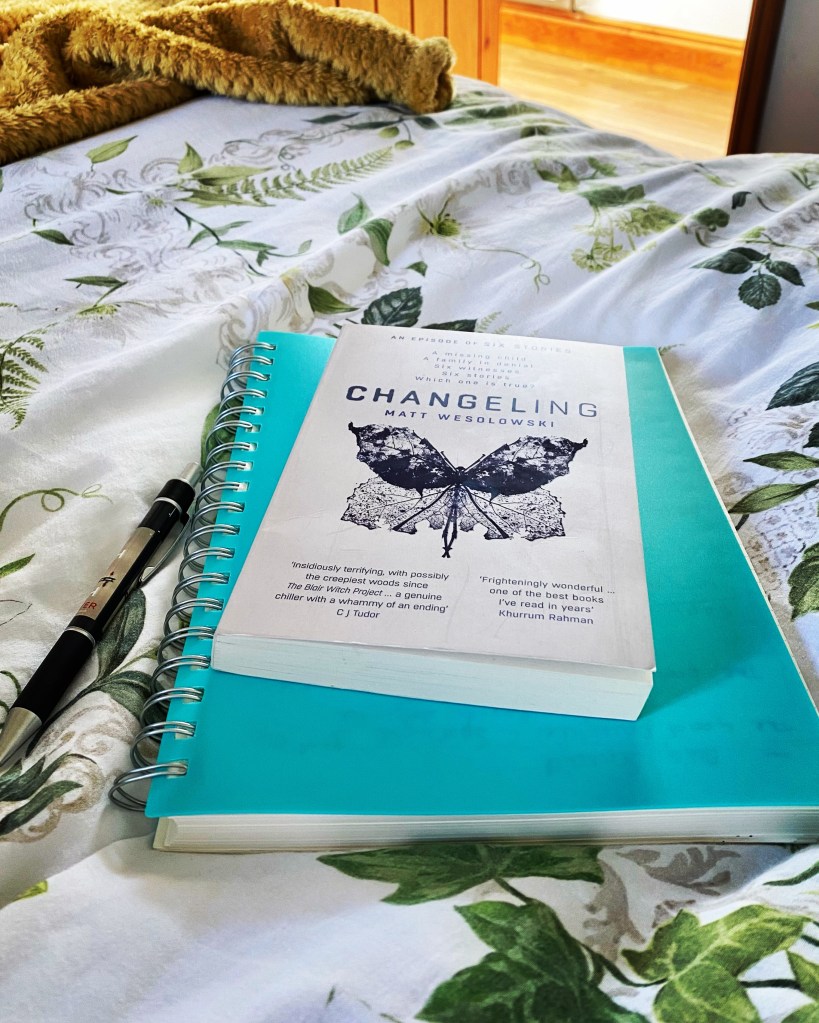
Changeling by Matt Wesolowski

I spent some of my recent holiday going back to the earlier books in a series I picked up half way through. I often review for Orenda books blog tours and this has meant picking up on some fabulous authors who are on the fourth or fifth book in a series. I then slowly buy the previous novels in the series and take them on holiday so I can wallow in them for a couple of days. So, it was with no idea of the subject matter, except it would be a mystery and was being revisited by a podcast called Six Stories where Scott King interviews six people connected to the case. It’s not that he expects or aims to solve the case, although that’s a possibility, it’s about hearing different voices, perhaps ones that haven’t been heard or have something to add to their original evidence. I had no idea of the geographical location in The Changeling, nor could I have predicted reading it when I did. The case begins on Christmas Eve 1988 when Sorrel Marsden is travelling along the Wentshire Forest Pass, a road between Chester and Wrexham in North Wales. He hears a knocking sound in the car and decides to pull over in a lay-by to investigate. As he gets out he glances back to check on his son Alfie who is fast asleep in his booster seat in the back. Sorrel checks under the bonnet of the car, but not seeing anything obvious he decides to continue his journey. However, as he drops the bonnet he notices the rear passenger door is open and Alfie’s booster seat is empty. He looks for his son on the edges of the forest, but with no clue where Alfie has gone he goes to the phone box and calls the police.

We holidayed on the welsh borders, with the River Wye running through the garden of the cottage. We were travelling back from Chester Zoo when I started to read The Changeling and I’d passed navigation duties to my stepdaughter so I could put my feet up in the back. So I read Sorrel Marsden’s account of his son’s disappearance as we drove from Chester into Wales! Wesolowski is skilled at creating a setting that slowly unnerves the reader and I felt this as I read about the history of the forest and the interview King does with a contractor working on the construction of a holiday park. He was working in the forest at the time of Alfie’s disappearance and tried to help with the search for the boy. Not that searching was easy, as floodlights that worked earlier that day completely malfunctioned when needed. It was also impossible to move vehicles from the area of the search, the very embodiment of a ghost in the machine or gremlins in the works. The builder claimed that strange events started happening when they tried to remove ancient trees from the woodland. With normal tools not working, they were reduced to hacking at the trunks of the trees with little success except for a few blood injuries. They were sleeping onsite in temporary buildings when the knocking started, insistent and gaining in volume despite having no visible source. Most fanciful were his stories of seeing an animal out the corner of his eye, possibly a goat or wild boar. What i found most chilling though were the voices, whispery and urgent little voices that were indecipherable but angry in tone. Sorrel Marsden has made a point of walking the pass every year on the anniversary of Alfie’s disappearance. He never claims to hear or see anything on his treks, but they do serve a purpose. They set him up as the victim, the hero of the piece, especially then compared with Alfie’s mother Sonia who has never taken part in the search or been interviewed about her son. Until now.

The character’s in the novel are open to interpretation and our impression of them might change, depending on whose account we are listening to. Part of Sorrel’s story of that night is as damning for Sonia as her absence at memorials and other events. He claims to have suggested to spend Christmas with his estranged wife and son, but as Sonia’s drinking worsened he decided to remove Alfie from his mother’s care and return with him to his own home in Wrexham. This would have given people a terrible impression of Sonia and as an uncaring and unfit mother. Yet we haven’t heard her or anyone else’s opinion, only Sorrel’s. People tend not to question or accuse the bereaved and with Sorrel being found by police curled up in the phone box in a foetal position, it’s hard to blame those in attendance for treating him with care and compassion. Yet Sonia does consent to meeting King and talks for the first time about that awful Christmas. She doesn’t deny drinking, but has some explanations for her actions. She claims that Sorrel is an unusual man, with an ability to draw people to him that goes beyond his looks or personality. She recalls being belittled and controlled. Yes she struggled as a very young and isolated mum, but no help came. Despite claiming she was a bad mother, Sorrel left her alone with Alfie and rarely visited. I loved the women who contacted Scott King to tell their story of encounters with Sorrel. Like a mini ‘Me Too’ movement these women come together to talk about coercive control, psychological abuse, strange knocking sounds keeping them awake and leaving them unnerved. These women have incredible strength and having experienced a relationship like this I had my suspicions about Sorrel Marsden.

Sorrel is controlled, especially in his work as a chef. Other kitchen workers comment on his admiration for the military way of running a kitchen, a system of rules and regulations he also expects in his kitchen at home. Women refer to an unusual feeling they’d experience, as if he had them in an enchantment. It made me think of the word ‘glamour’ in the way it’s applied to witches – folk tales tell of a witch’s ability to ‘glamour’ people, to only show those sides of themselves they wish to be seen, often appearing as a beautiful young woman when they are in fact a shrivelled old woman. If we look at it realistically, Sorrel is a master manipulator and serial abuser able to charm and convince women to trust him. He then slowly isolates them, breaks down their confidence, gaslights them and convinces them they are worthless. When his story is picked apart there are holes everywhere, including a past link to the forest. When Alfie is a toddler he suggests a family camping holiday to the forest, with a friend of his called Wendy to help with the childcare. On this trip Alfie ‘disappeared’ into the forest for the first time, found by Sorrel who walks back into the clearing with his son in his arms. Both Sonia and Wendy claim that Alfie was never the same after this trip. I could only wonder why Sorrel would have taken them to a wood with no facilities and such a haunted reputation. Did Sorrel know what was in the woods? Was Alfie some sort of sacrifice? From then on Sonia would hear strange voices and knocking when no one was there.

The section that genuinely lifted up the hairs on the back my neck seemed a bit tenuous at first. King interviews a man whose mother has recently died. She was a teacher back in the 1980’s and as part of her training she was gathering research on pupils who had behavioural issues. When she died her son found the research in the attic and was intrigued by her notes on Child A, because Child A was Alfie Marsden. Delyth recorded his behaviour on several occasions and the more she saw, the more scared she was. Alfie would turn his back on other pupils, deliberately not participating in what everyone else is doing. Alone with him, Delyth heard muttering and although he wasn’t moving, she could hear a strange knocking. There were times where she was scared to look him in the face. Yes, other teachers warned her that he might bite or lash out, but with her he was unnaturally still as if he was listening somewhere else or to something else. Did Alfie just have behavioural issues or was there something more sinister at play? Were the knockings and strange voices similar to those mentioned by the building contractors or by the women who knew Sorrel?

By the final stages of the book I was wondering exactly who is The Changeling of the story? Was Alfie’s sudden change after visiting the forest on the camping trip a sign that he was possessed or changed in some way? Or was Sorrel’s affinity with the forest a sign that he’d been there before? A Changeling is a child swapped in it’s infancy by the fairy folk, either because something wrong or because fairies want to strengthen their fairy blood. The behaviour of a Changeling is ‘unresponsiveness, resistance to physical affection, obstreperousness, inability to express emotion, and unexplained crying and physical changes such as rigidity and deformity.’ Some are unable to speak at all. I was also a little unnerved by the psychic who was brought in after Alfie’s disappearance, then stalled proceedings by saying Alfie was ‘in a Royal Court.’ It has never made sense and it never changed. As she corresponds with Scott I was unnerved by her, what does she know and how? There are a couple of utterly brilliant twists towards the end, neither of which I’d expected and one made me rethink everything I’d read up to that point, in a Sixth Sense way. I wanted to go back and reread with that knowledge, to see how I’d missed it. This was a brilliant and disturbing novel, a clever mix of psychological and supernatural elements that’s very addictive and will stay with you long after the book is finished.

Out now from Orenda Books

Meet the Author

Matt Wesolowski is an author from Newcastle-upon-Tyne in the UK. He is an English tutor for young people in care. Matt started his writing career in horror, and his short horror fiction has been published in numerous UK- and US-based anthologies, such as Midnight Movie Creature, Selfies from the End of the World, Cold Iron and many more. His novella, The Black Land, a horror set on the Northumberland coast, was published in 2013. Matt was a winner of the Pitch Perfect competition at the Bloody Scotland Crime Writing Festival in 2015. His debut thriller, Six Stories, was an Amazon bestseller in the USA, Canada, the UK and Australia, and a WHSmith Fresh Talent pick, and film rights were sold to a major Hollywood studio. A prequel, Hydra, was published in 2018 and became an international bestseller. Changeling, the third book in the series, was published in 2019 and was longlisted for the Theakston’s Old Peculier Crime Novel of the Year. His fourth book, Beast, won the Amazon Publishing Readers’ Independent Voice Book of the Year award in 2020. Matt lives in Newcastle with his partner and young son, and is currently working on the sixth book in the Six Stories series. Chat to him on Twitter @ConcreteKraken.

Posted in Netgalley, Publisher Proof

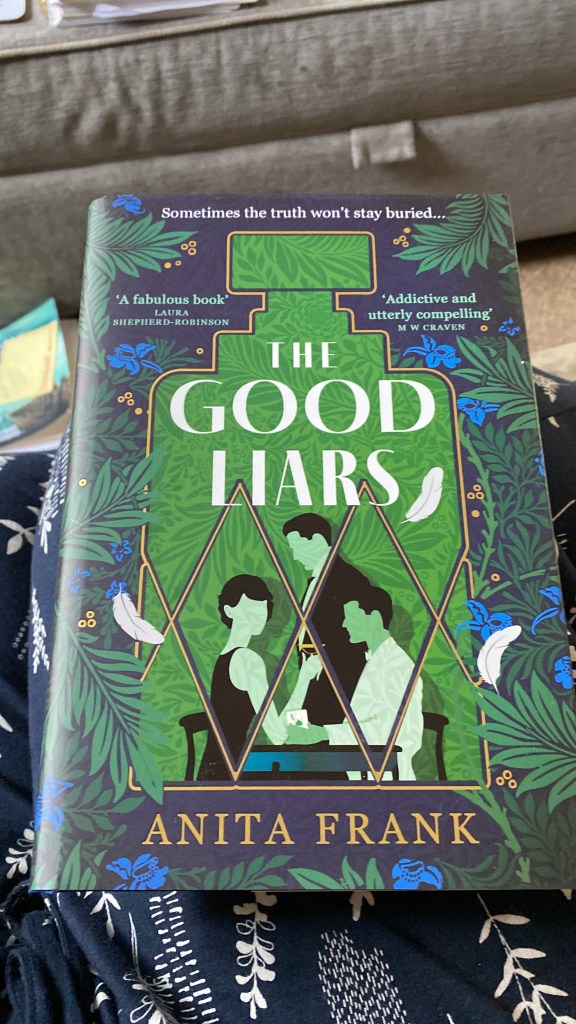
The Good Liars by Anita Frank

This is my favourite of Anita Frank’s novels so far. She’s chosen a fascinating period of history to set this gothic mystery and it adds something a little different to the ‘new servant in a creepy old house’ story. This is time when the country is traumatised, mired in grief and adjusting to the changes wrought by World War One. A time when loss looms large and people are searching for answers. Sarah is the new employee arriving at Darkacre, the family seat of the Stilwells. Like many aristocratic families, WW1 has wreaked havoc on the men in this family. When their father died, the eldest son Hugo became the heir of Darkacre. Yet his time as heir was very short, as he was killed on his return to the front leaving middle brother Maurice as heir to the Stilwell estate. Maurice was not prepared to be the master of the house and with double death duties already crippling the estate, he has learn fast. Unfortunately Maurice has returned from war a changed man, plagued by nightmares, flashbacks and extreme responses to loud noises, he has PTSD or what was then referred to as shell shock. With youngest brother Leonard severely disabled by his war injuries and struggling to come to terms with the loss of his limbs, the family are depleted and barely coping. However, as Leonard so cryptically tells us, perhaps it is no more than they deserve? Sarah’s arrival is the catalyst for this story and it isn’t just the relationship between family members that points to there being issues at Darkacre, soon a series of unexplained happenings start to gnaw away at the nerves of even the most stoic inhabitants.

Darkacre is the perfect gothic setting for the story and to some extent she represents the changes wrought on the aristocracy during this time period. Where before the war the family would have had several house servants, as well as gardeners, land agents, farm managers and so on, there is now just the brothers, Maurice’s wife Ida and Victor, a lifelong friend of Maurice. Due to the way army units were organised, Hugo Stilwell would have found himself the officer to a group of men he knew well, comprised of his brothers, tenants, young men and boys from the village. The losses were astronomical and not a single family in the parish missed out on their share of grief. This also left Maurice facing families of the young men he led to their deaths on a regular basis, including the upcoming ceremonies at the new war memorial. Servants were now in short supply and the tradition of going ‘into service’ had started to decline. We can see how social groupings have become blurred in the way Ida invites Sarah to eat with the family, instead of in the kitchen alone. They converse as equals, often as sitting together after dinner in the parlour. We can see how Ida has been craving female friendship and where it would be unsuitable to be passing confidences on to village women, Ida does start to confide in Sarah. Up till now it has very much been Victor’s role to inject a little levity into the proceedings and to amuse Ida. He confides to Sarah that both he and Maurice fell in love with her on sight, but she was more interested in Maurice and possibly the house and land that have her a title she craved.

On Sarah’s part there are few confidences shared and I found her rather mysterious and enigmatic. I was at first sure this was only a residue of the deference she had always shown employers in the past, but perhaps there is more to it than that. In a therapy situation, silence tends to draw the client forward and share confidences. In fact silence has often been my most powerful skill in terms of growth for the client and Sarah seemed to be using it for good effect. Is she simply trying to forge good relationships with her employers or is there something more sinister going on? The growing closeness between her and Leonard definitely feels genuine and I wondered what it was about their relationship that made Sarah relate to him differently. Was it that she saw him differently due to his disability, or is it a natural affinity? He seems to have different world views to the rest of the group, more compassionate and accepting of human imperfections. This is ironic given the family skeletons hiding out in closets and cupboards all over Darkacre. What was behind the sense of collaboration I felt between Ida and Victor? Why was Maurice so disturbed, not just by flashbacks and dreams, but possibly by his own conscience? Why is Ida unwelcome at the village’s ceremony for the new war memorial and does it have something to do with the disturbing parcel of an animal’s heart covered feathers that she receives?

Since I have a disability it would be remiss of me not to mention the veterans of WW1 left disabled by this horrifying war. Over one million men were killed in combat, but a further two million were left with some form of disability, 40,000 of which were amputees like Leonard Stilwell. He sits alongside such contemporary literary characters as Clifford Chatterley with a lot of the same emotional issues coping with the change of self-identity. Sarah represents a new stage in Leonard’s recovery, one he might resent, but yet they do become friends. On her first morning, Sarah arrives at Leonard’s room to find Victor smoking and Maurice laid across his brother’s bed rather like they’re still in barracks or the hospital. It’s a little glimpse into the institutionalisation of the men, more used to other male company in a military setting than the domestic sphere. Sarah could be seen as a barrier between Leonard and his fellow veterans, whereas before his care was kept within the sphere of the family now it is contracted out for money. Leonard could have felt as if he belonged, that his brother and Victor were still in the trenches with him, sharing the seismic shift his life has taken. His getting up routine was part of family life, whereas now it’s a job. A stranger has to perform the most intimate care for him and they are obliged to do it for money. He is now facing his disability alone. Yet he and Sarah muddle on quite well together, helped in part by Sarah’s training and professionalism, but also because they perhaps share the same anger and disdain for the futility of war.

Early on in the novel we see that Maurice is tormented by the memory of a young soldier who has half his face blown away. He can’t forget the horror of it, so it is perhaps fitting that the visiting Sergeant who arrives in the storm has a facial disfigurement. It’s as if Maurice’s worst nightmare has come knocking on the door. The inspector has only visited the day before and the sergeant seems to be following up, carrying out orders by interviewing the family. His disfigurement is covered by a copper mask, it’s smoothness belying the tangled and complex injuries underneath. For Maurice it almost seems worse that his injury is covered, because he can imagine in detail what’s actually there and imagination is worse than the reality. His mask also gives that element of disguise, it conceals his expression and leaves people wondering what he’s really thinking. There’s a definite Agatha Christie feel as a storm cuts the house off from civilisation and the family are trapped with these two outsiders. One of them a detective, trained to uncover secrets and the other has shown herself to have psychic tendencies. There are twists and turns, more than I expected in fact! I loved the atmosphere and Anita is brilliant at those little creepy happenings, that might have an innocent explanation, but start to unnerve you. The battle scenes are so well written too, perfectly capturing the chaos, the fear and a different kind of horror. This is a great read and Anita goes from strength to strength.

Published 17th August by HQ Stories.

Meet the Author

Born in Shropshire, Anita studied English and American History at the University of East Anglia. She now lives in Berkshire with her husband and three children.

You can connect with Anita via social media:

Twitter – @Ajes74

Instagram – @anitafrankauthor

Posted in Squad Pod

Lowbridge by Lucy Campbell

This story really crept up and took hold of me. It’s a slow burn, dual timeline mystery set in small town Australia. Katherine has moved to her husband James’s hometown of Lowbridge, a town with a very clear line between ‘the haves and have-nots’. Katherine is struggling with her mood and self-medicating with drink. James is hoping that the move will help her and has made it clear that they can’t continue as they are. He encourages her to get dressed and leave the house or go for a run like she used to. It’s clear something momentous has happened and their lives have imploded, but they are each dealing with it in different ways. In fact their teenage daughter Maggie was killed in a car accident, where the designated driver had been drinking. When Katherine does leave the house she accidentally stumbles across the town’s historical society and shows an interest in the exhibition they’re putting together. It’s something she can potentially help with and it’s enough to get her motivated. However, when she comes across a thirty year old mystery, problems start to arise. The disappearance of a young girl called Tess during the summer of 1987 has remained unsolved and Katherine thinks it may be time to highlight the case and perhaps jog people’s memories. She knows she must involve Tess’s family in the decision, but she doesn’t expect opposition from anyone else. It’s James’s opposition that surprises her most. He tells her to leave the mystery alone, that it will stir up trouble and it’s would be unhealthy for her to become wrapped up in another family’s grief. Katherine is determined though and with Tess’s family on board she starts to research what happened in 1987.

From the beginning, the author really gives us the sense of what it’s like to live in a small town where everyone knows each other. Having grown up in a small market town I know it’s rare for me to run errands without seeing someone I know. I still have friends that I had when I was thirteen and when I was sixteen a friend of mine was murdered, a few days before Christmas. A death like that sends a shockwave through the whole town and I could clearly imagine the collective grief and anger that Katherine would unearth as she investigates what happened. In the summer of 1987 the town was already at odds over a women’s clinic being proposed by a local doctor. This has enraged the anti-abortion lobby leading to protests and appeals to the locals authorities to stop the development. Three teenagers from the ‘right side’ of town are reaching an age where they’re asserting their independence and finishing their leaving certificates at school. Tess and Sim are friends with the slightly younger Luisa who is from an Italian family. The girls try to keep the clinic out of their conversation because it is Sim’s mother fighting to get the clinic open and Luisa parents are Roman Catholics, utterly opposed to abortion. Because they’re from the more middle class part of town they tend to keep separate from the ‘Pitsville’ kids, the area mainly inhabited by miners and their families. The author has really captured what it’s like to be a teenage girl on the cusp of womanhood. In the girl’s conversations there are all those insecurities about how they look and what they wear, their popularity and how boys view them. All three acknowledge that one girl at school really does capture the boy’s attention.

Jac is thought of as ‘easy’ by other girls, mainly because of the attention she receives from boys but also because of her sexy clothes. A lot of the derision also comes from the fact she’s a miner’s daughter from Pitsville, but they rarely think about what her life is actually like. The author takes us into her home, with a father who works and drinks heavily, often bringing other miners back to the house to continue drinking late into the night. Unbeknownst to anyone it’s on one of these nights that something terrible happens to Jac, setting in motion a sequence of events that will change her life. As Tess disappears off the face of the earth, Jac also goes missing but no one notices. I enjoyed this angle on the story very much, because it injects a element of social injustice into the mystery. We know that when girls go missing, even now, there are all sorts of social factors that play into the way the police investigate and the media report on the story. Often girls from black british and other minority communities go missing and don’t even make the evening news. Sim and Tess take Luisa to a house party after drinking a lot of home made ‘punch’. When they lose sight of their friend they go searching and find a brawl going on in an upstairs bedroom. Luisa is on the bed and two boys are fighting, each one claiming to be the knight in shining armour who’s found Luisa being attacked. It’s such a big story that everyone at school knows by Monday morning. It’s a big story because it’s Luisa. If it was a Pitsville girl would the popular kids get to know? Would they even care?

Katherine is a complicated heroine. She’s trying to avoid grief by drinking and I had a huge amount of empathy for her. Yet in a vicious argument with husband Jamie, he tells her a few home truths that made me think about it a different way. She wants him to grieve the same way she does, but he points out that he’s never been able to. It’s not that he doesn’t want to cry and shut the world out, it’s that he’s never had the luxury of falling apart. When their daughter Maggie was killed Katherine was able to keep her wonderful memories. She can imagine their daughter’s beautiful face when she thinks of her, but only because he had to see her broken and bleeding. He identified Maggie so that Katherine could keep her memories intact. He went to the inquest, so she didn’t have to hear the horrific details. She has felt alone, but so has he. I found this really powerful and I could understand why he thought involving herself in another family’s grief was unwise. Yet that’s not the full story, because Jamie has been keeping something from Katherine. That last summer when Tess disappeared, Jamie was secretly in a relationship with her. Maybe it’s in Jamie’s interest to stop Katherine from digging up the past. Could it be that he knows more than he’s letting on? The story dragged me in different ways, as each revelation came to light. I loved that the more we found out about Tess, the more special she became. It was wonderful to see her offer support and practical help to others, even to people others might have overlooked. She’s aware of the popular crowd’s opinion, but doesn’t let it sway her. She makes her own decisions and sets aside judgement. I had to have an early night to finish the book in one go, because I didn’t want to miss anything. This is a fascinating mystery, with a powerful theme running throughout about women’s rights over their lives and their own bodies.

Thank you to the Squad Pod Collective and Ultimo Press for my copy of this book.

Posted in Netgalley, Publisher Proof

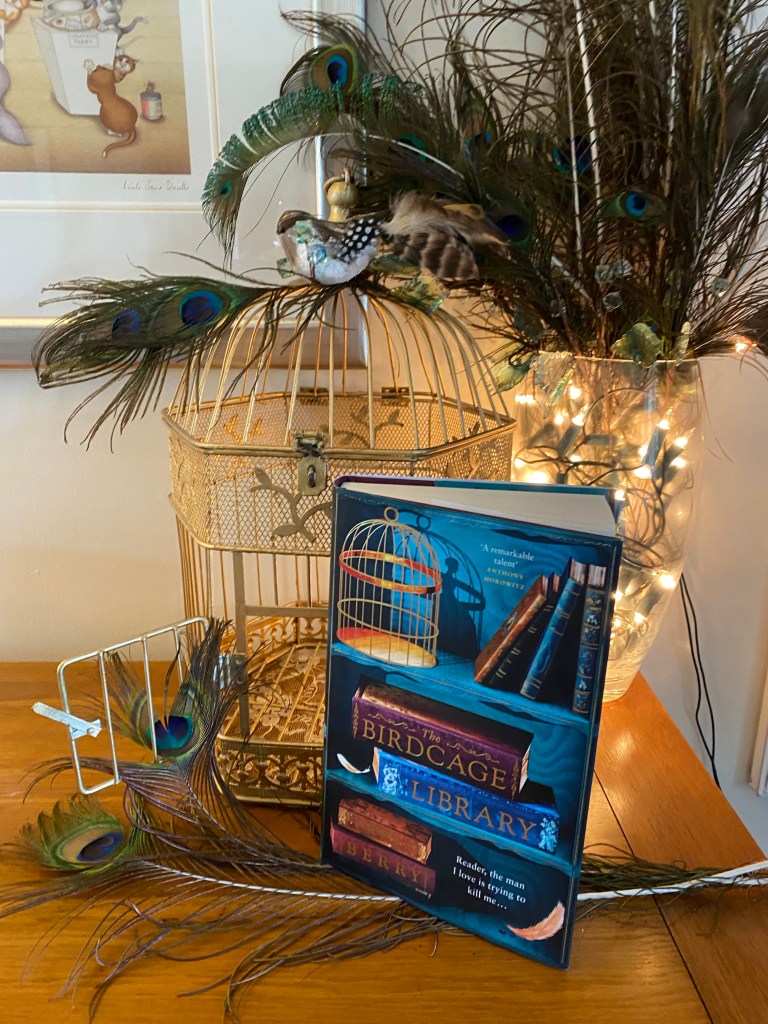
The Birdcage Library by Freya Berry

Dear Reader, the man I love is trying to kill me ….

In 1932 Emily Blackwood, an adventurer and plant collector, is employed by Heinrich Vogel to solve a puzzle. A treasure is hidden in his remote Scottish castle and he has employed her to find it. Her excavations take us back several years to New York and a young woman called Hester caught between two brothers and the family business of supplying rare animals to society homes and show business. As Emily follows the clues she discovers torn out clumps of pages from their hiding places around the castle. These tell Hester’s story in her own words and Emily starts to piece together this part of the Vogel’s family history. However, the discovery means she also starts to question her host, the isolated place she’s staying and whether or not she is safe within it’s walls. As Emily solves the clues and we race towards her final conclusions I found myself anxious and thoroughly addicted to Freya Berry’s intriguing and puzzling mystery.

I also found myself rather spellbound by the a book because it features one of my more macabre favourite things – I have to admit that vintage taxidermy has a strange fascination for me and the quirkier it is the better. Victorian tableaux with their anthropomorphised animals really do make my heart flutter. Rationally, I know it’s horrible and undignified for these beautiful creatures but I can’t resist a squirrel tea party. This book is set at a time when killing these beautiful living creatures and posing them for the collections of rich men is huge business. The Scottish castle has it’s owncollection, but we are also taken back a few years to Heinrich Vogel’s youth when he and his brother were the source of all these wondrous creatures. In one example, sourcing a vast collection of hummingbirds to be the talking point of an exotically themed gathering for the great and good of New York Society.

Emily rather reminded me of another incredible heroine, botanist Alma Whittaker in Elizabeth Gilbert’s wonderful novel The Signature of all Things. Like Alma she is intelligent, curious and forges her own path in the world of scientific discovery. I loved that Emily wasn’t like other women in society, usually depicted in fiction as diverted by dances and adorning themselves for the marriage market. She is an academic and sets foot in places across the world that many men haven’t yet reached, never mind the supposed fairer sex. That said, her biggest adventure and challenge is trying to be acknowledged for her expertise within an academic system that’s firmly a patriarchy. It is a lack of funds that put Emily in Vogel’s orbit, when he hears of her employment cataloguing the Rothschild’s butterfly collection. He feels that only the intelligent and ingenious Miss Blackwood will do as he wishes to catalogue his own incredible collection of taxidermy creatures. It doesn’t take long for Emily to discover there’s a more intriguing task though. Heinrich Vogel’s sister-in-law Hester famously threw herself to her death from the Brooklyn Bridge. From an old book entitled The Birdcage Library, Emily deciphers clues that lead her to the remains of Hester’s diary and her words pull Emily into a past filled with clues, explaining all that happened to the Vogel brothers and Hester’s relationship with them.

The highest form of love is indistinguishable from liberty.

Freya Berry uses her historical knowledge perfectly. It grounds the story within it’s time, using real people and places to anchor Hester’s account until it feels like part of history rather than fiction. The world she describes is so rich, alive with sound and colour, creating an all round sensory experience for the reader. I felt like I knew this world inside out. As many of you know, the birdcage is a potent symbol for me, one that I have tattooed on my body as a reminder to never let anyone put me inside one again. Here Freya Berry uses it as a metaphor for the way high society and wealth keep women from living the fullest lives they could. A cage is a cage, even if it’s a gilded one. The women in New York society may have money enough to adorn themselves with the feathers of birds of paradise, but they would never have the freedom that Emily has had to travel abroad and see these birds living in their native habitat – something infinitely more valuable than wearing them as a hat. Despite having a central role in the Vogel’s business operations, Hester is soon relegated to the parlour when her brother-in-low returns to New York. The business is going in a different direction, as her husband pursues the kind of fame and fortune earned by Barnum. Her creativity, business acumen and financial know how are sidelined and she finds herself bored and dissatisfied. Her distraction from the boredom and bewilderment of being relegated to the parlour, is a destructive one.

As Emily gets closer and closer to the final parts of Hester’s diary, she realises that the repercussions of what happened in New York are still playing out, but now she is in the middle. I was actually starting to be scared for her safety. The arrival of Vogel’s nephew Yves made me wonder if Emily could find an ally in this isolated castle? Or is she doomed to live out Hester’s life, caught between two Vogel men? The novel is the perfect combination of historical novel and mystery, with just the right edge of gothic darkness. There are echoes of both Jane Eyre and Rebecca here, two of my all time favourites. Freya Berry has created two interesting and intelligent heroines in Hester and Emily, and I was enthralled by their stories till the final page. I think you will be too.

I am no bird; and no net ensnares me

Jane Eyre by Charlotte Brontë

Meet the Author


Freya Berry always loved stories, but it took several years as a journalist to realise she loves the kind of truth that lies in fiction, not reality. (Or, to put it another way, making stuff up is more fun.) 

Her second novel, The Birdcage Library, is out now, a gothic mystery and literary treasure hunt packed with twists. A 1930s adventuress discovers an old book containing clues about the disappearance of a woman who vanished 50 years before. Set between a Scottish castle in the 1930s and an exotic animal emporium in Gilded Age New York, it’s a gothic tale of secrets, obsession and murder. Oh, and taxidermy. 

Her first novel The Dictator’s Wife, a high-stakes exploration of power, glamour and complicity, was published in 2022. It was shortlisted for the Authors’ Club First Novel Award, a pick for the BBC’s flagship book show Between The Covers, and The New European’s novel of the year. 

Freya lives in London and graduated with a double first in English from Cambridge. She spends more time reading smutty fantasy novels than she likes to admit.

Posted in Netgalley

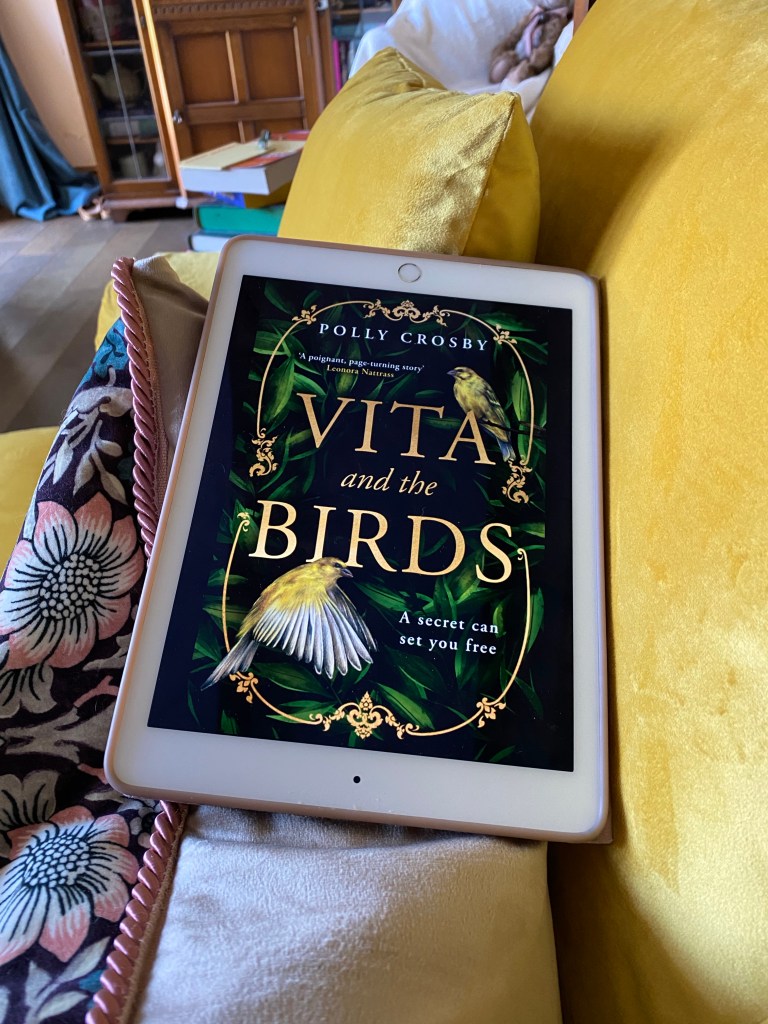
Vita and the Birds by Polly Crosby

1938: Lady Vita Goldsborough lives in the menacing shadow of her controlling older brother, Aubrey. But when she meets local artist Dodie Blakeney, the two women form a close bond, and Vita finally glimpses a chance to be free.

1997: Following the death of her mother, Eve Blakeney returns to the coast where she spent childhood summers with her beloved grandmother, Dodie. Eve hopes that the visit will help make sense of her grief. The last thing she expects to find is a bundle of letters that hint at the heart-breaking story of Dodie’s relationship with a woman named Vita, and a shattering secret that echoes through the decades.

What she discovers will overturn everything she thought she knew about her family – and change her life forever.

I’ve looked forward to the new Polly Crosby novel for a while, it was one of my most anticipated books of 2023. I love her writing so I gave myself a lovely sunny weekend to completely wallow in the story. It seemed fitting that I was outside, since nature plays a strong part in the novel both metaphorically and as an extra character that’s often more vivid than the inner spaces. Eve has felt adrift since her mum Angela died so her four brothers think it might be good for her to take a trip to the coast and clear out their grandmother’s studio. Grandmother Dodie was a painter and lived a fairly basic life in a small ramshackle studio just off the beach. Eve has fond memories of childhood holidays there, when her brothers would snuggle up with her like sleepy puppies on the studio floor at night. Close by is the strangely alluring Cathedral of the Marshes, a glass building so imposing it has the presence of such a holy building. Once, when she was a teenager, Eve had taken a dare to go into the cathedral with Elliot, one of the local boys. She remembers being terrified, but doesn’t remember much else about that night apart from seeing a painting standing on an easel. Strangely, it was a portrait of her and she ran out into the night, never to return. How will it feel to be back in a place that she has feared, but that still holds some of her best childhood memories? When she finds Dodie’s letters and reads of her relationship with Vita, she is plunged into a completely hidden part of her grandmother’s life.

This is a dual timeline novel, so through the letters we go back to the outbreak of WW2 and Dodie’s early years at the studio. She met one of her more notorious neighbours, Vita Goldsborough, resident of Goldsborough Hall and an owner of the glass cathedral. Vita and her brother Aubrey are the subject of gossip in the village. The stories are varied: Vita went mad and was put in a psychiatric hospital; Vita and Aubrey committed incest; they were to blame for ‘the vanishings’. They didn’t mix in the village and the stories around the siblings seemed to multiply and when a local girl vanished they were the first to be blamed by villagers. Strangely, as Eve arrives, a boy goes missing. It seems like an echo of the past, a foreshadowing, as if this is a thin place where memories and historical events seem close enough to touch. The physical sorting of her grandmother’s belongings is a simple enough task, she will just hire a skip, but when it comes to finding things that evoke memories and emotions they’re not so easily thrown away. Now Eve finds herself questioning the past and discovering things about this place and her beloved grandmother that she’d never imagined.

I thought this was a fascinating story highlighting women’s history and showing how much Victorian attitudes still prevailed in aristocratic society. The way Aubrey Goldsborough thinks feels around forty years out of date and the power he has over his sister we would now label as coercive control. Vita tries to explain to Dodie that his hold over her is so powerful he doesn’t have to force her, he simply has to tell her what to do and she obeys. He wants Vita to be respectable and only spend time with the right sort of people. Becoming friends with a bohemian artist like Dodie was definitely unexpected and she is the epitome of the wrong sort of company. Vita decides that Dodie must paint her portrait, something that her brother can’t really object to. Aubrey would like her to make a good marriage, but Vita’s interactions with men are fast and short-lived. Vita’s rebellions had to be passive aggressive – she gathers her jewels and keeps them in a box chained to the bottom of a pond in the glass cathedral. Hopefully, she can sell them without Aubrey knowing and have some financial freedom. She and Dodie hide in plain sight after Aubrey goes to war. They set up home in the cathedral, able to see everything around them, but thanks to the reed beds outside they are very unlikely to be seen. In another echo of her grandmother’s past, Eve meets an elderly lady in the village who asks to have her portrait painted. Eve isn’t usually a portrait painter, but can’t turn down the generous money offered for the work. She has the key to the cathedral and suggests they use it for their sitting, so Eve stands where her grandmother did many years before. What might this lady know about that time and her grandmother’s life?

The outside spaces seem to have an effect on Eve and I noticed a more natural, authentic part of her shine through. When she’s wild swimming or having a campfire on the beach with her brothers it feels like she belongs here. I was fascinated with how Polly plays with interior and exterior spaces, mirroring the parts of themselves her characters are revealing and concealing. Dodie’s studio has one glass side, leaving the whole living space open to view and her only concession to privacy is a screen where her models can undress. This is so in keeping with Dodie’s character, she is who she is and nothing is usually concealed. A beautiful detail comes when Eve is aware that putting the light on opens the space up to the outside like a stage set, but switching it off opens up the landscape outside. The cathedral is something of a paradox because I thought at first the glass would be very exposing, but Aubrey had designed it with living spaces that were kept private. I was imagining it like a Victorian glasshouse or orangery, very ornate with an almost tropical climate inside. The central ‘Turkish Room’ where Vita sits for her portrait has an otherworldly feel, with a smell of vegetation and rotting fruit. A large pool sits at the centre and church pews are placed around it upholstered with Turkish throws and pillows. There’s a sensuality to this space, the heavy warmth and the softness of pillows contrasts sharply with the glass. The room is hidden by the marsh reeds and it feels like a world apart, a feeling echoed by the ornamental bird cage engraved just for them. It holds Vita’s canaries, until one day they escape out through a hole in the roof. Yet they come back and visit Vita, eating out of her hand and filling the room with beautiful bird song. The name Eve finds scratched on the cage alongside that of Vita and Dodie should be no surprise. It’s a hope that person will return and bring a new generation back to the cathedral, represented by the flock of yellow and brown canaries Eve sees fly into the cathedral – the ancestors of those first two birds returning to their home.

As with previous novels, Polly really knows how to pile on the layers of mystery and create an undercurrent that’s quite unnerving: the painting that looks like Eve; the birdcage and the names engraved on it; the earrings Eve finds under the sink in the studio that she’s never seen her grandmother wear. Eve’s mind plays tricks on her, confused by the likeness between Vita and her grandmother, but also with herself. She’s still confused about that night when she was a teenager, when she went into the cathedral on a dare. Did she really hear a woman’s voice? Was she holding something when she ran away? Was it a shard of glass? As we move towards finding out what happened in the cathedral all those years ago the tension builds and I worried whether the two women would be safe from someone like Aubrey. Eve knows that he was found dead in the cathedral cut by a shard of glass, but was it suicide or murder? Whatever happened to Vita, someone her grandmother never talked about? There’s also the question of Eve’s mum Angela, born around the same time period but brought up by Dodie alone and has never known her father. As Goldsborough Hall was obliterated by a bomb during the war, only the cathedral remains and I wondered who owned it now? I was totally engrossed by this point and dishes went unwashed, the dog went unwalked and my other half, who knows when I’m lost in a story, kept me amply supplied with tea and toast. I do this strange thing when I’ve really enjoyed a book, I seem to hug it to my heart as if it can reach the characters inside. This was one of those books. It’s a beautiful hidden love story and an intriguing mystery as well, told with compassion and empathy.

Meet the Author

Polly Crosby grew up on the Suffolk coast, and now lives with her husband and son in the heart of Norfolk.

Polly’s third novel, Vita & the Birds, came out in May this year. Her first novel for young adults, This Tale is Forbidden – a dystopian fractured fairytale with hints of the Brother’s Grimm and The Handmaid’s Tale – is out in January next year with Scholastic.

In 2018, Polly won Curtis Brown Creative’s Yesterday Scholarship, which enabled her to finish her debut novel, The Illustrated Child. Later the same year, she was awarded runner-up in the Bridport Prize’s Peggy Chapman Andrews Award for a First Novel. Polly received the Annabel Abbs Creative Writing Scholarship at the University of East Anglia.

Polly can be found on Twitter, Instagram & Tiktok as @WriterPolly

Website: pollycrosby.com

Posted in Publisher Proof

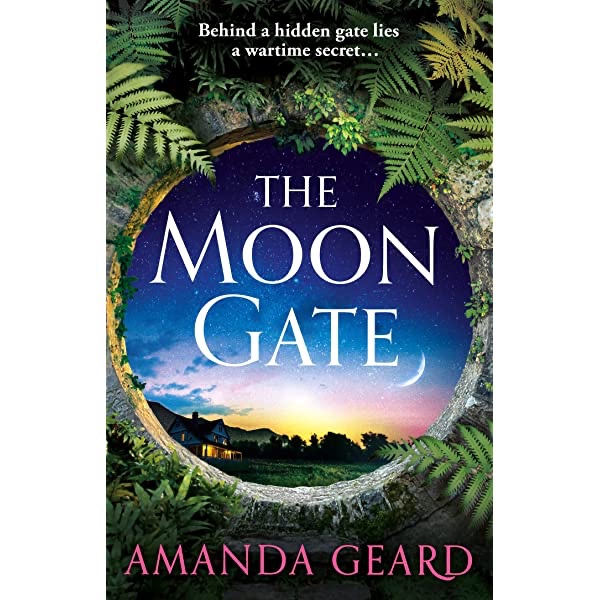
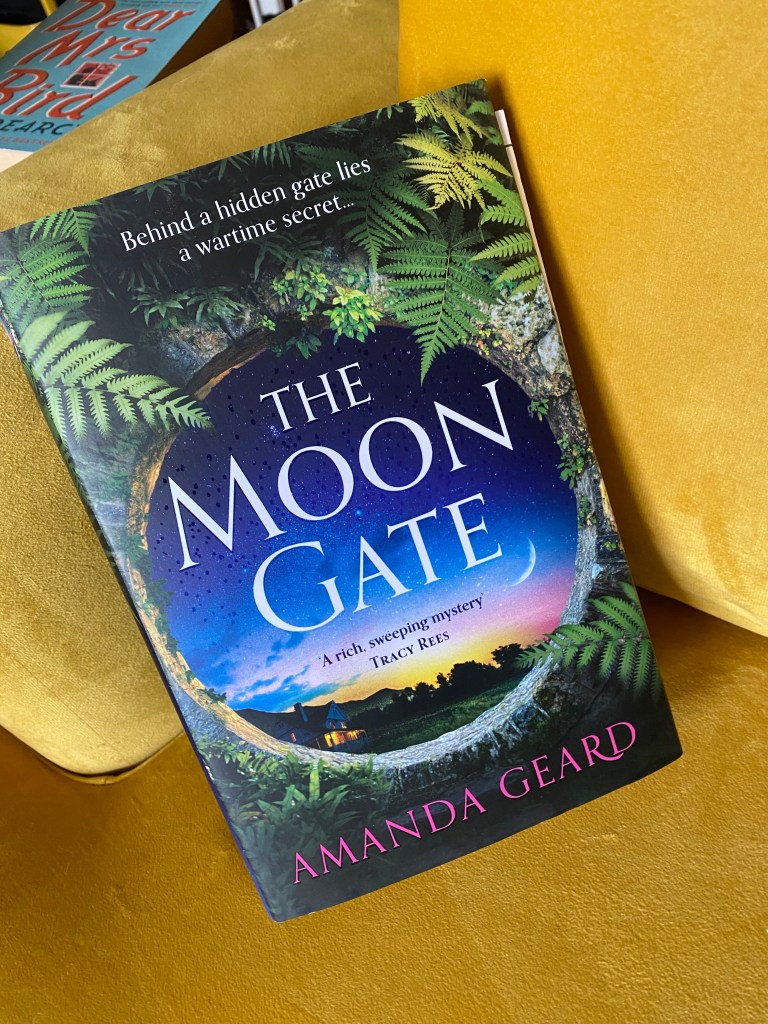
The Moon Gate by Amanda Geard.

1939 – Grace Grey lives in Grosvenor Place in London, with her mother Edeline who is a friend of the notorious Mosleys and wears the uniform of the Blackshirts. As war comes ever closer, Edeline makes the decision to send Grace and the housekeeper’s daughter Rose Munro to stay with her brother Marcus and his wife Olive in the north west coast of Tasmania. After an eight week voyage the girls are welcomed to Towerhurst, an unusual house with a whole tower where Uncle Marcus writes his poetry. Olive immediately takes to the beautiful Rose, but Marcus forms a bond with Grace over the poems of Banjo Patterson, an Australian ballad poet. Grace is reserved and shy, but is slowly coaxed out of her shell by Daniel McGillycuddy an Irish lad working at his aunt and uncle’s sawmill for Huron Pine. As war creeps ever nearer to their part of the Pacific there are dangerous emotional games at play between these young people with fall out that will extend over the rest of the century.

1975 – out of the blue Willow and Ben have been summoned to the north west of Tasmania because of a mysterious legacy. Willow has been left a house called Towerhurst, by an anonymous benefactor who placed it in trust. They decide it’s a great place for Ben to write and Willow to paint, but on their first visit Ben goes missing in the rainforest having fallen down an old mine shaft. What he finds there sends him on a quest that ends in London chasing a story about two young girls who lived at Towerhurst during WW2.

2004 – Libby has flown from Tasmania to London, wanting to claim the belongings of her father who died in the Moorgate Tube Station accident before she was born. Staying with her eccentric aunts in Grosvenor Square, she starts to follow the clues she finds in her father’s satchel: a publisher’s address, a book of ballads by poet D. McGillycuddy and the name Molly Munroe. Her quest will take her to a gentleman’s club, a narrow boat and eventually out to Ireland to solve a mystery that’s been laid buried for half a century.

I enjoyed Amanda Gerard’s first novel last year, so looked forward to reading her new one for a while. I was interested to see how her writing had developed over the last couple of years. To undertake a novel that takes in most of the 20th Century, three timelines and three different settings takes enormous confidence and she has definitely grown in confidence. This is a more complex novel, combining historical fiction with mystery and some romance too, but she pulls it off beautifully and I’ve absolutely loved it. From the historical perspective I learned a lot about living through WW2 in the Pacific Ocean, a completely different experience compared to Europe and the U.K. particularly. I thought Amanda beautifully captured how transient lives were at that time. This wasn’t just about the two English girls, Grace and Rose, uprooted from everything they knew and sent to the other side of the world. It was about the chaos of war, never knowing where your loved ones were, particularly if they were away fighting and whether they would ever come home again. For women that was especially difficult, left at home to wait but also left outside the experiences their men were having. Many women did their own war work, both to do their bit but also to feel a little closer to their men and as if they’re helping them to fight. War displaces people and there were huge shifts across the years of WW2 and afterwards as prisoners of war were slowly released and women who’d married a G.I. or perhaps a Polish airman travelled back to their native countries to start a new married life. It was a good time for people to disappear or slip away under the radar. I already knew a lot about the Blackshirts and their admiration of Hitler’s Nazi Party, but here I learned more about the women recruits and their activities. There was a breadth of research here, underpinning and enhancing the story across three different generations.

The main love story is so touching as the slightly awkward Grace is lured down to the beach by neighbour Daniel where he tries to kiss her. Sadly though it’s for a five shilling bet and as his mates turn up in a boat to witness her humiliation she runs away into the sea. It’s his friend Puds who has to rescue her, as she can’t swim and finds herself caught in an undertow. Daniel regrets his actions deeply, apologising the very next day and asking if Grace would perhaps share the book of ballads she’d been telling him about. They pass through the Moon Gate, a perfectly round doorway made of Atlantisite that leads to the waterfall and a small freshwater pool. Uncle Marcus claims that to pass through the gate is to become a new person and that certainly seems the case with Grace who not only forgives Daniel, but shares the ballad poems and agrees that he can teach her to swim. It’s so beautiful to watch them become close friends, but Grace knows that it’s Rose that Daniel finds attractive as everyone does at first. I felt for Grace deeply and I think a lot of other bookworms will too because she’s so uncomfortable in company, prefers solitude and loves words so much. My therapist side wanted to help her, because how does she learn to be herself and be confident in that, when even her own mother preferred Rose? When we’re not shown love from our parents, a child can’t understand that it’s a fault of the parent, so they learn there is something wrong with themselves. Grace is shocked by the help and affection she gets from Uncle Marcus, because her own mother is so austere and critical.

It was Rose who spent time with Edeline and became a member of the Blackshirts alongside her. Whereas Rose’s mother, the housekeeper Molly, can see something wonderful in Grace and so can her Uncle Marcus, it just needed to be coaxed out and nurtured. I was so invested in her feelings for Daniel and desperate for him to be clear about whether he had feelings for her. Rose is doing her bit in undermining and leading Grace to believe that Daniel only has eyes for her. She makes sure Grace knows when he writes from wherever he is in the world and if Grace shares news of her friend, Rose makes it clear she knew first. I’ve never wanted to slap a book character more! I wasn’t even sure that she genuinely loved Daniel, she’s just so used to getting one over on Grace that she hasn’t stopped to think it through. There are rumours in town about Rose and Uncle Marcus, she even winds Puds round her little finger but I wasn’t sure to what end? She certainly keeps her cards close to her chest, but when Rose takes up war work and isn’t around as much Grace can actually breathe. As I read I wasn’t sure what Rose was up to but I was certain there was something behind her manipulations and out of character support for the war effort. It’s a shock when her name comes up again in Libby’s investigations, was her father Ben simply interested in her fascist connections or is it something more personal?

There are definite echoes through the different time periods and motherhood is one of those themes that recurs. It’s an inter-generational trauma that starts with Edeline’s treatment of her daughter. Grace knows she isn’t her mother’s favourite, but is confused when this animosity seems to recur with her Aunt Olive. She asks a devastating question of her Uncle Marcus – ‘am I unloveable?’ because if her own mother can’t love her, why would anyone else? Willow has never known her birth parents, instead brought up with her two sisters who are twins. She never asked the question, even though she can see how different she is physically from her sisters. So when Towerhurst comes along, she starts to be intrigued by who created the trust and whether it could be one of her real parents. She finds out she’s pregnant alone, while Ben is over in London, but manages to tell him on the phone just before he is killed and they are both so happy in that moment. To then become a single parent, in such tragic circumstances must have been so difficult to come to terms with. Willow has never tried to collect Ben’s belongings despite knowing they were found and Libby clearly thinks her mother will disapprove of her choice to follow in his footsteps. Willow hasn’t been a terrible mother, just rather aloof and deeply engrossed in her work as a painter, where she demonstrates her terrible grief by only painting in black and white. She hasn’t grieved fully and I could see that Libby’s findings might bring those feelings to the surface. Luckily, Libby has had her eccentric aunts for support and it’s clear they adore her, but I hoped that Libby and Willow would have chance to talk and heal together.

As the mystery begins to unravel, there are revelations about these three generations that keep coming and a twist I truly didn’t expect. There are small disclosures, like the local police sergeant who helps the search for Ben is actually Puds, Daniel’s best friend who suffered a serious injury in the war and had to return home. How will he go about investigating what Ben finds in the mine shaft, when it might be better if they’d stayed buried? I was desperate to find the whereabouts of Rose, because all the hints are pointing to an answer I simply couldn’t bear! It seems possible that Grace never returned to England, but when Rose’s mother tells Ben she definitely saw Grace after the war he starts his search afresh. Could she have disappeared on this side of the world? I was constantly holding out a little bit of hope for the ending I wanted, so I had to keep reading – up till 2am again! There are so many layers to this story and often with dual timelines there’s a weaker section, but every timeline is intriguing, evocative and emotional. Tasmania sounds wild, dangerous, magical and atmospheric all at once. I loved the reference to the creature that lurks around the pool beyond the moon gate, could it be a shy Tasmanian devil? There’s such a massive difference between Tasmania and London, which feels more domestic than wild with very curated spaces like the old fashioned gentleman’s club and the minimalist narrow boat where Libby meets Sam. Then there’s Ireland, waiting like a promised land with all the answers and the beauty that Daniel shares with Grace right back at the beginning. We are left with an incredible tapestry of places and people full of colour, emotion and a yearning for home whether home is a place or a person.

Meet the Author

I have always loved dual-timeline novels, where stories from the past weave with those of the present day. I want to write books that transport you to another time and place, where secrets lie just beneath the surface if only the characters know where to look.

My new novel, The Moon Gate, is set across three locations I ADORE: Tasmania (my home state), London (where I rented a houseboat for many years) and County Kerry, Ireland (where I now live with my family). Each of these places is special to me and I hope you’ll feel you’re entering the temperate rainforest with Grace, opening the door to Towerhurst with Willow, walking through London’s layered history with Libby and stepping out to the heather-clad hills of County Kerry with … well, with several characters, the names of who I won’t reveal here!

The inspiration for my first novel, The Midnight House, appeared in the rafters of our Irish home, a two-hundred-year-old stone building perched on the edge of the Atlantic. Hidden there was a message, scratched into wood: ‘When this comes down, pray for me. Tim O’Shea 1911’. As I held that piece of timber in my hands, dust clinging to my paint-stained clothes, I was humbled that a person’s fingerprint could, in a thousand ways, transcend time, and I wanted nothing more than to capture that feeling of discovery on the page.

I’m also a geologist who loves to explore the world’s remote places. Luckily for me, writing novels provides a similar sense of wonder and discovery; but the warm office, fresh food and a shower in the evening make the conditions rather more comfortable! It’s also the perfect excuse to regularly curl up by a fire with a great book (often by the wonderful authors who write in my genre). I treasure my reading time, and I know you do too, so thank you for taking a chance on my books.

Come over to Instagram and Twitter (@amandageard) where I share plenty of photos of the wild settings in The Midnight House. You can also find me on Facebook (@amandageardauthor).

I love hearing from readers, so please get in touch!

From Amanda’s Amazon author page.

Posted in Orenda, Random Things Tours

Thirty Days of Darkness by Jenny Lund Madsen

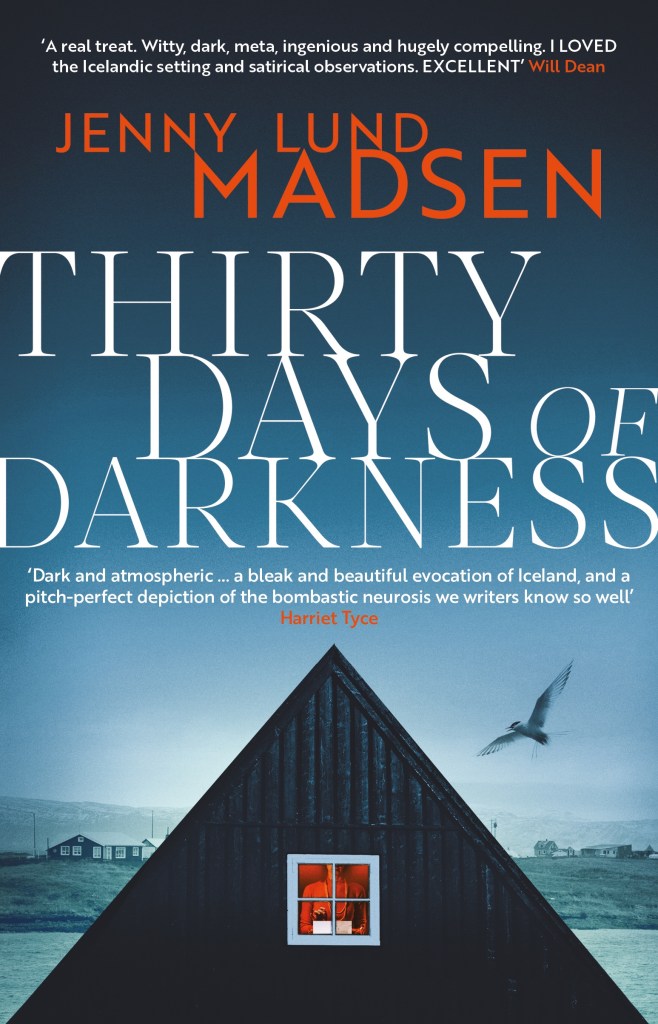
The first thing I loved about this book was that stunning cover. I hadn’t fully taken it in when I received the book, but once I’d found my reading glasses I couldn’t stop looking at it. That tiny lit up window, a little orange glow of creativity in the darkness really fired up my imagination. I’d love Orenda to create some book posters to accompany their author’s work. The blurb drew me in with it’s conflict between genre authors and their supposedly high brow literary fiction colleagues. Hannah writes literary fiction and is dismayed at a book festival to see the crowds attending a Q and A with Jørn Jenson, the darling of Scandi Noir, who churns out a formulaic book every year. Yet he’s filling a tent with fans and she’s in a lonely booth waiting for someone to drop by. I loved that she launched a book at his head! In the ensuing row, Jensen goads Hannah into saying she could write a crime novel in a month. Her agent uses the incident as a great marketing strategy and pours fuel on the fire, talking to the press about the wager and even putting Hannah on a plane to Iceland as a writing retreat. There she will live with a lady called Ella and hopefully, within thirty days, complete a commercial success. Yet within days of Hannah’s arrival there’s a real life crime, as Ella’s nephew Thor is found drowned in the waters of the harbour. Can Hannah use the case to write her crime masterpiece? As she starts to ask questions about this small town community will she find inspiration, or will she be in more danger than she ever imagined?

Hannah is an interesting heroine in that she isn’t all that likeable at first. She’s prickly, arrogant and a definite book snob.

“Hannah Krause-Bendix has never received a bad review. Not once has anyone had a negative thing to say in any of the reviews of her four novels. A literary superstar, twice nominated for the Nordic Council Literature Prize. Didn’t win, but that doesn’t matter; anyway, she doesn’t believe the mark of good literature is how many awards it’s won. She’s actually refused the numerous other prizes she’s won over the years. No – Hannah sees herself as a forty-five year old living embodiment of integrity and will always maintain that it is beneath her to seek commercial success.”

I was starting to feel sorry for her editor and publisher. Her disgust for the current literary scene is obvious. She hates festivals and signings, prizes, social media and is dismissive of bloggers (how dare she – *swoon*). As she picks up Jensen’s latest book as if it is ‘a pair of homeless man’s lost pants’ she notes that most of the reviews are from obscure bloggers she’s never heard of. She’s no better as she arrives in Iceland, annoyed that her new landlady is late, that her jeep looks and sounds like it’s five miles off it’s new home at the scrap yard, plus she drives with her steamed up glasses so close to the windscreen that Hannah wonders whether she can drive, or even see. Then she makes the terrible faux pas of calling her friend and publisher Bastian to get her a flight back to Copenhagen, assuming Ella can’t understand her. Of course she can. I was cringing about her behaviour. Yet I didn’t dislike her. Despite these failings, plus the alcoholism, infidelity, snooping and complete conviction she’s in the right, there’s something rather freeing about her impulsiveness. We all have those thoughts, those imps of the perverse, that pop into our mind and encourage us to poke that person who’s bending over to reach a low shelf in the supermarket. We don’t do it of course, but Hannah does. In the course of the novel she randomly feels a homeless man’s head, buys the town teenagers alcohol, starts an affair with someone she’s barely met and as we know, tries to hit a man in the head with a book. She seems disconnected from others in the sense that we don’t know her family, she has few obligations and she thinks nothing of asking very personal questions in entirely inappropriate circumstances. I sort of loved that.

There is definitely a blackly comic element to this story and a satirical eye for both the book world and crime fiction in general. There’s a meta element to the story too, as Hannah makes observations and discoveries about crime fiction that then seem to bleed into the actual case. She observes that her investigations are suggesting the case is actually quite simple to solve, Jørn, who has followed her to Iceland, advises that in crime fiction the killer is never the most obvious suspect. Subsequently, her enquiries move from the her current suspect and start to take a darker turn, towards the last people she’s suspected. Jørn tells her:

“ a good crime novel has three crucial components. One: a spectacular and violent opening, preferably a murder. Two: false leads and false suspects. […] Point three is surprises.’

He also rather amusingly points out that the protagonist shouldn’t be likeable, because no one enjoys a likeable protagonist in crime. In fact during a violent clash with her first, rather boringly obvious suspect, she even doubts her own credentials as a protagonist. As she fights for her life, she berates herself for her stupid plan of luring him to a window, because she’s now in front of an open window with a possible murderer.

Of course, he isn’t the murderer after all. In the end the crime is complex and rather like the book of Icelandic sagas that Ella gives her to read. The roots of this murder lie way in the past with the last people Hannah suspected. In fact in the echo of the saga, someone takes something that is highly prized and didn’t belong to them, setting in motion years of secrets, lies and denial. Yes, there’s a lot of the clever stuff going on that us ‘weirdo’ readers like, as one teenager describes Hannah’s fan base, but there’s also a solid thriller as well. It’s a bleak and claustrophobic atmosphere as soon as Hannah reaches the island where she knows no one and feels alien. The remoteness of the town and it’s isolation when the bad weather comes just add to that sense of being completely alone. This is not a place to be injured or to be a victim of crime; there is only one police officer in town, with back up over an hour away on a good day. Jørn may preen and prance around like the archetypal action hero, but he is surprisingly very useful to have around in a sticky situation and despite his woeful writing, is possibly a good friend to have, especially where he’s the only familiar and friendly face. Alongside Hannah I suspected three or four different people and the author kept me guessing, just leaving tiny clues along the way. At first there was a little bit of scepticism -I remember watching Murder She Wrote with my parents when I was younger and my dad wondering why nobody told Jessica Fletcher to ‘bugger off and mind her own business’. However, once the action started to heat up I forgot that Hannah had no business interrogating suspects and just kept reading. She’s no Jessica and this is definitely not cozy crime. It’s dark, disorientating and scary as hell, but you’ll not be able to put it down. This is an incredible debut and I’d love to see where Hannah ends up next. Now back to that cover – I think it would make a lovely tote bag ……

Meet The Author

Jenny Lund Madsen is one of Denmark’s most acclaimed scriptwriters (including the international hits Rita and Follow the Money) and is known as an advocate for better representation for sexual and ethnic minorities in Danish TV and film. She recently made her debut as a playwright with the critically acclaimed Audition (Aarhus Teater) and her debut literary thriller, Thirty Days of Darkness, first in an addictive new series, won the Harald Mogensen Prize for Best Danish Crime Novel of the year and was shortlisted for the coveted Glass Key Award. She lives in Denmark with her young family.

Posted in Random Things Tours

When We Fall by Aoife Clifford

I’m slowly becoming a fan of ‘Outback Noir’ so I guess I picked up Aoife Clifford’s new novel with certain expectations. I was pleasantly surprised to find a few differences in this crime novel and a labyrinthine story that really pulls the reader into small town Australia with its complicated relationships. As one Merritt resident says:

“People here are a bit like trees, with roots deep in the earth, far more tangled than what’s visible on the surface.”

Criminal barrister Alex has returned to her home town to spend some time with her mother Denny and have one of those difficult conversations. Denny is struggling with dementia, but is stubborn and in denial. She had a distant relationship with her own parents and had Alex as a young Mum. Alex has bad memories of her grandparents so Merritt isn’t her favourite place, but Denny is getting worse, no matter how much she tries to cover it up and Alex must talk to her about sheltered accommodation. It’s on a beach walk trying to broach the subject that they find a dismembered leg with a distinctive black feather tattoo. It turns out that the leg belongs to art gallery owner Maxine MacFarlane and local police chief Kingsley ‘King’ Kelly dismisses it as a boating accident when the rest of her body is found further up the coast. But Alex’s barrister’s instincts tell her there might be more to this than meets the eye and she starts to snoop. King Kelly warns her off very early on and comes across as the archetypal small town cop – lazy, prejudiced and jaded, not to mention a misogynist. He holds court in his local cafe and seems well connected in the town, especially with people who matter. Alex wants to question a possible link between Maxine’s death and the disappearance of artist and activist Bella Gregg two years before. Not only did Bella exhibit at Maxine’s gallery, but as an activist she often protested wearing black feather wings that went missing at the same time she did. There’s also a strange symmetry about their autopsy results – Maxine was washed up on the sea shore but didn’t have saltwater in her lungs whereas Bella did have saltwater in her lungs but was found inland. There was also an upcoming exhibition at Maxine’s gallery, linked to Bella’s death. Could this have laid the blame for Bella’s death at a local’s door?

The plot is intriguing, full of different avenues that are never obvious. Some keep you reading ferociously but turn out to be red herrings, while truths lurk underneath like a riptide. One minute I suspected someone, then someone completely different, although that’s not surprising in a town where male suspects are plentiful. My eye was on King Kelly throughout because he’s a thoroughly unpleasant character, but there are strangers in town; a new doctor who’s just arrived, as well as a visiting investor in a potential eco-friendly extension of the town. Locally there’s the rep for the town extension who seems keen to do anything for a better future than the local fishermen he went to school with. Bella’s own stepfather is known to be dealing drugs and there’s even a link to Alex’s family, with one thread involving a GP who was the partner of her grandfather. The past definitely has a role here, both in the crime and in the questions Alex has about her childhood. I was nervous for her in a town where outspoken women seem to get silenced. Alex is just as stubborn as her mother once she has an idea in her head and she’s been without cases to distract her of late.

Aside from the crime, Alex has a lot to contend with: her husband Tom is pushing for their divorce to move a bit quicker; her career seems to have taken a nosedive since their separation; then there’s her formidable mother to contend with. I loved the snappish and often humorous dialogue between Alex and Denny. There was a lot of truth in their exchanges, but that humorous edge offered a bit of light in the shade of a terrible crime. Alex’s instincts are strong, she’s perceptive and intelligent but seems to have a blind spot when it comes to danger. She places herself in potentially life threatening situations without seeing the danger looming over her. I didn’t always understand why, but felt it might have had something to do with her childhood in Merritt. Clifford surprised me with Alex’s home town, because I didn’t get the dry outback setting I expected. Despite wanting to develop as a holiday destination, it didn’t feel very welcoming and it seems to be raining constantly. Everyone is in raincoats. This is a small seaside town and has a claustrophobic feel without the outback heat. She shows it through the people, like the local cop with a finger in every pie and suspicious residents who are reluctant to talk. She gave me an Australia I hadn’t seen before and it gave this read a unique feel. This was such a well-written book, sinister and complicated with an ending that felt just right. I’m now looking for a gap to read her earlier novels, because I’ve already ordered them.

Meet the Author

Aoife Clifford is the author of All These Perfect Strangers, which was long-listed for both
the Australian Industry General Fiction Book of the Year and the Voss Literary Prize, and Second Sight, a Publishers Weekly (starred review) and PW Pick for Book of the Week. Aoife’s short stories have been published in Australia, United Kingdom and the United States, winning premier prizes such as the Scarlet Stiletto and the S.D. Harvey Ned Kelly Award.