Posted in Random Things Tours

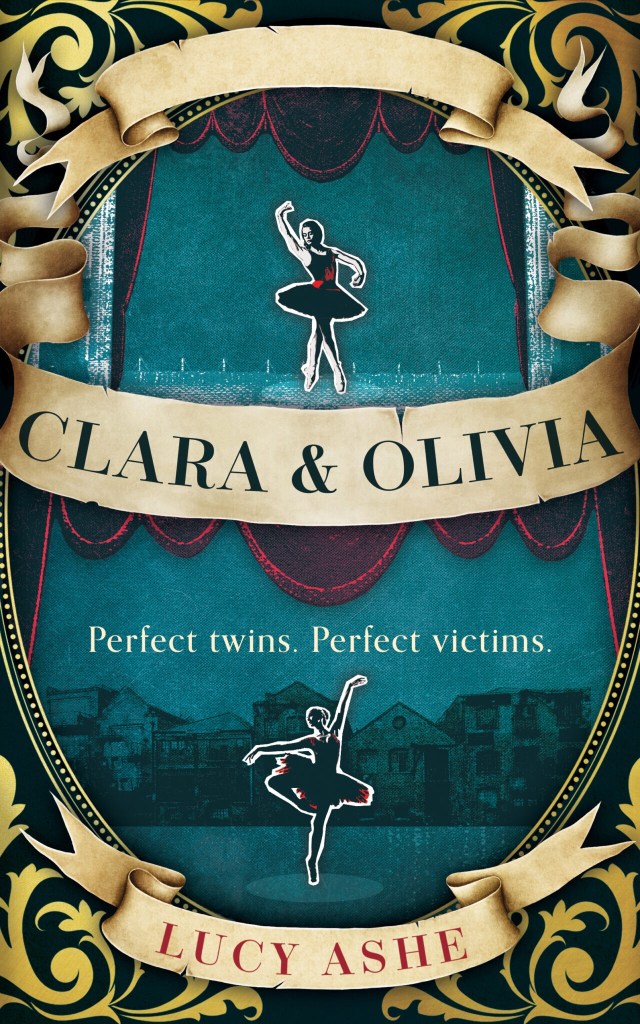
Clara and Olivia by Lucy Ashe.

“Surely you would like to be immortalised in art, fixed forever in perfection?”

I would kill to dance like her.

Disciplined and dedicated, Olivia is the perfect ballerina. But no matter how hard she works, she can never match identical twin Clara’s charm.

I would kill to be with her.

As rehearsals intensify for the ballet Coppélia, the girls feel increasingly like they are being watched. And, as infatuation turns to obsession, everything begins to unravel.

We’re in Black Swan territory here with the company at Sadler’s Wells as they rehearse Coppélia, which couldn’t be more apt for the story of Clara and Olivia. Clara and Olivia are identical twins, shaped by their ballet mad mother to become the perfect ballerinas. The girls are so identical that in order to assert her own identity Olivia wears her hair in a higher bun than her sister, with a rose attached. There are ballerinas who must be the epitome of perfection and blend in with the chorus so the audience sees perfectly synchronised ballet; the company as one rather than individuals. Olivia has taken her mother’s lessons to heart and is that perfect ballerina, she blends perfectly into the company, but she’ll never be the prima ballerina. Clara has that something extra.

Coppelia is about a man who creates a dancing doll, the image of a perfect ballerina. It’s so beautiful that Franz, a young man from the village, falls in love with it and sets aside his real sweetheart Swanhilda. To teach him a lesson Swanhilda dresses as the doll and pretends it has come to life. While the ballet is a comic one there is a more disturbing similarity, between the doll and the ballerina when each dancer stands at the barre every morning, identical in uniform and in movement. These are the parts the audience doesn’t see, that daily dedication to the same movements over and over until they are second nature. We are also blind to the years before this, where each dancer has persevered through pain and injury or given up sleep overs with friends, teenage boyfriends and even school work to become as light as air on the stage. To move like butterflies, while their worn out and broken shoes are the equivalent of Dorian Gray’s picture in the attic. When watching a ballet it’s not hard to imagine a giant puppet master behind the scenery controlling this whole row of ballerinas so they move as one. With the echoes of Black Swan in my head I was feeling a creeping sense of unease and psychological drama, both around the sisters and whoever it is who watches them.

There are two men in the book, employed or contracted by the ballet company and they too are caught up in this theme of appearances being deceptive. Samuel is a giant. A large, ungainly man whose looks mark him out as different. People would struggle to imagine that it is he who makes their pointe shoes; something that looks so delicate should not be made by people who look like him. When he finds out that the shoes he’s making are for Olivia Marionetta he knows he must find some way to mark them out as different from all the others, just as he noticed her among the other dancers in the company. He always writes the dancer’s name across the sole in pen, but her shoes should have something more. He takes his inspiration from the white rose he has seen pinned just about her bun and engraves it into the sole then, as he leaves the shoes in her pigeon hole, he places a white rose on top. Samuel is lucky that despite his size he can travel around the theatres and dance studios largely unnoticed. His contribution is unseen and therefore, he is invisible. So he has no doubt that Olivia won’t guess who has paid her this tribute, even if he has been hanging around the rehearsal room. He noticed that despite looking identical, the girls are not the same. Olivia is obedient and keeps her eyes cast down during rehearsals, not daring to challenge the dance mistress. Whereas Clara scares him, she knows she is an excellent dancer and there’s a challenge in her moves and the way she looks directly at the dance mistress. When given direction, she turns away and rolls her eyes at the other dancers. Clara knows she outshines the others, but he hopes his shoes will make Olivia feel adored too.

Nathan is even closer to the dancers during rehearsal because he is their practice pianist. He and Clara go out with the company at night while Olivia stays home, soaks her feet and mends her shoes for the following day. Her legs will be refreshed and her bag carefully packed, whereas Clara knows her feet will ache from practice, followed by dancing through the clubs till the early hours. She also knows that when she opens her bag, her tights will be full of hair grips. Usually the girls share clothes, but Clara has been wearing a dazzling green coat that Nathan bought her. Of late she has started to find the coat a little claustrophobic, the belt too restrictive and the shoulders too heavy. Nathan too seems to get a little closer each time, his hand always at her waist and his knee pressed tightly against hers under the table. She was also a little unnerved at the line of verse he scribbled when they were playing a game – ‘A lovely apparition, sent to be a moment’s ornament’ – while she isn’t sure what it means, something about it bothers her and I thought back to the puppet ballerina Coppelia. Nathan appears to be the perfect companion for a beautiful young dancer, but the closer he gets the more she wants to pull away. She imagines his houseboat, the ideal home for a young bohemian musician, but despite it being a few moments away from her flat he never takes her there. Is the look and idea of her more alluring than the reality? In their own private rehearsal he pushes her, far beyond tiredness and hunger. In the dressing room after he apologises, she notices how he looks at the dancer’s jumble of make up, jewellery and bits of costume that haven’t been returned to wardrobe. The one thing he becomes fixed on is a tiny figurine of a ballerina, like the ones you might find in a girl’s jewellery box, permanently on point and turning endlessly without exhaustion or hunger to mar her beauty. No real woman could be so perfect.

Although I found the novel a little slow at first, but I soon realised that the inner thoughts and feelings are slowly building towards action. Once strange things start happening around the theatre the pace picks up and I became intrigued. In the well under the theatre, where the dancers like to go for pre-performance rituals, a single shoe is found floating in the water like an evil portent. Then life changes start to come tick and fast. Clara receives an offer she has never imagined, but it will mean moving away from Nathan and choosing independence from her sister. Their mother, the woman who inspired their career choice, is deteriorating in a nursing home. Her imminent passing is another sign – do they still need to be in each other’s pockets? Usually they need their combined strength but without their mothers rigid ideals to live up to could they go it alone? The author hints at these changes of identity, with one sister choosing to borrow the other one’s clothes, perhaps hoping for a little of their attitude too. She often feels like a mere echo of her sister, but I worried that this ‘doubling’ would land one or both of them in further danger. This tension is offset by Samuel’s story, of being led away from an obsession towards something more real. Living instead of watching. If the ballerinas represent perfect objects of desire, he is being offered a real relationship. But is it Samuel who watches the twins and can he see that someone to love and support you is more important than appearance? As the hidden desires and obsessions of these characters come to the surface and explode into action more than one of them will be in danger. This thriller has real atmosphere and characters with fascinating psychological issues that drive the plot.

Published 2nd Feb by Magpie Publishing.

Meet the Author

LUCY ASHE trained at the Royal Ballet School for eight years, first as a Junior Associate and then at White Lodge. She has a diploma in dance teaching with the British Ballet Organisation. She decided to go to university to read English Literature at St Hugh’s College, Oxford (MA Oxon), while continuing to dance and perform. She then took a PGCE teaching qualification and became a teacher. She currently teaches English at Harrow School, an all-boys boarding school in North London. Her poetry and short stories have been published in a number of literary journals and she was shortlisted for the 2020 Impress Prize for New Writers. She also reviews theatre, in particular ballet, writing for the website Playstosee.com.

Posted in Netgalley

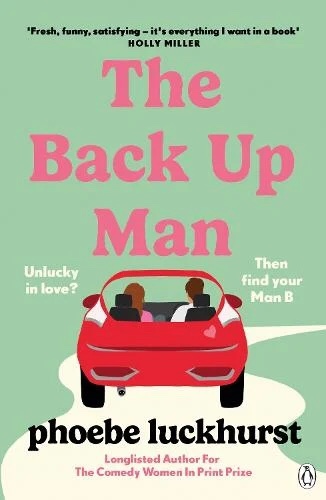
The Back Up Man by Phoebe Luckhurst.

I was enticed into our heroine Anya’s world for two main reasons: Glasgow is one of my favourite cities and I too had a back up man. My best friend Elliot and I made a pact when we were moving on from sixth form. He didn’t know that I was head over heels in love with him, but he was my best friend and I didn’t want to ruin anything (we did ruin things a few years later, after university, but that’s another story). So we decided that if both of us were single at the age of 40, we’d get married. Life takes strange turns and although we were still in touch, Elliot had a long term partner and three children by then and I was a widow. We’ve all had a break up or other difficult life event and been overcome with a bout of nostalgia. Sometimes what has happened to us has been so scary and life changing, it makes more sense to lapse into the past, revisiting times and people who feel safe. We’re always doing this through rose tinted spectacles forgetting the negative aspects of the relationship or memory. So I could really understand Anya’s reasoning, especially after the shock she gets on a visit to Sunday lunch at her boyfriend’s mother’s home. In fact it’s on their way home, as they drop into a Shell garage, where Callum ends their four year relationship. Because he hadn’t wanted to upset his mum by doing it sooner. So Anya is facing a massive life change. The couple live together in Callum’s flat and while he can find somewhere to stay for a few days until she gets herself together, he will want her to move out by the end of the week. What else can go wrong?

Glasgow’s west end is a beautiful setting, giving both atmosphere and warmth to the story. I love the beautiful Victorian stone homes in the area and I have imagined myself living in one of them, but they’re pricey and only for the city’s professional classes. People like Anya’s cousin Claire. It’s her sister Georgie who suggests that Claire might want a lodger. Georgie gets on better with Claire than Anya does, because Anya finds her a bit stuck up and joyless. She also dislikes her creepy partner Richard. So once her best friend Paddy has helped her move to a single mattress in Claire’s back bedroom, Anya lies there wondering if life could get any worse? Then the next day she loses her job. As she’s going through her badly packed boxes she finds her old year book from school and a note from Euan. In her final year of school, Euan and Anya had a casual connection that could perhaps have become something more had he not been going away to university. They were never officially together, so they didn’t really break up, but they did make a pact. If they are both single when they are thirty years old they will make a go of it together. In a wave of nostalgia, borne out of feeling her life has fallen apart, Anya starts to search for Euan when she’s surprised by a message from a mutual friend. Jamie has also been looking for Euan, maybe they could join forces?

For me, this romcom worked because it is so much more than a simple boy meets girl. This period of time is transformative for Anya in so many different ways. She learns so much about herself and for me that is the most interesting part of the story. She and sister Georgie live in Glasgow with their parents living out in a suburb of the city. Anya and her mother have a spiky relationship because she has very set ideas about how life should be. Anya’s favourite pastime is cooking, in fact she finds that in the week where she’s alone in Callum’s flat, the night she cooks from scratch is when she feels most relaxed. For a little while she’s been running a page on Instagram called anyaeatstoomuch and her friend Paddy suggests that she could develop this hobby into a business. So she starts to look into turning it into a catering company, but in the meantime her mum isn’t going to let her sit around feeling sorry for herself. She finds her a job looking after the granddaughters of a woman she knows, their mother is working as a beauty influencer. These terrible twins are brilliant comic relief, being both unruly and sneaky, but subdued by Anya’s incredible food. It could be a complete waste of her time, or it could provide opportunities.

This is just one of the things that Anya has to learn. She can’t continue to drift and let life happen to her, she has to take control to get the life she wants. There was a sense of mystery too, in the search for Euan and the dead ends they find but I also wondered about Jamie. His interest legitimises Anya’s search, just when everyone else is telling her she’s behaving like a crazy person. I could understand her need to look back when everything else is falling apart, but what was Jamie’s reason for looking for Euan? I was also concerned about Claire’s fiancé Richard. He’s very furtive, lurking around corners and exercising his ability to soundlessly appear in the room. Their relationship also teaches Anya something important, just because someone’s life looks perfect it doesn’t mean it is. We all show a very edited version of life on social media and the reality is often very different. Another lesson is that having everything you want – the fiancé, the West End house, the great career – doesn’t necessarily mean you’re happy. It’s all these bits of learning and the potential growth Anya could make in her emotional life and career that really make this story. I was rooting her her to make the right choices, survive the terrible twins and forge an exciting life for herself, whether a man is involved or not.

Published 19th January 2023 by Penguin

Meet The Author

Phoebe Luckhurst is a journalist and author, who has written for publications including the Evening Standard, ES Magazine, ELLE, Grazia, Sunday Times Style, Guardian, Telegraph and Grazia. The Lock In is her first novel and this is her second.

Posted in Publisher Proof

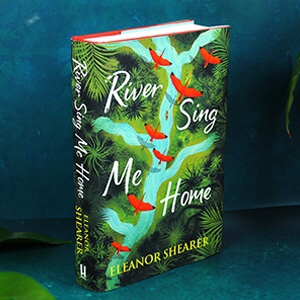
River Sing Me Home by Eleanor Shearer

This incredible debut novel grabbed hold of my mind and heart, never letting go until the final paragraph. I shed tears at several points in Rachel’s journey and she’s a character I won’t forget. We meet her working on a plantation in Barbados, at that strange point after slavery when plantations were instructed to free slaves, but their sense of freedom was short-lived as masters were able to keep slaves for a further six years as apprentices. So, despite being freed the day afterwards started just the same, at the crack of dawn and walking to the cane fields for a day of back breaking work. Having nothing meant that most had no other choice. Rachel is thinking of her children, several lost before they had a chance to live but others scattered to the four winds. Her boys Micah and Thomas Augustus and her girls Cherry Jane, Mary Grace and Mercy all taken from her in different ways. Only Cherry Jane spends a few years nearby as a house slave, but in her superior position she doesn’t acknowledge Rachel who is merely a field hand. One day she decides that she must find her children, she must know where they are and what happened to them, even if the news is that devastating final loss. Rachel says that as a slave she plants cane but nothing of her own. However her children came about, Rachel feels that they anchor her in this world and she can’t rest until she finds them. So she runs and with our hearts pounding we follow her.
As Rachel took her journey I kept thinking about my own mum. She always feels at her happiest when we’re all under her roof, all four generations. She told me that she feels like we’re all safe and there’s a feeling of completeness. I am not a mother, so until recently I hadn’t experienced anything like this, but now I am a step-mum and I do get a sense of relief when both my stepdaughters are here under my roof. There’s a feeling that I could close the curtains and we’d all be safe. I couldn’t imagine how it must feel to have those children stripped from you as commodities to be sold. As I finished reading the book on Holocaust Memorial Day, my mind was also taken to an account by a survivor on TikTok where she described her family being split apart into separate queues as they reached Auschwitz. She was placed in one queue bound for a factory sewing uniforms, but her mother and sister were deemed unsuitable for work and in the chaos was the final moment she saw them. It’s a similar atrocity, so huge that it’s hard to imagine or compute. A whole race of people are deemed as expendable and discarded with no more regard than swatting a fly. In amongst some powerful and distressing scenes in the book, one thing that hit me really hard was Rachel’s realisation that her emotions didn’t matter. As a younger woman she had held herself proudly and resolutely, determined that the actions of the overseer wouldn’t make her cry. As an older woman she realises that she could have owned her grief, it wouldn’t have satisfied or pleased the overseer to see her distress because she simply didn’t matter to him.

Rachel’s journey is a long one, across Barbados and over to Trinidad, and we experience every moment with her. The author provides vivid descriptions of each place Rachel experiences down to the way the earth feels under her feet. Cities give her a certain anonymity, but it’s in nature that I really felt Rachel’s freedom. The author layers sounds of birds, running water and wind through the trees with the feel of leaves or water against the skin. The water of the rivers are welcoming and help her journey: kayaking up the Demerara to look for runaway communities in the forest and Thomas Augustus; rushing down river holding an uprooted tree to avoid capture; feeling cocooned and supported by the water in a bathing pool. The runaway community are made up of escaped slaves and indigenous tribesmen who have survived the colonisation of their island and the forest both hides them and supports them. There is a sense of abundance in the food, the company and the mix of cultures that comes out in musical form. The ancient songs of Rachel’s African heritage come alive for her when mixed with slave songs and the music of the indigenous tribes represented. It seems fitting that it is in the forest that a marriage takes place and a baby is born – these are the building blocks of the future and that future is truly free.

I found some of the characters Rachel comes across on her travels fascinating and they add something to the tale by bringing their own experience, adjustment and acceptance of their situation. Nobody has adopted the very part of his identity forged by the slave experience, the sense that he is no one and belongs nowhere. Despite the negative connotations of the name, being nobody allows him to take his power back, to be anonymous, to escape unseen and leave a mark nowhere. He has been transitory ever since he started running, living a transitory life on the ships that travel between the islands, perhaps feeling more at home in the water than on the land he was enslaved by. I wondered whether Rachel’s quest would make a mark on him and if he would find a true home, whether that be a place or a person. I was also intrigued by Hope, whose very name embodies looking forward. She has found her place in Bridgetown by entertaining paying gentlemen. She is beautiful, impeccably dressed and seems to have found a independent way of living she’s at peace with. While some people don’t want to be seen with her, Rachel is not so judgmental. After all, Rachel tells us, men have been inside her but there she was the one who paid the price. The threat of sexual violence is alluded to but never explicit. Rachel won’t discuss or ask another woman how her children have come into being, because she knows the pain of a pregnancy where you pray the child you carry has no resemblance to it’s father. Equally she knows what it’s like to dread the birth of a child who might bear a resemblance to a man greatly loved and lost forever. We don’t know about the conception of any of Rachel’s children. Her ‘pickney’, as she calls them, are hers and hers alone and it is this that makes it imperative that she finds them. She needs to find them, in order to feel whole.

The whole journey is littered with joys and terrible grief, but Rachel knows she must keep going. She meets others who have started to build a new life, placing the past firmly behind them and never pining for it. They live firmly in the here and now with questions left unanswered and people left behind. For Rachel that isn’t enough. Her children are like the scattered pieces of a broken vase. She doesn’t expect her family to be perfect and knows that there will be cracks and missing pieces. Rachel is putting her broken vase back together and she will pour a substance into the cracks, bringing the pieces together until her past is whole again. The binding substance used in Japanese Kintsugi pottery is usually gold, each crack making the piece more beautiful. In Rachel’s case the binding substance is love. Love for those here, those found but far away and those gone forever. An all encompassing love symbolised by the birth of a baby in the forest.

There was a ‘feeling of complete, absorbing, unqualified love. The baby was a stranger, without speech, unknowable. It would be years before he could say what was on his mind. And yet, love did not wait. Love was there in the beginning – even before the beginning. Love needed no words, no introduction. Existence was enough.’

Published on 19th Jan by Headline Review

Meet The Author

Eleanor Shearer is a mixed race writer from the UK. She splits her time between London and Ramsgate on the coast of Kent, so that she never has to go too long without seeing the sea.

As the granddaughter of Caribbean immigrants who came to the UK as part of the Windrush Generation, Eleanor has always been drawn to Caribbean history. Her first novel, RIVER SING ME HOME (Headline, UK & Berkley, USA) is inspired by the true stories of the brave woman who went looking for their stolen children after the abolition of slavery in 1834. 

The novel draws on her time spent in the Caribbean, visiting family in St Lucia and Barbados. It was also informed by her Master’s degree in Politics, where she focused on how slavery is remembered on the islands today. She travelled to the Caribbean and interviewed activists, historians and family members, and their reflections on what it really means to be free made her more determined than ever to bring the hidden stories of slavery to light.

Posted in Random Things Tours

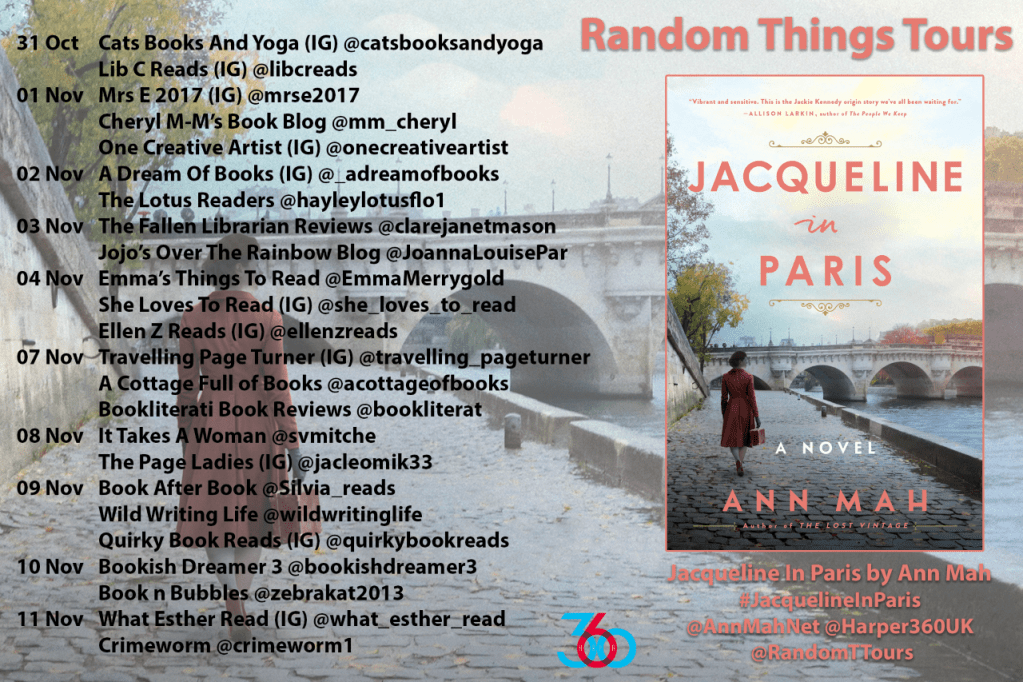
Jacqueline in Paris by Ann Mah

Jacqueline Bouvier Kennedy Onassis is one of those iconic women that we can’t help but be curious about. From watching the film JFK and numerous documentaries about the death of President Kennedy with my mother, I started to be curious about the woman in the blood-stained pink suit. I think people are drawn to women who remain silent. As far as I’m aware she has never spoken directly about the horrific, life changing events of that day. She has almost seemed stoic. The perfect widow, in her lace mantilla at the funeral, still seeming numb and shell-shocked. When she surprised everyone by marrying Aristotle Onassis, the millionaire shipping magnate, I think it was driven by a need to hide. She needed a place to be without cameras following her every move and on his yacht she was definitely away from prying eyes. Perhaps his protection allowed her to grieve and come to terms with her trauma. I wanted to read this book, because I was fascinated to meet this version of Jackie – the Jacqueline before she was Jackie in. I always had the impression that she could have been a woman in her own right, more than the political wife she became.

Ann Mah has set her book in one particular year. In 1949 Jacqueline Bouvier travelled abroad for her junior year at college. It was to be her last year of freedom. She was aware that despite being poised and ready for society, her family were on the edge financially and she felt pressure from her mother to make a good match on her return. She met Jack Kennedy in 1952. Jacqueline lives in an apartment with a widowed French countess and her daughters. She finds a world of champagne, avant-garde theatre and jazz clubs and socialises with people she would never have met in her home town or the social circles at Vassar. There’s even romance with a man who loves literature like she does, but who would be totally unsuitable back home. Yet Paris isn’t all fun and glamour, because this is the aftermath of WW2 and its clear that the city’s people have suffered. The countess and her daughters have suffered too, as part of the resistance. The whole city is haunted by events during the Occupation and it will take many years for them to recover from the lies, betrayals and suspicion that lurk round every corner.

I love that Mah has written this novel in the first person, so we have Jacqui’s unguarded thoughts and emotions from the start. Even though it is a fictionalised self we’re getting to know, it still feels like a rare window into the innermost thoughts of a very private woman. It may sound strange to regard her as private when she was later married to the most powerful leader in America and arguably the world. Jacqui is private though. From this part of her life when she has the most freedom she’s ever known she’s testing people out for herself, but there’s still a natural reserve. She gets to decide who to spend time with and who to trust. On her return to the US and her subsequent relationship with John Kennedy, she is private by design. It’s part of the mystique of being a powerful politician’s wife who should show loyalty, discretion and control of her emotions. Once she’s in those circles, who can she trust to be a true friend? Where many might have seen her as the archetypal political spouse, this was the ambition of her mother rather than Jacqui’s own desire. Here we see her when she was naive and idealistic. Her love of art and for the city of Paris is evident. She’s also keen to make friends and experience real French life, but that reserve can make it hard for others to feel they know the real her.

She finds that one of the biggest differences between the US and Europe is a political one. During the war, Parisian people did what they had to in order to survive and there are still grudges against those forced to collaborate. She learns which subjects to avoid. Madame de Renty is a lively and colourfully dressed woman during the day, but she was imprisoned at Ravensbrück concentration camp during the war and Jacqui hears her crying in the night. Some truths can never be spoken. Aside from the post-war adjustments and the effects of trauma that will last for generations, Jacqui is most shocked by the Parisian’s politics. There is a lean towards communism here, something that’s unthinkable in the US where it’s considered in the same breath as Nazism. Her mind is broadened by friends who explain it’s underlying principles – an equal, fair society. This has huge resonance for us, because we understand she will be First Lady during the Cuban missile crisis, and the 1950’s saw a wave of suspicion about communism that fuelled the McCarthy era.

Despite these darker undercurrents there’s also the joy of seeing Paris through her eyes, for the very first time. The beautiful language, the smells of incredible food and early morning croissants. There’s also Jacqui’s love of learning and through this I could see glimmers or the different life she could have had, if her family had valued her as more than a marriage commodity. This is a well-researched account that held some of the answers I’d pondered about her life: that pull between the security of marriage and the more precarious life of her own; the love of Europe that would see her return there after Kennedy’s death; the education from a really great college versus the education of how to be a wife provided by her mother. I thought the author found a great balance between fleshing out a story and what we know of Jacqui’s year abroad through historical research. I understood this Jacqui and felt I’d met her before in my own reading. Now I have to give this straight to my mum so we can talk about it.

Meet the Author

Ann Mah is an American food and travel writer. She is the author of the USA
Today and Wall Street Journal bestseller The Lost Vintage, as well as three other books. She contributes regularly to the New York Times Travel section, and her articles have appeared in the Washington Post, Condé Nast Traveler, The Best American Travel Writing, The New York Times Footsteps, Washingtonian magazine, Vogue.com, BonAppetit.com, Food52.com, TheKitchn. com, and other publications

Posted in Sunday Spotlight

Sunday Spotlight! Great Celebrity Memoirs.

I’m not a usual reader of celebrity memoirs. I know there’s a certain snobbery in bookish circles for the celebrity memoir, so I thought I’d get that in there before you click away to another blog. I’m all for whatever gets people reading to be honest, but it’s a rare book that sits above the usual ghost written Christmas fare. These are memoirs that sit above the ordinary, that have touched me emotionally or made me laugh, that have surprised me with the beauty of their writing or their inventiveness, or even revealed incredible stories that kept me gripped to the final page. Some you may have heard of while others are lesser known, but just as compelling.

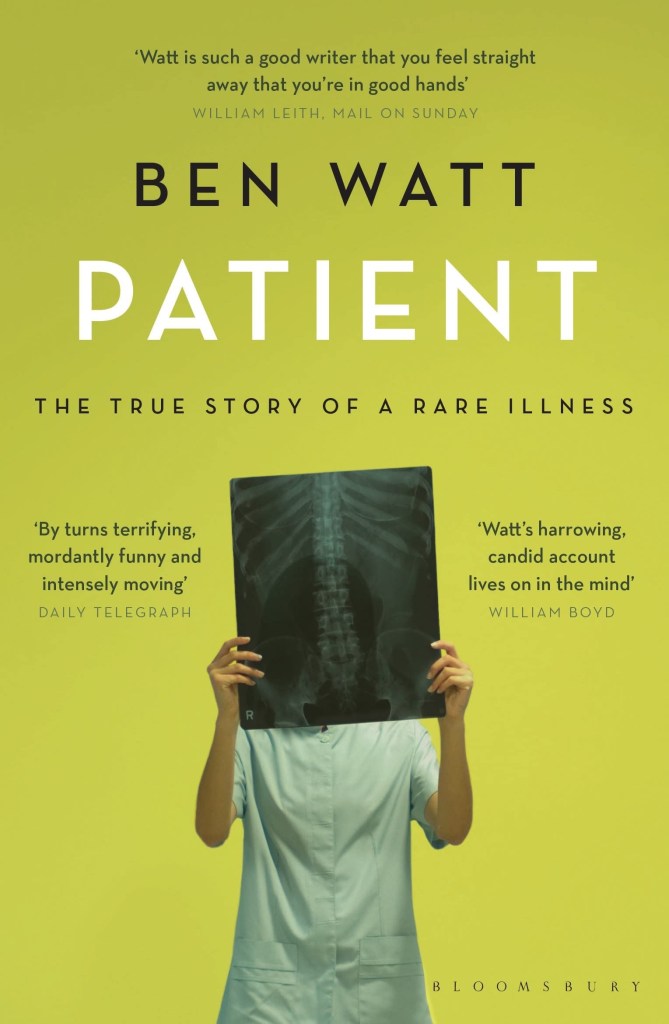
Patient by Ben Watt.

‘In the summer of 1992, on the eve of a trip to America, I was taken to a London hospital with bad chest pain and stomach pains. They kept me in for two and half months. I fell very ill – about as ill it is possible to be without actually dying – confronting a disease hardly anyone, not even some doctors, had heard of. People ask what was it like, and I say yes, of course it was dramatic and graphic and all that stuff, but at times it was just kind of comic and strange. It was, I suppose, my life-changing story.’

Benn Watt is half of the band Everything But The Girl and his short memoir covers a period when his bandmate Tracey Thorn was also his partner. In 1992, when I was taking my ALevels and listening to his band, Ben contracted a rare life-threatening illness that baffled doctors and required months of hospital treatment and operations. This is the story of his fight for survival and the effect it had on him and those nearest him. I recommend this book because it is beautifully written and captures the feeling of being seriously unwell perfectly. He describes coming institutionalised, so in sync with the day to day running of the ward that he could tell to the second when the newspaper lady was going to enter the ward. I love his play on ‘Patient’ as noun and verb at the same time, the patience it requires to endure the diagnostic process and to cope with what I call ‘hospital time’ – where ‘I’ll be a minute’ means half an hour. Only two years after his book is set, I was going through my own lengthy periods of hospitalisation, enduring unpleasant tests and realising there are limits to medical science. It’s an incredibly scary place to be and Ben conveys that so well, as well as the strange feeling when discharged when the patient goes from totally dependent to alone. I remember after a lengthy hospital stay, sitting in my flat thinking it was getting close to mealtime and that I was hungry, then a second later realising I had to make my own food! What he captures best is the realisation that what he expected to be a short interlude in his life, is actually becoming his life. The narrowing of his horizons from someone who toured the world to a resident of a single ward, or even to an individual bed.

Ben Watt

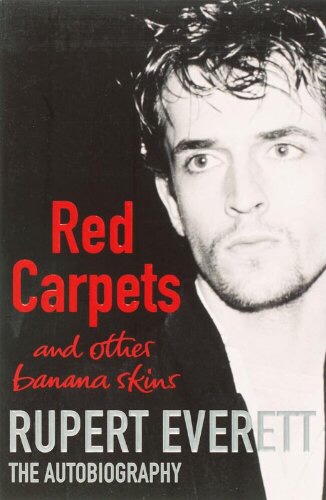
Red Carpets and Other Banana Skins by Rupert Everett

I became fascinated with Rupert Everett after seeing him on Graham Norton’s chat show and finding him both hilarious and painfully honest, both about himself and others. I loved his wit and comic timing in My Best Friend’s Wedding and especially in the Oscar Wilde films he starred in. I was pleased to find he was a devotee of Wilde, who wanted to make an honest film about his later life. My best friend from university always sends me a book at Christmas and I was lucky enough to receive a signed copy of his second memoir Vanished Years. I made sure I found a copy of his first memoir above so I could read them back to back. They both lived up to my expectations. I seem to remember first noticing him in conjunction with Madonna back in the 80’s and he had come across as a pretty boy in that context, but there is so much more to that rather spoiled exterior. His performance in Another Country was exceptional and his eventual film of Oscar Wilde was extraordinarily moving, but it is the drama of his private life that has attracted more attention than his talent. These memoirs show that he has always been surrounded by interesting and notorious people, becoming friends with Andy Warhol by the time he was 17. He has been friend to some of the most famous women in the world: Donatella Versace, Bianca Jagger, Sharon Stone and Faye Dunaway. This notoriety and films such as Dunstan Checks In overshadow incredible work with the RSC and I finally saw him shine on stage in the West End as Professor Higgins in Pygmalion.

I have always known, from his interview with Graham Norton, that Everett is a raconteur, but these memoirs show he can write a great story too. He has an uncanny ability to be at the centre of dramatic events: he was in Berlin when the wall came down, in Moscow at the end of Communism and in Manhattan on September 11th. The celebrity stories are deliciously gossipy and terribly honest. It seems Everett doesn’t hold anything back, whether he’s lampooning someone else or himself. His second memoir is again mischievous, but also touching with stories from childhood and early life. He takes the reader on an amazing journey around the world and from within the celebrity circus from LA to London. I loved the addition of family stories, such as a pilgrimage to Lourdes with his father that is both hilarious and moving. There’s a misguided step into reality TV that goes horribly wrong. A lot of celebrity authors are easy on themselves, writing solely from their own perspective rather than presenting life objectively. Everett is unfailingly honest, presenting his flaws and tragedies with the same scrutiny and irreverence he gives to others. Both books are incredibly enjoyable, a journey with the best and most disreputable storyteller you will ever meet.

Rupert Everett as Oscar Wilde

The Storyteller by Dave Grohl.

One of my favourite video clips recently was of the Westboro’ Baptist Church protesting outside a Foo Fighter’s gig. Then with perfect timing around the corner came a couple of majorettes, followed by a flat bed truck with a band playing The Beatle’s ‘All You Need Is Love’. On the back stood Dave Grohl with a microphone, shouting out their love for the protestors. I’ve always known that Grohl was a good guy and despite only enjoying some of the Foo Fighter’s music I’ve always thought he was an interesting and enlightened person. I’ve also wondered how he recovered following the suicide of Nirvana front man and personal friend Kurt Cobain, an event that stood out in my mind in the same way the death of John Lennon did for my parents. I loved Grohl’s humour and willingness to make an idiot of himself. My best friend and I rewatched the Tenacious D video for Tribute where Grohl is painted red and given an amazing pair of horns as Lucifer. I was bought this book last Christmas by my stepdaughters. However, it was only recently, after the death of another bandmate and friend Taylor Hawkins, that I picked it up and read a few pages every night in bed.

Grohl addresses my reservations about about celebrity memories straight away, stating that he’s even been offered a few questionable opportunities: ‘It’s a piece of cake! Just do four hours of interviews, find someone else to write it, put your face on the cover, and voila!’. Grohl writes his early experiences with fondness and an obvious nostalgia. He found the writing process much the same as writing songs, with the same eagerness to share the stories with the world. He has clearly linked back to old memories and emotions, feeling as if he was recounting ‘a primitive journal entry from a stained notebook’. He has definitely embraced the opportunity to show us what it was like to be a kid from Springfield, Virginia with all the crazy dreams of a young musician. He takes us from gigging with Scream at 18 years old, through his time in Nirvana to the Foo Fighters. What’s lovely is that same childlike enthusiasm while jamming with Iggy Pop, playing at the Academy Awards, dancing with AC/DC and the Preservation drumming for Tom Petty or meeting Sir Paul McCartney at Royal Albert Hall, hearing bedtime stories with Joan Jett or a chance meeting with Little Richard, to flying halfway around the world for one epic night with his daughters…the list goes on. We may know some of these stories, but what he promises is to help us reimagine these stories, focused through his eyes. I’ve seen reviews that claim he has glossed over or withheld some of the truth of his experiences, particularly around Kurt Cobain with Courtney Love absent from proceedings. I don’t think this is being disingenuous, I think this is what Dave Grohl is like – generous, humble and honest with regard to his own take on events. Perhaps he feels other people’s stories are their own and not his to tell. I was so impressed with how grounded he is and how aware of the most important things in his life: his family; his daughters; his friends; those who remind him of where he’s come from; and lastly, his music.

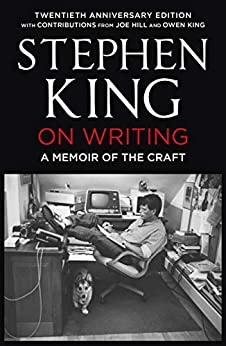
On Writing: A Memoir of the Craft by Stephen King.

Stephen King begins this memoir with the accident that he says has made the last twenty years of his life an incredible gift. With some humour he recounts being on his four mile daily walk and taking a break to relive himself in the woods. As he was returning to the road, a van driver was simultaneously trying to prevent one of his dogs rummaging in a beer cooler. This unlucky coincidence meant King was in a position to be struck as the van swerved off the road. A man who witnessed the crash watched as the impact threw King up and over the van, smashing the windscreen with his head and propelling him into a ditch 14 feet away. Local man, Donald Baker, found King ‘in a tangled-up mess, lying crooked, and had a heck of gash in his head. He kept asking what had happened.’ The van driver seemed devoid of emotion or panic, claiming he thought he’d hit a deer until he noticed King’s bloody glasses on his front seat. In a strange parody of his bestselling novel Misery King was left hospitalised with a shattered hip and pelvis, broken ribs, a punctured lung and fractured femur. The driver died only one year after the accident, from unrelated causes. It took King months to recover, with some limitations remaining to this day.

This strange hybrid book comes out of that time, from that trauma which affected him mentally as well as physically, back to his childhood, his early adult life, his marriage and the drinking that nearly cost him his relationship. If people read this hoping to read a masterclass or a shortcut to writing a bestseller, they’ll be disappointed. You don’t need a fancy masterclass to be a writer, you simply need to write. However, he does explore his own process and influences. There’s some practical advice on character building and plotting, showing how a spark of an idea was turned into Carrie. He also talks about pace, plots and presentation of a manuscript. He talks about he origins and development of certain books and uses examples of other writer’s work to illustrate what he’s advising. What he can’t do is identify that magic or spark that made him a No 1 bestseller for almost half a century. I enjoyed his stories about his early adult years when he was struggling financially, but was so persistent. The jobs he had to take to support his family, when the writing simply wasn’t paying. He was teaching by day and writing in the evenings. He also talks about the perceptions of him in the industry, perceptions I have always thought unfair, that despite incredible economic success and prolific output, he will never be considered a good writer. I loved his advice to write in a room with blinds and a closed door, if you’re not distracted by a view it is easy to disappear into a vista of your own making. He also plays loud rock music, but that wouldn’t be for me, I need silence or calm background music, no TV and no talking. It’s true that every writer needs their own best conditions for writing – although a closed door with no interruptions seems universal – you will need to find your own process. However, I do think he hits upon something important about life, like Dave Grohl, and that is the importance of family to ground us and stand by us while we create and especially when economic success does come.


Posted in Random Things Tours

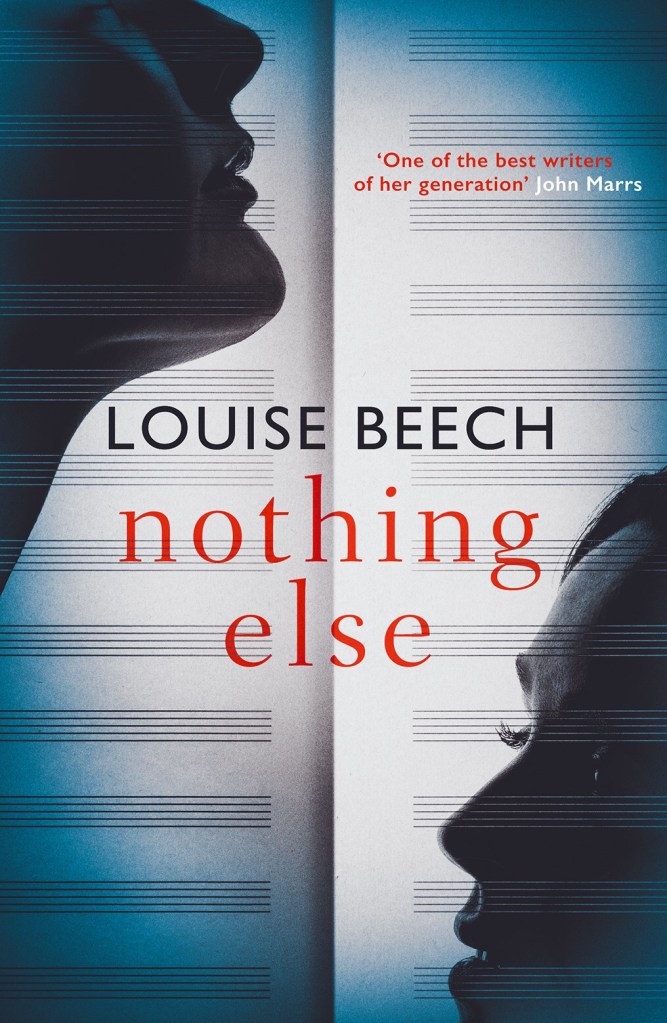
Nothing Else by Louise Beech.

Louise Beech’s new novel, pulls us into the emotional and traumatic life of Heather, a pianist who lives in Hull. She teaches and plays in local bars, then relaxes in her harbour front flat looking out to the Humber Estuary and the North Sea. Heather has a quiet life and quite a solitary one too. She has no family and relies more on her strong connections with friends. In fact it is one of them that encourages her to try out for a job on a cruise ship, something she would never have imagined doing. She would be scheduled to play in different bars on the ship through the day, but as her friend says, she can enjoy the facilities and gets to travel. This particular cruise is stopping in New York then on to the Caribbean before doing it all again in reverse. There’s something lonely and a bit melancholy about her and we learn that Heather and her sister have grown up in the care system, after their parents were killed. Music was the girl’s escape, once their mother had convinced their father it wouldn’t hurt for them to learn on the piano they were given. They both had an aptitude for music, but it was Heather’s salvation, the only place she could fully express her emotions. With their father unwilling to pay for lessons, their mother secretly sent them to piano teacher Mr Hibbard who lived a few doors away. When their parents died, both girls were taken into a children’s home together, but one morning her sister Harriet was taken to see the staff in the office and Heather never saw her again. She could only hope that a kind family had adopted Harriet, but for some reason hadn’t been able to take her too. When the girls had most needed to express themselves they would play a duet they had composed called Nothing Else. It was this piece of music that stayed with Heather all her life, instantly taking her back to the piano and her little sister.

Heather’s chapters follow her current life and the piano job she applies for on a cruise ship. Here and there the author takes us back in time to her childhood, where their father was a controlling and violent man and Heather felt responsible for keeping her little sister Harriet safe. Like all children who have traumatic home lives, Heather had become attuned to the slightest hint of tension. She knew when her father was going to explode and on those nights where the sounds downstairs were terrifying, Heather would keep Harriet out of earshot and they felt safe when they were tucked up in just one bed. She was also aware that their father preferred cute and cheeky Harriet, so knew to stay quiet and keep her head down. These sections from the past are traumatic and very moving. The author maintains the tension in these flashbacks, until we too are on edge, always waiting for something to happen. The author moves deftly between the experiences of Heather as a child in the middle of this situation, and a grown up Heather commenting on what happened with the clarity and insight of an adult. There were brilliant present day sections onboard the cruise ship where Heather befriends a writer who is also working aboard, teaching sessions in creative writing. Heather joins her morning sessions and finds them much deeper than she expected. I could recognise this from the writing therapy sessions I’ve facilitated – the prompt is always just a starting point and eventually you start writing what you need to write about. This definitely happens to Heather and is one way of processing the care records she applied for before the trip, dipping into them little by little, like a reluctant bather dipping her toe into the cold, deep water. She doesn’t want to be overwhelmed.

Harriet has her own section of the book, again split into her current life and the past she doesn’t fully understand. Now living in America, Harriet has a daughter whose left home and case of empty nest syndrome. Her flashbacks into the past remind us that Heather’s story is only part of this family’s history and Harriet may have a very different tale to tell. We learn most when their narratives overlap and we see a subtly different side of the events Heather describes, like two sides of the same coin. Again, it’s psychologically very clever and gives the perspective of the younger sibling, the one who is cared for and shown love by her big sister. I was longing to know what had happened at the children’s home. Where did Harriet go and how was she persuaded to go without her sister? Thanks to all of these questions and my curiosity over whether the sisters would ever meet again, I was totally gripped by the story and immersed into the worlds of these sisters. I enjoyed their different characters, developed by their separate upbringings, as well as their different experiences with their parents due to their ages. There are secrets that neither child was aware of, so there are some rewarding revelations to be found. I was eager to know if the sisters were somehow able to find each other. Mainly though, I was moved to read their tales of childhood trauma and wanted to understand the adults they became in light of that experience. Which of their characteristics could be explained by the past? There’s a cautiousness in Heather, because her ability to trust others is affected, leading to a quiet and lonely life. It was lovely to watch the cruise atmosphere, and proximity to others, forcing her into being sociable and to make friends. There’s a sense that she’s coming alive in these moments, which felt hopeful and uplifting. This was an addictive read that beautifully captured how childhood trauma and it’s effects can follow us into adulthood. The author showed, so beautifully, that it’s only by sharing and in this case, playing out that experience that we begin to heal.

Published by Orenda Books 23rd June 2022

Meet The Author

All six of Louise Beech’s books have been digital bestsellers. Her novels have been a Guardian Readers’ Choice, shortlisted for Not the Booker Prize, and shortlisted for the RNA Most Popular Romantic Novel Award. Her short fiction has won the Glass Woman Prize, the Eric Hoffer Award for Prose, and the Aesthetica Creative Works competition, as well as shortlisting for the Bridport Prize twice. Louise lives with her husband on the outskirts of Hull. Follow her on Twitter @louisewriter

Posted in Queen’s Platinum Jubilee

Commonwealth Authors for the Platinum Jubilee.

India. Jasmine by Bharati Mukherjee –

When Jasmine is suddenly widowed at 17, she seems fated to a life of quiet isolation in the small Indian village where she was born. But the force of Jasmine’s desires propels her explosively into a larger, more dangerous, and ultimately more life-giving world. In just a few years, Jasmine becomes Jane Ripplemeyer, happily pregnant by a middle-aged Iowa banker and the adoptive mother of a Vietnamese refugee. Jasmine’s metamorphosis, with its shocking upheavals and its slow evolutionary steps, illuminates the making of an American mind; but even more powerfully, her story depicts the shifting contours of an America being transformed by her and others like her – our new neighbors, friends, and lovers. In Jasmine, Bharati Mukherjee has created a heroine as exotic and unexpected as the many worlds in which she lives. For me this was an incredible eye-opener into the immigrant experience and how identity is formed and changed, both by the British culture imposed on India, and the cultures Jasmine encounters on her travels.

Award-winning Indian-born American author Bharati Mukherjee was born in Calcutta (now called Kolkata) in 1940, the second of three daughters born to Bengali-speaking, Hindu Brahmin parents. She lived in a house crowded with 40 or 50 relatives until she was eight, when her father’s career brought the family to live in London for several years. Mukherjee is best known for her novels “The Tiger’s Daughter” (1971); “Wife” (1975); “Jasmine” (1989); “The Holder of the World” (1993); “Leave It to Me” (1997); “Desirable Daughters” (2002); “The Tree Bride” (2004); and “Miss New India” (2011). Her short story collections and memoirs include “Darkness” (1985); “The Middleman and Other Stories” (1988); and “A Father”. Non Fiction works include: “Days and Nights in Calcutta”; and “The Sorrow and the Terror.”

Nigeria. Things Fall Apart by Chinua Achebe – One of the BBC’s ‘100 Novels That Shaped Our World’

A worldwide bestseller and the first part of Achebe’s African Trilogy, Things Fall Apart is the compelling story of one man’s battle to protect his community against the forces of change. Okonkwo is the greatest wrestler and warrior alive, and his fame spreads throughout West Africa like a bush-fire in the harmattan. But when he accidentally kills a clansman, things begin to fall apart. Then Okonkwo returns from exile to find missionaries and colonial governors have arrived in the village. With his world thrown radically off-balance he can only hurtle towards tragedy. First published in 1958, Chinua Achebe’s stark, coolly ironic novel reshaped both African and world literature, and has sold over ten million copies in forty-five languages. This arresting parable of a proud but powerless man witnessing the ruin of his people begins Achebe’s landmark trilogy of works chronicling the fate of one African community, continued in Arrow of God and No Longer at Ease. This is a deeply moving look at how empire changed people’s lives and took apart their communities.

Chinua Achebe was a Nigerian novelist, poet, professor, and critic. His first novel Things Fall Apart (1958) was considered his magnum opus, and is the most widely read book in modern African literature. Raised by his parents in the Igbo town of Ogidi in South-Eastern Nigeria A titled Igbo chieftain himself, Achebe’s novels focus on the traditions of Igbo society, the effect of Christian influences, and the clash of Western and traditional African values during and after the colonial era. His style relies heavily on the Igbo oral tradition, and combines straightforward narration with representations of folk stories, proverbs, and oratory. He also published a number of short stories, children’s books, and essay collections.

Also Chimimanda Ngozie Adichie

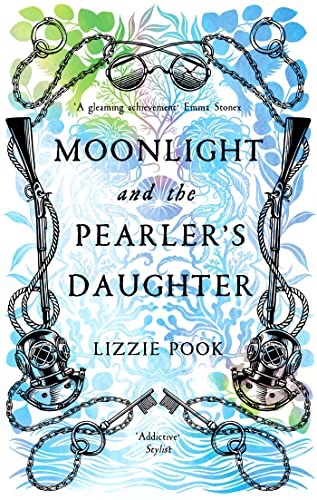
Australia: Moonlight and the Pearler’s Daughter by Lizzie Pook

It is 1886 and the Brightwell family has sailed from England to make their new home in Western Australia. Ten-year-old Eliza knows little of what awaits them in Bannin Bay beyond stories of shimmering pearls and shells the size of soup plates – the very things her father has promised will make their fortune. Ten years later, as the pearling ships return after months at sea, Eliza waits impatiently for her father to return with them. When his lugger finally arrives however, Charles Brightwell, master pearler, is declared missing. Whispers from the townsfolk point to mutiny or murder, but Eliza knows her father and, convinced there is more to the story, sets out to uncover the truth. She soon learns that in a town teeming with corruption, prejudice and blackmail, answers can cost more than pearls, and must decide just how much she is willing to pay, and how far she is willing to go, to find them.

This incredible debut is richly atmospheric from the get go, throwing us straight into the strangeness of 19th Century Western Australia as if it is an alien landscape. In fact that’s exactly what it is for the Brightwell family, particularly Eliza whose childhood eyes we see it through for the the first time

Lizzie is an award-winning writer and journalist. She is the author of Moonlight and the Pearler’s Daughter, a STYLIST and WOMAN & HOME ‘Best Books of 2022’ pick.

Lizzie began her career in women’s magazines, covering everything from feminist motorcycle gangs to conspiracy theorists, before moving into travel writing. Her assignments have taken her to some of the most remote parts of the world, from the uninhabited east coast of Greenland in search of polar bears, to the trans-Himalayas to track snow leopards. She was inspired to write Moonlight and the Pearler’s Daughter, her debut, after taking a road trip through Australia with her twin sister after the death of their father. A chance visit to the Maritime Museum in Fremantle led her to an exhibition about a family of British settlers involved in the early pearl diving industry. Thus began an obsession and a research journey that would take Lizzie from the corridors of the British Library to isolated pearl farms in the farthest reaches of northwest Australia.

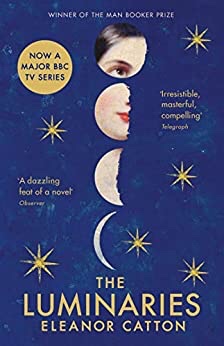
New Zealand: The Luminaries by Eleanor Catton

It is 1866, and Walter Moody has come to make his fortune upon the New Zealand goldfields. On arrival, he stumbles across a tense gathering of twelve local men, who have met in secret to discuss a series of unsolved crimes. A wealthy man has vanished, a whore has tried to end her life, and an enormous fortune has been discovered in the home of a luckless drunk. Moody is soon drawn into the mystery: a network of fates and fortunes that is as complex and exquisitely patterned as the night sky. The Luminaries is an extraordinary piece of fiction. It is full of narrative, linguistic and psychological pleasures, and has a fiendishly clever and original structuring device. Written in pitch-perfect historical register, richly evoking a mid-19th century world of shipping and banking and goldrush boom and bust, it is also a ghost story, and a gripping mystery. I loved this epic tale of mystery and adventure, with a spooky edge. This has recently been adapted for television and is worth a watch.

Eleanor Catton MNZM (born 24 September 1985) is a Canadian-born New Zealand author. Her second novel, The Luminaries, won the 2013 Man Booker Prize. In January 2015, she created a short-lived media storm in New Zealand when she made comments in an interview in India in which she was critical of “neo-liberal, profit-obsessed, very shallow, very money-hungry politicians who do not care about culture.”

Also Janet Frame

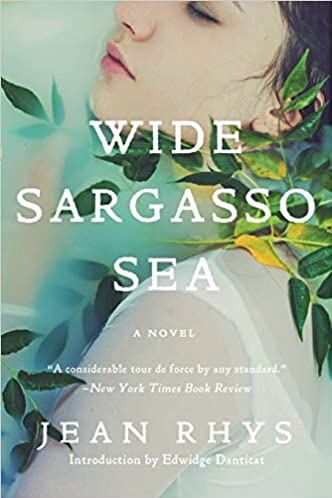
Jamaica and Dominica. Wide Sargasso Sea by Jean Rhys

I first read this novel while at uni, as a post-colonial response to Jane Eyre by Charlotte Brontë. Rhys was fascinated by Bertha Mason, Mr Rochester’s wife and the original ‘Madwoman in the Attic’. Born into the oppressive, colonialist society of 1930s Jamaica, white Creole heiress Antoinette Cosway meets a young Englishman who is drawn to her innocent beauty and sensuality. After their marriage, however, disturbing rumours begin to circulate which poison her husband against her. Caught between his demands and her own precarious sense of belonging, Antoinette is inexorably driven towards madness, and her husband into the arms of another novel’s heroine. This classic study of betrayal, a seminal work of postcolonial literature, is Jean Rhys’s brief, beautiful masterpiece. I loved how Rhys breathed life and a complex identity into a character seen as a Gothic monster, trying to burn her husband in his bed and stabbing her own brother. It raises questions about identity and colonialism, women’s identity and sexual desire. It also shows a great modernist contrast to the original novel.

Jean Rhys was born in Dominica in 1894. After arriving in England aged sixteen, she became a chorus girl and drifted between different jobs before moving to Paris, where she started to write in the late 1920s. She published a story collection and four novels, after which she disappeared from view and lived reclusively for many years. In 1966 she made a sensational comeback with her masterpiece, Wide Sargasso Sea, written in difficult circumstances over a long period. Rhys died in 1979.

Recent and Favourite Reads from Black British Writers

Louise Hare – This Lovely City. The experiences of the Windrush generation in 1950’s London, combining crime fiction and a love story.

Lizzie Damilola Blackburn – Yinka, Where Is Your Huzband? Nigerian-British young women negotiating courtship, identity, marriage and motherhood. Yinka is single and is constantly reminded of this by her mum and aunties. Funny, but touching too. You’ll fall in love with Yinka!

Bernadine Evaristo – Girl, Woman, Other. Stories exploring black womanhood from Newcastle to Cornwall. A series of stories looking at identity, race and motherhood in modern Britain. Winner of the Booker Prize.

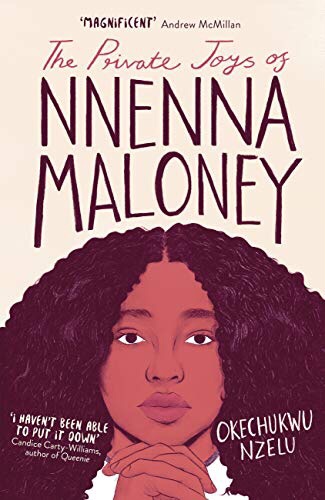
Okechukwu Nzelu -The Private Joys of Nnenna Maloney. Set in Manchester, this is the story of Nnenna Maloney through her journey of trying to connect with Igbo-Nigerian culture as she reaches adulthood.

Paul Mendez – Rainbow Milk. This queer literary debut follows Norman, a Jamaican immigrant in 1950s Black Country battling racism, disability and personal conflict, as he rebels against his religious upbringing.

Leanne Dillsworth – Theatre of Marvels. Black British actress Zillah performs as a tribeswoman in a variety show. Looking at spectacle, identity and exploitation in Victorian London.

Andrea Levy – Small Island. WWII and the Windrush in London. Exploring expectations against reality for Jamaican settlers in the U.K. Looking at loss and the aftermath of war, but also mixed race relationships and identity.

BBC Arts and The Reading Agency have announced the titles for the Big Jubilee Read, a reading for pleasure campaign celebrating great reads from celebrated authors from across the Commonwealth to coincide with Her Majesty The Queen’s Platinum Jubilee. The full list can be found by following the link below. The seventy titles consist of ten books from each decade of Her Majesty The Queen’s reign, offering a brilliant selection of beautiful and thrilling writing produced by authors from a wide range of Commonwealth countries.

The campaign enables readers to engage in the discovery and celebration of great books and shines a spotlight on lesser-known books and authors that deserve recognition.The books were chosen by an expert panel of librarians, booksellers and literature specialists from a “readers’ choice” longlist. Delivered with public libraries, reading groups, publishers, bookshops, and authors, the Big Jubilee Read campaign will use the proven power of reading to unite the public around the shared stories that define our social and cultural heritage.

Follow the latest developments on social media:
@ReadingAgency @BBCArts @ACE_National
#BigJubileeRead

You can find the list of 70 books and resources for your own reading group or book club via the link below

https://readinggroups.org/big-jubilee-read

Posted in Random Things Tours

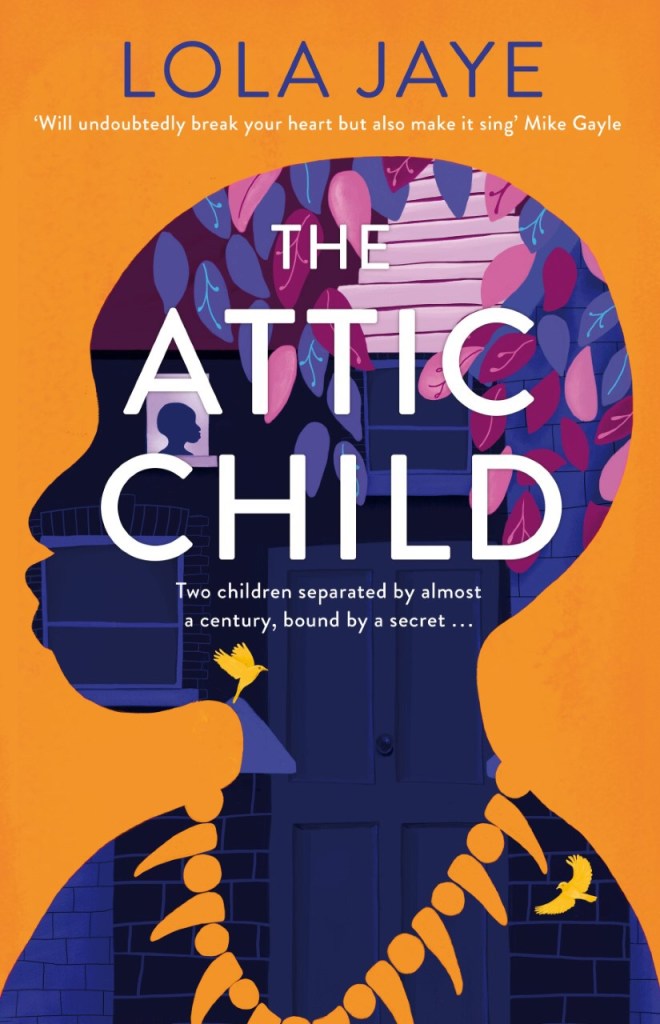
The Attic Child by Lola Jaye

“Until the lions have their own historians, the history of the hunt will always glorify the hunter.”
Chinua Achebe (Author)

I have been gathering books over the last few weeks, from all the countries of the Commonwealth. This is for a book stall on the Platinum Jubilee weekend, at our village celebrations. I run the village book exchange in an old red phone box on the green and I keep unwanted proofs until their publication date and then pop them in there for borrowing. I could have just found books relating to Elizabeth II but I wanted to look at the jubilee from a global viewpoint and include the voices of all the Queen’s subjects. For me that includes voices from countries that were once part of our empire, some of whom are now under the Commonwealth banner. I think these other voices are important; those who are literally silenced, but also those not listened to because were simply not the white, middle class, man that society is used to listening to. This book has a beautiful example of one such voice. Celestine Babbington is recorded for history in a silent form, photographed wearing clothes he didn’t choose and posing with a man whose relationship to him is very problematic. The man, Richard Babbington, is a rich explorer who has a love for Africa and a large mansion house in England. Yet by 1907, Celestine is being kept in the attic of the house, only allowed out to work as a domestic slave.

Years later, a young girl called Lowra is suffering the same fate. Locked in the attic as punishment for any transgression, when her fate has been left in the hands of her resentful stepmother. After her mother died, Lowra’s dad remarried and from that day on her life was punctuated by spells of abuse. While locked in the attic she finds an unusual necklace with clawed hands, unlike anything she’s seen before. There’s also an old-fashioned porcelain doll and a sentence on the wall, written in an unfamiliar language. These are her only comfort, because she feels as if the person that owned them is with her in some way. As an adult, her stepmother’s abuse still affects her and she’s conflicted when she inherits Babbington’s house. People seem to think she’s lucky and the town is proud of this intrepid explorer. Looking into the house’s history leads her to an exhibition of Babbington’s life, where she sees photographs of Babbington and a young black boy wearing an African wrap and what looks like her necklace, the one from the attic. However, the thing that keeps Lowra transfixed, is the young boy’s eyes. Lowra sees someone filled with sorrow, a fellow sufferer of the darkness inside that house. His name is Celestine Babbington. Lowra wants to find out more about this boy, how he came to be in England and what happened to him after Babbington’s death. She enlists the help of a history specialist called Monty, who has an interest in stories that have not been told, particularly those of empire. Together they start their search for the attic child.

I think anyone who talks about the glory of our empire should be encouraged to read this book. It’s fitting that the opening quote of the book is from the incredible author Chinua Achebe, because his novel Things Fall Apart is a perfect companion to this tale. This time the story is partially told by the most innocent victim of our Victorian forays into Africa, a child called Dikembe who is largely ignorant of exactly what atrocities are being carried out by the Belgian forces plundering the natural resources of his homeland. At the time of Dikembe’s childhood, his homeland was named the Belgian Congo, a large area of Africa known as Zaire, then the Democratic Republic of Congo. Very few Europeans had reached this area of Africa, known for tropical diseases like sleeping sickness. King Leopold of Belgium had urged the Belgian Government to colonise the country, but when they stalled their efforts he decided to take charge himself. He took ownership of the country and named it the Congo Free State in 1885, using his private army the Force Publique to press gang Congolese men and boys to work for him in the production of rubber. No one knows the exact population of the country at this time, but due to exploitation and the exposure to new diseases it is estimated that up to ten million native people died during Leopold’s rule of the country. Dikembe is young enough to stay at home each day with his mother, but he envies his brothers who go off to work with their father every morning. His parents keep him ignorant of the way native workers were treated so it is an utter shock when his father is killed one day. Richard Babbington, based on Henry Morton Stanley, expresses an interest in Dikembe. He wants to take him back to England and turn him into a gentleman and his companion. Ridden with grief and terrified about what could happen to her youngest son, his mother agrees, knowing this may be the only way to keep him safe. Although his intentions seem pure, isn’t this just another form of colonisation? He then takes away Dikembe’s name, calling him Celestine Babbington.

I found both children’s circumstances heartbreaking and could see that they might have an affinity, because Lowra sees something in the photographs that is probably echoed in her own eyes. I thought the two character narrative worked really well here, but all of the characters are so well crafted that they pulled me into their stories and didn’t let go till the end. We’re with Lowra and Monty on their quest, finding out more about Dikembe’s story and we experience the effect these revelations have on all the characters. It’s moving to see Monty identifying with Dikembe and feeling emotional pain from the injustices he has gone through. Monty still experiences racism and oppression, just in different ways and Lowra can’t be part of that even though she has empathy for how Monty feels. Lowra can feel an instant kinship with Dikembe over the abuse they’ve suffered and those lonely hours in the dark of the attic. I also liked how Monty and Lowre worked together and slowly come to know each other by being honest about their pasts and what effect their life experiences have had on them mentally. Lola Jaye has managed to engage the emotions, but also educate me at the same time, because I didn’t know much about the Belgian empire or King Leopold’s exploitation and murder of the Congolese population. However, it was those complex issues of identity and privilege that really came across to me, especially in the character of Richard Babbington. His arrogant assumption that he could give Dikembe a better life is privilege in action, as Dikembe soon finds out that he’s a womanising drunk and the companionship he spoke of only works one way. All he does bestow is money, for clothes and school, but what Dikembe craves is the warmth and love of his mother calling him a ‘good child’. The way this need for love and comfort was also exploited made me cry. I was desperately hoping that by the end, these terrible injustices didn’t stop him living his life to the full, including embracing happiness when the chance came his way. We see this play out for Lowra during the novel, can she ever accept that she is worthy of love? I wasn’t surprised to learn that Lola Jaye is a therapist, because she understands trauma and how it can manifest through several generations. The story doesn’t pull it’s punches so I felt angry and I felt sad, but somehow the author has managed to make the overall message one of hope. Hope in the resilience of the human spirit.

Meet The Author

Lola Jaye is an author and registered psychotherapist. She was born and raised in London and has lived in Nigeria and the United States. She has a degree in Psychology and a Masters in Psychotherapy and Counselling. She has contributed to the sequel to the bestseller Lean In, penned by Facebook COO Sheryl Sandberg, and has also written for the Huffington Post, CNN, Essence, HuffPost and the BBC.

She is a member of the Black Writers’ Guild and the author of five previous novels. The Attic Child is her first epic historical novel.

Posted in Monthly Wrap Up

Books Of The Month! April 2022.

It’s been another bumper book month at The Lotus Readers and it looks like 2022 is going to be an amazing reading year, in fact I’m already worrying about how I’m going to choose between these books when it comes to my end of year list. Can I really do 22 books this year? It’s also a year of fantastic debuts with another four debut novels being top of my list this month. There’s been a few tears shed over some of the stories and characters within these pages, but I’ve been uplifted too by these stories of overcoming. Surviving trauma and recovering through the support of others, particularly where women are supporting women, has been a theme here too. Its been the first month where I’ve been able to sit in the garden with a book, so most of these have accompanied me outside and onto my recliner, usually ending with me falling asleep under a dog and a cat! So here are some shortened reviews, to whet your appetite for these wonderful novels,

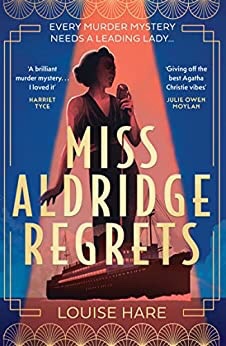
Reminiscent of those stylish novels of the great Agatha Christie, this was a brilliant mystery with a glamorous location, wealthy passengers and sumptuous clothes and jewellery. The period detail is spot on whether it’s the latest bathing suit or 1930’s politics. It’s not just a whodunnit either, because woven within are themes of identity, belonging, family and class division. It’s gripping without being showy or depending on shocks, or endless twists and turns. It’s elegant and allows it’s secrets to unfurl slowly. Lena is a sympathetic character, who has sacrificed starting her career to care for her father Alfie who has recently died. To pay the bills Lena has been singing in a club band, but she has always wanted to work on the West End or Broadway. Her chance comes in the aftermath of a death at the club. A favour from a an old friend of her father. She’s found by theatre producer’s assistant, Charlie Bacon, whose boss is offering Lena the chance of a lifetime, a part on Broadway in a new musical. As they set off across the Atlantic in their first class accommodation, they make the acquaintance of a very wealthy family with an ailing patriarch. What follows is intrigue, murder, mayhem and the realities of being a black performer. Lena is now caught up in a murder plot, and doesn’t know if she’ll be the next suspect, or victim.

Incredibly strong women, three generations of a Memphis family, are the focus of this amazing debut by Tara Stringfellow that made me angry, made me cry and somehow helped me feel uplifted all at the same time. Grandma Hazel is the first resident of the house in Memphis, a house her sweetheart Myron builds for their family. When he is lynched by his own police squad, Hazel is nine months pregnant and left heartbroken, angry and scared. Her daughters, Miriam and August, then call this place home and it also becomes August’s place of work. When Miriam leaves home, travelling with her husband Jax who is in the military, August turns the back of the house into a hair salon for a community of black women who gather there to laugh, to support each other and to plan activism. When Miriam returns with her own daughters, Joan and Myra, she has mixed feelings. She needs a roof over her head, she loves where she grew up, but something happened here that daughter Joan can’t quite remember. Yet she feels I’ll, deep down. There’s fear and shame in this place, but she doesn’t know why and we follow her quest to process and heal from this hidden trauma. With a backdrop of the biggest events of the 20th Century from the Kennedy and Martin Luther King assassinations to 9/11, this is a story of what it means to be a black woman in 20th Century America. Simply outstanding.

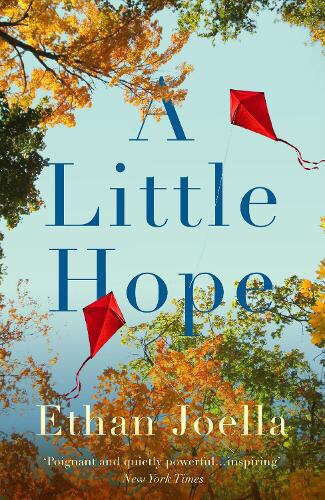
Ethan Joella’s novel was perfect for this moment in life. Set in an idyllic Connecticut town over the course of a year, our story follows the intertwining lives of a dozen neighbours as they confront everyday desires and fears: an illness, a road not taken, a broken heart, a betrayal. Freddie and Greg Tyler seem to have it all: a comfortable home at the edge of the woods, a beautiful young daughter, a bond that feels unbreakable. But when Greg is diagnosed with a rare and aggressive form of cancer, the sense of certainty they once knew evaporates overnight. Meanwhile, Darcy Crowley is still coming to terms with the loss of her husband as she worries over her struggling adult son, Luke. Elsewhere, Ginger Lord returns home longing for a lost relationship; Ahmed Ghannam wonders if he’ll ever find true love; and Greg’s boss, Alex Lionel, grapples with a secret of his own. We are all familiar with the hashtag #BeKind and through these stories, what seems like a platitude, is brought home to the reader. Our characters touch on each other’s lives, sometimes without knowing what each other are coping with just under the surface. Despite taking us through every experience from infidelity to loss, the book never feels overwhelming or melancholy. Yes I wanted to shed tears from time to time, but somehow there is always a ray of hope. It reminded me that things like community, friendship, shared experiences and compassion can change everything. The author doesn’t hold back on how difficult and painful life can be, but yet always finds some element of joy that reminds us what a gift it is too. This book is poetic, achingly beautiful and full of empathy for the human condition.

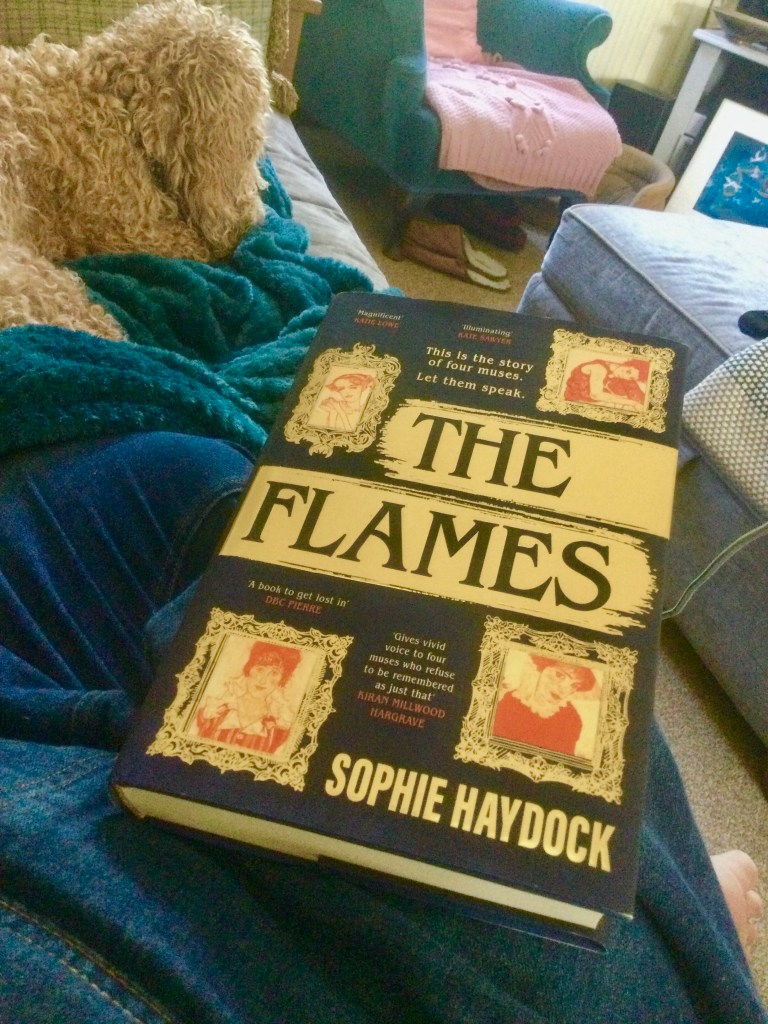
I knew this book would be one I enjoyed, after all it encompasses some of my favourite things: History between the World Wars; the Vienna Secession and Gustav Klimt; Art Nouveau; a feminist narrative. However, I didn’t expect it would grab hold of me in the way it did! I sat down with it in the garden one Sunday afternoon and read two thirds straight away. When duty and blog tours called that week I had to set it aside, but I kept glancing over at it like a lost lover all week. Haydock takes four of Egon Schiele’s portraits and explores the women depicted – society sisters Adele and Edith, artists model Wally and his younger sister Gertie. Schiele’s portraits are not life-like reproductions of his model and while they might shed light on aspects of their characters, they can only ever be the artist’s view of that woman with all the prejudices and biases of his time. Haydock is challenging Schiele’s representation of these women and here we get to hear the women’s stories, how they see themselves and their relationship with Schiele. Some of his life choices felt like betrayals to those women who risked everything by literally laying themselves bare before him and the world, for his sake and for the sake of art. I thought Haydock beautifully captured this sacrifice and it’s consequences, something she picks up beautifully in the short interludes from the 1960’s where an elderly woman searches for a painting she’s glimpsed of someone she loved. Desperate to give an apology she never heard in life. Haydock beautifully captures a rapidly changing Vienna between two World Wars where barriers of class and gender are breaking down. She also captures the complexities of the barriers for women and those who have the pioneering spirit to break them. She gives a voice to their silent gaze. This is one of the best books I’ve read so far this year and I read it greedily in just two sessions. I’m already looking forward to entering Haydock’s world and savouring these wonderful women again.ok”

My interest in 19th Century freak shows, Sarah Baartman (the Hottentot Venus), disability and difference, made Lianne Dillsworth’s debut novel a perfect fit for me. Our setting is a theatre and a performing troupe including singers, magicians and dancers who perform a variety show under the watchful eye of Mr Crillick. His current headline act is Amazonia – a true African tribeswoman, dressed in furs and armed with a shield and spear, her native dancing brings down the house in Crillick’s show. The audience watch, transfixed with fear and fascination, never realising that she is a ‘fagged’ act. Zillah has never set foot in Africa and is in fact of mixed race heritage, born in East London. She is making her money by pretending to be what the, largely white, audience wants to see. It doesn’t sit well with Zillah, but she is alone in the world and does need to make money. Besides it’s better than the other options for a young woman who finds herself in poverty. She’s used to slipping between worlds on stage and in her private life, renting a room in the rough St Giles area of the city, but regularly making her way to a more salubrious area and the bed of a Viscount by night. However, when Crillick brings a new exhibit to his London home, dubbed the Leopard Lady, Zillah’s eyes are opened to the politics and misogyny of displaying difference. A meeting with an activist forces her to think about her own performance, but also the danger that Crillick’s new exhibit might be in, especially his ‘private’ audiences complete with medical equipment. Can Zillah help this woman and what does her own future hold, because in good conscience she can no longer perform? This is a brilliant novel, doing for race and disability, what Sarah Water’s novels did for the representation of sexuality in the 19th Century.

I’d never read a novel by Dolen Perkins-Valdez and she pulled me into her story from the very first page, with Civil seeming real almost immediately. I’ve been interested in eugenics since I wrote my undergraduate dissertation on disability and 20th Century literature. I knew a lot about the movement in the U.K., US and Germany in the lead up to WW2, but this book shocked me because I had no idea that forced sterilisations were still happening in the 1960s and 70s. I knew this had happened in earlier in the century with Native American communities, so I shouldn’t have been surprised that it was still happening to African American women, especially where the woman had a disability too. The writer shows how our biases and emotions feed into the work we do within the caring professions. Having worked in mental health and disability as a support worker, advocate and counsellor, I did identify strongly with Civil and the way she became involved with the Williams family. The Williams girls are her very first patients and she is sent out on a home visit to give them a Depo Provera injection, a long term method of contraception. When she notices that India is only 11 years old her brain immediately starts questioning, who put this little girl on this injection, has anyone asked if she has a boyfriend or worse, is she being preyed upon? Is this an assumption that young African-American women are promiscuous or that African- American men can’t be trusted, even within their own families? The judgement that bringing a child into this family would be disastrous comes from a lack of knowledge around India Williams’s learning disability, but is also an assumption about race too. The fall out from Civil’s discoveries is huge and life-changing, not just for the Williams family but for Civil too. This book sheds light on an important hidden history and took me through a rollercoaster of emotions.

I fell utterly in love with Dot Watson, a rather abrupt and persnickety member of the staff at London Transport’s lost property office. It took me about five pages to be drawn into Dot Watson’s quirky world and her love for the lost property office where honest people bring their found items. Dot is like the backbone of the office and the other workers would be lost without her. A lover of proper procedure and organisation, Dot is the ‘go to’ employee for anyone starting work with the team, or just to answer a question about an item. Dot thinks lost things are very important, almost like an extension of that person. Their lost item can tell her a lot about the person they are and she fills the lost luggage tags with as much detail as possible so that they have the greatest chance of locating it. Dot believes that when we lose a person, their possessions can take us right back to the moment they were with us. When Mr Appleby arrives at the office to find his lost leather hold-all it is what the case contains that moves Dot. Inside is a tiny lavender coloured purse that belonged to his late wife and he carries it everywhere. Something inside Dot breaks for this lonely man and she is determined she will find his hold-all. Her search becomes both the driving force of Dot’s story and the key to unlocking her own memories. I loved our journey into Dot’s past, her relationship with her father and the trauma that she’s tried to lock away for so long. This book has difficult emotions, but also glimpses of humour and is ultimately an uplifting journey with an unforgettable woman.

A teenage girl wanders out of the woods. She’s striking, with flame-red hair and a pale complexion. She’s also covered in blood. She appears in the pub’s beer garden as Jonah is enjoying a beer after a walk with his baby son. Detective Jonah Sheens quickly discovers that Keely and her sister, Nina, disappeared from a children’s home a week ago. Now, Keely is here – but Nina’s still missing. Keely knows where her sister is – but before she tells, but first she wants Jonah’s full attention. Is she killer, witness, or victim? The opening scene is absolutely brilliant, vivid and shocking at the same time. As the girl’s history starts to unfold, they hear about several failed placements and a long stay in a children’s home. The girls made complaints about two of their homes, but were thought to be troublemakers. Jonah and his excellent team have to tread a very fine line. Keeley comes across as cold and calculating one moment, but then like a broken little girl the next. Which is an act? There are some very dark stories here and they could be distressing for people who’ve gone through a similar experience, but it’s that darkness that keeps the reader wanting the truth and to see those responsible punished. If Keeley has planned how to elicit sympathy from the police, she certainly knows what she’s doing. As readers we are pulled along with Jonah, from distress and empathy to disbelief and a sense that something is very, very wrong either with Keeley or the system. This is a great mystery, with huge twists in store and a police team I enjoyed getting to know. Now I’m looking forward to going back to the first novel in this series and filling in the gaps in my knowledge, while enjoying even more of this talented writer’s incredibly creative plots and dark, brooding atmosphere.

So these were my favourite reads in a very busy reading month. I read seventeen books which surprised even me! Next month I’m looking forward to a slightly quieter month with some great thrillers to read, some historical fiction from another of my favourite historical periods – the beginnings of the Tudor dynasty, and hopefully a few choices from NetGalley too so I can keep on beating that backlog. I hope you enjoy these choices as much as I did and i’ll see you again next month.

Posted in Netgalley

The Image of Her by Sonia Velton

From the author of Blackberry & Wild Rose comes an extraordinary story of two women who never meet and yet share the closest possible bond.

STELLA and CONNIE are strangers, brought together by two traumatic events – cruel twists of fate that happen thousands of miles apart.

Stella lives with her mother, a smothering narcissist. When she succumbs to dementia, the pressures on Stella’s world intensify, culminating in tragedy. As Stella recovers from a near fatal accident, she feels compelled to share her trauma but she finds talking difficult. In her head she confides in Connie because there’s no human being in the world that she feels closer to.

Connie is an expat living in Dubai with her partner, Mark, and their two children. On the face of it she wants for nothing and yet … something about life in this glittering city does not sit well with her. Used to working full time in a career she loves back in England, she struggles to find meaning in the expat life of play-dates and pedicures.

Two women set on a collision course. When they finally link up, it will not be in a way that you, or I, or anyone would ever have expected.

This was an unusual follow up to Sonia Velton’s historical fiction debut Blackberry and Wild Rose, but had the same stunning characterisation and detail that set her writing apart. This was a classy domestic thriller with two characters on such a fascinating journey. Connie and Stella are such complex characters, written with incredible psychological insight, that I felt immediately drawn into their disparate worlds.

Stella’s life has been dominated by her mother, who died after a long struggle with dementia. Stella has been her full-time carer and this would be enough to explain her sense of dislocation from the rest of the world, but their relationship was always difficult anyway. She’s now 39 and as well as feeling burnout from her caring role, she thinks her inability to connect with others has a root in their mother-daughter relationship. Utterly ground down by life, Stella realises that her mother has been psychologically abusive and manipulative her whole life. It felt to me that Stella’s mental health issues were directly related to having a narcissistic parent. It’s clear that Stella’s mother belittled her, knowing exactly which buttons to push to inflict the most pain. There was also an element of gaslighting, where her mother would deny things she’d said or convince Stella she’d misconstrued them. She never validates Stella’s feelings, so instead of acknowledging her words and apologising, she says she’s sorry that Stella felt upset.

Her mother’s love came with conditions, turning Stella into a perfectionist, constantly feeling she has to change or placate the other person to deserve their love. The perfectionism has bled into all areas of Stella’s life. Her mother wanted her to be successful, because it reflected on her own skills as a mother. Stella is very aware of how others might see her, because it was all her mother cared about – the emphasis on how things appear rather than caring how they actually are. If Stella was well-behaved, well turned out and looked pretty it didn’t matter to her mother how she felt. As she wrestles with these issues in later life, Stella doesn’t really have anyone in whom to confide. However, when she’s recovering from a serious accident, she starts a dialogue with a woman called Connie on social media. It may be the safety of not being seen, being able to hide behind the anonymity of the keyboard, but Stella feels this is someone she can trust with even her most private thoughts.

Connie is a stay at home Mum, on a compound of British families in Dubai. Her husband was offered a great job opportunity, but it left her in an unfamiliar place with all her usual support network thousands of miles away. Connie doesn’t find Dubai inspiring and, perhaps because of where they’re living, she doesn’t feel as immersed in local culture as she expected. Dubai is a man made and designed space. Although it existed as a small fishing village as far back as the 18th Century, the current expanded city is very much focused on tourism with sculptured and themed island complexes such as the Palm Jumeirah. This means it is a place that people pass through, rather than stay. Feeling increasingly lonely and isolated, Connie needs something to do outside the home, and her husband Mark has suggested they have a live-in housekeeper. This would free Connie to do other things, but her keen sense of social justice means she finds this a difficult prospect. She finds she can’t ignore the exploitation of local people by the foreign settlers. She simply can’t ignore the inequality in front of her and her marriage starts to feel the strain, not helped by in-laws she doesn’t see eye to eye with. Although this two women are geographically miles away from each other, their overwhelming sense of isolation and loneliness is very similar.

I thought the author was brilliant at letting her characters tell the story. Stella narrates in the first person and I felt completely absorbed in her narrative. Maybe that was because she talks like a client would speak to me in the counselling room. I was soon drawn in to her world and the difficulties she’s having. Connie’s narrative is in the third person, so it didn’t feel quite as immersive as Stella’s, although it did allow for the points of view of other characters like her husband or in-laws. I thought the authors insight into an ex-pat life in the Middle East was brilliant, because it felt raw and honest, and a million miles away from how people often describe Dubai. I really became incensed with the social injustice and know I couldn’t have lived there and let it wash over me, without trying to change things. I also liked her honesty about motherhood – there are no rose- tinted spectacles here.

I thought that this complete change of genre and time period really showed this author’s range as a writer and her incredible skill at creating complex and believable characters. I loved the focus on themes of self- worth and what we draw on to create our identity; is it our inner life or our outer appearance that informs us of who we are? It brought me back to an idea that fascinates me as a therapist that we call congruence. Are we presenting to the world the authentic person we are inside or a constructed identity based on outer appearances? Do our inside and outside selves match up and how does it feel when they don’t? This was a thoroughly enjoyable novel that will be fascinating to anyone interested in character driven narratives, identity and social justice. It will be interesting to see what this talented writer creates next.

Meet The Author

Sonia Velton has been a solicitor in Hong Kong, a Robert Schuman Scholar in Luxembourg and spent eight years being an expat Mum of three in Dubai. She now lives in Kent. Her first novel, BLACKBERRY AND WILD ROSE was short-listed for the Lucy Cavendish Fiction Prize, long-listed for the HWA Debut Crown and has been optioned for film. Her second book, THE IMAGE OF HER, is a literary thriller about two women whose lives come together in a way that is both chilling and awe-inspiring.