Posted in Random Things Tours

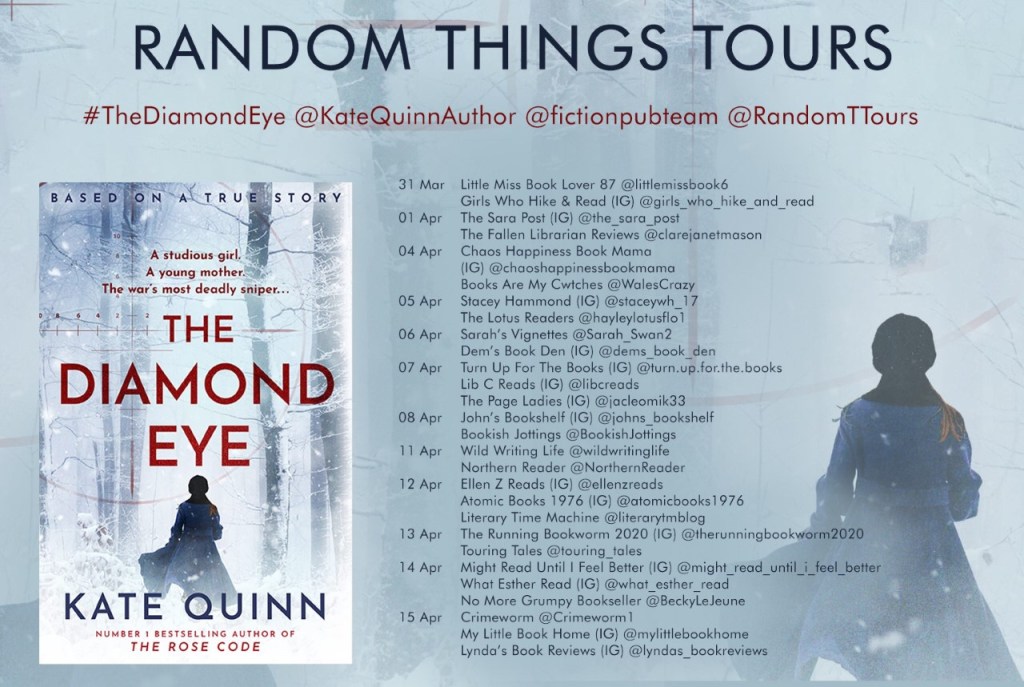
The Diamond Eye by Kate Quinn

She’s the war’s most lethal sniper. And the one they least expect…

In the snowbound city of Kiev, aspiring historian Mila Pavlichenko’s life revolves around her young son – until Hitler’s invasion of Russia changes everything. Suddenly, she and her friends must take up arms to save their country from the Fuhrer’s destruction.

Handed a rifle, Mila discovers a gift – and months of blood, sweat and tears turn the young woman into a deadly sniper: the most lethal hunter of Nazis.

Yet success is bittersweet. Mila is torn from the battlefields of the eastern front and sent to America while the war still rages. There, she finds an unexpected ally in First Lady Eleanor Roosevelt, and an unexpected promise of a different future.

But when an old enemy from Mila’s past joins forces with a terrifying new foe, she finds herself in the deadliest duel of her life.

The Diamond Eye is a haunting novel of heroism born of desperation, of a mother who became a soldier, of a woman who found her place in the world and changed the course of history forever.
I found this novel a compulsive and totally immersive read. So much so that if I was interrupted I would often look up in surprise to find that I wasn’t in a freezing cold trench, aching and covered with mud. Kate Quinn really gives us a vivid picture of WW2 in Russia, a front of the war I knew little about. In Lyudmila Pavlichenko, Quinn has a complex heroine, but she creates a nuanced, three dimensional woman, who is so much more than her nickname of Lady Death. I’d imagined a rather joyless, dour individual who was strong and almost masculine. However, instead I was shown a rather diminutive figure, with dark eyes and her long hair hacked off for practicality. This is the soldier. A woman with so much self-discipline she put me to shame, not only working on her university dissertation and looking after her son, while taking a year long marksmanship course so she could be the one to teach her son to shoot. However, when war breaks out Milla feels she must leave her beloved Ukraine and sign up for frontline duty. I loved the way the novel brought up the issues of womanhood in Russia, both Mila and her friend Lena are shocked by how few women were signed up. It never occurred to Mila to let men fight for her, she had the ability and as she mentions on her visit to Washington – Russian women are equal as human beings. I loved how Quinn focused on her vulnerability as much as her strength and the fact she’s only fighting out of necessity; she doesn’t revel in her 309 kills. She is a cultured woman, often enjoying the ballet and opera in Odessa before the war and very proud of her student status – her half written dissertation being the only personal thing she takes with her to the front.

I felt that the book wore it’s extensive research lightly. The story was grounded within the history, but doesn’t lecture or give huge amounts of exposition. This is a personal story about one woman’s war, within that larger history. Battles are mentioned and ground is won or lost, but it’s the character we focus one and those around her. I loved her relationship with Kostia, her shadow and fellow sniper, who keeps her warm on night long stake-outs by letting her lie along his back for body heat. He is of Siberian/Irish heritage, taciturn and serious, but when he finds his childhood friend Lyonya they are soon laughing and wrestling like a pair of ten year olds. Mila relationship with Lyonya was beautiful and probably the only mutual and equal romantic relationship she’d had to that point. Their story broke my heart, but it also broke for Kostia too. The detail is brutal, shrapnel injuries are described in raw, bloody ways because it’s necessary to show the dangers our characters are in. These terrible injuries also provide a contrast to the swift, clinical and clean kills carried out by Mila and Kostia. There are times where I thought their victims were the lucky ones. Mila’s ex-husband is written so well, because he infuriated me. Always with an eye on the main chance, Alexei is a brilliant surgeon and a shitty husband. Having seduced Mila at 15 years old, he then womanised his way to the divorce courts and has no intention of building a proper relationship with his son. His teasing and little digs at Mila felt like the tip of the iceberg to me and I wondered how manipulative and emotionally abusive he had been within the marriage.

The book is structured with Mila’s time fighting in Russia, sandwiched with chapters that show the delegation of students, including Mila, visiting Washington to elicit US support to open a second front in the war. Inbetween are excerpts from Mila’s diary (official and personal), Eleanor Roosevelt’s diary and notes written for her husband Franklin. There’s a humour in these scenes I enjoyed immensely, especially when Americans underestimate Mila, in her ability to understand them and her talent for sarcasm. These parts made me smile and I also loved the section where Eleanor Roosevelt drives Mila to an event personally, and navigates the streets of Washington like a racing driver! These later chapters are also tense as Mila has to learn to cope with the media, weird marriage proposals and threatening notes posted under her bedroom door by someone travelling with the delegation. The question of who they are and what they’re up to kept me alert and wary of everyone. What Quinn does so breathtakingly well is to breathe life into this woman, who I’d never heard of two weeks ago. She made me care about her and want to investigate her story more. She takes Russia’s poster girl and makes her human, a complex woman with courage, hopes and desires. She shows us that all Mila really wanted from life was to be a history professor, but war got in the way.

Meet The Author

Kate Quinn is a native of southern California. She attended Boston University, where she earned a Bachelor’s and Master’s degree in Classical Voice. A lifelong history buff, she has written four novels in the Empress of Rome Saga, and two books in the Italian Renaissance detailing the early years of the infamous Borgia clan. All have been translated into multiple languages. She and her husband now live in Maryland with two black dogs named Caesar and Calpurnia.
Posted in Throwback Thursday

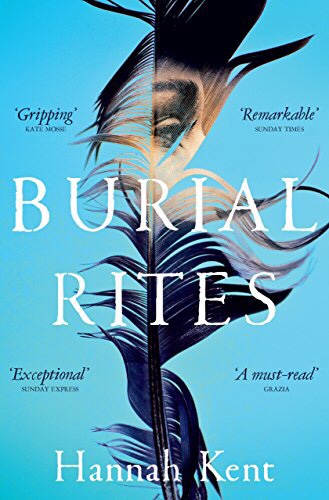
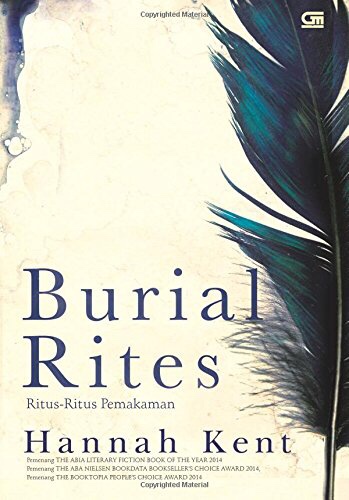
Throwback Thursday! Burial Rites by Hannah Kent.

In the wake of this talented writer’s new novel Devotion, for this week’s Throwback Thursday I decided to look at her debut novel Burial Rites. Set in Iceland in 1829 and based on a true story, we follow the final days of Agnes; a young woman accused of the murder of her former master. Housed at an isolated farm until her execution, Agnes is accompanied by Tóti, a priest she has mysteriously chosen as her spiritual guardian. The family are horrified to be housing a murderer, but as time goes on and her death looms closer, they start to listen to Agnes and hear a different side to the sensationalised story they’ve accepted as truth. How can Agnes cope with her impending death and the realisation that history will define her: as a murderess, a monster, a woman without mercy?

The first thing that comes to mind when I think about this book is the stark scenery and the way it’s linked to Agnes’s emotions. She reminded me of my favourite literary heroine Jane Eyre, in that she’s so passionate, with every emotion unfiltered, raw and open for the reader to see. Jane is condemned as too passionate when she’s a child, but even though she learns to rein her emotions in as an adult, there are glimpses of her true nature in her eerie paintings and her feelings for Rochester. Jane’s warning of what happens when a women’s passions are unbound, comes in the shape of Bertha Mason, Rochester’s wife and the madwoman in the attic. Bertha acts on her feelings immediately; her anger leads to the burning of Rochester’s bed and the wounding of her brother Richard. However, in his explanation after their abandoned wedding, Rochester tells Jane of mood swings and childlike behaviour, but also hints at an unladylike lust that’s unbecoming in a wife. This is certainly implied strongly in Jean Rhys’s impressive post-colonial prequel Wide Sargasso Sea, where his wife’s enthusiasm in the bedroom feels unchaste and his claims of being duped by her family might relate more to her virginal state than her potential for insanity. Agnes is similarly passionate about her lover:

“I cannot think of what it was not to love him. To look at him and realise I had found what I had not known I was hungering for. A hunger so deep, so capable of driving me into the night, that it terrified me.”

Just as Jane’s heartbreak and spiritual battle after her flight from Thornfield is characterised by the biting wind and lack of shelter of the bleak moorland, Agnes seems so deeply in tune with her Icelandic surroundings. The claustrophobic atmosphere of her final days is heightened by being sequestered in someone else’s space and marooned in the middle of an Icelandic winter. There is nothing soft here. The relentless freezing air and sparse vegetation echo the frozen glares of the women in the family, the barren and friendless days that count down slowly without joy or pleasure to make them bearable. Both the landscape, and Agnes herself, are haunting and have stayed with me way beyond the final pages.

I love how the author plays with the idea of self and it’s construction in fiction. She takes a real person, with a real criminal case against them and starts to give them thoughts and feelings. The Agnes Magnússdóttir she could read about in records and news reports is a distant, lifeless, individual. In fact any contemporary writing about her that gives more than the bare facts, is only one person’s idea of who she was and what her motivations might have been. It’s a false self and what Kent tries to do is breathe life into Agnes, to create a real person with thoughts and feelings, someone we can perhaps start to understand and empathise with. I love though how Agnes has an awareness of this and how even in Kent’s story, she isn’t real. She explains that people will think they have a sense of who she is through her perceived actions, but that isn’t her. She knows she will be labelled and for some people that will forever define her, but only she knows her true character and her true motivations. How can a woman hope to survive when her very life is dependent on the stories told about her by others, rather than her own word?

“They will see the whore, the madwoman, the murderess, the female dripping blood into the grass and laughing with her mouth choked with dirt. They will say “Agnes” and see the spider, the witch caught in the webbing of her own fateful weaving. They might see the lamb circled by ravens, bleating for a lost mother. But they will not see me. I will not be there.”

Paperback Published by Picador 27th Feb 2014

Meet The Author

Hannah Kent’s first novel, the international bestseller, BURIAL RITES, was translated into over 30 languages and won the ABIA Literary Fiction Book of the Year, the Indie Awards Debut Fiction Book of the Year, the Prix Critiqueslibres Découvrir Étranger, the Booktopia People’s Choice Award, the ABA Nielsen Bookdata Booksellers’ Choice Award and the Victorian Premier’s People’s Choice Award. It was shortlisted for the Women’s Prize for Fiction and the Guardian First Book Award, the Stella Prize and the International IMPAC Dublin Literary Award, amongst others. It is currently being adapted for film by Sony TriStar. 

Hannah’s second novel, THE GOOD PEOPLE, was translated into 10 languages and shortlisted for the Walter Scott Award for Historical Fiction, the Indie Books Award for Literary Fiction, the ABIA Literary Fiction Book of the Year and the Readings Prize for New Australian Fiction. It is currently being adapted for film by Aquarius Productions. 

DEVOTION, Hannah’s third novel, will be published in November 2021 (Australia) and February 2022 (UK & Ireland) by Picador.

Hannah’s original feature film, Run Rabbit Run, will be directed by Daina Reid (The Handmaid’s Tale) and produced by Carver and XYZ Films. It was launched at the Cannes 2020 virtual market where STX Entertainment took world rights. 

Hannah co-founded the Australian literary publication Kill Your Darlings. She has written for The New York Times, The Saturday Paper, The Guardian, the Age, the Sydney Morning Herald, Meanjin, Qantas Magazine and LitHub.

Hannah lives and works on Peramangk country near Adelaide, Australia.

Read More

https://www.panmacmillan.com/blogs/literary/burial-rites-iceland-photos-hannah-kent-setting

https://www.theguardian.com/film/2017/dec/13/jennifer-lawrence-to-star-in-film-adaptation-of-hannah-kents-burial-rites

Posted in Random Things Tours

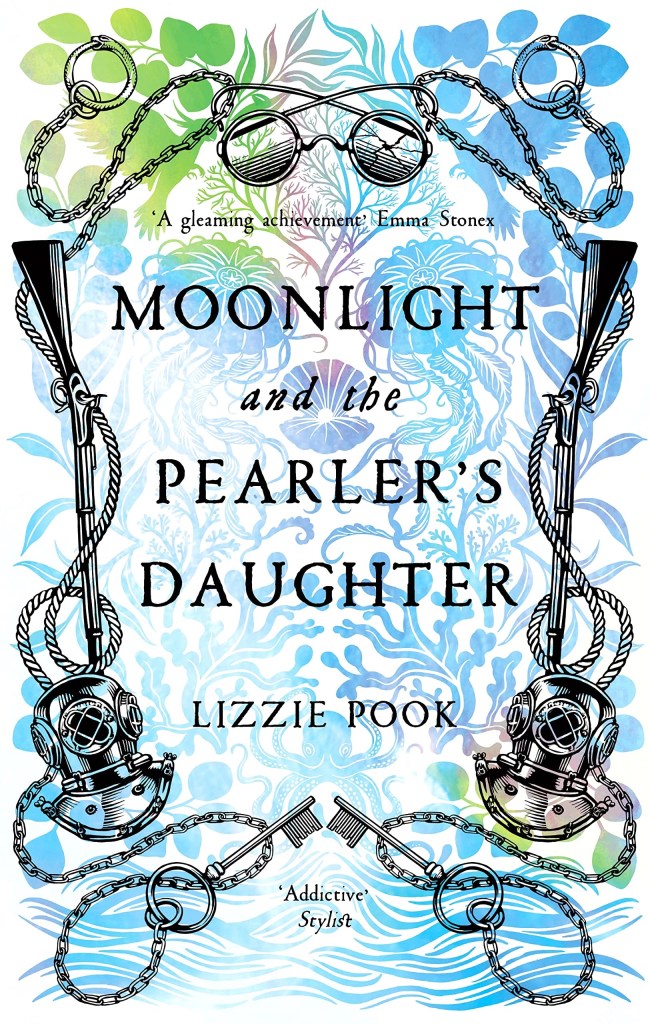
Moonlight and the Pearler’s Daughter by Lizzie Pook.

Fortune favours the brave . . .

It is 1886 and the Brightwell family has sailed from England to make their new home in Western Australia. Ten-year-old Eliza knows little of what awaits them in Bannin Bay beyond stories of shimmering pearls and shells the size of soup plates – the very things her father has promised will make their fortune. Ten years later, as the pearling ships return after months at sea, Eliza waits impatiently for her father to return with them. When his lugger finally arrives however, Charles Brightwell, master pearler, is declared missing. Whispers from the townsfolk point to mutiny or murder, but Eliza knows her father and, convinced there is more to the story, sets out to uncover the truth. She soon learns that in a town teeming with corruption, prejudice and blackmail, answers can cost more than pearls, and must decide just how much she is willing to pay, and how far she is willing to go, to find them.

This incredible debut is richly atmospheric from the get go, throwing us straight into the strangeness of 19th Century Western Australia as if it is an alien landscape. In fact that’s exactly what it is for the Brightwell family, particularly Eliza whose childhood eyes we see it through for the the first time as, in a particularly disgusting parody of baptism, a bucket of fish guts is thrown into her face. Of course the fisherman apologises for the accident, but we’re left wondering if it’s anything but as he says the words ‘welcome to Bannin Bay’. It foreshadows that immediate imbalance between those who do the work and those who aim to make the money. Eliza’s father has been full of dreams, not just of pearls, but the pearl shells to be turned into buttons, hat pins and pistol handles. Yet their unsuitability for this rough and ready environment can be seen as soon as they arrive in the fine clothing they must keep lifted away from the red earth, especially when compared to the stevedores dirty vests and cut off trousers. Eliza describes her mother as ‘a dragonfly, once resplendent, marooned in a bucket of old slop water.’ Delicate Victorian ladies are not built for this environment that stinks of sweat, fish guts and the mineral tang of sea kelp. With this alien landscape the author creates a vivid backdrop for the incredible historical detail of her story, whilst also creating a mythic, almost fairy tale quality to the story.

Only ten years after the prologue we meet an older Eliza, who’s wiser to the ways of the Bay and has developed into a interesting character. Women are either categorised as polite society -‘white glove wearers’ – or harlots and it’s a source of irritation to most women in the community that Eliza refuses to be either. She is ploughing her own furrow and whereas her friend Min’s childhood dreams develop, from escapades on the high seas to the type of sailor she might marry, Eliza still craves the adventure. She can see no use for a husband, although she doesn’t deny an interest in men, which is quite a scandalous notion even if her main interest is the contents of his library. Eliza’s knowledge of sailing and pearl diving is forensic in its detail and through exploring with her father she has developed a keen interest in the areas flora and fauna too. She is quite unlike the respectable women who still look like wedding cakes in the impossible heat. Her father has been on a voyage for the past three months and a lonely Eliza has been looking forward to his return, but as she sits and waits doubt starts to set in about whether the ship is returning. The light is fading as his lugger appears on the horizon, but her stomach fills with dread when she realises something is wrong. The ship’s flag is at half-mast. When her brother Thomas emerges she learns that her father is gone. While Thomas rushes to secure the business Eliza is left to find out the truth and while she’s told he went overboard, there are also tales of mutiny and murder. Eliza has to visit the sergeant to convince him that she suspects their father’s death was not an accident. Sergeant Archibald Parker is an unpleasant racist and his immediate action is to arrest aboriginal man Billy Balaari, but Eliza is told that Billy wasn’t even on the boat. When Billy escapes, the sergeant is completely focused on finding him, leaving Eliza to do the detective work herself. She finds her father’s diary and eventually sets sail on Father McVeigh’s lugger Moonlight with Axel Kramer and an aboriginal boy called Knife, determined to find the truth of what happened.

I wasn’t surprised to find a very seedy underbelly to the trade where Eliza’s father had hoped the build the family fortune. Where incomers make large amounts of money, there is always exploitation and in this case the workers have a very tough working life. Of course it’s the native Australians who are exploited the most and the author doesn’t pull her punches when it comes to portraying the terrible treatment they receive. Aboriginal families are torn apart as the strong are enslaved for labour on the Pearler’s boats, usually as pearl divers, the most dangerous job on board. The sheer weight of their gear is terrifying as they don lead boots and copper chest plates. It felt so claustrophobic to imagine them sinking slowly to the bottom of the sea, with only a line connecting them to the ship above. The relief of being winched back to the surface must have been tempered by the danger of the bends, caused by the pressure of resurfacing too quickly, forcing organs upward in the body leaving the diver dead or ‘agonisingly crippled’. It made me feel a little bit anxious as I was reading their potential fates. If this wasn’t enough, aboriginals were treated as worthless, beaten and even killed without consequence. Eliza has to negotiate her way through the community’s corruption, violence, blackmail and the criminal elements of the pearling business. All the while reading her father’s diary for clues and guiding us to a cast of fascinating characters, some of which are based on historical figures. I loved Eliza’s early feminist stance and her sense of adventure, not to mention the gripping twists and turns that pull you even deeper into the story. This is a fantastic debut full of life and death, just like it’s setting. The richness and depth of her storytelling marks Lizzie Pook out as a talented writer I’ll keep watching out for in the future.

Published by Mantle Books 3rd March 2022

Meet The Author

Lizzie Pook is an award-winning journalist and travel writer contributing to The Sunday
Times, Lonely Planet, Rough Guides, Condé Nast Traveller and more. Her assignments have taken her to some of the most remote parts of the planet, from the uninhabited east coast of Greenland in search of roaming polar bears, to the foothills of the Himalayas to track endangered snow leopards.
She was inspired to write Moonlight and the Pearler’s Daughter, her debut novel, after spending time in north-western Australia researching the dangerous and fascinating pearl-diving industry. She lives in London.
You can find Lizzie on Twitter and Instagram: @LizziePook.

Posted in Throwback Thursday

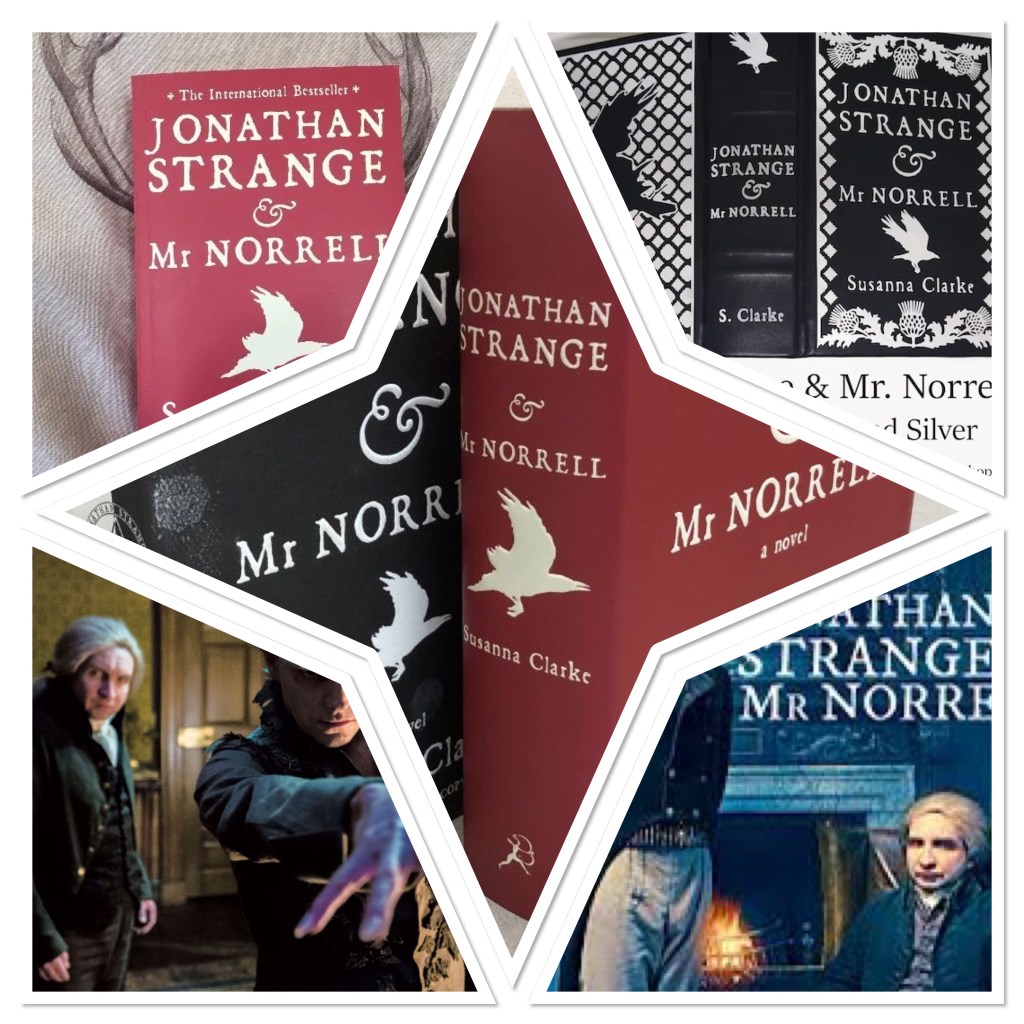
Jonathon Strange and Mr Norrell by Susanna Clarke.

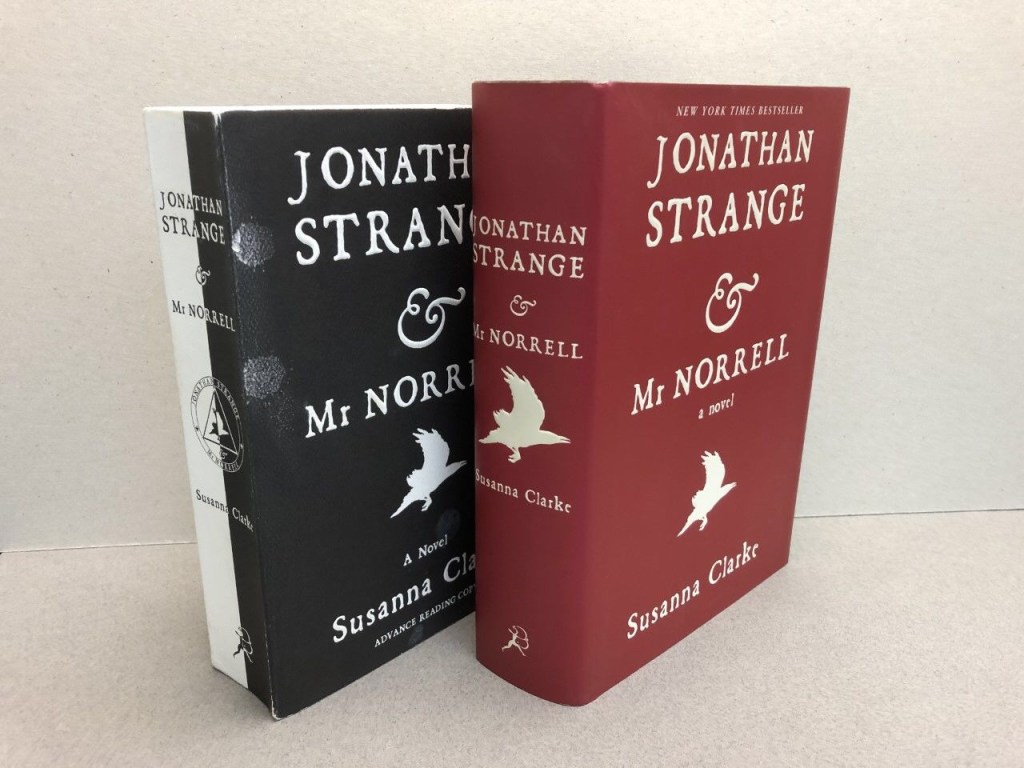
I’ll own up to the fact that this beautiful book remained on my shelves for about five years before I read it. I’d bought it while doing my degree in literature, so I was already reading five books a week and although I loved the blurb I just couldn’t get into such a weighty book. I remember picking it up and reading the opening paragraph, then slotting it back on the shelf a few times too. When I finally did read it I was absolutely enchanted and amazed by the incredibly detailed world the author had created.

The year is 1806. centuries have passed since practical magicians faded into the nation’s past. But scholars of this glorious history discover that one remains: the reclusive Mr Norrell hoards books of magic for his library and can perform incredible and unexpected feats of magic. He is approached by Sir Walter Pole whose wife has died and he begs Norrell to revive her. Despite his scruples about old magic he knows this might be the only way to bring this beautiful young woman back to life. So, he is tempted by a richly dressed gentleman fairy, who agrees to help Norrell on two conditions. First he would like a keepsake of the lady and takes a finger which he keeps in a jewellery box. Secondly, if he is to give life back to her, it seems only fair that he should have half of it. Norrell does a quick calculation and decides it will not matter to have a few years shaved off her life. However, as Mr Norrell himself knows, fairies can be tricky, deceptive little creatures and this one may have ulterior motives. After this amazing feat of magic MrNorrell becomes the talk of London and finds himself working for the government, conjuring illusions to aid England in their war with the French. However, Norrell would still like to keep magic controlled, only performed by serious and studious men. Constantly, at the back of his mind, is the bargain he’s made with the fairy creature. Can he be trusted and will the magic that brought Lady Pole back to life work as planned?

Marc Warren and Eddie Marsan in the BBC adaptation.

Norrell becomes challenged by the emergence of another magician: the brilliant novice Jonathan Strange. Young, handsome and daring, Strange is the very antithesis of Norrell. He only begins to study magic because he is in love and she loves him back, but there is a very stern father in the way, who does not like Jonathon. He thinks he’s an idle layabout with a rich father, but no real prospects. Unless he commits himself to a profession, he will not give permission for Jonathon to marry his daughter. Jonathon Strange finds he is surprisingly good at magic and he’s certainly a showman, enjoying the performance element of magic. As word spreads of this new magician on the block, Mr Norrell becomes concerned. In a bid to contain the situation he asks to meet Jonathon Strange and offers him an apprenticeship. This will control Jonathon’s wild exhibitions of magical power. He sets him to studying, but Jonathon is increasingly frustrated by Norrell’s unwillingness to perform magic. A row erupts and so begins a dangerous battle between these two great men which overwhelms the war between England and France. Each man’s obsessions and secret dabblings with the dark arts are going to cause more trouble than they can imagine, while all the time Norrell’s dabble with the fairy gentleman and old magic is coming back to haunt him.

It’s really hard to explain the richness of the detail in this beautifully written novel. There’s the amazing historical background with 18th Century society vividly brought to life and the rural home of Jonathon Strange contrasting sharply with London society. There’s the city of York, where an incredible scene in the Minster involves Mr Norrell bringing all the statues to life in front of a terrified magician’s society. Of course the illusions are spectacular, but so is the fashion and just wait until you enter the dreams of our poor resurrected Lady Pole! The characterisation is playful and humorous, with both magicians thought of as great men but each ridiculously comical in their own way. Mr Strange is like an overexcited puppy who has just found a tennis ball and might trample the whole garden in his exuberance. Mr Norrell on the other hand, is like a squirrel gathering nuts for winter, collecting all the magic and storing it in a safe place where no one else will find it. He is fussy and persnickety in his manner, but can also be rude and abrupt with people. This is where Mr Strange excels, he is handsome and charming, making his magic appear to be an innate talent rather than the result of studying dusty books. We go from rural England, to London, to France and Venice with every setting evocative and rich. I loved incidental characters like the street magician who plies his trade in a rather tongue in cheek way, using props that Mr Norrell finds deplorable. Mr Norrell’s servant is also a fascinating puzzle. I was truly sucked in by the story of Stephen, a servant in the household where Mr Norrell dabbles in fairy magic. The way he is slowly sucked into something he doesn’t understand is incredibly well done, from the bell ringing that only he can hear and the mysterious guest upstairs who he didn’t see arrive. Stephen serves with pride and is proud of the place he has reached in life as a black man in 18th Century society, but promises of greatness from the new guest appeal to his need to be respected. Why is he offering these opportunities and why is Stephen so incredibly tired all the time? It’s as if he hasn’t slept at all.

TV Tie-In Edition showing Bertie Carvel and Eddie Marsan as Jonathon Strange and Mr Norrell

The novel explores the 18th Century preoccupations with reason and madness, but also with classification and includes long academic style footnotes referencing an entire fictional body of literature on magic. Last year Collins released her second novel Piranesi, a full seventeen years after Jonathon Strange and Mr Norrell. It had taken her almost ten years in her spare time to write this debut novel, which isn’t surprising given the level of detail. It was revealed recently that she struggles with chronic fatigue syndrome and having experienced this level of fatigue for many years as part of my MS, I can only marvel that she managed to write such a substantial debut. However, if Jonathon Strange and Mr Norrell had been the only novel she wrote in her lifetime, I would still think of her as a genius, because this novel is an absolute masterpiece.

Showing the original editions of the novel

Meet The Author

Susanna Clarke

Susanna Mary Clarke was born 1 November 1959 in Nottingham and is an English author known for her debut novel Jonathon Strange and Mr Norrell (2004), a Hugo award winning historical novel. Clarke began Jonathan Strange in 1993 and worked on it during her spare time. For the next decade, she published short stories from the Strange universe, but it was not until 2003 that Bloomsbury bought her manuscript and began work on its publication. The novel became a best-seller.

Two years later, she published a collection of her short stories The Ladies of Grace Adieu (2006). Both Clarke’s debut novel and her short stories are set in a magical England and are written in a pastiche of the styles of 19th-century writers such as Jane Austen and Charles Dickens. While Strange focuses on the relationship of two men, Jonathan Strange and Gilbert Norrell, the stories in Ladies focus on the power women gain through magic.

Clarke’s second novel, Piranesi was published in September 2020, winning the 2021 Women’s Prize for Fiction.

Posted in Random Things Tours

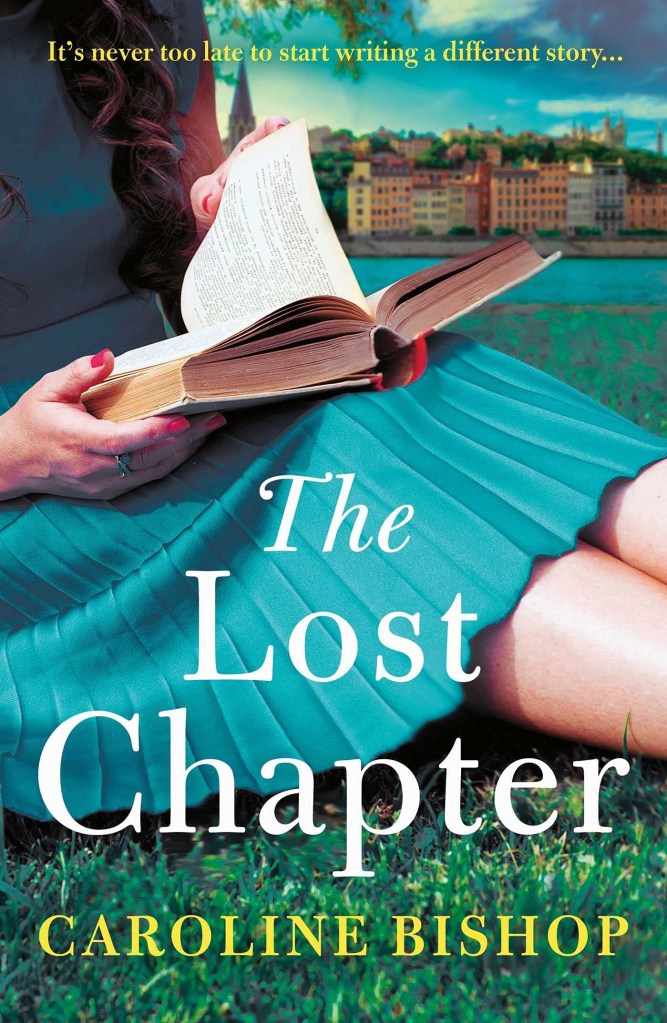
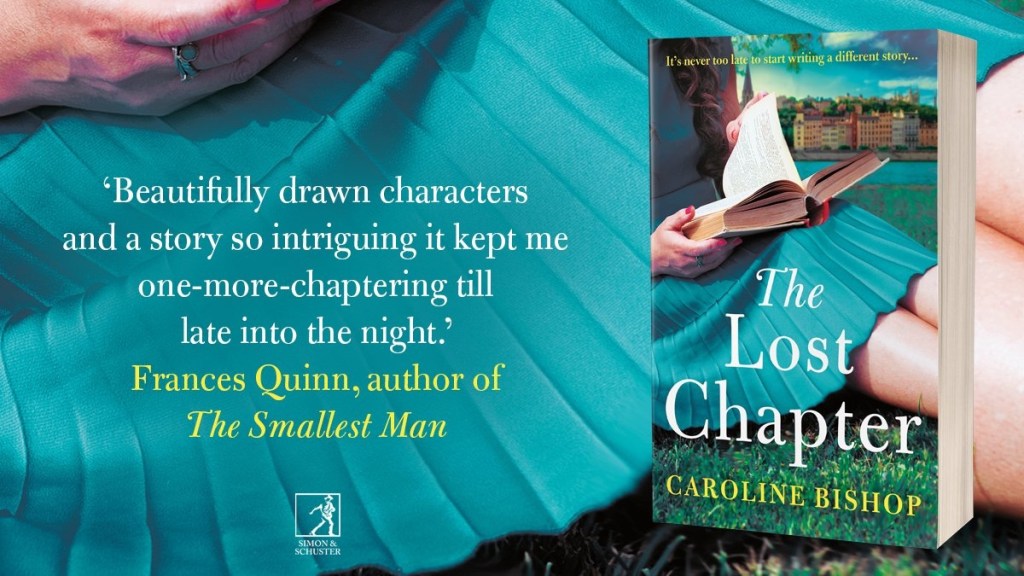
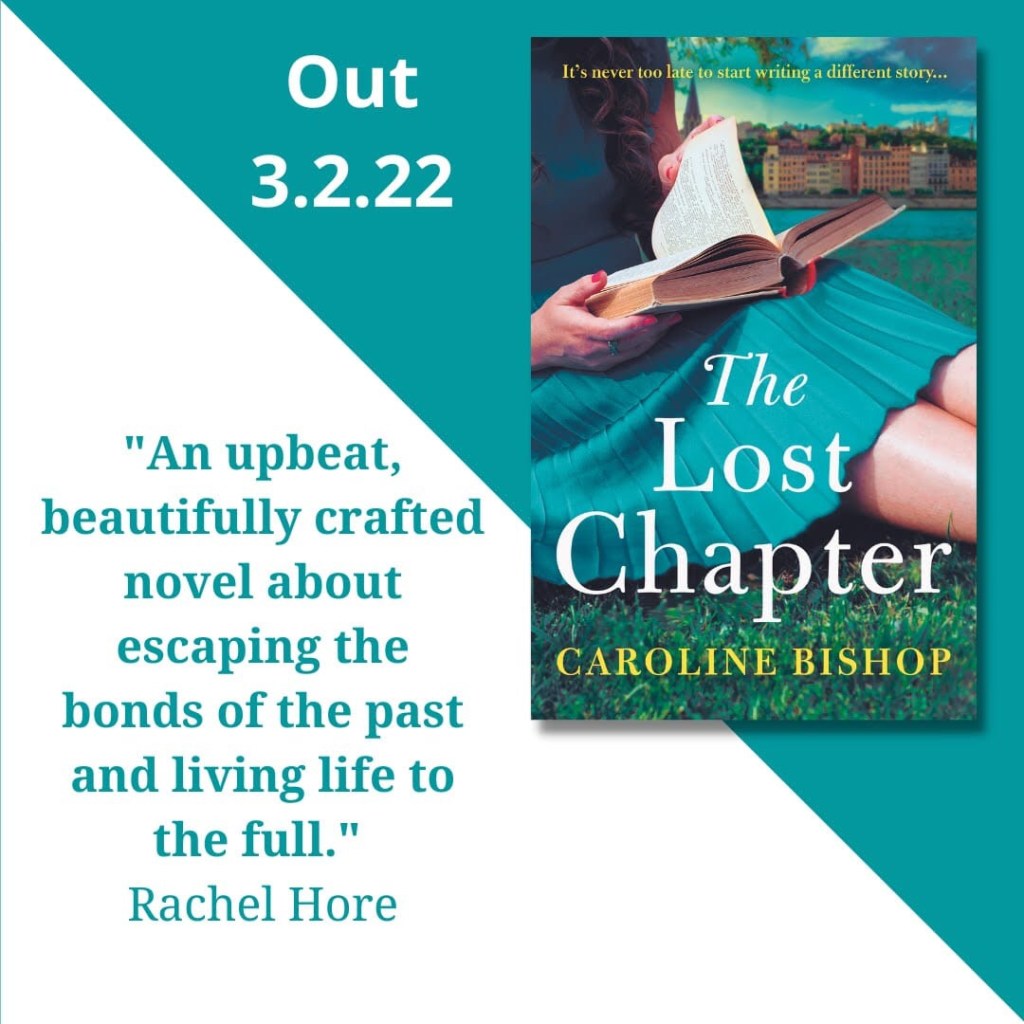
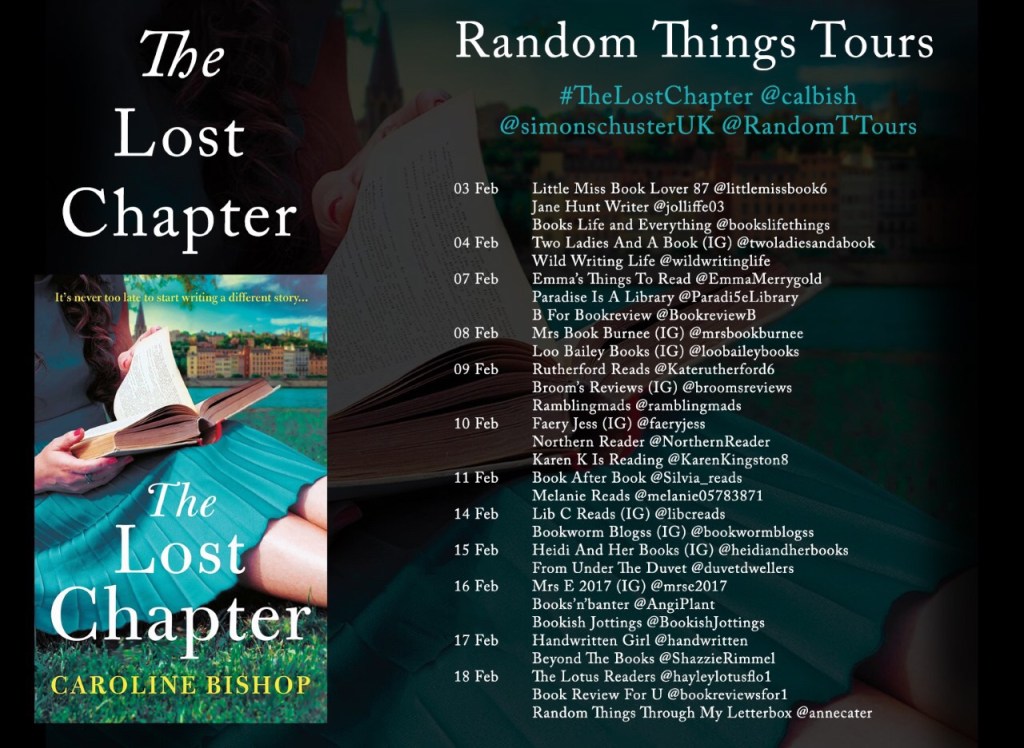
The Lost Chapter by Caroline Bishop

Teenager Alice has escaped a terrible accident that left her friend Ella dead, hit by a lorry and killed outright. Her mum Carla worries about her so much and noticed a huge change in her daughter’s behaviour, even before the accident, but is unsure how to broach the subject and too nervous to push her into moving on in life. Carla doesn’t know how Ella’s parents have coped with her death, but she does know that if Alice had been take from her, she would have fallen to pieces. Constrained by their grief and anxieties, both mum and daughter are too scared to fully live. Then Alice ends up walking Flo’s dog. Flo is in her eighties and knows a thing or two about choosing to live life. She rues spending years married to a man she didn’t love, scared of taking a leap into the unknown till years later when his affair ended the marriage. Alone and free to do anything for the first time, Flo thought back to the example of her friend Lilli at finishing school and decided to take more chances. She’s had a long life with times of pure happiness, but some incredible lows too. Now she lives with her dog, Ernie, and earns a living creating lino prints in her garden studio to sell in local outlets. She can feel the anxiety in Alice and convinces her to try printing. Flo can see that she needs to learn mistakes don’t matter – in fact it’s the mistakes that often make the picture. She encourages Alice into applying for art college, but when that plan is pushed aside for a safer option, Flo knows she needs time with both mum and daughter. So she invites Alice and Carla to travel to France with her and meet her friend Lilli. They have been apart for 60 years, will they still know each other and will that friendship be there after what Flo did?

Flo has been inspired to find Lilli because of a book she wrote based on the girl’s shared past. Through each chapter the author takes us back to when the girls were roommates at finishing school in Lyon. Their families were of a similar class and had only one expectation of their daughters – that they marry well and be ready to run a household. However different Flo and Lilli were on the surface, both were stifled by the minutiae of table settings (three forks on the left of the plate must not be more than one inch from the edge of the table) flower arranging and party planning. Yet only one of them had the courage to risk her family’s wrath for some freedom and adventure. When Lilli meets a young man named Hugo there’s a spark between them, but the school would never allow them to meet. She uses her brother to write a letter, granting permission for her to be taken out once a week by their cousin. The couple are now allowed out more easily and spend their stolen afternoons in bed more often than not. A young woman called Celeste who is in the same circles, takes Lilli aside and warns her that Hugo might not be as in love as he seems. A warning that Lilli brushes aside, thinking Celeste is perhaps jealous. It isn’t long before she finds out that men can often walk away from an affair unscathed and women are left with the consequences.

I loved how these fundamental inequalities in society are picked up in the novel – that women are held to account, while men can simply move on and pick their next mark. I felt the fear of Flo and Lilli, terrified to step outside the rigid lines that their society dictates, but also full of regret for the time they wasted being conventional. I thought the author had a brilliant grasp of human psychology, showing beautifully how mental ill health can be passed on to the next generation. Carla is so fearful I sometimes found myself wincing as she spoke to her daughter, because I could see the damage her words would do. She’s so intent on protecting her daughter that she’s actually harming her. The sense of place created, whether in the surroundings of the artist studio or the incredible heat of the South of France, is incredible and so evocative. The stunning setting of Lilli’s home is idyllic and made me want to visit France. Aside from the character of Hugo, this is a novel peopled by women and it was great to see such a celebration of female friendship. Even Celeste, in her way, had tried to be a friend to Lilli and share some female wisdom. I loved how the author showed, with the benefit of hindsight, how important that shared wisdom is. Often we only see the benefits of learning from the women around us when we’re older. I also enjoyed the age difference between these friendships. This allowed the older friends learn about things that are current and new. Whereas the wisdom and past experience of the older friend filters down and supports the younger. Flo wants to make sure that neither Carla or Alice live in fear of their future, like she did. What she most admired about her friend Lilli was that she always took responsibility for her actions, even when the outcome was going to cause difficulty or even change her life forever. She simply embraced every challenge that came along. I read this so quickly, because I simply couldn’t tear myself away from the story of these four women. This book is beautifully written, moving and really celebrates the joy of female friendship.

Meet The Author

Caroline Bishop began her journalism career at a small arts magazine in London, after a brief spell in educational publishing. She soon moved to work for a leading London theatre website, for which she reviewed shows and interviewed major acting and directing stars. Caroline turned freelance in 2012 and a year later moved to Switzerland, where her writing veered towards travel and she has contributed to publications including the Guardian, the Independent, the Telegraph and BBC Travel, writing mainly about Switzerland, and co-wrote the 2019 edition of the DK Eyewitness Guide to Switzerland. For two years Caroline was editor of TheLocal.ch, an English-language Swiss news site, and it was during this time that she became fascinated with aspects of Swiss history and culture, particularly the evolution of women’s rights.

Posted in Publisher Proof

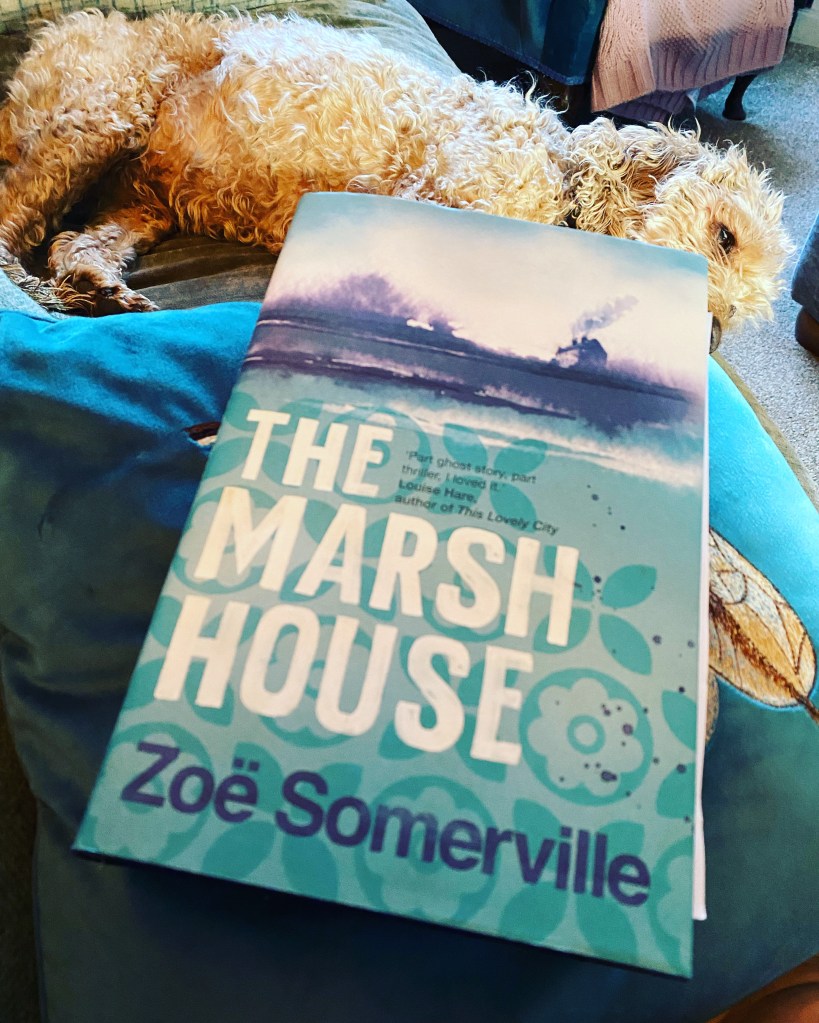
The Marsh House by Zoë Somerville

I simply loved this book. In fact, a finished copy arrived through the post and I started browsing the first page then couldn’t stop reading. So I read it straight through, finishing at 2am. It’s a split timeline story, beginning with Malorie and her daughter deciding to spend Christmas in a cottage on the Norfolk coast after an argument with her boyfriend. Malorie feels like a bad mother and wants to get one thing right – an idyllic holiday cottage Christmas for her daughter. Maybe if she achieves this one thing, she can convince herself she’s not as useless as she imagines. The sense of foreboding hits the reader immediately as the weather promises snow and Malorie becomes disoriented in the fog. She skids and ends up wedged into a hedge. The Marsh House itself is damp, dark and neglected. They cannot even see the sea through the mist. Malorie begins to wonder if this is a bad idea, but finds a pair of journals in the attic while searching for Christmas decorations, and she begins to read. Written by a young woman called Rosemary, who lived in the house, the journals tell a tale of a young woman’s crush on the boy from the big house. This young woman’s story paints a picture of 1930’s rural Norfolk, becoming a young mum and her husband’s link to fascism and Oswald Moseley in particular. Malorie can’t put the journals down, but alongside the house’s strange atmosphere, they are having an effect on her sleep and her state of mind.

I felt for Malorie straight away and her sprite of a daughter. Malorie is very hard on herself and has a negative inner voice, not helped by an over critical partner at home. Here she is capable, ordering logs and a turkey, rigging up a Christmas tree with vintage ornaments from the loft, and even managing real candles in their holders. However, even when she’s barely started the journals, the locals are giving her the house’s sordid history. That whiff of fascism becomes stronger when Malorie finds leaflets in the attic and the girl in the village shop asks if she knows what happened at The Marsh House? Tales of lost cocklers cut off by the tide that can still be heard screaming in the fog don’t help her state of mind. The house itself holds some scary relics too including a weird picture of women who perhaps lived here, one with bright green eyes that bore into you. I loved how the author drip fed these little bits of information, adding to the house’s history but also to the creepy tension that keeps building. It’s Malorie’s kinship with Rosemary, the writer of the journals, that drives the story forwards. The more she understands about the writer’s life, the more confused she becomes between fantasy and reality leading to some truly terrifying visions in the night. Why does she feel so connected with someone she’s never met who lived here thirty years before? Who is the strange woman with the large dog she sees from time to time, and why does she seem to be looking after the family by leaving logs to keep them warm?

I did enjoy Rosemary’s story too, her innocent crush on the boy from the family at the big house. She fantasises about what it would be like to have him like her too, to kiss her on the cheek and choose her above the more well to do girls in society. There does seem to be a part of him that is attracted to Rose, but she might also suit his purposes – a compliant country wife at home to keep the line going while he gallivants in London with Moseley’s social circle. Having read a bit about the Mitford sisters and Unity in particular, I had already known how popular fascism was in the ranks of the aristocracy and how some of our great country houses were used as meeting places for talks on appeasing Hitler. I hadn’t known of it’s hold in Norfolk and found this aspect of the book interesting. As time goes on and Rosemary is treated very badly by her husband it was clear that something terrible was going to happen, but the final revelations are truly shocking. I loved the way she delved into the complicated, emotional experience of becoming a mother. She opens up the inner world of these women, with their constant questioning of whether they’re good enough, or are they failing at this job we’re led to believe should come naturally? There is a special skill in weaving real historical events with fiction and this author is so talented and creative. She brings this area of England to life and makes the reader want to visit and search it out for themselves. The atmosphere was so evocative I spent two days with a ‘book hangover’ – unable to start another book because my emotions and senses were so embedded in Malorie’s story. I loved this so much I could have happily gone back to the first page and read it over again.

Published by Apollo 3rd March 2022

Meet The Author

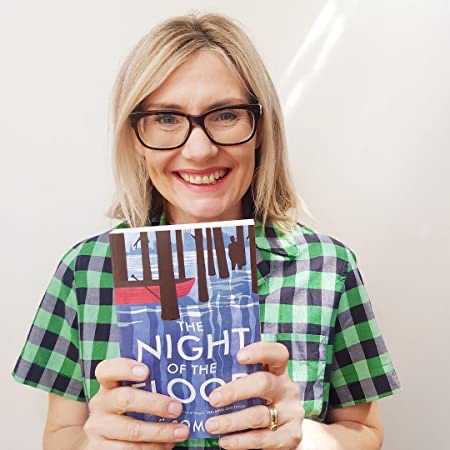
Zoë Somerville is originally from Norfolk, but has settled with her husband and children in the West Country. She works as an English teacher. Zoë began her debut novel, The Night of the Flood on the Bath Spa Creative Writing MA in 2016. It was published in September 2020. Her second novel, The Marsh House, a ghost story and mystery is published in March 2022. She is currently writing her third novel.

Posted in Random Things Tours

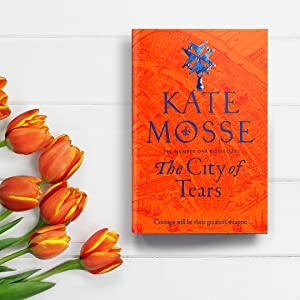
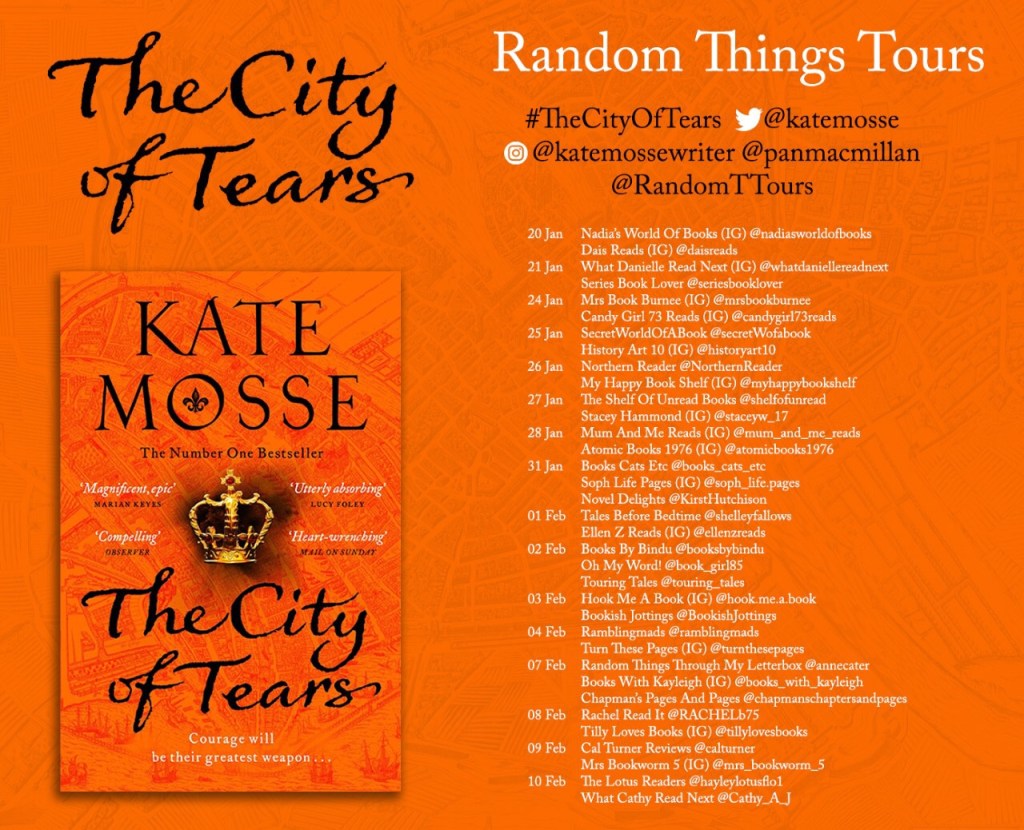
The City of Tears (The Burning Chambers 2) by Kate Mosse.

I’ve been reading Kate Mosse since Labyrinth all those years ago and I’m always impressed by the level of detail and knowledge of French history she weaves into her books. Every detail is considered and you have the impression straight away that you’re in safe hands. In The City of Tears she combines her fictional narrative with fascinating real events focusing on the Catholic and Huguenot conflicts of the 16th Century. This is the second book in the Burning Chambers series and I did choose to go back and read the first book. However, due to Mosse’s ability to immerse you in her world, I think this could be read as a stand alone novel. It continues the adventures of Minou Reydon-Joubert and Piet Reydon, characters caught up in a period beset by complicated religious and political wars. Mosse walks the tightrope between these warring factions carefully, illustrating that there is honour and corruption on both sides, but keeping the focus on the family at the centre of these conflicts.

We return to the Languedoc region of France and the wars have now raged for ten years. It’s May 1572 and Minou and Piet travel with their two children, Marta and Jean Jacques, to Paris for the royal wedding of Charles IX’s sister, Catholic Marguerite de Valois, and Protestant Henry III of Navarre. This wedding has the political and religious benefits of uniting both Catholic and Protestant factions, so could mark the start of peace, but it’s a fragile accord. Piet’s old acquaintance Cardinal Valentin (Vidal) is in Paris too, but he’s now an enemy, unbeknownst to Piet he has a plan to kill all important Huguenots during the celebrations. The terrible violence that follows was known as the St Bartholomew’s Day Massacre and thousands of Huguenots were murdered. Seven year old Marta is separated from her parents in the chaos and goes missing. It’s a parent’s worst fear, but unable to find her, Minou and Piet have to flee the city without her. The pair are devastated as they cross the border and make their way to safety in Amsterdam. I loved the way Mosse depicted the strain this decision places on the couple’s relationship. They have managed to ensure the safety of their two year old son, but are filled with guilt for leaving their daughter behind.

Minou and Piet only return to France twelve years later after hearing of a woman who bears a resemblance to Minou. Could it be Marta? They have to take a chance and search for their daughter, but danger is still everywhere. They don’t know that family enemy Vidal is there, with his collection of fake relics, that he intends to use with the ambition of gaining power and position. He believes Piet is in possession of a stolen relic and is driven by bitterness and revenge. His evil nature and conviction he is carrying out God’s work, is beautifully offset by Minou who is a strong willed and opinionated woman doing the best for her family rather than a religion. Piet is also more logical and open-minded, he’s a Huguenot by religion, but doesn’t believe there is only one way to God, particularly when religious difference is used as an excuse to oppress and murder. The couple’s return has raised the tension and jeopardy for all their friends and family, and Mosse delivers some suspense filled twists and turns where the hunted and hunter just miss each other.

I felt like I was in the hands of a master storyteller here. Mosse is able to bring historical fiction to life, and really makes the reader care about the lives of people long gone. She delivers the drama at such a pace, her characters barely have time to draw breath. The depth of her research is truly impressive, even if sometimes I found myself having to read very carefully so I didn’t become confused – but that’s my failing, not hers. The family are so well drawn I truly cared about their outcome and the dynamics between them are written with emotional intelligence. The character’s emotions feel so real and add depth to an already absorbing story. My heart broke for Minou at the loss of her daughter, and I was so invested in her grief that I couldn’t see how she would adjust to living without her. The strain they were under and the constant danger they’re in added an intensity to Minou and Piet’s relationship that was so romantic. Mosse’s incredible skill is to make the reader care about and feel a connection with people who lived in the 16th Century. They are so different to us in dress, daily life and beliefs but the themes of family, parenthood and loss are so universal that they cross the centuries. It will be interesting to see where these fascinating characters go next.

Check out the other reviews from these great bloggers:

Meet The Author

Kate Mosse is a number one international bestselling novelist, playwright and non-fiction writer. The author of eightnovels and short story collections –including the multimillion-selling Languedoc Trilogy (Labyrinth, Sepulchreand Citadel) and Gothic fiction The Winter Ghosts and The Taxidermist’s Daughter, which she is adapting for the stage –her books have been translated into thirty-eightlanguages and published in more than forty countries. She is the Founder Director of the Women’s Prize for Fiction and a regular interviewer for theatre & fiction events. Kate divides her time between Chichester in West Sussex and Carcassonnen in south-west France.

Posted in Publisher Proof

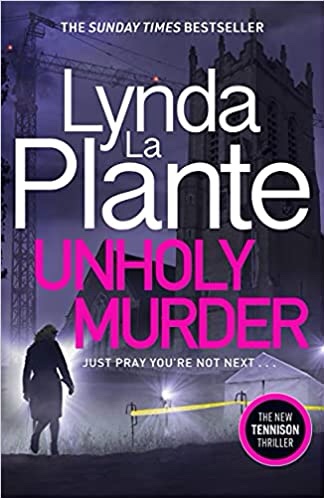
Unholy Murder by Lynda La Plante.

The great thing about having friends who are bloggers is that occasionally they have spare proofs lying around and are very generous in sharing them. I’m very lucky to be a member of the blogger’s group the Squad Pod Collective, they’re a great group of ladies and we all support each other so much. There are often spare, or unwanted, proofs trundling back and forth to each other through the post. However, this time I was lucky enough to receive a bundle of spares from a blogger more local to me and I’ve been sitting on them waiting for the New Year. I planned to take a lot less blog tours and read more by choice in 2022, because I’m back at university and didn’t want to become overwhelmed. Not that I’m finding it easy, especially when the siren song of blog tour organisers drifts into my inbox almost daily. I’m taking half the tours I did last year, which averages at about one a week. The bonus is that when I’m feeling frazzled with my uni reading I can read something really escapist or more gentle to offset the tension. Luckily for me, in my friend’s big box of books, was the latest crime novel featuring one of my all-time favourite fictional characters in books and television – Jane Tennison.

Starting with the eponymous Tennison back in 2015, Unholy Murder is the seventh novel in the Prime Suspect 1973 series. As prolific as ever, Lynda La Plante is delivering one of these novels per year and I’ve found it fascinating to watch the character we’re used to watching as a Detective Inspector, starting out in uniform and learning the ropes. This novel finds Jane as DS Tennison and embroiled in the case of a body found on a building society, in a coffin. The grounds where the developer is digging foundations used to belong to a convent that burned down a couple of decades earlier. The inhabitant of the strange metal coffin is dressed modestly, and her hands are entwined with both a crucifix and a rosary. So it would seem that the victim could be a nun. Who would kill a nun? The investigation will place Jane between developers keen to restart work and get the money rolling and a secretive Catholic diocese, desperate to sweep any evidence under the carpet. Not only is she concerned about finding the killer so many years later, but will she even be able to identify her?

I remember watching Prime Suspect as a very young teenager and I really admired Tennison. She was tough, clever and able to hold her own in a room full of men. I wanted to be a professional too, as good at my job as Tennison is. I even thought of being a police officer, but when it came to it I couldn’t meet the height restriction which was 5 feet and 5 inches back in the early 1990s. I loved her ability to read people, profile them psychologically and question them until they cracked. Of course if you asked my little brother why I used to love watching Prime Suspect he’d say because we were both bossy, but often bossy is a term used to silence ambitious women who are only giving orders. I was interested in the gender politics of the series, the way male officers would deride and try to undermine Tennison was shocking. The old boys network was working overtime, to wrong foot her and get her removed, especially if she had been made their superior. To me she was the first feminist character I’d really noticed in a lead role in a prime time tv series and i was inspired by that. She was also sexy, not afraid of asking for what she wanted in a partner. I couldn’t remember seeing a woman who was open and unapologetic in this way, even about one night stands. It was relationships she struggled with, finding that men wanted to be more important than the job. She was constantly apologising for not working regular hours, for not being available for family events and not being the little woman at home.

The great thing about these prequel novels is that we go back even further, to when a policewoman’s uniform included a matching handbag – useful for filling with stones and hitting criminals I guess. Jane is trying to make her mark, studying for her inspector’s exam and impressing the right people. The problem is that when she tries to impress she often goes off alone, takes unnecessary risks and leaves colleagues feeling that she’s holding out on them, to keep the best information to herself. Here she takes risks by befriending the parish priest and passing on a little more information than she should. She also keeps back something she’s seen because it doesn’t fit the way the investigation is heading, she wants to check it out for herself first. This puts her in considerable danger, as do her dating choices. The story of what has transpired in the old convent is harrowing, but believable and the author explores what happens when an institution cares more about it’s reputation than the truth. This should be scandalous, but seems very realistic, as is the reaction of Jane’s superior officer who has come up against the Catholic Church before. I am a Catholic and there was one detail that confused me. The nun in the coffin is Sister Melissa, but nuns would usually take saints names. I was taught by Sister Joan, Sister Anne and Sister Stephen (which at seven years old was incredibly funny). It’s a small thing, but these things jar in an otherwise well put together tale. I truly enjoyed the plot and spending time with a character I’ve known for a very long time. I would definitely recommend all of the Tennison series, for great storylines and the fascination of watching such a successful woman taking her first steps into the police force.

Meet The Author

Lynda’s latest book, Tennison, was published on 24th September 2015 and is the prequel the highly acclaimed Prime Suspect. The story charts Jane Tennison’s entry into the police force as a 22 year old Probationary Officer at Hackney Police Station in 1973.

Lynda La Plante is published in the UK by Simon & Schuster.

Lynda La Plante is published in the US by HarperCollins Publishers.

Please visit http://www.lyndalaplante.com for further information. You can also follow Lynda on Facebook and Twitter.

Posted in Publisher Proof

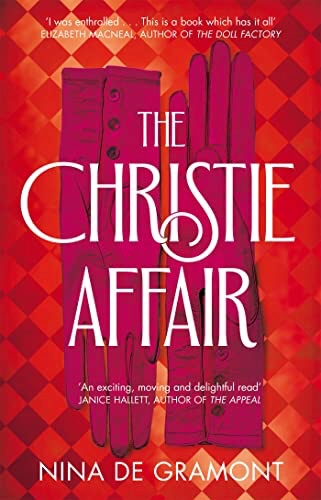
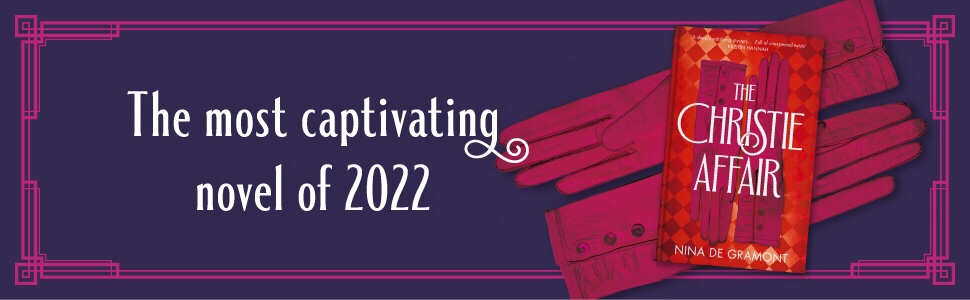
The Christie Affair by Nina de Gramont.

I enjoyed this fascinating novel that fictionalises the famous disappearance of Agatha Christie. On December 3rd 1926, after an argument with her husband Archie, Agatha Christie disappeared. Although there is still some mystery around her movements, it seems she crashed her car while driving down to London. Thousands of police officers and volunteers scoured the countryside near the crash site for Christie, but she was nowhere to be found. It was a huge news story with Arthur Conan Doyle becoming involved and famously hiring a spirit medium to find her whereabouts. She stayed missing for eleven days until she was found in a spa hotel in Harrogate, signed in under the surname of Archie’s lover. Contemporary theories were that this was a publicity stunt, even though Christie appeared to have been in a fugue state. She may have suffered a nervous breakdown after hearing the news that Archie was leaving her. Nina de Gramont weaves a complex tale around this incident, told through the eyes of Nan – Archie Christie’s mistress – an Irish woman whose pursuit of Archie had been so successful he decided to leave Agatha and divorce her, in order to marry Nan. This is only one part of the jigsaw that makes up the full story the author is telling, ranging back and forth and touching on various viewpoints, with the central figure never quite clear and the importance of peripheral figures more vital than I first realised.

We travel back to WW1 and it’s terrible effects on the years that follow. A time when the nation didn’t yet know that the peace they’d achieved was a mere interval of respite where recovery was barely possible. Nan is born of an Irish family, living in London, but is sent back to visit relatives in County Cork in summer since childhood. There she forms a friendship with Finnbarr, a dark Irish boy who has an affinity with animals, particularly his sheepdog Alby. Over the years their friendship grows into love and she is sure they will marry. A chance meeting on Armistice Day is a passionate interlude which leads to Nan being pregnant. Believing their marriage to be only a formality, Nan steals some money, laid aside by her Mum in case one of her daughters gets herself into trouble, and travels to Ireland and the farm. There she finds that Finn is delirious with fever from the Spanish Influenza brought back by returning soldiers. Denied by his family and with Finn thought to be at death’s door, she ends up in a Catholic Home for unmarried mothers. This place is really the genus of the story, because this isn’t Agatha’s tale, despite her being famous and the one who disappeared.

Meanwhile years later, as the Christie’s marriage implodes and Agatha disappears, we’re taken to a hotel in Yorkshire where Nan goes to stay and take a break before the transition of living with Archie. It’s a spa hotel with healing springs, two sets of newly wed couples and an Inspector Chiltern who has been sent to search for Mrs Christie. From these two time frames, the author cleverly weaves her story with the past gradually catching up with the present. I loved the historical detail of the story as the author uses everything from the decor to the women’s clothes to evoke the 1920s setting. There’s a sumptuousness to these descriptions that contrasts strongly with the earlier poverty, with the Magdalene Laundry section being particularly harrowing. I loved how playful the structure was, not quite revealing it’s genre. Is it a love story, an autobiography, or a detective novel? I also loved going back and forth in time, slowly picking up new threads of the story. I had no idea how they would all come together, but loved the way they did.

Meet The Author

Nina de Gramont’s latest novel, The Christie Affair, will be available In February, 2022. She is the author of a collection of short stories, Of Cats and Men, as well as the novels Gossip of the Starlings and The Last September. She has written several YA novels (Every Little Thing in the World, Meet Me at the River, The Boy I Love, and — under the pen name Marina Gessner — The Distance From Me to You). Nina teaches creative writing at the University of North Carolina Wilmington. She lives in coastal North Carolina with her daughter and her husband, the writer David Gessner. 

Learn more about Nina at http://www.ninadegramont.com

Posted in Netgalley, Publisher Proof

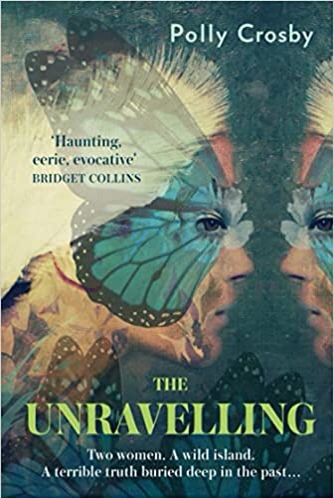
The Unravelling by Polly Crosby

When Tartelin Brown accepts a job with the reclusive Marianne Stourbridge, she finds herself on a wild island with a mysterious history. Tartelin is tasked with hunting butterflies for Marianne’s research. But she quickly uncovers something far more intriguing than the curious creatures that inhabit the landscape. Because the island and Marianne share a remarkable history, and what happened all those years ago has left its scars, and some terrible secrets. As Tartelin pieces together Marianne’s connection to the island, she must confront her own reasons for being there. Can the two women finally face up to the painful memories that bind them so tightly to the past?

I found the last chapter of this new novel incredibly moving and I was smiling through tears as I closed the book.

Polly Crosby you ruined me for other books, for at least a couple of days!

Marianne’s memories of the island take us back to the years between WW1 and WW2, when she lived in the same family home with her mother and father. The Stourbridges were the guardians of the island, through her mother’s side of the family. However, it was Marianne’s father who had taken control of the island and it’s resources. Her family were rich, relying on herrings and pearls to keep their fortunes buoyant and providing work for the islanders. Under Mr Stourbridge’s control the businesses were losing money so he needed to diversify, and settled on silk-making as a way out of difficulty. Mulberry trees and silkworms arrived on the island and Marianne was researching to find out how to produce the best silk thread, but didn’t know that her father had hired a silk girl to come and start things. Nan came to live in their house and although the girls built a friendship, Marianne missed time with her father which was now being sacrificed for Nan and the silk worms. I had so many thoughts and questions in my head by this point. How had the family’s fortunes changed so drastically? How sad it must be for Marianne’s mother to watch her family businesses taken from her and mismanaged simply because she was a woman. Who was Nan and why was she dominating so much of Mr Stourbridge’s time? The author drip feeds these memories into the present day story, answering some questions but leaving others so I was always waiting for the next memory to know what happened next. There was a growing tension in the house that led me to believe an explosion was coming, something that would change Marianne”s life forever. Each section shed light on something in the present day, but I wanted the whole story of why Marianne was so alone in her old age, when did her family leave the island but most of all why was the island requisitioned?

I loved the sense of the uncanny that the author created; a feeling that life on the island was like real life, but not quite. There are strange, unfinished or half destroyed buildings, eroded cliffs and houses that have been literally swallowed up by the sea. Tartelin’s island has a feel of dilapidated grandeur in it’s buildings. They must have once been extravagant and beautiful, like the pavilion where Tartelin meets the peacock, but slowly being broken down and reclaimed by the sea. This is a strong theme throughout the novel, the idea that nature will always find a way, like a flower growing from a tiny crack in the pavement. I found Marianne a fascinating character with the manner of someone very intelligent and far too busy to be bothered with trifles. Her exterior as this grumpy old woman probably brushes most people off, but Tartelin is more persistent than most. Watching these two women slowly learning to trust and understand one another was a joy. Marianne’s story, as it is revealed, moved me beyond words. Even though there’s a fantastical, dream-like quality to her recollections the emotions ring true and are devastating to witness. However, I also felt an incredible sense of joy over the ending too. This novel is evocative and bittersweet, full of rich detail and interesting women. I have no hesitation in recommending all of Polly Crosby’s writing, but this is extraordinary and will stay with me forever.

Published by HQ on 6th Jan 2022

Meet The Author

Polly Crosby grew up on the Suffolk coast, and now lives with her husband and son in the heart of Norfolk. Her debut novel, The Illustrated Child (The Book of Hidden Wonders in the US and Australia) is out now. Polly’s second novel, The Unravelling will be published in January ‘22.

In 2018, Polly won Curtis Brown Creative’s Yesterday Scholarship, which enabled her to finish her novel. Later the same year, The Illustrated Child was awarded runner-up in the Bridport Prize’s Peggy Chapman Andrews Award for a First Novel. Polly received the Annabel Abbs Creative Writing Scholarship at the University of East Anglia, and is currently working on her third novel.

Twitter: @WriterPolly

Instagram: @polly_crosby

Website: pollycrosby.com