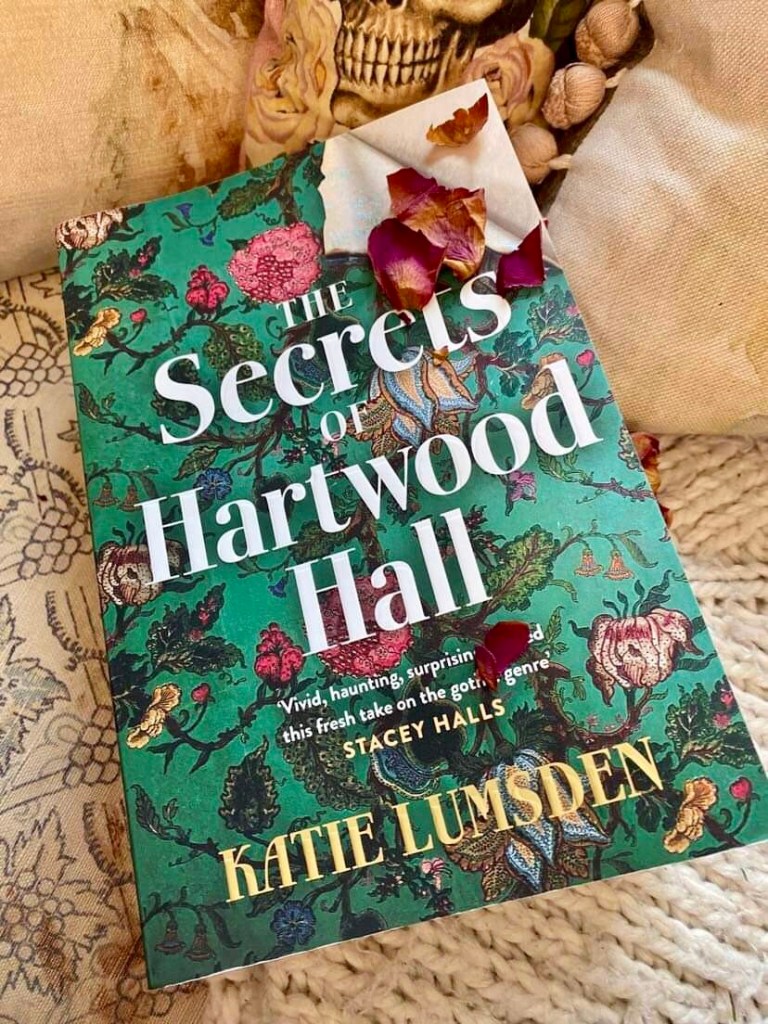
There couldn’t have been a better choice for a squad of female bookworms than this gothic mystery, full of spooky incidents, forbidden love, an orphan governess and within a house that holds many secrets. There was such a Jane Eyre feel about the book and also an hint of the Daphne Du Maurier opening as our narrator looks back to the hall’s approach.
‘when i think of Hartwood Hall, there are moments that come back to me again and again, moments that stain me, that cling like ink to my skin. My first view of the house: a glimpse of stone, of turrets and gables, tall windows and long grass’.
Our heroine is Margaret Lennox, recently widowed and forced to find paid work when her husband leaves his estate to his mother. She is offered a post by the mysterious Mrs Eversham, to educate her son Louis. This should be a moment of freedom for Margaret, but she notes the strange mood of the coach driver as soon as they enter the boundaries of the hall. Local people do not come near here. There is also a very clear rule: do not enter the East Wing of the house, because it is no longer used. As Margaret starts to find her way in Hartwood Hall and enjoys her time with Louis, she does notice a few strange things. She seems under suspicion from one of the existing staff, Susan. She has noticed Margaret’s response to a letter she receives at the breakfast table and is keen to find out more. Stranger than that, she has seen a distance figure in white out in the gardens and followed a figure with a candle down the stairs and towards the East Wing. Maybe the house is haunted, but there are other mysteries too such as what happened to Mr Eversham and why do people in the village treat this woman and her boy with such suspicion and fear?
I was hooked by this story straight away. Just like the author, Jane Eyre was the first grown up book I ever read and I was enthralled with it as a gothic story, years before I started to deconstruct it’s complexity at university. I was also hooked by the Sunday teatime BBC series starring Timothy Dalton as Mr Rochester. It’s the perfect mix of ghostly mystery, intrigue and romance. This book was inspired by the classic but breaks new ground of it’s own in terms of forbidden relationships, marital abuse, and freedom. The freedom of women making their own choices, having freedom of sexual expression and to earn their own living. The governess has always been a liminal figure in literature because they are educated more than other servants and even the woman of the house. They are usually single so have more freedom in their lifestyle and finances. Here Margaret is a widow, she chooses her own destiny and can shape her life as far as choosing where she works and for whom. She also has the choice of what to do with her spare time, no household chores or husband and family to consider. We learn that Margaret’s marriage was not a happy one and she has never felt the love that’s spoken of in literature and poetry. In fact she is surprised to learn it exists and it is joyous to watch her explore that chemistry, even if I did fear for her recklessness. She also becomes the face of Hartwood Hall in the village, choosing to take Louis to church and sit in the hall’s pew, whereas the hall’s gardener sits with his family. She even makes friends with the minister’s wife, although the rest of the village seem to avoid and ostracise them.
As always in these mysteries Margaret is drawn towards the very part of the house she is told not to enter, in fact it is a perfect way into the house after the main doors are locked at night. She is sure she’s seen a candle moving around the East Wing’s rooms when walking in the gardens one evening. There are also noises in the dead of night that can’t be accounted for, but for me the tension really arises at the less mysterious points in the novel. The sly, unpleasant Susan really made my pulse race at points and her blackmail of Margaret feels grubby. She really enjoys the power of knowing something that gives her power over the other person and she seems to enjoy taking something valuable or precious from her victim. The way she commits little acts of dissent when only Margaret is looking, such as stuffing bacon in her mouth in the breakfast room shows resentment about her position. As I could see Margaret settling and enjoying her new pupil I desperately didn’t want Susan to ruin it. The period where both Louis and Susan are ill was truly tense as the whole house waits for the fever of the measles virus to pass. The isolation of Mrs Eversham and her boy is brought into stark relief when they can’t secure a nurse from the village to care for the patients. Mrs Eversham is in despair:
‘So these people will let a child and a young woman die because they suspect me, because they distrust this house? […] Because they believe in ghosts and spirits and curses? Or because they think I am a woman of low character, that I have never had a husband?’
This speech reveals another possibility about their isolation, that Mrs Eversham’s widowhood is not what it seems. It also shows me that Mrs Eversham has a different set of morals to the Victorian norm, she is wiling to set aside ideas about decency and propriety when it comes to saving a life. Margaret is so relieved when Miss Davis appears from nowhere claiming she’s come from the further village of Medley because she heard there was a child who needed a nurse. Yet the other servants seem uncomfortable and even Mrs Eversham seems on edge. Margaret wonders whether Mrs Pulley knows something troubling about this young woman. This brings another yet another layer of mystery to the house: why isn’t Miss Davis as prejudiced against the hall as the locals? Where did she spring from so quickly? By this time I was fascinated and couldn’t stop myself from picking the book up at every opportunity to resolve all my suspicions. Needless to say that when the truth comes out, it was nothing I expected and I loved it! I loved that these strong, determined female characters were living according to their authentic selves. There’s a lot of discussion around the ending of Jane Eyre, I’ve even had an argument about it at a literature talk. A woman said that she felt let down by the ending and Jane’s choice to return to Rochester, because it betrayed her feminism. I argued that she goes back a different woman, with her own money and able to make her own choices. Rochester is her choice and their relationship is on her terms. The ending of Hartwood Hall definitely goes further. It was really heart-stopping, but also satisfying. Both Mrs Eversham and Margaret make their independent choices and decide to live life on their own terms. I throughly enjoyed this atmospheric gothic mystery and it’s strong, forward-thinking, female characters.
Meet the Author.
Katie Lumsden read Jane Eyre at the age of thirteen and never looked back. She spent her teenage years devouring Victorian literature. She has a degree in English Literature and History from the University of Durham and an MA in Creative Writing from Bath Spa University. Her short stories have been shortlisted for the London Short Story Prize and the Bridport Prize, and have been published in various literary magazines. Kate’s YouTube channel Book and Things has more than 20,000 subscribers and was long listed for the Book Vlogger of the Year Award at the London Book Fair Awards 2020. She lives in London and works in publishing.
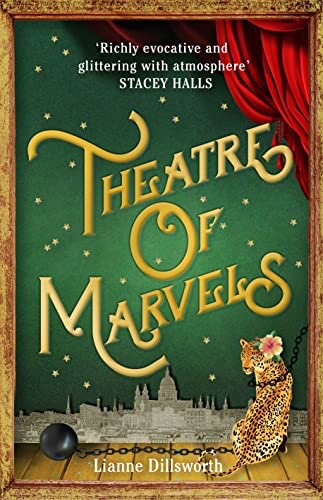
You may have heard of Sarah Baartman, a Khoekhoe woman from South West Africa who was exhibited as a freak show attraction in 19th-century Europe under the name the Hottentot Venus. She was even exhibited after her death, with one showman dissecting her body and keeping her genitalia and skull. Another museum displayed her skeleton and a body cast, which were still exhibited up till the 1970’s. She was exhibited for her steatopygic body type, where body fat is concentrated on the bottom and thighs. This body type wasn’t seen in Europe and was perceived as a curiosity. She was also a subject of scientific interest, but through the gaze of racial bias and erotic projection. In the 19th Century her body could be viewed for two shillings and for a bit extra you could poke her with a stick. Her genitalia were of specific interest as they were said to show her sexual primitivism, although this was more about the men’s erotic projection than Sarah’s own sexuality or libido. Recently, black women in academia and culture have been using her story and reframing it as a source of empowerment, rejecting the ideals of white mainstream beauty, and embracing more curvaceous figures as a source of female beauty. This is the historical and social background that I had in mind while reading this fascinating debut novel from Lianne Dilsworth. I was swept up into her world straight away and my personal academic interest in disability and the display of ‘other’ bodies added to my enjoyment.
Our setting is a theatre and a group of performers from singers to magicians who perform a variety show under the watchful eye of Mr Crillick. His current headline act is Amazonia – a true African tribeswoman, dressed in furs and armed with a shield and spear, her native dancing brings down the house in Crillick’s show. The audience watch, transfixed with fear and fascination, never realising that she is a ‘fagged’ act. Zillah has never set foot in Africa and is in fact of mixed race heritage, born in East London. She is making her money by pretending to be what the, largely white, audience wants to see. It doesn’t sit well with Zillah, but she is alone in the world and does need to make money. Besides it’s better than the other options for a young woman who finds herself in poverty. She’s used to slipping between worlds on stage and in her private life, renting a room in the rough St Giles area of the city, but regularly making her way to a more salubrious area and the bed of a Viscount by night. She and Vincent have been lovers for some time, but he is estranged from his family and can easily keep her a secret, never even walking with her in public. Their shared bed is situated in the middle class home of her boss Crillick. Now, everything is about to change, as Zillah’s consciousness is raised in several ways.
First, she realises that Vincent will never admit to their relationship in public, as he yet again cancels plans to take her to Richmond for the day. Secondly, she meets a young black man called Lucien, who is campaigning in the street. He addresses her in Swahili, with a suggestion this may be the native language of her ancestors, and he places a question in her mind that she can’t shake off. How does it feel to earn money misrepresenting her ancestors? In fact she is representing her ancestors through the gaze of a white audience. The sense that this is wrong, has always been on the edge of her conscience, but Lucien gives her doubts a voice and opens a door towards embracing both sides of her identity. While she dismisses him at first, the thought of him seeing her as Amazonia seems to fill her with shame. Lucien is working on a campaign to relocate black and mixed race Londoners to Africa and the first site is in Sierra Leonne. Meanwhile, Crillick has returned from a trip abroad with shipping containers that suggest he’s been gathering props and it seems he’s been finding new acts too. He taunts Zillah with the suggestion he has found an act that may even eclipse her and one night at his house she sees a new act unveiled to a small group of people. She is horrified to see him parade a terrified women he’s called the ‘Leopard Lady’, with strange white patches all over her dark skin. The men in the party are fascinated, drawing near and touching her skin, even roughly scratching it to see if it comes off. When Zillah notices medical implements laid out on a tray, the horror of what might happen to this woman overwhelms her. She must rescue the Leopard Lady from Crillick’s clutches. There’s a freedom Zillah has compared to a lot of Victorian heroines we might remember, due to her station in life there are certain rules and etiquette of dress and behaviour that don’t apply. Although that freedom does come at a cost – poverty, not belonging anywhere, and the way she is viewed in more polite society. She knows that if she could be with someone like Lucien then she’d be settled in a place society expects of her, still in poverty but at least belonging to a community. Her feelings for Vincent can never come to anything, because his society would never accept her and they would always be a secret.
Through Zillah’s search for the Leopard Lady, we see the truth of a man wiling to make his money treating human beings as objects for display. Whereas before Zillah’s act has at least had the sheen of the theatre world, the Leopard Lady will not be afforded that excitement and sense of performance. This is because Zillah was acting a part, whereas this poor woman is being shown as she is because due to how she looks and where’s she’s from. Zillah chooses to put on her Amazonia costume and take to a stage, if living hand to mouth is ever a choice. Crillick’s plans revolve around his ‘Odditorium’, but in the meantime he plans to show his new acquisition privately to small groups of men. I could imagine these sordid gatherings taking place, with men enjoying an after dinner viewing where the woman is both viewed, potentially sexually assaulted and experimented on. It made me feel sick. I was willing Zillah on in her efforts to find and free the lady, and I found her quest tense and gripping. I thought Zillah’s awakening was handled really well, but I was in two minds about where I wanted her to story to end. Of course there’s an opportunity of relocation to a new life in Sierra Leone, but here I felt strangely similar feelings to those I had about another 19th Century heroine Jane Eyre. We know that Jane’s flight from Thornfield Hall, and the man she loves, is the right move for her. Yet despite the space and time it’s given her to process Rochester’s attempt at bigamy, I never warm to St John Rivers. Although he rescues her from the moors and gives her life purpose again, when he proposes, I can’t be the only reader who’s screaming ‘No’ in her head. As for Zillah, I though Lucien was a good, honest and intelligent man, but to me he feels like the wrong choice. The contrast between him and the passionate relationship she has with Vincent is rather like the two sides of her identity battling against each other. I was hoping that, for a while at least, she could find a way for herself, separate from them both.
This was an exciting and fascinating tale, with elements of the thriller and a central character who is resilient and brave in her quest. I found the settings of the theatre, and Crillick’s home, beautifully rich. Whereas the St Giles area is brought to life with descriptions of sights, smells, many bodies sharing rented rooms and even beds in an attempt to keep costs down. The author has backed up her tale with solid research into freak shows, the many layers of Victorian society and details of food, fashion and leisure time. Through her main character we get an insight into women’s lives, the realities of being bi-racial and the struggles of identity and belonging. I also enjoyed the themes of ‘otherness’ and how outsiders survive in society; the complexities of display and exploitation when weighed against poverty and deprivation. Can freak shows be acceptable if individuals make a choice to exhibit themselves? Or should any exhibition of ‘different’ bodies be unacceptable? This is a question that still needs debate in light of television shows that exhibit overweight and disabled bodies in a prurient way. I really liked Zillah‘s quest to rescue another woman in danger and her own personal journey too. I read this so quickly and will definitely be putting a finished copy on my bookshelves, because I know it’s one I’ll want to read again and again. I just know I’ll find more and more detail in this brilliantly atmospheric exploration of the dark corners of Victorian London.
Published Penguin 28th April 2022.
Meet The Author
Lianne Dillsworth
Lianne Dillsworth has MAs in Creative Writing and Victorian Studies and won a place on the London Library Emerging Writers Programme. She was first runner up in the 2020 SI Leeds Literary Prize for Black and Asian Women Writers in the UK. Lianne lives in London where she works on growing inclusion within the Civil Service. Theatre of Marvels is her debut novel.
It is 1923 and a country is in mourning. Thousands of husbands, fathers, sons and sweethearts were lost in the war, millions more returned home wounded and forever changed.
Beatrice Cade is an orphan, unmarried and childless. London is full of invisible women who struggle to find somewhere to work through their grief. But Bea is determined to make a new life for herself. She takes a room in a Bloomsbury ladies’ club and a job in the City. Just when her new world is taking shape, a fleeting encounter threatens to ruin everything.
Kate Ryan is an ordinary wife and mother. Following the end of the war, she has managed to build an enviable life with her husband and young daughter. To anyone looking in from the outside, they seem like a normal, happy family. But when two policemen knock on her door one morning and threaten to destroy the facade Kate has created, she knows what she has to do to protect the people she loves. And suddenly, two women who never should have met are connected for ever . . .
I can’t say enough great things about this incredible novel, but I’m going to try and do it justice. It’s a historical mystery, extraordinarily clever psychologically and made me think about feminism, sisterhood and the difference between what society expects women’s lives to look like and the life decisions we make for ourselves. Flint has told her story through the eyes of the Kate and Bea, two women who are strangers, but connected by one man. Bea was an orphan and is now an unmarried woman in her late thirties. She’s the book-keeper for a firm in London who has pretty much resigned herself to being a career girl and living in a woman’s hostel. All this changes when she meets the handsome and charming Tom Ryan, a salesman at her firm. Bea struggles to believe that this man, with his movie star looks, would be interested in a woman like her. She expects him to chat up the young women, who have noticed him and are giggling, but he makes a point of stopping at her desk. He comments on her name, telling her that Beatrice was the great love of a poet. Bea is smitten and agrees to meet him, despite the fact that he is married. She is mentally aware of his wife’s presence, the third person always standing between them. Despite this, will Bea allow herself to succumb to Tom’s advances and can it end any other way but heartbreak or disaster?
Flint’s setting is vitally important to this story. We can draw parallels between contemporary women and these two characters, but they are also very much products of their time. This is a post-war Britain and everything has been changed by a war so terrible it is known as the Great War. Men have come home destroyed by what they’ve experienced physically and mentally.
‘There were empty sleeves and eye patches that one must not stare at or draw attention to; there were crutches and bandages and dreadful ridges of thick pink skin; and sometimes there was simply an absence in a face where a man had left a part of himself – the brightest and most vital part – in a muddy foreign field.’
Whereas women could be said to have flourished. Yes, there’s the ever present weight of grief and loss, but some of the changes in women’s lives had been positive. Both Kate and Bea are working women, and represent the many women who became wage earners during the Great War, plugging the gap in the employment market as more men joined up to fight. This was liberating for many women, who were then reluctant to move back to the domestic sphere after the war. There were also a shortage of men in the marriage market, some women had lost their fiancé or husband but there were others who came of age just after WW1 for whom eligible men were scarce. Having the option of throwing themselves into an absorbing career instead proved very fulfilling for some, like Morley’s office manager who clearly expected Bea to be left on the shelf and had marked her out as a potential replacement. Women being outside the domestic sphere meant that the pre-war rigid barriers of social class started to be breached. Different classes of people mingled in work places and matches that would have been impossible a few years before became more common. Bea still longs for love, but as her personal life becomes complicated and painful she does muse on what she has lost. As a single working woman she had women friends and lived in a vibrant city where she could take herself to the theatre, to a museum or for tea with friends. Now that she can see the reality of a relationship, she wonders was she better off before?
Bea knows there is a difference between herself and the girls who have young men to wait for. These are carefree girls, full of life, ‘neat and slender – sleek hair, dainty ankles, flickering glances and quicksilver laughter.’ She’s of a different sort, in looks and class. Where her married sister Jane looks on career girls as modern, smart and fashionable Bea looks a little closer and sees
‘frizzed modern hairstyles that they’d seen in advertisements and that didn’t suit them; women with lines around their eyes that no amount of cream or powder would cover. And women who, despite the well-cut clothes, had red rough hands and nails cut to the quick.’
Bea is well aware she is plain and there are references to Jane Eyre in the way she sees herself. After talking to Tom, she sees herself in the bathroom mirror and is shocked at the difference between her tumultuous, rich inner life and this pale, plain outside. She feels such overwhelming emotions that she disassociates from her rather normal body; ‘how can all these feelings come out of this plain face and body?’ It immediately took me to the conversation between Jane and Rochester when she challenges him for underestimating her:
‘Do you think, because I am poor, obscure, plain, and little, I am soulless and heartless? You think wrong! I have as much soul as you, and full as much heart!…’
In fact Tom uses the comparison to flatter her, praising her strength and courage in living such a lonely life. Patronised by her sister too, she is full of anger inside and expresses the creeping fear that not only is she without a husband, she’s noticed younger, smarter girls starting to come into the workplace. Bright, young things who might be better at her job and quicker. She admits to being afraid of the day when the axe falls, her clothes become shabbier and she gets more desperate. Yet is it any better to be at the mercy of a man? As Kate’s story unfolds we can see that the state of being a wife, is just as unstable and scary, because where Bea has all the responsibility and makes decisions for herself Kate is powerless, entirely dependent on the whims of her husband. A husband who is capable of terrible things. The more Kate starts to learn about her husband, tiny jigsaw pieces start to slot together in her head. She has to admit to herself that she has always known there was something hidden underneath:
‘Hadn’t I known – hadn’t I always known – that he had something terrible inside him, something that lay rotting under the smooth surface of our normal life? I saw glimpses of it sometimes. I thought of his face as he persuaded me, sweet-talked me, into doing things I did not want to do. I thought of how dirty, how shamed, I felt afterwards.’
Set in the 1920’s, this story is based on the true case of Emily Kaye and her married lover Herbert Mahon. The novel’s aim was to give voice to Mahon’s wife and so Kate’s voice came to life, creating a brilliant interplay between her narration and Bea’s. I loved how well the pace was controlled, from relatively slow at the beginning to a breakneck pace towards the end as Kate makes sense of what has happened and holds the key to solve the mystery. I loved how the author showed us the truth of contemporary attitudes to women, that a man can do something terrible, but it will always be the woman’s fault. How Bea is simply disregarded as shameless, getting old and desperate, brazen and responsible for enticing Tom, despite him being married. It’s quite shocking, but then when I thought about our tabloid’s attitudes to women, I realised that women are judged every day for their appearance, their sexuality, their life choices and if ever there is a marital affair in the papers the ‘other woman’ is always blamed. It’s scary to think how little some people’s attitudes have changed, but thank goodness we can earn for ourselves, own property and have bank accounts. I loved the sense of sisterhood the author brings into the story and it made me think about how it’s the women in my life who have held me up when I couldn’t manage alone. I was on tenterhooks wondering whether Kate would realise that to choose the sisterhood is to change things for her own daughter. To make a decision towards a better world for women. This book was a brilliant piece of historical fiction, an addictive mystery that stirred up the emotions and had me completely hooked. As soon as I’d finished, I wanted to read it again.
Published by Picador 23rd February 2023
Meet The Author
Emma Flint was born and grew up in Newcastle upon Tyne. She graduated from the University of St Andrews with an MA in English Language and Literature, and later completed a novel-writing course at the Faber Academy. She lives and works in London.
Since childhood, she has been drawn to true-crime stories, developing an encyclopaedic knowledge of real-life murder cases from the early 20th century. Her first novel, Little Deaths, was longlisted for the Women’s Prize for Fiction, for the Desmond Elliott Prize, for the Crime Writers’ Association Gold Dagger Award, and for The Guardian’s Not the Booker Prize.
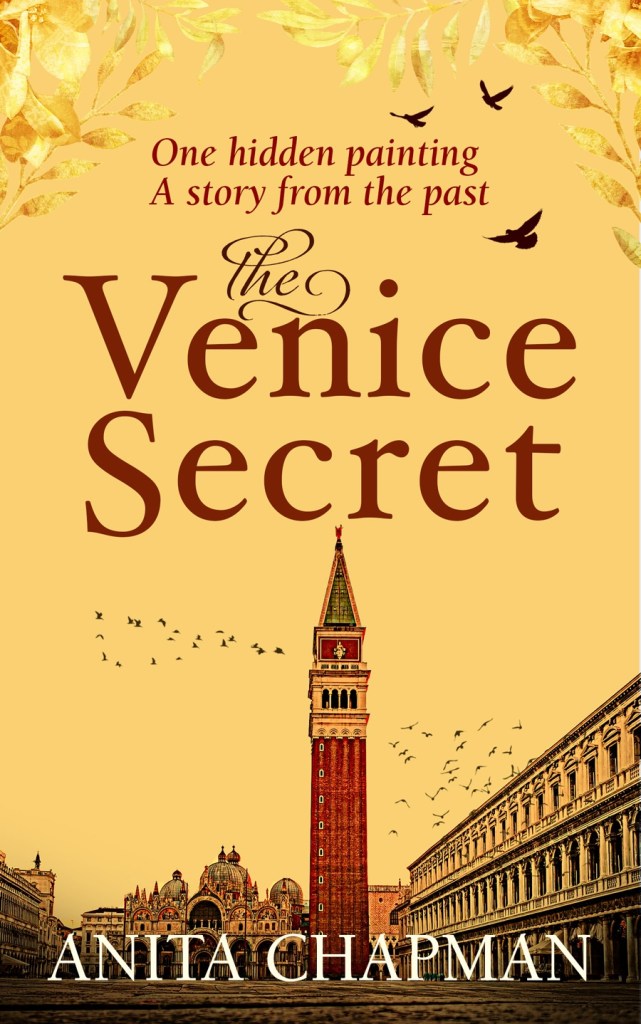
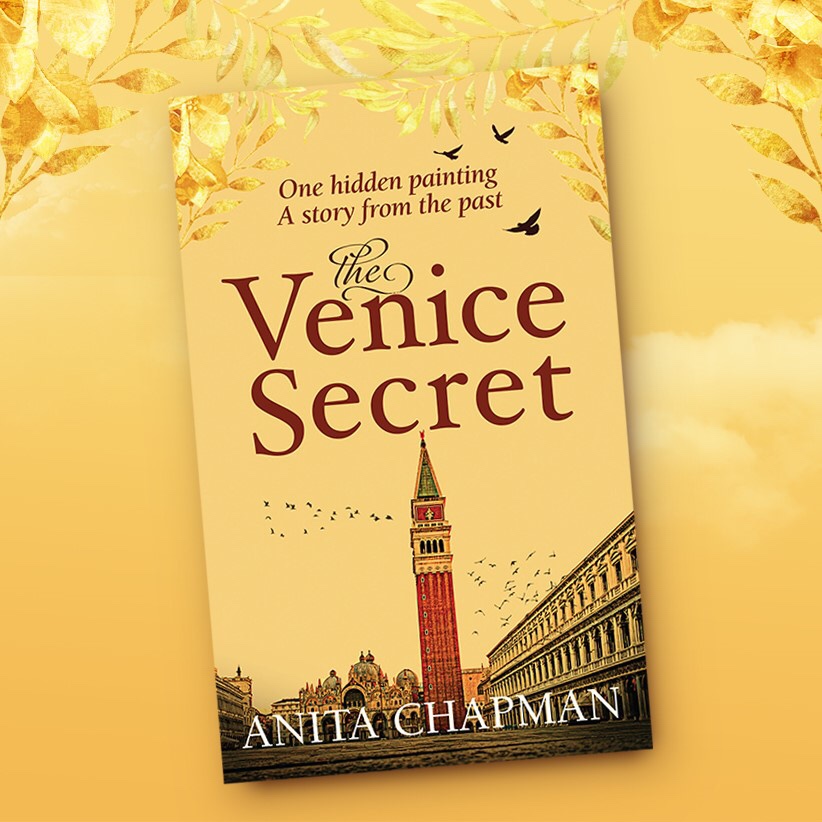
I’m sure amongst those who travel a lot, saying that Venice is your favourite travel destination is a bit of a cliché. I’d first wanted to go aged around ten years old, when I first read the children’s book What Katy Did Next. This third book in the Katy series followed the eponymous heroine as she travelled Europe as companion to a woman and her little girl and is lucky enough to be in Venice for Carnival. I first travelled there with my mum as a fortieth birthday celebration and we both fell completely in love. A couple of years later I visited again, this time with my best friend and enjoyed exploring more of the city, beyond the usual tourist sites. Mainly I enjoyed wandering the labyrinthine streets, taking photographs and soaking up the atmosphere. It has a magic that’s part romance and part mystical, with an edgy gothic darkness that can easily unnerve you – especially when the fog comes down, you’ve lost your way and keep finding lonely dead ends. There’s a little maze behind Teatro La Fenice where you can spend untold hours, wondering if you’re stuck in a time loop. It is one of those places where I wouldn’t have been surprised to turn a corner and find myself back in the 18th Century. So it seemed fitting to me that Venice is a backdrop to Anita Chapman’s debut, a dual timeline story with two narrators; firstly in 2019 with Rachel, then back to the late 18th Century with Phillipa. Both women are going through a period of upheaval and change, another uncanny similarity to fit a city that seems to be a ‘thin place’: a city without the normal barriers of space and time.
In the present we meet Rachel who is helping to sort through her grandmother’s belongings while temporarily living in her cottage. She will soon have to make a decision, to share a home with her mother and her horrible new partner, or become homeless. Rachel is feeling a bit lost and displaced, so needs a project to get her teeth into. She certainly gets more than she bargained for! She discovers what appears to be a Canaletto painting in her grandmother’s loft along with a note addressed to Philippa in 1782. With help from Jake at the local art gallery, Rachel endeavours to find out if the painting is an original and uncovers a secret from the past. The painting depicts a view of St Mark’s Square towards the Basilica from one of the south corners of the piazza. It seems to have some provenance and Rachel sets out to discover who painted it and whether it’s really as old as it’s style suggests. It purports to be a Canaletto, but can it really be genuine and if so, what is it doing in her grandmother’s attic? If it is the real deal, it could be the link between Rachel and our 18th Century narrator, Philippa. Phillipa has gone through a huge change in circumstances, following the death of her father who was a preacher. He has left behind a family struggling to make ends meet and Phillipa feels weighed down by responsibility for them. So she takes the decision to become a governess, leaving her family behind in order to earn enough money to keep them. She manages to get a position at the prestigious Chipford Hall, the family seat of the Duke of Oxon, who has two little girls. Yet, it isn’t long before Phillipa is forced on the move again but this time she’s asked to accompany a family friend, Lady Cordelia, on a trip to Venice, researching her latest novel. It was Phillipa’s part of the story that really engaged me as I felt a real kinship with her. She is quite a level-headed and sensible young woman, prepared to take on her father’s responsibilities. There was common sense, but also a deep kindness in her – she’s willing to give up any dreams of her own to keep the family going.
While I enjoyed aspects of Rachel’s story, I didn’t feel she was as strong and her character didn’t quite grab me in the same way Phillipa did. Rachel’s difficulties often seemed to come from her own choices, but I did feel sorry for her. Nevertheless, her sections do hold the story together well and the history of the painting she finds is fascinating and very well researched too. The author has the skill of bringing the historical aspects of the story to life, full of vivid details and characters. For someone who loves Venice, those sections of the story were particularly enjoyable, taking me back to those tiny streets and romantic canals, triggering some incredible memories along the way. I was also interested in the way the author used the figure of the governess, which ever since Jane Eyre has provided rich material for the writer of historical fiction. Governesses are in a position within the house as neither servant nor master, she is rather unique and potentially dangerous. She has access to the centre of the home, working upstairs with the children and often living with the family, rather than in the servant’s quarters. This position allowed the author to really open up the 18th Century for us, particularly in terms of society and it’s hierarchies. The pace is slower at first, but soon speeds up as the clues start to be revealed and we each time we get a bit closer to the truth and the link with Phillipa. We also come closer to the resolution of each woman’s inner journey. Would Phillipa’s be able to construct better boundaries and gain some wisdom in discerning someone’s character before trusting them? Would Rachel learn to stand on her own feet more, despite the difficulties in her background? I loved how we could see the changes in women’s lives since the 18th Century and how we were less at the mercy of the men in our lives, some of whom seemed perfectly happy to sacrifice a woman if it brought them closer to the power they sought. Each part of the story was woven together beautifully towards a satisfying conclusion, ensuring that I’ll be be looking forward to whatever Anita Chapman writes next.
Meet The Author
Anita Chapman enjoyed writing stories from a young age, and won a local writing competition when she was nine years old. Encouraged by this, she typed up a series of stories about a mouse on her mum’s typewriter and sent them to Ladybird. She received a polite rejection letter, her first.
Many of Anita’s summers growing up were spent with her family driving to Italy, and she went on to study French and Italian at university. As part of her degree, Anita lived in Siena for several months where she studied and au paired, and she spent a lot of time travelling around Italy in her twenties.
Anita likes to read journals and diaries from the past, and one of her favourite pastimes is visiting art galleries and country houses. Her first published novel, The Venice Secret is inspired by her mother taking her to see the Canalettos at The National Gallery in London as a child.
Since 2015, Anita has worked as a social media manager, training authors on social media, and helping to promote their books. She’s run several courses in London and York, and has worked as a tutor at Richmond and Hillcroft Adult Community College.
1922. Jack Treadwell arrives at The Empire in the middle of a rehearsal and he is instantly mesmerised. Once you look past the glitz and glamour, the true magic of the theatre lies in its cast of characters – both on stage and behind the scenes. There’s stunning starlet Stella Stanmore and Hollywood heartthrob Lancelot Drake; and Ruby Rowntree, who keeps the music playing, while Lady Lillian Lassiter, theatre owner and former showgirl, is determined to take on a bigger role. And then there’s cool, competent Grace Hawkins, without whom the show would never go on . . . could she be the leading lady Jack is looking for? When long-held rivalries threaten The Empire’s future, tensions rise along with the curtain. There is treachery at the heart of the company and a shocking secret waiting in the wings. Can Jack discover the truth before it’s too late, and the theatre he loves goes dark?
Jack is our eyes in this unfamiliar world, explaining the theatre whilst also representing the issues a man of his age would face post WW1. He outlines the theatre for the reader as a physical space first, both backstage, front of house and as a performer. There are three distinct aspects to the magic we see created on the stage. There’s the physical building and it’s structure, the artists and stagehands who build the scenery and then there’s the money. Without any of these aspects it’s impossible to create the business we call show. As Jack learns so do we and it brings a brilliant sense of wonder to the reading experience. The author also uses him to make the language of the theatre accessible to us, so we can understand everything that’s going on. Finally, Jack brings to life an aspect of life that affects all men of his age in the early twenties; learning to cope in the post war world. The trauma of war is explored through Jack and Danny Moon, with both young men very reluctant to discuss their experiences. However, as the story progresses it’s clear there are physical and emotional scars that can’t be seen.
Danny Moon in particular embodies a sad truth about war, men go into battle as one person and come out of as someone completely different, someone we may not recognise. All of the characters in the book have their own quirks and personality traits, making them feel real and individual in a large cast of characters. Often in casts like this people get lost but not here, where even if they are slightly stereotypical they’re still memorable. There’s a nice class distinction between upper and lower class characters and how they interact with each other too. The author even touched on the changes in women’s lives in the early Twentieth Century in a subtle but effective way. The issue of women’s legal and political equality was only one aspect of the volatile social change women faced at this time. In fact their social mobility had changed during the war and there were elements in society who wanted their roles to revert to pre-war tradition. Women were not so easily persuaded and the author represents this with headstrong female characters who struggle against the belief that women should return to the home. The role of actress had traditionally been synonymous with women of easy virtue and those attitudes still persist in the 1920s, as well as mistaken beliefs that women can’t think and therefore act as well as men. The women here definitely prove those theories wrong! Finally, there were returning soldiers struggling with their mental health and Billy Barlow represents this wave of men with depression, anxiety and P.T.S.D. His struggles are enacted on the stage, bringing real meaning to his performance. Of course the author isn’t aiming to make these issues the focus of the novel, but by adding it as background he has grounded the story in it’s place and time.
Whilst I’m not specifically a Michael Ball fan, I am a huge fan of musical theatre and I know what an incredible talent he is in that world. I figured if anyone knows how to put the magic of the theatre into words then it’s him. I had a certain amount of scepticism though – as a lover of books I’ve looked on with dismay at brilliant writers struggling to get publishing deals, when celebrities seem to find it easy. Just because someone is a celebrity doesn’t make them a great writer. However, here Michael Ball’s warmth and love of his subject comes across beautifully and I really enjoyed the book. For a first novel, the story is long with many different avenues to explore, but I found that despite the complexity it wasn’t hard to follow and I didn’t have to go back over earlier sections to keep track. The structure helped, because in addition to chapter breaks there were clever changes in tone, setting and description. His story immerses the reader in the world of theatre, but the author has also created sympathetic characters and opened a window on the social issues of the 1920s. I look forward to more adventures at The Empire.
Published by Zaffre 13th October 2022
Meet The Author
Michael Ball OBE is a singer, actor, presenter and now author. He’s been a star of musical theatre for over three decades, winning the Laurence Olivier Award for Best Actor in a Musical twice, he’s also won two BRIT awards and been nominated for a Grammy. Michael regularly sells out both his solo tours and his Ball & Boe shows with Alfie Boe and has multiple platinum albums. The Empire is his first novel.
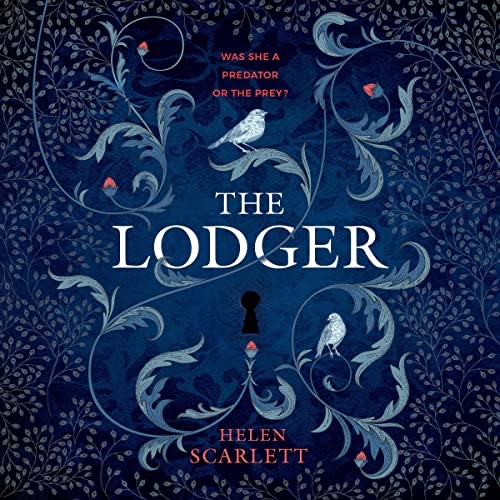
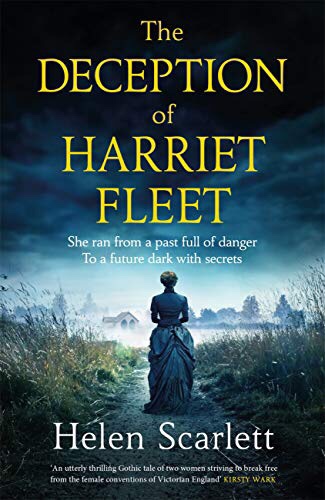
I’d throughly enjoyed Helen’s last book The Deception of Harriet Fleet, so I was looking forward to this release. The Lodger is an interesting historical fiction novel set in the period post WW1 and the Spanish Flu epidemic.. It’s a period I’m particularly interested in and I was drawn to the premise and how it brought the changes of that time into the plot of the story. This was a time of personal and national mourning, with the war appearing like a scar cut right across the public’s consciousness that hasn’t yet had time to heal. Our heroine, Grace, has a family torn apart by grief. She lost her brother Edward at the front and her parents grieved very differently, with her father keeping quite stoic and her mother struggling to cope. Eventually it was decided that for her own good, Grace’s mother would go and rest in an institution where she could be cared for properly. Grace also lost her fiancé Robert at the Somme, a loss she’s struggling to come to terms with as she keeps seeing him on the street, in crowds and on buses. Yet she can never find him. In order to make ends meet and to further an ambition Grace has taken a job at a nursing newspaper and wants to become a journalist, something that would have been unthinkable a few years before. Similarly, to make ends meet in their London home, they have taken in a lodger. Many well-to-do families were forced to do this at the time and Grace has struck up quite a friendship with Elizabeth, a church going woman who was proving to be a great friend. So when Elizabeth is found dead in the river and the police quickly rule it a suicide, Grace is shocked but determined to leave no stone unturned in finding out about the death of her friend.
The historical background was woven into the story so well: a general sense of everyone mourning someone, the fact that women’s positions in society were changing and the difficulties for those returning from the horrors they’ve seen. It was great that this was sometimes incidental background, such as someone Grace goes to speak to having a bad morning, because it’s the anniversary of his son’s death. It gave a real sense that this was an all pervasive grief and hung over the whole country. We would see it in more depth in certain characters. Her friend Edward still has an air of the last century in the way he deals with what he’s seen. He’s very protective of Grace and doesn’t want to tell her things that might distress her, and you get the sense he will take his experiences to the grave. Whereas his friend Tom is willing to be more vulnerable and has clearly suffered mentally since he returned with PTSD. He’s more willing to share with Grace and be honest about what the war has cost him. A character that really shows a change in women’s behaviour is Lady Bunty Jaggers, a friend of Grace’s mother. Grace asks for help in reaching a society lady whose husband knew Elizabeth, so goes to meet Bunty in her London home. She is a very colourful character and has an interesting way of looking at her marriage and what it gives her. She could leave her husband, but at the moment she has the best of both worlds. She’s cushioned by his money and title, but he remains resolutely in the country and she stays in their London townhouse living entirely separate lives. She’s also very forthright about Grace’s mother, suggesting that all the care home does is medicate her to the point of being unconscious. She thinks Grace should take her away from there and simply let her cope with the grief unmedicated, after all grief is normal.
Grace uncovers a terrible story of Elizabeth’s past life, including sexual impropriety, blackmail and possibly murder. None of which seems to fit with the Elizabeth she knew. She will need to interview many people, some of the them wealthy and very dangerous, to get to the truth. Was Elizabeth a changed woman because of all the wrongs she’d committed before or is there more to this story than meets the eye. Grace will need all of her investigative skills to uncover what really happened and she needs to keep an eye out for whoever is watching her and potentially wants to stop her. There were parts of the book that were a little slow and it could have benefited from a chapter or two from Elizabeth’s point of view in a separate timeline. However, I did enjoy that this news about female friendship and going the extra mile for someone who has been good to you, no matter what others say. Grace’s loyalty and determination are evident here. She also shows loyalty to her mother and a willingness to defy her father when she thinks he’s wrong. I really enjoyed how their mother daughter relationship developed.over the book. Finally there’s a little bit of romance too and a choice to be made between a man who is loyal, kind and would keep her safe or a different man who is more progressive, open and would see her as a partner, not a dependent. I liked that this choice was left till late in the book, because it would signify how Grace saw her future and whether or not she was in charge of it.
Out now from Quercus.
Meet the Author
‘The Deception of Harriet Fleet’ is my first novel and is set in the north east of England. I’ve always loved the big, classic novels from the nineteenth century, with lots of governesses and intrigue, and I sometimes wonder whether I was born in the wrong era! Although the Victorian period was a time of huge changes, the inhabitants of Teesbank Hall are trapped in the past by the destructive secrets they hold. Teesbank Hall itself is fictional but most of the other settings in the novel are real and close to where I live with my husband and two daughters. I teach A Level English and write whenever I can grab a spare moment. (Taken from Helen’s Amazon Author Page).
You might also enjoy Helen’s first novel. A dark tale that’s brimming with suspense, an atmospheric Victorian chiller set in brooding County Durham for fans of Stacey Halls and Laura Purcell
1871. An age of discovery and progress. But for the Wainwright family, residents of the gloomy Teesbank Hall in County Durham the secrets of the past continue to overshadow their lives.
Harriet would not have taken the job of governess in such a remote place unless she wanted to hide from something or someone. Her charge is Eleanor, the daughter of the house, a fiercely bright eighteen-year-old, tortured by demons and feared by relations and staff alike. But it soon becomes apparent that Harriet is not there to teach Eleanor, but rather to monitor her erratic and dangerous behaviour – to spy on her.
Worn down by Eleanor’s unpredictable hostility, Harriet soon finds herself embroiled in Eleanor’s obsession – the Wainwright’s dark, tragic history. As family secrets are unearthed, Harriet’s own begin to haunt her and she becomes convinced that ghosts from the past are determined to reveal her shameful story.
For Harriet, like Eleanor, is plagued by deception and untruths.
Welcome to 2023 at The Lotus Readers! It’s already looking like a busy one and if January is anything to go by there are going to to be some hot contenders for my round-up in twelve months time. I’m going to be spoiled for choice. There are going to be some new and developing projects this year that I’m excited about and I’m already planning into June. I’m doing a lot more work with the Squad Pod Collective this year and I’m very excited at some of the books and read alongs we have scheduled. On a more personal level I’m hoping to be a better planner this year, with the hope of clearing some of my NetGalley backlog and keeping on top of publisher’s proofs. I want to develop my Instagram account and start work on TikTok too. I have various themes planned throughout the year and new spotlights to bring to you, with poetry and classics featuring more prominently. I’ve also realised I need to tell you all a little bit about me and I must get used to seeing to showing you my face a little bit. Finally I’m hoping to update the website with new photos and a better layout so I’m easier to find. So to kick off this new year, here are my first books of the month for January.
House of Fortune by Jessie Burton
To say I’m a fan of Jessie Burton is an understatement. I am in awe of her writing abilities and love every one of her books, but there’s a soft spot in my heart for her debut novel The Miniaturist. I was transported straight back to 16th Century Amsterdam and whenever I think about the town house where Nella goes to live with her new husband Johannes and his sister Marin, I have an almost synaesthesic response because I can smell it. It’s a mixture of wood panelling and beeswax. Considering how attached I am to this extraordinary tale, there was a certain amount of trepidation in reading her follow up House of Fortune. I’d saved it for the end of the year and it came to me in two special editions, one with spredges in a green pattern and one with a yellow pineapple print. It’s been eighteen years since the events of the first book and Thea’s birthday approaches. As her father Otto is let go by his employer the household is in decline, almost down to the last treasures it can sell to stay afloat. Maybe their only hope for the future is Thea and the family are forced to launch her on Amsterdam society with the hope of finding her a husband with the fortune to keep them afloat. Otto wants Thea to have a choice and with new friend Caspar he has planned to farm Thea’s childhood home, Assendelft, by growing a crop of pineapples. However, Thea has her own plans and when small packages start appearing on the doorstep it’s clear a period of change is on the way. Could this be the miniaturist, up to her old tricks?
I was sucked straight back into Nella’s world as mistress of this extraordinary house. I loved that Burton took us to Nella’s childhood, with the walls of Assendelft full of memories, good and bad. Over the eighteen years since Johannes’s death she has become a force to be reckoned with and this reminds us of how naïve and young she was at the beginning. I felt sad that she had almost written herself off, pinning all their hopes for the future on Marin’s daughter Thea and not even considering that she could be the one pursued by potential husbands. Wealthy widows can be very attractive in the marriage market and nobody knows what Johannes’s arrangements were for his wife. I felt that Nella didn’t want marriage though, having been free for eighteen years it would certainly be hard to adjust to the more conventional woman’s role a husband might expect. I also really enjoyed being taken into the world of the theatre, where Thea is transfixed by the stories being told on stage. Her fear that someone has seen her hanging around backstage, especially since spending time with scene painter Walter, really came across strongly. I felt for her and I wanted Thea to remember what it felt like to be a teenager without her whole family’s fortunes weighing heavy on her shoulders. I was compelled to keep reading, completely caught up in the world of this strange family of outsiders, but also wondering if this time the miniaturist would be unmasked and her purpose revealed. I throughly enjoyed being back in Nella’s world and it renewed my desire to go to Amsterdam to see the original cabinet house that fired up Jessie’s imagination.
We All Want Impossible Things by
This book was a joy. That’s going to seem odd when I explain what it’s about, but it is joyful and full of life. Even though at it’s centre there’s a death. Ash and Edi have been friends forever, since childhood in fact. They’ve gone through adolescence together: survived school; other girls; discovering boys and even that awkward phase of starting adult life, when one went to college and the other stayed behind. They’ve both married and been each other’s maids of honour and become mothers. Instead of any of these things pulling them apart they’ve remained platonic partners in life. However, now Edi is unwell and decisions need to be made. After years of struggle with being, treatment, remission and recurrence, Edi now has to decide how she’ll be dying. With all the hospices locally being full, Ash makes an offer – if Edi comes to a hospice near Ash, she can devote time to being with her and Edi’s husband can get on with every day life for her son Dash. There’s a hospice near Ash that’s like a home from home, with everything that’s needed medically, but the informality and personal touch of a family. Now Ash and Edi have to negotiate that strange contradiction; learning how to live, while dying.
Ash’s home and family life is so enviable I wanted to be part of it. Her estranged husband Honey is an incredible chef and her daughter seems to have picked up the talent. The author’s descriptions of their meals really did make the mouth water and are their way of contributing and supporting Ash. All of these people are so nurturing, in Honey’s case this is despite he and Ash being separated. Before you think this sounds schmaltzy and sentimental I can assure you that these characters are not perfect. Each has their flaws and their ways of coping, some of which are destructive and possibly difficult for others to understand. Ash particularly has a novel approach to grief, but I understood it. If we look beneath the surface, it’s a way of forging connection with others on the same journey and expressing their love for Edi. It’s also a distraction, a way of leaving all the paraphernalia of death behind and affirming life. That doesn’t mean her behaviour isn’t confusing, especially to her teenage daughter who supplies whip smart commentary, eye rolls and remarkable wisdom. The men in this friendship group seem to understand that their grief is secondary, because Edi is the love of Ash’s life. I enjoyed the little addition of Edi’s other friend – the college friend – who Ash has concerns about. Does Edi like her more than Ash? Do they have a special bond? The author provides us with this loving picture but then undermines it slightly, so it isn’t perfect. We are imperfect beings and no one knows how they will react in a time like this, until we’re there. Catherine Newman shows this with realism, charm, humour and buckets of compassion.
The Curious Case of The Alperton Angels by Janice Hallett.
I was enthralled, addicted and so desperate to find out what actually did happen on the night when the police found a strange cult massacre in a deserted warehouse. Open the safe deposit box. Inside you will find research material for a true crime book. You must read the documents, then make a decision. Will you destroy them? Or will you take them to the police? Everyone knows the sad story of the Alperton Angels: the cult who brainwashed a teenage girl and convinced her that her newborn baby was the anti-Christ. Believing they had a divine mission to kill the infant, they were only stopped when the girl came to her senses and called the police. The Angels committed suicide rather than stand trial, while mother and baby disappeared into the care system. Nearly two decades later, true-crime author Amanda Bailey is writing a book on the Angels. The Alperton baby has turned eighteen and can finally be interviewed; if Amanda can find them, it will be the true-crime scoop of the year, and will save her flagging career. But rival author Oliver Menzies is just as smart, better connected, and is also on the baby’s trail. As Amanda and Oliver are forced to collaborate, they realise that what everyone thinks they know about the Angels is wrong. The truth is something much darker and stranger than they’d ever imagined. And the story of the Alperton Angels is far from over.. After all, the devil is in the detail…
It was hard to review when I didn’t want to let slip any signal or clue, so I won’t comment on the storyline. It’s drip fed to you in the different communications and I loved how we were presented with other people’s opinions and thoughts on the discoveries being made. Who to trust and who to ignore wasn’t always clear and the red herrings, including the involvement of the Royal Family, were incredible. I felt that true crime author Amanda had an agenda, that possibly had nothing to do with the story at hand and was more about a personal grudge. Janice Hallet’s research is impeccable and here she has to cover the early 1990’s and 2003, as well as the workings of the police, special forces and the social services – some of which is less than flattering and even corrupt. I found delving into the True Crime genre fascinating considering how popular it is these days, something I’m personally very conflicted about. This has all the aspects of a sensational True Crime investigation with a more nuanced perspective from other characters to balance things out. I was gripped to the end and the end didn’t disappoint.
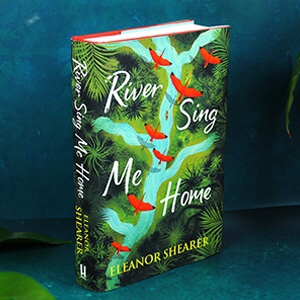
River Sing Me Home by Eleanor Shearer.
This incredible debut novel grabbed hold of my mind and heart, never letting go until the final paragraph. I shed tears at several points in Rachel’s journey and she’s a character I won’t forget. We meet her working on a plantation in Barbados, at that strange point after slavery when plantations were instructed to free slaves, but their sense of freedom was short-lived as masters were able to keep slaves for a further six years as apprentices. So, despite being freed the day afterwards started just the same, at the crack of dawn and walking to the cane fields for a day of back breaking work. Having nothing meant that most had no other choice. Rachel is thinking of her children, several lost before they had a chance to live but others scattered to the four winds. Her boys Micah and Thomas Augustus and her girls Cherry Jane, Mary Grace and Mercy all taken from her in different ways. Only Cherry Jane spends a few years nearby as a house slave, but in her superior position she doesn’t acknowledge Rachel who is merely a field hand. One day she decides that she must find her children, she mustknow where they are and what happened to them, even if the news is that devastating final loss. Rachel says that as a slave she plants cane but nothing of her own. However her children came about, Rachel feels that they anchor her in this world and she can’t rest until she finds them. So she runs and with our hearts pounding we follow her.
Shearer uses incredibly evocative detail to bring nature to life in this book and underscore Rachel’s sense of freedom. A river takes them deep into the forest and a community of freed slaves and indigenous tribespeople where one of her sons may be. It also sweeps them along, back to freedom after searching Grenadian plantation for daughter Mary Grace. The whole journey is littered with joys and terrible grief, but Rachel knows she must keep going. She meets others who have started to build a new life, placing the past firmly behind them and never pining for it. They live firmly in the here and now with questions left unanswered and people left behind. For Rachel that isn’t enough. Her children are like the scattered pieces of a broken vase. She doesn’t expect her family to be perfect and knows that there will be cracks and missing pieces. Rachel is putting her broken vase back together and she will pour a substance into the cracks, bringing the pieces together until her past is whole again. The binding substance used in Japanese Kintsugi pottery is usually gold, each crack making the piece more valuable and beautiful. In Rachel’s case the binding substance is love. Love for those here, those found but far away and those gone forever. An all encompassing love symbolised by the bond between a mother and her children.
Amazing Grace Adams by Fran Littlewood.
It’s possibly way too early to start picking candidates for favourite books of 2023 – I’m still deliberating over 2022 – but I think this book is certainly going to be in contention. Grace is one of those characters that you fantasise about having cocktails with and you already know you’d have the best time. Grace is stuck in traffic, it’s a boiling hot day and she’s melting. All she wants to do is get to the bakery and pick up the cake for her daughter’s birthday. This is one hell of a birthday cake, not only is it a Love Island cake; it has to say that Grace cares, that she’s sorry, that will show Lotte she loves her and hasn’t given up on their relationship. It’s shaping up to be the day from hell and as Grace sits in a tin can on boiling hot tarmac, something snaps. She decides to get out of the car and walk, leaving her vehicle stranded and pissing off everyone now blocked by a car parked in the middle of a busy road. So, despite the fact her trainers aren’t broken in, she sets off walking towards the bakery and a reunion with Lotte. There are just a few obstacles in the way, but Grace can see the cake and Lotte’s face when she opens the box. As she walks she recounts everything that has happened to bring her to where she is now.
When we first meet Grace she’s living alone, estranged from husband Ben and even from her teenage daughter Lotte. She’s peri-menopausal, wearing trainers her daughter thinks she shouldn’t be wearing at her age and she’s had enough. There’s that sense of the Michael Douglas film Falling Down except when the meltdown comes all she has is a water pistol filled with river water, an embarrassingly tiny Love Island cake and a blister on her heel. Then in flashbacks we can follow Grace all the way back to the start, to when she and Ben met at a competition for polyglots. The truth when it comes is devastating, but feels weirdly like something you’ve known all along. Those interspersed chapters from happier times are a countdown to this moment, a before and after that runs like a fault line through everything that’s happened since. As Grace closes in on Lotte’s party, sweaty, dirty and brandishing her tiny squashed cake, it doesn’t seem enough to overturn everything that’s happened, but of course it isn’t about the cake. This is about everything Grace has done to be here, including the illegal bits. In a day that’s highlighted to Grace how much she has changed what will happen to her relationship to the people she loves most?
All of these books are out now and you can potter along to your local book shop for them. Happy Reading! ❤️📚
Lesley and Jonesy have been in foster care together ever since they can remember, in the same room and often in the same bed if Jonesy creeps in late at night. Our narrator is Lesley and she stands out as a little different from the other girls in the homes. She’s clever and goes to the grammar school instead of the one on site. She’s good at maths and seeing patterns in things, so what starts happening at the homes seems to her like a puzzle she can solve. Because someone at the homes is killing girls, possibly raping them and killing them. Who could it be?
The Homes are a sprawling institution made up of 30 cottages filled with the orphans of Glasgow and those needing care. So large, it has it’s own hospital, church and school, with every cottage run by a house mother and father with a Christian ethos. Set in the 1960’s and based on the Quarrier’s orphan village near the Bridge of Weir, where the author’s mother spent some of her childhood. He writes these girls as very isolated and dealt with at a distance, not just from their families, but from the staff too. He throws us in at the deep end with a morning that Lesley’s been dreading. Today she has to face the school bully Glenda, who lives a few cottages up. The adults know that Lesley is very likely to take a beating, but they do nothing. As she leaves for her school bus, Lesley can see a crowd of girls gathering at Glenda’s gate hoping for blood. It’s fair to say they get a bit of a surprise when the encounter doesn’t play out the way they expect. I felt as if the children were treated like animals, like when I’ve brought rescue cats home and left them to sort out their hierarchy amongst themselves. Even so, I would worry if any of them were distressed or fighting. These kids are fed, watered and disciplined, but they’re not cherished.
Only once called by her Christian name, Morag is known as Jonesey and she is a larger than life character. I loved the little characteristics that Lesley relates to us, such as the giggling in church, the constant chatter, and the way she often slips into Lesley’s bed at night but still isn’t restful. Even in her sleep Lesley is often woken by Jonesey’s jerking limbs, she’s like a puppy whose brain is asleep but whose body is still on the go. She’s absolutely irrepressible and incredibly loyal to Lesley, often waiting outside for her bus to arrive in the early evening, wriggling like that excited puppy again. By contrast, Lesley is outwardly very quiet. Her inner world is lively though, bright and full of questions. She has a dogged determination that helps her at school with tricky maths problems, but proves to be a nuisance to the police and the perpetrator of these terrible murders. Unfortunately, her amateur sleuthing is not quick enough to save the third victim. In between the case we learn a lot about the upheaval Lesley has suffered in life. She’s visited by her gran mostly, but she isn’t great at answering all the questions Lesley has. She’s clearly very fond of her granddaughter, but doesn’t want to get into the minutiae of why her mother placed her in care. Her mother visits less, but when the answers finally come there are painful truths to process. I was so glad she had Jonesey and her therapist Eadie but I worried for her going forwards and eventually leaving care. I bonded with Lesley, enjoying her intelligence and sense of fun as well as the way she coped with difficult situations.
A bit like Lesley I suspected every character along the way, knowing that people who work with children are not always doing it for the right reasons. There are people at the homes who are there for their own ends. There are various levels of abuse going on in the community. They’re forced into a religious upbringing they may not want and the expectations, particularly of girls, is tied up in that Christian morality. The discipline is down to each house parent and is always strict, but could also be violent and humiliating. At worst these children are preyed upon by the most horrific kinds of abuser and the tension builds towards a conclusion that not only unmasks a killer, but blows the lid open on everything that is wrong with the institution. I thought the historical setting was captured incredibly well, not so much the location but the emotional landscape of the 1960s. This was a time of secrets, when children were seen and not heard and definitely didn’t have rights. A time when young women were still shamed for their burgeoning sexuality and perfectly normal urges and their consequences. This was the time when my mother was growing up and it felt as if the author had the context just right. I thought the author perfectly balanced Lesley’s personal realisations and growth, with the tension of the murder investigation. As the inhabitants of Lesley’s cottage sit down for Sunday lunch with their houseparents, the Pattersons, she has a very grown up revelation. In the space of her week, this is the only time they feel ‘like a big normal family’ and it’s becoming apparent that all adults will eventually let her down. By the end I realised Lesley had drawn me into her story to such an extent I was wondering about her future. Despite the murders being solved, I was reluctant to close the book and leave her behind.
Published by Viper, 26th May 2022.
Meet the Author
J.B. Mylet was inspired to write The Homes based on the stories his mother told him about her childhood. She grew up in the infamous Quarrier’s Homes in Scotland in the 1960s, along with a thousand other orphaned or unwanted children, and did not realise that children were supposed to live with their parents until she was seven. He felt this was a story that needed to be told. He lives in London.
This incredible debut novel grabbed hold of my mind and heart, never letting go until the final paragraph. I shed tears at several points in Rachel’s journey and she’s a character I won’t forget. We meet her working on a plantation in Barbados, at that strange point after slavery when plantations were instructed to free slaves, but their sense of freedom was short-lived as masters were able to keep slaves for a further six years as apprentices. So, despite being freed the day afterwards started just the same, at the crack of dawn and walking to the cane fields for a day of back breaking work. Having nothing meant that most had no other choice. Rachel is thinking of her children, several lost before they had a chance to live but others scattered to the four winds. Her boys Micah and Thomas Augustus and her girls Cherry Jane, Mary Grace and Mercy all taken from her in different ways. Only Cherry Jane spends a few years nearby as a house slave, but in her superior position she doesn’t acknowledge Rachel who is merely a field hand. One day she decides that she must find her children, she must know where they are and what happened to them, even if the news is that devastating final loss. Rachel says that as a slave she plants cane but nothing of her own. However her children came about, Rachel feels that they anchor her in this world and she can’t rest until she finds them. So she runs and with our hearts pounding we follow her.
As Rachel took her journey I kept thinking about my own mum. She always feels at her happiest when we’re all under her roof, all four generations. She told me that she feels like we’re all safe and there’s a feeling of completeness. I am not a mother, so until recently I hadn’t experienced anything like this, but now I am a step-mum and I do get a sense of relief when both my stepdaughters are here under my roof. There’s a feeling that I could close the curtains and we’d all be safe. I couldn’t imagine how it must feel to have those children stripped from you as commodities to be sold. As I finished reading the book on Holocaust Memorial Day, my mind was also taken to an account by a survivor on TikTok where she described her family being split apart into separate queues as they reached Auschwitz. She was placed in one queue bound for a factory sewing uniforms, but her mother and sister were deemed unsuitable for work and in the chaos was the final moment she saw them. It’s a similar atrocity, so huge that it’s hard to imagine or compute. A whole race of people are deemed as expendable and discarded with no more regard than swatting a fly. In amongst some powerful and distressing scenes in the book, one thing that hit me really hard was Rachel’s realisation that her emotions didn’t matter. As a younger woman she had held herself proudly and resolutely, determined that the actions of the overseer wouldn’t make her cry. As an older woman she realises that she could have owned her grief, it wouldn’t have satisfied or pleased the overseer to see her distress because she simply didn’t matter to him.
Rachel’s journey is a long one, across Barbados and over to Trinidad, and we experience every moment with her. The author provides vivid descriptions of each place Rachel experiences down to the way the earth feels under her feet. Cities give her a certain anonymity, but it’s in nature that I really felt Rachel’s freedom. The author layers sounds of birds, running water and wind through the trees with the feel of leaves or water against the skin. The water of the rivers are welcoming and help her journey: kayaking up the Demerara to look for runaway communities in the forest and Thomas Augustus; rushing down river holding an uprooted tree to avoid capture; feeling cocooned and supported by the water in a bathing pool. The runaway community are made up of escaped slaves and indigenous tribesmen who have survived the colonisation of their island and the forest both hides them and supports them. There is a sense of abundance in the food, the company and the mix of cultures that comes out in musical form. The ancient songs of Rachel’s African heritage come alive for her when mixed with slave songs and the music of the indigenous tribes represented. It seems fitting that it is in the forest that a marriage takes place and a baby is born – these are the building blocks of the future and that future is truly free.
I found some of the characters Rachel comes across on her travels fascinating and they add something to the tale by bringing their own experience, adjustment and acceptance of their situation. Nobody has adopted the very part of his identity forged by the slave experience, the sense that he is no one and belongs nowhere. Despite the negative connotations of the name, being nobody allows him to take his power back, to be anonymous, to escape unseen and leave a mark nowhere. He has been transitory ever since he started running, living a transitory life on the ships that travel between the islands, perhaps feeling more at home in the water than on the land he was enslaved by. I wondered whether Rachel’s quest would make a mark on him and if he would find a true home, whether that be a place or a person. I was also intrigued by Hope, whose very name embodies looking forward. She has found her place in Bridgetown by entertaining paying gentlemen. She is beautiful, impeccably dressed and seems to have found a independent way of living she’s at peace with. While some people don’t want to be seen with her, Rachel is not so judgmental. After all, Rachel tells us, men have been inside her but there she was the one who paid the price. The threat of sexual violence is alluded to but never explicit. Rachel won’t discuss or ask another woman how her children have come into being, because she knows the pain of a pregnancy where you pray the child you carry has no resemblance to it’s father. Equally she knows what it’s like to dread the birth of a child who might bear a resemblance to a man greatly loved and lost forever. We don’t know about the conception of any of Rachel’s children. Her ‘pickney’, as she calls them, are hers and hers alone and it is this that makes it imperative that she finds them. She needs to find them, in order to feel whole.
The whole journey is littered with joys and terrible grief, but Rachel knows she must keep going. She meets others who have started to build a new life, placing the past firmly behind them and never pining for it. They live firmly in the here and now with questions left unanswered and people left behind. For Rachel that isn’t enough. Her children are like the scattered pieces of a broken vase. She doesn’t expect her family to be perfect and knows that there will be cracks and missing pieces. Rachel is putting her broken vase back together and she will pour a substance into the cracks, bringing the pieces together until her past is whole again. The binding substance used in Japanese Kintsugi pottery is usually gold, each crack making the piece more beautiful. In Rachel’s case the binding substance is love. Love for those here, those found but far away and those gone forever. An all encompassing love symbolised by the birth of a baby in the forest.
There was a ‘feeling of complete, absorbing, unqualified love. The baby was a stranger, without speech, unknowable. It would be years before he could say what was on his mind. And yet, love did not wait. Love was there in the beginning – even before the beginning. Love needed no words, no introduction. Existence was enough.’
Published on 19th Jan by Headline Review
Meet The Author
Eleanor Shearer is a mixed race writer from the UK. She splits her time between London and Ramsgate on the coast of Kent, so that she never has to go too long without seeing the sea.
As the granddaughter of Caribbean immigrants who came to the UK as part of the Windrush Generation, Eleanor has always been drawn to Caribbean history. Her first novel, RIVER SING ME HOME (Headline, UK & Berkley, USA) is inspired by the true stories of the brave woman who went looking for their stolen children after the abolition of slavery in 1834.
The novel draws on her time spent in the Caribbean, visiting family in St Lucia and Barbados. It was also informed by her Master’s degree in Politics, where she focused on how slavery is remembered on the islands today. She travelled to the Caribbean and interviewed activists, historians and family members, and their reflections on what it really means to be free made her more determined than ever to bring the hidden stories of slavery to light.
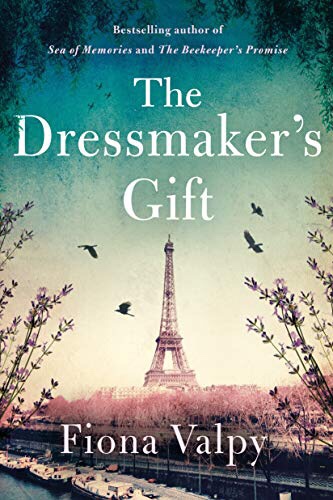
This book is a real hidden gem. I love fashion, so the idea of a dress that calls down through the years – the midnight blue satin, made of many pieces but with such tiny stitches it appears as if one piece of fabric – really appealed to me. Added to this, my in-laws history of escaping the Warsaw ghetto – at 8 years old in one case, and being sent to Siberia in the other – means I am interested in the threads of family history at a time of turmoil. My late husband’s family has its own incredible story with repercussions that echo down the generation , so I understand that lives can be displaced and changed beyond recognition, with the results of that still being felt two generations later,
It is Harriet’s love for fashion and an old photograph that leads her to the door of a Paris fashion PR for a year long internship. She is loaned a room in the apartment above the office alongside another girl. Harriet knows this is the very apartment where her grandmother Clare lived in the 1940s. She has left behind a difficult situation!. Having finished university Harriet has been living with her father and stepmother, where she has never felt welcome. Her father sent Harriet to boarding school when he first lived with her stepmom, following her mums death. Her father seemed to find it difficult to cope with a grieving daughter and a burgeoning relationship. One of Harriet’s most treasured possessions is the photo she has of her grandmother Claire and her two best friends in Paris, Mirreile and Vivi. She also has a charm bracelet given by her grandmother and it’s charms show Harriet a story of who her grandmother was. When we are taken back into the past we learn more about these three women. All work in an atelier for the Paris fashion houses. We find out that Claire and Mirreille lived upstairs first, but are later joined by Vivi. All three are great seamstresses and are quick to become friends.
When the Germans arrive in Paris at first is it easy to carry on as normal. Yes, there are more German voices in the cafes and bars, more German vehicles in the streets, but people still order couture clothes. However, as the war really starts to bite things begin to change. The girls friendship survives Claire’s disastrous dalliance with a German officer, but afterwards she notices a difference in her friends. What mysterious work is Vivi doing in the atelier after hours? Who is the gentleman Mirreille is seen with and why is she often missing after curfew? The girls are about to be involved in the war in ways they didn’t imagined; ways that’s could mean paying the ultimate price.
Just like the stitches in a beautiful garments the threads of history are so beautifully intertwined with the fictional story of the girls. I read Alice Hoffman’s new novel in the last few weeks and it is also set in 1940s Paris so it was interesting to see the same historic events from a different viewpoint. I could see how much research the author had done and her skill in mentioning actual events without them feeling tacked on to the girls story was brilliant, I slowly came to care about each of the girls and although Vivi seems less accessible than the other two at first, it was interesting to see how central to Harriet’s history she becomes.
The detail is often harrowing to read and the idea that trauma can be passed through generations is one I’m familiar with because I’m a therapist and have read the same research as the author. She uses this beautifully in the novel, illustrating that the German’s horrendous acts of cruelty were on such a scale that it echoes down to the next generation. It is only when someone identifies the trauma in their family and gets professional help to let go of it’s effects, that someone can start to heal. I think I expected this book to be lighter and more focused on fashion from the blurb, but what I got was far superior: an incredible story of friendship and survival.
Meet The Author
Fiona is an acclaimed number 1 bestselling author, whose books have been translated into more than twenty different languages worldwide. She draws inspiration from the stories of strong women, especially during the years of World War II. Her meticulous historical research enriches her writing with an evocative sense of time and place.
She spent seven years living in France, having moved there from the UK in 2007, before returning to live in Scotland. Her love for both of these countries, their people and their histories, has found its way into the books she’s written.