Posted in Orenda, Random Things Tours

Living is a Problem by Doug Johnstone.
Living is a problem, because everything dies. Biffy Clyro

Every Skelf novel begins with a funeral, but they rarely go off without a hitch. This one is no exception, with a drone buzzing the ceremony. Could it be to do with the deceased or has someone got it in for the Skelfs? Jenny’s following the case from the last book, keeping an eye on the cops they investigating for sexually abusing young girls in the travelling community. Both are inexplicably out on bail and Jenny likes to know where they are, talking to Webster’s wife and setting up surveillance cameras. Hannah’s case also links back to the last book, concerning Brodie the new recruit to the undertaking business. Brodie had been living on the streets since the loss of his baby son broke his world apart. He has found strange scrabbled marks around his son’s grave that don’t look like they’ve been done by an animal. Hannah agrees to set up a camera, but being told that Brodie hears voices she wonders if he might have gone to the grave and acted subconsciously. Dorothy’s case comes from her involvement with a community choir that includes some Ukrainian war widows. One of the women, Yanna, has gone missing. Her husband Fedir was killed over a year ago and now she’s left her two small children with her mother-in-law. Could she have returned to Ukraine to fight, or has something happened to her? Each of the Skelf women feel vulnerable this time and I felt like the author was playing on my emotions a little. I could sense we were on the verge of a huge change and it left me on tenterhooks throughout.  

Hannah’s vulnerability comes from finishing her PhD and feeling a bit lost. While there’s always work in the family businesses she doesn’t know if it’s what she wants to do forever. She’s happily married to Indy but worries about her fascination with powerful older women, such as the astronaut Helen in the last novel and now a professor, Rachel Tanaka who researches into people who hear voices. Is it simply that she’s attracted to their power and position in academia or is it a sexual attraction? I wondered whether it was their competence and their certainty in their career and outlook that she craved. Having Jenny for a mum can’t always have been easy, especially when she was drinking. Then there was her relationship with Hannah’s dad Craig, which was full of fighting and volatility. It could have been scary for her. Maybe these older women feel more stable and dependable and she’s craving what she missed as a child? Jenny felt vulnerable throughout the novel. Part of this was entering into a new relationship, a time when your feelings are on the line and you’re not sure whether it will work out or not. This relationship comes with the extra pressure of knowing him for a long time. She is aware that if it does go wrong, more than her own feelings are at stake. Also Webster and Low, the police officers Jenny is a witness against, are piling on the pressure. They’re facing accusations of sexual assault and the beating of Dorothy and Thomas, but are on bail. Jenny feels unsafe, especially when Webster pulls a knife on her in the street. She petitions the officer in charge to have them dealt with for intimidating a witness. Until they’re remanded everyone is vulnerable. Thomas is not coping and Jenny has started having the odd drink or two. Where will it end? 

Dorothy feels the most vulnerable to me. She’s still working on funerals and investigating, and it’s clear how much her drumming and being part of a band is a solace for her. Usually, Dorothy and Thomas have been a united front. It’s always been a strong relationship, based on friendship, but now she can feel a shift in him. The beating they took from Webster has left them both at a low ebb, but instead of coming together to recover, she feels that their experience has separated them. Thomas seems distant and inward looking, he’s also started the process of Swedish Death Cleaning – sorting through his belongings and giving away what he no longer needs. Even though he explains that it is not just for those who are dying, Dorothy is uneasy that he appears to be putting his affairs in order. She has suggested PTSD and counselling, but he wants to deal with things in his own way. His way started to scare me. What happens when an experience changes your partner beyond recognition? I sensed impending doom and I was on high alert as Dorothy tried to find out what his plans were. I was genuinely scared for her and every time she seemed close to danger my heart skipped a beat. I realised just how fond I was of this badass grandmother. As we moved towards a potentially terrible conclusion I could barely breathe. Could I cope with losing the amazing matriarch of this family? Within her thoughts was a counsellor’s lament: 

‘Sometimes she got it wrong, but she always attempted to have empathy. She tried to see things from the point of view of Yana, Oliver, Veronika and Camilla. She tried to understand Thomas, as well as Griffiths and Webster and Low, their victims Billie and Ruby’. 

Sometimes we have so much empathy for others that we forget about ourselves. Our own anger and sadness gets pushed to the bottom of the pile as we try and try to understand why people do what they do. Each of the Skelf’s cases has a surprising ending and a particularly devastating one for all the women.

As usual the author included his mix of science, philosophy and spirituality. The phone box in the garden is still doing it’s bit, helping the bereaved speak to their loved ones. The funeral business is changing towards being even more sustainable, signified by the new wording on their business information. The Skelfs are now ‘natural undertakers’ rather than funeral directors. It changes the focus and places the dead person and their family at the centre of planning the funeral they want, rather than a stranger dictating what happens. Their resomation rather than cremation system is going well, they’ve stopped embalming altogether and they have mushroom suits that speed up the process of decomposition and improve the soil. They also have their own funeral site for burials and the move towards wicker and cardboard coffins is becoming accepted practice. They are still working with the council on the Communal Funeral Project, providing funerals for people who are homeless or destitute. Hannah is interested in the concept of panpsychism, the idea that everything in the universe has consciousness. Therefore every element is conscious, earth, air, water and fire. Even a rock has an essential spirit. I was also fascinated with the Hearing Voices movement, something I’ve been aware of from working in mental health, but the statistic that one in ten people hear voices or have auditory hallucinations was surprising. I have a medication that causes auditory hallucinations and I only take it at night, so as I’m going to sleep I can hear a constant murmur as if someone is having a conversation downstairs or the radio has been left on. Luckily I know what it is, but for people with direct and often damaging voices it must be so hard to ignore. I loved that there are other cultures where hearing voices is more accepted, normal even. Maybe people who hear voices are simply more in tune with the essential spirit in all things? 

Sometimes, the only thing that keeps the Skelfs (and us) going is hope. There’s usually a wellspring of hope in these novels. A hope for recovery from addiction. Interesting and unusual ways of coping with grief, such as the wind phone. The people these women lift up, like Archie and now Brodie, leaves the reader with a sense that they are on the right side, a glimpse of a more compassionate and inclusive future – something that feels all too distant these days. No other workplace would have employed Archie who has Cotard’s Syndrome, the delusion that he’s dead. Brodie is a risk, he’s been homeless and is in deep grief for his little boy Jack. When his ex, Phoebe, tells Hannah that he hears voices she has to think about this carefully. Could Brodie be mentally unwell? Is this that one time when their trust and nurturing instinct is wrong? I felt there was a little less hope here. Along with the vulnerability comes doubt and there seemed to be a lot of it. Although that’s no surprise when the very people we expect to serve and protect, like Webster and Low, are capable of using that trust and abusing it. Or when the person we share our most intimate moments with can change beyond recognition. Sometimes we have to grieve for those still living. One of the most hopeful things mentioned in the novel was The Future Library Project, which is commissioning new books by writers every year for the next one hundred years. They won’t be read until 2114. This seemed like such an act of hope. The assumption that in a hundred years people will still be hungry for stories, for novels that help them make sense of the world and the people in it. Yet, I kept thinking back to the title of the novel, a quote taken from a Biffy Clyro song that is tattooed on a homeless man whose funeral they’re planning. The full quote is ‘living is a problem, because everything dies’. It felt like an acceptance that life is a series of seasons, or chapters in a book and the story must have ups and downs in order to feel complete. There are beginnings and endings, but some ending arrive before we’re ready. I’m always hoping for one more book in this incredible series and I know whenever the end comes it will be too soon and I’ll miss these incredible women so much. 

Published by Orenda Books on 12th September 2024

Meet the Author

Doug Johnstone is the author of seventeen novels, many of which have been bestsellers. The Space Between Us was chosen for BBC Two’s Between the Covers, while Black Hearts was shortlisted for and The Big Chill was longlisted for Theakston Crime Novel of the Year. Three of his books – A Dark Matter, Breakers and The Jump – have been shortlisted for the McIlvanney Prize. Doug has taught creative writing or been writer in residence at universities, schools, writing retreats, festivals, prisons and a funeral home. He’s also been an arts journalist for 25 years. He is a songwriter and musician with six albums and three EPs released, and he plays drums for the Fun Lovin’ Crime Writers, a band of crime writers. He’s also co-founder of the Scotland Writers Football Club and lives in Edinburgh with his family.

Posted in Squad Pod

The Next Mrs Parrish by Liv Constantine 

Amber Parrish has worked her way up from being invisible nobody Lana Crump, to prominent socialite over a number of years. There have been many bumps along the way but now she’s made it. Even her husband Jackson’s current status hasn’t stopped her reigning supreme over the Bishop’s Harbour community on the Long Island Sound. Jackson is coming to the end of a prison sentence for tax evasion, but with a month or so left to serve Amber is fast running out of money. Daphne, the first Mrs Parrish, left Bishop’s Harbour after her divorce from Jackson and swore she would never return. She believed that he would never change. His abuse was psychological, physical and emotional, but she has tried to keep the truth of her marriage secret from her girls until they’re older. When she sees daughter Tallulah struggling and desperate to see her father, Daphne relents and agrees to spend the summer in Bishop’s Harbour. For as long as Jackson agrees to her boundaries and rules. Jackson proclaims he is a changed man and agrees to family therapy, but Daphne is on her guard, unsure whether a man like him can ever change. Daisy Anne lives in Texas with husband Mason and their children and enjoys a very close relationship with her in-laws, especially her mother-in-law Birdie. Even so, Daisy Anne feels the loss of her father very deeply, especially since she suspects foul play. After her mother’s death he jumped into an ill-advised relationship with a younger woman and was killed while they were elk hunting. The death was ruled an accident, because his wife claimed she’d mistaken movement up ahead for an elk, but Daisy Anne knows it was murder. When this woman walks into an exhibition for Daisy Anne’s White Orchid jewellery company in New York, she is furious and has her thrown out. The incident hardens her resolve to bring this woman to justice. Amber, Daphne and Daisy Anne’s lives become interlinked, in a dangerous game with complicated motives of revenge, justice and greed.  

This is one of those books where it’s hard to like any of the characters, instead it’s driven by it’s complicated and thrilling plot of deceit and betrayal. I found myself mentally berating some characters and hating others with a passion, but still I felt compelled to keep reading. I’ll admit this was mainly because I wanted to see some people get their comeuppance. I did a lot of internal screaming if I thought one of the women was doing something stupid. My husband will tell you it wasn’t all silent screaming, because I honestly wanted to give others a swift slap. I had sympathy for Daphne, especially when learning the extent of the abuse she suffered while married. I desperately wanted to intervene and tell her not to return to Bishop’s Harbour ever. I could understand her concern about her daughters, but when the abuse was so extensive and he showed signs of starting to control their children it has to be non-negotiable. I would have had to draw a line. Instead of allowing him access to the family, she needed to have a very hard, but honest conversation with her eldest daughter. Once they knew the truth, she needed to work on blocking his access and maybe relocating. Daphne came across as wary one moment then far too trusting the next. When she made the decision to stay close to Jackson for the summer and he stepped over her first boundary, I was screaming at her to get back on a plane. I probably had a huge reaction to this storyline because I have been through psychological abuse and I had to set hard boundaries after leaving. It was great to see the author use this subject in one of her novels and portraying it so accurately, because she shows how pervasive and relentless coercive control is. She covers all the red flags too, showing the initial love bombing – something that’s really off the scale with a man as wealthy as Jackson Parrish. Then she shows him slowly ramping up the control, starting with what Daphne wears and weighs. It isn’t clear if he continues this pattern with current wife Amber, but she’s quite the operator herself having used every trick in the book to end up in such a wealthy position as the second Mrs Parrish. 

As Jackson comes out of prison, their relationship deteriorates over Amber’s solution to their short term cash flow problems. Seemingly having no jealousy or feelings for her husband, Amber agrees to help with his plan to get Daphne and the girls back. Only if she gets the right terms of divorce of course – the guarantee of this standard of living for life. She aims to get her own back on someone from the past, someone who got in the way of her social climbing and humiliated her. She’s determined to buy into their business, setting up a dummy company to buy the controlling share and ruin it from the inside. She is utterly ruthless and there’s a definite pleasure in knowing that she got one over on Jackson but it’s hard to empathise with her, especially when she knows Jackson plans for Daphne. Meanwhile, Daisy Anne continues to be suspicious of the woman who married her father. His sudden death left Daisy Anne without either parent and although she’s since had a family of her own, she’s missed out on that grounding and support we get from our parents. She starts looking into his death in more detail, searching out CCTV and witnesses to the shooting ‘accident’. She also puts out feelers to find out where his widow came from, someone with her father’s interests of fly fishing and shooting would probably have lived on a large estate or been known in their social circle. She can feel in her bones there was a scam involved and she’s not going to let it go. You’re not quite sure how these women overlap at first, as the author ekes out the revelations and takes us on a rollercoaster of twists and turns. Often books have twists just for the sake of it but this was a belter and totally unexpected. I devoured the last few chapters, desperate to get the ending I wanted; finally I could find out how these women link together and watch certain characters get their just desserts. This is the perfect summer read with a great combination of serious issues, the beautiful Long Island beach backdrop and those delicious glimpses into the lives (and wardrobes) of the wealthy women who live there. Definitely one for your suitcase if you’re popping off for some late summer sun.

Meet the Author

Liv Constantine is the pen name of sisters Lynne Constantine and Valerie Constantine. Lynne and Valerie are New York Times and international bestselling authors with over two million copies sold worldwide. Their books have been translated into 29 languages, are available in 34 countries, and are in development for both television and film. Their novels have been praised by The Washington Post, USA Today, The Sunday Times, People Magazine, and Good Morning America, among many others. Their debut novel, THE LAST MRS. PARRISH, is a Reese Witherspoon Book Club selection.

Posted in Orenda

Black Hearts by Doug Johnstone

As all subscribers and Twitter followers must know by now, I am a huge fan of The Skelf series. I’m a Skelfaholic and it’s become a strange cycle of waiting for the next book to be published, devouring it overnight then longing for the next one. It’s even worse this time because I have it on good authority that this might be the penultimate book in the series. So one more book and no more Skelfing! I’m going to be like a weasel with a sore head when I have to go cold turkey. It has been wonderful to be back in Edinburgh with this family: part private investigators, part undertakers and all round incredible women. For those who haven’t met them yet, the Skelfs are three generations of one family. Grandmother Dorothy is in her seventies, but is still active in both the investigative and the funeral parts of the business. In her spare time she still drums like a badass and has a lover almost twenty years her junior. Daughter Jenny is back home, living above the business and struggling with memories of psychopath ex- husband Craig. She’s drowning her pain with alcohol and sex. Jenny’s daughter Hannah is now a PhD student, working in the astrophysics department, but still finding time to help out. She’s now married to Indy, feeling settled and starting to move past what happened to her father. The women are brought some unusual cases, both for funerals and PI work. A gentleman approaches Dorothy after his wife’s funeral, to ask if they can help him with a nighttime visitor. He believes his wife’s spirit is punishing him and he has the bruises to prove it. Hannah is approached by Laura, a young woman who claims to know her, but Hannah has no recollection of her. When Laura starts to turn up wherever Hannah goes, she suspects mental health problems. She stops being harmless the closer she gets to the family, especially when Hannah drops into the funeral parlour and finds Laura talking to Indy. Laura wants them to do her mother’s funeral, but Hannah thinks it’s unwise. How can she let this fragile girl down gently? 

Aside from their cases Johnstone picks up those storylines that weave throughout the novels. In the main we are drawn back to Craig, Jenny’s ex-husband and Hannah’s father, who is still haunting the family. Jenny is most visibly affected by her interactions with Craig’s family, most notably his sister, who seems to have inherited his ability to manipulate and turn to violence to get what she wants. Will Craig ever leave them alone and will Jenny be able to tread the line between her own pain as his ex and Hannah’s pain as his daughter. Both tend to overlook the grief that Dorothy still feels at the loss of her own husband Jim, complicated now by her relationship with police detective Thomas. Indy’s grief is also overlooked a lot, especially since she’s just gone through disinterring her parents in order to give them the cremation in line with their faith. Hannah and Jenny bring the drama and it’s Jenny I was particularly worried about. She’s getting messy, day drinking and embarking on a highly controversial sexual relationship with the wrong person. She never wakes up feeling better, but in the moment she has to drown out the constant pictures in her head. This is PTSD and she’s in danger of drawing others into her drama, especially Archie who works for the funeral business. Can she rein in her behaviour? Even professional help seems doomed to failure at this point. 

Aside from these incredible women, and the lovely Indy of course, the things I most love about these books is Doug Johnstone’s love for Edinburgh and the way he weaves incredible ideas, philosophy and physics into his novels. I’ve not been to Edinburgh since I was in my twenties, but the way he describes the city makes me want to go back. He doesn’t sugar coat the place either, there’s good and bad here, but as a whole it’s a poem to a place that’s in his soul. Dorothy muses on her home town a lot in this novel and considering she was born in America, this place is her heart’s homeland. She ponders on the people this city produces, including her husband and child, the history, the architecture almost as if she’s taking stock. She concludes that she’s a person who always looks forward to where life’s going, but grief is like the tide and there’s no telling when those waves will wash ashore again. Jenny tends to frequent the less salubrious areas of the city. She’s stuck. Her past has quite literally washed ashore and the problem with losing someone is you’re not the only one grieving and everyone grieves differently. She’s not mourning Craig as he truly was. She’s grieving the loss of all that hope; the hope they both had for the future on their wedding day and when Hannah was born. Similarly Craig’s mum and sister aren’t missing the Craig who committed all those terrible crimes. Violet misses the little boy she had and the life she wanted for him and his sister misses her baby brother. Hannah seems to be the person most resigned to the loss of her father. She always seems older than she is and with Indy alongside her she has the support she needs. There’s so much wisdom in these two young women, honed from a combination of Indy’s spirituality, years of working with grieving families and Hannah’s physics knowledge, especially where it tries to explain the universe. The supermassive black holes that are thought to be at the heart of every galaxy are mysterious. We know that they have a huge power that acts like a magnet, drawing in items from across the universe. 

I loved the element of Japanese spirituality and having read Messina’s novel The Phonebox at the Edge of the World, I loved the concept of the wind phone. I’ve always thought that a good way of letting go of the past, especially when you’re struggling emotionally, is to make a physical gesture or step in the direction you want to go. That might mean taking off a wedding ring when you’re getting divorced, or moving house where it’s full of old memories. I found talking to my late husband in my head a bit strange and it only made me miss him more. So I wrote to him in my journal instead. To have a phonebox dedicated to speaking with those who have died seems a very effective way of keeping them in the present with you, but in a controlled and deliberate way. Samuel Beckett said: 

“Memories are killing. So you must not think of certain things, of those that are dear to you, or rather you must think of them, for if you don’t there is the danger of finding them, in your mind, little by little.” 

Each of the Skelf women have their own grief to bear, a black hole at the centre of their heart. Each must find their own way to remember a little, to prevent becoming overwhelmed by their memories. Only by reconciling this, can they live in the present moment and make plans for their altered future. 

Meet the Author

Doug Johnstone is the author of fifteen novels, most recently The Space Between Us (2023). Several of his books have been bestsellers, The Big Chill (2020) was longlisted for the Theakston Crime Novel of the Year, while A Dark Matter (2020), Breakers (2019) and The Jump (2015) were all shortlisted for the McIlvanney Prize for Scottish Crime Novel of the Year. He’s taught creative writing and been writer in residence at various institutions over the last two decades including festivals, libraries, universities, schools, prisons and a funeral directors.

Doug is a Royal Literary Fund Consultant Fellow and works as a mentor and manuscript assessor for many organisations, including The Literary Consultancy, Scottish Book Trust and New Writing North. He’s been an arts journalist for over twenty years and has also written many short stories and screenplays. He is a songwriter and musician with six albums and three EPs released, and plays drums for the Fun Lovin’ Crime Writers, a band of crime writers. He’s also co-founder of the Scotland Writers Football Club.

Posted in Orenda

The Great Silence by Doug Johnstone

I have already created two new hashtags for this third novel in the Skelf family series. The first was #bookbereavement, because when I finished it I wanted to turn straight back to the first page and start again. The second was #Skelfaholic and I am a fully paid up member. It is agreed that if this series ends (please no!) then we Skelfaholics will be holding a wake by drinking whiskey in a funeral home, followed by star-gazing at the observatory. It’s hard to put across how much I love the Skelf women, their cases, the way they conduct their funeral business with such dignity, and their investigation business with more balls than most men. I read this book almost as soon as I received it, and I’ve been sitting on it excitedly ever since, desperately trying not to say anything until the blog tour. Now I can happily say Doug Johnstone has done it again. This is a fantastic read. 

For those who are new to the series, the Skelf women are three generations living under the same roof: Dorothy the grandmother, Jenny the mother, and Hannah the granddaughter. They ‘live above the shop’; their businesses being a strange mix of funeral directors and private investigators. Oh and Dorothy is a music teacher too, so there are often teenagers wandering in and out and playing the drums. In fact there are often waifs and strays under the Skelf’s roof. Hannah’s girlfriend Indy was one of their waifs, brought into the fold when her parents died and the Skelf’s organised their funeral. She now looks after the funeral business with the same calm and dignity she brings to Hannah’s life. Einstein the dog arrived when a police chase ended with a van crashing nose first into one of their graves, during the funeral. The dog was in the van and with his owner dead, he became part of the household and a companion of Schrodinger, the cat. Jenny mainly works on the private investigation side, but has a lot of her time taken up by her ex and Hannah’s father, Craig who escaped prison and is now closer than they think. Finally, there’s Hannah, starting her PhD with the astrophysics department and pondering the question of why other life in the universe has never tried to contact us – the ‘Great Silence’ of the title. 

The book begins with a strange event. Dorothy takes Einstein for a walk in the park and he fetches a human foot, even more strange is that it appears to be embalmed. This embroils Dorothy in a very unusual case that could be deadly. Jenny is dealing with the aftermath of her ex-husband’s actions in the last book, she’s still healing emotionally and potentially regretting the end of her relationship with painter, Liam. She misses him, and wonders if perhaps they could rekindle something. Then the other daughter of her ex-husband disappears and Jenny wonders if her life will ever be free of this man, as she joins forces with the other woman in his life to find her daughter. Finally, Hannah is facing massive changes in her academic and personal life. In a sense she’s being pulled between past and future. Her graduation becomes a double celebration when Indy proposes, but then she’s pulled into the past when their flat is broken into and someone makes it clear they still want to be part of her life. Her academic supervisor asks her if she’ll look into one of the central questions of astrophysics, if there is extraterrestrial life, why haven’t they replied to our messages? José has had a reply, but doesn’t know where it’s come from. Is it really from another life form or is someone playing game with him? 

There’s so much packed into this novel, but Doug Johnstone never loses a thread. Each storyline is given equal time and care. As I was reading the novel and writing this review, my husband saw my search history on my iPad and looked confused. I had tabs open for SETI (an institute set up to search for possible extraterrestrial life), the embalming process, numbers of big cats kept in domestic homes in the U.K, and Hindu funeral rites. Yes, the author does go to all these different places in the novel, not to mention the Italian gigolo and elderly lady, and they all interweave harmoniously.  I love the unexpected situations they find themselves in, such as Indy and Hannah taking a walk in the park and encountering a black panther. I also love how these women throw off expectations and be themselves. Dorothy is an elderly lady, but she goes to clubs when one of her students is playing a gig, and has a healthy sex life with her long time friend and police contact, Thomas. She’s investigating the ‘foot’ incident, which becomes more urgent once another foot turns up belonging to someone different. She’s also investigating the panther incident and visits experts keeping wildcats at their homes. In between she’s supporting Abi, now living with the Skelfs, who gets a huge shock when a man claiming to be her birth father shows up. 

Jenny has to face her ex- husband and there is a sense that this might be their final showdown. They had originally thought he’d be far away in another country, but with huge estates covering thousands of acres in Scotland, it’s not inconceivable that he’s been hiding close by all along. The strength of both Hannah and Jenny in facing him again, is amazing.  They’re scared – so much so that Hannah and Indy move back in to the family home – but know that the only way to stop this man ruling their lives is to find him and have him locked away again. I felt for Jenny, who had just turned a corner emotionally and was considering her life moving forward, and whether she wanted to remain alone. She’s also investigating on behalf of a brother and sister who are concerned their elderly mother is being misled by an Italian playboy. As usual Jenny is professional with her investigation, but uneasy about her clients and their motives. Meanwhile, behind all these fireworks, the kind and loyal Indy is having a crisis about her grandparents. They are traditional, but to Hannah’s surprise they want to fly over from India for their wedding. They don’t mind their granddaughter marrying a woman it seems, but they do have a huge request relating to the death of Indy’s parents. Leading to some very hard choices for Indy, who I’m especially fond of.  

Doug Johnstone is so many things at once: a gritty crime writer; a poet; a philosopher; a lover of the city where he bases this series; and an incredible writer of women. Johnstone writes real women, women who are intelligent, ballsy and true to themselves which is why I love them so much. One philosophical idea that stood out to me was ‘sonder’. It’s a word I’ve become aware of because it’s the title of my work in progress – where there are people in a difficult situation desperately trying to understand each other. Sonder is the sense I often get in a very busy train station when I look around at all the people and realise that every one of them has a complex and unique life just like mine. It’s the name of a cafe that Hannah visits near the university campus and as she sits there after her graduation, with Indy, Jenny and Dorothy she realises something. These three women come into people’s lives at a terrible moment, but have the ability to treat each person’s grief as if it was the most important thing to them. It reminded me of bringing a client into my counselling room, creating a safe space where, for an hour, the most important thing in the room is this person and whatever they bring to talk about. I think this is possibly why I feel such a strong kinship with these women. Jenny will take a drink with a homeless person and pass the time of day and Dorothy will connect with a young person fifty years her junior and make them feel welcome. I hope a little of the Skelfs rubs off on all of us. There was something about this book that felt like a finale, but I’m hoping against hope there’s more to come from these characters who I love. I’ll miss them, till next time. 

Meet the Author

Doug Johnstone is the author of fifteen novels, most recently The Space Between Us (2023). Several of his books have been bestsellers, The Big Chill (2020) was longlisted for the Theakston Crime Novel of the Year, while A Dark Matter (2020), Breakers (2019) and The Jump (2015) were all shortlisted for the McIlvanney Prize for Scottish Crime Novel of the Year. He’s taught creative writing and been writer in residence at various institutions over the last two decades including festivals, libraries, universities, schools, prisons and a funeral directors.

Doug is a Royal Literary Fund Consultant Fellow and works as a mentor and manuscript assessor for many organisations, including The Literary Consultancy, Scottish Book Trust and New Writing North. He’s been an arts journalist for over twenty years and has also written many short stories and screenplays. He is a songwriter and musician with six albums and three EPs released, and plays drums for the Fun Lovin’ Crime Writers, a band of crime writers. He’s also co-founder of the Scotland Writers Football Club.

Posted in Random Things Tours

Prey by Vanda Symon 

Sam Shephard is on the verge of returning to work after maternity leave and the traumatic circumstances around Amelia’s birth. In order to make the transition as easy as possible, Paul is staying home with Amelia for the first week Sam returns. As is predictable, her boss DI Johns isn’t the most welcoming and gives her a cold case – the murder of Rev. Mark Freeman outside his own church. There’s one potential issue, Mark Freeman was the father of DI Johns wife Felicity. Felicity’s mother has been diagnosed with cancer and the boss would like her to go to her grave knowing who killer her husband. My first thought was that this had the potential to blow up in his face: he’d be all over her progress, creating conflict of interest for Sam that would be exploited if a case ever went to court. He was also being his typical sensitive self by ensuring that his mother-in-law would spend her final months reliving the most terrible experience of her life. Rev. Freeman was found at the bottom of the stone stairs leading up to the church entrance. He had been stabbed in the stomach by a small knife, but that wasn’t the cause of death. His subsequent fall down the steps broke his neck, immediately cutting off his ability to breathe. Horrifically he was found by his son Callum, who had ventured back out into the pouring rain when his father hadn’t returned home after the service. Yet we know at least one other person witnessed the killing, because the book begins with their anonymous account of the murder. The boss has essentially handed Sam a poisoned chalice and she fears one of two outcomes – she won’t be able to solve the case, so will be held responsible for disappointing his wife and her mother or she will solve it, making the previous investigation seem incompetent and potentially tearing his family apart in the process. If we as readers know one thing, it’s that Sam will not rest until the case is solved. 

I loved the happy family life Sam and Paul have created with baby Amelia. Their relationship feels like a real long-term partnership with the added bonus that Paul is also a detective. They understand that it’s hard for either of them to switch off when they’re working a case, so can happily bounce ideas and theories off each other in the evening. The addition of Amelia to their relationship is something they’ve taken in their stride. It isn’t always easy. There’s a return to work poonami that had me laughing; how do you shit in your own hair? There’s also an afternoon where each thinks the other is picking her up from childcare, but other than this they’re coping well. The author brings home to us the difficulties of being a working mum. Sam misses Amelia and has to call home to check in and hear what they’re doing. There’s also the issue of expressing milk at work, the family room is at her disposal but it feels awkward and isn’t as private as it could be. It doesn’t take long to get used to her new routine though and she’s soon busy using the time to go through interview notes and test out different scenarios. Paul is incredibly supportive, totally backing Sam up in her eventual decision to swap to bottle-feeding. Of course her mother has plenty to say, but she’s besotted with her granddaughter so that helps ease tensions. This is a case that brings up a lot of personal feelings and memories for Sam, because she too was brought up in a church environment and talking to Callum and Felicity, Mark Freeman’s children, brings up some memories of her own that it might be time to disclose. 

“What I hadn’t factored in, though, was the emotional toll it took. The wrench of being away from Amelia when I loved every second of being in her company. The regret about going back to work and putting her into childcare, which felt like paying for someone else to bring up my child. And the guilt over the immense sense of relief I felt at getting away from her and from the relentless demands and responsibility of looking after a baby.”

The Freeman children and their mother are first on the list of people Sam needs to re-interview, but as she suspected, keeping her boss away from her case is difficult. He blows up over the fact she’s interviewed his wife without his knowledge and express permission. He wants all access to the family to come through him, but Sam stands her ground. If his fingerprints are all over this case it doesn’t matter what she finds out. The case would be thrown out of court, a fate even worse than failing to find the killer. I loved how Sam stuck to her guns though and called him out in front of the whole team. He has to stay away from the case and trust her. If he keeps a stranglehold on who she can talk to and what avenue her investigation takes, he will ultimately be responsible for it’s failure. The Freeman family seem lovely, but as Sam knows that’s no indicator of innocence. Sam has had a church upbringing, something I have in common with her, so we know better than anyone that sometimes people hide within a congregation. Their Christianity is a mask, a mask that seems to confer an unquestioning trust on them.  Most people Sam talks to see the Reverend as a saint, but Sam isn’t taken in and knows she just has to ask the right people. Luckily, she has two potential witnesses: Aaron Scott was an operative in an Organised Crime Group and he certainly appears ferocious with his size and his Māori tattoos, then there’s Mel Smythe, former youth leader and now a drunk living in a hostel. What Aaron tells her blows the Freeman’s timeline totally off kilter and gives her a glimpse into an angrier and self-righteous Mark Freeman. Mel was well-known for being a bit of a rebel, mainly because she was gay yet she was still a youth leader. I found myself wondering whether the church was quite progressive after all. Despite her heavy involvement at the church during the time of the murder, she was soon caught up in the aftermath. She also brings throws new light on the case, but only twenty-four hours later she’s dead. Stabbed in the stomach in her lonely and bleak hostel room. 

The author brings up something about church people that I was very aware of as a Christian teenager. They can seem welcoming, hospitable, even saint-like but if you breach one of their most important rules you can meet a completely different side to that person. While they might preach forgiveness, there are certain things they hold true and they are immovable. Aaron certainly places a new spin on the Reverend, with whom he’d had a great friendship. What he overheard that night showed that when faced with a challenge to his Christian values he wasn’t so great at forgiving. Mel Smyth backs up his story with a revelation of her own, a problem that was brought to her perhaps because she was different and lived outside the traditional Christian view of relationships. These new statements show that the original investigation missed so many leads or simply didn’t follow them up. That it took the saintliness of the Reverend and others around him at face value, perhaps because he was a figure of authority in the community. It’s also leading her towards conclusion that the boss isn’t going to like. As the rest of the team, including Paul, take on the Mel Smyth case Sam feels more supported. She knows that Paul and Shortie have her back and trust her methods to get results. I loved how the author gave us more on the relationship between Sam and her mother too, especially now she has a grandchild to dote on. It’s clear to see in any conversation with her mother where Sam’s self-doubt and over-thinking come from. Trying to please a critical parent is a self-defeating task and even here when talking about the Reverend Freeman case, her mother shows a total belief in the church and it’s figures of authority that’s probably hard for us to fathom in this day and age. Yet it gives us some indication of why the original case had been conducted in the way it was and how powerful church figures were several decades ago. 

At the end of the case I felt so sad, that belief in the church and it’s rules were often put before the well-being and love of family and the real and flawed people who make up a congregation. I felt it because I lived it, being a teenager in an evangelical church was no picnic and I got out as soon as I could. I regularly see other waifs and strays who are no longer in the church and thankfully we get a lot of humour and relief or closure from each other. We can say ‘that was a bit mad wasn’t it?’ and hear confirmation that yes, it was utterly bonkers. I was so incredibly proud of Sam to know she was ready to talk to her mother about what happened during those years. It’s common that having your own child triggers feelings about your childhood and how you were parented, especially where there are unresolved issues. It’s no coincidence that in this novel she’s ready to take on the boss and the past, perhaps not just because of Amelia but because of the family unit she’s building with Paul. That was the feeling I took away from this novel overall, it’s main theme is family whether that’s a nuclear family in its most traditional sense, a work family that grows in professions like policing, or a church family. It also gave me a reminder that in all of these relationships, it’s communication and honesty that are the most important facets. If those two things are broken or over-shadowed by authority, a web of secrets and lies are woven that can prove very difficult to unravel. I love Sam, she’s a no bullshit character and at this moment when I am still struggling with my health and keeping up, she gave me some healthy reminders that it’s ok to let things slide a little. This was another great novel in this series, Sam is a character I’d love to go for a drink with and seeing her stand up to her boss was a real highlight! 

“I suspected I’d get bored and frustrated with a life of domestic bliss. I certainly wasn’t cut out to be a domestic goddess. Six months of maternity leave had driven that home. Fortunately for me, I wasn’t aware of anyone dying from a lack of vacuuming, bed-making and not managing to get out of their PJs all day.”

Out in August 2024 from Orenda Books

Meet the Author

Vanda Symon is a crime writer from Dunedin, New Zealand, and the President of the New Zealand Society of Authors Te Puni Kaituhi o Aotearoa. The Sam Shephard series, which includes Overkill, The Ringmaster, Containment, Bound and Expectant, hit number one on the New Zealand bestseller list, and has also been shortlisted for the Ngaio Marsh Award. Overkill was shortlisted for the CWA John Creasey (New Blood) Dagger and Bound and Expectant have been nominated for USA Barry Awards. All five books have been digital bestsellers, and are in production for the screen. She is also the author of the standalone thriller Faceless, and lives in Dunedin with her family.

Posted in Orenda

The Big Chill by Doug Johnstone

First posted on publication and being shared as part of #SkelfSummer.

How have I come this far in my reading life without reading Doug Johnstone? The Skelfs are the family I didn’t even know I was missing. To prepare for reading the second novel in Johnstone’s Skelf series, I made the decision to read the first novel entitled A Dark Matter. I couldn’t have imagined this incredible group of women, but now I feel like I know them personally. Set within the city of Edinburgh, this is a family of undertakers and private investigators. Just to set up the kind of family they are, the author places their residence and place of work at No 0 – somewhere that doesn’t exist. Grandmother Dorothy is a Californian lured to Edinburgh after falling in love with Jimmy Skelf who has passed away at the beginning of book one. Dorothy works in the funeral business with employee Archie, but also takes on PI duties and in her spare time teaches spunky young girls to play the drums. Mum Jenny is at a loose end so comes into the family business after her father dies. She jumps into the PI business with both feet, which is how she seems to do most things. Granddaughter Hannah is studying physics at Edinburgh University and lives with her girlfriend Indy. She has a good relationship with her parents and her grandmother. The first book concerns the disappearance of Hannah’s uni friend Mel and the shock when her killer is revealed is seismic, hitting all the Skelf family hard. 

The beginning of The Big Chill reads like the explosive ending of most books. In a scene as comical as it is tragic, Dorothy and Archie are overseeing a routine funeral at the cemetery when sirens start moving closer and drowning out the service. The guests and undertakers stare aghast as a van driven at high speed forces its way through the cemetery gates followed by the police. As the van careers towards them, mourners start to scatter and Dorothy narrowly misses being ploughed into ground, as the van speeds straight into the grave nose first. Dorothy clambers in to check on the driver and finds he has died instantaneously from a head injury. However, what does survive is a scruffy Collie dog she names Einstein to sit alongside Schroedinger the cat. She immediately offers the Skelfs’ services for the man she names Jimmy X but she would like to find a little more out about him before she conducts his funeral. So, Dorothy sets out, with Einstein in tow, to find out how Jimmy X ended up living in a van that literally ‘ended up’ in an open grave. 

Of course, this is only one of the mysteries the women are investigating. Hannah makes friends with an elderly physics professor at university when he asks if she’ll help with a memorial for Mel. Not long after they are performing dual duties for him too, when he dies suddenly and unexpectedly. Hannah can’t accept his death and even if it is just a displacement activity, begins to look into his personal life for answers. Dorothy is overstretched with cases when one of her drumming students doesn’t turn up for practice. This is so unusual because Abi loves to drum and has never missed a lesson. When she visits Abi’s home she is told that she was unwell, but Dorothy senses an undercurrent in the air and eventually finds our that Abi has run away. In order to find her, 70 year old Dorothy will have to start thinking like a 14 year old girl, which isn’t easy when the back ache doesn’t go away as quickly as it used to. The scars of her assault in the previous novel are not just mental. 

Hanging over them all is the trial of Mel’s killer, known intimately to the Skelf women and still keeping a hold over them where he can. Not only did he kill the pregnant Mel but when found out he attacked Jenny. He stabbed her in the stomach and beat Dorothy too. He has found a psychiatrist to claim he was incapacitated by mental illness at the time of the original killing. Even worse he lures Jenny to visit him, then presses charges when she assaults him. In the aftermath, Hannah is drowning. She’s well supported by Indy, but can’t sleep, feels anxious and when under pressure has panic attacks and passes out. It may take a seismic change to shake her from personalising all these difficult life experiences and thinking she is the only victim. She is having counselling, but there’s so much to unpick and she is in danger of ignoring the one person who helps her most. The women usually gather at the end of the day in the kitchen and catch each other up on the days events, but when even that ritual starts to fall apart Dorothy knows her family are stretched to breaking point. Yet, everyone has to heal in their own time and in their own way. She is wondering whether there is life after Jimmy, and whether her long held friendship and working relationship with a certain Swedish police officer, could become more? 

These women are great characters. They’re tough, but still vulnerable. Full of quirky detail and boundless energy. They are also wonderfully good at picking up ‘waifs and strays’. They try not to judge people. I loved Jenny, trekking round homeless shelters and approaching groups in the street, but stopping to pass the time of day or joining them in beer. As someone who is also very good at collecting people, I know how much it widens horizons, teaches us about our own preconceptions and sometimes brings unexpected but wonderful friends. Their arms and their home are open. I found myself thinking a lot about the wonderfully patient and wise Indy, who comes into contact with the Skelfs as a teenager organising her parents funeral after a car accident. She is always quietly working in the background: cooking mouthwatering curries when Hannah hasn’t eaten; taking the reins at funerals when private investigating takes over; listening to bereaved family and respecting the person who died with so much attention to detail. There are such hidden depths here and I found myself hoping that’s explored more in later novels. 

I loved the Edinburgh backdrop. In fact it becomes a character in its own right from the touristy areas, to the student quarter, to the areas that missed regeneration, this is such a varied and richly atmospheric city. I don’t know it well but I feel this has taken me under that tourist facade to find something more interesting. We also see such a variety of people from those on the streets to those who in academia or in private education. Death is a great leveller though and these people are often side by side once they reach Skelf’s undertakers. We also see that these extremes can all be found in one person; there isn’t a ‘type’ that becomes homeless or commits a murder. I also find the way Hannah makes sense of her world through science really interesting. She muses on quantum suicide and whether we, like Schroedinger’s Cat, can be alive and dead at the same time. People often think that science is anathema to concepts like faith, hope and a belief in God. However, there is beauty and wonder in everything Hannah knows about space. 

What I take away most from this book is the way the author writes with bluntness, but also kindness, acceptance and wonder about the human condition and the strange galaxy we call home. Hannah muses on the end of the universe with her counsellor: 

‘stars will stop forming, the sun will wink out, the solar system will collapse. Then in the black-hole era galaxies disband, all proton matter decays, supermassive black holes swallow everything, then they’ll evaporate too, all the energy and matter in the cosmos gone […] it’s called the big chill’. 

Hannah comments that it’s not such a bad way to go, but her counsellor reminds her that it’s a long way into the future. Dorothy has the same thoughts as her mind is flooded with images of everything they’ve experienced. She has felt the cold, icy creep of death: 

‘death so close that she could feel its breath on her neck, could smell it every day when she woke, could feel its icy touch spreading from her mind to her limbs’. 

So she sits behind her drums, plays the Black Parade album by My Chemical Romance, and starts to tap out a rhythm until she can feel the music within her, warming her veins and bursting to life. While we’re here we have to find a way to keep living. 

Shared as part of #SkelfSummer

Meet the Author

Doug Johnstone is the author of fifteen novels, most recently The Space Between Us (2023). Several of his books have been bestsellers, The Big Chill (2020) was longlisted for the Theakston Crime Novel of the Year, while A Dark Matter (2020), Breakers (2019) and The Jump (2015) were all shortlisted for the McIlvanney Prize for Scottish Crime Novel of the Year. He’s taught creative writing and been writer in residence at various institutions over the last two decades including festivals, libraries, universities, schools, prisons and a funeral directors.

Doug is a Royal Literary Fund Consultant Fellow and works as a mentor and manuscript assessor for many organisations, including The Literary Consultancy, Scottish Book Trust and New Writing North. He’s been an arts journalist for over twenty years and has also written many short stories and screenplays. He is a songwriter and musician with six albums and three EPs released, and plays drums for the Fun Lovin’ Crime Writers, a band of crime writers. He’s also co-founder of the Scotland Writers Football Club.

Posted in Netgalley

The Mayor of Maxwell Street by Avery Cunningham

This fascinating debut is set in 1920’s Chicago and concerns an heiress called Penelope ‘Nelly’ Sawyer, described by the author as the ‘wealthiest Negro in America’. Her father, Ambrose Sawyer, has managed to catapult his family into the upper echelons of black society. Nelly is getting over the death of her brother Elder, who has been killed in a road accident but her mother wants her to attend a Cotillien in the city at the end of summer. This is the American equivalent of a Debutante Ball, where the most prominent young women in society are presented in high society. Suddenly, and against her wishes, Nelly becomes the season’s ‘diamond’ – to use a Bridgerton term. This honour means that Nelly is now the most eligible young woman in society, but her ambitions don’t end at a society marriage. For the past year she has been indulging her passion for journalism, researching and anonymously submitting articles to a Black-run newspaper called The Chicago Defender. Her brother Elder was her co-conspirator and sounding board for her articles. He was the go-between, taking Nelly’s articles to the editor Richard Norris. Now she faces a choice, not only is she unexpectedly involved in a love triangle, she must decide to reveal her true identity to the newspaper, or allow her journalistic ambitions to end.

I really enjoy a plucky and transgressive heroine, so I was immediately on Nelly’s side. She’s been looking into the underworld of Chicago society and the leader of an organised crime group called the Mayor of Maxwell Street. This is the prohibition era and the dark but glamorous world of the secret ‘speakeasy’. She has already met one club owner through her brother. Jay Shorey is intriguing and first caught her eye at Elder’s funeral, where they seemed to spark a mutual attraction despite the unusual surroundings. Jay is the archetypal bad boy, but does find many young people from high society visit his club. He doesn’t have their family connections but has access to so many people in Chicago through the club and his ‘god-uncle’ who is a bit of a gangster. His ability to move between the darker parts of Chicago society and her own, more elevated, circles means he’s invaluable to Nelly and her investigations, but is there more to their relationship than that? Yet he isn’t the only suitor on the horizon.

As Nelly bursts onto the socialite scene, she meets Tomás Escalante y Roche at a polo match. He is one of the polo players with an uncle who is a French marquis, and a father who “owns half of Mexico” according to the wonderfully sardonic and witty Sequoia McArthur. Tomás rides a horse that Nelly happened to raise on the Sawyer ranch and she doesn’t mind giving her sharp feedback on what he’s doing wrong! Needless to say he isn’t used to hearing such criticism, especially from a young woman but her honesty makes her memorable. Tomás is hooked and he intends to court her. As far as Nelly’s family are concerned she’d be crazy not to reciprocate his affections and should jump at the chance to come out of the Cotillion summer with a fiancé. So, it’s a bit of a love triangle but also a young woman’s choice between the the life she wants and the life her family wants for her. I was rooting for her.

She chooses to face things head on by meeting Her editor in a cafeteria, and has to convince him that yes, she did write the articles. However, she comes up against a very sharp reality. Norris tells her he can’t publish articles under her real name because of her family’s position in society. He knows that the Ambrose Sawyer would soon be knocking on his door if he did. Nelly is so disappointed that Norris makes a deal. He gives her an assignment and if she succeeds he promises she can publish under her own name. Of course it’s impossible. He tells her about the Mayor of Maxwell Street, a secretive figure in gangland who seems to have achieved the impossible and brought different organisations together across the race divide. Usually Irish, Italian, Jewish and Black gangsters are having turf wars and killing each other, but that’s stopped and he thinks this new Mayor is behind it. He tells Nelly that if she can correctly identify this man he will publish her article and take the consequences of using her real name. Of course she accepts his challenge.

This is a page turner and it’s impossible not to like Nelly and admire her guts. I over the way the author handled the attitudes and outright racism of a hundred years ago. She even highlights the experiences of diverse characters on a spectrum of issues, such as poverty, class, education and skin tone. Jay’s relatively light skin enables him to ‘pass’, yes it opens doors but then you’re participating with your own oppressor. Nelly is very disapproving of living life on those terms. Jay is mixed race and he explains to her:

“There are two candy jars, right? One marked for Negroes, and one for white folk. The Negro — under penalty of death — can only take from one jar. The white man, though, he can take from one or the other. He can take from both. Never mind that the jars have the exact same candy; the white man still gets to choose. That is all I want, Nelly. The freedom to choose. I don’t want to look like them, or act like them, or be them. But I want their options.”

These issues come organically from the characters and they’re inclusion really add some weight to the historical background of the novel. Her depiction of Chicago in the 1920’s feels authentic, rather than the stylised razzle dazzle of the musical, but they come from the same world. There’s even a nod to The Great Gatsby too. This is an entertaining novel with a plucky heroine and some gravitas behind the compelling story and a compulsive need to keep reading. I look forward to seeing what the author does next.

Out Now from Thorndike Press

Meet the Author

Avery Cunningham is a resident of Memphis, TN, and a 2016 graduate of DePaul University’s Master of Arts Writing & Publishing program. She has over a decade of editorial experience with various literary magazines, small presses, and best-selling authors. Avery grew up surrounded by exceptional African-Americans who strived to uplift their communities while also maintaining a tenuous hold on prosperity in a starkly segregated environment. The sensation of being at once within and without is something she has grappled with since childhood and explores thoroughly in her work of historical fiction. When not writing, Avery is adventuring with her Bernese Mountain Dog, Grizzly, and wading waist-deep in research for her next novel. She aspires to tell the stories of complex characters fighting for their right to exist at the fringes of history. THE MAYOR OF MAXWELL STREET is her debut novel.

Posted in Netgalley

Our Holiday by Louise Candlish

Pine Ridge is a small coastal village off the south coast, somewhere near Bournemouth and has that castaway feeling from the moment you cross on the car ferry. However, this idyllic village is the setting for discontent and divided loyalties between those DFL (down from London) residents and those who have grown up in Pine Ridge and mainly work servicing those August visitors. The ridge has a resort hotel, beach bar and spa to keep holiday makers happy, but some visitors have gone away dreaming of their own little slice of south coast heaven. One summer Pine Ridge becomes the centre of a dispute over second home ownership. This is a bad time for Amy and Linus who have just bought their own little bungalow with coastal views up on the ridge. It needs work, having been the home of an elderly couple, but she has a plan and builders starting this summer. She was inspired by friend Charlotte whose banker husband Perry used a huge bonus to buy their perfect holiday home with it’s own summer house overlooking the sea, nicknamed The Nook. It’s people like this that friends Robbie and Tate are angry about. They grew up here but are stuck living in static caravans on a temporary site because they can’t afford to buy or rent anywhere. The private rental market has shrunk as people refurb for the AirBnB market and no new houses are being built. People on service wages can’t hope to pay the prices of houses on the ridge, so they’re snapped up by Londoners who only come in August. This leaves huge homes empty all year while villagers are homeless, this is why the men have set up the NJFA – ‘Not Just For August’ Campaign. As tensions rise towards the August bank holiday, the NJFA are gearing up to make their final public protest of the summer. As the music festival gears up on the beach, people are interested in the design they’ve created on the sand, but they’re stopped in their tracks when half way through the day a summer house is bulldozed from the cliff and into the sea. Was this the NJFA plan all along or is something else going on?

Louise Candlish is brilliant at satirising the middle classes and she’s hit upon an issue that holiday destinations around the world are facing. I’ve always visited Venice in winter or early spring because I can’t stand cruise crowds and I was emotionally drawn in by the problem of keeping that balance between tourists and residents. They’ve addressed the cruise ship issue in recent years, have set up campaigns that show tourists which are the authentic Venetian restaurants and shops rather than the tourist traps. Authorities are now considering curbing numbers. Otherwise, it will become little more than a Disneyland experience; can Venice be the city it is, without it’s people? It’s a problem that areas like Devon and Cornwall have faced for years, with second home owners and holiday cottages turning whole villages into ghost towns in the winter. Even worse, it means the opinions of people who are not even year round residents, hold more sway in local matters than people trying to earn their livelihood. This came to the fore a few years ago in Cornwall where local fishermen’s need for a new jetty was being blocked by second home owners objecting to the planning application. There is always a tipping point and Candlish has demonstrated that exquisitely here. I had so much sympathy for Tate and his girlfriend Ellie, working in the beach bar and spa but not able to buy a home where they were born. They finished long shifts, only to broil all night in the heat of a static caravan. Tate’s friend Robbie is determined to take action and his NJFA campaign starts with throwing eggs and soup at DFL cars at the ferry stop. He pushes his agenda at council meetings and in the press, especially when he parks his caravan on the drive of a Pine Ridge home that’s been empty all year.

When we meet the DFL families their privilege is apparent. Candlish has this brilliant way of creating the stereotype we expect then subverting it. Perry is the archetypal banker – big car, egocentric and totally unapologetic about his banker’s bonus that allowed him to buy their holiday home and retire early. It’s easy to find fault with him; the drinking, the toxic masculinity and the absolute rejection of the type of ‘woke’ causes the younger people are hung up on. His son Benedict has brought girlfriend Tabitha to Pine Ridge, but she’s so ‘woke’ that she gets under Perry’s skin. Her sympathy for the NJFL cause grinds his gears, especially when she criticises his lifestyle while happy to enjoy the benefits for herself. Perry is simply incapable of keeping the peace, tearing up to the caravan park to give Robbie a piece of his mind and his fists. He’s also irritated by Linus, who is more aware of his impact on the world and travels everywhere in the village by bicycle. Perry finds his middle-aged Lycra wearing ridiculous and vents much of his rage on him and his bike. Yet there’s another side to Perry, a fear of being who he really is perhaps? He’s on the wagon after years of alcoholism and has formed an attachment to a resident at the halfway house for addicts where he volunteers in London. Charlotte is suspicious of his weekly drives back up to the city, but it’s fair to say doesn’t suspect the identity or gender of the object of his affections. It’s clear that Perry’s lies are starting to stack up and he won’t be able to hold his perfect life together for very long.

Another interesting character is Linus and Amy’s daughter Beatrice, who at 17 has blossomed into a goddess, something her mother realises when she sees her on the beach in a bikini. Beatrice could be an rich bitch, totally unaware of how privileged she is. Of course they’re not as well off as Perry and Charlotte, but still they can afford to renovate the bungalow as a second home and she has the usual teenage accoutrements of manicured nails, the latest iPhone and enough clothing to dress the whole family. Underneath Beatrice doesn’t seem happy though and when Charlotte notices a wrap she’s wearing on the beach is genuine designer and not the Vinted fake she claimed it was, her mind starts whirring. Where is Beattie getting the money for all these designer items? Candlish has all the right brands here including the designer collaboration Birkenstocks. It turns out that Beattie has a way of acquiring her goods that is less than savoury. I was expecting OnlyFans or an online sugar daddy! Yet what does Amy expect when she’s already going out of her way to keep up with Charlotte and Perry? It’s something that’s very apparent when she purchases her own summer house to sit overlooking the bay and christens it The Niche. Beattie has other secrets too, involving the The Niche and a certain beach barman. All hell will break loose if Linus finds out that this man, with a pregnant girlfriend, is hanging around his daughter. Tate is feeling ever more desperate and utterly trapped. He can’t bear the idea of the winter in the confines of their static with a screaming baby. He isn’t ready. While Ellie is planning to tell her parents and lobbying the council for more permanent housing, he is meeting his teenage lover and planning his escape.

There are so many strands to this story that by the time the summer house slides off the cliff and onto the beach I had no idea who had done it. The shockwaves ripple through the villagers when the police find a body in the wreckage and start a murder enquiry. Tate knows he and Robbie will be in the frame for their activist antics and their ability to use a bulldozer. I couldn’t help but think that it wouldn’t be as simple as that. Despite their circumstances driving them to criminal behaviour, they really aren’t bad boys. My money was on one of the DFL crowd: had Charlotte found out about Perry’s extra-curricular activities? Was Beattie so scared of her secrets coming to light she’d silenced someone? Had Perry been driven to distraction by Linus and his bike? We didn’t even know whose summer house was wrecked at first. This labyrinth of possibilities slowly unravels, including some fascinating twists and turns. I loved how Candlish highlighted a very real injustice, while weaving a unputdownable thriller around it. I genuinely felt for locals having to sofa surf, while huge houses stood empty all year. To then add insult to injury they then have to earn their money servicing these families and their houses, providing their massages in the spa and listening while they complain about their busy lives and seeing how much they spend without thinking on their food and drink. I could see why they were angry and it was interesting to see how those inequalities lead to other ideologies – when locals find out that asylum seekers might be housed nearby they are incensed. Their antipathy comes from fear that someone will jump them in the queue, but they’re missing who the real enemy is. Everybody has to do a lot of learning as we rush towards her conclusion, there’s some learning around respecting differing opinions, understanding why the other person thinks like they do and finding ways of working together. This is a fabulously current morality tale with some delicious satire and lots of secrets to uncover. The perfect summer read.

Out Now in Hardback from HQ

Meet the Author

Hello and welcome! You join me as my new thriller OUR HOLIDAY is published – it is out now in paperback, ebook and audio and was just announced as a Richard & Judy Book Club pick for the summer! It features my favourite ever love-to-hate characters (wait till you meet Perry and Charlotte!), second home owners in an idyllic beach resort who think they’re in town for another summer of sun, sea and rosé… But instead, they’re in for a bit of a reckoning…

I’m also celebrating my 20th year as an author this summer – that’s right, my first book came out in 2004, which somehow manages to feel both like yesterday AND a hundred years ago. 

OUR HOUSE is the one you may know me for as it’s on our screens as a major four-part ITV drama starring Martin Compston, Tuppence Middleton and Rupert Penry-Jones (watch the full series free on ITVX). This is the novel that turned my career around – right when I was about to give up. It won the 2019 British Book Awards Book of the Year – Crime & Thriller and was shortlisted for the Goldsboro Books Glass Bell Award, the Capital Crime Amazon Publishing Best Crime Novel of the Year Award​, and the Audible Sounds of Crime Award. It was also longlisted for the Theakston Old Peculier Crime Novel of the Year Award and the Specsavers National Book Awards. 

It recently received a Nielsen Bestseller Silver Award for 250,000 copies sold and I feel so proud that readers are continuing to discover it and recommend it far and wide.

My 1990s-set thriller THE ONLY SUSPECT just won the 2024 Capital Crime Fingerprint Award for Thriller of the Year and I was recently nominated for a CWA Dagger in the Library Award, voted for by librarians and readers. 

OUR HOLIDAY, THE ONLY SUSPECT, THE OTHER PASSENGER, THE SWIMMING POOL and THE DAY YOU SAVED MY LIFE have all been optioned for the screen – I’ll share development news on those as soon as I can.

A bit about me: I live in a South London neighbourhood not unlike the one in my books, with my husband, daughter (when she’s not at uni), and a fox-red Labrador called Bertie who is the apple of my eye. Books, TV and long walks are my passions – and drinking wine in the sun with family and friends. My favourite authors include Tom Wolfe, Patricia Highsmith, Barbara Vine and Agatha Christie.

Be the first to hear about new releases and price drops by clicking on the ‘Follow’ button under my pic or: 

Website: louisecandlish dot com

X/Twitter: louise_candlish

Instagram: louisecandlish

FB: LouiseCandlishAuthor

Author photos: ©Neil Spence; ©Johnny Ring; ©Joe Lord/Archant

From Louise’s Amazon Author Page.

Posted in Monthly Wrap Up

Best Books June 2024

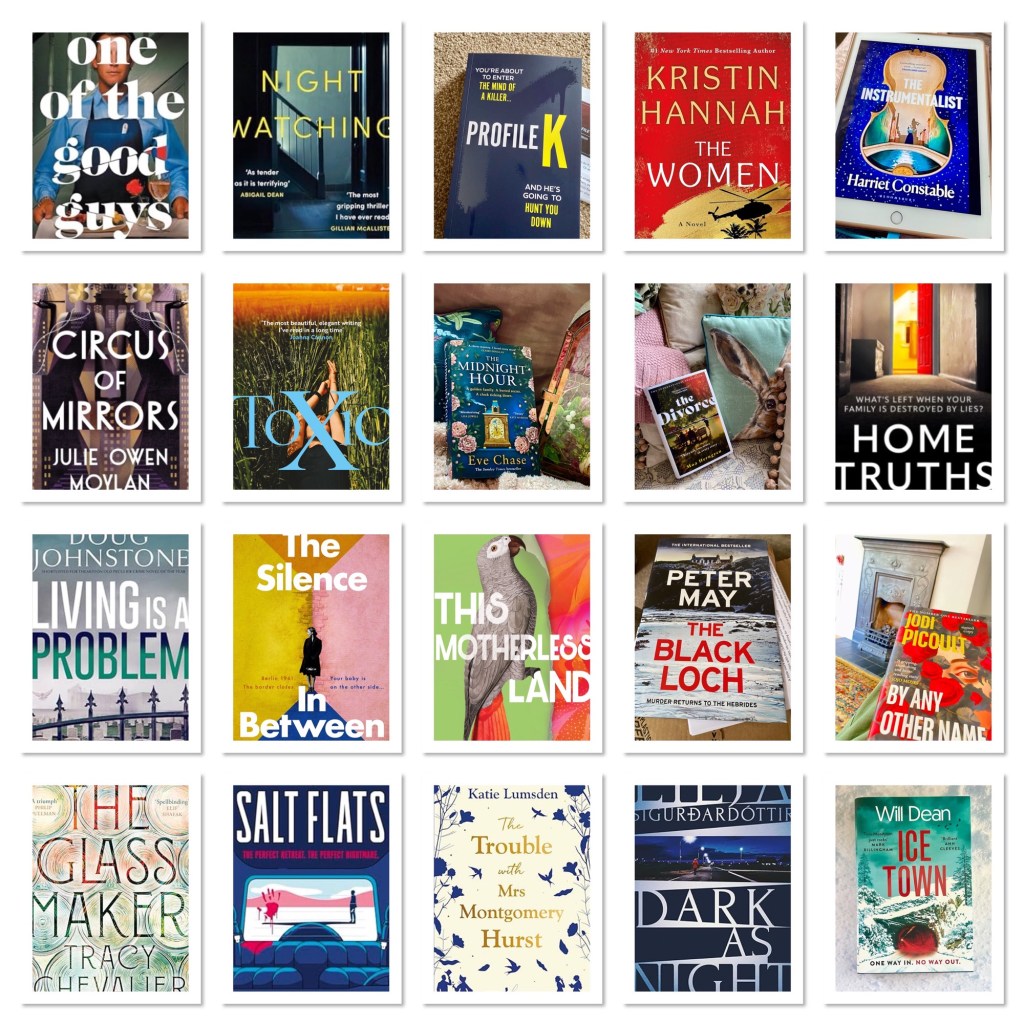
Wow! That was a busy book month. I read so much and enjoyed pretty much every book I read, but these were the stand outs for me this month. I think a combination of having a really painful back and the recent heatwave has meant a lot of resting and time to read. In fact I’ve read so much this month I’m slightly behind on reviews. My NetGalley account is looking seriously neglected though and one of my priorities for next month is to get some of those choices reviewed and tidied away. I hope you’re all enjoying the weather. I’m surgically attached to my new Shark fan which is so quiet I don’t feel like a jet engine is taking off next to the bed! Multiple Sclerosis and heat don’t mix well so I try and keep cool with cold drinks, a cooling mat, cooling spray and frozen strawberries or iced fruit lollies. I’m pretty much guaranteed to be having an afternoon nap each day too. I’m expecting similar conditions next month so lots more reading time. Here are some mini reviews of my June reading:

This excellent contemporary short story collection features an interlinked group of young Black British people. It opens strongly with an introduction to one woman’s tube ride to work and the emotions that arise when she sees an eligible man reading her favourite book. It sets the tone for the whole book with a narrative voice that’s immediate and modern. Reading this as a 50 year old in my rural village opens up a much younger generation to me and reminded me of the way my stepdaughters communicate – across so many social media apps I can barely keep up. There are bittersweet feelings of regret and love, the realisation that sometimes love isn’t enough. I loved the way that each story bled into the next, so while we meet a character like Jonathon in the context of the girl who’s always loved him in a later story we can see him visit Ghana with friends discussing how hard it is to be a young black man in Britain. So we know there’s so much more to him than at first appearance. I also love that these stories come full circle in an unexpected way within the final story. This beautiful writing is so immediate with no superfluous words or descriptions. My full review will be up this week.

I’ve never read a Jane Cory novel but was intrigued by the premise of this story revolving around a historic case. Janie tells us ‘on the day I died the sea was exceptionally flat’. She’s a young girl on the verge of exciting life changes, she’s been offered a publishing job in London. It’s something she has always wanted to do and she’s had a last early morning swim. Afterward she starts to cycle home when a 4×4 hurtles round the corner and knocks her off her bike causing horrendous injuries. Janie survives but is severely disabled, struggling to even communicate until she realises that although she can’t speak, she is able to sing. Years later, music legend Robbie is arrested for the offence. The clean living band member, then solo artist, wants to plead guilty but his solicitor is sure there’s something he’s not saying. Victim support volunteer Vanessa is assigned to Janie throughout the court process. Now a widow, she has spent most of her life unwittingly controlled by her husband. Her secret heartbreak is that she couldn’t have children because after a fall when pregnant she sadly had a stillborn baby that didn’t see due to being so unwell. So when a young man turns up claiming to be her grandson it throws her whole life into confusion. Luckily she has Judge, who she’s built up a friendship with after meeting at court, but he has his on secrets too. There are so many tangled threads in the stories of these people who revolve around a single court case. I was compelled to keep reading as the questions started to pile up and revelations came thick and fast. This was an interesting thriller with four narrators taking us into their own inner worlds and slowly revealing it’s darkest secrets.

I loved this story of a marriage gone wrong from Moa Herngren, set in Stockholm. Our narrator is Bea, the wife in this divorce, who is angry with husband Niklas because he forgot to buy the ferry tickets to take them on holiday. Bea does everything else so why couldn’t he remember this one thing? Now they’ll be stuck in the city for another week in the heat or they’ll have to take a car and drive to a different ferry. Bea is sometimes exasperated with her husband who has started a new job as doctor in a maternity department, in fact she even picked out the job for him knowing that he would happily stay working in paediatrics in their local hospital for life. If she didn’t push him he wouldn’t fulfil his potential and they’d never have a new kitchen. Niklas and Bea met as teens when Bea’s brother Jacob started to hang out with him. When Jacob killed himself both of them were grieving and he felt a natural pull towards Bea, wanting to look after her. They’ve been together for thirty years and have two teenage daughters Alexia and Alma. Niklas suddenly distances himself from Bea saying he’s not coming home, saying he needs some space. Bea is bewildered by his behaviour. Is it a mid-life crisis? He gets a tattoo and starts to rent an apartment belong to the Ericssons down the road. Bea doesn’t know what she’s done wrong and he won’t communicate, but she’s terrified because if she loses him she loses His family too – the only family she’s known. We’re team Bea at this point and then the author switches to Niklas’s point of view at the half-way point. This is a clever and subtle story of something many of us experience, but shown from two different and fascinating perspectives.

I loved The Phonebox at the Edge of the World and the idea of a place to go and talk to your lost people. It’s a ritual. A point and place of connection where all your anger and grief can be expressed. Then when you put the phone down and leave the box, you leave those feelings behind. Catharsis is very important, but as time goes on so is containment. It allows people to grieve, but at a time and place of their choice. Shuichi is an artist who returns to her home town of Kamakura after the death of her mother to do carry out the administrative tasks that follow a death, but also to sort her belongings. As she starts to sort the contents of her mother’s house into boxes in the garage, she isn’t expecting to find a young boy in there, going through the boxes and taking items out. As a friendship grows between Shuichi and this boy called Kenya, Shuichi’s parental feelings are stirred up by this new child in her life. Children are very healing, because they’re a beginning rather than an end, experiencing the world for the first time with joy and wonder. This book is about the inner journey and the human process of change. There are moments of exquisite descriptions and a philosophical element. It’s one of those books where you find yourself going back to re-read a sentence that’s so beautiful it stops you in your tracks. Although it starts with a feeling of sadness, I felt uplifted at the end. There’s nothing overwrought it sentimental about it either, and it’s because the writer has such a gentle touch that the full impact of the emotions really surprise you. I felt changed by this story and that’s how powerful literature can be.

It seems a long time since I last accompanied Jensen on her investigative adventures, so I was very pleased to receive a proof for this third instalment. As usual this was a complex plot involving politics, organised crime, hackers and headless bodies being fished out of the water. Jensen fears that one of the bodies might belong to a Syrian refugee named Aziz who was working as security for MP Esben Nørregaard, one of her friends. Esben asks Jensen and her assistant Gustav to look into it for him as he doesn’t yet want to involve the police. Meanwhile, detective Henrik Jungersen and his team try to find out who the bodies belong to and where their heads have gone. This complicated investigation means that Jensen and Henrik are going to cross paths. Jensen is in a good place, after a round of redundancies at her newspaper Dagbladet she has become chief crime reporter. Also, she has just moved in with her tech billionaire boyfriend Kristoffer Bro. Henrik can’t believe that Jensen has left him behind for good. He’s still married, just barely, and is due to go on holiday to Italy with his family when the first body is found. Guiltily he can’t imagine anything worse than the holiday, but if he doesn’t go he knows it’s probably the last straw for his long suffering wife and that’s before she knows Jensen is involved in his case. Jensen still feels slightly odd in Kristoffer’s flat and when she starts to look for something of Kristoffer’s that’s personal I could understand why, even if it is an invasion of his privacy. Jensen’s investigative urge could come between them and up until now this is the healthiest relationship she’s ever had. Henrik has never made himself available, but that attraction is still there. The story is compelling, well-structured and there were revelations I wasn’t fully expecting. What’s fascinating about Jensen is that by instinct she’s a lone wolf, suspicious of everyone and very headstrong. Yet she seems to be slowly collecting people in her work and private life. I think these ties make her feel vulnerable, but she’s starting to realise that without them she’d be in a much worse place. The ending was tooth-clenchingly tense and I’m already looking forward to their next adventure.

It seems to be a year of incredible debuts and this one is definitely going to stay with me. We open at a dinner party. Robyn and her wife Cat are hosting an evening for their friends Willa and Jamie, Robyn’s brother Michael and his partner Liv, and Cat’s brother Nat and his new girlfriend Claudette. It’s the first time the group will meet Claudette and Robyn hopes to make it a chilled, relaxed evening. Robyn had a scholarship for a private girl’s school and she ‘buddied’ with Willa who was a new sixth former. Robyn soon learns that Willa’s life is overshadowed by the disappearance of her sister Laika. Michael’s girlfriend Liv is a psychologist and she begins a discussion about implicit and explicit memories. Our explicit memories include times, dates and places and they tend to be from older children. Implicit memories are usually from unconscious emotional recollections and can be an amalgamation of several memories, as well as a few bits of what others have told us. These are memories created when we’re very small, usually pre-school age. Jamie isn’t convinced and Liv’s assertions seem to unsettle the party. As Jamie gets louder, Willa tells a memory of being tickled until she wets herself. She has always hated being tickled. However, someone in the party knows this isn’t actually Willa’s memory. It’s her sister Laika’s. The psychological dynamics of the dinner party are explored within narratives from Robyn, Willa and Laika. We each carry hidden histories within us and these ones are complex and affected by loss and trauma. While the compelling psychological thriller aspect is concerned with finding out what happened to Laika, I was fascinated with the upbringing of the characters and how they became the adults they are. I loved the analogy of the natural pool where Robin’s parents take everyone to bathe. It’s a direct contrast to the sterile and man made pool at Willa’s childhood home. The natural pool at Robyn’s family home is filled with this self-made family that includes their friends too. Robyn and Michael’s family have so much love that it can easily take in others, old friends and new generations. Their love is like the natural spring that feeds the pool, constantly flowing and endlessly replaced.

I love historical thrillers and this one really is bristling with menace. This novel pulls together so many things I love in one incredible story: the Victorians; a touch of the macabre; a spooky and unique house; a heroine who has her consciousness raised and a simmering tension that builds to a heart hammering conclusion. Bonnie is our heroine, a young woman who resides in St Giles and earns a living running a scam with her lover Crawford and their friend Rex. The trio hang around public houses looking for a man that Bonnie can lure to a quiet alley for sex, only for Crawford and Rex to appear, rough him up and steal anything they can sell on. However, one night as Bonnie lures a red-headed man to their usual place, Crawford and Rex don’t appear. Pressed up against the wall while the man tries to haul up her skirt, she has to fight him off herself. Bonnie knew as soon as head hit brick, he was dead. Crawford tells her lie low and shows her an advert for a lady’s maid at Endellion – a labyrinthine Gothic house on the outskirts of London. Bonnie goes to meet the owner, a Mr Montcrieffe. He’s a widower with a teenage daughter Cissie who desperately misses her mother. Bonnie gets the job and looks forward to working with Cissie. Yet there is so much more to these unrelated events than she knows and so much about Crawford that’s been hidden by her love for him. Now events are set in motion, Bonnie is caught in a spider web of lies, betrayals and the very darkest of intentions. I loved Bonnie’s development through the book, Crawford has definitely underestimated her. She feels trapped by Crawford but he doesn’t have the hold on her he once did. She wants to remove deceit from her life at Endellion. The revelations keep coming in the latter half of the book, some expected and others a complete shock to Bonnie and to us. I felt a physical sensation of holding my breath in parts and I devoured the final three sections in one afternoon, desperate to find out what happened. Bonnie has to be super-resourceful to survive and create a better life for herself. I was desperate for her to succeed! This novel is a brilliant thriller with an atmospheric and beautiful backdrop. We also have a resourceful heroine with more strength and intelligence than she realises. This is an absolute must read for those who love Gothic and historical fiction.

I started this book in bed at night, which turned out to be a big mistake because I didn’t want to go to sleep once I’d started. We’re introduced to the village of Tome (pronounced ‘tomb’ by the locals just to add a sense of foreboding) and the new wellness retreat created there by Francesca Woodland who inherited The Manor and it’s land from her grandfather. Her husband Owen has created woodland ‘hutches’ for guests, featuring outdoor showers and luxurious linens. The Manor itself is the central hub with classes in meditation and yoga, a spa and breakfast area. The opening weekend looms and while there’s a hint of anxiety Fran is sure she has everything under control. On the final night she has planned a mini-festival with live music, a meal out in the woods and crowns fashioned from twigs creating the look and feel of a pagan celebration. While the music is at it’s loudest she has given Owen the go ahead to start digging the foundations for the tree houses, in the hope the music drowns out the noise. However, that’s not the only problem on the horizon because when Owen arrives the workmen are confused by new symbols on the trees. They look like seagulls in flight. By the morning there’s a burned effigy and a body on the beach, a wrecked Aston Martin with blood inside and the manor has been rased to the ground by a ferocious fire. Everyone in Tome knows the local saying- ‘Don’t disturb the birds’. Could Francesca’s dream be over when it had only just begun? The book also goes back twenty years, when Francesca was a teenager living at the manor with her grandparents and twin brothers.

There are several narrators, but there are others who have reason to hate The Manor and some exact their revenge in amusing ways, while others want to end the retreat and Francesca for good. I loved the folk ritual element, reminiscent of Thomas Tryon’s Harvest Home mixed with a dose of Hitchcock’s killer birds. Except these birds are the size of a human, covered in black feathers and under their cloak is the huge beak. The villagers take them seriously, even the contractors who turn up to remove the trees don’t want to mess with those marked by the birds, they’d rather give the money back. Are the birds a simple folk tale that keeps Tome safe or are they real? Tome’s forest and it’s beaches are for the villagers and not to be fenced off for the use of rich visitors. As we countdown to what happened on the big night, two parties twenty years apart reveal their secrets and the birds will have their final say. The ending is terrifyingly final for some, while others will wake up hungover and wondering what exactly they witnessed. As for me, the final page reveal really made me smile.

One week in Cape Cod. The perfect family holiday. What could possibly go wrong…?

Rocky and her husband Nick have reached that middle point in life where adults seem to be at their most stretched. They’re coping with children who have left home or are living at university as well as increasingly elderly parents who need more help than they have before. Rocky is a great narrator because I was comfortable and believed in her world. In fact the book flowed so beautifully that I finished it in a day. The family trip to the Cape Cod holiday home they’ve rented since the children were small throws Rocky’s three generation family under one roof. Eldest child Tim is there with girlfriend Maya and student Willa has travelled from her college and meets them there. Later in the week grandma and grandad will join them for two days and of course there’s the ancient cat. They are rather piled in on tap of one another but they couldn’t come here to a different, bigger rental because so many of their memories have been made in this house. During the week Rocky will learn and divulge some secrets, all of them filtered through her anxiety and what husband Nick jokingly calls a hint of narcissism. Rocky is a passionate and emotionally intelligent mother, the sort of mum you might go to with a secret. She also happy to be schooled where she gets it wrong, especially where daughter Willa is concerned. She might use the wrong pronouns and need to check her privilege occasionally but largely she’s the sort of mum you want. She feels things almost too deeply and I understood that in her. I think Catherine Newman is brilliant when it comes to trauma and intergenerational family dynamics and every family has them. Rocky reminisces about the time she miscarried, the unresolved emotions are clear and perhaps stirred up by menopause symptoms and having her babies under one roof. I loved Rocky and Nick’s marriage too because it’s not perfect – they haven’t really connected for a while, physically or mentally. When he stumbles on a long held secret it throws their dislocation into the spotlight and gives them the opportunity to talk. He still loves her, despite the secrets and narcissism. She recognises that throughout the holiday Nick has been cooking, organising, driving and just quietly looking after everyone. They’ve been in their mum and dad roles for so long they’ve forgotten how to be Rocky and Nick. It’s something of a relief for Rocky to know that Nick still desires her, despite the expanding waistline and loss of libido. Each generation has it’s own issues: the grandparents are facing health issues, brought into sharp focus when grandma faints at the beach: Rocky’s son and girlfriend are facing some huge life choices; Willa is listening and helping where she can. Catherine Newman has once again written a novel about family that is truthful, funny and life-affirming. I can easily see this being on my end of year list because it’s raw, emotional and relatable.

If you haven’t had the pleasure of meeting Tracy Whitwell’s character Tanz yet, you’ve been missing out. This bold, sweary Geordie actress and accidental medium is a delight and this is her third adventure in the series. Tanz is being torn in two directions as she reluctantly agrees to do a fringe play in London, but is also suddenly ‘activated’ as her spirit guide Frank explains. She is sent a new guide who she calls ‘Soft Voiced Lass’ and her flat is suddenly teeming with visions and apparitions, including a nurse who is on duty and walks through into Tanz’s bedroom which is quite a feat when you don’t have any legs! Luckily she has friend and fellow medium Sheila to rely on, but there’s a lot of sleeping with the light on. Tanz is guided down to Southwark and a cemetery known as Cross Bones, the burial place of the prostitutes licensed by the Bishop of Winchester. However, Tanz is greeted by a horrific vision of the burial ground in the Victorian period, when overcrowded tenements spread diseases like wildfire and deaths from cholera, typhus and consumption were the daily norm. What Tanz sees isn’t an ordinary graveyard though. The smell hits her first; death, smoke and sewage creates a miasma that seems to cling to your clothes. In the yard Tanz can see a grave digger with a woman screaming at him, when she looks down she can see some fingers and a skull where he has been digging a body up to make room for more. She is overwhelmed and doesn’t really know what her purpose is here, just that it isn’t going to be easy.

I love Tanz because she’s one of the most real people I’ve ever met in a book, despite the spooky stuff that surrounds her. She’s very down to earth, independent and has a few vices. She thinks her visions relate to several generations of the same family. Between the spooky action there’s an injection of dark humour that I really appreciated. I love Tanz’s slightly prophetic phone calls from her ‘mam’ who strangely seems to know when her daughter’s up to something. Thank God she doesn’t find out about the black faced woman, the homeless man and the knife! There’s also a side order of romance in this novel, with a younger police officer stirring up rather unexpected feelings for Tanz. She’s developed some boundaries and her self-worth enough to accept that someone like this could like her. She’s also stopped the habit of keeping her eye on the exit in her romantic affairs. She’s also taking her gift seriously, starting to accept that it’s this type of work that she finds fulfilling. Although, she also makes a radical move in her acting career too. It’s lovely to see Tanz in such a strong position in life, she’s ready to take on the world and I can’t wait for her next adventures.

Judy left England as a teenager and lived with her aunt In New York City. Judy’s mother drummed it into her that it was wise for a woman to have her own money and never rely solely on a man. This lesson was well learned, but without any real qualifications or means of making money Judy has to be more creative. She’s a grifter, stealing here and scamming there. So when she sees a story in a newspaper about a rich resident of Cape Cod becoming a widower, she decides on her next mark. Judy finds her way to a vineyard in the same area, taking a job there and making herself known until the inevitable happens and she meets Rory. She plays it clever, doesn’t ask for anything and is never pushy or monopolises his time. She’s playing the long game because she wants him to fall for her, hook line and sinker. What she didn’t bank on was falling in love with him. When they marry she has access to some of the wealthiest people in the area so she’s easily sneaking the odd item from their home and from other society people to sell on through a fence. When Rory’s asked to hold the local Wine Appreciation Society ball at their chateau in France, Judy is left with a dilemma. Her fence in London is blackmailing her, asking her to provide details of the ball including exits and entrances of the chateau and a guest list of who’s attending. She doesn’t want to help, but when he threatens to tell husband Rory about her past she has no choice. When one of the robbers dies she laments that a young man has died because of her and can’t shake it off. It’s in her French home that Judy receives the phone call, the one she’s dreaded and expected all at the same time. The police are looking into a murder, but is the victim the man in France?

When Judy’s daughter Francesca gets a visit from the police and journalists it’s like a bolt from the blue. She’s a lawyer, in London and is aghast when police inform her that her mother seems to have fled the country and is wanted for murder. Francesca is left bewildered and unsure what to do. The author is very adept at giving out just enough information, drip feeding little clues here and there that keep you reading and keep you guessing. Then, suddenly, she wrong foots you with a different direction. I found Judy so fascinating that Francesca suffered a bit in comparison. She’s the female equivalent of the ruggedly handsome rogue, with a habit of stealing from the rich like a modern day Robin Hood. There is only one woman who suspects Judy might not be all she seems and she won’t let go of her suspicions, even taking them to the grave. I loved the allusions to Lady Audley’s Secret a Victorian ‘sensation’ novel based around the fact that Lady Audley is living a lie. It had pace and excitement just like a contemporary thriller and this book is in that tradition, except the heroine has less to lose, thanks to never relying solely on a man. I was pretty sure that Judy would try her hardest to find a cunning way out. Is it wrong that the thought of her getting away with it made me smile?

This novel is historical fiction, based during the reign of Elizabeth I and James VI of Scotland (James I of England). I knew of James VI’s obsession with witches after studying the Malleus Malificarum at university, the bible for witch finders, describing all the behaviour and characteristics of possible witches. It’s a guide to James VI, who was alarmed by news of witch hunts in Germany. His proposed bride, Princess Anna of Denmark, set sale for Scotland in 1590 and was driven back by catastrophic storms. The storms were blamed on witches in Denmark and when James travelled to meet her in Norway he heard allegations of witchcraft first hand. Around the same time, in North Berwick, a housemaid called Geillis Duncan was accused of sorcery and when tortured she implicated several other witches, allegedly conspiring with the Earl of Bothwell to take the throne from the King. Kate Foster has taken this history and weaves a story from three women’s points of view, giving a feminist slant on the witch trials that killed thousands over the next two centuries. As Kate points out in her historical notes, the majority of these were women over forty. There are three narratives in the book, from women in different positions of society. Princess Anna of Denmark was a young girl of fourteen when he was betrothed to James VI and attempted to reach Scotland with an enormous pressure on her shoulders. They will have a Scottish hand-fasting, if she should please him within the next year he will marry her. If not, she will be ruined for any other marriage and her future looks set to be a life within an abbey. Adding to the pressure, there is a witch burning just before they leave and Anna is compelled to watch, because burnings are a warning to all women.

The renowned witch finder Dr Hemmingsen from Copenhagen assures the king that he has a unique way to identify witches, using a bodkin to prick them and find the devil’s mark on their body. He also sends the king a golden amulet for protection, carved by a man who knows how to ward off evil. It seems signs and charms are only witchcraft when a man says they are. In fact Anna has never heard so much about the practises of witches as she does from the king, regaling her with tales of baby-killing and orgies with man, woman and beast. Her maid Kristen tells Anna that James is becoming a danger, his fervour is a kind of madness and a licence to abuse and degrade women. Anna has a realisation that a woman’s body is never truly her own, no matter what their position in society. Whether you’re a housemaid whose master decides you’re his property, a witch who can be stripped and examined by men who call themselves god-fearing, or a princess whose family hand-fasted her to James Stuart and didn’t ask her if it was what she wanted. Women must work together if they want to survive. These women are strong, but are they intelligent enough to try and outsmart a king? Kate is brilliant with twists and turns, so I wasn’t surprised to find a few revelations towards the end. I was driven to finish to know what happened to all three women and whether any of them would achieve the freedom they craved. This is historical fiction at it’s best.

That’s a lot of fiction for one month. I read around fifteen books in June and had to be choosy, but this tells me there’s a wealth of fantastic fiction out there, especially if you enjoy various different genres as I do. I’m behind in my Squad Pod reading so that’s the focus for July and catching up on my NetGalley reads too. I’m hoping to get my percentage up to 70% over the next couple of months. Here’s a little preview of what I’m hoping to read in July.

Posted in Netgalley

Back from the Dead by Heidi Amsinck

A Missing person … a headless corpse … Jensen is on the case. 

June, and as Copenhagen swelters under record temperatures, a headless corpse surfaces in the murky harbour, landing a new case on the desk of DI Henrik Jungersen, just as his holiday is about to start. 

Elsewhere in the city, Syrian refugee Aziz Almasi, driver to Esben Nørregaard MP has vanished. Fearing a link to shady contacts from his past, Nørregaard appeals to crime reporter Jensen to investigate. 

Could the body in the harbour be Aziz? Jensen turns to former lover Henrik for help. As events spiral dangerously out of control, they are thrown together once more in a pursuit of evil, more dangerous than they either could have imagined.

It seems a long time since I last accompanied Jensen on her investigative adventures, so I was very pleased to receive a proof for this third instalment. As usual this was a complex plot involving politics, organised crime, hackers and headless bodies being fished out of the water. Jensen fears that one of the bodies might belong to a Syrian refugee named Aziz who was working as security for MP Esben Nørregaard, a friend of Jensen. Esben asks Jensen and her assistant Gustav to look into it for him as he doesn’t yet want to involve the police. Meanwhile, detective Henrik Jungersen and his team try to find out who the bodies belong to and where their heads have gone. This complicated investigation means that Jensen and Henrik are going to cross paths. Jensen is in a good place, after a round of redundancies at her newspaper Dagbladet she has become chief crime reporter. Also, she has just moved in with her tech billionaire boyfriend Kristoffer Bro. Henrik can’t believe that Jensen has left him behind for good. He’s still married, just barely, and is due to go on holiday to Italy with his family when the first body is found. Guiltily he can’t imagine anything worse than the holiday, but if he doesn’t go he knows it’s probably the last straw for his long suffering wife. That’s before she knows Jensen is involved in his case.

The story is told from both of their perspectives alternately, giving us all the case action but also their private lives too. Inevitably, their paths will cross although Henrik doesn’t know about Aziz’s disappearance at first. When the second body turns up in the harbour it’s clear that this is much more complex than either of them expected. I always find myself very unsure about Henrik. He’s a competent detective even where he doesn’t always play by the rules. Once he knows Jensen is investigating, he can’t get her out of his head. I find their relationship very like those old Rock Hudson – Doris Day movies where they seem to hate each other, but not really. Even though this is a crime novel, there are witty exchanges and Jensen aggravates him to a comical level. This is especially obvious at press conferences where Henrik can be a liability and Jensen can really press his buttons. He’s also furious that she hasn’t told him about the disappearance of Aziz, because he’s a Syrian refugee there are national security implications. The story moves fast and I loved how much Gustav has come on with his investigative skills. He seems to intuitively know what Jensen needs him to do now, but his aunt (and Jensen’s boss) wants him to return to school in the autumn. I think I would miss him if this comes to pass.

I’ve been suspicious of Kristoffer Bro from the start, based on the premise that if something looks too good to be true it usually is. His flat just isn’t Jensen. In fact she’s kept her small flat that she was renting from him and a lot of her stuff is still there. Their shared home is pristine, with clean lines and absolutely zero clutter. Like Jensen I tend to collect piles of books, magazines and other stuff so I certainly couldn’t live in such an austere place. If I go into a home and there are no belongings, nothing to tell me who this person is, it makes me really uncomfortable. When Jensen starts to look for something of Kristoffer’s that’s personal I could understand why, even if it is an invasion of his privacy. How do people get through life without things? However, Jensen’s investigative urge could come between them and up until now this is the healthiest relationship she’s ever had. Henrik has never made himself available, but that attraction is still there. The story is compelling, well-structured and there were revelations I wasn’t fully expecting. What’s fascinating about Jensen is that by instinct she’s a lone wolf, suspicious of everyone and very headstrong. Yet she seems to be slowly collecting people in her work and private life. I think these ties make her feel vulnerable, but she’s starting to realise that without them she’d be in a much worse place. The ending was tooth-clenchingly tense and I’m already looking forward to their next adventure. I want to end with a plea to Muswell Press to release the covers of these books as prints, I need them on my wall at home.

Out now from Muswell Press

Meet the Author

Heidi Amsinck won the Danish Criminal Academy’s Debut Award for My Name is Jensen (2021), the first book in a new series featuring Copenhagen reporter sleuth Jensen and her motley crew of helpers. She published her second Jensen novel, The Girl in Photo, in July 2022, and the third in April 2024. A journalist by background, Heidi spent many years covering Britain for the Danish press, including a spell as London Correspondent for the broadsheet daily Jyllands-Posten. She has written numerous short stories for BBC Radio 4, such as the three-story sets Danish Noir, Copenhagen Confidential and Copenhagen Curios, all produced by Sweet Talk and featuring in her collection Last Train to Helsingør (2018). Heidi’s work has been translated from the original English into Danish, German and Czech.