Posted in Random Things Tours

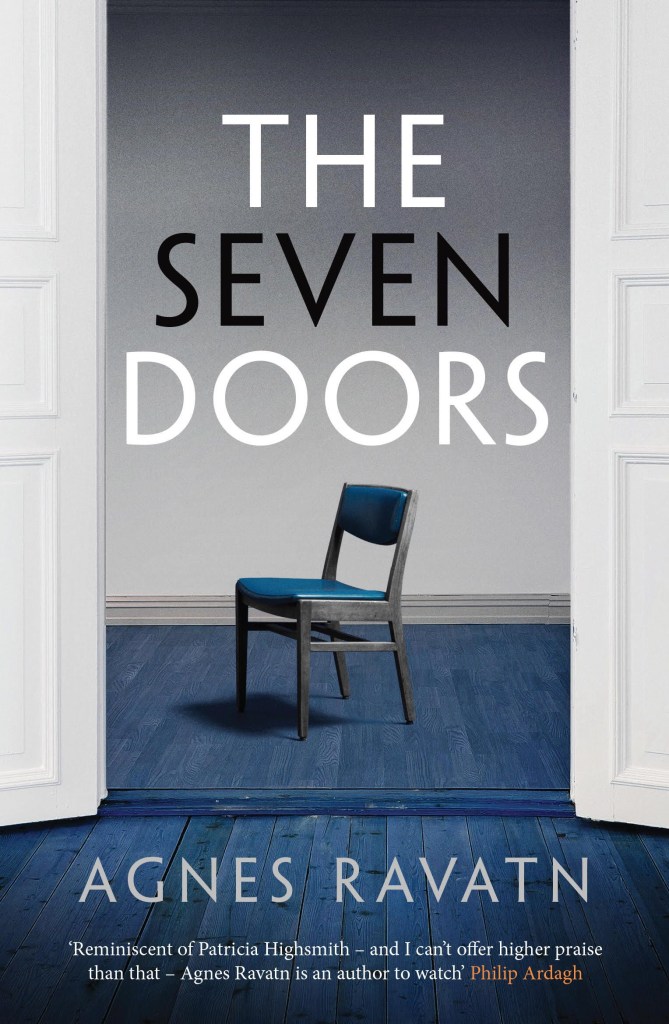
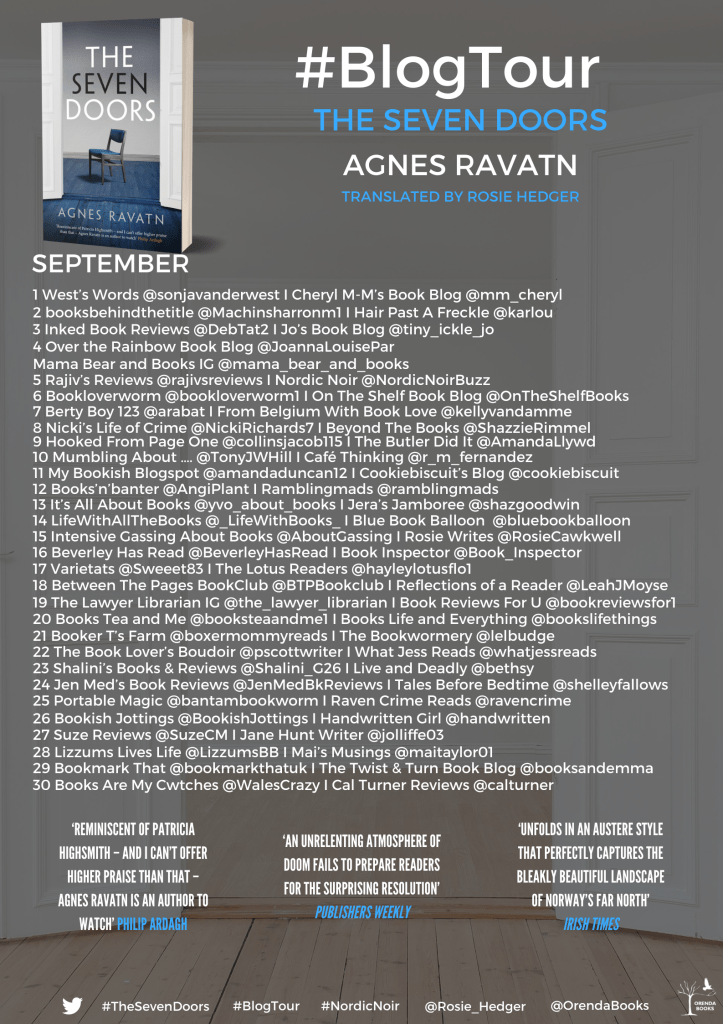
Seven Doors by Agnes Ravatn.

#OrendaBooks. #RandomThingsTours #blogtour #SevenDoors
While reading this book I had one of those odd reading experiences that only happens on Kindle or other e-reader. When I’m reading a proper physical copy of a book, I’m constantly aware of how much book is left. I’m literally holding it in my hand. I read this in one sitting, only realising how quickly time had passed when I stopped to mark a page and saw 93% in the bottom corner! Time really flew because I was so absorbed into Ravatn’s world.

Set in Bergen, Oslo, this is a thriller with so many possible outcomes. Our main character Nina follows a labyrinthine trail to find the killer of a musical prodigy. Nina is a professor of literature and gives a speech at a symposium about the futility of studying literature. Lit students are following their own, selfish lines of academic enquiry she argues, but their study doesn’t help anyone or bring anything important to the world. It doesn’t make a difference, except to the student. She proposes that in order to be useful, literature students make them self available as investigators to the police force. They are trained to analyse documents, to read between the lines, to apply psychoanalytic theory to texts and understand character’s motivations. All skills that might be useful when investigating a crime. Little does she know, she will soon be using those very skills in the real world.

Nina and her husband Mads have an absolutely insufferable daughter Ingeborg. When she announces that her home has silverfish, and she is three months pregnant, she asks Nina to intercede with Mads for an advance on her inheritance. Nina idly observes they have a house in town that belonged to an aunt, but she needs to talk to Mads. They are in their own difficult living situation, as their home is being compulsory purchased to make room for a railway. This is affecting Nina much more than Mads because of the emotional attachment; it was her family home, she grew up there. They are negotiating a settlement with the council, but Nina can’t see any property she would want to purchase. She needs to live in something with soul, not a slick waterfront retirement pad. Ingeborg convinces her mum that they should go and look at the house, but Nina warns that there is a tenant that they shouldn’t disturb. Despite the tenant telling her it’s a bad time, Ingeborg goes bustling in, badgering the tenant about the end of her lease and offering her money to leave as quickly as possible. The tenant, a single mother with a little boy, is blindsided by this forceful woman. Nina feels terrible and makes her apologies, sure that the tenant looks familiar to her.

Later, she realises where she has seen the woman. Their tenant is concert violinist Mari Bull, world renowned and now dropped out of sight. Strangely, she then does the same thing again, exiting the property within a couple of days and leaving no forwarding address. Surely this can’t be solely to do with their visit? Not long after, her disappearance is reported by local then national newspapers. She went to her parents place out on one of the islands, where Nina has a holiday cabin, but left her son and went for a walk, never to return. Nina finds herself intrigued by the case and follows clues, from the opera her ex-husband plays as her requiem to a small notebook with musical terms she finds in a box at the house. Fairytales also play a role in the book and like most literature students I am familiar with the work of Bettelheim quoted by Nina. Using this and Freud’s work on transference Nina starts to construct a theory and follows each clue like the breadcrumb trail of Hansel and Gretel. I liked the play on our usual ideas about fairy tales, which tend to be very Disney-fied, and everything comes to a completed happy ending. The original tales Nina starts to tell her granddaughter Milja are far more dark and bloodthirsty. In fact, the darker they are the sooner Milja will quiet down and go to sleep. They include anxious, suicidal hares and a murderous husband who gaslights his wives then kills them when they find out the truth.

From a psychological perspective there are interesting theories around transference and counter-transference, not just in the therapeutic relationship but in any relationship with a power balance that’s heavily in one person’s favour. I was also interested in the theorising around the Oedipus and Electra complexes. Nina is discussing the theory with her students and they don’t see the point of learning about a concept that started in Ancient Greek theatre and seems to bear no relevance to the present day. Yet, there’s a definite unease in Nina’s own relationship with her daughter – Ingeborg has been more likely to confide in or ask favours from her father. For Mari too there is a complicated mother – daughter relationship in that her parents sacrificed their own relationship to make sure their daughter had opportunities with the best teachers and orchestras. Mari and her father were often away together, touring Europe, leaving her mother at home. There is resentment over this and a definite coolness between mother and daughter.

Ravatn’s writing is spare, it gets to the point quickly and without poetry. She can establish a feeling or setting in just a few words, such as how the light changes when it snows or how it must feel to give ourselves up to the water, like Virginia Woolf with the stones in her pockets. Her characters are well defined and psychologically complex, such as Ingeborg’s narcissism and inability to gauge other’s feelings. I have real worries for her daughter Milja, a future psychopath if ever I met one. As I felt the book build in pace and tension towards the end, I knew Nina was getting close to the answers, but is the answer getting closer to her? The end, when it comes, is satisfyingly unexpected and shocking. I love Nordic Noir and this was a great addition to my collection. This was a clever and psychologically literate thriller. I would love to read more of Nina in the future.
Posted in Random Things Tours

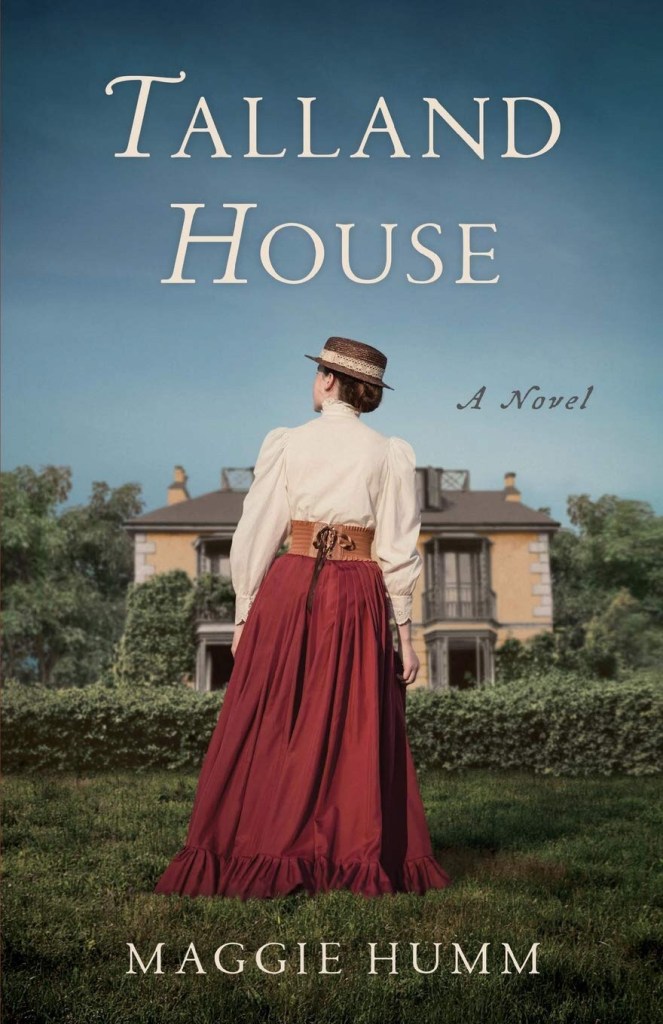
Talland House by Maggie Humm.

#TallandHouse #RandomThingsTours

In Virginia Woolf’s famous novel To The Lighthouse we visit the Ramsay family at Talland House in St Ives, Cornwall. I remember a particular dinner scene in the novel, often used as an example of how subjective the sense of self is, as we float between dinner guest’s perspectives of the dinner and each other. Maggie Humm takes one of Talland House’s guests, Lily Briscoe, and weaves a tale of love and friendships across the turbulent decades at the beginning of the 20th Century. We start at the Royal Academy in 1919, when Lily has a painting on display and runs into her one time tutor Louis Grier. This meeting takes Lily back to a time when she attended a painting school in St Ives. Now Lily is a successful artist, and in the time since her student days has been a nurse and a suffragette. She is much more self-assured than back then, when she was lacking confidence and still struggled with the loss of her mother. At a student art show, Mrs Ramsay and her husband buy one of Lily’s paintings and the two women become close. Lily attends dinner at Talland House and asks if she might paint Mrs Ramsay’s portrait. Lily has become fascinated with her hostess who has all the elegance of the model she used to be, but also the soft calming nature integral to her role as hostess, wife and mother. With Mr Ramsay’s violent outbursts, Lily suspects she needs to be patient more often than not. As they meet Louis in 1919, Lily realises two things; she is still in love with Louis, and she must explore what happened to her beloved Mrs Ramsay, who has died suddenly without Lily knowing.

From a historical perspective this novel is fascinating. Not only is this an interesting time in history, but To The Lighthouse was a turning point in the history of the novel – showing a lean towards Modernism in its various perspectives and informal structure. Historically, this is a time when women start to become independent and we see this in Lily’s student years – she studies in Paris before Cornwall and now trudges around the Cornish coastline, sketching with her friend Emily at the weekends. She chooses how she spends her time and with whom, although there are some constraints within her class and gender. With the advent of WW1 women are working in men’s roles as they join up and go to the front, working in retail and in factories to ensure the country keeps running. Lily’s wartime job as a nurse further emphasises her competence and independence. It’s a time of huge change and upheaval for everyone, but on a personal level Lily is shocked to be told about the sudden death of her former friend Mrs Ramsay. Her mind is drawn back to those sudden outbursts of her friend’s husband when she was visiting. It is Lily’s interest in this mystery as well as her potential love story that kept me reading.

The pace is slow, full of beautiful detailed descriptions of surroundings and the art being created. The colours are vivid and I can almost see a particularly colourful part of the Ramsay’s garden where delphiniums flower in a blue haze in contrast to the purple hedge. I loved the descriptions of St Ives, especially the depiction of Pilchard Day with all its activity and noise. Although these descriptions slow the story down, they are very important. Humm is creating a painting with words. The difficulties of women’s roles in society are depicted beautifully in Lily; there is tension between her status as an independent woman and a woman in love. Can both of these roles exist in conjunction with one another? She has the example of Mrs Ramsay before her, a once celebrated model, with her role now confined to mother and wife. Any artistic sensibilities she had now restricted to making Talland House the perfect place to entertain her husband’s contacts. Every skill she has is now used to create the perfect back drop, making her husband more successful in society. Instead of furthering her own independent skills and interests. Does Lily want that same role? There is also the similarity Lily sees between Mrs Ramsay and her mother, whose loss seems to haunt her in some way. Is there a way in which these two women’s fates are linked and what does this mean for Lily?

This novel is a beautiful elegy to the world Virginia Woolf created at Talland House. There is something dreamlike about those early days in St Ives, as if this lifestyle has now been lost in the wake of WW1. This feeling also extends to the love story; can Lily’s infatuation with Louis survive all that has happened since they last met? Would the reality of their relationship be those traditional roles or would Lily be free to pursue her independent career? Everything that has happened gives her room to ask these questions. This is a thoughtful, leisurely novel with bags of historical detail and painterly descriptions. It was a perfect summer story, in the same way as LP Hartley’s The Go-Between. It drifts like a summer breeze, and captures its moment perfectly.

Posted in Random Things Tours

The Big Chill by Doug Johnstone. #OrendaBooks #RandomThingsTours #Blogtour #Bookblogger #TheBigChill

How have I come this far in my reading life without reading Doug Johnstone? The Skelfs are the family I didn’t even know I was missing, but now can’t imagine my reading life without. To prepare for reading the second novel in Johnstone’s Skelf series, I made the decision to read the first novel entitled A Dark Matter. I couldn’t possibly have imagined this incredible group of women, but now I feel like I know them personally. Set within the city of Edinburgh, this is a family of undertakers and private investigators. Just to set up the kind of family they are, the author places their residence and place of work at No 0 – somewhere that doesn’t exist. Grandmother Dorothy is a Californian lured to Edinburgh after falling in love with Jimmy Skelf who has passed away at the beginning of book one. Dorothy works in the funeral business with employee Archie, but also takes on PI duties and in her spare time teaches spunky young girls to play the drums. Mum Jenny is at a loose end so comes into the family business after her father dies. She jumps into the PI business with both feet, which is how she seems to do most things. Granddaughter Hannah is studying physics at Edinburgh University and lives with her girlfriend Indy. She has a good relationship with her parents and her grandmother. The first book concerns the disappearance of Hannah’s uni friend Mel and the shock when her killer is revealed is seismic, hitting all the Skelf family hard.

The beginning of The Big Chill reads like the explosive ending of most books. In a scene as comical as it is tragic, Dorothy and Archie are overseeing a routine funeral at the cemetery when sirens start moving closer and drowning out the service. The guests and undertakers stare aghast as a van driven at high speed forces its way through the cemetery gates followed by the police. As the van careers towards them, mourners start to scatter and Dorothy narrowly misses being ploughed into ground, as the van speeds straight into the grave nose first. Dorothy clambers in to check on the driver and finds he has died instantaneously from a head injury. However, what does survive is a scruffy Collie dog she names Einstein to sit alongside Schroedinger the cat. She immediately offers the Skelfs’ services for the man she names Jimmy X but she would like to find a little more out about him before she conducts his funeral. So, Dorothy sets out, with Einstein in tow, to find out how Jimmy X ended up living in a van that literally ‘ended up’ in an open grave.

Of course, this is only one of the mysteries the women are investigating. Hannah makes friends with an elderly physics professor at university when he asks if she’ll help with a memorial for Mel. Not long after they are performing dual duties for him too, when he dies suddenly and unexpectedly. Hannah can’t accept his death and even if it is just a displacement activity, begins to look into his personal life for answers. Dorothy is overstretched with cases when one of her drumming students doesn’t turn up for practice. This is so unusual because Abi loves to drum and has never missed a lesson. When she visits Abi’s home she is told that she was unwell, but Dorothy senses an undercurrent in the air and eventually finds our that Abi has run away. In order to find her, 70 year old Dorothy will have to start thinking like a 14 year old girl, which isn’t easy when the back ache doesn’t go away as quickly as it used to. The scars of an assault in the previous novel are not just mental.

Hanging over them all is the trial of Mel’s killer, known intimately to the Skelf women and still keeping a hold over them where he can. Not only did he kill the pregnant Mel, but when found out he attacked Jenny, stabbing her in the stomach and beat Dorothy. He has found a psychiatrist to claim he was incapacitated by mental illness at the time of the original killing. Even worse he lures Jenny to visit him, then presses charges when she assaults him. In the aftermath, Hannah is drowning. She’s well supported by Indy, but can’t sleep, feels anxious and when under pressure has panic attacks and passes out. It may take a seismic change to shake her from personalising all these difficult life experiences and thinking she is the only victim. She is having counselling, but there’s so much to unpick and she is in danger of ignoring the one person who helps her most. The women usually gather at the end of the day in the kitchen and catch each other up on the days events, but when even that ritual starts to fall apart Dorothy knows her family are stretched to breaking point. Yet, everyone has to heal in their own time and in their own way. She is wondering whether there is life after Jimmy, and whether her long held friendship and working relationship with a certain Swedish police officer, could become more?

These women are great characters. They’re tough, but still vulnerable. Full of quirky detail and boundless energy. They are also wonderfully good at picking up ‘waifs and strays’. They try not to judge people. I loved Jenny, trekking round homeless shelters and approaching groups in the street, but stopping to pass the time of day or joining a group of homeless men in a beer. As someone who is also very good at collecting people, I know how much it widens horizons, teaches us about our own preconceptions and sometimes brings unexpected, but wonderful friends. Their arms and their home are open. I found myself thinking a lot about the wonderfully patient and wise Indy, who comes into contact with the Skelfs as a teenager organising her parents funeral after a car accident. She is always quietly working in the background: cooking mouthwatering curries when Hannah hasn’t eaten; taking the reins at funerals when private investigating takes over; listening to bereaved family and respecting the person who died with so much attention to detail. There are such hidden depths here and I found myself hoping that Indy is featured and explored more in later novels.

I loved the Edinburgh backdrop. In fact it becomes a character in its own right from the touristy areas, to the student quarter, to the areas that missed regeneration, this is such a varied and richly atmospheric city. I don’t know it well but I feel this has taken me under that tourist facade to find something more interesting. We also see such a variety of people from those on the streets to those who in academia or in private education. Death is a great leveller though and these people are often side by side once they reach Skelf’s undertakers. We also see that these extremes can all be found in one person; there isn’t a ‘type’ that becomes homeless or commits a murder. I also find the way Hannah makes sense of her world through science really interesting. She muses on quantum suicide and whether we, like Schroedinger’s Cat, can be alive and dead at the same time. People often think that science is anathema to concepts like faith, hope and a belief in God. However, there is beauty and wonder in everything Hannah knows about space.

What I take away most from this book is the way the author writes with bluntness, but also kindness, acceptance and wonder about the human condition and the strange galaxy we call home. Hannah muses on the end of the universe with her counsellor:

‘stars will stop forming, the sun will wink out, the solar system will collapse. Then in the black-hole era galaxies disband, all proton matter decays, supermassive black holes swallow everything, then they’ll evaporate too, all the energy and matter in the cosmos gone […] it’s called the big chill’.

Hannah comments that it’s not such a bad way to go, but her counsellor reminds her that it’s a long way into the future. Dorothy has the same thoughts as her mind is flooded with images of everything they’ve experienced. She has felt the cold, icy creep of death:

‘death so close that she could feel its breath on her neck, could smell it every day when she woke, could feel its icy touch spreading from her mind to her limbs’.

So she sits behind her drums, plays the Black Parade album by My Chemical Romance, and starts to tap out a rhythm until she can feel the music within her, warming her veins and bursting to life. While we’re here, she concludes, we have to find a way to keep living. This is an explosive and enthralling novel, character driven and full of life, and death.

Posted in Random Things Tours

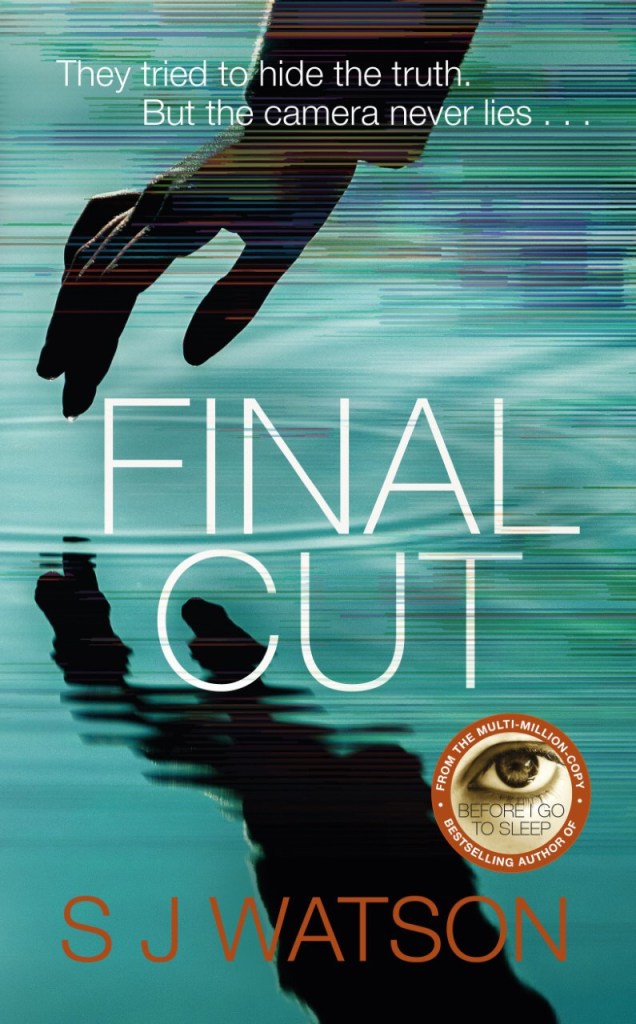
Final Cut by S.J.Watson

#RandomThingsTours #blogtour #TheLotusReaders

This novel was definitely a ‘reading experience’ as I felt confused, then blind-sided with a revelation I wasn’t expecting. If the author wanted to express what a dissociative state felt like in the structure of the novel then he definitely succeeded with this reader. As I read, there were times where I felt like I was in a dream state, others where I felt a piece of time had gone missing and when I reached the end I felt disoriented and needed to go back and piece the story together bit by bit. It was such a clever structure, because it enhanced my doubt of the narrator and every person she met. I didn’t know whether the events she related were happening to her, to someone else, or in reality not happening at all. I found myself left feeling unsettled and ‘jangly’ after each spell of reading.

Alex is a successful documentary film maker, in a great position as her last feature made money and won awards. The question now is what the next subject will be. In this early stage we learn that Alex has a traumatic past, culminating in a hospital stay where she was diagnosed as experiencing dissociative or fugue states. She hasn’t put all of her past back together, but knows there was a squat, drugs and exploitative sexual encounters. There is an element of survivor’s guilt since her success as she feels she’s making money from people who are struggling, where she was several years ago. Her manager suggests going to a town called Blackwood Bay on the coast somewhere up North. The concept is for Alex to stay up there and film local life for a while, but also to get locals to film and anonymously upload their take on Blackwood Bay to a website. Alex likes the idea but is unnerved by the location. Her manager mentions in passing an underlying story of girls going missing, but assures her she isn’t there to film that. Alex knows that if she goes to Blackwood Bay she will have no choice but to get involved in that story, because she wasn’t always from London. Blackwood Bay is her hometown; she is Sadie, one of the missing girls, and what happened there was so terrifying she has dissociated from it in order to survive.

Watson creates a dark and disturbing atmosphere in the bay, where we trust no one and look for clues everywhere. The residents are equally unsure of her, uncomfortable about what she’s there to film and why. This is a typical seaside town, that in spring and summer bustles with life, but in the winter months is practically shut down leaving locals bored, time rich but money poor. The pub is still a centre of activity, but here, and other places in the town, unnerve Alex or take her back to traumatic episodes in her past. Her cottage is rented from Monica, who seems like a mother hen figure to the young girls of the bay and Alex knows better than anyone they need protection. I enjoyed the way the story was built, both on the present film making, but on those moments where Alex remembers something. She remembers knowing all the constellations in the sky, but who taught them to her? She recognises a couple of tattoos on young girls that are exactly the same as her own, but why did she get it? A smokey upstairs room at the pub, is a scene for a quick chat, but induces physical symptoms in Alex like she’s been winded. Her search for answers is compulsive and I noticed there are many times where she doesn’t even consider her present safety, wandering the town and surrounding countryside at all hours of the night and trusting people she maybe shouldn’t. I found myself on tenterhooks all the time and I kept questioning her feeling of safety in the holiday cottage, where both landlord and any number of other locals might have a key.

The truth, when it finally emerges is very dark and disturbing. Growing up in Blackwood Bay is a dangerous game for girls and reading these pages is might be tough for people who’ve had personal experience of exploitation or abuse. There were things I had worked out, but others that came as a shock. I suspected some people very strongly, who turned out to be innocent, and trusted others that were very twisted, disturbing characters. The knowledge that the girls in Blackwood Bay have been unsafe for generations is shocking, but unfortunately all too real. This is a tainted community where people have closed their eyes to the truth for far too long. Alex tries to keep her identity as Sadie secret for as long as possible. She becomes focused on finding out the fate of a friend called Daisy. The story is that she jumped from the cliff into the bay, witnessed by a distressed Monica and filmed by a lonely man who lives in Bluff Cottage. This interplay between what is seen and what is seen on camera is interesting and builds more layers to conceal or reveal. When the final shock twist happened I was genuinely surprised. This version of the truth hadn’t entered my head. This is a book I will be thinking about long after I put it down. The central theme, that the camera can lie, is very effective. More devastating and seen through several characters stories, is that we can even lie to those we profess to love. In fact we can even lie to ourselves.

Posted in Random Things Tours

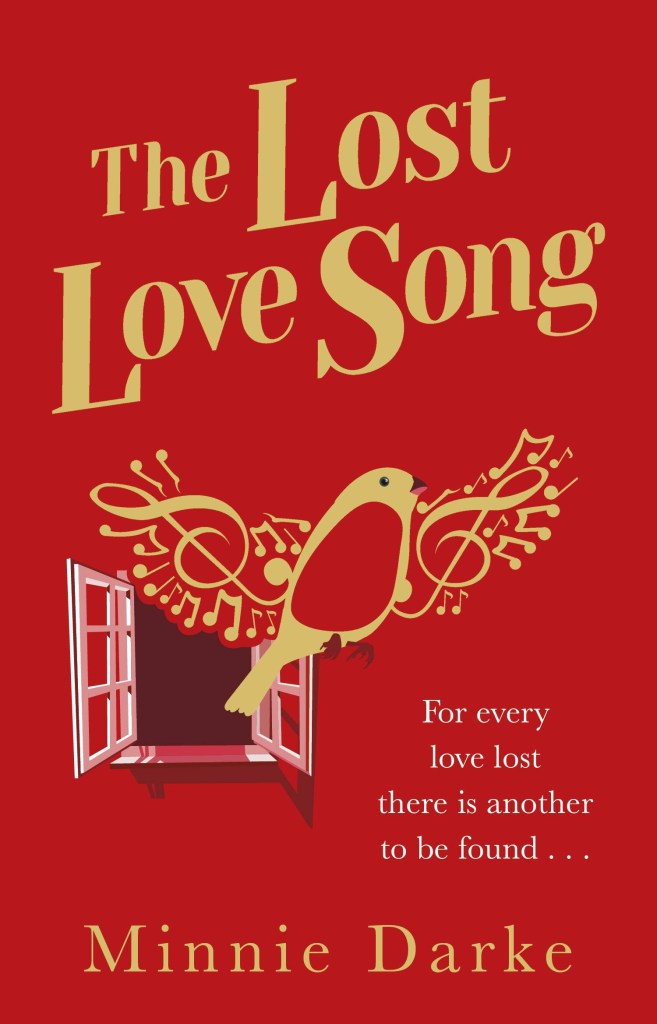
The Lost Love Song by Minnie Darke

#TheLostLoveSong #RandomThings Tours #blogtour

Lost Love Song

I’m writing this review just moments after finishing this beautifully romantic book, so I still have a lump in my throat and I’m torn between the desire to capture how I feel in words or go to Spotify and create the musical playlist the author has created for her characters, to stay in the emotions of the book. I feel such a bittersweet sense of love lost and love found, of reinventing oneself, and building a completely new life. This feeling is so bound up with my own life story, that the ending was particularly poignant. I have been where Arie is, but I’ve also been where Evie is. I have felt that confusing sense of falling in love, when I haven’t fully healed from loss. I have also been that open hearted girl, willing to leap in with both feet in that dangerous all or nothing way, only other ‘leapers’ would understand. I have felt that pain of not being wanted enough, of being the wrong person or even the right person at the wrong time.

Minnie Darke’s book centres on music, mainly in the form of a book that once belonged to the beautiful concert pianist Diana Clare. Diana was greatly in demand and flew all over the world to play and record with different orchestras. Known for her flaming red hair, her signature red dresses and the Converse trainers she preferred to play in wherever she was. The book of music belonged to Diana and in it she’d been writing a love song for her long term boyfriend Arie. Arie was a self-confessed computer geek (in my head he looked like Richard Ayoade) who met Diana at the music academy where she studied, when asked to fix a problem with her computer. They seemed opposites, Diana was mercurial and hard to pin down, whereas Arie was solid and even tempered, but what Diana was trying to show him was that when put together, they were like a pair of musical notes that when played together created perfect cadence. Arie only heard her song once, she played it one night when he brought up the question of why, after seven years together, they weren’t married yet. Diana didn’t feel the same urgency, but played the song to show him how much she felt, when words failed her. Sadly, Arie never hears the song again because the next morning, Diana leaves their home in Australia for a concert in Europe. Her plane, flown by Air Pleiades, disappears into the sea after the cabin fails to pressurise the cabin correctly and all the passengers and crew succumb to hypoxia.

Arie feels like their time together is like the part written song, never finished just left hanging in the air without a conclusion. He retreats into his world, living in their house where Diana’s Steinway still sits in the bay window. He still observes festivals with Diana’s distraught mother Belinda such as their apricot jam making day, bonfire night and of course Diana’s anniversary and birthday. There is a beautiful tenderness to the way Arie treats this broken hearted older woman, whilst knowing a time will come when he disappoints her, by making changes or maybe one day moving on. For now he’s okay where he is, treading water. Until one day a few years later he notices that the Air BnB next door is occupied again. He notices the young woman with her Cleopatra dark bob and an easy air of style. This is Evie and one evening, he notices her in the garden. Then he hears a familiar piece of music he’d thought was lost. She’s playing Diana’s song so quietly and tentatively, picking out the chords as if she’s piecing it together by memory.

In fact that’s exactly what Evie is doing because she doesn’t have the music. She heard it being played by a young flautist and cellist as she was leaving Waverley Station in Edinburgh, travelling towards Melbourne. The players were so absorbed in their music and each other, clearly in love. It piques her interest, because she’s walking away from a relationship where she wasn’t loved enough. She has resolved to not be involved with someone ever again unless they truly want her. He must find her and want her as much as these musicians clearly want each other. Darke tells her story through these main chapters that alternate between her and Arie, but there are musical interludes where we follow Diana’s notebook. It slowly wends its way through different people, from different musical backgrounds like classical orchestra to bluegrass. This is such a clever way of following the musical theme, but never forgetting our main pair as they move through the world.

Evie and Arie are possibly perfect together, but does such love come twice in a lifetime? Their tentative friendship is so fragile and I was desperately wiling it to work for both of them. I thought the author handled the emotions of being widowed with such knowledge and care. I’ve been there and have felt every one of Arie’s emotions, but that huge question of moving on is the most pertinent here. When we build a relationship with our in-laws they become our family. For me, and for Arie, that relationship continues after the loss of our partner. I felt that no one understood the enormity of my loss more than my brother and father-in-law, I wanted to continue that relationship with them and keep them as my family, to reminisce and celebrate my husband’s life. Then as time passed and I continued to live, I was very conscious of not upsetting them, respecting my husband’s memory and keeping them part of the new life I was creating. I made mistakes and it added to my pain, the feeling that I’d let them down. Now there is just me and my sister-in-law left and we talk a lot, and try to support each other even from her home on the other side of the world in New Zealand. We keep each other up to date on our children/step-children and reminisce about our husbands (and what a pair of rascals those brothers could be when they got together).

In this book, Arie doesn’t know how to reconcile these two parts of his life; the left behind and the moving on. Perhaps made more complicated, because just like the music Diana leaves behind, there was no real conclusion to her death. One minute she was there and the next, far away, she was gone and there was no funeral. Just the terrible knowledge she was lost somewhere under the sea. It takes Evie’s poetry to express this inbetween place, her talent for just the right words to capture a maelstrom of emotions is similar to Diana’s ability to convert emotion into musical notes. What stands out above everything in this novel is how artistic expression can explain, contain and elevate human experience. Most importantly, in Arie’s case, what comes across so strongly is art’s eventual power to heal.

Posted in Random Things Tours

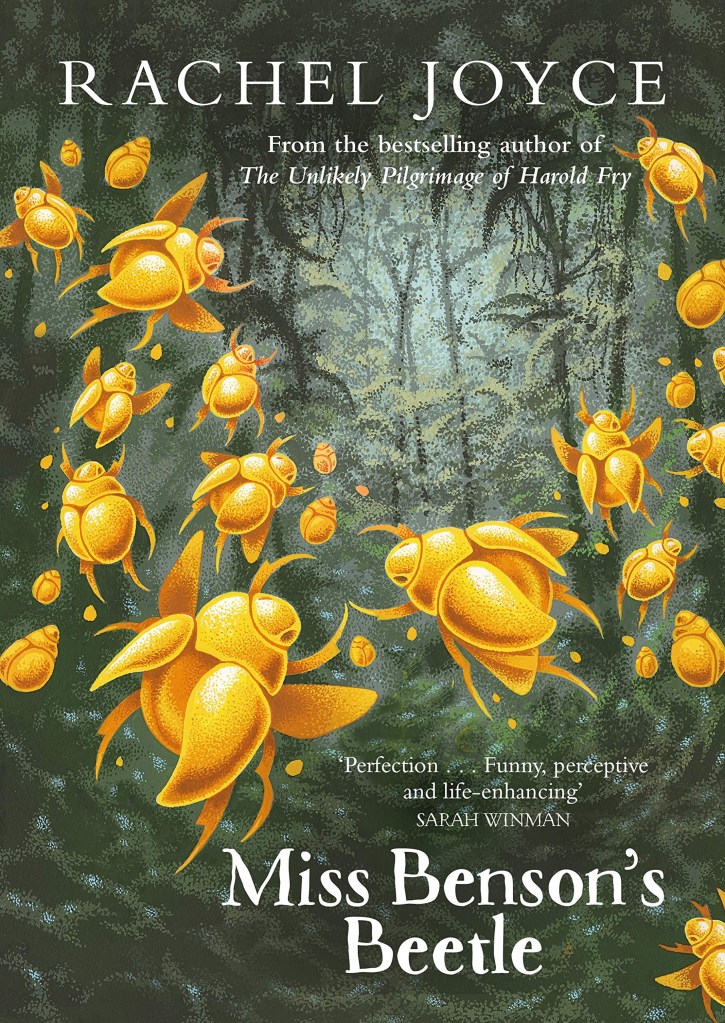
Miss Benson’s Beetle by Rachel Joyce.

#MissBensonsBeetle #RandomThingsTours #blogtour

Rachel Joyce’s books are always full of charm, emotion and character growth. Often, while undertaking life altering feats of stamina and strength, her characters reveal themselves to the reader slowly like the peeling layers of an onion. This novel is no exception when it comes to a central character who has a pilgrimage to make, but for some reason this one hit me right in the heart. Maybe it’s because I’m a woman of a certain age. It could be because I’m not thin or conventionally pretty. It may be because I also have unfulfilled ambitions. Whatever the reason, Miss Benson brought a huge lump to my throat. So many things moved me: her unspoken love for a man who never even considers a relationship with her; her difficulty conforming to the post-war standards of beauty and fashion; her introvert nature and feeling of being out of step with other women. I loved the growth that comes from realising she is the only one who can follow her dream. I loved the relationship she builds with Edith, an assistant she didn’t want or expect. I’m always moved when people realise that they don’t fit in because they aren’t being themselves. Miss Benson doesn’t fit with ordinary people, not because she’s inferior, but because she is extraordinary.

We join Margery Benson as she is teaching in a girl’s school, bored and under appreciated. On this particular day, the girls draw an image of Margery that shocks and upsets her. There is a sudden realisation that this is how people see her. Something snaps and Margery simply packs up and walks out, for some inexplicable reason with a pair of hockey/ lacrosse boots under her arm. Joyce takes us back to the past when Margery was a little girl, sitting at her father’s desk being taught about beetles. He tells her about a place called New Caledonia, right at the bottom of the world where a Golden Flower Beetle lives, on a particular type of orchid. One afternoon, while reading about the beetle her father goes to answer the door. All Margery hears is her father say ‘All? What? ALL?’ He then returns to the study, takes something from his drawer and walks past her as if she isn’t there, into the garden. There he blows his brains out with his pistol, without saying another word. These two events are linked. If Margery was different, she might have gone home after seeing the cruel photo drawn by her pupils and done the same, but for some reason this mid-life realisation seems to galvanise her. For so long her most precious belongings were her beetle necklace, a pocket guide of New Caledonia and a map of its terrain. She remembered the moment she decided, in her childhood determination, that when she grew up she would go to the island and search for the Golden Beetle. Then something happened and she settled for being a middle aged teacher. She knew she’d let herself go and she also knew she didn’t have a single friend to help her. Similarly though, she doesn’t have a single friend to stop her.

Rachel Joyce has written a love song to all women who have unlived potential inside them. Margery does what many of us want to do. She throws the old life away and starts again. I loved the friendship that grows between Margery and her assistant Enid Pretty. Enid was, quite literally, her last choice for the job, but she turns out to be the perfect candidate. As Margery suffers horrendous seasickness on the boat, Enid simply rolls up her sleeves and gets on with helping. She supplies and scrubs buckets, keeps her hydrated and never once shies away from the difficult jobs. Margery thought she needed a scientist to accompany her, but no one could possibly be as resourceful as Enid, even if her methods are slightly questionable. When her equipment is lost Margery thinks the trip is over, but Enid magics up replacements for all their equipment and even a jeep to take them into the mountains. Enid has an eye for a good looking man, but usually the wrong sort. Her lifetime’s ambition is to be a mother and she approaches this with the same dogged determination Margery has shown to finding the beetle. If you think the two ambitions are incompatible you are underestimating these women and their bond with each other.

The most incredible thing is the effect Enid has on Margery’s view of herself. From trying to be a ‘proper’ woman and failing. Enid makes her see that she doesn’t have to try. Once they are in the thick of climbing the mountain, searching in sunshine and one of the worst storms the island has seen, Margery realises she feels comfortable with her body. She looks down and instead of her giant dress, she’s wearing the stolen boots, shorts and a man’s shirt. Yet she has never felt more herself. Joyce cleverly gives us examples of how women are expected to be, such as the English wives in the local village. When Enid and Margery go and talk to their group about their mission they come up against some suspicion. The wives are worried about Enid and see her as a threat because of her bleached hair and tight clothing. Margery is a ‘big’ woman and dwarfs the tiny and delicate women at the gathering. She feels awkward. As soon as one of the wives hears about a burglary at the school and a jeep going missing the gossip begins. Then when the English newspapers arrive with the story of a femme fatale who killed her husband and fled the country. They wonder, could this woman and the flirty Enid Pretty be one and the same person?

I felt completely immersed in New Caledonia and the women’s expedition. Joyce brought to life the heat, the lush greenery, the sheer volume of different species and the changeable weather. I was desperate for them to be successful and find this magical beetle. I won’t reveal the ending, but it was a perfect moment that brought a tear to my eye. Tension builds towards the end as we wonder whether the strange man, stalking them throughout the novel, will actually catch up, or if the village women will take their suspicions to the authorities. I was desperate that their mission wouldn’t come to a premature end and that they would plot their escape together, even if it had to be a Thelma and Louise style ending. The book teaches us that it’s okay to be different and that once you live authentically, you will find your people. If we choose to live within societies constraints we might always feel like a misfit; not fitting in can feel painful, but it always feels like freedom. Women can play it safe, but then think of the friendship and adventures you could miss out on. Margery also learns that the joy comes not in realising your dreams, but in continuing to pursue them. This is a strongly feminist piece of work that spoke to me deeply about fulfilling my purpose and the importance of my female friendships. However, the most important relationship is always with ourselves and freedom comes in realising we only have one life and we don’t get another chance to pursue our dreams.

Posted in Random Things Tours

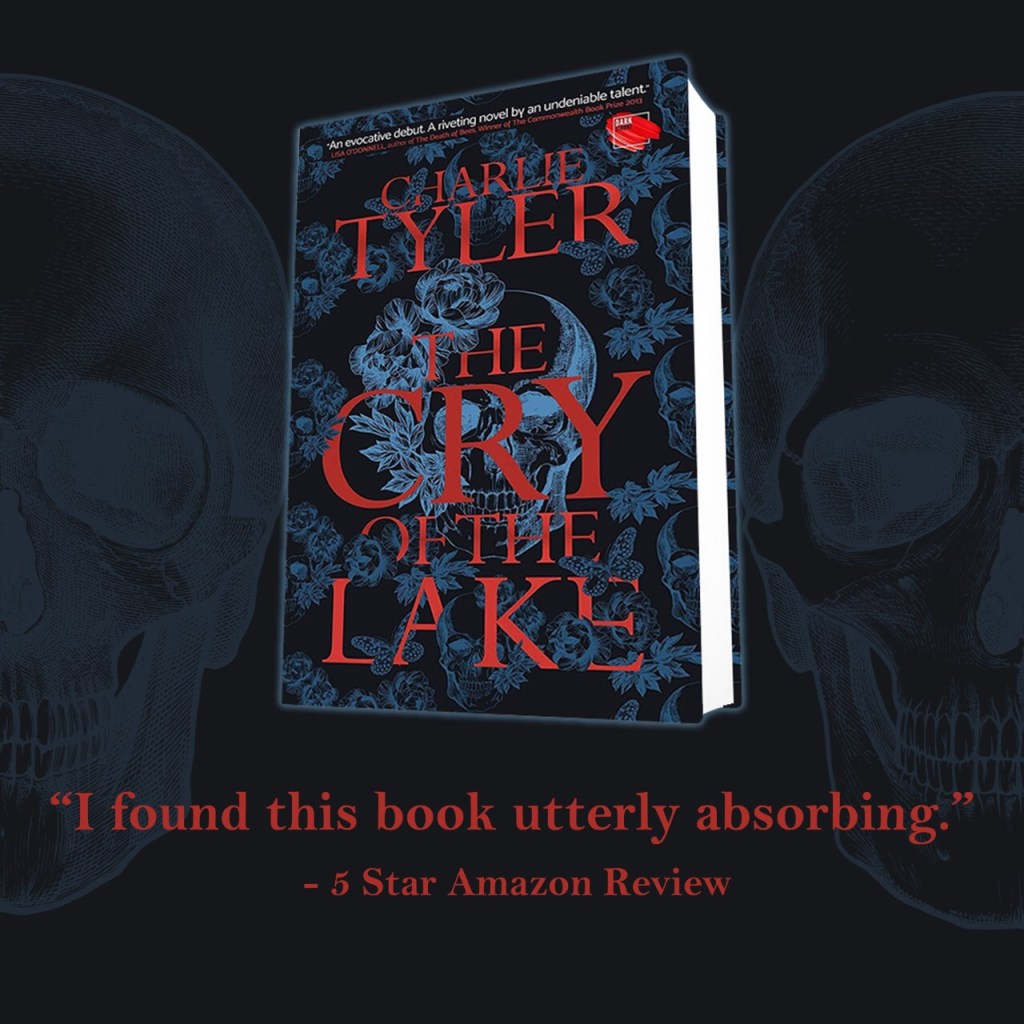
The Cry of the Lake by Charlie Tyler.

#RandomThingsTours #blogtour #TheCryOfTheLake

Firstly I was drawn in by the beautiful cover art on this novel. The red title contrasting sharply with the shades of grey background, and a human skull eerily visible against the flock wallpaper pattern. Even the blurb is fascinating and magical, as a young girl tries to capture a mermaid in the pond at the bottom of the garden. She’s been told stories of Myrtle the mermaid with a crown of flowers singing ‘as I went down to the river to pray’. However, instead of Myrtle she finds a dead body. Confused and terrified she learns to take the memory and lock it away deep inside her mind. Yet, still she sees the mermaid in dreams, luring her down to the water with her beautiful singing voice. She sleepwalks and finds herself out in the garden at night, barefoot and cold from the dew on the grass. In order to stop these ‘night terrors’ she is medicated. Although she is a maelstrom of emotions and experiences Lily will not talk. Ten years down the line Lily’s mother Grace is marrying Tony, who has his own teenage daughter Flo. Flo and Lily strike up a friendship despite Lily’s silence and find ways of communicating through text and scribbles on notepads. When Flo’s father is accused of killing a schoolgirl, the girls join forces to find out what’s really happened, but this opens up Lily’s past. Now she must force herself back to that boathouse in order to unearth what really happened and who is responsible.

The author has written a great debut here where she skilfully wrong foots the reader and subverts expectation. That very first line – ‘Death smells of macaroons’ – it drew me into the story. I knew it was going to be sugary sweet on the surface with a nasty aftertaste – a description that suits our narrator Grace perfectly. From the cover I was expecting an older setting, but this is as modern as it gets. Small details, such as Grace dressing from the Joules catalogue, or the teenagers coming into the cafe for Frappuccino’s set this firmly within the 21st Century. The author also places terrible and disturbing events in beautiful, lush countryside full of wild garlic and bluebells. The setting is idyllic, but the events are far from it. I had the sense of the opening of Dorian Gray where something lush and overblown like lilies or lilacs, give out a scent is so strong it’s cloying.

The jump from one narrator to another kept me on my toes too. I did get confused from time to time about who was who, especially when we moved back and forth in time. The characters are fascinating. We meet Lily and her mum Grace as they are coming to an exciting time in their lives. Grace is about to be engaged to Tom and she is the perfect girlfriend, with a plan for a traditional wedding. She and Lily live in a cottage and work in Tom’s cafe. Grace doesn’t want them to live together until they’re married. She thinks pre-marital sex would be a bad example for their daughters. Of course Lily also has health problems. She has selective mutism, and a sleep disorder causing sleepwalking and night terrors that need heavy medication. Tom’s daughter Flo gets along really well with Lily, and has encouraged her to communicate using texts. They also get along well in the village, the only fly in the ointment, as far as Grace is concerned, is Tom’s ex Annie the local police woman. It slowly becomes clear that she has deliberately lured Tom away from Annie and feels threatened by their easy intimacy and connection, as well as Annie’s continued friendship with Flo.

Grace is simply trying too hard though. Lily thinks she dresses like she’s colour blind or she copies the model in the catalogue exactly. At the village picnic Lily is a amused by how overdressed Grace is – in the catalogue the outfit would have been set off with a fascinator, but Grace has had to contain herself with a ribbon round her straw hat. Whilst Annie rolls up in denim with a carrier bag of corned beef sandwiches and pickled onion Monster Munch, Grace has smoked salmon on vintage china. Everything is just so. Except Flo doesn’t like fish. The reader starts to glimpse beneath this drive for perfection – it is simply a thin veneer covering a much darker heart. Her sugary sweet exterior is as real as her flowing red hair. When schoolgirl Amelie goes missing, Lily knows exactly where she is, because she had to help Grace package her body on the kitchen floor. Grace is as meticulous at cleaning up after the crime as she was at packing a picnic. After disposing of the body, Lily is forced to strip and get in the shower. Then Grace is waiting with hot milk and her pills. Lily’s often so spaced out that she doesn’t know what’s real and what isn’t.

The author reveals that Grace’s adoration of Tom is an act too. In a passage as they snuggle on the sofa, Grace’s real feelings belie her actions:

‘I sat, legs curled up on the sofa, with Tom’s arm draped around my shoulders. The heaviness of his body; the musky scent of his cologne and the graze of his cheek against mine made me feel nauseous. I suppose, if I were forced to be objective, I could see why Annie had been attracted to him and sometimes, when we kissed, the pit of my stomach whirred with a brief flutter of desire. Desire which was quickly followed by a flood of disgust. Tom Marchant was a pathetic liar of a man and every ounce of his being repulsed me.’

This is not just a passing dislike, this is a hatred that runs deep. There is a past here that is complicated and disturbing. Is the key Myrtle the Mermaid? The intriguing event that Lily dreams about and has been in therapy for, way back in the past. This started with a fairytale told to her by Grace and Uncle Frank, accompanied by the folk song Down to the River to Pray. Lily hears snatches of it in her dreams. Again, while this sounds like a beautiful story, it comes about around the time that Lily stopped speaking and Grace’s hair turned white overnight. How lucky the girls were to be looked after by Uncle Frank who ran an institute for mental well-being and was involved with pioneering mental health drugs. Lily was seen by a young junior doctor who used a visualisation method to help her with the feelings that disturbed her. He tells her to imagine somewhere she enjoys, and Lily chooses the aquarium with a treasure chest on the sea floor where she can lock away those memories that disturb her. She chooses a key decorated with a spiders web and mimes locking the chest. Then, when she feels safer, they can slowly unlock the chest and taking out one image at a time to work on. Yet this part of the therapy never happened and Lily was left with all these images locked up inside.

Back at the picnic, the villagers were horrified to find human remains in the lake. Could they belong to Amelie? In the aftermath, Grace agrees that they should all be together, so she and Lily stay over with Tom and Flo. Next morning Flo is horrified to find her beloved fish all dead in the garden pond, the telltale blue of slug pellets lingering on the bottom. Flo calls Annie and she comes out to question everyone. Grace and Tom seem oddly tense, but Flo remembers seeing pond scum on the floor and didn’t Grace put Lily in a shower in the night? As the study the pond Annie sees something else submerged in the rushes. It’s a bundle of shoes, tied together with a pair of knickers and it looks incriminating. There’s no option but to question Tom, remove phones and laptops and start to ask if anyone has noticed Tom getting a little too close to one of his students. Annie isn’t so sure. She confides in Flo that she can’t investigate the case, but she’s suspicious that it all looks a bit too cut and dried. Also, if you were really trying to keep evidence hidden, why would you draw attention to it by committing another crime?

There’s never a moment to to stop and contemplate though. The different perspectives and timelines keep revealing new clues and new horrors. There were times where I had to go back and reread a section to be sure I’d got the right sequence of events, especially where people’s names have changed. That’s mainly because the story is addictive and the pace is relentless. Over 24 hours I was rarely without my head in this book because I was so involved in all the little twists and turns. I wanted to understand how Lily and Grace had become so psychologically disturbed. I had a hunch that Lily would start to make more sense once Grace stopped giving her such strong medication. I also sensed she was a lot stronger than she thought, but the gaslighting kept her in doubt. I was fascinated in finding out what had formed Grace’s personality and sometimes drove her to be so cruel and cunning. I couldn’t stop reading until the tangled web was unravelled. Until Lily’s treasure chest of memories was unlocked and she was able to speak freely again. You will want to keep reading until she does. This is a tale about the heart of darkness, in the beautiful country village that’s an urban dweller’s dream; original, addictive and deliciously, darkly funny.

Posted in Random Things Tours

One Step Behind by Lauren North. #RandomThingsTours #OneStepBehind

I found myself sucked in very quickly by this narrator and her mysterious story. Jenna is an A and E doctor and appears to have a picture perfect life. She’s well regarded in her work, has a good marriage to builder Stuart, two lovely children and a beautiful Victorian house. They’ve recently adapted downstairs to create a huge living area that opens onto the garden. From the outside she’s living the 21st Century dream, but when we look a little closer it’s not that simple. There’s the mother’s guilt of course, she worries about Beth and Archie and the difficulties of spending enough time with then while working 12 hour shifts. Stuart picks up the slack as he can set his own hours, and they have a great childminder in Christie, but she still worries that she’s selfish in pursuing her career the way she does. They’re proving to be a great parenting team, but sometimes Jenna and Stuart are like ships that pass in the night. Finally, the main cause of stress in her life is an unknown stalker, who has been making her life hell. She is followed, the garden is broken into, dolls and flowers are left for her and the emails, both at work and home are endless. The stress has been so bad she hasn’t been sleeping, she’s becoming paranoid and wants to put the house up for sale and start again elsewhere.

Her narrative is alternated with that of Sophie, a personal trainer who lives with her boyfriend Nick and seems very concerned about the welfare of her younger brother, Matthew. Matt is a bit of an oddball. He seems to wander aimlessly around town taking photos of people, he also seems secretive and uncooperative with his sister. I wondered whether Sophie was a bit of a mother hen character, but they seem to have no other family either. It seemed inevitable that the two narratives would come together in some way, or that one of them might be Jenna’s stalker. However, I couldn’t think of any link between them because Jenna is too young to be their mother and she never mentions brothers and sisters. As the stalker escalates into leaving dressed dolls, and even getting into their home, I started to feel panicky too. I also suspected every person around Jenna, from Thomas who works with her at the hospital and is a little too friendly, all they way to her husband Stuart. Every single male she was in contact with came under my suspicion at different points in the novel. So, when Matthew is brought into A and E after being hit by a bus and she recognises him, I breathed a sigh of relief that maybe her ordeal was over. Could it be that simple?

The author really puts her heroine through the mill in terms of the relationships around her and a series of betrayals. These come to a head on a night out in town for her best friend Diya’s birthday. She had just been told to take a leave of absence from work and she finds out that the complaint made to management about her fitness to practice came from Diya. She is shocked and feels betrayed. She also sees her childminder Christie, with Matt’s sister Sophie and Rachel – a mum from school that she’s sure doesn’t like her. Immediately she wonders if either Christie or Rachel has been helping to keep her stalker informed. However the next morning, an even worse betrayal comes to light. Christie comes round to explain why she was with Rachel, but also to confess to knowing something that will break our Jenna’s heart. This is where she really starts to come apart. Her worse fears are being realised, while her attention has been focused on her job and the stalker, her life has been falling apart around her.

This was a successful story in that it made me feel paranoid and on edge a lot of the way through. I also felt very tense, because I was desperate for Jenna to give herself a break. It was like she was juggling so many plates at once and couldn’t stop. I just wanted her to find a way to get a break, spend more time with those she loved and create some balance in her life. No one could sustain the level of stress she puts herself under. Much as I want to say women can be successful working mums, it’s clear that Jenna’s working hours are unsustainable if she wants a better relationship with her children. I also kept wondering where this couple’s genuine family and friends are? It takes a strong network to sustain a lifestyle this crazy – even without the stalker. It was very clever to keep shifting the possible identity of the stalker. There was a final stand off that made me look at my own biases when it comes to this type of crime and I think that was deliberate on the part of the author. I also realised at the end that I couldn’t remember the name of our protagonist at first, even though she narrated the majority of the book. That tells me a little about how much the character was consumed by her job and the crime being perpetrated against her. It was almost as if, by being constantly watched, she had become invisible to those around her. This was an unsettling, tense and addictive read that explores how childhood trauma affects people in different ways.

Posted in Random Things Tours

Fleishman Is In Trouble by Taffy Brodesser-Akner. #RandomThingsTours #blogtour #FleishmanIsInTrouble

I really enjoy books with psychological insight and no one does psychological self-exploration like rich New Yorkers. Fleishman is a forty-something hepatologist, recently divorced from ambitious wife Rachel and discovering a whole new world of dating options. It sounds like a Woody Allen film, and there is some humour in his situation. Still as short and pathetic as he was in his teenage years full of romantic rejection, he was starting to ask himself whether he could actually be attractive? Or was it more the case that looks were not sexual currency any more and being a newly divorced doctor in NYC was enough to warrant the attention he was receiving, from the dating apps downloaded to his phone by a work colleague. He was being sent side-boob, aubergine emojis, ass crack and devils with little horns from women who were available right now, and for nothing more than ‘no strings’ sex. However, despite this huge change in how women date he is still processing what went wrong in his marriage to Rachel, a woman he describes as having the perfect geometric hair of a blonde Cleopatra. As the novel opens, Toby Fleishman wakes up to find a text message from his ex-wife to say she has used the emergency key he gave her, to drop the children at his flat in the night because she had to go on a work trip. This is a huge imposition, although he loves being with his children, because he has things to do, work to go to and social plans in place. Rachel may as well have left a note saying ‘welcome to being a woman’.

It soon becomes clear that the author has reversed the gender roles in Toby’s marriage. He has a great job, but he is the one who takes the children to school and changes his schedule to accommodate pick ups, but this only makes sense. Toby has a lack of ambition that drives Rachel to distraction, while she travels all over the world for her job as a PR consultant and also has a busy social life. Even though Toby, and our narrator, are quite scathing about her, I could understand her trying to live up to that ideal of having it all. Isn’t it what the media tells us all women want? This is a common misconception for both men and women; having it all is possible, just not all at the same time. Rachel comes across as quite a negative character, but perhaps that’s down to the people narrating and analysing her. I didn’t find Toby a very sympathetic character either. I think this was a bias in me, it’s hard to sympathise with Upper East Side New Yorkers who are high earning professionals, when you’ve been brought up in council houses.

These characters can do anything they want. They’ve forgotten that where they are in life is a series of choices made; Rachel has chosen to pursue her ambitions and become a Mum. Toby has an incredibly rewarding career, but he has also chosen to have children and be the one who leaves work early to accommodate that. They could make different choices, but don’t seem to know this. Maybe this is the downside to being at the top of Maslow’s Hierarchy of Need, because once you’ve self-actualised there’s a lot of space for introspection. However, despite the level of introspection and analysis these characters do, they’re not very self-aware. I found this novel so psychologically astute when dissecting modern marriage, parenthood and divorce. There are beautiful passages early on where our narrator discusses the deterioration of marriage and trying to move on. Toby keeps meeting people who want to know when the rot set in:

‘These questions weren’t really about him; no they were questions about how perceptive people were and what they missed and who else was about to announce their divorce and whether the undercurrent of tension in their own marriages would eventually lead to their demise’.

More people divorce these days and there is still a value judgement made, because older generations seemed to stay together. Were they immune to the misery of marriage difficulties? If a marriage is struggling, how do we make the decision to leave?

‘How miserable is too miserable?’

In a discussion with his old friend, and our narrator Libby, Toby talks about how hindsight and perspective can change our views of the whole marriage. Does the fact the marriage ended, mean it was wrong right from the start? He likens it to a game of Othello where you start out with a board full of white discs, but they slowly become black:

‘Now you look at the marriage, even the things that were formally characterised as good memories, as tainted and rotten from the start’.

His therapy sessions ring very true, his therapist Carla is working with him on sitting with uncomfortable feelings. So, when having conversations with people who are mining him for information he tries to pass that lesson on:

‘He was working on trying not to fill in this pause; he was working on letting the discomfort of the silence be the property of the person who was mining him for dirt.’

A further awakening comes about after Rachel leaves and doesn’t return, leaving Toby to cope with work, their children Solly and Hannah, and the maelstrom of remembering the children’s heavy schedule, plus the age of social media and mobile phones with a surly teenager. This leads to a certain understanding of Rachel’s position as his career starts to suffer and he realises the full responsibilities of modern parenthood.

Then the author switches to Rachel’s perspective and we see their marriage in a totally different light. She feels that Toby is intent on being unhappy. He sees her success as the reason for his failure, when actually her success allowed him to do exactly what he wanted for a living. From his perspective, Rachel does nothing but work and neglect him and the children. He never asks whether she’s happy. When she gets home he regales her with his problems, and never lets her put her feet up and relax for a minute. She doesn’t consider divorce:

‘She never once thought she deserved happiness. She never once wondered if there was something better out there. This was their marriage; this was their family. It was theirs, they owned it, they made it. If there was one thing she’d learned from her grandmother, it was an understanding that life isn’t always what you want it to be’.

It’s hard to believe this novel was a debut, because it was so insightful and contains a wisdom about the 21st Century attitude to relationships, marriage and divorce as well as the differences between men and women. It sheds a light on unacknowledged differences between men and women in society. It’s sharply observed and describes life in upper class New York beautifully. These people are so remote from me that it was almost like having the habitat and behaviour of a rare animal presented as a study. Fleishman is the subject of the book, but the main perspectives I took away were those of Rachel and Libby. The author presses home the idea that we never truly know the inner world of those we are most intimate with. He sees Rachel as this strong bossy career woman, when actually she’s incredibly fragile. I couldn’t help but think that if Fleishman is in trouble, then Rachel is on the edge.

Posted in Random Things Tours

Spirited by Julie Cohen. #RandomThingsTours #blogtours #Spirited

I had never read Julie Cohen’s work before so I didn’t know what to expect from her writing. Only a few weeks ago on Twitter I was discussing when a new Sarah Waters novel would be appearing and Spirited by Julie Cohen has definitely filled that gap. It’s also made an impact on me that’s all it’s own. Viola Worth has grown up cared for by her clergyman Father, as well as his ward, a little boy called Jonah. Viola and Jonah are the best of friends, spending their childhoods largely inseparable. As we meet them in adulthood, they are getting married, but in mourning. A lot has happened during the period of their engagement. Jonah had been out to India, staying at his family’s haveli and checking on his financial interests. For Viola, it’s been a tough time nursing, then losing, her father. He encouraged her in his own profession as a photographer and she has become accomplished in her own right. Viola’s father wanted her to marry Jonah, and they are still the best of friends, but the time apart has changed them and neither knows the full extent of the other’s transformation. As they try to settle into married life on the Isle of Wight, Jonah spends his time sketching fossil and bone finds with his scientific a friend. Viola feels cut adrift and without purpose, as we find out later she doesn’t even feel she is fulfilling her role as Jonah’s wife. Through new friends the couple meet a visiting spirit medium, although as daughter of a clergyman, Viola would never normally enjoy this type of entertainment. Little do they know, this woman will change their lives.

The author slips back and forth in time to tell us about Henriette, who worked her way in life from being a servant to a respected spirit medium. She is a woman who started with no advantage in life, and as a young servant models herself on the governess in the house, a French woman known as Madame to the family. Henriette diligently listens to the children’s French lesson and nurses a hope of a future where she doesn’t clean up after other people or have to wish for a roommate so she isn’t sexually assaulted in the night. Her attacker labels her a whore and one early morning, after there’s been a house party, she stumbles on a group of men in the stables betting. They are playing cards for money, but once they see Henriette they become intent on a different sport. It is Madame who interrupts the attackers and she gives Henriette advice from one woman surviving alone in the world to another. The author also takes us back to Jonah’s time in India. We discover that in social circles Jonah is a hero, because during a massacre he rescued a young girl who lived in his haveli after all her family are killed. Viola wonders if it is this experience that has changed Jonah. They live as if they are brother and sister, Jonah spends less time with her than before and at bedtime they still go to their separate bedrooms and sleep apart. Viola knows there is more between husband and wife but doesn’t really know what and has no idea who to talk to. Through Henriette, Viola is asked to take a photograph of a child who has died so the parents have an image to keep. No one is more stunned than Viola when she develops the image and sees a blurred figure standing next to the bed, the likeness to their child shocks and comforts the parents; they feel reassured that their child lives on in spirit. This experience, and her experience of her first proper female friendship, is like a floodgate opening for Viola. She starts to question the limits of her faith, whether there is more in life she would like to try and as time goes on, whether the burgeoning feelings she has for Henriette are friendship or something else.

I loved the feminist threads running through this novel. The central women in the novel are each in liminal spaces, different from the conventional Victorian women we see like Mrs Newham. Henriette is a self-made woman, unmarried and travelling from space to space offering her spiritualist services for enough to survive on. She has moved from bar girl, to servant, to nursing and losing her elderly husband, and now into a semi-respected occupation. She gets to visit the homes of those she might have once waited upon, but isn’t tied by their social rules and conventions. In India we meet Pavan, who has made the exceptional choice within her societal rules to become educated and has made huge sacrifices in order to achieve that. Love was not on her agenda, and when it comes she experiences a painful separation between her intellectual choice and her emotions. Viola may seem the most conventional of these women, but her relationship with her father has set her apart from others of her class. He believed in educating Viola the same way as Jonah, then teaches her the art of photography too, usually considered a male pastime. Viola is respectful of many conventions, but finds herself emboldened by Henriette and the new experiences she brings to her life. She tries bathing in the sea and is bold enough to start accepting her ‘gift’ of capturing spirits. Behind them all is the french governess Madame. The role of Victorian governess is the very definition of a liminal space: she works in the home but is not a servant, educated and unmarried, respectable, but not on the same level as the family she works for. She has power in that she works for herself, has and controls her own money and can choose to leave her position and join another family, in a different place. Her acknowledgment of Henriette’s fate, as a pretty face in the power of men, inspires Henriette to be more. It gives her aspiration, although she may never be a gentlewoman, with careful decision making she could be more like Madame.

It is within the physical liminal spaces where there are beautiful passages of writing from the author. The scene where Henriette and Viola go bathing is absolutely exquisite because I could feel everything. The strangeness of undressing in a darkened box on wheels, the feel of the swimming dress, the rough and tumble of being pulled into the sea by a horse, then opening the door to see nothing but the ocean in front of you. This is a play on conventional baptism for Viola. She fully immerses herself in the water, supported by Henriette, and feels a rebirth. The heaviness in the uncoiling of her hair and letting it float free signifies a freeing from the constraints of Victorian fashion, as is the unlacing of the corsets. As they trundle back up to the sand after their swim, Viola wishes they could stay in this space in the dark for the intimacy with Henriette, and the knowledge of the freedom she will feel as she opens the door and sees nothing but ocean. When the women share Viola’s room the writing is so tender. Viola worries what the servants might think, but Henriette frees her thinking again. Love between women does not exist, she tells her, there are laws and conventions regarding love between a man and a woman, and even the love between men. What they are to each other is beyond the thoughts of most people, the servants will see two friends staying together and nothing more. Pavan and Jonah, don’t meet in the main haveli but in an ancient old temple in its grounds, a space no longer used for its purpose and outside the family structure inside the house. They meet as two people of different cultures and beliefs, but find a connection so powerful that each would put their lives on the line for the other. Jonah wonders whether he could live a different life to the one laid out for him back in England. He’s seen other English men here who have married Indian women and had children. They’re neither totally respectable, but are not shunned either. This is a novel of people, particularly women, learning to live in the spaces between; the places that promise more freedom.

This was an original, emotional and beautifully written novel that weaves a powerful story from a combination of painstaking historical research and imagination. Each character is fully fleshed out and has a rich inner life. Where real events such as the 1857 Siege of Delhi are used in the novel, they are deeply powerful and the author treats them with respect. The elements of spiritualism and spirit photography are well researched and based on a real fascination for the paranormal in Victorian society. Cohen acknowledges that this is a novel about faith: religious faith, faith in the paranormal and that the ties to those we love don’t end in death; faith in romantic love and the promises we make to each other; even the faith she has in herself. In the acknowledgements to this novel Julie Cohen says ‘I wrote the first draft of this book when I thought my writing career was over’. Judging by this book, it’s far from over. However, by allowing herself to think of that possibility, she gave herself the space to write something truly extraordinary.